


4300 Results
Form:
books
books

Actions:
Price:
$57.00
(available in store)
Summary:
In 1983, Ursula Schulz-Dornburg accompanied two ethnologists and an architect on a research trip to Tana Toraja on the central Indonesian island of Sulawesi. Initiated by the Royal Tropical Institute of Amsterdam, the trip was intended to “explore the changing patterns in architecture and symbolism among the Sa‘dan Toraja”. On the way back from Rantepao to Ujung Pandang(...)
Title:
Ursula Schulz-Dornburg: Bugis Houses, Celebes
Actions:
Price:
$57.00
(available in store)
Summary:
In 1983, Ursula Schulz-Dornburg accompanied two ethnologists and an architect on a research trip to Tana Toraja on the central Indonesian island of Sulawesi. Initiated by the Royal Tropical Institute of Amsterdam, the trip was intended to “explore the changing patterns in architecture and symbolism among the Sa‘dan Toraja”. On the way back from Rantepao to Ujung Pandang airport, Schulz-Dornburg passed the distinctive houses of the Bugis or To-Ugiq people, perched on the yellow paddy fields. Fascinated by their complex, expressive architectures, she began to photograph the houses in the short time she had before leaving, realising that the structures would likely not exist in their traditional form for much longer. The result is a body of work that not only surveys the houses’ physical forms but also considers wide-ranging ideas of physical and emotional homebuilding and the precarious place of tradition in the present day. Poised between heaven and earth and standing above the water when the rice fields are flooded, the Bugis houses reflect the creation myth of their people, in which the gods of the upper and lower worlds came together to create man to populate the uninhabited middle world. The farmers depicted by Schulz-Dornburg are likewise suspended between historic tradition and the impending pressures of the contemporary world. As they go about their work or greet her camera, they and their homes are held in the balance between past and future, mythology and everyday reality. With these shrewd and sensitive images, Schulz-Dornburg captures life as it is built and lived within a particular culture and landscape, offering a searching reflection on the places we call home.
Form:
books
books
Publication:
July 2021
July 2021
Subject:
Photography monographs
Photography monographs
Form:
books
books
Actions:
Holdings:
Description:
410 pages ; 23 cm
Description:
410 pages ; 23 cm
Author:
Subject:
Publication:
Chicago : University of Chicago Press, 2016., ©2015
Chicago : University of Chicago Press, 2016., ©2015
Title:
The marvelous clouds : toward a philosophy of elemental media. / John Durham Peters.
Actions:
Holdings:
Description:
410 pages ; 23 cm
The marvelous clouds : toward a philosophy of elemental media. / John Durham Peters.
Actions:
Holdings:
Description:
410 pages ; 23 cm
Form:
books
books
Publication:
Chicago : University of Chicago Press, 2016., ©2015
Chicago : University of Chicago Press, 2016., ©2015
Author:
Subject:
Form:
books
books
Actions:
Holdings:
Description:
182 pages illustrations 23 cm
Description:
182 pages illustrations 23 cm
Author:
Subject:
Publication:
London, J. Tiranti & Co., 1922.
London, J. Tiranti & Co., 1922.
Title:
Italian renaissance architecture; a short historical and descriptive account, with a series of 110 photographs and measured drawings, and 45 illustrations in the text, translated from the French by George F. Waters.
Actions:
Holdings:
Description:
182 pages illustrations 23 cm
Italian renaissance architecture; a short historical and descriptive account, with a series of 110 photographs and measured drawings, and 45 illustrations in the text, translated from the French by George F. Waters.
Actions:
Holdings:
Description:
182 pages illustrations 23 cm
Form:
books
books
Publication:
London, J. Tiranti & Co., 1922.
London, J. Tiranti & Co., 1922.
Author:
Subject:
Form:
books
books
Actions:
Price:
$68.50
(available to order)
Summary:
No creature on earth is better at pretending than we humans. The title of this book is a way of saying that our daily life is nothing other than a show played out in our minds. We have a talent for creating a fantasy world. Luckily for us. He who is unable to daydream becomes hopelessly depressed. Our talent for simulating is so strong that we are even able to pretend(...)
Title:
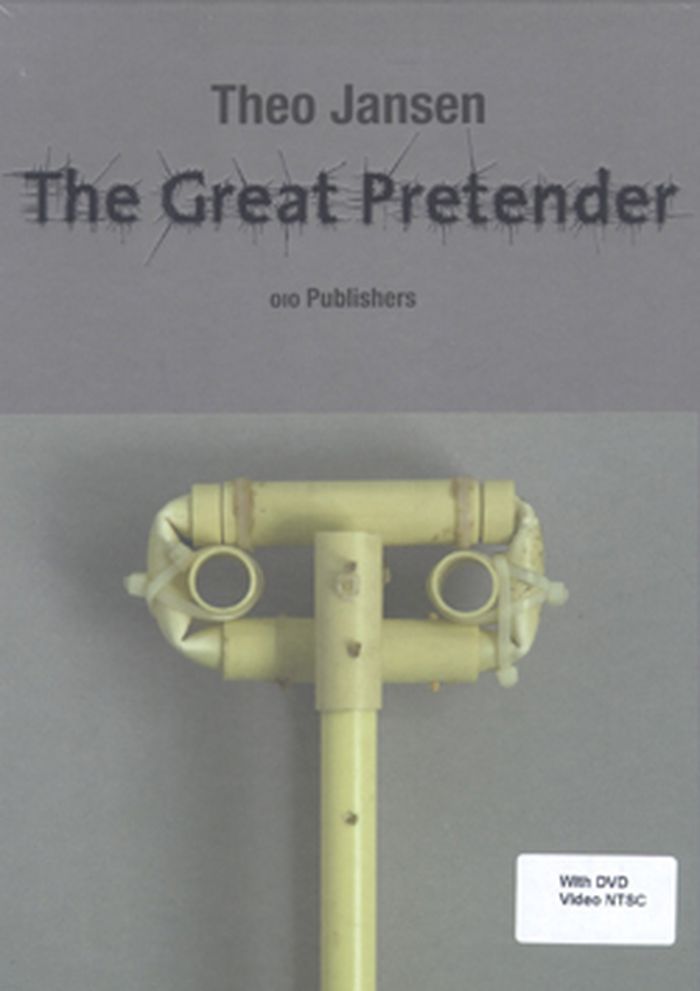
Theo Jansen. The great pretender
Actions:
Price:
$68.50
(available to order)
Summary:
No creature on earth is better at pretending than we humans. The title of this book is a way of saying that our daily life is nothing other than a show played out in our minds. We have a talent for creating a fantasy world. Luckily for us. He who is unable to daydream becomes hopelessly depressed. Our talent for simulating is so strong that we are even able to pretend that we exist. We simulate a first-person form, an ’I’. In The Great Pretender, kinetic artist Theo Jansen shows that the ’I’ we envision is a tool in our evolution. We need this tool to be selfish. There can be no selfishness without the I-fantasy. Since 1990 Theo Jansen has been engaged in creating new forms of life: beach animals. These are not made of protein like the existing life-forms but from another basic stuff, yellow plastic tubing. Skeletons made from these tubes are able to walk. They get their energy from the wind, so they don’t have to eat like regular animals. They evolved over many generations, becoming increasingly adept at surviving storms and and water from the sea. Theo Jansen’s ultimate wish is to release herds of these animals on the shore. In redoing the Creation, so to speak, he hopes to become wiser in his dealings with the existing nature by encountering problems the Real Creator had to face. The Great Pretender is a testimonial to his experiences as God. It’s not easy being God; there are plenty of disappointments along the way. But on the few occasions that things work out, being God is the most wonderful thing in the world. Includes a companiond DVD of beach animal videos.
Form:
books
books
Publication:
October 2007, Rotterdam
October 2007, Rotterdam
Subject:
Architecture Monographs
Architecture Monographs
Form:
books
books
Actions:
Price:
$8.95
(available to order)
Summary:
Among the fifty projects presented in this monograph are 'Windows of the world' restaurant in the World Trade Center and Bryant park in New York, the Cleveland Public Library, the Hawaii Theater Center in Honolulu, the comprehensive development plan for Warner Bros. Hollywood studios and the Los Angeles Public Library.
Title:
HHPA : buildings and projects, 1993-1998
Actions:
Price:
$8.95
(available to order)
Summary:
Among the fifty projects presented in this monograph are 'Windows of the world' restaurant in the World Trade Center and Bryant park in New York, the Cleveland Public Library, the Hawaii Theater Center in Honolulu, the comprehensive development plan for Warner Bros. Hollywood studios and the Los Angeles Public Library.
Form:
books
books
Publication:
November 1999, New York
November 1999, New York
Subject:
sale books
sale books
Form:
books
books
Actions:
Holdings:
Description:
398 pages : color illustrations ; 25 cm
Description:
398 pages : color illustrations ; 25 cm
Author:
Subject:
Publication:
London : Phaidon, 2004.
London : Phaidon, 2004.
Title:
False flat : why Dutch design is so good / Aaron Betsky with Adam Eeuwens.
Actions:
Holdings:
Description:
398 pages : color illustrations ; 25 cm
False flat : why Dutch design is so good / Aaron Betsky with Adam Eeuwens.
Actions:
Holdings:
Description:
398 pages : color illustrations ; 25 cm
Form:
books
books
Publication:
London : Phaidon, 2004.
London : Phaidon, 2004.
Author:
Subject:
Form:
books
books
Actions:
Holdings:
Description:
109 pages : chiefly color illustrations ; 31 x 39 cm
Description:
109 pages : chiefly color illustrations ; 31 x 39 cm
Author:
Subject:
Publication:
Göttingen : Steidl, 2003.
Göttingen : Steidl, 2003.
Title:
Zones of exclusion : Pripyat and Chernobyl / Robert Polidori ; text by Elizabeth Culbert.
Actions:
Holdings:
Description:
109 pages : chiefly color illustrations ; 31 x 39 cm
Zones of exclusion : Pripyat and Chernobyl / Robert Polidori ; text by Elizabeth Culbert.
Actions:
Holdings:
Description:
109 pages : chiefly color illustrations ; 31 x 39 cm
Form:
books
books
Publication:
Göttingen : Steidl, 2003.
Göttingen : Steidl, 2003.
Author:
Subject:
Form:
books
books
Actions:
Holdings:
Description:
263 pages : illustrations (chiefly color) ; 26 cm
Description:
263 pages : illustrations (chiefly color) ; 26 cm
Author:
Subject:
Publication:
New York : Aperture ; Washington, D.C. : Smithsonian Institution, ©2012.
New York : Aperture ; Washington, D.C. : Smithsonian Institution, ©2012.
Title:
Photography changes everything / edited by Marvin Heiferman ; foreword by Merry Foresta.
Actions:
Holdings:
Description:
263 pages : illustrations (chiefly color) ; 26 cm
Photography changes everything / edited by Marvin Heiferman ; foreword by Merry Foresta.
Actions:
Holdings:
Description:
263 pages : illustrations (chiefly color) ; 26 cm
Form:
books
books
Publication:
New York : Aperture ; Washington, D.C. : Smithsonian Institution, ©2012.
New York : Aperture ; Washington, D.C. : Smithsonian Institution, ©2012.
Author:
Subject:
Form:
books
books
Actions:
Holdings:
Description:
xv, 161 pages : illustrations (some color, some folded), maps (some color, some folded) ; 28 cm
Description:
xv, 161 pages : illustrations (some color, some folded), maps (some color, some folded) ; 28 cm
Author:
Subject:
Publication:
New Haven [Conn.] ; London [England] : Yale University Press, [2001], ©2001
New Haven [Conn.] ; London [England] : Yale University Press, [2001], ©2001
Title:
Mississippi floods : designing a shifting landscape / Anuradha Mathur and Dilip da Cunha.
Actions:
Holdings:
Description:
xv, 161 pages : illustrations (some color, some folded), maps (some color, some folded) ; 28 cm
Mississippi floods : designing a shifting landscape / Anuradha Mathur and Dilip da Cunha.
Actions:
Holdings:
Description:
xv, 161 pages : illustrations (some color, some folded), maps (some color, some folded) ; 28 cm
Form:
books
books
Publication:
New Haven [Conn.] ; London [England] : Yale University Press, [2001], ©2001
New Haven [Conn.] ; London [England] : Yale University Press, [2001], ©2001
Author:
Subject:
Form:
books
books
Price:
$37.50
(available to order)
Summary:
Although the seemingly apocalyptic scale of the World Trade Center disaster continues to haunt people across the globe, it is only the most recent example of a city tragically wounded. Cities are, in fact, perpetually caught up in cycles of degeneration and renewal. As with the WTC, from time to time these cycles are severely ruptured by a sudden, unpredictable event.(...)
Title:
Wounded cities : destruction and reconstruction in a globalized world
Actions:
Price:
$37.50
(available to order)
Summary:
Although the seemingly apocalyptic scale of the World Trade Center disaster continues to haunt people across the globe, it is only the most recent example of a city tragically wounded. Cities are, in fact, perpetually caught up in cycles of degeneration and renewal. As with the WTC, from time to time these cycles are severely ruptured by a sudden, unpredictable event. In the wake of recent terrorist activities, this timely book explores how urban populations are affected by "wounds" inflicted through violence, civil wars, overbuilding, drug trafficking, and the collapse of infrastructures, as well as "natural" disasters such as earthquakes. Mexico City, New York, Beirut, Belfast, Bangkok and Baghdad are just a few examples of cities riddled with problems that undermine, on a daily basis, the quality of urban life. What does it mean for urban dwellers when the infrastructure of a city collapses – transport, communication grids, heat, light, roads, water, and sanitation? What are the effects of foreign investment and huge construction projects on urban populations and how does this change the "look" and character of a city? How does drug trafficking intersect with class, race, and gender, and what impact does it have on vulnerable urban communities? How do political corruption and mafia networks distort the built environment? Drawing on in-depth case studies from across the globe, this book answers these intriguing questions through its rigorous consideration of changing global and national contexts, social movements, and corrosive urban events. Adopting a "grass roots up" approach, it places emphasis on people’s experiences of uneven development and inequality, their engagement with memory in the face of continual change, and the relevance of political activism to bettering their lives. It is especially attentive to the historical interaction of particular cities with wider political and economic forces, as these interactions have shaped local governance over time. Imagining each city as a "body politic", the authors consider its capacity both to mediate local conflict and to broach the healing of wounds.
Form:
books
books
Publication:
August 2003, Oxford
August 2003, Oxford
Subject:
Urban Theory
Urban Theory


