


6233 Results
Level of archival description:
Project
Project
Actions:
Reference number:
AP056.S1.1990.PR04
Description:
This project series documents a competition entry for the Canada Life Assurance building in Toronto in 1990. The office identified the project number as 9007. This project consisted of a proposal to renovate the existing Canada Life Assurance headquarters located in the historic Beaux-Arts style building on the corner of Queen and University Streets. This work would also include the construction of a new, 15 storey mixed-use development with approximately 1,000,000 square feet of commercial office space, retail space and a hotel. The design goal was to create an urban campus while extending the corporate headquarters. This proposal was done in joint-venture with Bregman & Hamann and was headed by Marianne McKenna and Bruce Kuwabara. This was not the winning entry for the competition and the project was eventually realized by Shore Tilbe Henshall Irwin. The project is recorded through drawings, a presentation painting and a model dating from 1988-1990. The drawings are mostly originals and consist of sketches, plans, elevations, perspectives and axonometric drawings.
AP056.S1.1990.PR04
Description:
This project series documents a competition entry for the Canada Life Assurance building in Toronto in 1990. The office identified the project number as 9007. This project consisted of a proposal to renovate the existing Canada Life Assurance headquarters located in the historic Beaux-Arts style building on the corner of Queen and University Streets. This work would also include the construction of a new, 15 storey mixed-use development with approximately 1,000,000 square feet of commercial office space, retail space and a hotel. The design goal was to create an urban campus while extending the corporate headquarters. This proposal was done in joint-venture with Bregman & Hamann and was headed by Marianne McKenna and Bruce Kuwabara. This was not the winning entry for the competition and the project was eventually realized by Shore Tilbe Henshall Irwin. The project is recorded through drawings, a presentation painting and a model dating from 1988-1990. The drawings are mostly originals and consist of sketches, plans, elevations, perspectives and axonometric drawings.
People:
Date:
1988-1990
1988-1990
Title:
Canada Life Assurance Building Competition, Toronto (1990)
Actions:
AP056.S1.1990.PR04
Description:
This project series documents a competition entry for the Canada Life Assurance building in Toronto in 1990. The office identified the project number as 9007. This project consisted of a proposal to renovate the existing Canada Life Assurance headquarters located in the historic Beaux-Arts style building on the corner of Queen and University Streets. This work would also include the construction of a new, 15 storey mixed-use development with approximately 1,000,000 square feet of commercial office space, retail space and a hotel. The design goal was to create an urban campus while extending the corporate headquarters. This proposal was done in joint-venture with Bregman & Hamann and was headed by Marianne McKenna and Bruce Kuwabara. This was not the winning entry for the competition and the project was eventually realized by Shore Tilbe Henshall Irwin. The project is recorded through drawings, a presentation painting and a model dating from 1988-1990. The drawings are mostly originals and consist of sketches, plans, elevations, perspectives and axonometric drawings.
Canada Life Assurance Building Competition, Toronto (1990)
Actions:
AP056.S1.1990.PR04
Description:
This project series documents a competition entry for the Canada Life Assurance building in Toronto in 1990. The office identified the project number as 9007. This project consisted of a proposal to renovate the existing Canada Life Assurance headquarters located in the historic Beaux-Arts style building on the corner of Queen and University Streets. This work would also include the construction of a new, 15 storey mixed-use development with approximately 1,000,000 square feet of commercial office space, retail space and a hotel. The design goal was to create an urban campus while extending the corporate headquarters. This proposal was done in joint-venture with Bregman & Hamann and was headed by Marianne McKenna and Bruce Kuwabara. This was not the winning entry for the competition and the project was eventually realized by Shore Tilbe Henshall Irwin. The project is recorded through drawings, a presentation painting and a model dating from 1988-1990. The drawings are mostly originals and consist of sketches, plans, elevations, perspectives and axonometric drawings.
Level of archival description:
Project
Project
Date:
1988-1990
1988-1990
People:
Level of archival description:
Project
Project
Title:
São Victor, Porto
São Victor, Porto
Actions:
Reference number:
CD034.S1.1974.PR04
Description:
This project series contains reproductions of photographs, drawings and panels displayed in the exhibit to document the São Victor neighbourhood, in Porto, Portugal. The exhibit text explained that: ... the group of 12 houses built for the São Victor neighbourhood was one of SAAL's most important operations, despite the fact that only a small part of the project was carried out. Maintaining the urban fabric of the 'ilhas' (islands) and their internal community ties, the São Victor design combined the responsiveness inherent in the participatory nature of the project with architectural and technical precision. An important case study, it led Álvaro Siza Vieira, the project architect, being invited to design projects in Berlin and The Hague in the following decade. In many aspects, São Victor represents an ethically and politically-minded architectural practice, with a stress on understanding the link between being responsive to the voice of the people and the permanence of architectural design. (The SAAL Process, Housing in Portugal 1974–76) Álvaro Siza worked for SAAL/North with Adalberto Dias, Domingos Tavares, Eduardo Souto de Moura, Francisco Guedes, Graça Nieto, Manuel Borges, Manuela Sambade, Paula Cabral and the residents' association S. Victor, that was founded on April 14th, 1975. The first phase of the project included 32 dwellings and the second, 20 dwellings. The operation began in November 1974, with a construction date in October 1975. This project series contains reproductions of design development drawings, exhibition panels and photographs. The original material was produced around 1974-1975 and were reproduced in 2015 for the exhibit.
CD034.S1.1974.PR04
Description:
This project series contains reproductions of photographs, drawings and panels displayed in the exhibit to document the São Victor neighbourhood, in Porto, Portugal. The exhibit text explained that: ... the group of 12 houses built for the São Victor neighbourhood was one of SAAL's most important operations, despite the fact that only a small part of the project was carried out. Maintaining the urban fabric of the 'ilhas' (islands) and their internal community ties, the São Victor design combined the responsiveness inherent in the participatory nature of the project with architectural and technical precision. An important case study, it led Álvaro Siza Vieira, the project architect, being invited to design projects in Berlin and The Hague in the following decade. In many aspects, São Victor represents an ethically and politically-minded architectural practice, with a stress on understanding the link between being responsive to the voice of the people and the permanence of architectural design. (The SAAL Process, Housing in Portugal 1974–76) Álvaro Siza worked for SAAL/North with Adalberto Dias, Domingos Tavares, Eduardo Souto de Moura, Francisco Guedes, Graça Nieto, Manuel Borges, Manuela Sambade, Paula Cabral and the residents' association S. Victor, that was founded on April 14th, 1975. The first phase of the project included 32 dwellings and the second, 20 dwellings. The operation began in November 1974, with a construction date in October 1975. This project series contains reproductions of design development drawings, exhibition panels and photographs. The original material was produced around 1974-1975 and were reproduced in 2015 for the exhibit.
People:
Date:
circa 1974-1975
circa 1974-1975
Title:
São Victor, Porto
Actions:
CD034.S1.1974.PR04
Description:
This project series contains reproductions of photographs, drawings and panels displayed in the exhibit to document the São Victor neighbourhood, in Porto, Portugal. The exhibit text explained that: ... the group of 12 houses built for the São Victor neighbourhood was one of SAAL's most important operations, despite the fact that only a small part of the project was carried out. Maintaining the urban fabric of the 'ilhas' (islands) and their internal community ties, the São Victor design combined the responsiveness inherent in the participatory nature of the project with architectural and technical precision. An important case study, it led Álvaro Siza Vieira, the project architect, being invited to design projects in Berlin and The Hague in the following decade. In many aspects, São Victor represents an ethically and politically-minded architectural practice, with a stress on understanding the link between being responsive to the voice of the people and the permanence of architectural design. (The SAAL Process, Housing in Portugal 1974–76) Álvaro Siza worked for SAAL/North with Adalberto Dias, Domingos Tavares, Eduardo Souto de Moura, Francisco Guedes, Graça Nieto, Manuel Borges, Manuela Sambade, Paula Cabral and the residents' association S. Victor, that was founded on April 14th, 1975. The first phase of the project included 32 dwellings and the second, 20 dwellings. The operation began in November 1974, with a construction date in October 1975. This project series contains reproductions of design development drawings, exhibition panels and photographs. The original material was produced around 1974-1975 and were reproduced in 2015 for the exhibit.
São Victor, Porto
Actions:
CD034.S1.1974.PR04
Description:
This project series contains reproductions of photographs, drawings and panels displayed in the exhibit to document the São Victor neighbourhood, in Porto, Portugal. The exhibit text explained that: ... the group of 12 houses built for the São Victor neighbourhood was one of SAAL's most important operations, despite the fact that only a small part of the project was carried out. Maintaining the urban fabric of the 'ilhas' (islands) and their internal community ties, the São Victor design combined the responsiveness inherent in the participatory nature of the project with architectural and technical precision. An important case study, it led Álvaro Siza Vieira, the project architect, being invited to design projects in Berlin and The Hague in the following decade. In many aspects, São Victor represents an ethically and politically-minded architectural practice, with a stress on understanding the link between being responsive to the voice of the people and the permanence of architectural design. (The SAAL Process, Housing in Portugal 1974–76) Álvaro Siza worked for SAAL/North with Adalberto Dias, Domingos Tavares, Eduardo Souto de Moura, Francisco Guedes, Graça Nieto, Manuel Borges, Manuela Sambade, Paula Cabral and the residents' association S. Victor, that was founded on April 14th, 1975. The first phase of the project included 32 dwellings and the second, 20 dwellings. The operation began in November 1974, with a construction date in October 1975. This project series contains reproductions of design development drawings, exhibition panels and photographs. The original material was produced around 1974-1975 and were reproduced in 2015 for the exhibit.
Level of archival description:
Project
Project
Date:
circa 1974-1975
circa 1974-1975
People:
Level of archival description:
Project
Project
Reference number:
AP178.S1.1968.PR02
Description:
This project series documents the Edifício de Escritórios na Av. D. Afonso Henriques, in Porto, also referred to as Avenida da Ponte I. While the records were held in the office’s archives this project was assigned the number 31/60. In the past the office identified the project as number 121. The office assigned the dates 1968-1974 for this project. The Edifício de Escritórios na Av. D. Afonso Henriques consisted of a building with offices, stores, and parking. Located on a historic site, the intention for the Edifício de Escritórios was to integrate the building into the existing urban landscape. The building was never realized. This project was done in relation to the Arranjo Urbanístico para a Av. D. Afonso Henriques, which was an urban renewal program in Porto. In the 1940s, waves of demolition in the old town created a rupture with the remaining buildings, including the Porto Cathedral. Since the 1950s, there have been several studies and proposals to revitalize this part of the city. Siza’s plan was the first to be accepted by the city council in 1968. Please see project series AP178.S1.1968.PR03, also described in this fonds, for further documentation. Siza also proposed a new design in 2001 for the site across the avenue from this one, known as Avenida da Ponte II. This included a museum, library, stores, parking, and houses. This project related to the building Casa Dos 24 Fernando Távora. The scheme was not realized. Documenting this project series are drawings, photographic materials and textual documentation. Among the drawings are plans, profiles, elevations, sections, cadastral maps and working details. Photographic materials document the model, site and residents of the neighborhood. Textual materials include project documentation, as well as correspondence with the city of Porto and suppliers. Note that materials related to the Arranjo Urbanístico para a Av. D. Afonso Henriques (project series AP178.S1.1968.PR03 in this fonds) are also found among these materials.
AP178.S1.1968.PR02
Description:
This project series documents the Edifício de Escritórios na Av. D. Afonso Henriques, in Porto, also referred to as Avenida da Ponte I. While the records were held in the office’s archives this project was assigned the number 31/60. In the past the office identified the project as number 121. The office assigned the dates 1968-1974 for this project. The Edifício de Escritórios na Av. D. Afonso Henriques consisted of a building with offices, stores, and parking. Located on a historic site, the intention for the Edifício de Escritórios was to integrate the building into the existing urban landscape. The building was never realized. This project was done in relation to the Arranjo Urbanístico para a Av. D. Afonso Henriques, which was an urban renewal program in Porto. In the 1940s, waves of demolition in the old town created a rupture with the remaining buildings, including the Porto Cathedral. Since the 1950s, there have been several studies and proposals to revitalize this part of the city. Siza’s plan was the first to be accepted by the city council in 1968. Please see project series AP178.S1.1968.PR03, also described in this fonds, for further documentation. Siza also proposed a new design in 2001 for the site across the avenue from this one, known as Avenida da Ponte II. This included a museum, library, stores, parking, and houses. This project related to the building Casa Dos 24 Fernando Távora. The scheme was not realized. Documenting this project series are drawings, photographic materials and textual documentation. Among the drawings are plans, profiles, elevations, sections, cadastral maps and working details. Photographic materials document the model, site and residents of the neighborhood. Textual materials include project documentation, as well as correspondence with the city of Porto and suppliers. Note that materials related to the Arranjo Urbanístico para a Av. D. Afonso Henriques (project series AP178.S1.1968.PR03 in this fonds) are also found among these materials.
People:
Date:
1968-1981
1968-1981
Title:
Edifício de Escritórios na Av. D. Afonso Henriques, Avenida da Ponte [Office building, Av. D. Afonso Henriques], Porto, Portugal (1968-1981)
Actions:
AP178.S1.1968.PR02
Description:
This project series documents the Edifício de Escritórios na Av. D. Afonso Henriques, in Porto, also referred to as Avenida da Ponte I. While the records were held in the office’s archives this project was assigned the number 31/60. In the past the office identified the project as number 121. The office assigned the dates 1968-1974 for this project. The Edifício de Escritórios na Av. D. Afonso Henriques consisted of a building with offices, stores, and parking. Located on a historic site, the intention for the Edifício de Escritórios was to integrate the building into the existing urban landscape. The building was never realized. This project was done in relation to the Arranjo Urbanístico para a Av. D. Afonso Henriques, which was an urban renewal program in Porto. In the 1940s, waves of demolition in the old town created a rupture with the remaining buildings, including the Porto Cathedral. Since the 1950s, there have been several studies and proposals to revitalize this part of the city. Siza’s plan was the first to be accepted by the city council in 1968. Please see project series AP178.S1.1968.PR03, also described in this fonds, for further documentation. Siza also proposed a new design in 2001 for the site across the avenue from this one, known as Avenida da Ponte II. This included a museum, library, stores, parking, and houses. This project related to the building Casa Dos 24 Fernando Távora. The scheme was not realized. Documenting this project series are drawings, photographic materials and textual documentation. Among the drawings are plans, profiles, elevations, sections, cadastral maps and working details. Photographic materials document the model, site and residents of the neighborhood. Textual materials include project documentation, as well as correspondence with the city of Porto and suppliers. Note that materials related to the Arranjo Urbanístico para a Av. D. Afonso Henriques (project series AP178.S1.1968.PR03 in this fonds) are also found among these materials.
Edifício de Escritórios na Av. D. Afonso Henriques, Avenida da Ponte [Office building, Av. D. Afonso Henriques], Porto, Portugal (1968-1981)
Actions:
AP178.S1.1968.PR02
Description:
This project series documents the Edifício de Escritórios na Av. D. Afonso Henriques, in Porto, also referred to as Avenida da Ponte I. While the records were held in the office’s archives this project was assigned the number 31/60. In the past the office identified the project as number 121. The office assigned the dates 1968-1974 for this project. The Edifício de Escritórios na Av. D. Afonso Henriques consisted of a building with offices, stores, and parking. Located on a historic site, the intention for the Edifício de Escritórios was to integrate the building into the existing urban landscape. The building was never realized. This project was done in relation to the Arranjo Urbanístico para a Av. D. Afonso Henriques, which was an urban renewal program in Porto. In the 1940s, waves of demolition in the old town created a rupture with the remaining buildings, including the Porto Cathedral. Since the 1950s, there have been several studies and proposals to revitalize this part of the city. Siza’s plan was the first to be accepted by the city council in 1968. Please see project series AP178.S1.1968.PR03, also described in this fonds, for further documentation. Siza also proposed a new design in 2001 for the site across the avenue from this one, known as Avenida da Ponte II. This included a museum, library, stores, parking, and houses. This project related to the building Casa Dos 24 Fernando Távora. The scheme was not realized. Documenting this project series are drawings, photographic materials and textual documentation. Among the drawings are plans, profiles, elevations, sections, cadastral maps and working details. Photographic materials document the model, site and residents of the neighborhood. Textual materials include project documentation, as well as correspondence with the city of Porto and suppliers. Note that materials related to the Arranjo Urbanístico para a Av. D. Afonso Henriques (project series AP178.S1.1968.PR03 in this fonds) are also found among these materials.
Level of archival description:
Project
Project
Date:
1968-1981
1968-1981
People:
Level of archival description:
Series
Series
Actions:
Reference number:
CD046.S1
Description:
The five diverse pamphlets and publications primarily document certain architecturally-related events during Vancouver's explosive growth through the 1950s. Included are a fund-raising campaign brochure for the expansion of the Vancouver Art Gallery, 1949-1951, and an invitation to the inauguration of the Frederick Lasserre Architecture and Fine Arts Building at the University of British Columbia (UBC). The building was constructed by architects Thompson, Berwick, Pratt in 1957-1958, but officially opened in 1962 after the death of Lasserre (1911-1961), UBC's first director of the school of architecture. The series also includes "Project '58", a relatively rare privately-printed pamphlet given to Rhodri Windsor-Liscombe by architect Geoffrey Massey. Written by Wells Coates, with Massey, Arthur Erickson, Peter Oberlander, and E.J. Watkins, the illustrated proposal recommended the creation of a local urban-design centre in 1958 to forestall the rise of private development through the implimentation of a master plan strategy for Vancouver. Material in this series was produced between 1946 and 1962. Series contains a pamphlet, invitation brochures and publications.
CD046.S1
Description:
The five diverse pamphlets and publications primarily document certain architecturally-related events during Vancouver's explosive growth through the 1950s. Included are a fund-raising campaign brochure for the expansion of the Vancouver Art Gallery, 1949-1951, and an invitation to the inauguration of the Frederick Lasserre Architecture and Fine Arts Building at the University of British Columbia (UBC). The building was constructed by architects Thompson, Berwick, Pratt in 1957-1958, but officially opened in 1962 after the death of Lasserre (1911-1961), UBC's first director of the school of architecture. The series also includes "Project '58", a relatively rare privately-printed pamphlet given to Rhodri Windsor-Liscombe by architect Geoffrey Massey. Written by Wells Coates, with Massey, Arthur Erickson, Peter Oberlander, and E.J. Watkins, the illustrated proposal recommended the creation of a local urban-design centre in 1958 to forestall the rise of private development through the implimentation of a master plan strategy for Vancouver. Material in this series was produced between 1946 and 1962. Series contains a pamphlet, invitation brochures and publications.
People:
Date:
1946-1962
1946-1962
Title:
Civic and Cultural Publications
Actions:
CD046.S1
Description:
The five diverse pamphlets and publications primarily document certain architecturally-related events during Vancouver's explosive growth through the 1950s. Included are a fund-raising campaign brochure for the expansion of the Vancouver Art Gallery, 1949-1951, and an invitation to the inauguration of the Frederick Lasserre Architecture and Fine Arts Building at the University of British Columbia (UBC). The building was constructed by architects Thompson, Berwick, Pratt in 1957-1958, but officially opened in 1962 after the death of Lasserre (1911-1961), UBC's first director of the school of architecture. The series also includes "Project '58", a relatively rare privately-printed pamphlet given to Rhodri Windsor-Liscombe by architect Geoffrey Massey. Written by Wells Coates, with Massey, Arthur Erickson, Peter Oberlander, and E.J. Watkins, the illustrated proposal recommended the creation of a local urban-design centre in 1958 to forestall the rise of private development through the implimentation of a master plan strategy for Vancouver. Material in this series was produced between 1946 and 1962. Series contains a pamphlet, invitation brochures and publications.
Civic and Cultural Publications
Actions:
CD046.S1
Description:
The five diverse pamphlets and publications primarily document certain architecturally-related events during Vancouver's explosive growth through the 1950s. Included are a fund-raising campaign brochure for the expansion of the Vancouver Art Gallery, 1949-1951, and an invitation to the inauguration of the Frederick Lasserre Architecture and Fine Arts Building at the University of British Columbia (UBC). The building was constructed by architects Thompson, Berwick, Pratt in 1957-1958, but officially opened in 1962 after the death of Lasserre (1911-1961), UBC's first director of the school of architecture. The series also includes "Project '58", a relatively rare privately-printed pamphlet given to Rhodri Windsor-Liscombe by architect Geoffrey Massey. Written by Wells Coates, with Massey, Arthur Erickson, Peter Oberlander, and E.J. Watkins, the illustrated proposal recommended the creation of a local urban-design centre in 1958 to forestall the rise of private development through the implimentation of a master plan strategy for Vancouver. Material in this series was produced between 1946 and 1962. Series contains a pamphlet, invitation brochures and publications.
Level of archival description:
Series
Series
Date:
1946-1962
1946-1962
People:
Level of archival description:
Sub-series
Sub-series
Title:
Domestic Commissions
Domestic Commissions
Reference number:
CI001.S2.D2
Description:
Hubert and Charles Rohault de Fleury received domestic commissions for both urban housing -hôtel particuliers and apartment houses- and rural dwellings -châteaux, country houses and estates. Hubert also executed designs for furniture and garden pavilions. Hubert' work is characterized by restrained classical exteriors and luxurious Empire style interiors; both Charles' exteriors and interiors, especially those for Hôtels Sauvage and Soltykoff, reflect the exuberance of the Second Empire. The CCA albums include drawings from all stages of the design process but with an emphasis on design development drawings. Hubert's albums contain cost calculations and estimates, notes and letters. In general, the drawings by Charles are from a more developed phase of design than Hubert's; Hubert's commissions are more varied than Charles'. Charles' Hôtel Soltykoff (1854)(DR1974:0002:003:001-105) is exemplary of the Second Empire not only in its architectural language, programme and interior decoration, but also its use of mixed stone and iron construction. The album for Hôtel Soltykoff is one of the most comprehensive in the CCA collection. The drawings incorporate several phases of the design process from conceptual ideas to post-construction revisions. Numerous drawings for the structure and exterior ornamentation are included as well as drawings for the embellishment of the interior spaces. The interior drawings are especially interesting for evidence they provide of the palette of colours and ornamental motifs utilized in the Second Empire. Several prints (plates XIX - XXIII) in 'Oeuvre de C. Rohault de Fleury, architecte', which include general plans and elevations (few of which are included in the Hôtel Solytkoff album), are a useful complement to more specific drawings in the album. The Hôtel Sauvage (ca. 1862) album (DR1974:0002:006:001-024) - a set of 24 contract drawings- consists exclusively general plans, sections and elevations. This group of drawings give a good overall sense of both the interior and exterior. Hôtel Sauvage, like Hôtel Soltykoff is also typical of the Second Empire in style and programme. Château de Marcoussis (ca. 1861), for which a group of drawings were acquired in 1986, diverges somewhat in character from the other examples of Charles' domestic works represented in the CCA collection (DR1986:0379 - DR1986:0413). While most of the other houses are strictly classical in planning and design, for Château de Marcoussis, Charles adopted a more romantic asymmetrical château style design. The domestic commissions (1838-1856) in album, DR1974:0002:002:001-094, roughly fall into two categories. The first category consists of single residences - both town and country. The regimentation of plans and façades in the hôtel particular and country houses manifests the continued influence of Durand, yet Charles was also clearly affected by the Second Empire propensity for elaborate façade treatments with decoratively-shaped windows, complex mouldings and extensive rustication. The second category consists of urban apartment building with stores or occasionally offices on the ground floor, apartments, generally two per floor, above and often servants' rooms in the attic. These buildings are articulated in a restrained manner with mouldings, decorative ironwork and some stone ornament.
CI001.S2.D2
Description:
Hubert and Charles Rohault de Fleury received domestic commissions for both urban housing -hôtel particuliers and apartment houses- and rural dwellings -châteaux, country houses and estates. Hubert also executed designs for furniture and garden pavilions. Hubert' work is characterized by restrained classical exteriors and luxurious Empire style interiors; both Charles' exteriors and interiors, especially those for Hôtels Sauvage and Soltykoff, reflect the exuberance of the Second Empire. The CCA albums include drawings from all stages of the design process but with an emphasis on design development drawings. Hubert's albums contain cost calculations and estimates, notes and letters. In general, the drawings by Charles are from a more developed phase of design than Hubert's; Hubert's commissions are more varied than Charles'. Charles' Hôtel Soltykoff (1854)(DR1974:0002:003:001-105) is exemplary of the Second Empire not only in its architectural language, programme and interior decoration, but also its use of mixed stone and iron construction. The album for Hôtel Soltykoff is one of the most comprehensive in the CCA collection. The drawings incorporate several phases of the design process from conceptual ideas to post-construction revisions. Numerous drawings for the structure and exterior ornamentation are included as well as drawings for the embellishment of the interior spaces. The interior drawings are especially interesting for evidence they provide of the palette of colours and ornamental motifs utilized in the Second Empire. Several prints (plates XIX - XXIII) in 'Oeuvre de C. Rohault de Fleury, architecte', which include general plans and elevations (few of which are included in the Hôtel Solytkoff album), are a useful complement to more specific drawings in the album. The Hôtel Sauvage (ca. 1862) album (DR1974:0002:006:001-024) - a set of 24 contract drawings- consists exclusively general plans, sections and elevations. This group of drawings give a good overall sense of both the interior and exterior. Hôtel Sauvage, like Hôtel Soltykoff is also typical of the Second Empire in style and programme. Château de Marcoussis (ca. 1861), for which a group of drawings were acquired in 1986, diverges somewhat in character from the other examples of Charles' domestic works represented in the CCA collection (DR1986:0379 - DR1986:0413). While most of the other houses are strictly classical in planning and design, for Château de Marcoussis, Charles adopted a more romantic asymmetrical château style design. The domestic commissions (1838-1856) in album, DR1974:0002:002:001-094, roughly fall into two categories. The first category consists of single residences - both town and country. The regimentation of plans and façades in the hôtel particular and country houses manifests the continued influence of Durand, yet Charles was also clearly affected by the Second Empire propensity for elaborate façade treatments with decoratively-shaped windows, complex mouldings and extensive rustication. The second category consists of urban apartment building with stores or occasionally offices on the ground floor, apartments, generally two per floor, above and often servants' rooms in the attic. These buildings are articulated in a restrained manner with mouldings, decorative ironwork and some stone ornament.
People:
Date:
[between 1838 and 1861]
[between 1838 and 1861]
Title:
Domestic Commissions
CI001.S2.D2
Description:
Hubert and Charles Rohault de Fleury received domestic commissions for both urban housing -hôtel particuliers and apartment houses- and rural dwellings -châteaux, country houses and estates. Hubert also executed designs for furniture and garden pavilions. Hubert' work is characterized by restrained classical exteriors and luxurious Empire style interiors; both Charles' exteriors and interiors, especially those for Hôtels Sauvage and Soltykoff, reflect the exuberance of the Second Empire. The CCA albums include drawings from all stages of the design process but with an emphasis on design development drawings. Hubert's albums contain cost calculations and estimates, notes and letters. In general, the drawings by Charles are from a more developed phase of design than Hubert's; Hubert's commissions are more varied than Charles'. Charles' Hôtel Soltykoff (1854)(DR1974:0002:003:001-105) is exemplary of the Second Empire not only in its architectural language, programme and interior decoration, but also its use of mixed stone and iron construction. The album for Hôtel Soltykoff is one of the most comprehensive in the CCA collection. The drawings incorporate several phases of the design process from conceptual ideas to post-construction revisions. Numerous drawings for the structure and exterior ornamentation are included as well as drawings for the embellishment of the interior spaces. The interior drawings are especially interesting for evidence they provide of the palette of colours and ornamental motifs utilized in the Second Empire. Several prints (plates XIX - XXIII) in 'Oeuvre de C. Rohault de Fleury, architecte', which include general plans and elevations (few of which are included in the Hôtel Solytkoff album), are a useful complement to more specific drawings in the album. The Hôtel Sauvage (ca. 1862) album (DR1974:0002:006:001-024) - a set of 24 contract drawings- consists exclusively general plans, sections and elevations. This group of drawings give a good overall sense of both the interior and exterior. Hôtel Sauvage, like Hôtel Soltykoff is also typical of the Second Empire in style and programme. Château de Marcoussis (ca. 1861), for which a group of drawings were acquired in 1986, diverges somewhat in character from the other examples of Charles' domestic works represented in the CCA collection (DR1986:0379 - DR1986:0413). While most of the other houses are strictly classical in planning and design, for Château de Marcoussis, Charles adopted a more romantic asymmetrical château style design. The domestic commissions (1838-1856) in album, DR1974:0002:002:001-094, roughly fall into two categories. The first category consists of single residences - both town and country. The regimentation of plans and façades in the hôtel particular and country houses manifests the continued influence of Durand, yet Charles was also clearly affected by the Second Empire propensity for elaborate façade treatments with decoratively-shaped windows, complex mouldings and extensive rustication. The second category consists of urban apartment building with stores or occasionally offices on the ground floor, apartments, generally two per floor, above and often servants' rooms in the attic. These buildings are articulated in a restrained manner with mouldings, decorative ironwork and some stone ornament.
Domestic Commissions
CI001.S2.D2
Description:
Hubert and Charles Rohault de Fleury received domestic commissions for both urban housing -hôtel particuliers and apartment houses- and rural dwellings -châteaux, country houses and estates. Hubert also executed designs for furniture and garden pavilions. Hubert' work is characterized by restrained classical exteriors and luxurious Empire style interiors; both Charles' exteriors and interiors, especially those for Hôtels Sauvage and Soltykoff, reflect the exuberance of the Second Empire. The CCA albums include drawings from all stages of the design process but with an emphasis on design development drawings. Hubert's albums contain cost calculations and estimates, notes and letters. In general, the drawings by Charles are from a more developed phase of design than Hubert's; Hubert's commissions are more varied than Charles'. Charles' Hôtel Soltykoff (1854)(DR1974:0002:003:001-105) is exemplary of the Second Empire not only in its architectural language, programme and interior decoration, but also its use of mixed stone and iron construction. The album for Hôtel Soltykoff is one of the most comprehensive in the CCA collection. The drawings incorporate several phases of the design process from conceptual ideas to post-construction revisions. Numerous drawings for the structure and exterior ornamentation are included as well as drawings for the embellishment of the interior spaces. The interior drawings are especially interesting for evidence they provide of the palette of colours and ornamental motifs utilized in the Second Empire. Several prints (plates XIX - XXIII) in 'Oeuvre de C. Rohault de Fleury, architecte', which include general plans and elevations (few of which are included in the Hôtel Solytkoff album), are a useful complement to more specific drawings in the album. The Hôtel Sauvage (ca. 1862) album (DR1974:0002:006:001-024) - a set of 24 contract drawings- consists exclusively general plans, sections and elevations. This group of drawings give a good overall sense of both the interior and exterior. Hôtel Sauvage, like Hôtel Soltykoff is also typical of the Second Empire in style and programme. Château de Marcoussis (ca. 1861), for which a group of drawings were acquired in 1986, diverges somewhat in character from the other examples of Charles' domestic works represented in the CCA collection (DR1986:0379 - DR1986:0413). While most of the other houses are strictly classical in planning and design, for Château de Marcoussis, Charles adopted a more romantic asymmetrical château style design. The domestic commissions (1838-1856) in album, DR1974:0002:002:001-094, roughly fall into two categories. The first category consists of single residences - both town and country. The regimentation of plans and façades in the hôtel particular and country houses manifests the continued influence of Durand, yet Charles was also clearly affected by the Second Empire propensity for elaborate façade treatments with decoratively-shaped windows, complex mouldings and extensive rustication. The second category consists of urban apartment building with stores or occasionally offices on the ground floor, apartments, generally two per floor, above and often servants' rooms in the attic. These buildings are articulated in a restrained manner with mouldings, decorative ironwork and some stone ornament.
Level of archival description:
File 2
File 2
Date:
[between 1838 and 1861]
[between 1838 and 1861]
People:
Form:
archives
Level of archival description:
Fonds
archives
Level of archival description:
Fonds
Title:
Aldo Rossi fonds
Aldo Rossi fonds
Reference number:
AP142
Synopsis:
The Aldo Rossi fonds documents the professional practice of architect Aldo Rossi and that of his firm, Studio di Architettura (SDA). Drawings of nearly every project by Rossi and SDA are present, with significant Italian, German and Japanese projects particularly well represented. The fonds also includes material relating to exhibitions and some material on publications that feature the work of Rossi and his firm. Material in this fonds was produced between 1953 and 1997.
AP142
Synopsis:
The Aldo Rossi fonds documents the professional practice of architect Aldo Rossi and that of his firm, Studio di Architettura (SDA). Drawings of nearly every project by Rossi and SDA are present, with significant Italian, German and Japanese projects particularly well represented. The fonds also includes material relating to exhibitions and some material on publications that feature the work of Rossi and his firm. Material in this fonds was produced between 1953 and 1997.
People:
Date:
1953-1997, predominant 1962-1997
1953-1997, predominant 1962-1997
Title:
Aldo Rossi fonds
Actions:
AP142
Synopsis:
The Aldo Rossi fonds documents the professional practice of architect Aldo Rossi and that of his firm, Studio di Architettura (SDA). Drawings of nearly every project by Rossi and SDA are present, with significant Italian, German and Japanese projects particularly well represented. The fonds also includes material relating to exhibitions and some material on publications that feature the work of Rossi and his firm. Material in this fonds was produced between 1953 and 1997.
Aldo Rossi fonds
Actions:
AP142
Synopsis:
The Aldo Rossi fonds documents the professional practice of architect Aldo Rossi and that of his firm, Studio di Architettura (SDA). Drawings of nearly every project by Rossi and SDA are present, with significant Italian, German and Japanese projects particularly well represented. The fonds also includes material relating to exhibitions and some material on publications that feature the work of Rossi and his firm. Material in this fonds was produced between 1953 and 1997.
Form:
archives
Level of archival description:
Fonds
archives
Level of archival description:
Fonds
Date:
1953-1997, predominant 1962-1997
1953-1997, predominant 1962-1997
People:
Level of archival description:
Project
Project
Actions:
Reference number:
AP075.S1.1979.PR04
Description:
Project series documents Cornelia Hahn Oberlander's landscape project for the British Columbia Institute of Technology (B.C.I.T.) site at the Discovery Parks Multi Tenant Facility, located on Willingdon Avenue, in Burnaby, British Columbia. Created in 1979, Discovery Parks is an organization with the mission to accomodate scientific and technological research activities by building and renting research installations. Initially founded by the provincial government, Discovery Parks became self-governning and independant in 1990. Oberlander worked on the Discovery Parks B.C.I.T's site from 1979-1984 with Russell Vandiver Architects. The concept of B.C.I.T's site was to create a park like environment for an industrial research site. The site was surrounded by a woodland and included a wetland. To reflect the existing condition of her landscape design, Oberlander added a rentention pool and a restored woodland, creating a urban forest using native plants. The project was completed in 1982. The project series contains textual documents, such as correspondence with client and architects, financial documents, minutes of meetings, specifications and Oberlander's concept notes. The project is also documented through working drawings, including grading plans, irrigation plans, landscape plans and sites plans. It also included reference drawings of the site, photographs of the completed landscape and a mounted photographs of the a section of the landscape design by Oberlander.
AP075.S1.1979.PR04
Description:
Project series documents Cornelia Hahn Oberlander's landscape project for the British Columbia Institute of Technology (B.C.I.T.) site at the Discovery Parks Multi Tenant Facility, located on Willingdon Avenue, in Burnaby, British Columbia. Created in 1979, Discovery Parks is an organization with the mission to accomodate scientific and technological research activities by building and renting research installations. Initially founded by the provincial government, Discovery Parks became self-governning and independant in 1990. Oberlander worked on the Discovery Parks B.C.I.T's site from 1979-1984 with Russell Vandiver Architects. The concept of B.C.I.T's site was to create a park like environment for an industrial research site. The site was surrounded by a woodland and included a wetland. To reflect the existing condition of her landscape design, Oberlander added a rentention pool and a restored woodland, creating a urban forest using native plants. The project was completed in 1982. The project series contains textual documents, such as correspondence with client and architects, financial documents, minutes of meetings, specifications and Oberlander's concept notes. The project is also documented through working drawings, including grading plans, irrigation plans, landscape plans and sites plans. It also included reference drawings of the site, photographs of the completed landscape and a mounted photographs of the a section of the landscape design by Oberlander.
People:
Date:
1979-1990
1979-1990
Title:
British Columbia Institute of Technology Multi Tenant Facility, Discovery Parks, Willingdon Site, Burnaby, British Columbia (1987-1984)
Actions:
AP075.S1.1979.PR04
Description:
Project series documents Cornelia Hahn Oberlander's landscape project for the British Columbia Institute of Technology (B.C.I.T.) site at the Discovery Parks Multi Tenant Facility, located on Willingdon Avenue, in Burnaby, British Columbia. Created in 1979, Discovery Parks is an organization with the mission to accomodate scientific and technological research activities by building and renting research installations. Initially founded by the provincial government, Discovery Parks became self-governning and independant in 1990. Oberlander worked on the Discovery Parks B.C.I.T's site from 1979-1984 with Russell Vandiver Architects. The concept of B.C.I.T's site was to create a park like environment for an industrial research site. The site was surrounded by a woodland and included a wetland. To reflect the existing condition of her landscape design, Oberlander added a rentention pool and a restored woodland, creating a urban forest using native plants. The project was completed in 1982. The project series contains textual documents, such as correspondence with client and architects, financial documents, minutes of meetings, specifications and Oberlander's concept notes. The project is also documented through working drawings, including grading plans, irrigation plans, landscape plans and sites plans. It also included reference drawings of the site, photographs of the completed landscape and a mounted photographs of the a section of the landscape design by Oberlander.
British Columbia Institute of Technology Multi Tenant Facility, Discovery Parks, Willingdon Site, Burnaby, British Columbia (1987-1984)
Actions:
AP075.S1.1979.PR04
Description:
Project series documents Cornelia Hahn Oberlander's landscape project for the British Columbia Institute of Technology (B.C.I.T.) site at the Discovery Parks Multi Tenant Facility, located on Willingdon Avenue, in Burnaby, British Columbia. Created in 1979, Discovery Parks is an organization with the mission to accomodate scientific and technological research activities by building and renting research installations. Initially founded by the provincial government, Discovery Parks became self-governning and independant in 1990. Oberlander worked on the Discovery Parks B.C.I.T's site from 1979-1984 with Russell Vandiver Architects. The concept of B.C.I.T's site was to create a park like environment for an industrial research site. The site was surrounded by a woodland and included a wetland. To reflect the existing condition of her landscape design, Oberlander added a rentention pool and a restored woodland, creating a urban forest using native plants. The project was completed in 1982. The project series contains textual documents, such as correspondence with client and architects, financial documents, minutes of meetings, specifications and Oberlander's concept notes. The project is also documented through working drawings, including grading plans, irrigation plans, landscape plans and sites plans. It also included reference drawings of the site, photographs of the completed landscape and a mounted photographs of the a section of the landscape design by Oberlander.
Level of archival description:
Project
Project
Date:
1979-1990
1979-1990
People:
Form:
events
events
Title:
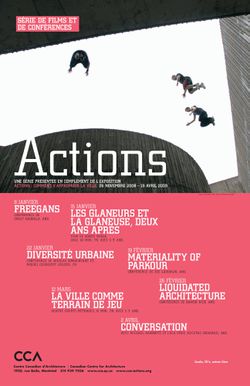
Materiality of Parkour
Materiality of Parkour
Actions:
Description:
Engineer, artist, and theoretician Zoe Laughlin presents the new functions of existing materials in public spaces in relation to parkour, an activity which reinterprets the urban landscape. Her ideas focus on the materiality of daily life: how matter behaves, its sensorial qualities, and how people react to it. A member of the Division of Engineering’s Materials Research(...)
Engineer, artist, and theoretician Zoe Laughlin presents the new functions of existing materials in public spaces in relation to parkour, an activity which reinterprets the urban landscape. Her ideas focus on the materiality of daily life: how matter behaves, its sensorial qualities, and how people react to it. A member of the Division of Engineering’s Materials Research(...)
Location:
Paul Desmarais Theatre
Paul Desmarais Theatre
Date:
19 February 2009
19 February 2009
Title:
Materiality of Parkour
Actions:
Description:
Engineer, artist, and theoretician Zoe Laughlin presents the new functions of existing materials in public spaces in relation to parkour, an activity which reinterprets the urban landscape. Her ideas focus on the materiality of daily life: how matter behaves, its sensorial qualities, and how people react to it. A member of the Division of Engineering’s Materials Research(...)
Materiality of Parkour
Actions:
Description:
Engineer, artist, and theoretician Zoe Laughlin presents the new functions of existing materials in public spaces in relation to parkour, an activity which reinterprets the urban landscape. Her ideas focus on the materiality of daily life: how matter behaves, its sensorial qualities, and how people react to it. A member of the Division of Engineering’s Materials Research(...)
Form:
events
events
Date:
19 February 2009
19 February 2009
Location:
Paul Desmarais Theatre
Paul Desmarais Theatre
Level of archival description:
Project
Project
Actions:
Reference number:
AP207.S1.2014.PR01
Description:
The project series documents the installation "Architettura "Correta"" designed by Pettena for the exhibition "Soleil Politique" at the Museion in Bolzano, in 2014. The project was a design for a new museum entrance. The installation was made of three glass walls on which were drawn facade details of three historical buildings of the city. The central glass wall represents the entrance from the Piacentini square in Bolzano, with, at its left, a ‘serlian’ arch, and, at its right, a detail of the portico of a ‘Piazza d’Italia’ by Giorgio de Chirico. The idea was to "connect the museum to the city’s history, an architectural element was chosen, one which, in addition to favoring the idea of ‘entrance’ to the exhibit also permitted a view both of the urban and the natural setting, the sky, the mountains, an environment typical of the area in which the city itself rises." [1] The project series contains a sketch and a spiral bound volume with correspondence between Pettena and Pierre Bal Blanc, curator of the exhibitions, and proposals for the installation. The project series also contains photographs of the installation, including printouts. Source: [1] Gianni Pettena website, https://www.giannipettena.it/italiano/opere-1/inst-revised-architecture-2014/ (last accessed 27 January 2020)
AP207.S1.2014.PR01
Description:
The project series documents the installation "Architettura "Correta"" designed by Pettena for the exhibition "Soleil Politique" at the Museion in Bolzano, in 2014. The project was a design for a new museum entrance. The installation was made of three glass walls on which were drawn facade details of three historical buildings of the city. The central glass wall represents the entrance from the Piacentini square in Bolzano, with, at its left, a ‘serlian’ arch, and, at its right, a detail of the portico of a ‘Piazza d’Italia’ by Giorgio de Chirico. The idea was to "connect the museum to the city’s history, an architectural element was chosen, one which, in addition to favoring the idea of ‘entrance’ to the exhibit also permitted a view both of the urban and the natural setting, the sky, the mountains, an environment typical of the area in which the city itself rises." [1] The project series contains a sketch and a spiral bound volume with correspondence between Pettena and Pierre Bal Blanc, curator of the exhibitions, and proposals for the installation. The project series also contains photographs of the installation, including printouts. Source: [1] Gianni Pettena website, https://www.giannipettena.it/italiano/opere-1/inst-revised-architecture-2014/ (last accessed 27 January 2020)
People:
Date:
2014-2015
2014-2015
Title:
Architettura "Correta" ["Revised" Architecture] (2014)
Actions:
AP207.S1.2014.PR01
Description:
The project series documents the installation "Architettura "Correta"" designed by Pettena for the exhibition "Soleil Politique" at the Museion in Bolzano, in 2014. The project was a design for a new museum entrance. The installation was made of three glass walls on which were drawn facade details of three historical buildings of the city. The central glass wall represents the entrance from the Piacentini square in Bolzano, with, at its left, a ‘serlian’ arch, and, at its right, a detail of the portico of a ‘Piazza d’Italia’ by Giorgio de Chirico. The idea was to "connect the museum to the city’s history, an architectural element was chosen, one which, in addition to favoring the idea of ‘entrance’ to the exhibit also permitted a view both of the urban and the natural setting, the sky, the mountains, an environment typical of the area in which the city itself rises." [1] The project series contains a sketch and a spiral bound volume with correspondence between Pettena and Pierre Bal Blanc, curator of the exhibitions, and proposals for the installation. The project series also contains photographs of the installation, including printouts. Source: [1] Gianni Pettena website, https://www.giannipettena.it/italiano/opere-1/inst-revised-architecture-2014/ (last accessed 27 January 2020)
Architettura "Correta" ["Revised" Architecture] (2014)
Actions:
AP207.S1.2014.PR01
Description:
The project series documents the installation "Architettura "Correta"" designed by Pettena for the exhibition "Soleil Politique" at the Museion in Bolzano, in 2014. The project was a design for a new museum entrance. The installation was made of three glass walls on which were drawn facade details of three historical buildings of the city. The central glass wall represents the entrance from the Piacentini square in Bolzano, with, at its left, a ‘serlian’ arch, and, at its right, a detail of the portico of a ‘Piazza d’Italia’ by Giorgio de Chirico. The idea was to "connect the museum to the city’s history, an architectural element was chosen, one which, in addition to favoring the idea of ‘entrance’ to the exhibit also permitted a view both of the urban and the natural setting, the sky, the mountains, an environment typical of the area in which the city itself rises." [1] The project series contains a sketch and a spiral bound volume with correspondence between Pettena and Pierre Bal Blanc, curator of the exhibitions, and proposals for the installation. The project series also contains photographs of the installation, including printouts. Source: [1] Gianni Pettena website, https://www.giannipettena.it/italiano/opere-1/inst-revised-architecture-2014/ (last accessed 27 January 2020)
Level of archival description:
Project
Project
Date:
2014-2015
2014-2015
People:
Form:
events
events

Title:
Learning from... Beirut
Learning from... Beirut
Actions:
Description:
Hashim Sarkis, Aga Khan Professor at Harvard University and Director of the Aga Khan Program at the Harvard Graduate School of Design (GSD), proposes an alternative reading of urban issues in Beirut that considers elements beyond the city’s post-war reconstruction and identity politics. Through a series of specific architectural and urban analyses, the lecture proposes(...)
Hashim Sarkis, Aga Khan Professor at Harvard University and Director of the Aga Khan Program at the Harvard Graduate School of Design (GSD), proposes an alternative reading of urban issues in Beirut that considers elements beyond the city’s post-war reconstruction and identity politics. Through a series of specific architectural and urban analyses, the lecture proposes(...)
Location:
Paul Desmarais Theatre
Paul Desmarais Theatre
Date:
11 March 2010 , 7pm
11 March 2010 , 7pm
Title:
Learning from... Beirut
Actions:
Description:
Hashim Sarkis, Aga Khan Professor at Harvard University and Director of the Aga Khan Program at the Harvard Graduate School of Design (GSD), proposes an alternative reading of urban issues in Beirut that considers elements beyond the city’s post-war reconstruction and identity politics. Through a series of specific architectural and urban analyses, the lecture proposes(...)
Learning from... Beirut
Actions:
Description:
Hashim Sarkis, Aga Khan Professor at Harvard University and Director of the Aga Khan Program at the Harvard Graduate School of Design (GSD), proposes an alternative reading of urban issues in Beirut that considers elements beyond the city’s post-war reconstruction and identity politics. Through a series of specific architectural and urban analyses, the lecture proposes(...)
Form:
events
events
Date:
11 March 2010
7pm
11 March 2010
7pm
Location:
Paul Desmarais Theatre
Paul Desmarais Theatre


