


4353 Results
Form:
books
books

Title:
St. Peter's
St. Peter's
Actions:
Price:
$22.95
(available to order)
Summary:
Built by the decree of Constantine, rebuilt by some of the most distinguished architects in Renaissance Italy, emulated by Hitler's architect in his vision for Germania, immortalized on film by Fellini, and fictionalized by a modern American bestseller, St. Peter's is the most easily recognizable church in the world. This book is a cultural history of one of the most(...)
$22.95
(available to order)
Summary:
Built by the decree of Constantine, rebuilt by some of the most distinguished architects in Renaissance Italy, emulated by Hitler's architect in his vision for Germania, immortalized on film by Fellini, and fictionalized by a modern American bestseller, St. Peter's is the most easily recognizable church in the world. This book is a cultural history of one of the most(...)
Title:
St. Peter's
Actions:
Price:
$22.95
(available to order)
Summary:
Built by the decree of Constantine, rebuilt by some of the most distinguished architects in Renaissance Italy, emulated by Hitler's architect in his vision for Germania, immortalized on film by Fellini, and fictionalized by a modern American bestseller, St. Peter's is the most easily recognizable church in the world. This book is a cultural history of one of the most significant structures in the West. It bears the imprint of Bramante, Raphael, Michelangelo, Bernini, and Canova. For Grand Tourists of the eighteenth century, St. Peter's exemplified the sublime. It continues to fascinate visitors today and appears globally as a familiar symbol of the papacy and of the Catholic Church itself. The church was first built in the fourth century on what is thought to be the tomb of Peter - the rock upon which Christ decreed his church shall be built. After twelve hundred years, the church was largely demolished and rebuilt in the sixteenth century when it came to acquire its present-day form. St. Peter's awes the visitor by its gigantic proportions, creating a city within itself. It is the mother church, the womb from which churches around the world have taken inspiration. This book covers the social, political, and architectural history of the church from the fourth century to the present. From the threshold, to the subterranean Roman necropolis, to the dizzying heights of the dome, this book provides rare perspectives and contexts for understanding the shape and significance of the most illustrious church in the world.
St. Peter's
Actions:
Price:
$22.95
(available to order)
Summary:
Built by the decree of Constantine, rebuilt by some of the most distinguished architects in Renaissance Italy, emulated by Hitler's architect in his vision for Germania, immortalized on film by Fellini, and fictionalized by a modern American bestseller, St. Peter's is the most easily recognizable church in the world. This book is a cultural history of one of the most significant structures in the West. It bears the imprint of Bramante, Raphael, Michelangelo, Bernini, and Canova. For Grand Tourists of the eighteenth century, St. Peter's exemplified the sublime. It continues to fascinate visitors today and appears globally as a familiar symbol of the papacy and of the Catholic Church itself. The church was first built in the fourth century on what is thought to be the tomb of Peter - the rock upon which Christ decreed his church shall be built. After twelve hundred years, the church was largely demolished and rebuilt in the sixteenth century when it came to acquire its present-day form. St. Peter's awes the visitor by its gigantic proportions, creating a city within itself. It is the mother church, the womb from which churches around the world have taken inspiration. This book covers the social, political, and architectural history of the church from the fourth century to the present. From the threshold, to the subterranean Roman necropolis, to the dizzying heights of the dome, this book provides rare perspectives and contexts for understanding the shape and significance of the most illustrious church in the world.
Form:
books
books
Publication:
October 2007, London
October 2007, London
Subject:
History until 1900, Italy
History until 1900, Italy
Form:
books
books

Actions:
Price:
$62.00
(available to order)
Summary:
Kara Walker is among the most complex and prolific American artists of her generation. Over the past decade, she has gained international recognition for her room-sized tableaux, which depict historical narratives haunted by sexuality, violence and subjugation and are made using the paradoxically genteel eighteenth-century art of cut-paper silhouettes. Set in the(...)
$62.00
(available to order)
Summary:
Kara Walker is among the most complex and prolific American artists of her generation. Over the past decade, she has gained international recognition for her room-sized tableaux, which depict historical narratives haunted by sexuality, violence and subjugation and are made using the paradoxically genteel eighteenth-century art of cut-paper silhouettes. Set in the(...)
Title:
Kara Walker : my complement, my enevy, my oppressor, my love
Actions:
Price:
$62.00
(available to order)
Summary:
Kara Walker is among the most complex and prolific American artists of her generation. Over the past decade, she has gained international recognition for her room-sized tableaux, which depict historical narratives haunted by sexuality, violence and subjugation and are made using the paradoxically genteel eighteenth-century art of cut-paper silhouettes. Set in the antebellum American South, Walker's compositions play off of stereotypes to portray, often grotesquely, life on the plantation, where masters, mistresses and slave men, women and children enact a subverted version of the past in an attempt to reconfigure their status and representation. Over the years, the artist has used drawing, painting, colored-light projections, writing, shadow puppetry, and, most recently, film animation to narrate her tales of romance, sadism, oppression and liberation. Her scenarios thwart conventional readings of a cohesive national history and expose the collective, and ongoing, psychological injury caused by the tragic legacy of slavery. Deploying an acidic sense of humor, Walker examines the dialectics of pleasure and danger, guilt and fulfillment, desire and fear, race and class. This landmark publication, which is sure to win international design awards, accompanies Walker's first major American museum survey. It features critical essays by Philippe Vergne, Sander L. Gilman, Thomas McEvilley, Robert Storr and Kevin Young, as well as an illustrated lexicon of recurring themes and motifs in the artist's most influential installations by Yasmil Raymond, more than 200 full-color images, an extensive exhibition history and bibliography, and a 36-page insert by the artist.
Kara Walker : my complement, my enevy, my oppressor, my love
Actions:
Price:
$62.00
(available to order)
Summary:
Kara Walker is among the most complex and prolific American artists of her generation. Over the past decade, she has gained international recognition for her room-sized tableaux, which depict historical narratives haunted by sexuality, violence and subjugation and are made using the paradoxically genteel eighteenth-century art of cut-paper silhouettes. Set in the antebellum American South, Walker's compositions play off of stereotypes to portray, often grotesquely, life on the plantation, where masters, mistresses and slave men, women and children enact a subverted version of the past in an attempt to reconfigure their status and representation. Over the years, the artist has used drawing, painting, colored-light projections, writing, shadow puppetry, and, most recently, film animation to narrate her tales of romance, sadism, oppression and liberation. Her scenarios thwart conventional readings of a cohesive national history and expose the collective, and ongoing, psychological injury caused by the tragic legacy of slavery. Deploying an acidic sense of humor, Walker examines the dialectics of pleasure and danger, guilt and fulfillment, desire and fear, race and class. This landmark publication, which is sure to win international design awards, accompanies Walker's first major American museum survey. It features critical essays by Philippe Vergne, Sander L. Gilman, Thomas McEvilley, Robert Storr and Kevin Young, as well as an illustrated lexicon of recurring themes and motifs in the artist's most influential installations by Yasmil Raymond, more than 200 full-color images, an extensive exhibition history and bibliography, and a 36-page insert by the artist.
Form:
books
books
Publication:
March 2007, Minneapolis
March 2007, Minneapolis
Subject:
Contemporary Art Monographs
Contemporary Art Monographs
Form:
books
books
Price:
$39.95
(available to order)
Summary:
Beginning with agoraphobia and claustrophobia in the late nineteenth century, followed by shell shock and panic fear after World War I, phobias and anxiety came to be seen as the mental condition of modern life. They became incorporated into the media and arts, in particular the (...)
$39.95
(available to order)
Summary:
Beginning with agoraphobia and claustrophobia in the late nineteenth century, followed by shell shock and panic fear after World War I, phobias and anxiety came to be seen as the mental condition of modern life. They became incorporated into the media and arts, in particular the (...)
Title:
Warped space : art, architecture, and anxiety in modern culture
Actions:
Price:
$39.95
(available to order)
Summary:
Beginning with agoraphobia and claustrophobia in the late nineteenth century, followed by shell shock and panic fear after World War I, phobias and anxiety came to be seen as the mental condition of modern life. They became incorporated into the media and arts, in particular the spatial arts of architecture, urbanism, and film. This "spatial warping" is now being reshaped by digitalization and virtual reality. Anthony Vidler is concerned with two forms of warped space. The first, a psychological space, is the repository of neuroses and phobias. This space is not empty but full of disturbing forms, including those of architecture and the city. The second kind of warping is produced when artists break the boundaries of genre to depict space in new ways. Vidler traces the emergence of a psychological idea of space from Pascal and Freud to the identification of agoraphobia and claustrophobia in the nineteenth century to twentieth-century theories of spatial alienation and estrangement in the writings of Georg Simmel, Siegfried Kracauer, and Walter Benjamin. Focusing on current conditions of displacement and placelessness, he examines ways in which contemporary artists and architects have produced new forms of spatial warping. The discussion ranges from theorists such as Jacques Lacan and Gilles Deleuze to artists such as Vito Acconci, Mike Kelley, Martha Rosler, and Rachel Whiteread. Finally, Vidler looks at the architectural experiments of Frank Gehry, Coop Himmelblau, Daniel Libeskind, Greg Lynn, Morphosis, and Eric Owen Moss in the light of new digital techniques that, while relying on traditional perspective, have radically transformed the composition, production, and experience of architecture.
Warped space : art, architecture, and anxiety in modern culture
Actions:
Price:
$39.95
(available to order)
Summary:
Beginning with agoraphobia and claustrophobia in the late nineteenth century, followed by shell shock and panic fear after World War I, phobias and anxiety came to be seen as the mental condition of modern life. They became incorporated into the media and arts, in particular the spatial arts of architecture, urbanism, and film. This "spatial warping" is now being reshaped by digitalization and virtual reality. Anthony Vidler is concerned with two forms of warped space. The first, a psychological space, is the repository of neuroses and phobias. This space is not empty but full of disturbing forms, including those of architecture and the city. The second kind of warping is produced when artists break the boundaries of genre to depict space in new ways. Vidler traces the emergence of a psychological idea of space from Pascal and Freud to the identification of agoraphobia and claustrophobia in the nineteenth century to twentieth-century theories of spatial alienation and estrangement in the writings of Georg Simmel, Siegfried Kracauer, and Walter Benjamin. Focusing on current conditions of displacement and placelessness, he examines ways in which contemporary artists and architects have produced new forms of spatial warping. The discussion ranges from theorists such as Jacques Lacan and Gilles Deleuze to artists such as Vito Acconci, Mike Kelley, Martha Rosler, and Rachel Whiteread. Finally, Vidler looks at the architectural experiments of Frank Gehry, Coop Himmelblau, Daniel Libeskind, Greg Lynn, Morphosis, and Eric Owen Moss in the light of new digital techniques that, while relying on traditional perspective, have radically transformed the composition, production, and experience of architecture.
Form:
books
books
Publication:
April 2002, Cambridge, Mass.
April 2002, Cambridge, Mass.
Subject:
Architectural Theory
Architectural Theory
Form:
books
books
Price:
$49.50
(available to order)
Summary:
Beginning with agoraphobia and claustrophobia in the late nineteenth century, followed by shell shock and panic fear after World War I, phobias and anxiety came to be seen as the mental condition of modern life. They became incorporated into the media and arts, in particular the (...)
$49.50
(available to order)
Summary:
Beginning with agoraphobia and claustrophobia in the late nineteenth century, followed by shell shock and panic fear after World War I, phobias and anxiety came to be seen as the mental condition of modern life. They became incorporated into the media and arts, in particular the (...)
Title:
Warped space : art, architecture, and anxiety in modern culture
Actions:
Price:
$49.50
(available to order)
Summary:
Beginning with agoraphobia and claustrophobia in the late nineteenth century, followed by shell shock and panic fear after World War I, phobias and anxiety came to be seen as the mental condition of modern life. They became incorporated into the media and arts, in particular the spatial arts of architecture, urbanism, and film. This "spatial warping" is now being reshaped by digitalization and virtual reality. Anthony Vidler is concerned with two forms of warped space. The first, a psychological space, is the repository of neuroses and phobias. This space is not empty but full of disturbing forms, including those of architecture and the city. The second kind of warping is produced when artists break the boundaries of genre to depict space in new ways. Vidler traces the emergence of a psychological idea of space from Pascal and Freud to the identification of agoraphobia and claustrophobia in the nineteenth century to twentieth-century theories of spatial alienation and estrangement in the writings of Georg Simmel, Siegfried Kracauer, and Walter Benjamin. Focusing on current conditions of displacement and placelessness, he examines ways in which contemporary artists and architects have produced new forms of spatial warping. The discussion ranges from theorists such as Jacques Lacan and Gilles Deleuze to artists such as Vito Acconci, Mike Kelley, Martha Rosler, and Rachel Whiteread. Finally, Vidler looks at the architectural experiments of Frank Gehry, Coop Himmelblau, Daniel Libeskind, Greg Lynn, Morphosis, and Eric Owen Moss in the light of new digital techniques that, while relying on traditional perspective, have radically transformed the composition, production, and experience of architecture.
Warped space : art, architecture, and anxiety in modern culture
Actions:
Price:
$49.50
(available to order)
Summary:
Beginning with agoraphobia and claustrophobia in the late nineteenth century, followed by shell shock and panic fear after World War I, phobias and anxiety came to be seen as the mental condition of modern life. They became incorporated into the media and arts, in particular the spatial arts of architecture, urbanism, and film. This "spatial warping" is now being reshaped by digitalization and virtual reality. Anthony Vidler is concerned with two forms of warped space. The first, a psychological space, is the repository of neuroses and phobias. This space is not empty but full of disturbing forms, including those of architecture and the city. The second kind of warping is produced when artists break the boundaries of genre to depict space in new ways. Vidler traces the emergence of a psychological idea of space from Pascal and Freud to the identification of agoraphobia and claustrophobia in the nineteenth century to twentieth-century theories of spatial alienation and estrangement in the writings of Georg Simmel, Siegfried Kracauer, and Walter Benjamin. Focusing on current conditions of displacement and placelessness, he examines ways in which contemporary artists and architects have produced new forms of spatial warping. The discussion ranges from theorists such as Jacques Lacan and Gilles Deleuze to artists such as Vito Acconci, Mike Kelley, Martha Rosler, and Rachel Whiteread. Finally, Vidler looks at the architectural experiments of Frank Gehry, Coop Himmelblau, Daniel Libeskind, Greg Lynn, Morphosis, and Eric Owen Moss in the light of new digital techniques that, while relying on traditional perspective, have radically transformed the composition, production, and experience of architecture.
Form:
books
books
Publication:
June 2000, Cambridge, Mass.
June 2000, Cambridge, Mass.
Subject:
Architectural Theory
Architectural Theory
Form:
books
books

Title:
Dafydd Jones: Screen time
Dafydd Jones: Screen time
Actions:
Price:
$26.95
(available to order)
Summary:
Dafydd Jones is recognized as one of the world's leading social photographers, which over the years has given him unique access to an extraordinary range of social events - from exclusive parties, to the races, to fashion shows, film festivals and debutantes balls• His keen eye, and an instinct for the absurd, has allowed him to capture the behaviour of people who are(...)
$26.95
(available to order)
Summary:
Dafydd Jones is recognized as one of the world's leading social photographers, which over the years has given him unique access to an extraordinary range of social events - from exclusive parties, to the races, to fashion shows, film festivals and debutantes balls• His keen eye, and an instinct for the absurd, has allowed him to capture the behaviour of people who are(...)
Title:
Dafydd Jones: Screen time
Actions:
Price:
$26.95
(available to order)
Summary:
Dafydd Jones is recognized as one of the world's leading social photographers, which over the years has given him unique access to an extraordinary range of social events - from exclusive parties, to the races, to fashion shows, film festivals and debutantes balls• His keen eye, and an instinct for the absurd, has allowed him to capture the behaviour of people who are either unaware of or indifferent to the camera. ''Screen time'' explores a variety of social situations, from the mundane to the exalted, and features celebrities, actors, models and even the occasional princess - all glued to their phonesAlmost everyone uses a smartphone, and most of us are addicted. In this book, photographer Dafydd Jones shows us just how pervasive our screen addiction has become. In almost every social situation, he shows how the smartphone has killed conversation and changed the way we look at the world. ''In the eighties and nineties,'' says Jones, ''when I photographed young people at parties or balls, I'd find them chatting each other up, or smooching in corners. Now I see them sneaking looks on their iPhones, checking on their Instagram feeds, or whatever it is they're hooked on. They hardly talk to each other, or make eye contact at all. And it's not just a generational thing - it afflicts the oldies too. Who knows what impact it's having in the bedroom. It's probably a race to see what will wipe out humanity first - global climate change or screen-induced sexual indifference.''
Dafydd Jones: Screen time
Actions:
Price:
$26.95
(available to order)
Summary:
Dafydd Jones is recognized as one of the world's leading social photographers, which over the years has given him unique access to an extraordinary range of social events - from exclusive parties, to the races, to fashion shows, film festivals and debutantes balls• His keen eye, and an instinct for the absurd, has allowed him to capture the behaviour of people who are either unaware of or indifferent to the camera. ''Screen time'' explores a variety of social situations, from the mundane to the exalted, and features celebrities, actors, models and even the occasional princess - all glued to their phonesAlmost everyone uses a smartphone, and most of us are addicted. In this book, photographer Dafydd Jones shows us just how pervasive our screen addiction has become. In almost every social situation, he shows how the smartphone has killed conversation and changed the way we look at the world. ''In the eighties and nineties,'' says Jones, ''when I photographed young people at parties or balls, I'd find them chatting each other up, or smooching in corners. Now I see them sneaking looks on their iPhones, checking on their Instagram feeds, or whatever it is they're hooked on. They hardly talk to each other, or make eye contact at all. And it's not just a generational thing - it afflicts the oldies too. Who knows what impact it's having in the bedroom. It's probably a race to see what will wipe out humanity first - global climate change or screen-induced sexual indifference.''
Form:
books
books
Publication:
October 2019
October 2019
Subject:
Photography monographs
Photography monographs
Form:
books
books
Actions:
Price:
$52.95
(available to order)
Summary:
When recession-plagued New York City abandoned its industrial base in the 1970s, performance artists, photographers, and filmmakers found their own mixed uses for the city's run-down lofts, abandoned piers, vacant lots, and deserted streets. Gordon Matta-Clark turned a sanitation pier into the celebrated work Day's End and Betsy Sussler filmed its making; the photographic(...)
$52.95
(available to order)
Summary:
When recession-plagued New York City abandoned its industrial base in the 1970s, performance artists, photographers, and filmmakers found their own mixed uses for the city's run-down lofts, abandoned piers, vacant lots, and deserted streets. Gordon Matta-Clark turned a sanitation pier into the celebrated work Day's End and Betsy Sussler filmed its making; the photographic(...)
Title:
Mixed use, Manhattan : photography and related practices, 1970 to the present
Actions:
Price:
$52.95
(available to order)
Summary:
When recession-plagued New York City abandoned its industrial base in the 1970s, performance artists, photographers, and filmmakers found their own mixed uses for the city's run-down lofts, abandoned piers, vacant lots, and deserted streets. Gordon Matta-Clark turned a sanitation pier into the celebrated work Day's End and Betsy Sussler filmed its making; the photographic team Shunk-Kender shot a vast series of images of Willoughby Sharp's Projects: Pier 18 (which included work by Vito Acconci, Mel Bochner, Dan Graham, Matta-Clark, and William Wegman, among others); and Cindy Sherman staged some of her Untitled Film Stills on the streets of Lower Manhattan. This publication documents and illustrates these projects as well as more recent work by artists who continue to engage with the city's public, underground, and improvised spaces. The book (which accompanies a major exhibition) focuses on several important photographic series: Peter Hujar's 1976 nighttime photographs of Manhattan's West Side; Alvin Baltrop's Hudson River pier photographs from 1975-1985, most of which have never before been shown or published; David Wojnarowicz's Rimbaud in New York (1978-1979), the first of Wojnarowicz's works to be published; and several of Zoe Leonard's photographic projects from the late 1990s on. The book includes 70 color and 130 black-and-white images, a chronology of the policy decisions and developments that altered the face of New York City from 1950 to the present; an autobiographical story by David Wojnarowicz; and essays by Johanna Burton, Lytle Shaw, Juan Suarez, and the exhibition's curators, Lynne Cooke and Douglas Crimp.
Mixed use, Manhattan : photography and related practices, 1970 to the present
Actions:
Price:
$52.95
(available to order)
Summary:
When recession-plagued New York City abandoned its industrial base in the 1970s, performance artists, photographers, and filmmakers found their own mixed uses for the city's run-down lofts, abandoned piers, vacant lots, and deserted streets. Gordon Matta-Clark turned a sanitation pier into the celebrated work Day's End and Betsy Sussler filmed its making; the photographic team Shunk-Kender shot a vast series of images of Willoughby Sharp's Projects: Pier 18 (which included work by Vito Acconci, Mel Bochner, Dan Graham, Matta-Clark, and William Wegman, among others); and Cindy Sherman staged some of her Untitled Film Stills on the streets of Lower Manhattan. This publication documents and illustrates these projects as well as more recent work by artists who continue to engage with the city's public, underground, and improvised spaces. The book (which accompanies a major exhibition) focuses on several important photographic series: Peter Hujar's 1976 nighttime photographs of Manhattan's West Side; Alvin Baltrop's Hudson River pier photographs from 1975-1985, most of which have never before been shown or published; David Wojnarowicz's Rimbaud in New York (1978-1979), the first of Wojnarowicz's works to be published; and several of Zoe Leonard's photographic projects from the late 1990s on. The book includes 70 color and 130 black-and-white images, a chronology of the policy decisions and developments that altered the face of New York City from 1950 to the present; an autobiographical story by David Wojnarowicz; and essays by Johanna Burton, Lytle Shaw, Juan Suarez, and the exhibition's curators, Lynne Cooke and Douglas Crimp.
Form:
books
books
Publication:
September 2010
September 2010
Subject:
Public Space
Public Space
Form:
books
books

Actions:
Price:
$52.00
(available to order)
Summary:
Known for their in-depth research and innovative, inventive, and meticulously constructed architecture, KieranTimberlake Assoicates put its ideas about streamlining the making of architecture to the test. The results took the form of a fully modular and award-winning house, featuring an active and adjustable double-skin facade so advanced that no client would consider it.(...)
$52.00
(available to order)
Summary:
Known for their in-depth research and innovative, inventive, and meticulously constructed architecture, KieranTimberlake Assoicates put its ideas about streamlining the making of architecture to the test. The results took the form of a fully modular and award-winning house, featuring an active and adjustable double-skin facade so advanced that no client would consider it.(...)
Subject:
Architecture Monographs
Architecture Monographs
Publication:
June 2008, New York
June 2008, New York
Title:
Loblolly House: elements of a new architecture
Actions:
Price:
$52.00
(available to order)
Summary:
Known for their in-depth research and innovative, inventive, and meticulously constructed architecture, KieranTimberlake Assoicates put its ideas about streamlining the making of architecture to the test. The results took the form of a fully modular and award-winning house, featuring an active and adjustable double-skin facade so advanced that no client would consider it. KieranTimberlake Assoicates boldly took the project upon themselves, using partner Stephen Kieran's own summer house as a laboratory. Situated on idyllic Taylors Island, off the coast of Maryland's Chesapeake Bay, Loblolly House inaugurates a truly new, more efficient way of building. Through the use of state-of-the-art building information modeling (BIM), the architects were able to streamline the design-build process. Thousands of parts were collapsed and integrated into a few dozen panels and blocks that slid into an aluminum frame set on wooden pylons. Consisting of 70 percent prefabricated components, the kit-of-parts house was assembled (mostly with a wrench) and lifted into place on-site in less than six weeks. Unlike most houses, even those built with sustainability in mind, Loblolly disassembles as easily as it assembles, making it an ecologically sound structure with a manageable environmental footprint. Focusing on a single built project and illustrated with extensive photographic documentation and numerous detailed drawings, Loblolly House is the manual for componentized prefab. The book includes a DVD of the film "A House in the Trees" by producers Rick Deppe and Kathleen Blake, a real-time documentary of the design, fabrication, and assembly of Loblolly House.
Loblolly House: elements of a new architecture
Actions:
Price:
$52.00
(available to order)
Summary:
Known for their in-depth research and innovative, inventive, and meticulously constructed architecture, KieranTimberlake Assoicates put its ideas about streamlining the making of architecture to the test. The results took the form of a fully modular and award-winning house, featuring an active and adjustable double-skin facade so advanced that no client would consider it. KieranTimberlake Assoicates boldly took the project upon themselves, using partner Stephen Kieran's own summer house as a laboratory. Situated on idyllic Taylors Island, off the coast of Maryland's Chesapeake Bay, Loblolly House inaugurates a truly new, more efficient way of building. Through the use of state-of-the-art building information modeling (BIM), the architects were able to streamline the design-build process. Thousands of parts were collapsed and integrated into a few dozen panels and blocks that slid into an aluminum frame set on wooden pylons. Consisting of 70 percent prefabricated components, the kit-of-parts house was assembled (mostly with a wrench) and lifted into place on-site in less than six weeks. Unlike most houses, even those built with sustainability in mind, Loblolly disassembles as easily as it assembles, making it an ecologically sound structure with a manageable environmental footprint. Focusing on a single built project and illustrated with extensive photographic documentation and numerous detailed drawings, Loblolly House is the manual for componentized prefab. The book includes a DVD of the film "A House in the Trees" by producers Rick Deppe and Kathleen Blake, a real-time documentary of the design, fabrication, and assembly of Loblolly House.
Form:
books
books
Publication:
June 2008, New York
June 2008, New York
Subject:
Architecture Monographs
Architecture Monographs
Form:
books
books
Actions:
Price:
$90.00
(available to order)
Summary:
Gordon Matta-Clark, scion and rebel, died at 35 in 1978 and has since become a cult figure of late-twentieth-century art. Born in New York and trained in architecture at Cornell, he went on to question the field's conventions in vivid projects that excised holes into existing buildings or assembled deeds to New York City alleys and curbs. As the son of the Chilean-born(...)
$90.00
(available to order)
Summary:
Gordon Matta-Clark, scion and rebel, died at 35 in 1978 and has since become a cult figure of late-twentieth-century art. Born in New York and trained in architecture at Cornell, he went on to question the field's conventions in vivid projects that excised holes into existing buildings or assembled deeds to New York City alleys and curbs. As the son of the Chilean-born(...)
Title:
Gordon Matta-Clark: works and collected writings
Actions:
Price:
$90.00
(available to order)
Summary:
Gordon Matta-Clark, scion and rebel, died at 35 in 1978 and has since become a cult figure of late-twentieth-century art. Born in New York and trained in architecture at Cornell, he went on to question the field's conventions in vivid projects that excised holes into existing buildings or assembled deeds to New York City alleys and curbs. As the son of the Chilean-born Surrealist painter Roberto Matta and Anne Clark, and godson of Marcel Duchamp, with whom he played a regular game of chess in the Village, Matta-Clark had grown up inside the art world, also working an as assistant to mavericks like Dennis Oppenheim and Robert Smithson. His work and words, while sophisticated enough to make him an "artist's artist," and colossal and outgoing enough to draw public attention and affection, were always also grounded in social or political convictions. He addressed not only space and real estate (in other words, housing), but the ultimate in necessity and nourishment, food. His "Pig Roast" under the Brooklyn Bridge offered passersby 500 pork sandwiches, and Food, the artist-staffed restaurant that he opened with dancer Caroline Goodden in SoHo, became a headquarters for that nascent neighborhood in the early 70s. He consistently broke the boundaries between sculpture and architecture, photography and film, performance and installation, and above all the permanent and the transitory. Once in a while he also broke the law. This book, published in celebration of the gradual opening of Matta-Clark's archives at the Canadian Centre for Architecture in Montreal, collects previously unavailable writings, including notecards and notebooks, along with interviews and more than 100 illustrations.
Gordon Matta-Clark: works and collected writings
Actions:
Price:
$90.00
(available to order)
Summary:
Gordon Matta-Clark, scion and rebel, died at 35 in 1978 and has since become a cult figure of late-twentieth-century art. Born in New York and trained in architecture at Cornell, he went on to question the field's conventions in vivid projects that excised holes into existing buildings or assembled deeds to New York City alleys and curbs. As the son of the Chilean-born Surrealist painter Roberto Matta and Anne Clark, and godson of Marcel Duchamp, with whom he played a regular game of chess in the Village, Matta-Clark had grown up inside the art world, also working an as assistant to mavericks like Dennis Oppenheim and Robert Smithson. His work and words, while sophisticated enough to make him an "artist's artist," and colossal and outgoing enough to draw public attention and affection, were always also grounded in social or political convictions. He addressed not only space and real estate (in other words, housing), but the ultimate in necessity and nourishment, food. His "Pig Roast" under the Brooklyn Bridge offered passersby 500 pork sandwiches, and Food, the artist-staffed restaurant that he opened with dancer Caroline Goodden in SoHo, became a headquarters for that nascent neighborhood in the early 70s. He consistently broke the boundaries between sculpture and architecture, photography and film, performance and installation, and above all the permanent and the transitory. Once in a while he also broke the law. This book, published in celebration of the gradual opening of Matta-Clark's archives at the Canadian Centre for Architecture in Montreal, collects previously unavailable writings, including notecards and notebooks, along with interviews and more than 100 illustrations.
Form:
books
books
Publication:
October 2006
October 2006
Subject:
Contemporary Art Monographs
Contemporary Art Monographs
Form:
books
books
Price:
$43.95
(available to order)
Summary:
Pioneering conceptual artist Vito Acconci began his career as a poet. In the 1960s, before beginning his work in performance and video art, Acconci studied at the Iowa Writers Workshop and published poems in journals and chapbooks. Almost all of this work remains unknown; much of it appeared in the self-produced magazines of the Lower East Side's mimeo revolution, and(...)
$43.95
(available to order)
Summary:
Pioneering conceptual artist Vito Acconci began his career as a poet. In the 1960s, before beginning his work in performance and video art, Acconci studied at the Iowa Writers Workshop and published poems in journals and chapbooks. Almost all of this work remains unknown; much of it appeared in the self-produced magazines of the Lower East Side's mimeo revolution, and(...)
Subject:
Contemporary Art Monographs
Contemporary Art Monographs
Publication:
March 2006, Cambridge, Mass.
March 2006, Cambridge, Mass.
Title:
Languages to cover a page : the early writings of Vito Acconci
Actions:
Price:
$43.95
(available to order)
Summary:
Pioneering conceptual artist Vito Acconci began his career as a poet. In the 1960s, before beginning his work in performance and video art, Acconci studied at the Iowa Writers Workshop and published poems in journals and chapbooks. Almost all of this work remains unknown; much of it appeared in the self-produced magazines of the Lower East Side's mimeo revolution, and many other pieces were never published. Language to Cover a Page collects these writings for the first time and not only shows Acconci to be an important experimental writer of the period, but demonstrates the continuity of his early writing with his later work in film, video, and performance. "Language to cover a page" documents a key moment in the unprecedented intersection of artists and poets in the late 1960s - as seen in the Dwan Gallery's series of "Language" shows (1967-1970) and in Acconci's own journal 0 to 9. Indeed, as Acconci moved from the poetry scene to the art world, his poetry became increasingly performative while his artwork was often structured and motivated by linguistic play. Acconci's early writing recalls the work of Samuel Beckett, the deadpan voice of the nouveau roman, and the jump cuts and fraught permutations of the nouvelle vague. Poems in "Language to cover a page" explore the materiality of language ("language as matter and not ideas," as Robert Smithson put it), the physical space of the page, and the physicality of source texts (phonebooks, thesauruses, dictionaries). Other poems take the space of the page as an analogue to performance space or implicate the poem in a network of activity (as in his "Dial-a-Poem" pieces).
Languages to cover a page : the early writings of Vito Acconci
Actions:
Price:
$43.95
(available to order)
Summary:
Pioneering conceptual artist Vito Acconci began his career as a poet. In the 1960s, before beginning his work in performance and video art, Acconci studied at the Iowa Writers Workshop and published poems in journals and chapbooks. Almost all of this work remains unknown; much of it appeared in the self-produced magazines of the Lower East Side's mimeo revolution, and many other pieces were never published. Language to Cover a Page collects these writings for the first time and not only shows Acconci to be an important experimental writer of the period, but demonstrates the continuity of his early writing with his later work in film, video, and performance. "Language to cover a page" documents a key moment in the unprecedented intersection of artists and poets in the late 1960s - as seen in the Dwan Gallery's series of "Language" shows (1967-1970) and in Acconci's own journal 0 to 9. Indeed, as Acconci moved from the poetry scene to the art world, his poetry became increasingly performative while his artwork was often structured and motivated by linguistic play. Acconci's early writing recalls the work of Samuel Beckett, the deadpan voice of the nouveau roman, and the jump cuts and fraught permutations of the nouvelle vague. Poems in "Language to cover a page" explore the materiality of language ("language as matter and not ideas," as Robert Smithson put it), the physical space of the page, and the physicality of source texts (phonebooks, thesauruses, dictionaries). Other poems take the space of the page as an analogue to performance space or implicate the poem in a network of activity (as in his "Dial-a-Poem" pieces).
Form:
books
books
Publication:
March 2006, Cambridge, Mass.
March 2006, Cambridge, Mass.
Subject:
Contemporary Art Monographs
Contemporary Art Monographs
Form:
books
books
Price:
$75.95
(available to order)
Summary:
More than one hundred exhibitions of Frank Lloyd Wright's work were mounted between 1894 and his death in 1959. Wright organized the majority of these exhibitions himself and viewed them as crucial to his self-presentation as his extensive writings. He used them to promote his designs, appeal to new viewers, and persuade his detractors. Wright on Exhibit presents the(...)
$75.95
(available to order)
Summary:
More than one hundred exhibitions of Frank Lloyd Wright's work were mounted between 1894 and his death in 1959. Wright organized the majority of these exhibitions himself and viewed them as crucial to his self-presentation as his extensive writings. He used them to promote his designs, appeal to new viewers, and persuade his detractors. Wright on Exhibit presents the(...)
Title:
Wright on exhibit: Frank Lloyd Wright's architectural exhibitions
Actions:
Price:
$75.95
(available to order)
Summary:
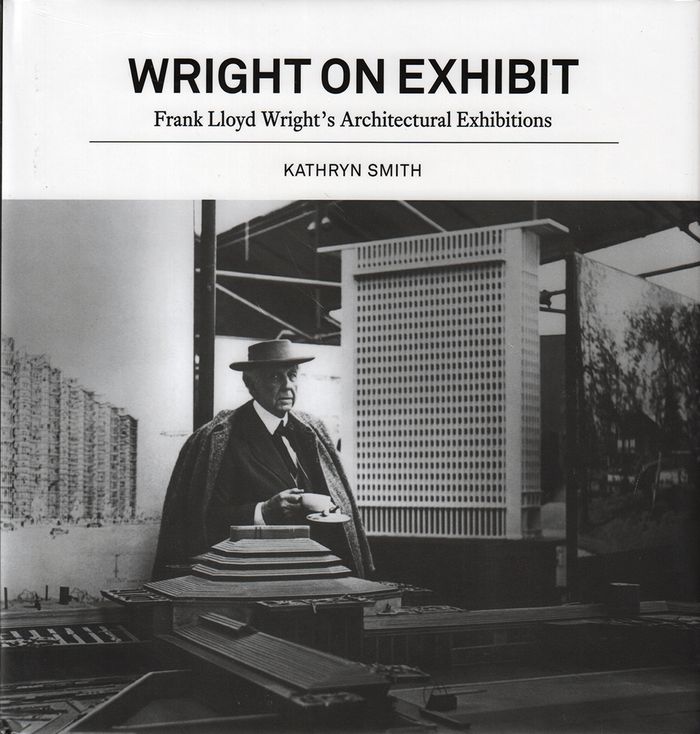
More than one hundred exhibitions of Frank Lloyd Wright's work were mounted between 1894 and his death in 1959. Wright organized the majority of these exhibitions himself and viewed them as crucial to his self-presentation as his extensive writings. He used them to promote his designs, appeal to new viewers, and persuade his detractors. Wright on Exhibit presents the first history of this neglected aspect of the architect’s influential career. Drawing extensively from Wright’s unpublished correspondence, Kathryn Smith challenges the preconceived notion of Wright as a self-promoter who displayed his work in search of money, clients, and fame. She shows how he was an artist-architect projecting an avant-garde program, an innovator who expanded the palette of installation design as technology evolved, and a social activist driven to revolutionize society through design. While Wright’s earliest exhibitions were largely for other architects, by the 1930s he was creating public installations intended to inspire debate and change public perceptions about architecture. The nature of his exhibitions expanded with the times beyond models, drawings, and photographs to include more immersive tools such as slides, film, and even a full-scale structure built especially for his 1953 retrospective at the Guggenheim Museum. Placing Wright’s exhibitions side by side with his writings, Smith shows how integral these exhibitions were to his vision and sheds light on the broader discourse concerning architecture and modernism during the first half of the twentieth century. Wright on Exhibit features color renderings, photos, and plans, as well as a checklist of exhibitions and an illustrated catalog of extant and lost models made under Wright’s supervision.
Wright on exhibit: Frank Lloyd Wright's architectural exhibitions
Actions:
Price:
$75.95
(available to order)
Summary:
More than one hundred exhibitions of Frank Lloyd Wright's work were mounted between 1894 and his death in 1959. Wright organized the majority of these exhibitions himself and viewed them as crucial to his self-presentation as his extensive writings. He used them to promote his designs, appeal to new viewers, and persuade his detractors. Wright on Exhibit presents the first history of this neglected aspect of the architect’s influential career. Drawing extensively from Wright’s unpublished correspondence, Kathryn Smith challenges the preconceived notion of Wright as a self-promoter who displayed his work in search of money, clients, and fame. She shows how he was an artist-architect projecting an avant-garde program, an innovator who expanded the palette of installation design as technology evolved, and a social activist driven to revolutionize society through design. While Wright’s earliest exhibitions were largely for other architects, by the 1930s he was creating public installations intended to inspire debate and change public perceptions about architecture. The nature of his exhibitions expanded with the times beyond models, drawings, and photographs to include more immersive tools such as slides, film, and even a full-scale structure built especially for his 1953 retrospective at the Guggenheim Museum. Placing Wright’s exhibitions side by side with his writings, Smith shows how integral these exhibitions were to his vision and sheds light on the broader discourse concerning architecture and modernism during the first half of the twentieth century. Wright on Exhibit features color renderings, photos, and plans, as well as a checklist of exhibitions and an illustrated catalog of extant and lost models made under Wright’s supervision.
Form:
books
books
Publication:
May 2017
May 2017
Subject:
Architecture Monographs
Architecture Monographs


