


10808 Results
Level of archival description:
Project
Project
Actions:
Reference number:
AP194.S1.1995.PR01
Description:
Project records consist of records documenting the three phases of the Synthetic Landscape project (1995-2000) as worked on by Johan Bettum and OCEAN North. The project was initially developed and submitted in 1995 for the Membrane Design International Competition held in Japan by the Taiyo Kogyo Corporation. The entry showcases a children’s playscape in the setting of Oslo’s Tøyen Park, joining both its urban surroundings and its natural landscape into a synthetic space. Afterwards, the project was exhibited at the Architecture Association (AA) in London, where Johan Bettum and Kivi Sotamaa met. This eventually led to Bettum and Sotamaa collaborating on projects, along with their respective OCEAN teams in Oslo and Helsinki. The Synthetic Landscape project continued as a research project, with a second phase in 1996 and a third phase which ran from 1997 through 2000 and integrated design methods (particle streaming, Channelling Systems) from the work made on the Töölö and Jyväskylä projects. In the third phase, a pavilion was also added to the setting. Aside from one drawing, all records for this project are in a digital format. Drawings and models from phase 1 show parts or the whole of a shell-like structure. A color scheme seems to be associated to the different components of the structure. A report on phases 1 and 2 discusses the use of synthetic and composite materials for the structure, explaining the concept for the site. Phase 2 textual records include a working plan, site charts and program. Additional drawings and models show an evolution in the shape of the landscape. Most records are related to the third phase of Synthetic Landscape. They are largely drawings and models showing textures and coloured grafts used in the design process, section and surfaces studies, as well as site plans. Other files of the third phase consist of animated renderings of Channelling Systems studies within the Synthetic Landscape topology, saved as Quicktime MOV files. Additionally, the third phase of Synthetic Landscape has files related to the FEM (finite element method) analysis process utilized in the project’s engineering. This particular section includes raster images showing vectorial drawings and data appearing to be surface studies. These were likely created with the software Mathematica. The bulk of textual documentation on the project’s scope and outcomes may be found in AP194.S1.1995.PR01.001 for phases 1 and 2, and in AP194.S1.1995.PR01.005 for phase 3. The latter file also contains documentation related to a grant application to The Research Council of Norway; a proposal for a conference and exhibition at the AA; and administrative records such as budgets, correspondence, invoices, progress reports, meeting agendas and minutes. For all project phases, records related to the design process consist of CAD models saved in a variety of modelling formats (iges, fmz, dgn, 3dm, dxf) as well as raster or vector images (tiff, jpeg, png, eps, pict, etc.). In some cases, only these raster or vector images of the original CAD drawings are present in the archive.
AP194.S1.1995.PR01
Description:
Project records consist of records documenting the three phases of the Synthetic Landscape project (1995-2000) as worked on by Johan Bettum and OCEAN North. The project was initially developed and submitted in 1995 for the Membrane Design International Competition held in Japan by the Taiyo Kogyo Corporation. The entry showcases a children’s playscape in the setting of Oslo’s Tøyen Park, joining both its urban surroundings and its natural landscape into a synthetic space. Afterwards, the project was exhibited at the Architecture Association (AA) in London, where Johan Bettum and Kivi Sotamaa met. This eventually led to Bettum and Sotamaa collaborating on projects, along with their respective OCEAN teams in Oslo and Helsinki. The Synthetic Landscape project continued as a research project, with a second phase in 1996 and a third phase which ran from 1997 through 2000 and integrated design methods (particle streaming, Channelling Systems) from the work made on the Töölö and Jyväskylä projects. In the third phase, a pavilion was also added to the setting. Aside from one drawing, all records for this project are in a digital format. Drawings and models from phase 1 show parts or the whole of a shell-like structure. A color scheme seems to be associated to the different components of the structure. A report on phases 1 and 2 discusses the use of synthetic and composite materials for the structure, explaining the concept for the site. Phase 2 textual records include a working plan, site charts and program. Additional drawings and models show an evolution in the shape of the landscape. Most records are related to the third phase of Synthetic Landscape. They are largely drawings and models showing textures and coloured grafts used in the design process, section and surfaces studies, as well as site plans. Other files of the third phase consist of animated renderings of Channelling Systems studies within the Synthetic Landscape topology, saved as Quicktime MOV files. Additionally, the third phase of Synthetic Landscape has files related to the FEM (finite element method) analysis process utilized in the project’s engineering. This particular section includes raster images showing vectorial drawings and data appearing to be surface studies. These were likely created with the software Mathematica. The bulk of textual documentation on the project’s scope and outcomes may be found in AP194.S1.1995.PR01.001 for phases 1 and 2, and in AP194.S1.1995.PR01.005 for phase 3. The latter file also contains documentation related to a grant application to The Research Council of Norway; a proposal for a conference and exhibition at the AA; and administrative records such as budgets, correspondence, invoices, progress reports, meeting agendas and minutes. For all project phases, records related to the design process consist of CAD models saved in a variety of modelling formats (iges, fmz, dgn, 3dm, dxf) as well as raster or vector images (tiff, jpeg, png, eps, pict, etc.). In some cases, only these raster or vector images of the original CAD drawings are present in the archive.
People:
Date:
1995-2000
1995-2000
Title:
Synthetic Landscape research project, Oslo, Norway (1995-2000)
Actions:
AP194.S1.1995.PR01
Description:
Project records consist of records documenting the three phases of the Synthetic Landscape project (1995-2000) as worked on by Johan Bettum and OCEAN North. The project was initially developed and submitted in 1995 for the Membrane Design International Competition held in Japan by the Taiyo Kogyo Corporation. The entry showcases a children’s playscape in the setting of Oslo’s Tøyen Park, joining both its urban surroundings and its natural landscape into a synthetic space. Afterwards, the project was exhibited at the Architecture Association (AA) in London, where Johan Bettum and Kivi Sotamaa met. This eventually led to Bettum and Sotamaa collaborating on projects, along with their respective OCEAN teams in Oslo and Helsinki. The Synthetic Landscape project continued as a research project, with a second phase in 1996 and a third phase which ran from 1997 through 2000 and integrated design methods (particle streaming, Channelling Systems) from the work made on the Töölö and Jyväskylä projects. In the third phase, a pavilion was also added to the setting. Aside from one drawing, all records for this project are in a digital format. Drawings and models from phase 1 show parts or the whole of a shell-like structure. A color scheme seems to be associated to the different components of the structure. A report on phases 1 and 2 discusses the use of synthetic and composite materials for the structure, explaining the concept for the site. Phase 2 textual records include a working plan, site charts and program. Additional drawings and models show an evolution in the shape of the landscape. Most records are related to the third phase of Synthetic Landscape. They are largely drawings and models showing textures and coloured grafts used in the design process, section and surfaces studies, as well as site plans. Other files of the third phase consist of animated renderings of Channelling Systems studies within the Synthetic Landscape topology, saved as Quicktime MOV files. Additionally, the third phase of Synthetic Landscape has files related to the FEM (finite element method) analysis process utilized in the project’s engineering. This particular section includes raster images showing vectorial drawings and data appearing to be surface studies. These were likely created with the software Mathematica. The bulk of textual documentation on the project’s scope and outcomes may be found in AP194.S1.1995.PR01.001 for phases 1 and 2, and in AP194.S1.1995.PR01.005 for phase 3. The latter file also contains documentation related to a grant application to The Research Council of Norway; a proposal for a conference and exhibition at the AA; and administrative records such as budgets, correspondence, invoices, progress reports, meeting agendas and minutes. For all project phases, records related to the design process consist of CAD models saved in a variety of modelling formats (iges, fmz, dgn, 3dm, dxf) as well as raster or vector images (tiff, jpeg, png, eps, pict, etc.). In some cases, only these raster or vector images of the original CAD drawings are present in the archive.
Synthetic Landscape research project, Oslo, Norway (1995-2000)
Actions:
AP194.S1.1995.PR01
Description:
Project records consist of records documenting the three phases of the Synthetic Landscape project (1995-2000) as worked on by Johan Bettum and OCEAN North. The project was initially developed and submitted in 1995 for the Membrane Design International Competition held in Japan by the Taiyo Kogyo Corporation. The entry showcases a children’s playscape in the setting of Oslo’s Tøyen Park, joining both its urban surroundings and its natural landscape into a synthetic space. Afterwards, the project was exhibited at the Architecture Association (AA) in London, where Johan Bettum and Kivi Sotamaa met. This eventually led to Bettum and Sotamaa collaborating on projects, along with their respective OCEAN teams in Oslo and Helsinki. The Synthetic Landscape project continued as a research project, with a second phase in 1996 and a third phase which ran from 1997 through 2000 and integrated design methods (particle streaming, Channelling Systems) from the work made on the Töölö and Jyväskylä projects. In the third phase, a pavilion was also added to the setting. Aside from one drawing, all records for this project are in a digital format. Drawings and models from phase 1 show parts or the whole of a shell-like structure. A color scheme seems to be associated to the different components of the structure. A report on phases 1 and 2 discusses the use of synthetic and composite materials for the structure, explaining the concept for the site. Phase 2 textual records include a working plan, site charts and program. Additional drawings and models show an evolution in the shape of the landscape. Most records are related to the third phase of Synthetic Landscape. They are largely drawings and models showing textures and coloured grafts used in the design process, section and surfaces studies, as well as site plans. Other files of the third phase consist of animated renderings of Channelling Systems studies within the Synthetic Landscape topology, saved as Quicktime MOV files. Additionally, the third phase of Synthetic Landscape has files related to the FEM (finite element method) analysis process utilized in the project’s engineering. This particular section includes raster images showing vectorial drawings and data appearing to be surface studies. These were likely created with the software Mathematica. The bulk of textual documentation on the project’s scope and outcomes may be found in AP194.S1.1995.PR01.001 for phases 1 and 2, and in AP194.S1.1995.PR01.005 for phase 3. The latter file also contains documentation related to a grant application to The Research Council of Norway; a proposal for a conference and exhibition at the AA; and administrative records such as budgets, correspondence, invoices, progress reports, meeting agendas and minutes. For all project phases, records related to the design process consist of CAD models saved in a variety of modelling formats (iges, fmz, dgn, 3dm, dxf) as well as raster or vector images (tiff, jpeg, png, eps, pict, etc.). In some cases, only these raster or vector images of the original CAD drawings are present in the archive.
Level of archival description:
Project
Project
Date:
1995-2000
1995-2000
People:
Form:
events
events

Title:
Learning from... Ordos
Learning from... Ordos
Actions:
Description:
The coal- and gas-rich city of Ordos in northern China boasts a new central district devoid of people. The contemporary city centre was built from scratch on the arid Mongolian steppe at a cost of over $161 billion, and was projected to house over 1 million people. Currently, the government claims that 28,000 reside in the new area. Despite the lack of residents, property(...)
The coal- and gas-rich city of Ordos in northern China boasts a new central district devoid of people. The contemporary city centre was built from scratch on the arid Mongolian steppe at a cost of over $161 billion, and was projected to house over 1 million people. Currently, the government claims that 28,000 reside in the new area. Despite the lack of residents, property(...)
Location:
Paul-Desmarais Theatre
Paul-Desmarais Theatre
Date:
8 November 2012 , 7pm
8 November 2012 , 7pm
Title:
Learning from... Ordos
Actions:
Description:
The coal- and gas-rich city of Ordos in northern China boasts a new central district devoid of people. The contemporary city centre was built from scratch on the arid Mongolian steppe at a cost of over $161 billion, and was projected to house over 1 million people. Currently, the government claims that 28,000 reside in the new area. Despite the lack of residents, property(...)
Learning from... Ordos
Actions:
Description:
The coal- and gas-rich city of Ordos in northern China boasts a new central district devoid of people. The contemporary city centre was built from scratch on the arid Mongolian steppe at a cost of over $161 billion, and was projected to house over 1 million people. Currently, the government claims that 28,000 reside in the new area. Despite the lack of residents, property(...)
Form:
events
events
Date:
8 November 2012
7pm
8 November 2012
7pm
Location:
Paul-Desmarais Theatre
Paul-Desmarais Theatre
Level of archival description:
Series
Series
Title:
Architectural projects
Architectural projects
Reference number:
AP178.S1
Description:
Series AP178.S1 is the largest series of the Álvaro Siza fonds and documents over 200 of Siza’s built and unbuilt architectural projects. The series is divided into project series which are arranged chronologically by project year. Presently, materials in this series range from 1958-2012. The CCA will also receive materials documenting Siza’s more recent work in future additions. Documenting the projects are conceptual, design, presentation, and working drawings, as well as photographic materials, textual documentation, and models. Although the drawings for each project have been identified, Siza often sketches or doodles on textual documentation, such as minutes of meetings or notes. When possible, folders that include textual documents with sketches or doodles have been identified. Amounts and types of materials vary from project to project. Project documentation is usually in Portuguese, with some exceptions including French, English, German, and Dutch. Most project series include sketches, studies, and working drawings. Other drawings included are site plans, floor plans, topographic surveys, elevations, sections, as well as technical and mechanical details. Also documenting the projects are photographic materials and textual documentation, such as correspondence, building programs, contracts, notes, and other working details. Photographic materials found within this archive are slides, negatives, photomontages and photographs of project sites and models.The photomontages were often used to study the function of the project site. To fully understand Siza’s methodology, sketchbooks (Series AP178.S2) should be viewed alongside the project drawings, when possible. Each project series description highlights sketchbooks in series AP178.S2 which contain related sketches. It is important to note that not all projects are represented in the sketchbooks in Series AP178.S2. Moreover, project series descriptions only list related sketchbooks when sketches have been positively identified as related to the corresponding project. The Siza fonds will be processed in four phases. The materials processed in the first, second, and third phases are architectural projects from the 1950’s, 1960’s, and 1970’s; urban planning projects; Reconstrução do Chiado; Berlin projects submitted to the IBA competition; cultural institutions; individual houses; and the Plano de urbanização Deelgebied 5 Schilderswijk-West in The Hague. Among The Hague and the Berlin projects are the Punt en Komma social housing, Bonjour Tristesse, and the Residential settlement in Schilderswijk. This series is better understood in the context of how the records for architectural projects were arranged by Siza’s office. Earlier projects were initially numbered by Siza’s office and then received new project numbers by the office archivist, who joined the office in the 1990s. Project files have been kept in the order in which they were received by the CCA, which is how they were arranged by the office archivist. The project numbers and dates assigned by Siza’s office archivist are included in the descriptions for each project and form the basis for the arrangement of this series. The office archivist numbered projects consecutively by decade, for instance, 58/80 was the 58th project during the 1980s. Numbers which were included in square brackets, ex. [14]/75, show that the project was not a ‘full’ project and contains a small amount of documentation. When projects are followed by a letter (A, B, C) this signifies a project is connected to the first. When the project number is followed by a number (1, 2, 3) this signifies a separate building within a larger project. For the purposes of arrangement, project numbers that were assigned a letter or number are arranged as sub-series of the related project series. Exceptions to this numbering convention are projects 23/60, 25/60, 28/60, 33/60, 34/60 and 35/60. These projects were not in the office’s original project list and were not officially considered projects. The office archivist assembled documentation related to these projects and assigned them numbers. In the early 2000s a large number of photographic materials were gathered together by the office archivist from various correspondence files for a digitization project initiated by the office. These materials remained housed together as a photograph collection in the office. Not all of these materials were digitized by the office. Those that were digitized were assigned numbers which have been identified in the file descriptions. It is important to note that several photographic materials were left with the textual documentation or drawings. When this is the case they are identified in the file description. There are also several panoramic photomontages which were created by either gluing or taping several photographs together to make panoramas of project sites.
AP178.S1
Description:
Series AP178.S1 is the largest series of the Álvaro Siza fonds and documents over 200 of Siza’s built and unbuilt architectural projects. The series is divided into project series which are arranged chronologically by project year. Presently, materials in this series range from 1958-2012. The CCA will also receive materials documenting Siza’s more recent work in future additions. Documenting the projects are conceptual, design, presentation, and working drawings, as well as photographic materials, textual documentation, and models. Although the drawings for each project have been identified, Siza often sketches or doodles on textual documentation, such as minutes of meetings or notes. When possible, folders that include textual documents with sketches or doodles have been identified. Amounts and types of materials vary from project to project. Project documentation is usually in Portuguese, with some exceptions including French, English, German, and Dutch. Most project series include sketches, studies, and working drawings. Other drawings included are site plans, floor plans, topographic surveys, elevations, sections, as well as technical and mechanical details. Also documenting the projects are photographic materials and textual documentation, such as correspondence, building programs, contracts, notes, and other working details. Photographic materials found within this archive are slides, negatives, photomontages and photographs of project sites and models.The photomontages were often used to study the function of the project site. To fully understand Siza’s methodology, sketchbooks (Series AP178.S2) should be viewed alongside the project drawings, when possible. Each project series description highlights sketchbooks in series AP178.S2 which contain related sketches. It is important to note that not all projects are represented in the sketchbooks in Series AP178.S2. Moreover, project series descriptions only list related sketchbooks when sketches have been positively identified as related to the corresponding project. The Siza fonds will be processed in four phases. The materials processed in the first, second, and third phases are architectural projects from the 1950’s, 1960’s, and 1970’s; urban planning projects; Reconstrução do Chiado; Berlin projects submitted to the IBA competition; cultural institutions; individual houses; and the Plano de urbanização Deelgebied 5 Schilderswijk-West in The Hague. Among The Hague and the Berlin projects are the Punt en Komma social housing, Bonjour Tristesse, and the Residential settlement in Schilderswijk. This series is better understood in the context of how the records for architectural projects were arranged by Siza’s office. Earlier projects were initially numbered by Siza’s office and then received new project numbers by the office archivist, who joined the office in the 1990s. Project files have been kept in the order in which they were received by the CCA, which is how they were arranged by the office archivist. The project numbers and dates assigned by Siza’s office archivist are included in the descriptions for each project and form the basis for the arrangement of this series. The office archivist numbered projects consecutively by decade, for instance, 58/80 was the 58th project during the 1980s. Numbers which were included in square brackets, ex. [14]/75, show that the project was not a ‘full’ project and contains a small amount of documentation. When projects are followed by a letter (A, B, C) this signifies a project is connected to the first. When the project number is followed by a number (1, 2, 3) this signifies a separate building within a larger project. For the purposes of arrangement, project numbers that were assigned a letter or number are arranged as sub-series of the related project series. Exceptions to this numbering convention are projects 23/60, 25/60, 28/60, 33/60, 34/60 and 35/60. These projects were not in the office’s original project list and were not officially considered projects. The office archivist assembled documentation related to these projects and assigned them numbers. In the early 2000s a large number of photographic materials were gathered together by the office archivist from various correspondence files for a digitization project initiated by the office. These materials remained housed together as a photograph collection in the office. Not all of these materials were digitized by the office. Those that were digitized were assigned numbers which have been identified in the file descriptions. It is important to note that several photographic materials were left with the textual documentation or drawings. When this is the case they are identified in the file description. There are also several panoramic photomontages which were created by either gluing or taping several photographs together to make panoramas of project sites.
People:
Date:
1948-2012
1948-2012
Title:
Architectural projects
Actions:
AP178.S1
Description:
Series AP178.S1 is the largest series of the Álvaro Siza fonds and documents over 200 of Siza’s built and unbuilt architectural projects. The series is divided into project series which are arranged chronologically by project year. Presently, materials in this series range from 1958-2012. The CCA will also receive materials documenting Siza’s more recent work in future additions. Documenting the projects are conceptual, design, presentation, and working drawings, as well as photographic materials, textual documentation, and models. Although the drawings for each project have been identified, Siza often sketches or doodles on textual documentation, such as minutes of meetings or notes. When possible, folders that include textual documents with sketches or doodles have been identified. Amounts and types of materials vary from project to project. Project documentation is usually in Portuguese, with some exceptions including French, English, German, and Dutch. Most project series include sketches, studies, and working drawings. Other drawings included are site plans, floor plans, topographic surveys, elevations, sections, as well as technical and mechanical details. Also documenting the projects are photographic materials and textual documentation, such as correspondence, building programs, contracts, notes, and other working details. Photographic materials found within this archive are slides, negatives, photomontages and photographs of project sites and models.The photomontages were often used to study the function of the project site. To fully understand Siza’s methodology, sketchbooks (Series AP178.S2) should be viewed alongside the project drawings, when possible. Each project series description highlights sketchbooks in series AP178.S2 which contain related sketches. It is important to note that not all projects are represented in the sketchbooks in Series AP178.S2. Moreover, project series descriptions only list related sketchbooks when sketches have been positively identified as related to the corresponding project. The Siza fonds will be processed in four phases. The materials processed in the first, second, and third phases are architectural projects from the 1950’s, 1960’s, and 1970’s; urban planning projects; Reconstrução do Chiado; Berlin projects submitted to the IBA competition; cultural institutions; individual houses; and the Plano de urbanização Deelgebied 5 Schilderswijk-West in The Hague. Among The Hague and the Berlin projects are the Punt en Komma social housing, Bonjour Tristesse, and the Residential settlement in Schilderswijk. This series is better understood in the context of how the records for architectural projects were arranged by Siza’s office. Earlier projects were initially numbered by Siza’s office and then received new project numbers by the office archivist, who joined the office in the 1990s. Project files have been kept in the order in which they were received by the CCA, which is how they were arranged by the office archivist. The project numbers and dates assigned by Siza’s office archivist are included in the descriptions for each project and form the basis for the arrangement of this series. The office archivist numbered projects consecutively by decade, for instance, 58/80 was the 58th project during the 1980s. Numbers which were included in square brackets, ex. [14]/75, show that the project was not a ‘full’ project and contains a small amount of documentation. When projects are followed by a letter (A, B, C) this signifies a project is connected to the first. When the project number is followed by a number (1, 2, 3) this signifies a separate building within a larger project. For the purposes of arrangement, project numbers that were assigned a letter or number are arranged as sub-series of the related project series. Exceptions to this numbering convention are projects 23/60, 25/60, 28/60, 33/60, 34/60 and 35/60. These projects were not in the office’s original project list and were not officially considered projects. The office archivist assembled documentation related to these projects and assigned them numbers. In the early 2000s a large number of photographic materials were gathered together by the office archivist from various correspondence files for a digitization project initiated by the office. These materials remained housed together as a photograph collection in the office. Not all of these materials were digitized by the office. Those that were digitized were assigned numbers which have been identified in the file descriptions. It is important to note that several photographic materials were left with the textual documentation or drawings. When this is the case they are identified in the file description. There are also several panoramic photomontages which were created by either gluing or taping several photographs together to make panoramas of project sites.
Architectural projects
Actions:
AP178.S1
Description:
Series AP178.S1 is the largest series of the Álvaro Siza fonds and documents over 200 of Siza’s built and unbuilt architectural projects. The series is divided into project series which are arranged chronologically by project year. Presently, materials in this series range from 1958-2012. The CCA will also receive materials documenting Siza’s more recent work in future additions. Documenting the projects are conceptual, design, presentation, and working drawings, as well as photographic materials, textual documentation, and models. Although the drawings for each project have been identified, Siza often sketches or doodles on textual documentation, such as minutes of meetings or notes. When possible, folders that include textual documents with sketches or doodles have been identified. Amounts and types of materials vary from project to project. Project documentation is usually in Portuguese, with some exceptions including French, English, German, and Dutch. Most project series include sketches, studies, and working drawings. Other drawings included are site plans, floor plans, topographic surveys, elevations, sections, as well as technical and mechanical details. Also documenting the projects are photographic materials and textual documentation, such as correspondence, building programs, contracts, notes, and other working details. Photographic materials found within this archive are slides, negatives, photomontages and photographs of project sites and models.The photomontages were often used to study the function of the project site. To fully understand Siza’s methodology, sketchbooks (Series AP178.S2) should be viewed alongside the project drawings, when possible. Each project series description highlights sketchbooks in series AP178.S2 which contain related sketches. It is important to note that not all projects are represented in the sketchbooks in Series AP178.S2. Moreover, project series descriptions only list related sketchbooks when sketches have been positively identified as related to the corresponding project. The Siza fonds will be processed in four phases. The materials processed in the first, second, and third phases are architectural projects from the 1950’s, 1960’s, and 1970’s; urban planning projects; Reconstrução do Chiado; Berlin projects submitted to the IBA competition; cultural institutions; individual houses; and the Plano de urbanização Deelgebied 5 Schilderswijk-West in The Hague. Among The Hague and the Berlin projects are the Punt en Komma social housing, Bonjour Tristesse, and the Residential settlement in Schilderswijk. This series is better understood in the context of how the records for architectural projects were arranged by Siza’s office. Earlier projects were initially numbered by Siza’s office and then received new project numbers by the office archivist, who joined the office in the 1990s. Project files have been kept in the order in which they were received by the CCA, which is how they were arranged by the office archivist. The project numbers and dates assigned by Siza’s office archivist are included in the descriptions for each project and form the basis for the arrangement of this series. The office archivist numbered projects consecutively by decade, for instance, 58/80 was the 58th project during the 1980s. Numbers which were included in square brackets, ex. [14]/75, show that the project was not a ‘full’ project and contains a small amount of documentation. When projects are followed by a letter (A, B, C) this signifies a project is connected to the first. When the project number is followed by a number (1, 2, 3) this signifies a separate building within a larger project. For the purposes of arrangement, project numbers that were assigned a letter or number are arranged as sub-series of the related project series. Exceptions to this numbering convention are projects 23/60, 25/60, 28/60, 33/60, 34/60 and 35/60. These projects were not in the office’s original project list and were not officially considered projects. The office archivist assembled documentation related to these projects and assigned them numbers. In the early 2000s a large number of photographic materials were gathered together by the office archivist from various correspondence files for a digitization project initiated by the office. These materials remained housed together as a photograph collection in the office. Not all of these materials were digitized by the office. Those that were digitized were assigned numbers which have been identified in the file descriptions. It is important to note that several photographic materials were left with the textual documentation or drawings. When this is the case they are identified in the file description. There are also several panoramic photomontages which were created by either gluing or taping several photographs together to make panoramas of project sites.
Level of archival description:
Series
Series
Date:
1948-2012
1948-2012
People:
Form:
photographs
photographs
Actions:
Reference number:
AP140.S2.SS1.D33.P23
Description:
views of schematic, design development, presentation, and publication drawings; many of the views of schematic, design development, and presentation drawings show drawings that are not otherwise present in the project documents; the views of schematic, design development, and presentation drawings show different schemes for site layouts, and for types and juxtaposition of dwellings; some of these drawings were possibly redrawn for presentation or publication purposes; there are views of an incomplete set of numbered presentation drawings for floor plans and a section, inscribed with the date 1969, which are not otherwise present in the project documents; there are views of drawings for a reurbanisation project for the Southgate Housing project by Rodrigo Perez de Arce, which was exhibited and published in the early 1980s; some of these views were also used to illustrate Stirling's published Southgate project; there are also views of the building site and of the exterior of the completed buildings; there is one colour negative with an exterior view of the completed buildings; there are also views of freehand site plans of urban architecture, including the Royal Crescent in Bath, England
AP140.S2.SS1.D33.P23
Description:
views of schematic, design development, presentation, and publication drawings; many of the views of schematic, design development, and presentation drawings show drawings that are not otherwise present in the project documents; the views of schematic, design development, and presentation drawings show different schemes for site layouts, and for types and juxtaposition of dwellings; some of these drawings were possibly redrawn for presentation or publication purposes; there are views of an incomplete set of numbered presentation drawings for floor plans and a section, inscribed with the date 1969, which are not otherwise present in the project documents; there are views of drawings for a reurbanisation project for the Southgate Housing project by Rodrigo Perez de Arce, which was exhibited and published in the early 1980s; some of these views were also used to illustrate Stirling's published Southgate project; there are also views of the building site and of the exterior of the completed buildings; there is one colour negative with an exterior view of the completed buildings; there are also views of freehand site plans of urban architecture, including the Royal Crescent in Bath, England
People:
Title:
Views of schematic, design development, presentation
Actions:
AP140.S2.SS1.D33.P23
Description:
views of schematic, design development, presentation, and publication drawings; many of the views of schematic, design development, and presentation drawings show drawings that are not otherwise present in the project documents; the views of schematic, design development, and presentation drawings show different schemes for site layouts, and for types and juxtaposition of dwellings; some of these drawings were possibly redrawn for presentation or publication purposes; there are views of an incomplete set of numbered presentation drawings for floor plans and a section, inscribed with the date 1969, which are not otherwise present in the project documents; there are views of drawings for a reurbanisation project for the Southgate Housing project by Rodrigo Perez de Arce, which was exhibited and published in the early 1980s; some of these views were also used to illustrate Stirling's published Southgate project; there are also views of the building site and of the exterior of the completed buildings; there is one colour negative with an exterior view of the completed buildings; there are also views of freehand site plans of urban architecture, including the Royal Crescent in Bath, England
Views of schematic, design development, presentation
Actions:
AP140.S2.SS1.D33.P23
Description:
views of schematic, design development, presentation, and publication drawings; many of the views of schematic, design development, and presentation drawings show drawings that are not otherwise present in the project documents; the views of schematic, design development, and presentation drawings show different schemes for site layouts, and for types and juxtaposition of dwellings; some of these drawings were possibly redrawn for presentation or publication purposes; there are views of an incomplete set of numbered presentation drawings for floor plans and a section, inscribed with the date 1969, which are not otherwise present in the project documents; there are views of drawings for a reurbanisation project for the Southgate Housing project by Rodrigo Perez de Arce, which was exhibited and published in the early 1980s; some of these views were also used to illustrate Stirling's published Southgate project; there are also views of the building site and of the exterior of the completed buildings; there is one colour negative with an exterior view of the completed buildings; there are also views of freehand site plans of urban architecture, including the Royal Crescent in Bath, England
Form:
photographs
photographs
People:
Level of archival description:
Project
Project
Actions:
Reference number:
AP194.S1.1997.PR02
Description:
Project records document the design process for OCEAN North’s competition entry for the Jyväskylä Music and Arts Centre in 1997. The project was titled Terra Cultura by OCEAN North. The competition was to create a multi-usage space that would include a venue for the symphonic orchestra, a music school, exhibition spaces and the possibility to host a variety of small cultural events in the Finnish city of Jyväskylä. The proposed site is in the center of the town, across the street from the Jyväskylä city church and its park, and nearby buildings designed by Alvar Aalto. OCEAN North’s concept presents a topological surface as an extension of the surrounding urban scape with two masses that would host the formal functions of the building (concert hall, music school, exhibition halls). The two volumes, or raised blocks, are divided along a diagonal elevated space, which is the extension of the ground’s topological surface filled and dubbed “Liquid Flow Space” by the design team. In their interview with Greg Lynn, Johan Bettum and Kivi Sotamaa mentioned that the idea for Jyväskylä was that it was a cloud. To reach this goal, the team used CAD software to trace streams of particles as a modelling approach. The masses of linear elements that were generated were further deconstructed and turned into “peels” and rearranged to create the masses of the building. Physical models were also used to test and further what had emerged from the digital design process, with results being fed back into the digital drawings. During the process, Bettum also brought in the idea of the internalisation of the outside, taking inspiration from the Centre Georges Pompidou. Digital records document the creative process with raster and vector images, CAD drawings and models, and few digital textual records describing the project and the program charts. Drawings and models show site and building plans, perspectives and sections; particles streaming and resulting linear masses; peels and sections identified per color; and renderings of aerials, perspectives and elevation views. OCEAN North seems to have mostly used Microstation for modelling, although there are a few files created with form*Z and 3D Studio. Some of the raster images might have been created with these software as well, showing a given stage of the design process and including renderings. There are also screen captures showing the top, front, left and perspective views of 3D models. Adobe Photoshop and Illustrator were also used to create and modify drawings and diagrams. Program charts were created in Microsoft Excel. Sources: Softspace: from a representation of form to a simulation of space, Edited by Sean Lally and Jessica Young. London, New York: Routledge, 2007. Greg Lynn, ed. Archaeology of the Digital 17: OCEAN North, Jyväskylä Music and Arts Centre, Montréal: Canadian Centre for Architecture, 2017. ePub.
AP194.S1.1997.PR02
Description:
Project records document the design process for OCEAN North’s competition entry for the Jyväskylä Music and Arts Centre in 1997. The project was titled Terra Cultura by OCEAN North. The competition was to create a multi-usage space that would include a venue for the symphonic orchestra, a music school, exhibition spaces and the possibility to host a variety of small cultural events in the Finnish city of Jyväskylä. The proposed site is in the center of the town, across the street from the Jyväskylä city church and its park, and nearby buildings designed by Alvar Aalto. OCEAN North’s concept presents a topological surface as an extension of the surrounding urban scape with two masses that would host the formal functions of the building (concert hall, music school, exhibition halls). The two volumes, or raised blocks, are divided along a diagonal elevated space, which is the extension of the ground’s topological surface filled and dubbed “Liquid Flow Space” by the design team. In their interview with Greg Lynn, Johan Bettum and Kivi Sotamaa mentioned that the idea for Jyväskylä was that it was a cloud. To reach this goal, the team used CAD software to trace streams of particles as a modelling approach. The masses of linear elements that were generated were further deconstructed and turned into “peels” and rearranged to create the masses of the building. Physical models were also used to test and further what had emerged from the digital design process, with results being fed back into the digital drawings. During the process, Bettum also brought in the idea of the internalisation of the outside, taking inspiration from the Centre Georges Pompidou. Digital records document the creative process with raster and vector images, CAD drawings and models, and few digital textual records describing the project and the program charts. Drawings and models show site and building plans, perspectives and sections; particles streaming and resulting linear masses; peels and sections identified per color; and renderings of aerials, perspectives and elevation views. OCEAN North seems to have mostly used Microstation for modelling, although there are a few files created with form*Z and 3D Studio. Some of the raster images might have been created with these software as well, showing a given stage of the design process and including renderings. There are also screen captures showing the top, front, left and perspective views of 3D models. Adobe Photoshop and Illustrator were also used to create and modify drawings and diagrams. Program charts were created in Microsoft Excel. Sources: Softspace: from a representation of form to a simulation of space, Edited by Sean Lally and Jessica Young. London, New York: Routledge, 2007. Greg Lynn, ed. Archaeology of the Digital 17: OCEAN North, Jyväskylä Music and Arts Centre, Montréal: Canadian Centre for Architecture, 2017. ePub.
People:
Date:
1997-1998
1997-1998
Title:
Terra Cultura – Jyväskylä Music and Arts Centre, international competition entry, Jyväskylä, Finland (1997)
Actions:
AP194.S1.1997.PR02
Description:
Project records document the design process for OCEAN North’s competition entry for the Jyväskylä Music and Arts Centre in 1997. The project was titled Terra Cultura by OCEAN North. The competition was to create a multi-usage space that would include a venue for the symphonic orchestra, a music school, exhibition spaces and the possibility to host a variety of small cultural events in the Finnish city of Jyväskylä. The proposed site is in the center of the town, across the street from the Jyväskylä city church and its park, and nearby buildings designed by Alvar Aalto. OCEAN North’s concept presents a topological surface as an extension of the surrounding urban scape with two masses that would host the formal functions of the building (concert hall, music school, exhibition halls). The two volumes, or raised blocks, are divided along a diagonal elevated space, which is the extension of the ground’s topological surface filled and dubbed “Liquid Flow Space” by the design team. In their interview with Greg Lynn, Johan Bettum and Kivi Sotamaa mentioned that the idea for Jyväskylä was that it was a cloud. To reach this goal, the team used CAD software to trace streams of particles as a modelling approach. The masses of linear elements that were generated were further deconstructed and turned into “peels” and rearranged to create the masses of the building. Physical models were also used to test and further what had emerged from the digital design process, with results being fed back into the digital drawings. During the process, Bettum also brought in the idea of the internalisation of the outside, taking inspiration from the Centre Georges Pompidou. Digital records document the creative process with raster and vector images, CAD drawings and models, and few digital textual records describing the project and the program charts. Drawings and models show site and building plans, perspectives and sections; particles streaming and resulting linear masses; peels and sections identified per color; and renderings of aerials, perspectives and elevation views. OCEAN North seems to have mostly used Microstation for modelling, although there are a few files created with form*Z and 3D Studio. Some of the raster images might have been created with these software as well, showing a given stage of the design process and including renderings. There are also screen captures showing the top, front, left and perspective views of 3D models. Adobe Photoshop and Illustrator were also used to create and modify drawings and diagrams. Program charts were created in Microsoft Excel. Sources: Softspace: from a representation of form to a simulation of space, Edited by Sean Lally and Jessica Young. London, New York: Routledge, 2007. Greg Lynn, ed. Archaeology of the Digital 17: OCEAN North, Jyväskylä Music and Arts Centre, Montréal: Canadian Centre for Architecture, 2017. ePub.
Terra Cultura – Jyväskylä Music and Arts Centre, international competition entry, Jyväskylä, Finland (1997)
Actions:
AP194.S1.1997.PR02
Description:
Project records document the design process for OCEAN North’s competition entry for the Jyväskylä Music and Arts Centre in 1997. The project was titled Terra Cultura by OCEAN North. The competition was to create a multi-usage space that would include a venue for the symphonic orchestra, a music school, exhibition spaces and the possibility to host a variety of small cultural events in the Finnish city of Jyväskylä. The proposed site is in the center of the town, across the street from the Jyväskylä city church and its park, and nearby buildings designed by Alvar Aalto. OCEAN North’s concept presents a topological surface as an extension of the surrounding urban scape with two masses that would host the formal functions of the building (concert hall, music school, exhibition halls). The two volumes, or raised blocks, are divided along a diagonal elevated space, which is the extension of the ground’s topological surface filled and dubbed “Liquid Flow Space” by the design team. In their interview with Greg Lynn, Johan Bettum and Kivi Sotamaa mentioned that the idea for Jyväskylä was that it was a cloud. To reach this goal, the team used CAD software to trace streams of particles as a modelling approach. The masses of linear elements that were generated were further deconstructed and turned into “peels” and rearranged to create the masses of the building. Physical models were also used to test and further what had emerged from the digital design process, with results being fed back into the digital drawings. During the process, Bettum also brought in the idea of the internalisation of the outside, taking inspiration from the Centre Georges Pompidou. Digital records document the creative process with raster and vector images, CAD drawings and models, and few digital textual records describing the project and the program charts. Drawings and models show site and building plans, perspectives and sections; particles streaming and resulting linear masses; peels and sections identified per color; and renderings of aerials, perspectives and elevation views. OCEAN North seems to have mostly used Microstation for modelling, although there are a few files created with form*Z and 3D Studio. Some of the raster images might have been created with these software as well, showing a given stage of the design process and including renderings. There are also screen captures showing the top, front, left and perspective views of 3D models. Adobe Photoshop and Illustrator were also used to create and modify drawings and diagrams. Program charts were created in Microsoft Excel. Sources: Softspace: from a representation of form to a simulation of space, Edited by Sean Lally and Jessica Young. London, New York: Routledge, 2007. Greg Lynn, ed. Archaeology of the Digital 17: OCEAN North, Jyväskylä Music and Arts Centre, Montréal: Canadian Centre for Architecture, 2017. ePub.
Level of archival description:
Project
Project
Date:
1997-1998
1997-1998
People:
Form:
drawings
drawings
Actions:
Reference number:
DR1994:0011:001 R/V
Description:
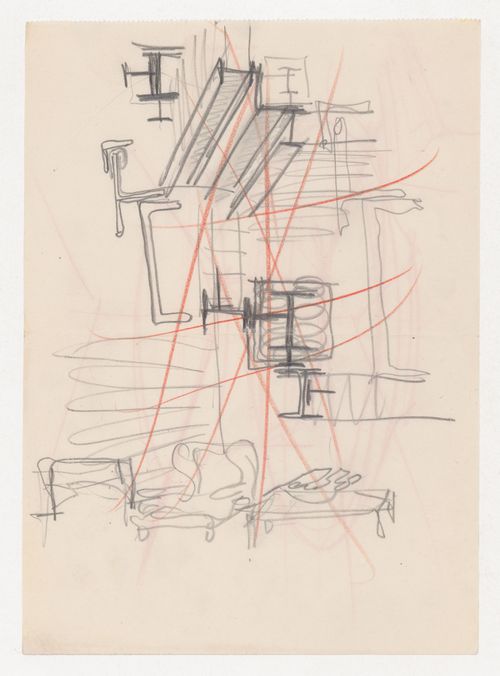
- Group DR1994:0011:001 R/V - DR1994:0011:030 includes three sketches (DR1994:0011:001 R/V - DR1994:0011:002 R/V and DR1994:0011:030), 24 pages of notes (DR1994:0011:003 - DR1994:0011:026), two sketchbooks (DR1994:0011:027:001-035 and DR1994:0011:028:001-008 R/V), and the envelope in which these materials were housed at acquisition (DR1994:0011:029). The sketches are for various subjects including I-beams (DR1994:0011:001 R/V), a column-to-beam connection and an unidentified building (DR1994:0011:002 R/V), and a sketch plan of Mies' 1928-1929 design for the Friedrichstrasse office building in Berlin (DR1994:0011:030). Notes DR1994:0011:003 - DR1994:0011:024 are written in German and are generally illegible. Many changes have been made to the notes, and some sheets appear to have been reordered or struck out. Some of the notes may be about urban planning. The number in the upper left corner of sheets DR1994:0011:010, DR1994:0011:012-016 and DR1994:0011:020-021 may indicate the order of the topics dealt with in the notes. Notes DR1994:0011:025 are illegible. Notes DR1994:0011:026 are written in English, and may be notes of a lecture. The notes in sketchbook DR1994:0011:027:001-035 are written in German, are generally illegible, and are usually written in point form or sometimes as lists. Chicago is mentioned on several of the sheets. There is a shift in the clarity of the handwriting halfway through the sketchbook and some of the notes in the latter half may relate to Mies' readings of philosophy. Some of the notes in sketchbook DR1994:0028:001-008 R/V are written in German and some in English. The first and second pages of the sketchbook describe measurements for addresses on the campus of IIT, as well as for the Power Plant. The last three pages of the sketchbook discuss the architectural education programm at IIT and an exhibition of student work.
DR1994:0011:001 R/V
Description:
- Group DR1994:0011:001 R/V - DR1994:0011:030 includes three sketches (DR1994:0011:001 R/V - DR1994:0011:002 R/V and DR1994:0011:030), 24 pages of notes (DR1994:0011:003 - DR1994:0011:026), two sketchbooks (DR1994:0011:027:001-035 and DR1994:0011:028:001-008 R/V), and the envelope in which these materials were housed at acquisition (DR1994:0011:029). The sketches are for various subjects including I-beams (DR1994:0011:001 R/V), a column-to-beam connection and an unidentified building (DR1994:0011:002 R/V), and a sketch plan of Mies' 1928-1929 design for the Friedrichstrasse office building in Berlin (DR1994:0011:030). Notes DR1994:0011:003 - DR1994:0011:024 are written in German and are generally illegible. Many changes have been made to the notes, and some sheets appear to have been reordered or struck out. Some of the notes may be about urban planning. The number in the upper left corner of sheets DR1994:0011:010, DR1994:0011:012-016 and DR1994:0011:020-021 may indicate the order of the topics dealt with in the notes. Notes DR1994:0011:025 are illegible. Notes DR1994:0011:026 are written in English, and may be notes of a lecture. The notes in sketchbook DR1994:0011:027:001-035 are written in German, are generally illegible, and are usually written in point form or sometimes as lists. Chicago is mentioned on several of the sheets. There is a shift in the clarity of the handwriting halfway through the sketchbook and some of the notes in the latter half may relate to Mies' readings of philosophy. Some of the notes in sketchbook DR1994:0028:001-008 R/V are written in German and some in English. The first and second pages of the sketchbook describe measurements for addresses on the campus of IIT, as well as for the Power Plant. The last three pages of the sketchbook discuss the architectural education programm at IIT and an exhibition of student work.
People:
Subject:
architecture
architecture
Date:
1944-1965
1944-1965
Title:
Sketch of a teacup; verso: Study sketches for I-beams and sketch of a chair and table
Actions:
DR1994:0011:001 R/V
Description:
- Group DR1994:0011:001 R/V - DR1994:0011:030 includes three sketches (DR1994:0011:001 R/V - DR1994:0011:002 R/V and DR1994:0011:030), 24 pages of notes (DR1994:0011:003 - DR1994:0011:026), two sketchbooks (DR1994:0011:027:001-035 and DR1994:0011:028:001-008 R/V), and the envelope in which these materials were housed at acquisition (DR1994:0011:029). The sketches are for various subjects including I-beams (DR1994:0011:001 R/V), a column-to-beam connection and an unidentified building (DR1994:0011:002 R/V), and a sketch plan of Mies' 1928-1929 design for the Friedrichstrasse office building in Berlin (DR1994:0011:030). Notes DR1994:0011:003 - DR1994:0011:024 are written in German and are generally illegible. Many changes have been made to the notes, and some sheets appear to have been reordered or struck out. Some of the notes may be about urban planning. The number in the upper left corner of sheets DR1994:0011:010, DR1994:0011:012-016 and DR1994:0011:020-021 may indicate the order of the topics dealt with in the notes. Notes DR1994:0011:025 are illegible. Notes DR1994:0011:026 are written in English, and may be notes of a lecture. The notes in sketchbook DR1994:0011:027:001-035 are written in German, are generally illegible, and are usually written in point form or sometimes as lists. Chicago is mentioned on several of the sheets. There is a shift in the clarity of the handwriting halfway through the sketchbook and some of the notes in the latter half may relate to Mies' readings of philosophy. Some of the notes in sketchbook DR1994:0028:001-008 R/V are written in German and some in English. The first and second pages of the sketchbook describe measurements for addresses on the campus of IIT, as well as for the Power Plant. The last three pages of the sketchbook discuss the architectural education programm at IIT and an exhibition of student work.
Sketch of a teacup; verso: Study sketches for I-beams and sketch of a chair and table
Actions:
DR1994:0011:001 R/V
Description:
- Group DR1994:0011:001 R/V - DR1994:0011:030 includes three sketches (DR1994:0011:001 R/V - DR1994:0011:002 R/V and DR1994:0011:030), 24 pages of notes (DR1994:0011:003 - DR1994:0011:026), two sketchbooks (DR1994:0011:027:001-035 and DR1994:0011:028:001-008 R/V), and the envelope in which these materials were housed at acquisition (DR1994:0011:029). The sketches are for various subjects including I-beams (DR1994:0011:001 R/V), a column-to-beam connection and an unidentified building (DR1994:0011:002 R/V), and a sketch plan of Mies' 1928-1929 design for the Friedrichstrasse office building in Berlin (DR1994:0011:030). Notes DR1994:0011:003 - DR1994:0011:024 are written in German and are generally illegible. Many changes have been made to the notes, and some sheets appear to have been reordered or struck out. Some of the notes may be about urban planning. The number in the upper left corner of sheets DR1994:0011:010, DR1994:0011:012-016 and DR1994:0011:020-021 may indicate the order of the topics dealt with in the notes. Notes DR1994:0011:025 are illegible. Notes DR1994:0011:026 are written in English, and may be notes of a lecture. The notes in sketchbook DR1994:0011:027:001-035 are written in German, are generally illegible, and are usually written in point form or sometimes as lists. Chicago is mentioned on several of the sheets. There is a shift in the clarity of the handwriting halfway through the sketchbook and some of the notes in the latter half may relate to Mies' readings of philosophy. Some of the notes in sketchbook DR1994:0028:001-008 R/V are written in German and some in English. The first and second pages of the sketchbook describe measurements for addresses on the campus of IIT, as well as for the Power Plant. The last three pages of the sketchbook discuss the architectural education programm at IIT and an exhibition of student work.
Form:
drawings
drawings
Date:
1944-1965
1944-1965
People:
Subject:
architecture
architecture
Form:
drawings
drawings
Actions:
Reference number:
DR1994:0011:002 R/V
Description:
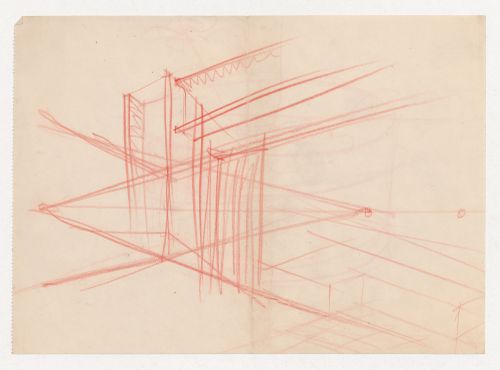
- Group DR1994:0011:001 R/V - DR1994:0011:030 includes three sketches (DR1994:0011:001 R/V - DR1994:0011:002 R/V and DR1994:0011:030), 24 pages of notes (DR1994:0011:003 - DR1994:0011:026), two sketchbooks (DR1994:0011:027:001-035 and DR1994:0011:028:001-008 R/V), and the envelope in which these materials were housed at acquisition (DR1994:0011:029). The sketches are for various subjects including I-beams (DR1994:0011:001 R/V), a column-to-beam connection and an unidentified building (DR1994:0011:002 R/V), and a sketch plan of Mies' 1928-1929 design for the Friedrichstrasse office building in Berlin (DR1994:0011:030). Notes DR1994:0011:003 - DR1994:0011:024 are written in German and are generally illegible. Many changes have been made to the notes, and some sheets appear to have been reordered or struck out. Some of the notes may be about urban planning. The number in the upper left corner of sheets DR1994:0011:010, DR1994:0011:012-016 and DR1994:0011:020-021 may indicate the order of the topics dealt with in the notes. Notes DR1994:0011:025 are illegible. Notes DR1994:0011:026 are written in English, and may be notes of a lecture. The notes in sketchbook DR1994:0011:027:001-035 are written in German, are generally illegible, and are usually written in point form or sometimes as lists. Chicago is mentioned on several of the sheets. There is a shift in the clarity of the handwriting halfway through the sketchbook and some of the notes in the latter half may relate to Mies' readings of philosophy. Some of the notes in sketchbook DR1994:0028:001-008 R/V are written in German and some in English. The first and second pages of the sketchbook describe measurements for addresses on the campus of IIT, as well as for the Power Plant. The last three pages of the sketchbook discuss the architectural education programm at IIT and an exhibition of student work.
DR1994:0011:002 R/V
Description:
- Group DR1994:0011:001 R/V - DR1994:0011:030 includes three sketches (DR1994:0011:001 R/V - DR1994:0011:002 R/V and DR1994:0011:030), 24 pages of notes (DR1994:0011:003 - DR1994:0011:026), two sketchbooks (DR1994:0011:027:001-035 and DR1994:0011:028:001-008 R/V), and the envelope in which these materials were housed at acquisition (DR1994:0011:029). The sketches are for various subjects including I-beams (DR1994:0011:001 R/V), a column-to-beam connection and an unidentified building (DR1994:0011:002 R/V), and a sketch plan of Mies' 1928-1929 design for the Friedrichstrasse office building in Berlin (DR1994:0011:030). Notes DR1994:0011:003 - DR1994:0011:024 are written in German and are generally illegible. Many changes have been made to the notes, and some sheets appear to have been reordered or struck out. Some of the notes may be about urban planning. The number in the upper left corner of sheets DR1994:0011:010, DR1994:0011:012-016 and DR1994:0011:020-021 may indicate the order of the topics dealt with in the notes. Notes DR1994:0011:025 are illegible. Notes DR1994:0011:026 are written in English, and may be notes of a lecture. The notes in sketchbook DR1994:0011:027:001-035 are written in German, are generally illegible, and are usually written in point form or sometimes as lists. Chicago is mentioned on several of the sheets. There is a shift in the clarity of the handwriting halfway through the sketchbook and some of the notes in the latter half may relate to Mies' readings of philosophy. Some of the notes in sketchbook DR1994:0028:001-008 R/V are written in German and some in English. The first and second pages of the sketchbook describe measurements for addresses on the campus of IIT, as well as for the Power Plant. The last three pages of the sketchbook discuss the architectural education programm at IIT and an exhibition of student work.
People:
Subject:
architecture
architecture
Date:
1944-1965
1944-1965
Title:
Sketch of a container with a plant; verso: Perspective sketch, possibly for a column to beam connection, and axonometric sketch for an unidentified building
Actions:
DR1994:0011:002 R/V
Description:
- Group DR1994:0011:001 R/V - DR1994:0011:030 includes three sketches (DR1994:0011:001 R/V - DR1994:0011:002 R/V and DR1994:0011:030), 24 pages of notes (DR1994:0011:003 - DR1994:0011:026), two sketchbooks (DR1994:0011:027:001-035 and DR1994:0011:028:001-008 R/V), and the envelope in which these materials were housed at acquisition (DR1994:0011:029). The sketches are for various subjects including I-beams (DR1994:0011:001 R/V), a column-to-beam connection and an unidentified building (DR1994:0011:002 R/V), and a sketch plan of Mies' 1928-1929 design for the Friedrichstrasse office building in Berlin (DR1994:0011:030). Notes DR1994:0011:003 - DR1994:0011:024 are written in German and are generally illegible. Many changes have been made to the notes, and some sheets appear to have been reordered or struck out. Some of the notes may be about urban planning. The number in the upper left corner of sheets DR1994:0011:010, DR1994:0011:012-016 and DR1994:0011:020-021 may indicate the order of the topics dealt with in the notes. Notes DR1994:0011:025 are illegible. Notes DR1994:0011:026 are written in English, and may be notes of a lecture. The notes in sketchbook DR1994:0011:027:001-035 are written in German, are generally illegible, and are usually written in point form or sometimes as lists. Chicago is mentioned on several of the sheets. There is a shift in the clarity of the handwriting halfway through the sketchbook and some of the notes in the latter half may relate to Mies' readings of philosophy. Some of the notes in sketchbook DR1994:0028:001-008 R/V are written in German and some in English. The first and second pages of the sketchbook describe measurements for addresses on the campus of IIT, as well as for the Power Plant. The last three pages of the sketchbook discuss the architectural education programm at IIT and an exhibition of student work.
Sketch of a container with a plant; verso: Perspective sketch, possibly for a column to beam connection, and axonometric sketch for an unidentified building
Actions:
DR1994:0011:002 R/V
Description:
- Group DR1994:0011:001 R/V - DR1994:0011:030 includes three sketches (DR1994:0011:001 R/V - DR1994:0011:002 R/V and DR1994:0011:030), 24 pages of notes (DR1994:0011:003 - DR1994:0011:026), two sketchbooks (DR1994:0011:027:001-035 and DR1994:0011:028:001-008 R/V), and the envelope in which these materials were housed at acquisition (DR1994:0011:029). The sketches are for various subjects including I-beams (DR1994:0011:001 R/V), a column-to-beam connection and an unidentified building (DR1994:0011:002 R/V), and a sketch plan of Mies' 1928-1929 design for the Friedrichstrasse office building in Berlin (DR1994:0011:030). Notes DR1994:0011:003 - DR1994:0011:024 are written in German and are generally illegible. Many changes have been made to the notes, and some sheets appear to have been reordered or struck out. Some of the notes may be about urban planning. The number in the upper left corner of sheets DR1994:0011:010, DR1994:0011:012-016 and DR1994:0011:020-021 may indicate the order of the topics dealt with in the notes. Notes DR1994:0011:025 are illegible. Notes DR1994:0011:026 are written in English, and may be notes of a lecture. The notes in sketchbook DR1994:0011:027:001-035 are written in German, are generally illegible, and are usually written in point form or sometimes as lists. Chicago is mentioned on several of the sheets. There is a shift in the clarity of the handwriting halfway through the sketchbook and some of the notes in the latter half may relate to Mies' readings of philosophy. Some of the notes in sketchbook DR1994:0028:001-008 R/V are written in German and some in English. The first and second pages of the sketchbook describe measurements for addresses on the campus of IIT, as well as for the Power Plant. The last three pages of the sketchbook discuss the architectural education programm at IIT and an exhibition of student work.
Form:
drawings
drawings
Date:
1944-1965
1944-1965
People:
Subject:
architecture
architecture
Form:
textual records
textual records
Actions:
Reference number:
DR1994:0011:003
Description:
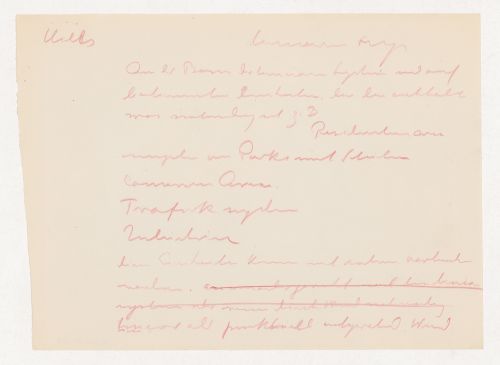
- Group DR1994:0011:001 R/V - DR1994:0011:030 includes three sketches (DR1994:0011:001 R/V - DR1994:0011:002 R/V and DR1994:0011:030), 24 pages of notes (DR1994:0011:003 - DR1994:0011:026), two sketchbooks (DR1994:0011:027:001-035 and DR1994:0011:028:001-008 R/V), and the envelope in which these materials were housed at acquisition (DR1994:0011:029). The sketches are for various subjects including I-beams (DR1994:0011:001 R/V), a column-to-beam connection and an unidentified building (DR1994:0011:002 R/V), and a sketch plan of Mies' 1928-1929 design for the Friedrichstrasse office building in Berlin (DR1994:0011:030). Notes DR1994:0011:003 - DR1994:0011:024 are written in German and are generally illegible. Many changes have been made to the notes, and some sheets appear to have been reordered or struck out. Some of the notes may be about urban planning. The number in the upper left corner of sheets DR1994:0011:010, DR1994:0011:012-016 and DR1994:0011:020-021 may indicate the order of the topics dealt with in the notes. Notes DR1994:0011:025 are illegible. Notes DR1994:0011:026 are written in English, and may be notes of a lecture. The notes in sketchbook DR1994:0011:027:001-035 are written in German, are generally illegible, and are usually written in point form or sometimes as lists. Chicago is mentioned on several of the sheets. There is a shift in the clarity of the handwriting halfway through the sketchbook and some of the notes in the latter half may relate to Mies' readings of philosophy. Some of the notes in sketchbook DR1994:0028:001-008 R/V are written in German and some in English. The first and second pages of the sketchbook describe measurements for addresses on the campus of IIT, as well as for the Power Plant. The last three pages of the sketchbook discuss the architectural education programme at IIT and an exhibition of student work.
DR1994:0011:003
Description:
- Group DR1994:0011:001 R/V - DR1994:0011:030 includes three sketches (DR1994:0011:001 R/V - DR1994:0011:002 R/V and DR1994:0011:030), 24 pages of notes (DR1994:0011:003 - DR1994:0011:026), two sketchbooks (DR1994:0011:027:001-035 and DR1994:0011:028:001-008 R/V), and the envelope in which these materials were housed at acquisition (DR1994:0011:029). The sketches are for various subjects including I-beams (DR1994:0011:001 R/V), a column-to-beam connection and an unidentified building (DR1994:0011:002 R/V), and a sketch plan of Mies' 1928-1929 design for the Friedrichstrasse office building in Berlin (DR1994:0011:030). Notes DR1994:0011:003 - DR1994:0011:024 are written in German and are generally illegible. Many changes have been made to the notes, and some sheets appear to have been reordered or struck out. Some of the notes may be about urban planning. The number in the upper left corner of sheets DR1994:0011:010, DR1994:0011:012-016 and DR1994:0011:020-021 may indicate the order of the topics dealt with in the notes. Notes DR1994:0011:025 are illegible. Notes DR1994:0011:026 are written in English, and may be notes of a lecture. The notes in sketchbook DR1994:0011:027:001-035 are written in German, are generally illegible, and are usually written in point form or sometimes as lists. Chicago is mentioned on several of the sheets. There is a shift in the clarity of the handwriting halfway through the sketchbook and some of the notes in the latter half may relate to Mies' readings of philosophy. Some of the notes in sketchbook DR1994:0028:001-008 R/V are written in German and some in English. The first and second pages of the sketchbook describe measurements for addresses on the campus of IIT, as well as for the Power Plant. The last three pages of the sketchbook discuss the architectural education programme at IIT and an exhibition of student work.
People:
Subject:
architecture
architecture
Date:
1955
1955
Title:
Notes, probably for a lecture
Actions:
DR1994:0011:003
Description:
- Group DR1994:0011:001 R/V - DR1994:0011:030 includes three sketches (DR1994:0011:001 R/V - DR1994:0011:002 R/V and DR1994:0011:030), 24 pages of notes (DR1994:0011:003 - DR1994:0011:026), two sketchbooks (DR1994:0011:027:001-035 and DR1994:0011:028:001-008 R/V), and the envelope in which these materials were housed at acquisition (DR1994:0011:029). The sketches are for various subjects including I-beams (DR1994:0011:001 R/V), a column-to-beam connection and an unidentified building (DR1994:0011:002 R/V), and a sketch plan of Mies' 1928-1929 design for the Friedrichstrasse office building in Berlin (DR1994:0011:030). Notes DR1994:0011:003 - DR1994:0011:024 are written in German and are generally illegible. Many changes have been made to the notes, and some sheets appear to have been reordered or struck out. Some of the notes may be about urban planning. The number in the upper left corner of sheets DR1994:0011:010, DR1994:0011:012-016 and DR1994:0011:020-021 may indicate the order of the topics dealt with in the notes. Notes DR1994:0011:025 are illegible. Notes DR1994:0011:026 are written in English, and may be notes of a lecture. The notes in sketchbook DR1994:0011:027:001-035 are written in German, are generally illegible, and are usually written in point form or sometimes as lists. Chicago is mentioned on several of the sheets. There is a shift in the clarity of the handwriting halfway through the sketchbook and some of the notes in the latter half may relate to Mies' readings of philosophy. Some of the notes in sketchbook DR1994:0028:001-008 R/V are written in German and some in English. The first and second pages of the sketchbook describe measurements for addresses on the campus of IIT, as well as for the Power Plant. The last three pages of the sketchbook discuss the architectural education programme at IIT and an exhibition of student work.
Notes, probably for a lecture
Actions:
DR1994:0011:003
Description:
- Group DR1994:0011:001 R/V - DR1994:0011:030 includes three sketches (DR1994:0011:001 R/V - DR1994:0011:002 R/V and DR1994:0011:030), 24 pages of notes (DR1994:0011:003 - DR1994:0011:026), two sketchbooks (DR1994:0011:027:001-035 and DR1994:0011:028:001-008 R/V), and the envelope in which these materials were housed at acquisition (DR1994:0011:029). The sketches are for various subjects including I-beams (DR1994:0011:001 R/V), a column-to-beam connection and an unidentified building (DR1994:0011:002 R/V), and a sketch plan of Mies' 1928-1929 design for the Friedrichstrasse office building in Berlin (DR1994:0011:030). Notes DR1994:0011:003 - DR1994:0011:024 are written in German and are generally illegible. Many changes have been made to the notes, and some sheets appear to have been reordered or struck out. Some of the notes may be about urban planning. The number in the upper left corner of sheets DR1994:0011:010, DR1994:0011:012-016 and DR1994:0011:020-021 may indicate the order of the topics dealt with in the notes. Notes DR1994:0011:025 are illegible. Notes DR1994:0011:026 are written in English, and may be notes of a lecture. The notes in sketchbook DR1994:0011:027:001-035 are written in German, are generally illegible, and are usually written in point form or sometimes as lists. Chicago is mentioned on several of the sheets. There is a shift in the clarity of the handwriting halfway through the sketchbook and some of the notes in the latter half may relate to Mies' readings of philosophy. Some of the notes in sketchbook DR1994:0028:001-008 R/V are written in German and some in English. The first and second pages of the sketchbook describe measurements for addresses on the campus of IIT, as well as for the Power Plant. The last three pages of the sketchbook discuss the architectural education programme at IIT and an exhibition of student work.
Form:
textual records
textual records
Date:
1955
1955
People:
Subject:
architecture
architecture
Form:
textual records
textual records
Actions:
Reference number:
DR1994:0011:004
Description:
- Group DR1994:0011:001 R/V - DR1994:0011:030 includes three sketches (DR1994:0011:001 R/V - DR1994:0011:002 R/V and DR1994:0011:030), 24 pages of notes (DR1994:0011:003 - DR1994:0011:026), two sketchbooks (DR1994:0011:027:001-035 and DR1994:0011:028:001-008 R/V), and the envelope in which these materials were housed at acquisition (DR1994:0011:029). The sketches are for various subjects including I-beams (DR1994:0011:001 R/V), a column-to-beam connection and an unidentified building (DR1994:0011:002 R/V), and a sketch plan of Mies' 1928-1929 design for the Friedrichstrasse office building in Berlin (DR1994:0011:030). Notes DR1994:0011:003 - DR1994:0011:024 are written in German and are generally illegible. Many changes have been made to the notes, and some sheets appear to have been reordered or struck out. Some of the notes may be about urban planning. The number in the upper left corner of sheets DR1994:0011:010, DR1994:0011:012-016 and DR1994:0011:020-021 may indicate the order of the topics dealt with in the notes. Notes DR1994:0011:025 are illegible. Notes DR1994:0011:026 are written in English, and may be notes of a lecture. The notes in sketchbook DR1994:0011:027:001-035 are written in German, are generally illegible, and are usually written in point form or sometimes as lists. Chicago is mentioned on several of the sheets. There is a shift in the clarity of the handwriting halfway through the sketchbook and some of the notes in the latter half may relate to Mies' readings of philosophy. Some of the notes in sketchbook DR1994:0028:001-008 R/V are written in German and some in English. The first and second pages of the sketchbook describe measurements for addresses on the campus of IIT, as well as for the Power Plant. The last three pages of the sketchbook discuss the architectural education programme at IIT and an exhibition of student work.
DR1994:0011:004
Description:
- Group DR1994:0011:001 R/V - DR1994:0011:030 includes three sketches (DR1994:0011:001 R/V - DR1994:0011:002 R/V and DR1994:0011:030), 24 pages of notes (DR1994:0011:003 - DR1994:0011:026), two sketchbooks (DR1994:0011:027:001-035 and DR1994:0011:028:001-008 R/V), and the envelope in which these materials were housed at acquisition (DR1994:0011:029). The sketches are for various subjects including I-beams (DR1994:0011:001 R/V), a column-to-beam connection and an unidentified building (DR1994:0011:002 R/V), and a sketch plan of Mies' 1928-1929 design for the Friedrichstrasse office building in Berlin (DR1994:0011:030). Notes DR1994:0011:003 - DR1994:0011:024 are written in German and are generally illegible. Many changes have been made to the notes, and some sheets appear to have been reordered or struck out. Some of the notes may be about urban planning. The number in the upper left corner of sheets DR1994:0011:010, DR1994:0011:012-016 and DR1994:0011:020-021 may indicate the order of the topics dealt with in the notes. Notes DR1994:0011:025 are illegible. Notes DR1994:0011:026 are written in English, and may be notes of a lecture. The notes in sketchbook DR1994:0011:027:001-035 are written in German, are generally illegible, and are usually written in point form or sometimes as lists. Chicago is mentioned on several of the sheets. There is a shift in the clarity of the handwriting halfway through the sketchbook and some of the notes in the latter half may relate to Mies' readings of philosophy. Some of the notes in sketchbook DR1994:0028:001-008 R/V are written in German and some in English. The first and second pages of the sketchbook describe measurements for addresses on the campus of IIT, as well as for the Power Plant. The last three pages of the sketchbook discuss the architectural education programme at IIT and an exhibition of student work.
People:
Subject:
architecture
architecture
Date:
1955
1955
Title:
Notes, probably for a lecture
Actions:
DR1994:0011:004
Description:
- Group DR1994:0011:001 R/V - DR1994:0011:030 includes three sketches (DR1994:0011:001 R/V - DR1994:0011:002 R/V and DR1994:0011:030), 24 pages of notes (DR1994:0011:003 - DR1994:0011:026), two sketchbooks (DR1994:0011:027:001-035 and DR1994:0011:028:001-008 R/V), and the envelope in which these materials were housed at acquisition (DR1994:0011:029). The sketches are for various subjects including I-beams (DR1994:0011:001 R/V), a column-to-beam connection and an unidentified building (DR1994:0011:002 R/V), and a sketch plan of Mies' 1928-1929 design for the Friedrichstrasse office building in Berlin (DR1994:0011:030). Notes DR1994:0011:003 - DR1994:0011:024 are written in German and are generally illegible. Many changes have been made to the notes, and some sheets appear to have been reordered or struck out. Some of the notes may be about urban planning. The number in the upper left corner of sheets DR1994:0011:010, DR1994:0011:012-016 and DR1994:0011:020-021 may indicate the order of the topics dealt with in the notes. Notes DR1994:0011:025 are illegible. Notes DR1994:0011:026 are written in English, and may be notes of a lecture. The notes in sketchbook DR1994:0011:027:001-035 are written in German, are generally illegible, and are usually written in point form or sometimes as lists. Chicago is mentioned on several of the sheets. There is a shift in the clarity of the handwriting halfway through the sketchbook and some of the notes in the latter half may relate to Mies' readings of philosophy. Some of the notes in sketchbook DR1994:0028:001-008 R/V are written in German and some in English. The first and second pages of the sketchbook describe measurements for addresses on the campus of IIT, as well as for the Power Plant. The last three pages of the sketchbook discuss the architectural education programme at IIT and an exhibition of student work.
Notes, probably for a lecture
Actions:
DR1994:0011:004
Description:
- Group DR1994:0011:001 R/V - DR1994:0011:030 includes three sketches (DR1994:0011:001 R/V - DR1994:0011:002 R/V and DR1994:0011:030), 24 pages of notes (DR1994:0011:003 - DR1994:0011:026), two sketchbooks (DR1994:0011:027:001-035 and DR1994:0011:028:001-008 R/V), and the envelope in which these materials were housed at acquisition (DR1994:0011:029). The sketches are for various subjects including I-beams (DR1994:0011:001 R/V), a column-to-beam connection and an unidentified building (DR1994:0011:002 R/V), and a sketch plan of Mies' 1928-1929 design for the Friedrichstrasse office building in Berlin (DR1994:0011:030). Notes DR1994:0011:003 - DR1994:0011:024 are written in German and are generally illegible. Many changes have been made to the notes, and some sheets appear to have been reordered or struck out. Some of the notes may be about urban planning. The number in the upper left corner of sheets DR1994:0011:010, DR1994:0011:012-016 and DR1994:0011:020-021 may indicate the order of the topics dealt with in the notes. Notes DR1994:0011:025 are illegible. Notes DR1994:0011:026 are written in English, and may be notes of a lecture. The notes in sketchbook DR1994:0011:027:001-035 are written in German, are generally illegible, and are usually written in point form or sometimes as lists. Chicago is mentioned on several of the sheets. There is a shift in the clarity of the handwriting halfway through the sketchbook and some of the notes in the latter half may relate to Mies' readings of philosophy. Some of the notes in sketchbook DR1994:0028:001-008 R/V are written in German and some in English. The first and second pages of the sketchbook describe measurements for addresses on the campus of IIT, as well as for the Power Plant. The last three pages of the sketchbook discuss the architectural education programme at IIT and an exhibition of student work.
Form:
textual records
textual records
Date:
1955
1955
People:
Subject:
architecture
architecture
Form:
textual records
textual records
Actions:
Reference number:
DR1994:0011:005
Description:
- Group DR1994:0011:001 R/V - DR1994:0011:030 includes three sketches (DR1994:0011:001 R/V - DR1994:0011:002 R/V and DR1994:0011:030), 24 pages of notes (DR1994:0011:003 - DR1994:0011:026), two sketchbooks (DR1994:0011:027:001-035 and DR1994:0011:028:001-008 R/V), and the envelope in which these materials were housed at acquisition (DR1994:0011:029). The sketches are for various subjects including I-beams (DR1994:0011:001 R/V), a column-to-beam connection and an unidentified building (DR1994:0011:002 R/V), and a sketch plan of Mies' 1928-1929 design for the Friedrichstrasse office building in Berlin (DR1994:0011:030). Notes DR1994:0011:003 - DR1994:0011:024 are written in German and are generally illegible. Many changes have been made to the notes, and some sheets appear to have been reordered or struck out. Some of the notes may be about urban planning. The number in the upper left corner of sheets DR1994:0011:010, DR1994:0011:012-016 and DR1994:0011:020-021 may indicate the order of the topics dealt with in the notes. Notes DR1994:0011:025 are illegible. Notes DR1994:0011:026 are written in English, and may be notes of a lecture. The notes in sketchbook DR1994:0011:027:001-035 are written in German, are generally illegible, and are usually written in point form or sometimes as lists. Chicago is mentioned on several of the sheets. There is a shift in the clarity of the handwriting halfway through the sketchbook and some of the notes in the latter half may relate to Mies' readings of philosophy. Some of the notes in sketchbook DR1994:0028:001-008 R/V are written in German and some in English. The first and second pages of the sketchbook describe measurements for addresses on the campus of IIT, as well as for the Power Plant. The last three pages of the sketchbook discuss the architectural education programm at IIT and an exhibition of student work.
DR1994:0011:005
Description:
- Group DR1994:0011:001 R/V - DR1994:0011:030 includes three sketches (DR1994:0011:001 R/V - DR1994:0011:002 R/V and DR1994:0011:030), 24 pages of notes (DR1994:0011:003 - DR1994:0011:026), two sketchbooks (DR1994:0011:027:001-035 and DR1994:0011:028:001-008 R/V), and the envelope in which these materials were housed at acquisition (DR1994:0011:029). The sketches are for various subjects including I-beams (DR1994:0011:001 R/V), a column-to-beam connection and an unidentified building (DR1994:0011:002 R/V), and a sketch plan of Mies' 1928-1929 design for the Friedrichstrasse office building in Berlin (DR1994:0011:030). Notes DR1994:0011:003 - DR1994:0011:024 are written in German and are generally illegible. Many changes have been made to the notes, and some sheets appear to have been reordered or struck out. Some of the notes may be about urban planning. The number in the upper left corner of sheets DR1994:0011:010, DR1994:0011:012-016 and DR1994:0011:020-021 may indicate the order of the topics dealt with in the notes. Notes DR1994:0011:025 are illegible. Notes DR1994:0011:026 are written in English, and may be notes of a lecture. The notes in sketchbook DR1994:0011:027:001-035 are written in German, are generally illegible, and are usually written in point form or sometimes as lists. Chicago is mentioned on several of the sheets. There is a shift in the clarity of the handwriting halfway through the sketchbook and some of the notes in the latter half may relate to Mies' readings of philosophy. Some of the notes in sketchbook DR1994:0028:001-008 R/V are written in German and some in English. The first and second pages of the sketchbook describe measurements for addresses on the campus of IIT, as well as for the Power Plant. The last three pages of the sketchbook discuss the architectural education programm at IIT and an exhibition of student work.
People:
Subject:
architecture
architecture
Date:
1955
1955
Title:
Notes, probably for a lecture
Actions:
DR1994:0011:005
Description:
- Group DR1994:0011:001 R/V - DR1994:0011:030 includes three sketches (DR1994:0011:001 R/V - DR1994:0011:002 R/V and DR1994:0011:030), 24 pages of notes (DR1994:0011:003 - DR1994:0011:026), two sketchbooks (DR1994:0011:027:001-035 and DR1994:0011:028:001-008 R/V), and the envelope in which these materials were housed at acquisition (DR1994:0011:029). The sketches are for various subjects including I-beams (DR1994:0011:001 R/V), a column-to-beam connection and an unidentified building (DR1994:0011:002 R/V), and a sketch plan of Mies' 1928-1929 design for the Friedrichstrasse office building in Berlin (DR1994:0011:030). Notes DR1994:0011:003 - DR1994:0011:024 are written in German and are generally illegible. Many changes have been made to the notes, and some sheets appear to have been reordered or struck out. Some of the notes may be about urban planning. The number in the upper left corner of sheets DR1994:0011:010, DR1994:0011:012-016 and DR1994:0011:020-021 may indicate the order of the topics dealt with in the notes. Notes DR1994:0011:025 are illegible. Notes DR1994:0011:026 are written in English, and may be notes of a lecture. The notes in sketchbook DR1994:0011:027:001-035 are written in German, are generally illegible, and are usually written in point form or sometimes as lists. Chicago is mentioned on several of the sheets. There is a shift in the clarity of the handwriting halfway through the sketchbook and some of the notes in the latter half may relate to Mies' readings of philosophy. Some of the notes in sketchbook DR1994:0028:001-008 R/V are written in German and some in English. The first and second pages of the sketchbook describe measurements for addresses on the campus of IIT, as well as for the Power Plant. The last three pages of the sketchbook discuss the architectural education programm at IIT and an exhibition of student work.
Notes, probably for a lecture
Actions:
DR1994:0011:005
Description:
- Group DR1994:0011:001 R/V - DR1994:0011:030 includes three sketches (DR1994:0011:001 R/V - DR1994:0011:002 R/V and DR1994:0011:030), 24 pages of notes (DR1994:0011:003 - DR1994:0011:026), two sketchbooks (DR1994:0011:027:001-035 and DR1994:0011:028:001-008 R/V), and the envelope in which these materials were housed at acquisition (DR1994:0011:029). The sketches are for various subjects including I-beams (DR1994:0011:001 R/V), a column-to-beam connection and an unidentified building (DR1994:0011:002 R/V), and a sketch plan of Mies' 1928-1929 design for the Friedrichstrasse office building in Berlin (DR1994:0011:030). Notes DR1994:0011:003 - DR1994:0011:024 are written in German and are generally illegible. Many changes have been made to the notes, and some sheets appear to have been reordered or struck out. Some of the notes may be about urban planning. The number in the upper left corner of sheets DR1994:0011:010, DR1994:0011:012-016 and DR1994:0011:020-021 may indicate the order of the topics dealt with in the notes. Notes DR1994:0011:025 are illegible. Notes DR1994:0011:026 are written in English, and may be notes of a lecture. The notes in sketchbook DR1994:0011:027:001-035 are written in German, are generally illegible, and are usually written in point form or sometimes as lists. Chicago is mentioned on several of the sheets. There is a shift in the clarity of the handwriting halfway through the sketchbook and some of the notes in the latter half may relate to Mies' readings of philosophy. Some of the notes in sketchbook DR1994:0028:001-008 R/V are written in German and some in English. The first and second pages of the sketchbook describe measurements for addresses on the campus of IIT, as well as for the Power Plant. The last three pages of the sketchbook discuss the architectural education programm at IIT and an exhibition of student work.
Form:
textual records
textual records
Date:
1955
1955
People:
Subject:
architecture
architecture


