


5194 Results
Form:
books
books
Title:
Lyle Gomes : imagining Eden
Lyle Gomes : imagining Eden
Actions:
Price:
$10.00
(available to order)
Summary:
What did Eden look like? In "Imagining Eden", the photographer Lyle Gomes observes landscapes that represent the idea of locus amoenus—the pleasant place. The tradition of locus amoenus goes back to the idyllic descriptions of fictional locations, often called Arcadia, in the writings of Sappho, Apollonius, and Virgil, in the imagined period of the Golden Age. We also(...)
$10.00
(available to order)
Summary:
What did Eden look like? In "Imagining Eden", the photographer Lyle Gomes observes landscapes that represent the idea of locus amoenus—the pleasant place. The tradition of locus amoenus goes back to the idyllic descriptions of fictional locations, often called Arcadia, in the writings of Sappho, Apollonius, and Virgil, in the imagined period of the Golden Age. We also(...)
Subject:
sale books
sale books
Publication:
November 2005, Charlottesville, London
November 2005, Charlottesville, London
Title:
Lyle Gomes : imagining Eden
Actions:
Price:
$10.00
(available to order)
Summary:
What did Eden look like? In "Imagining Eden", the photographer Lyle Gomes observes landscapes that represent the idea of locus amoenus—the pleasant place. The tradition of locus amoenus goes back to the idyllic descriptions of fictional locations, often called Arcadia, in the writings of Sappho, Apollonius, and Virgil, in the imagined period of the Golden Age. We also recognize this concept in Eden, of course, where it suggests a loss that still haunts our imaginations. It is an idea distinctly different from that of wilderness, for we feel protected in these places—even provided for, though there is no sign of toil. The chance that this Eden might somehow be regained gives the concept its consolatory power. For fifteen years, Gomes has traveled across America and Europe to find examples of this enduring ideal of place in parks, English gardens, even golf courses. Gomes’s search took him to Mount Auburn cemetery, Central Park, Monticello, the San Francisco Presidio, villa gardens near Italy’s Lake Como, Melbourne Hall in Derbyshire, and private gardens such as Biltmore and Dumbarton Oaks. "Imagining Eden" includes an introductory essay in which the landscape historian Denis Cosgrove explores how the concept of the locus amoenus relates to Gomes’s work, and the photographs are accompanied by an evocative selection of quotes by the various settings designers and by inspired observers. The book concludes with an extensive interview in which Gomes discusses how he balances craft and inspiration, the role of research in preparing a shoot, his preference for black-and-white over color (“I was completely, and immediately, enamored with the silver image”), and a sense of discovery as a chief motivation in all his work.
Lyle Gomes : imagining Eden
Actions:
Price:
$10.00
(available to order)
Summary:
What did Eden look like? In "Imagining Eden", the photographer Lyle Gomes observes landscapes that represent the idea of locus amoenus—the pleasant place. The tradition of locus amoenus goes back to the idyllic descriptions of fictional locations, often called Arcadia, in the writings of Sappho, Apollonius, and Virgil, in the imagined period of the Golden Age. We also recognize this concept in Eden, of course, where it suggests a loss that still haunts our imaginations. It is an idea distinctly different from that of wilderness, for we feel protected in these places—even provided for, though there is no sign of toil. The chance that this Eden might somehow be regained gives the concept its consolatory power. For fifteen years, Gomes has traveled across America and Europe to find examples of this enduring ideal of place in parks, English gardens, even golf courses. Gomes’s search took him to Mount Auburn cemetery, Central Park, Monticello, the San Francisco Presidio, villa gardens near Italy’s Lake Como, Melbourne Hall in Derbyshire, and private gardens such as Biltmore and Dumbarton Oaks. "Imagining Eden" includes an introductory essay in which the landscape historian Denis Cosgrove explores how the concept of the locus amoenus relates to Gomes’s work, and the photographs are accompanied by an evocative selection of quotes by the various settings designers and by inspired observers. The book concludes with an extensive interview in which Gomes discusses how he balances craft and inspiration, the role of research in preparing a shoot, his preference for black-and-white over color (“I was completely, and immediately, enamored with the silver image”), and a sense of discovery as a chief motivation in all his work.
Form:
books
books
Publication:
November 2005, Charlottesville, London
November 2005, Charlottesville, London
Subject:
sale books
sale books
Form:
books
books
Price:
$58.95
(available to order)
Summary:
The Pan Am Building and the reaction to it signalled the end of an era. Begun when the modernist aesthetic and the architectural star system ruled architectural theory and practice, the completed building became a symbol of modernism's fall from grace. In “The Pan Am Building and the Shattering of the Modernist Dream”, Meredith Clausen tells the story as both history and(...)
$58.95
(available to order)
Summary:
The Pan Am Building and the reaction to it signalled the end of an era. Begun when the modernist aesthetic and the architectural star system ruled architectural theory and practice, the completed building became a symbol of modernism's fall from grace. In “The Pan Am Building and the Shattering of the Modernist Dream”, Meredith Clausen tells the story as both history and(...)
Subject:
Architecture since 1900, Europe
Architecture since 1900, Europe
Publication:
December 2004, Cambridge, Mass.
December 2004, Cambridge, Mass.
Title:
The Pan Am building and the shattering of the modernist dream
Actions:
Price:
$58.95
(available to order)
Summary:
The Pan Am Building and the reaction to it signalled the end of an era. Begun when the modernist aesthetic and the architectural star system ruled architectural theory and practice, the completed building became a symbol of modernism's fall from grace. In “The Pan Am Building and the Shattering of the Modernist Dream”, Meredith Clausen tells the story as both history and cautionary tale -- a case study of how not to plan and execute a large-scale urban project that seems especially relevant in light of the World Trade Center and the ongoing discussions over what should be built in its place. The Pan Am Building was despised by many as soon as the plans were announced in 1958. The star power of the celebrity architects -- those deans of modernism, Walter Gropius and Pietro Belluschi -- overrode critics' objections. When construction was completed in 1963, it became more than an architectural question; this "mute, massive, over-scaled octagonal slab," as Clausen describes it, built over Grand Central Terminal, blocked the view down Park Avenue, created deep shadows where there had been sunlight, and poured 25,000 office workers on the sidewalks each morning and evening. As Clausen tells it, the story of the building -- which was undistinguished architecturally but important because of its location and its moment in history -- encompasses the end of modernism's social idealism, the decline of Gropius's and Belluschi's reputations, the victory of private interests over public good, the revival of architectural criticism in the press (both Ada Louise Huxtable and Jane Jacobs emerged as prominent and influential critics), the birth of the historic preservation movement, and the changing culture and politics of New York City.
The Pan Am building and the shattering of the modernist dream
Actions:
Price:
$58.95
(available to order)
Summary:
The Pan Am Building and the reaction to it signalled the end of an era. Begun when the modernist aesthetic and the architectural star system ruled architectural theory and practice, the completed building became a symbol of modernism's fall from grace. In “The Pan Am Building and the Shattering of the Modernist Dream”, Meredith Clausen tells the story as both history and cautionary tale -- a case study of how not to plan and execute a large-scale urban project that seems especially relevant in light of the World Trade Center and the ongoing discussions over what should be built in its place. The Pan Am Building was despised by many as soon as the plans were announced in 1958. The star power of the celebrity architects -- those deans of modernism, Walter Gropius and Pietro Belluschi -- overrode critics' objections. When construction was completed in 1963, it became more than an architectural question; this "mute, massive, over-scaled octagonal slab," as Clausen describes it, built over Grand Central Terminal, blocked the view down Park Avenue, created deep shadows where there had been sunlight, and poured 25,000 office workers on the sidewalks each morning and evening. As Clausen tells it, the story of the building -- which was undistinguished architecturally but important because of its location and its moment in history -- encompasses the end of modernism's social idealism, the decline of Gropius's and Belluschi's reputations, the victory of private interests over public good, the revival of architectural criticism in the press (both Ada Louise Huxtable and Jane Jacobs emerged as prominent and influential critics), the birth of the historic preservation movement, and the changing culture and politics of New York City.
Form:
books
books
Publication:
December 2004, Cambridge, Mass.
December 2004, Cambridge, Mass.
Subject:
Architecture since 1900, Europe
Architecture since 1900, Europe
Form:
books
books
Price:
$38.00
(available to order)
Summary:
Fifty years after the British annexed the Punjab and made Lahore its provincial capital, the city—once a prosperous Mughal center that had long since fallen into ruin—was transformed. British and Indian officials had designed a modern, architecturally distinct city center adjacent to the old walled city, administered under new methods of urban governance. In Making(...)
$38.00
(available to order)
Summary:
Fifty years after the British annexed the Punjab and made Lahore its provincial capital, the city—once a prosperous Mughal center that had long since fallen into ruin—was transformed. British and Indian officials had designed a modern, architecturally distinct city center adjacent to the old walled city, administered under new methods of urban governance. In Making(...)
Title:
Making Lahore Modern: constructing and imagining a colonial city
Actions:
Price:
$38.00
(available to order)
Summary:
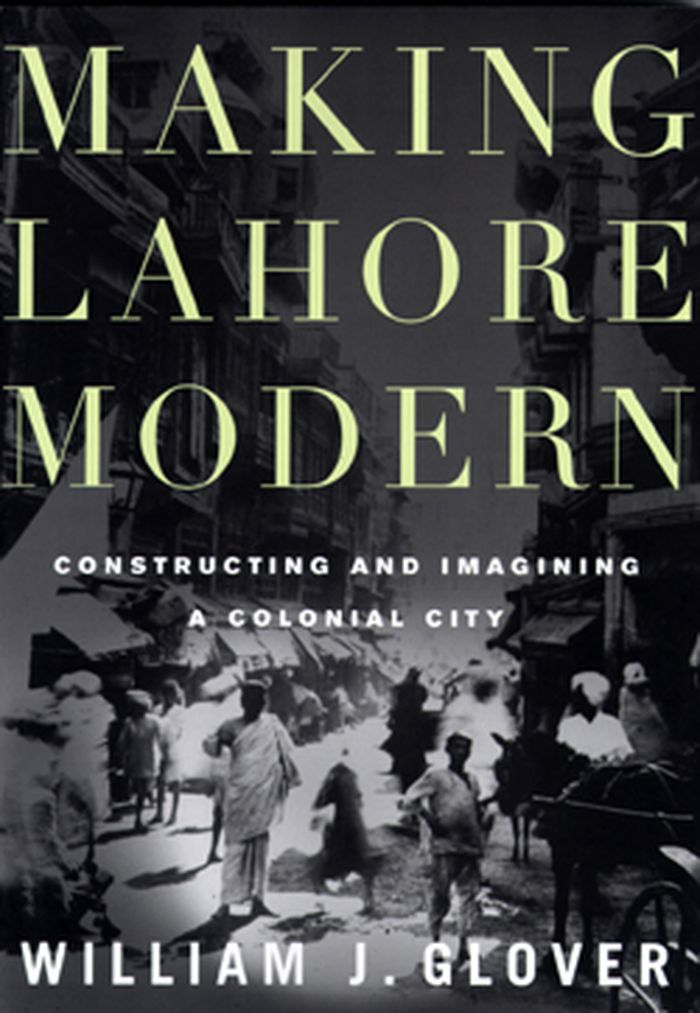
Fifty years after the British annexed the Punjab and made Lahore its provincial capital, the city—once a prosperous Mughal center that had long since fallen into ruin—was transformed. British and Indian officials had designed a modern, architecturally distinct city center adjacent to the old walled city, administered under new methods of urban governance. In Making Lahore Modern, William J. Glover investigates the traditions that shaped colonial Lahore. In particular, he focuses on the conviction that both British and Indian actors who implemented urbanization came to share: that the material fabric of the city could lead to social and moral improvement. This belief in the power of the physical environment to shape individual and collective sentiments, he argues, links the colonial history of Lahore to nineteenth-century urbanization around the world. Glover highlights three aspects of Lahore’s history that show this process unfolding. First, he examines the concepts through which the British understood the Indian city and envisioned its transformation. Second, through a detailed study of new buildings and the adaptation of existing structures, he explores the role of planning, design, and reuse. Finally, he analyzes the changes in urban imagination as evidenced in Indian writings on the city in this period. Throughout, Glover emphasizes that colonial urbanism was not simply imposed; it was a collaborative project between Indian citizens and the British. Offering an in-depth study of a single provincial city, Glover reveals that urban change in colonial India was not a monolithic process and establishes Lahore as a key site for understanding the genealogy of modern global urbanism. William J. Glover is associate professor of architecture at the University of Michigan.
Making Lahore Modern: constructing and imagining a colonial city
Actions:
Price:
$38.00
(available to order)
Summary:
Fifty years after the British annexed the Punjab and made Lahore its provincial capital, the city—once a prosperous Mughal center that had long since fallen into ruin—was transformed. British and Indian officials had designed a modern, architecturally distinct city center adjacent to the old walled city, administered under new methods of urban governance. In Making Lahore Modern, William J. Glover investigates the traditions that shaped colonial Lahore. In particular, he focuses on the conviction that both British and Indian actors who implemented urbanization came to share: that the material fabric of the city could lead to social and moral improvement. This belief in the power of the physical environment to shape individual and collective sentiments, he argues, links the colonial history of Lahore to nineteenth-century urbanization around the world. Glover highlights three aspects of Lahore’s history that show this process unfolding. First, he examines the concepts through which the British understood the Indian city and envisioned its transformation. Second, through a detailed study of new buildings and the adaptation of existing structures, he explores the role of planning, design, and reuse. Finally, he analyzes the changes in urban imagination as evidenced in Indian writings on the city in this period. Throughout, Glover emphasizes that colonial urbanism was not simply imposed; it was a collaborative project between Indian citizens and the British. Offering an in-depth study of a single provincial city, Glover reveals that urban change in colonial India was not a monolithic process and establishes Lahore as a key site for understanding the genealogy of modern global urbanism. William J. Glover is associate professor of architecture at the University of Michigan.
Form:
books
books
Publication:
January 1900, Miineapolis, London
January 1900, Miineapolis, London
Subject:
Urban Theory
Urban Theory
Form:
books
books
Actions:
Price:
$39.95
(available to order)
Summary:
For generations, our remote ancestors have been cast as primitive and childlike--either free and equal innocents, or thuggish and warlike. Civilization, we are told, could only be achieved by sacrificing those original freedoms, or alternatively, by taming our baser instincts. Graeber and Wengrow show how such theories first emerged in the eighteenth century as a(...)
$39.95
(available to order)
Summary:
For generations, our remote ancestors have been cast as primitive and childlike--either free and equal innocents, or thuggish and warlike. Civilization, we are told, could only be achieved by sacrificing those original freedoms, or alternatively, by taming our baser instincts. Graeber and Wengrow show how such theories first emerged in the eighteenth century as a(...)
Title:
The dawn of everything: a new history of humanity
Actions:
Price:
$39.95
(available to order)
Summary:
For generations, our remote ancestors have been cast as primitive and childlike--either free and equal innocents, or thuggish and warlike. Civilization, we are told, could only be achieved by sacrificing those original freedoms, or alternatively, by taming our baser instincts. Graeber and Wengrow show how such theories first emerged in the eighteenth century as a conservative reaction to powerful critiques of European society posed by Indigenous observers and intellectuals. Revisiting this encounter has startling implications for how we make sense of human history today, including the origins of farming, property, cities, democracy, slavery, and civilization itself. Drawing on path-breaking research in archaeology and anthropology, the authors show how history becomes a far more interesting place once we learn to throw off our conceptual shackles and perceive what's really there. If humans did not spend 95% of their evolutionary past in tiny bands of hunter-gatherers, what were they doing all that time? If agriculture, and cities, did not mean a plunge into hierarchy and domination, then what kinds of social and economic organization did they lead to? What was really happening during the periods that we usually describe as the emergence of "the state"? The answers are often unexpected, and suggest that the course of human history may be less set in stone, and more full of playful, hopeful possibilities, than we tend to assume. ''The dawn of everything'' fundamentally transforms our understanding of the human past and offers a path toward imagining new forms of freedom, new ways of organizing society. This is a monumental book of formidable intellectual range, animated by curiosity, moral vision, and a faith in the power of direct action.
The dawn of everything: a new history of humanity
Actions:
Price:
$39.95
(available to order)
Summary:
For generations, our remote ancestors have been cast as primitive and childlike--either free and equal innocents, or thuggish and warlike. Civilization, we are told, could only be achieved by sacrificing those original freedoms, or alternatively, by taming our baser instincts. Graeber and Wengrow show how such theories first emerged in the eighteenth century as a conservative reaction to powerful critiques of European society posed by Indigenous observers and intellectuals. Revisiting this encounter has startling implications for how we make sense of human history today, including the origins of farming, property, cities, democracy, slavery, and civilization itself. Drawing on path-breaking research in archaeology and anthropology, the authors show how history becomes a far more interesting place once we learn to throw off our conceptual shackles and perceive what's really there. If humans did not spend 95% of their evolutionary past in tiny bands of hunter-gatherers, what were they doing all that time? If agriculture, and cities, did not mean a plunge into hierarchy and domination, then what kinds of social and economic organization did they lead to? What was really happening during the periods that we usually describe as the emergence of "the state"? The answers are often unexpected, and suggest that the course of human history may be less set in stone, and more full of playful, hopeful possibilities, than we tend to assume. ''The dawn of everything'' fundamentally transforms our understanding of the human past and offers a path toward imagining new forms of freedom, new ways of organizing society. This is a monumental book of formidable intellectual range, animated by curiosity, moral vision, and a faith in the power of direct action.
Form:
books
books
Publication:
October 2021
October 2021
Subject:
Social
Social
Form:
books
books
Holdings:
Description:
31 pages : illustrations ; 26 cm
Description:
31 pages : illustrations ; 26 cm
Author:
Subject:
Publication:
[New Haven] : Yale University, 2002.
[New Haven] : Yale University, 2002.
Title:
Robert Adams : what we bought: the new world / Tod Papageorge.
Actions:
Holdings:
Description:
31 pages : illustrations ; 26 cm
Robert Adams : what we bought: the new world / Tod Papageorge.
Actions:
Holdings:
Description:
31 pages : illustrations ; 26 cm
Form:
books
books
Publication:
[New Haven] : Yale University, 2002.
[New Haven] : Yale University, 2002.
Author:
Subject:
Form:
books
books
Actions:
Holdings:
Description:
ix, 237 pages : illustrations ; 24 cm
Description:
ix, 237 pages : illustrations ; 24 cm
Author:
Subject:
Publication:
Budapest ; New York : Central European University Press ; New York : Distributed by Oxford University Press, 1995.
Budapest ; New York : Central European University Press ; New York : Distributed by Oxford University Press, 1995.
Title:
The Bauhaus idea and Bauhaus politics / Éva Forgács ; translated by John Bátki.
Actions:
Holdings:
Description:
ix, 237 pages : illustrations ; 24 cm
The Bauhaus idea and Bauhaus politics / Éva Forgács ; translated by John Bátki.
Actions:
Holdings:
Description:
ix, 237 pages : illustrations ; 24 cm
Form:
books
books
Publication:
Budapest ; New York : Central European University Press ; New York : Distributed by Oxford University Press, 1995.
Budapest ; New York : Central European University Press ; New York : Distributed by Oxford University Press, 1995.
Author:
Subject:
Form:
books
books
Price:
$86.00
(available to order)
Summary:
"The Elements of Style" is a comprehensive visual survey, period-by-period, feature-by-feature, of the styles that have had the greatest impact on the interiors of American and British domestic architecture. This is the first book on architectural styles that is comprehensive, thorough, and accessible in its presentation of individual details. This volume covers more(...)
$86.00
(available to order)
Summary:
"The Elements of Style" is a comprehensive visual survey, period-by-period, feature-by-feature, of the styles that have had the greatest impact on the interiors of American and British domestic architecture. This is the first book on architectural styles that is comprehensive, thorough, and accessible in its presentation of individual details. This volume covers more(...)
Title:
The elelments of style : an encyclopedia of domestic architectural detail
Actions:
Price:
$86.00
(available to order)
Summary:
"The Elements of Style" is a comprehensive visual survey, period-by-period, feature-by-feature, of the styles that have had the greatest impact on the interiors of American and British domestic architecture. This is the first book on architectural styles that is comprehensive, thorough, and accessible in its presentation of individual details. This volume covers more than 500 years of architectural styles from Tudor to Post-Modern and includes American and British vernacular styles. First published in 1991, this new edition is expanded to include the most contemporary styles. Detailed illustrations include 3,000 analytical drawings and historic engravings, 400 photographs in color and 1,000 in black and white.
The elelments of style : an encyclopedia of domestic architectural detail
Actions:
Price:
$86.00
(available to order)
Summary:
"The Elements of Style" is a comprehensive visual survey, period-by-period, feature-by-feature, of the styles that have had the greatest impact on the interiors of American and British domestic architecture. This is the first book on architectural styles that is comprehensive, thorough, and accessible in its presentation of individual details. This volume covers more than 500 years of architectural styles from Tudor to Post-Modern and includes American and British vernacular styles. First published in 1991, this new edition is expanded to include the most contemporary styles. Detailed illustrations include 3,000 analytical drawings and historic engravings, 400 photographs in color and 1,000 in black and white.
Form:
books
books
Publication:
September 2005, Buffalo
September 2005, Buffalo
Subject:
Interior Design
Interior Design
Form:
books
books
Actions:
Price:
$99.00
(available to order)
Summary:
The power consumption due to air-conditioning of buildings becomes particularly significant in an urban environment because the temperature of the air of dense urban districts is higher than in the suburbs. This phenomenon, as well as the increase in the standards of living and other factors namely heatwaves, contribute to the growth of the traditionally low demand for(...)
$99.00
(available to order)
Summary:
The power consumption due to air-conditioning of buildings becomes particularly significant in an urban environment because the temperature of the air of dense urban districts is higher than in the suburbs. This phenomenon, as well as the increase in the standards of living and other factors namely heatwaves, contribute to the growth of the traditionally low demand for(...)
Title:
Cooling the cities : Rafraichir les villes
Actions:
Price:
$99.00
(available to order)
Summary:
The power consumption due to air-conditioning of buildings becomes particularly significant in an urban environment because the temperature of the air of dense urban districts is higher than in the suburbs. This phenomenon, as well as the increase in the standards of living and other factors namely heatwaves, contribute to the growth of the traditionally low demand for artificial air-conditioning in Europe. Case studies make it possible to measure the heat island effect (the accumulation of heat in cities), to characterize the additional electricity consumption of the buildings in an urban environment, and to give an overall picture of the practices, techniques and materials which can help to cool the cities. Priority is given to the practices which avoid the need for artificial air-conditioning by taking into account the environment, the use of vegetation and " cool " materials for the construction of pavements and buildings. For the remaining needs for air-conditioning, the present systems of air-conditioning can also become more energy efficient. Case studies conducted in Seville made it possible to measure the dispersion of the needs for air-conditioning around their average value for the various zones of the city. One of the case studies evaluates the benefit associated with the systematic plantation of trees and other plants in Athens. Another case study relates to Paris and estimates the importance of centralized solutions for air-conditioning in an urban environment. This book results from a study launched by the European Commission and is written by authors from three European countries very concerned by heatwaves and their effects downtown : Greece (Athens), Spain (Seville) and France (Paris). All of them are professors or researchers in very high level laboratories (Group Building Environmental Studies in Athens University, Energy Laboratory in Ecole des Mines de Paris and in Seville University).
Cooling the cities : Rafraichir les villes
Actions:
Price:
$99.00
(available to order)
Summary:
The power consumption due to air-conditioning of buildings becomes particularly significant in an urban environment because the temperature of the air of dense urban districts is higher than in the suburbs. This phenomenon, as well as the increase in the standards of living and other factors namely heatwaves, contribute to the growth of the traditionally low demand for artificial air-conditioning in Europe. Case studies make it possible to measure the heat island effect (the accumulation of heat in cities), to characterize the additional electricity consumption of the buildings in an urban environment, and to give an overall picture of the practices, techniques and materials which can help to cool the cities. Priority is given to the practices which avoid the need for artificial air-conditioning by taking into account the environment, the use of vegetation and " cool " materials for the construction of pavements and buildings. For the remaining needs for air-conditioning, the present systems of air-conditioning can also become more energy efficient. Case studies conducted in Seville made it possible to measure the dispersion of the needs for air-conditioning around their average value for the various zones of the city. One of the case studies evaluates the benefit associated with the systematic plantation of trees and other plants in Athens. Another case study relates to Paris and estimates the importance of centralized solutions for air-conditioning in an urban environment. This book results from a study launched by the European Commission and is written by authors from three European countries very concerned by heatwaves and their effects downtown : Greece (Athens), Spain (Seville) and France (Paris). All of them are professors or researchers in very high level laboratories (Group Building Environmental Studies in Athens University, Energy Laboratory in Ecole des Mines de Paris and in Seville University).
Form:
books
books
Publication:
September 2004, Paris
September 2004, Paris
Subject:
Green Architecture
Green Architecture
Form:
books
books
Actions:
Price:
$27.95
(available to order)
Summary:
For Sherry Turkle, "We think with the objects we love; we love the objects we think with." In "Evocative objects", Turkle collects writings by scientists, humanists, artists, and designers that trace the power of everyday things. These essays reveal objects as emotional and intellectual companions that anchor memory, sustain relationships, and provoke new ideas. This(...)
$27.95
(available to order)
Summary:
For Sherry Turkle, "We think with the objects we love; we love the objects we think with." In "Evocative objects", Turkle collects writings by scientists, humanists, artists, and designers that trace the power of everyday things. These essays reveal objects as emotional and intellectual companions that anchor memory, sustain relationships, and provoke new ideas. This(...)
Title:
Evocative objects : things we think with
Actions:
Price:
$27.95
(available to order)
Summary:
For Sherry Turkle, "We think with the objects we love; we love the objects we think with." In "Evocative objects", Turkle collects writings by scientists, humanists, artists, and designers that trace the power of everyday things. These essays reveal objects as emotional and intellectual companions that anchor memory, sustain relationships, and provoke new ideas. This volume's special contribution is its focus on everyday riches: the simplest of objects - an apple, a datebook, a laptop computer - are shown to bring philosophy down to earth. The poet contends, "No ideas but in things." The notion of evocative objects goes further : objects carry both ideas and passions. In our relations to things, thought and feeling are inseparable. Whether it's a student's beloved 1964 Ford Falcon (left behind for a station wagon and motherhood), or a cello that inspires a meditation on fatherhood, the intimate objects in this collection are used to reflect on larger themes -the role of objects in design and play, discipline and desire, history and exchange, mourning and memory, transition and passage, meditation and new vision. In the interest of enriching these connections, Turkle pairs each autobiographical essay with a text from philosophy, history, literature, or theory, creating juxtapositions at once playful and profound. So we have Howard Gardner's keyboards and Lev Vygotsky's hobbyhorses; William Mitchell's Melbourne train and Roland Barthes' pleasures of text; Joseph Cevetello's glucometer and Donna Haraway's cyborgs. Each essay is framed by images that are themselves evocative. Essays by Turkle begin and end the collection, inviting us to look more closely at the everyday objects of our lives, the familiar objects that drive our routines, hold our affections, and open out our world in unexpected ways.
Evocative objects : things we think with
Actions:
Price:
$27.95
(available to order)
Summary:
For Sherry Turkle, "We think with the objects we love; we love the objects we think with." In "Evocative objects", Turkle collects writings by scientists, humanists, artists, and designers that trace the power of everyday things. These essays reveal objects as emotional and intellectual companions that anchor memory, sustain relationships, and provoke new ideas. This volume's special contribution is its focus on everyday riches: the simplest of objects - an apple, a datebook, a laptop computer - are shown to bring philosophy down to earth. The poet contends, "No ideas but in things." The notion of evocative objects goes further : objects carry both ideas and passions. In our relations to things, thought and feeling are inseparable. Whether it's a student's beloved 1964 Ford Falcon (left behind for a station wagon and motherhood), or a cello that inspires a meditation on fatherhood, the intimate objects in this collection are used to reflect on larger themes -the role of objects in design and play, discipline and desire, history and exchange, mourning and memory, transition and passage, meditation and new vision. In the interest of enriching these connections, Turkle pairs each autobiographical essay with a text from philosophy, history, literature, or theory, creating juxtapositions at once playful and profound. So we have Howard Gardner's keyboards and Lev Vygotsky's hobbyhorses; William Mitchell's Melbourne train and Roland Barthes' pleasures of text; Joseph Cevetello's glucometer and Donna Haraway's cyborgs. Each essay is framed by images that are themselves evocative. Essays by Turkle begin and end the collection, inviting us to look more closely at the everyday objects of our lives, the familiar objects that drive our routines, hold our affections, and open out our world in unexpected ways.
Form:
books
books
Publication:
April 2007, Cambridge (MA)
April 2007, Cambridge (MA)
Subject:
Design Theory
Design Theory
Form:
books
books
Price:
$90.95
(available in store)
Summary:
Roger Fenton (1819-1869) was England’s most celebrated and influential photographer during the 1850s, the “golden age” of this radically new medium. Fenton’s majestic pictures of cathedrals, country houses, and varied countryside were without peer in England--as were his views of the royal castles and Houses of Parliament that embodied Britain’s power. But Fenton’s(...)
$90.95
(available in store)
Summary:
Roger Fenton (1819-1869) was England’s most celebrated and influential photographer during the 1850s, the “golden age” of this radically new medium. Fenton’s majestic pictures of cathedrals, country houses, and varied countryside were without peer in England--as were his views of the royal castles and Houses of Parliament that embodied Britain’s power. But Fenton’s(...)
Subject:
Photography monographs
Photography monographs
Publication:
November 2004, New Haven, London
November 2004, New Haven, London
Title:
All the mighty world : the photographs of Roger Fenton, 1852-1860
Actions:
Price:
$90.95
(available in store)
Summary:
Roger Fenton (1819-1869) was England’s most celebrated and influential photographer during the 1850s, the “golden age” of this radically new medium. Fenton’s majestic pictures of cathedrals, country houses, and varied countryside were without peer in England--as were his views of the royal castles and Houses of Parliament that embodied Britain’s power. But Fenton’s choice of subjects ranged more widely still: he was among the first to photograph the Kremlin and other landmarks of Moscow and Kiev; he was commissioned in 1855 to document the Crimean War, producing early war photographs; and he created theatrical Orientalist costume pictures and a startling series of lush still lifes. Fenton had first studied law and painting, but soon after he took up the camera he was making photographs that were technically superb and highly original in their handling of composition, perspective, atmosphere, and light. Always he strove to demonstrate that photography could equal the art of painting and even surpass it. He was the force behind the founding of the Photographic Society (later the Royal Photographic Society), which worked to advance the profession and encouraged the exhibition of members’ works throughout Britain. In a career of a single decade, Fenton did much to transform photography into a medium of powerful expression and visual delight. This exquisitely produced book--the first comprehensive publication on Fenton in almost twenty years--presents eighty-five of the artist’s finest photographs and discusses every aspect of his work and his remarkable career. This catalogue accompanies an exhibition on view at the National Gallery of Art, Washington, D.C. (October 17, 2004, to January 2, 2005); the J. Paul Getty Museum, Los Angeles (February 1 to April 25, 2005); The Metropolitan Museum of Art, New York (May 16 to August 14, 2005); and Tate Britain, London (September 25, 2005, to January 2, 2006).
All the mighty world : the photographs of Roger Fenton, 1852-1860
Actions:
Price:
$90.95
(available in store)
Summary:
Roger Fenton (1819-1869) was England’s most celebrated and influential photographer during the 1850s, the “golden age” of this radically new medium. Fenton’s majestic pictures of cathedrals, country houses, and varied countryside were without peer in England--as were his views of the royal castles and Houses of Parliament that embodied Britain’s power. But Fenton’s choice of subjects ranged more widely still: he was among the first to photograph the Kremlin and other landmarks of Moscow and Kiev; he was commissioned in 1855 to document the Crimean War, producing early war photographs; and he created theatrical Orientalist costume pictures and a startling series of lush still lifes. Fenton had first studied law and painting, but soon after he took up the camera he was making photographs that were technically superb and highly original in their handling of composition, perspective, atmosphere, and light. Always he strove to demonstrate that photography could equal the art of painting and even surpass it. He was the force behind the founding of the Photographic Society (later the Royal Photographic Society), which worked to advance the profession and encouraged the exhibition of members’ works throughout Britain. In a career of a single decade, Fenton did much to transform photography into a medium of powerful expression and visual delight. This exquisitely produced book--the first comprehensive publication on Fenton in almost twenty years--presents eighty-five of the artist’s finest photographs and discusses every aspect of his work and his remarkable career. This catalogue accompanies an exhibition on view at the National Gallery of Art, Washington, D.C. (October 17, 2004, to January 2, 2005); the J. Paul Getty Museum, Los Angeles (February 1 to April 25, 2005); The Metropolitan Museum of Art, New York (May 16 to August 14, 2005); and Tate Britain, London (September 25, 2005, to January 2, 2006).
Form:
books
books
Publication:
November 2004, New Haven, London
November 2004, New Haven, London
Subject:
Photography monographs
Photography monographs


