


4284 Results
Form:
drawings, textual records
drawings, textual records
Actions:
Reference number:
ARCH257015
Description:
Park Survey, landscape survey, highway design standards and site map, Baghdad Trunk project, Riverwalk concept proposal, soft report on Abu Nuwas in Arabic, Cornic Road details and plans by International consulting Engineers, photographs of models (Khulafa Street Development Project by The Architects Cooperative), Iraq water supply plan views, Bab Al Sheik L. Development drawings, general plans, office building elevations by Arup Associates
ARCH257015
Description:
Park Survey, landscape survey, highway design standards and site map, Baghdad Trunk project, Riverwalk concept proposal, soft report on Abu Nuwas in Arabic, Cornic Road details and plans by International consulting Engineers, photographs of models (Khulafa Street Development Project by The Architects Cooperative), Iraq water supply plan views, Bab Al Sheik L. Development drawings, general plans, office building elevations by Arup Associates
People:
Date:
1981
1981
Title:
Park Survey, landscape survey, highway design standards and site map
Actions:
ARCH257015
Description:
Park Survey, landscape survey, highway design standards and site map, Baghdad Trunk project, Riverwalk concept proposal, soft report on Abu Nuwas in Arabic, Cornic Road details and plans by International consulting Engineers, photographs of models (Khulafa Street Development Project by The Architects Cooperative), Iraq water supply plan views, Bab Al Sheik L. Development drawings, general plans, office building elevations by Arup Associates
Park Survey, landscape survey, highway design standards and site map
Actions:
ARCH257015
Description:
Park Survey, landscape survey, highway design standards and site map, Baghdad Trunk project, Riverwalk concept proposal, soft report on Abu Nuwas in Arabic, Cornic Road details and plans by International consulting Engineers, photographs of models (Khulafa Street Development Project by The Architects Cooperative), Iraq water supply plan views, Bab Al Sheik L. Development drawings, general plans, office building elevations by Arup Associates
Form:
drawings, textual records
drawings, textual records
Date:
1981
1981
People:
Level of archival description:
Project
Project
Reference number:
AP178.S1.1961.PR02
Description:
This project series documents the Piscina de Marés in Leça da Palmeira, Matosinhos, Portugal. While the records were held in the office’s archives this project was assigned the number 9/60. The office assigned the date 1961. Piscina de Marés was built between 1961 and 1966. The project included two salt water pools, one for adults and another for children, and changing rooms. A restaurant was later added in 1965. The pools were embedded in rock formations situated on the northern coastline of the Atlantic Ocean in Matosinhos. Siza used concrete to build the pools and walls while preserving some of the rock formation. There was also restoration work done for both the pools and the restaurant in the mid 1990s. The project series includes sketches, elevations, plans, and details, as well as correspondence and project documentation. Photographic materials document the project site, the built project, the model, and drawings. Also included are panoramas of the built project and aerial views of the project site. Note that photographic materials related to the 1995 renovation are also found among these materials, however the rest of the materials related to the renovations are in subseries Recuperação da Piscina de Marés (AP178.S1.1995.PR01).
AP178.S1.1961.PR02
Description:
This project series documents the Piscina de Marés in Leça da Palmeira, Matosinhos, Portugal. While the records were held in the office’s archives this project was assigned the number 9/60. The office assigned the date 1961. Piscina de Marés was built between 1961 and 1966. The project included two salt water pools, one for adults and another for children, and changing rooms. A restaurant was later added in 1965. The pools were embedded in rock formations situated on the northern coastline of the Atlantic Ocean in Matosinhos. Siza used concrete to build the pools and walls while preserving some of the rock formation. There was also restoration work done for both the pools and the restaurant in the mid 1990s. The project series includes sketches, elevations, plans, and details, as well as correspondence and project documentation. Photographic materials document the project site, the built project, the model, and drawings. Also included are panoramas of the built project and aerial views of the project site. Note that photographic materials related to the 1995 renovation are also found among these materials, however the rest of the materials related to the renovations are in subseries Recuperação da Piscina de Marés (AP178.S1.1995.PR01).
People:
Date:
1961-1995
1961-1995
Title:
Piscina de Marés [Ocean swimming pool], Leça da Palmeira, Matosinhos, Portugal (1961-1966)
Actions:
AP178.S1.1961.PR02
Description:
This project series documents the Piscina de Marés in Leça da Palmeira, Matosinhos, Portugal. While the records were held in the office’s archives this project was assigned the number 9/60. The office assigned the date 1961. Piscina de Marés was built between 1961 and 1966. The project included two salt water pools, one for adults and another for children, and changing rooms. A restaurant was later added in 1965. The pools were embedded in rock formations situated on the northern coastline of the Atlantic Ocean in Matosinhos. Siza used concrete to build the pools and walls while preserving some of the rock formation. There was also restoration work done for both the pools and the restaurant in the mid 1990s. The project series includes sketches, elevations, plans, and details, as well as correspondence and project documentation. Photographic materials document the project site, the built project, the model, and drawings. Also included are panoramas of the built project and aerial views of the project site. Note that photographic materials related to the 1995 renovation are also found among these materials, however the rest of the materials related to the renovations are in subseries Recuperação da Piscina de Marés (AP178.S1.1995.PR01).
Piscina de Marés [Ocean swimming pool], Leça da Palmeira, Matosinhos, Portugal (1961-1966)
Actions:
AP178.S1.1961.PR02
Description:
This project series documents the Piscina de Marés in Leça da Palmeira, Matosinhos, Portugal. While the records were held in the office’s archives this project was assigned the number 9/60. The office assigned the date 1961. Piscina de Marés was built between 1961 and 1966. The project included two salt water pools, one for adults and another for children, and changing rooms. A restaurant was later added in 1965. The pools were embedded in rock formations situated on the northern coastline of the Atlantic Ocean in Matosinhos. Siza used concrete to build the pools and walls while preserving some of the rock formation. There was also restoration work done for both the pools and the restaurant in the mid 1990s. The project series includes sketches, elevations, plans, and details, as well as correspondence and project documentation. Photographic materials document the project site, the built project, the model, and drawings. Also included are panoramas of the built project and aerial views of the project site. Note that photographic materials related to the 1995 renovation are also found among these materials, however the rest of the materials related to the renovations are in subseries Recuperação da Piscina de Marés (AP178.S1.1995.PR01).
Level of archival description:
Project
Project
Date:
1961-1995
1961-1995
People:
Form:
drawings
Quantity:
25 File
drawings
Quantity:
25 File
Title:
C.P.O. building beams and columns diagrams, plot plans showing location of roads and services
C.P.O. building beams and columns diagrams, plot plans showing location of roads and services
Actions:
Reference number:
ARCH41184
Description:
C.P.O. building beams and columns diagrams, plot plans showing location of roads and services, squash courts, plot plan showing water lines and hydrants, gymnasium lighting fixtures, swimming pool room ventilation, fan ducts, retaining wall, timber reinforcement and steel plates for C.P.O. building, gymnasium floor plans, lighting shields in bowling alley, swimming pool markings, squash court markings, plot plan showing sewers and manholes
ARCH41184
Description:
C.P.O. building beams and columns diagrams, plot plans showing location of roads and services, squash courts, plot plan showing water lines and hydrants, gymnasium lighting fixtures, swimming pool room ventilation, fan ducts, retaining wall, timber reinforcement and steel plates for C.P.O. building, gymnasium floor plans, lighting shields in bowling alley, swimming pool markings, squash court markings, plot plan showing sewers and manholes
People:
Title:
C.P.O. building beams and columns diagrams, plot plans showing location of roads and services
Actions:
ARCH41184
Description:
C.P.O. building beams and columns diagrams, plot plans showing location of roads and services, squash courts, plot plan showing water lines and hydrants, gymnasium lighting fixtures, swimming pool room ventilation, fan ducts, retaining wall, timber reinforcement and steel plates for C.P.O. building, gymnasium floor plans, lighting shields in bowling alley, swimming pool markings, squash court markings, plot plan showing sewers and manholes
C.P.O. building beams and columns diagrams, plot plans showing location of roads and services
Actions:
ARCH41184
Description:
C.P.O. building beams and columns diagrams, plot plans showing location of roads and services, squash courts, plot plan showing water lines and hydrants, gymnasium lighting fixtures, swimming pool room ventilation, fan ducts, retaining wall, timber reinforcement and steel plates for C.P.O. building, gymnasium floor plans, lighting shields in bowling alley, swimming pool markings, squash court markings, plot plan showing sewers and manholes
Form:
drawings
Quantity:
25 File
drawings
Quantity:
25 File
People:
Form:
textual records
textual records
Title:
Receipts
Receipts
Actions:
Reference number:
ARCH255528
Description:
18 accordion files with receipts from - Canadian Knife & Saw, Canadian Tire, City of Toronto 7 Highland Ave. (water), Clarence La Fountaine Inc., C.N.C.P Communications, Con Edison (Olympic Towers), consultant fees payable, Cory Coffee service plan, Curry's Art Store, John Cook time charges, Design Services International, Diamond Taxicab, Dominion Saw and Sales, Douglas Elliman (Olympic Towers), Empire Office Equipment, employee advances
ARCH255528
Description:
18 accordion files with receipts from - Canadian Knife & Saw, Canadian Tire, City of Toronto 7 Highland Ave. (water), Clarence La Fountaine Inc., C.N.C.P Communications, Con Edison (Olympic Towers), consultant fees payable, Cory Coffee service plan, Curry's Art Store, John Cook time charges, Design Services International, Diamond Taxicab, Dominion Saw and Sales, Douglas Elliman (Olympic Towers), Empire Office Equipment, employee advances
People:
Date:
1976-1979
1976-1979
Title:
Receipts
Actions:
ARCH255528
Description:
18 accordion files with receipts from - Canadian Knife & Saw, Canadian Tire, City of Toronto 7 Highland Ave. (water), Clarence La Fountaine Inc., C.N.C.P Communications, Con Edison (Olympic Towers), consultant fees payable, Cory Coffee service plan, Curry's Art Store, John Cook time charges, Design Services International, Diamond Taxicab, Dominion Saw and Sales, Douglas Elliman (Olympic Towers), Empire Office Equipment, employee advances
Receipts
Actions:
ARCH255528
Description:
18 accordion files with receipts from - Canadian Knife & Saw, Canadian Tire, City of Toronto 7 Highland Ave. (water), Clarence La Fountaine Inc., C.N.C.P Communications, Con Edison (Olympic Towers), consultant fees payable, Cory Coffee service plan, Curry's Art Store, John Cook time charges, Design Services International, Diamond Taxicab, Dominion Saw and Sales, Douglas Elliman (Olympic Towers), Empire Office Equipment, employee advances
Form:
textual records
textual records
Date:
1976-1979
1976-1979
People:
Form:
textual records
textual records
Actions:
Reference number:
ARCH264496
Description:
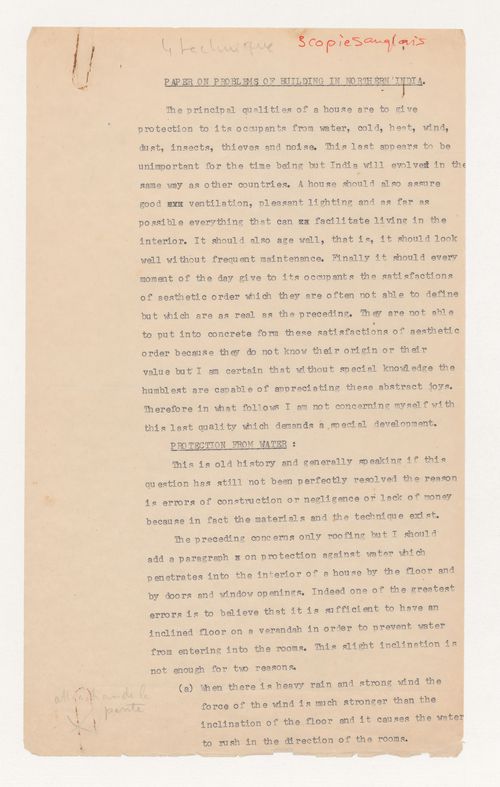
Le tapuscrit traite, entre autres, des sujets suivants : la protection contre l'eau, le froid, la chaleur, et la poussière. Il a aussi pour sujet les pare-soleils, la ventilation, la lumière naturelle et artificielle ainsi que la protection contre les voleurs. This typescript deals, among other things, with the following topics: protection against water, cold, heat, and dust. It also mentioned sunshades, ventilation, natural and artificial lighting, and protection against thieves.
ARCH264496
Description:
Le tapuscrit traite, entre autres, des sujets suivants : la protection contre l'eau, le froid, la chaleur, et la poussière. Il a aussi pour sujet les pare-soleils, la ventilation, la lumière naturelle et artificielle ainsi que la protection contre les voleurs. This typescript deals, among other things, with the following topics: protection against water, cold, heat, and dust. It also mentioned sunshades, ventilation, natural and artificial lighting, and protection against thieves.
People:
Date:
between 1951 and 1967
between 1951 and 1967
Title:
Text entitled "Paper on problems of building in Northern India"
Actions:
ARCH264496
Description:
Le tapuscrit traite, entre autres, des sujets suivants : la protection contre l'eau, le froid, la chaleur, et la poussière. Il a aussi pour sujet les pare-soleils, la ventilation, la lumière naturelle et artificielle ainsi que la protection contre les voleurs. This typescript deals, among other things, with the following topics: protection against water, cold, heat, and dust. It also mentioned sunshades, ventilation, natural and artificial lighting, and protection against thieves.
Text entitled "Paper on problems of building in Northern India"
Actions:
ARCH264496
Description:
Le tapuscrit traite, entre autres, des sujets suivants : la protection contre l'eau, le froid, la chaleur, et la poussière. Il a aussi pour sujet les pare-soleils, la ventilation, la lumière naturelle et artificielle ainsi que la protection contre les voleurs. This typescript deals, among other things, with the following topics: protection against water, cold, heat, and dust. It also mentioned sunshades, ventilation, natural and artificial lighting, and protection against thieves.
Form:
textual records
textual records
Date:
between 1951 and 1967
between 1951 and 1967
People:
Level of archival description:
Project
Project
Actions:
Reference number:
AP075.S1.1999.PR05
Description:
Project series documents Cornelia Hahn Oberlander's landscape project for the garden of Linda Yorke and Gordon Forbes in Vancouver, British Columbia. Oberlander worked on this project in the second half of the 1990s. She worked with architect André Rowland who was in charge of designing an addition to the residence designed in the late 1940s by Ned Pratt from architectural firm Sharp, Thompson, Berwick and & Pratt. The project consisted in redesigning the entire yard and adding a play area for children. Oberlander included terraces next to the addition to the house, planting beds and planters. The play area included a tower house accessible by a rope bridge, a two levels playhouse with wooden porch, a slide, a fireman pole and a ladder, and a small water canal with stone edges and activated by a hand pump. The project series contains landscape sketches, design development drawings, including a landscape concept plan, details, sections and elevations for play area and play structures, and building plans used as reference. The project is also documented through correspondence, including with clients, suppliers and consultants, concept notes by Oberlander, plant lists, financial material, research material, and photographs of the landscaping. Source: Herrington, Susan. Cornelia Hahn Oberlander: Making the Modern Landscape, University of Virginia Press, 2014, 304 pages.
AP075.S1.1999.PR05
Description:
Project series documents Cornelia Hahn Oberlander's landscape project for the garden of Linda Yorke and Gordon Forbes in Vancouver, British Columbia. Oberlander worked on this project in the second half of the 1990s. She worked with architect André Rowland who was in charge of designing an addition to the residence designed in the late 1940s by Ned Pratt from architectural firm Sharp, Thompson, Berwick and & Pratt. The project consisted in redesigning the entire yard and adding a play area for children. Oberlander included terraces next to the addition to the house, planting beds and planters. The play area included a tower house accessible by a rope bridge, a two levels playhouse with wooden porch, a slide, a fireman pole and a ladder, and a small water canal with stone edges and activated by a hand pump. The project series contains landscape sketches, design development drawings, including a landscape concept plan, details, sections and elevations for play area and play structures, and building plans used as reference. The project is also documented through correspondence, including with clients, suppliers and consultants, concept notes by Oberlander, plant lists, financial material, research material, and photographs of the landscaping. Source: Herrington, Susan. Cornelia Hahn Oberlander: Making the Modern Landscape, University of Virginia Press, 2014, 304 pages.
People:
Date:
1947-2006
1947-2006
Title:
Yorke-Forbes Residence, Vancouver, British Columbia (1999)
Actions:
AP075.S1.1999.PR05
Description:
Project series documents Cornelia Hahn Oberlander's landscape project for the garden of Linda Yorke and Gordon Forbes in Vancouver, British Columbia. Oberlander worked on this project in the second half of the 1990s. She worked with architect André Rowland who was in charge of designing an addition to the residence designed in the late 1940s by Ned Pratt from architectural firm Sharp, Thompson, Berwick and & Pratt. The project consisted in redesigning the entire yard and adding a play area for children. Oberlander included terraces next to the addition to the house, planting beds and planters. The play area included a tower house accessible by a rope bridge, a two levels playhouse with wooden porch, a slide, a fireman pole and a ladder, and a small water canal with stone edges and activated by a hand pump. The project series contains landscape sketches, design development drawings, including a landscape concept plan, details, sections and elevations for play area and play structures, and building plans used as reference. The project is also documented through correspondence, including with clients, suppliers and consultants, concept notes by Oberlander, plant lists, financial material, research material, and photographs of the landscaping. Source: Herrington, Susan. Cornelia Hahn Oberlander: Making the Modern Landscape, University of Virginia Press, 2014, 304 pages.
Yorke-Forbes Residence, Vancouver, British Columbia (1999)
Actions:
AP075.S1.1999.PR05
Description:
Project series documents Cornelia Hahn Oberlander's landscape project for the garden of Linda Yorke and Gordon Forbes in Vancouver, British Columbia. Oberlander worked on this project in the second half of the 1990s. She worked with architect André Rowland who was in charge of designing an addition to the residence designed in the late 1940s by Ned Pratt from architectural firm Sharp, Thompson, Berwick and & Pratt. The project consisted in redesigning the entire yard and adding a play area for children. Oberlander included terraces next to the addition to the house, planting beds and planters. The play area included a tower house accessible by a rope bridge, a two levels playhouse with wooden porch, a slide, a fireman pole and a ladder, and a small water canal with stone edges and activated by a hand pump. The project series contains landscape sketches, design development drawings, including a landscape concept plan, details, sections and elevations for play area and play structures, and building plans used as reference. The project is also documented through correspondence, including with clients, suppliers and consultants, concept notes by Oberlander, plant lists, financial material, research material, and photographs of the landscaping. Source: Herrington, Susan. Cornelia Hahn Oberlander: Making the Modern Landscape, University of Virginia Press, 2014, 304 pages.
Level of archival description:
Project
Project
Date:
1947-2006
1947-2006
People:
Form:
photographs
Quantity:
9 photograph(s)
photographs
Quantity:
9 photograph(s)
Actions:
Reference number:
ARCH269658
Description:
Group consists of various photographs predominantly of Chandigarh, India, including: - A man sitting in front of a rural house - A tree in a field - Women walking in a street - Women and children spinning string in a rural home near Chandigarh - Portrait of a bearded man - Men and children washing oxen in water - Unidentified bas-relief of the sun in concrete - The Secretariat in the Capitol Complex - Open hand bas-relief in concrete
ARCH269658
Description:
Group consists of various photographs predominantly of Chandigarh, India, including: - A man sitting in front of a rural house - A tree in a field - Women walking in a street - Women and children spinning string in a rural home near Chandigarh - Portrait of a bearded man - Men and children washing oxen in water - Unidentified bas-relief of the sun in concrete - The Secretariat in the Capitol Complex - Open hand bas-relief in concrete
People:
Date:
between 1951 and 1965
between 1951 and 1965
Title:
Various photographs predominantly of Chandigarh, India
Actions:
ARCH269658
Description:
Group consists of various photographs predominantly of Chandigarh, India, including: - A man sitting in front of a rural house - A tree in a field - Women walking in a street - Women and children spinning string in a rural home near Chandigarh - Portrait of a bearded man - Men and children washing oxen in water - Unidentified bas-relief of the sun in concrete - The Secretariat in the Capitol Complex - Open hand bas-relief in concrete
Various photographs predominantly of Chandigarh, India
Actions:
ARCH269658
Description:
Group consists of various photographs predominantly of Chandigarh, India, including: - A man sitting in front of a rural house - A tree in a field - Women walking in a street - Women and children spinning string in a rural home near Chandigarh - Portrait of a bearded man - Men and children washing oxen in water - Unidentified bas-relief of the sun in concrete - The Secretariat in the Capitol Complex - Open hand bas-relief in concrete
Form:
photographs
Quantity:
9 photograph(s)
photographs
Quantity:
9 photograph(s)
Date:
between 1951 and 1965
between 1951 and 1965
People:
Level of archival description:
Project
Project
Reference number:
AP207.S1.1968.PR04
Description:
This project series documents Pettena's installation entitled "Grazia & Giustizia", named after the Ministry of Justice in Italy. This project is the third of a series of three installations created in 1968 which consisted of large three-dimensional letters, forming words, and made purposely of perishable materials. The "Grazia & Giustizia" was created and constructed in the context of the 6th Festival of Avant-Garde Music in Palermo, in 1968. Unlike the first two installations in this series, this one was destroyed intentionally and was more of a performance as each cardboard letter was taken and thrown in the sea after a funeral procession accompanied by music played by the group MEV (Musica Elettronica Viva). The installation was re-created in 2012, this time in Civitella del Tronto, at "a great fort dating from the 16th century, which was not only the dominant architectural feature in that context but in particular the place where 'justice' used to be dispensed (or not)." [1] The project series contains photographs of the procession and of the letters once in the sea, and two drawings, including one showing the letters floating in the water. The project series also contains photographs showing the installation at the fort of Civitella del Tronto in 2012 and project descriptions in English and Italian. Source: [1] Gianni Pettena website, https://www.giannipettena.it/italiano/opere-1/inst-grazia-ii-2012-1/ (last accessed 30 October 2019)
AP207.S1.1968.PR04
Description:
This project series documents Pettena's installation entitled "Grazia & Giustizia", named after the Ministry of Justice in Italy. This project is the third of a series of three installations created in 1968 which consisted of large three-dimensional letters, forming words, and made purposely of perishable materials. The "Grazia & Giustizia" was created and constructed in the context of the 6th Festival of Avant-Garde Music in Palermo, in 1968. Unlike the first two installations in this series, this one was destroyed intentionally and was more of a performance as each cardboard letter was taken and thrown in the sea after a funeral procession accompanied by music played by the group MEV (Musica Elettronica Viva). The installation was re-created in 2012, this time in Civitella del Tronto, at "a great fort dating from the 16th century, which was not only the dominant architectural feature in that context but in particular the place where 'justice' used to be dispensed (or not)." [1] The project series contains photographs of the procession and of the letters once in the sea, and two drawings, including one showing the letters floating in the water. The project series also contains photographs showing the installation at the fort of Civitella del Tronto in 2012 and project descriptions in English and Italian. Source: [1] Gianni Pettena website, https://www.giannipettena.it/italiano/opere-1/inst-grazia-ii-2012-1/ (last accessed 30 October 2019)
People:
Date:
1968-2017
1968-2017
Title:
Grazia & Giustizia [Grace & Justice] (1968)
Actions:
AP207.S1.1968.PR04
Description:
This project series documents Pettena's installation entitled "Grazia & Giustizia", named after the Ministry of Justice in Italy. This project is the third of a series of three installations created in 1968 which consisted of large three-dimensional letters, forming words, and made purposely of perishable materials. The "Grazia & Giustizia" was created and constructed in the context of the 6th Festival of Avant-Garde Music in Palermo, in 1968. Unlike the first two installations in this series, this one was destroyed intentionally and was more of a performance as each cardboard letter was taken and thrown in the sea after a funeral procession accompanied by music played by the group MEV (Musica Elettronica Viva). The installation was re-created in 2012, this time in Civitella del Tronto, at "a great fort dating from the 16th century, which was not only the dominant architectural feature in that context but in particular the place where 'justice' used to be dispensed (or not)." [1] The project series contains photographs of the procession and of the letters once in the sea, and two drawings, including one showing the letters floating in the water. The project series also contains photographs showing the installation at the fort of Civitella del Tronto in 2012 and project descriptions in English and Italian. Source: [1] Gianni Pettena website, https://www.giannipettena.it/italiano/opere-1/inst-grazia-ii-2012-1/ (last accessed 30 October 2019)
Grazia & Giustizia [Grace & Justice] (1968)
Actions:
AP207.S1.1968.PR04
Description:
This project series documents Pettena's installation entitled "Grazia & Giustizia", named after the Ministry of Justice in Italy. This project is the third of a series of three installations created in 1968 which consisted of large three-dimensional letters, forming words, and made purposely of perishable materials. The "Grazia & Giustizia" was created and constructed in the context of the 6th Festival of Avant-Garde Music in Palermo, in 1968. Unlike the first two installations in this series, this one was destroyed intentionally and was more of a performance as each cardboard letter was taken and thrown in the sea after a funeral procession accompanied by music played by the group MEV (Musica Elettronica Viva). The installation was re-created in 2012, this time in Civitella del Tronto, at "a great fort dating from the 16th century, which was not only the dominant architectural feature in that context but in particular the place where 'justice' used to be dispensed (or not)." [1] The project series contains photographs of the procession and of the letters once in the sea, and two drawings, including one showing the letters floating in the water. The project series also contains photographs showing the installation at the fort of Civitella del Tronto in 2012 and project descriptions in English and Italian. Source: [1] Gianni Pettena website, https://www.giannipettena.it/italiano/opere-1/inst-grazia-ii-2012-1/ (last accessed 30 October 2019)
Level of archival description:
Project
Project
Date:
1968-2017
1968-2017
People:
Level of archival description:
Project
Project
Actions:
Reference number:
AP075.S1.2009.PR01
Description:
Project series documents Cornelia Hahn Oberlander's project for the new Visitor Centre of VanDusen Botanical Garden in Vancouver, British Columbia. Oberlander worked on this project from 2007 to 2011 with architectural firm Busby Perkins+Will Architects and landscape architecture firm Sharp and Diamond Landscape Architects. The project consisted in building an access to the botanical garden from Oak Street. The building includes a undulating green roof shaped as a native orchid leaf and covered in plants inspired by the Pacific Northwest Coastal grassland. The building entrance is marked by "a single petal raised above the others" [1] while another of the giant roof petal in the back "almost touched the ground, and transported water to Oberlander's rainwater garden." [2] The project series contains design developement drawings such as site plans, planting plans, landscape plans, landscape sections and a few sketches, and also sets of building drawings or older landscape drawings of the garden used as reference. The project is also documented through textual records, including correspondence with architects, consultants and clients, project proposals, documentation on botanical garden or on the VanDusen Botanical Garden, and press articles and clippings about the project. The project series comprises also digital photographs of the completed building. Source: [1] [2] Herrington, Susan. Cornelia Hahn Oberlander: Making the Modern Landscape, University of Virginia Press, 2014, 304 pages, p. 225.
AP075.S1.2009.PR01
Description:
Project series documents Cornelia Hahn Oberlander's project for the new Visitor Centre of VanDusen Botanical Garden in Vancouver, British Columbia. Oberlander worked on this project from 2007 to 2011 with architectural firm Busby Perkins+Will Architects and landscape architecture firm Sharp and Diamond Landscape Architects. The project consisted in building an access to the botanical garden from Oak Street. The building includes a undulating green roof shaped as a native orchid leaf and covered in plants inspired by the Pacific Northwest Coastal grassland. The building entrance is marked by "a single petal raised above the others" [1] while another of the giant roof petal in the back "almost touched the ground, and transported water to Oberlander's rainwater garden." [2] The project series contains design developement drawings such as site plans, planting plans, landscape plans, landscape sections and a few sketches, and also sets of building drawings or older landscape drawings of the garden used as reference. The project is also documented through textual records, including correspondence with architects, consultants and clients, project proposals, documentation on botanical garden or on the VanDusen Botanical Garden, and press articles and clippings about the project. The project series comprises also digital photographs of the completed building. Source: [1] [2] Herrington, Susan. Cornelia Hahn Oberlander: Making the Modern Landscape, University of Virginia Press, 2014, 304 pages, p. 225.
People:
Date:
1973-2018
1973-2018
Title:
VanDusen Botanical Garden, Vancouver, British Columbia (2009)
Actions:
AP075.S1.2009.PR01
Description:
Project series documents Cornelia Hahn Oberlander's project for the new Visitor Centre of VanDusen Botanical Garden in Vancouver, British Columbia. Oberlander worked on this project from 2007 to 2011 with architectural firm Busby Perkins+Will Architects and landscape architecture firm Sharp and Diamond Landscape Architects. The project consisted in building an access to the botanical garden from Oak Street. The building includes a undulating green roof shaped as a native orchid leaf and covered in plants inspired by the Pacific Northwest Coastal grassland. The building entrance is marked by "a single petal raised above the others" [1] while another of the giant roof petal in the back "almost touched the ground, and transported water to Oberlander's rainwater garden." [2] The project series contains design developement drawings such as site plans, planting plans, landscape plans, landscape sections and a few sketches, and also sets of building drawings or older landscape drawings of the garden used as reference. The project is also documented through textual records, including correspondence with architects, consultants and clients, project proposals, documentation on botanical garden or on the VanDusen Botanical Garden, and press articles and clippings about the project. The project series comprises also digital photographs of the completed building. Source: [1] [2] Herrington, Susan. Cornelia Hahn Oberlander: Making the Modern Landscape, University of Virginia Press, 2014, 304 pages, p. 225.
VanDusen Botanical Garden, Vancouver, British Columbia (2009)
Actions:
AP075.S1.2009.PR01
Description:
Project series documents Cornelia Hahn Oberlander's project for the new Visitor Centre of VanDusen Botanical Garden in Vancouver, British Columbia. Oberlander worked on this project from 2007 to 2011 with architectural firm Busby Perkins+Will Architects and landscape architecture firm Sharp and Diamond Landscape Architects. The project consisted in building an access to the botanical garden from Oak Street. The building includes a undulating green roof shaped as a native orchid leaf and covered in plants inspired by the Pacific Northwest Coastal grassland. The building entrance is marked by "a single petal raised above the others" [1] while another of the giant roof petal in the back "almost touched the ground, and transported water to Oberlander's rainwater garden." [2] The project series contains design developement drawings such as site plans, planting plans, landscape plans, landscape sections and a few sketches, and also sets of building drawings or older landscape drawings of the garden used as reference. The project is also documented through textual records, including correspondence with architects, consultants and clients, project proposals, documentation on botanical garden or on the VanDusen Botanical Garden, and press articles and clippings about the project. The project series comprises also digital photographs of the completed building. Source: [1] [2] Herrington, Susan. Cornelia Hahn Oberlander: Making the Modern Landscape, University of Virginia Press, 2014, 304 pages, p. 225.
Level of archival description:
Project
Project
Date:
1973-2018
1973-2018
People:
Level of archival description:
Sub-series
Sub-series
Reference number:
AP178.S1.2002.PR05.SS3
Description:
This project subseries documents the Clubhouse de Vidago in Vidago, Portugal. While the records were held in the office’s archives this project was assigned the number 49/00. The office assigned the dates 2007-2010 to this project. The project, part of larger renovations to the Vidago Palace Hotel, consisted of the conversion of an old building into the new golf clubhouse. Originally constructed in 1886, the stone building was first used for bottling the Vidago spring water. The clubhouse consisted of a large restaurant and bar space, with white walls, high ceilings and a central skylight to illuminate its spacious interior. A golf shop and dressing room were also part of the clubhouse. Siza designed two other buildings for the new 18-hole golf course, the golf academy and the maintenance building, but neither of these was ever realized. This project subseries is recorded through photographic materials, drawings, study models and textual records dating from 2002-2015. These records document the clubhouse, the golf academy and the maintenance building. The photographic materials are mostly printed digital photos showing the site, construction work, the model and reference images. The drawings include studies, plans, elevations, sections, details, and structural, mechanical and electrical drawings. The textual records include furniture documentation, records for permits, budgets, supplier catalogues, correspondence and meeting minutes. There are also a number of records documenting various mechanical, electrical and structural systems.
AP178.S1.2002.PR05.SS3
Description:
This project subseries documents the Clubhouse de Vidago in Vidago, Portugal. While the records were held in the office’s archives this project was assigned the number 49/00. The office assigned the dates 2007-2010 to this project. The project, part of larger renovations to the Vidago Palace Hotel, consisted of the conversion of an old building into the new golf clubhouse. Originally constructed in 1886, the stone building was first used for bottling the Vidago spring water. The clubhouse consisted of a large restaurant and bar space, with white walls, high ceilings and a central skylight to illuminate its spacious interior. A golf shop and dressing room were also part of the clubhouse. Siza designed two other buildings for the new 18-hole golf course, the golf academy and the maintenance building, but neither of these was ever realized. This project subseries is recorded through photographic materials, drawings, study models and textual records dating from 2002-2015. These records document the clubhouse, the golf academy and the maintenance building. The photographic materials are mostly printed digital photos showing the site, construction work, the model and reference images. The drawings include studies, plans, elevations, sections, details, and structural, mechanical and electrical drawings. The textual records include furniture documentation, records for permits, budgets, supplier catalogues, correspondence and meeting minutes. There are also a number of records documenting various mechanical, electrical and structural systems.
People:
Date:
2002-2015
2002-2015
Title:
Clubhouse de Vidago [Vidago Palace Hotel Club House], Vidago, Portugal (2007-2010)
Actions:
AP178.S1.2002.PR05.SS3
Description:
This project subseries documents the Clubhouse de Vidago in Vidago, Portugal. While the records were held in the office’s archives this project was assigned the number 49/00. The office assigned the dates 2007-2010 to this project. The project, part of larger renovations to the Vidago Palace Hotel, consisted of the conversion of an old building into the new golf clubhouse. Originally constructed in 1886, the stone building was first used for bottling the Vidago spring water. The clubhouse consisted of a large restaurant and bar space, with white walls, high ceilings and a central skylight to illuminate its spacious interior. A golf shop and dressing room were also part of the clubhouse. Siza designed two other buildings for the new 18-hole golf course, the golf academy and the maintenance building, but neither of these was ever realized. This project subseries is recorded through photographic materials, drawings, study models and textual records dating from 2002-2015. These records document the clubhouse, the golf academy and the maintenance building. The photographic materials are mostly printed digital photos showing the site, construction work, the model and reference images. The drawings include studies, plans, elevations, sections, details, and structural, mechanical and electrical drawings. The textual records include furniture documentation, records for permits, budgets, supplier catalogues, correspondence and meeting minutes. There are also a number of records documenting various mechanical, electrical and structural systems.
Clubhouse de Vidago [Vidago Palace Hotel Club House], Vidago, Portugal (2007-2010)
Actions:
AP178.S1.2002.PR05.SS3
Description:
This project subseries documents the Clubhouse de Vidago in Vidago, Portugal. While the records were held in the office’s archives this project was assigned the number 49/00. The office assigned the dates 2007-2010 to this project. The project, part of larger renovations to the Vidago Palace Hotel, consisted of the conversion of an old building into the new golf clubhouse. Originally constructed in 1886, the stone building was first used for bottling the Vidago spring water. The clubhouse consisted of a large restaurant and bar space, with white walls, high ceilings and a central skylight to illuminate its spacious interior. A golf shop and dressing room were also part of the clubhouse. Siza designed two other buildings for the new 18-hole golf course, the golf academy and the maintenance building, but neither of these was ever realized. This project subseries is recorded through photographic materials, drawings, study models and textual records dating from 2002-2015. These records document the clubhouse, the golf academy and the maintenance building. The photographic materials are mostly printed digital photos showing the site, construction work, the model and reference images. The drawings include studies, plans, elevations, sections, details, and structural, mechanical and electrical drawings. The textual records include furniture documentation, records for permits, budgets, supplier catalogues, correspondence and meeting minutes. There are also a number of records documenting various mechanical, electrical and structural systems.
Level of archival description:
Subseries
Subseries
Date:
2002-2015
2002-2015
People:


