


622 Results
Form:
books
books
Actions:
Price:
$12.95
(available to order)
Summary:
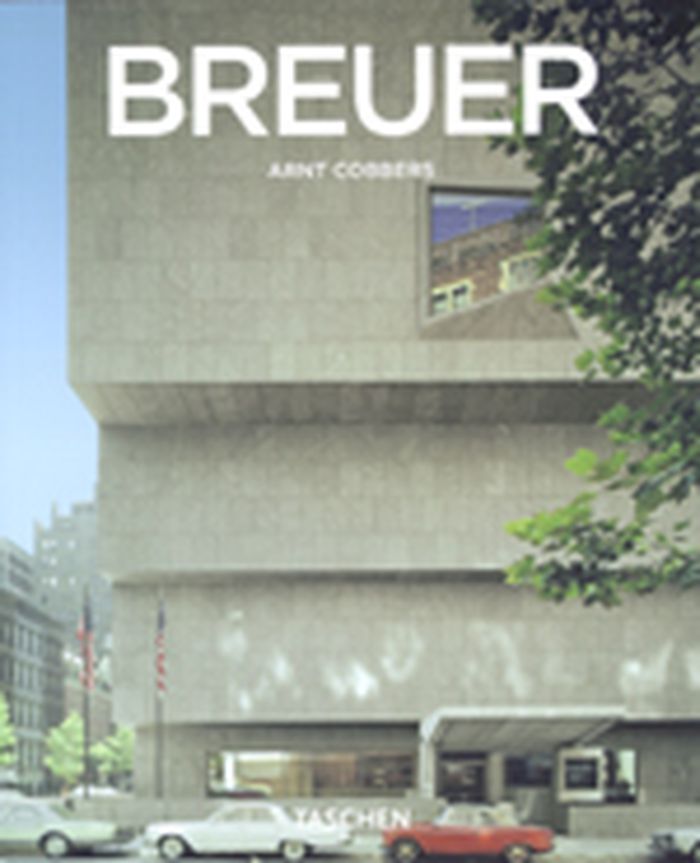
In 1956, Time magazine called him one of the “form-givers of the 20th century“: with his invention of steel-tube furniture, Marcel Breuer (1902-1981) has made his mark in the history of design at the tender age of 23. He started his architectural career as one of the Bauhaus’s most influential architects with the 1932 Harnischmacher House. Even Breuer’s earliest work was(...)
Title:
Breuer : 1902-1981 Createur de formes du XXe siecle
Actions:
Price:
$12.95
(available to order)
Summary:
In 1956, Time magazine called him one of the “form-givers of the 20th century“: with his invention of steel-tube furniture, Marcel Breuer (1902-1981) has made his mark in the history of design at the tender age of 23. He started his architectural career as one of the Bauhaus’s most influential architects with the 1932 Harnischmacher House. Even Breuer’s earliest work was marked by the search for a symbiosis between local and global, big and small, smooth and rough. His sparse use of materials emphasized the balance among textures, colors, and shapes. In 1943, he conceived the “binuclear” house concept—the splitting of living and sleeping areas into separate wings—which he first applied to the Geller House I (1944-1946), and which would attain great popularity. After designing the UNESCO headquarters in Paris (1953-1958), reinforced concrete, with its formal plasticity und structural elasticity, continued to give monumental character to buildings such as the Abbey and Campus of St. John’s University in Minnesota (1953-1961), the IBM Research Center in France (1960-1962), and the Whitney Museum of American Art (1963-1966) in New York City. With his keen sense of proportion, shape, and material, Breuer is one of the most important Modernists and is still very much central in the discussion of contemporary architecture.
Form:
books
books
Publication:
July 2007, Cologne
July 2007, Cologne
Subject:
Architecture Monographs
Architecture Monographs
Form:
journals and magazines
journals and magazines
Title:
Quaderns 229 : borders
Quaderns 229 : borders
Actions:
Price:
$39.95
(available to order)
Summary:
Issue 229 of the magazine Quaderns explores the theme of the border in its literal sense -the border as a political and cultural separation between countries or geographical areas- but also as a place which gives rise to cultural crossovers alongside its function as separator. This issue looks firstly at the transformation of two formerly divided(...)
Subject:
Magazines
Magazines
Publication:
June 2001, Barcelona
June 2001, Barcelona
Title:
Quaderns 229 : borders
Actions:
Price:
$39.95
(available to order)
Summary:
Issue 229 of the magazine Quaderns explores the theme of the border in its literal sense -the border as a political and cultural separation between countries or geographical areas- but also as a place which gives rise to cultural crossovers alongside its function as separator. This issue looks firstly at the transformation of two formerly divided cities, Berlin and Beirut, which are currently undergoing processes of integration of what used to be opposing sectors and of recovery as city-centre spaces of the wastelands generated by division. Then it analyses the present-day situation in two border areas characterised by strong economic and cultural contrasts between the two sides of the dividing line: the border between the United States and Mexico, and the Strait of Gibraltar. The works of architects and artists who have recently worked in these places are taken as a starting point for debate about the strategies brought to bear in frontier territory by urbanism, art and architecture. The issue includes an introductory text by Saskia Sassen and features Mathias Sauerbruch on Berlin, Álvaro Siza on Ceuta, Rafael Moneo and Ousama Kabbani on Beirut, and Gloria Anzaldúa on the border between Mexico and the United States. It also presents a series of works actually carried out in these cities by Sauerbruch & Hutton, Álvaro Siza and Rafael Moneo, along with projects by Berger-Parkinnen, Kollhof & Kollhoff, Gustav Lange, OMA/Rem Koolhaas and Peter Zumthor, among others, and features a dossier with projects carried out in other countries by Catalan architects, including works by Miralles-Tagliabue, J. Ll. Mateo and Elías Torres. The theme is completed by an extensive photo reportage by Camilo José Vergara about the Mexican border.
Form:
journals and magazines
journals and magazines
Publication:
June 2001, Barcelona
June 2001, Barcelona
Subject:
Magazines
Magazines


