


36154 Results
Form:
books
books
Actions:
Price:
$24.50
(available to order)
Summary:
In Evocative Objects, Turkle collects writings by scientists, humanists, artists, and designers that trace the power of everyday things. These essays reveal objects as emotional and intellectual companions that anchor memory, sustain relationships, and provoke new ideas. These days, scholars show new interest in the importance of the concrete. This volume's special(...)
$24.50
(available to order)
Summary:
In Evocative Objects, Turkle collects writings by scientists, humanists, artists, and designers that trace the power of everyday things. These essays reveal objects as emotional and intellectual companions that anchor memory, sustain relationships, and provoke new ideas. These days, scholars show new interest in the importance of the concrete. This volume's special(...)
Title:
Evocative objects : things we think with
Actions:
Price:
$24.50
(available to order)
Summary:
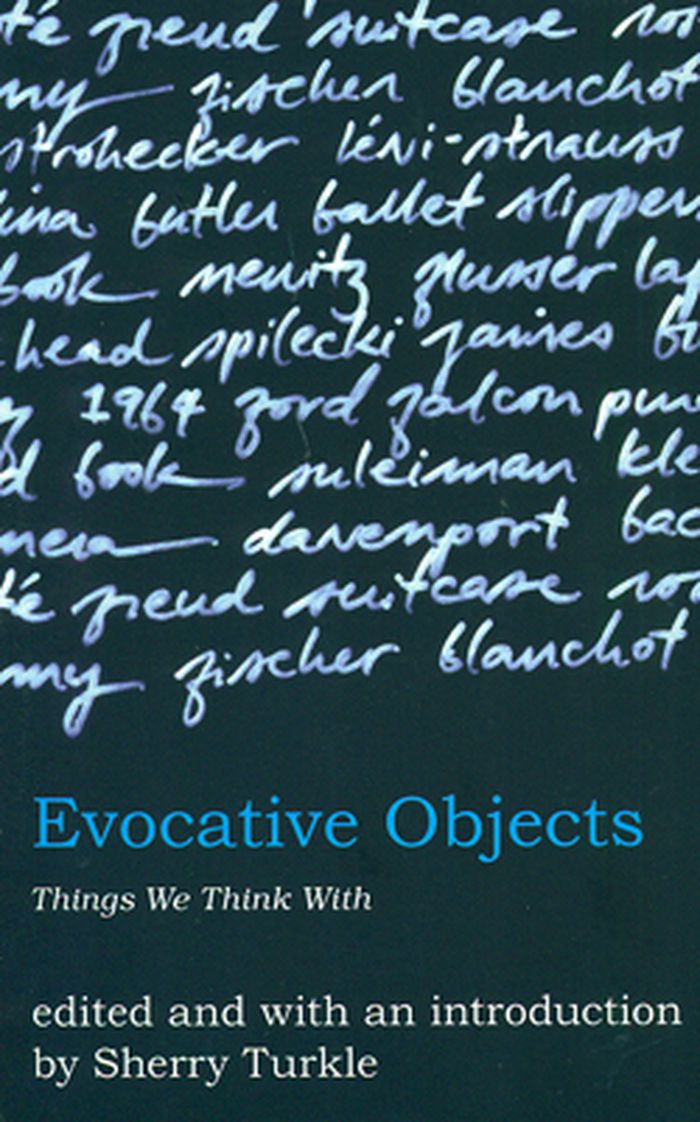
In Evocative Objects, Turkle collects writings by scientists, humanists, artists, and designers that trace the power of everyday things. These essays reveal objects as emotional and intellectual companions that anchor memory, sustain relationships, and provoke new ideas. These days, scholars show new interest in the importance of the concrete. This volume's special contribution is its focus on everyday riches: the simplest of objects - an apple, a datebook, a laptop computer - are shown to bring philosophy down to earth. The poet contends, "No ideas but in things." The notion of evocative objects goes further: objects carry both ideas and passions. In our relations to things, thought and feeling are inseparable. Whether it's a student's beloved 1964 Ford Falcon (left behind for a station wagon and motherhood), or a cello that inspires a meditation on fatherhood, the intimate objects in this collection are used to reflect on larger themes - the role of objects in design and play, discipline and desire, history and exchange, mourning and memory, transition and passage, meditation and new vision.
Evocative objects : things we think with
Actions:
Price:
$24.50
(available to order)
Summary:
In Evocative Objects, Turkle collects writings by scientists, humanists, artists, and designers that trace the power of everyday things. These essays reveal objects as emotional and intellectual companions that anchor memory, sustain relationships, and provoke new ideas. These days, scholars show new interest in the importance of the concrete. This volume's special contribution is its focus on everyday riches: the simplest of objects - an apple, a datebook, a laptop computer - are shown to bring philosophy down to earth. The poet contends, "No ideas but in things." The notion of evocative objects goes further: objects carry both ideas and passions. In our relations to things, thought and feeling are inseparable. Whether it's a student's beloved 1964 Ford Falcon (left behind for a station wagon and motherhood), or a cello that inspires a meditation on fatherhood, the intimate objects in this collection are used to reflect on larger themes - the role of objects in design and play, discipline and desire, history and exchange, mourning and memory, transition and passage, meditation and new vision.
Form:
books
books
Publication:
July 2011
July 2011
Subject:
Design Theory
Design Theory
Form:
books
books
Price:
$25.95
(available to order)
Summary:
Photography Degree Zero is the first anthology of writings on Roland Barthe's Camera Lucida. It includes essays written soon after Barthes’s book appeared as well as more recent rereadings of it, some previously unpublished. The variety of perspectives included in this publication, and the focus on Camera Lucida in the context of photography rather than literature or(...)
$25.95
(available to order)
Summary:
Photography Degree Zero is the first anthology of writings on Roland Barthe's Camera Lucida. It includes essays written soon after Barthes’s book appeared as well as more recent rereadings of it, some previously unpublished. The variety of perspectives included in this publication, and the focus on Camera Lucida in the context of photography rather than literature or(...)
Title:
Photography degree zero: reflection on Roland Barthe's Camera Lucida
Actions:
Price:
$25.95
(available to order)
Summary:
Photography Degree Zero is the first anthology of writings on Roland Barthe's Camera Lucida. It includes essays written soon after Barthes’s book appeared as well as more recent rereadings of it, some previously unpublished. The variety of perspectives included in this publication, and the focus on Camera Lucida in the context of photography rather than literature or philosophy, servetoreopen a vital conversation on Barthes’s influential work.
Photography degree zero: reflection on Roland Barthe's Camera Lucida
Actions:
Price:
$25.95
(available to order)
Summary:
Photography Degree Zero is the first anthology of writings on Roland Barthe's Camera Lucida. It includes essays written soon after Barthes’s book appeared as well as more recent rereadings of it, some previously unpublished. The variety of perspectives included in this publication, and the focus on Camera Lucida in the context of photography rather than literature or philosophy, servetoreopen a vital conversation on Barthes’s influential work.
Form:
books
books
Publication:
October 2011
October 2011
Subject:
Theory of Photography
Theory of Photography
Form:
books
books
Actions:
Price:
$39.95
(available to order)
Summary:
Institutional critique is an artistic practice that reflects critically on its own housing in galleries and museums and on the concept and social function of art itself. Such concerns have always been a part of modern art but took on new urgency at the end of the 1960s, when -driven by the social up heaval of the time and enabled by the tools and techniques of conceptual(...)
$39.95
(available to order)
Summary:
Institutional critique is an artistic practice that reflects critically on its own housing in galleries and museums and on the concept and social function of art itself. Such concerns have always been a part of modern art but took on new urgency at the end of the 1960s, when -driven by the social up heaval of the time and enabled by the tools and techniques of conceptual(...)
Title:
Institutional critique : an anthology of artists' writings
Actions:
Price:
$39.95
(available to order)
Summary:
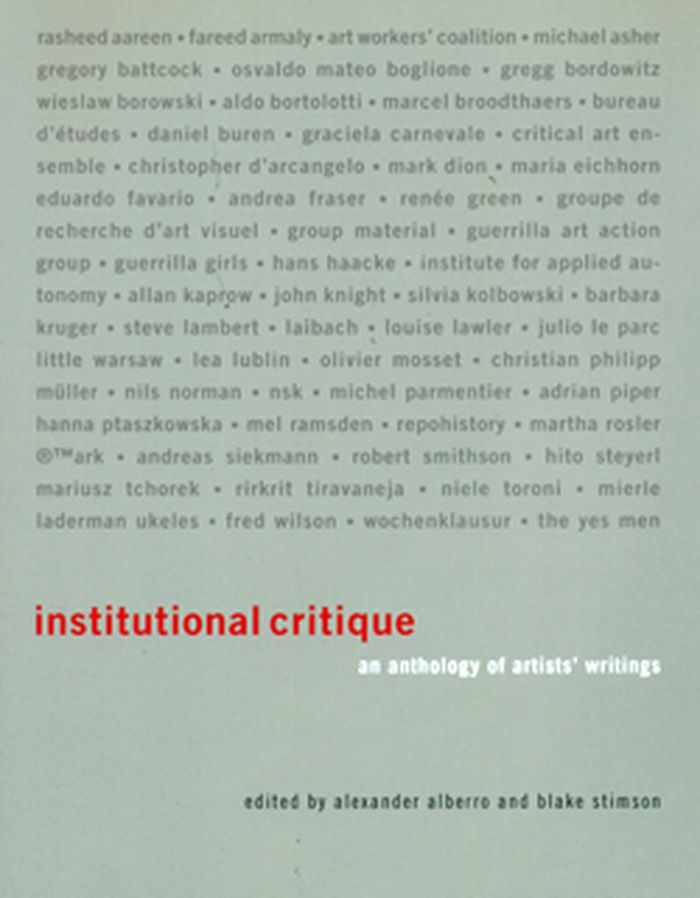
Institutional critique is an artistic practice that reflects critically on its own housing in galleries and museums and on the concept and social function of art itself. Such concerns have always been a part of modern art but took on new urgency at the end of the 1960s, when -driven by the social up heaval of the time and enabled by the tools and techniques of conceptual art - institutional critique emerged as a genre. This anthology traces the development of institutional critique as an artistic concern from the 1960's to the present by gathering writings and representative art projects of artists from across Europe and throughout the Americas who developed and extended the genre.
Institutional critique : an anthology of artists' writings
Actions:
Price:
$39.95
(available to order)
Summary:
Institutional critique is an artistic practice that reflects critically on its own housing in galleries and museums and on the concept and social function of art itself. Such concerns have always been a part of modern art but took on new urgency at the end of the 1960s, when -driven by the social up heaval of the time and enabled by the tools and techniques of conceptual art - institutional critique emerged as a genre. This anthology traces the development of institutional critique as an artistic concern from the 1960's to the present by gathering writings and representative art projects of artists from across Europe and throughout the Americas who developed and extended the genre.
Form:
books
books
Publication:
October 2011
October 2011
Subject:
Art Theory
Art Theory
Form:
books
books
Title:
Imagery in the 21st century
Imagery in the 21st century
Actions:
Price:
$44.95
(available in store)
Summary:
We are surrounded by images as never before: on Flickr, Facebook, and YouTube; on thousands of television channels; in digital games and virtual worlds; in media art and science. Without new efforts to visualize complex ideas, structures, and systems, today’s informatio explosion would be unmanageable. The digital image represents endless options for manipulation; images(...)
$44.95
(available in store)
Summary:
We are surrounded by images as never before: on Flickr, Facebook, and YouTube; on thousands of television channels; in digital games and virtual worlds; in media art and science. Without new efforts to visualize complex ideas, structures, and systems, today’s informatio explosion would be unmanageable. The digital image represents endless options for manipulation; images(...)
Title:
Imagery in the 21st century
Actions:
Price:
$44.95
(available in store)
Summary:
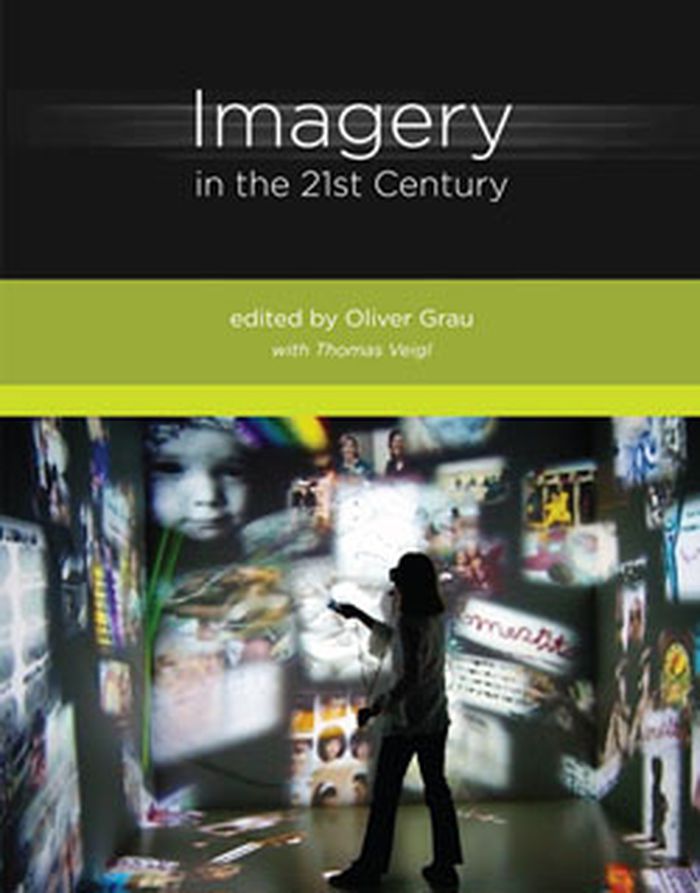
We are surrounded by images as never before: on Flickr, Facebook, and YouTube; on thousands of television channels; in digital games and virtual worlds; in media art and science. Without new efforts to visualize complex ideas, structures, and systems, today’s informatio explosion would be unmanageable. The digital image represents endless options for manipulation; images seem capable of changing interactively or even autonomously. This volume offers systematic and interdisciplinary reflections on these new image worlds and new analytical approaches to the visual. This publication examines this revolution in various fields, with researchers from the natural sciences and the humanities meeting to achieve a deeper understanding of the meaning and impact of the image in our time. The contributors explore and discuss new critical terms of multidisciplinary scope, from database economy to the dramaturgy of hypermedia, from visualizations in neurosciences to the image in bio art. They consider the power of the image in the development of human consciousness, pursue new definitions of visual phenomena, and examine new tools for image research and visual analysis. The goal is to expand visual competence in investigating new visual worlds and to build cross-disciplinary exchanges among the arts, humanities, and natural sciences.
Imagery in the 21st century
Actions:
Price:
$44.95
(available in store)
Summary:
We are surrounded by images as never before: on Flickr, Facebook, and YouTube; on thousands of television channels; in digital games and virtual worlds; in media art and science. Without new efforts to visualize complex ideas, structures, and systems, today’s informatio explosion would be unmanageable. The digital image represents endless options for manipulation; images seem capable of changing interactively or even autonomously. This volume offers systematic and interdisciplinary reflections on these new image worlds and new analytical approaches to the visual. This publication examines this revolution in various fields, with researchers from the natural sciences and the humanities meeting to achieve a deeper understanding of the meaning and impact of the image in our time. The contributors explore and discuss new critical terms of multidisciplinary scope, from database economy to the dramaturgy of hypermedia, from visualizations in neurosciences to the image in bio art. They consider the power of the image in the development of human consciousness, pursue new definitions of visual phenomena, and examine new tools for image research and visual analysis. The goal is to expand visual competence in investigating new visual worlds and to build cross-disciplinary exchanges among the arts, humanities, and natural sciences.
Form:
books
books
Publication:
September 2011
September 2011
Subject:
Art Theory
Art Theory
Form:
books
books
Price:
$32.95
(available to order)
Summary:
Events are always passing; to experience an event is to experience the passing. But how do we perceive an experience that encompasses the just-was and the is-about-to-be as much as what is actually present? In Semblance and Event, Brian Massumi, drawing on the work of William James, Alfred North Whitehead, Gilles Deleuze, and others, develops the concept of "semblance" as(...)
$32.95
(available to order)
Summary:
Events are always passing; to experience an event is to experience the passing. But how do we perceive an experience that encompasses the just-was and the is-about-to-be as much as what is actually present? In Semblance and Event, Brian Massumi, drawing on the work of William James, Alfred North Whitehead, Gilles Deleuze, and others, develops the concept of "semblance" as(...)
Title:
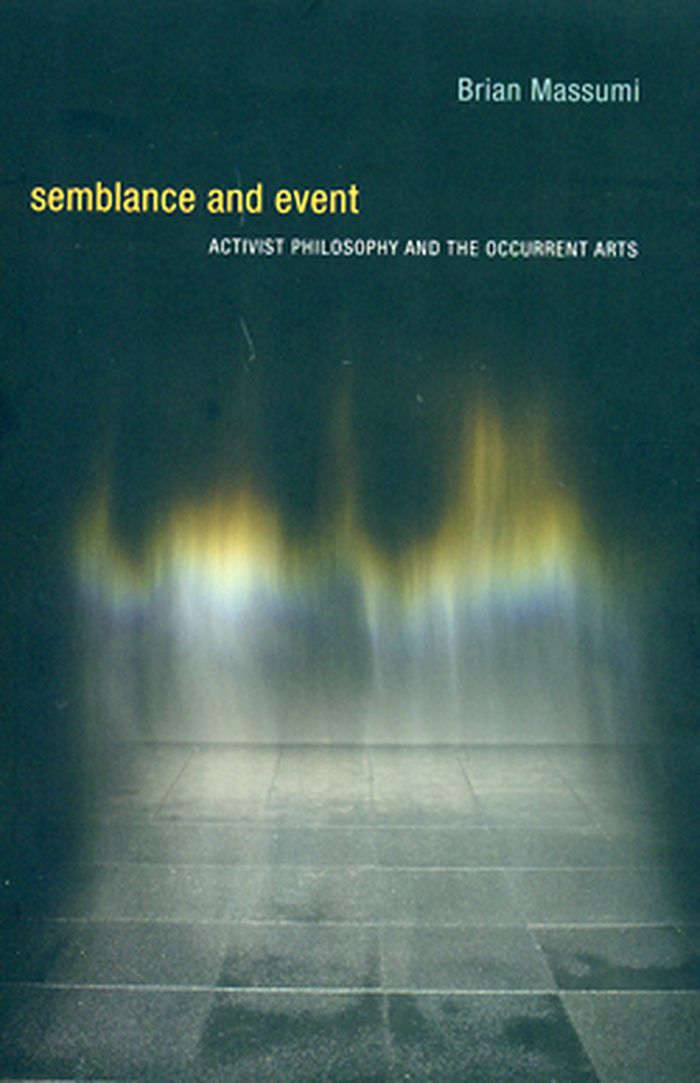
Semblance and event : activist philosophy and the occurrent arts
Actions:
Price:
$32.95
(available to order)
Summary:
Events are always passing; to experience an event is to experience the passing. But how do we perceive an experience that encompasses the just-was and the is-about-to-be as much as what is actually present? In Semblance and Event, Brian Massumi, drawing on the work of William James, Alfred North Whitehead, Gilles Deleuze, and others, develops the concept of "semblance" as a way to approach this question. It is, he argues, a question of abstraction, not as the opposite of the concrete but as a dimension of it: "lived abstraction." A semblance is a lived abstraction. Massumi uses the category of the semblance to investigate practices of art that are relational and event-oriented - variously known as interactive art, ephemeral art, performance art, art intervention - which he refers to collectively as the "occurrent arts."
Semblance and event : activist philosophy and the occurrent arts
Actions:
Price:
$32.95
(available to order)
Summary:
Events are always passing; to experience an event is to experience the passing. But how do we perceive an experience that encompasses the just-was and the is-about-to-be as much as what is actually present? In Semblance and Event, Brian Massumi, drawing on the work of William James, Alfred North Whitehead, Gilles Deleuze, and others, develops the concept of "semblance" as a way to approach this question. It is, he argues, a question of abstraction, not as the opposite of the concrete but as a dimension of it: "lived abstraction." A semblance is a lived abstraction. Massumi uses the category of the semblance to investigate practices of art that are relational and event-oriented - variously known as interactive art, ephemeral art, performance art, art intervention - which he refers to collectively as the "occurrent arts."
Form:
books
books
Publication:
July 2011
July 2011
Subject:
Critical Theory
Critical Theory
Form:
books
books
Actions:
Price:
$31.00
(available to order)
Summary:
Today on almost every desk in every office sits a computer. Eighty years ago, desktops were equipped with a nonelectronic data processing machine: a card file. In this publication, Markus Krajewski traces the evolution of this proto-computer of rearrangeable parts (file cards) that became ubiquitous in offices between the world wars. The story begins with Konrad(...)
$31.00
(available to order)
Summary:
Today on almost every desk in every office sits a computer. Eighty years ago, desktops were equipped with a nonelectronic data processing machine: a card file. In this publication, Markus Krajewski traces the evolution of this proto-computer of rearrangeable parts (file cards) that became ubiquitous in offices between the world wars. The story begins with Konrad(...)
Title:
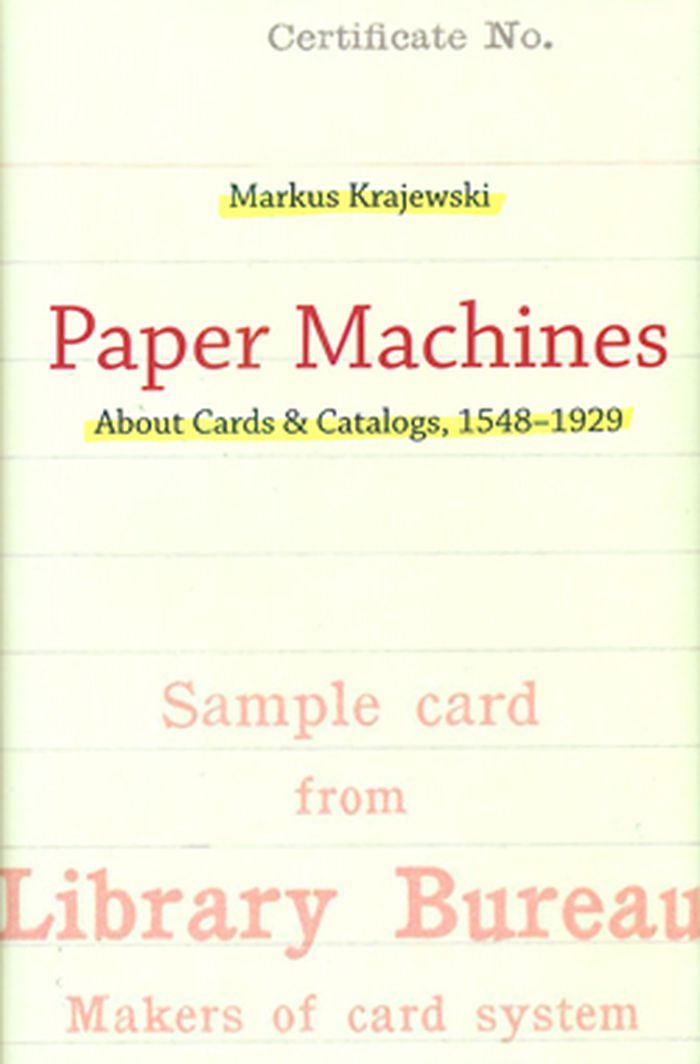
Paper machines : about cards & catalogs, 1548-1929
Actions:
Price:
$31.00
(available to order)
Summary:
Today on almost every desk in every office sits a computer. Eighty years ago, desktops were equipped with a nonelectronic data processing machine: a card file. In this publication, Markus Krajewski traces the evolution of this proto-computer of rearrangeable parts (file cards) that became ubiquitous in offices between the world wars. The story begins with Konrad Gessner, a sixteenth-century Swiss polymath who described a new method of processing data: to cut up a sheet of handwritten notes into slips of paper, with one fact or topic per slip, and arrange as desired. In the late eighteenth century, the card catalog became the librarian's answer to the threat of information overload. Then, at the turn of the twentieth century, business adopted the technology of the card catalog as a bookkeeping tool. Krajewski explores this conceptual development and casts the card file as a "universal paper machine" that accomplishes the basic operations of Turing's universal discrete machine: storing, processing, and transferring data. In telling his story, Krajewski takes the reader on a number of illuminating detours, telling us, for example, that the card catalog and the numbered street address emerged at the same time in the same city (Vienna), and that Harvard University's home-grown cataloging system grew out of a librarian's laziness; and that Melvil Dewey (originator of the Dewey Decimal System) helped bring about the technology transfer of card files to business.
Paper machines : about cards & catalogs, 1548-1929
Actions:
Price:
$31.00
(available to order)
Summary:
Today on almost every desk in every office sits a computer. Eighty years ago, desktops were equipped with a nonelectronic data processing machine: a card file. In this publication, Markus Krajewski traces the evolution of this proto-computer of rearrangeable parts (file cards) that became ubiquitous in offices between the world wars. The story begins with Konrad Gessner, a sixteenth-century Swiss polymath who described a new method of processing data: to cut up a sheet of handwritten notes into slips of paper, with one fact or topic per slip, and arrange as desired. In the late eighteenth century, the card catalog became the librarian's answer to the threat of information overload. Then, at the turn of the twentieth century, business adopted the technology of the card catalog as a bookkeeping tool. Krajewski explores this conceptual development and casts the card file as a "universal paper machine" that accomplishes the basic operations of Turing's universal discrete machine: storing, processing, and transferring data. In telling his story, Krajewski takes the reader on a number of illuminating detours, telling us, for example, that the card catalog and the numbered street address emerged at the same time in the same city (Vienna), and that Harvard University's home-grown cataloging system grew out of a librarian's laziness; and that Melvil Dewey (originator of the Dewey Decimal System) helped bring about the technology transfer of card files to business.
Form:
books
books
Publication:
October 2011
October 2011
Subject:
Archive, library and the digital
Archive, library and the digital
Form:
books
books
Actions:
Price:
$27.50
(available to order)
Summary:
The concept of an encyclopedic museum was born of the Enlightenment, a manifestation of society's growing belief that the spread of knowledge and the promotion of intellectual inquiry were crucial to human development and the future of a rational society. With Museums Matter, James Cuno, president and director of the Art Institute of Chicago, takes us on a brief tour(...)
$27.50
(available to order)
Summary:
The concept of an encyclopedic museum was born of the Enlightenment, a manifestation of society's growing belief that the spread of knowledge and the promotion of intellectual inquiry were crucial to human development and the future of a rational society. With Museums Matter, James Cuno, president and director of the Art Institute of Chicago, takes us on a brief tour(...)
Title:
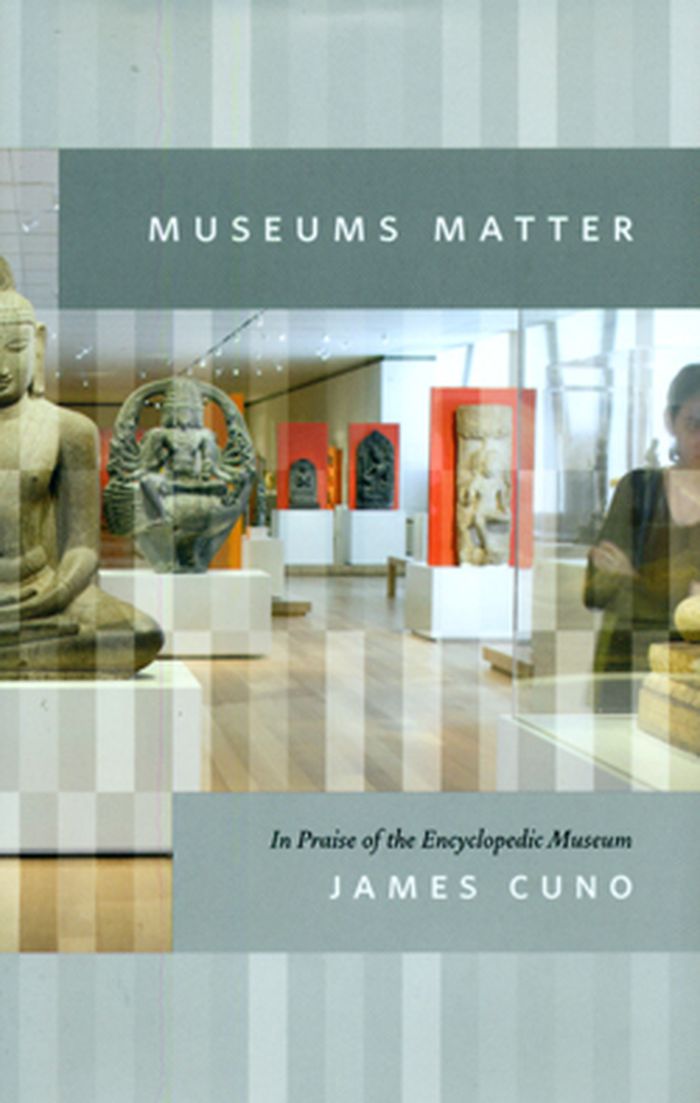
Museums matter: in praise of the encyclopedic museum
Actions:
Price:
$27.50
(available to order)
Summary:
The concept of an encyclopedic museum was born of the Enlightenment, a manifestation of society's growing belief that the spread of knowledge and the promotion of intellectual inquiry were crucial to human development and the future of a rational society. With Museums Matter, James Cuno, president and director of the Art Institute of Chicago, takes us on a brief tour of the modern museum, from the creation of the British Museum - the archetypal encyclopedic collection - to the present, when major museums host millions of visitors annually and play a major role in the cultural lives of their cities. Engaging with thinkers such as Edward Said and Martha Nussbaum, and drawing on examples from the politics of India to the destruction of the Bramiyan Buddhas to the history of trade and travel, Cuno makes a case for the encyclopedic museum as a truly cosmopolitan institution, promoting tolerance, understanding, and a shared sense of history - values that are essential in our ever more globalized age.
Museums matter: in praise of the encyclopedic museum
Actions:
Price:
$27.50
(available to order)
Summary:
The concept of an encyclopedic museum was born of the Enlightenment, a manifestation of society's growing belief that the spread of knowledge and the promotion of intellectual inquiry were crucial to human development and the future of a rational society. With Museums Matter, James Cuno, president and director of the Art Institute of Chicago, takes us on a brief tour of the modern museum, from the creation of the British Museum - the archetypal encyclopedic collection - to the present, when major museums host millions of visitors annually and play a major role in the cultural lives of their cities. Engaging with thinkers such as Edward Said and Martha Nussbaum, and drawing on examples from the politics of India to the destruction of the Bramiyan Buddhas to the history of trade and travel, Cuno makes a case for the encyclopedic museum as a truly cosmopolitan institution, promoting tolerance, understanding, and a shared sense of history - values that are essential in our ever more globalized age.
Form:
books
books
Publication:
December 2011
December 2011
Subject:
Museums and Universal Exhibitions
Museums and Universal Exhibitions
Form:
books
books
Price:
$18.00
(available to order)
Summary:
I Swear I Saw This records visionary anthropologist Michael Taussig’s reflections on the fieldwork notebooks he kept through forty years of travels in Colombia. Taking as a starting point a drawing he made in Medellin in 2006—as well as its caption, “I swear I saw this”—Taussig considers the fieldwork notebook as a type of modernist literature and the place where writers(...)
$18.00
(available to order)
Summary:
I Swear I Saw This records visionary anthropologist Michael Taussig’s reflections on the fieldwork notebooks he kept through forty years of travels in Colombia. Taking as a starting point a drawing he made in Medellin in 2006—as well as its caption, “I swear I saw this”—Taussig considers the fieldwork notebook as a type of modernist literature and the place where writers(...)
Title:
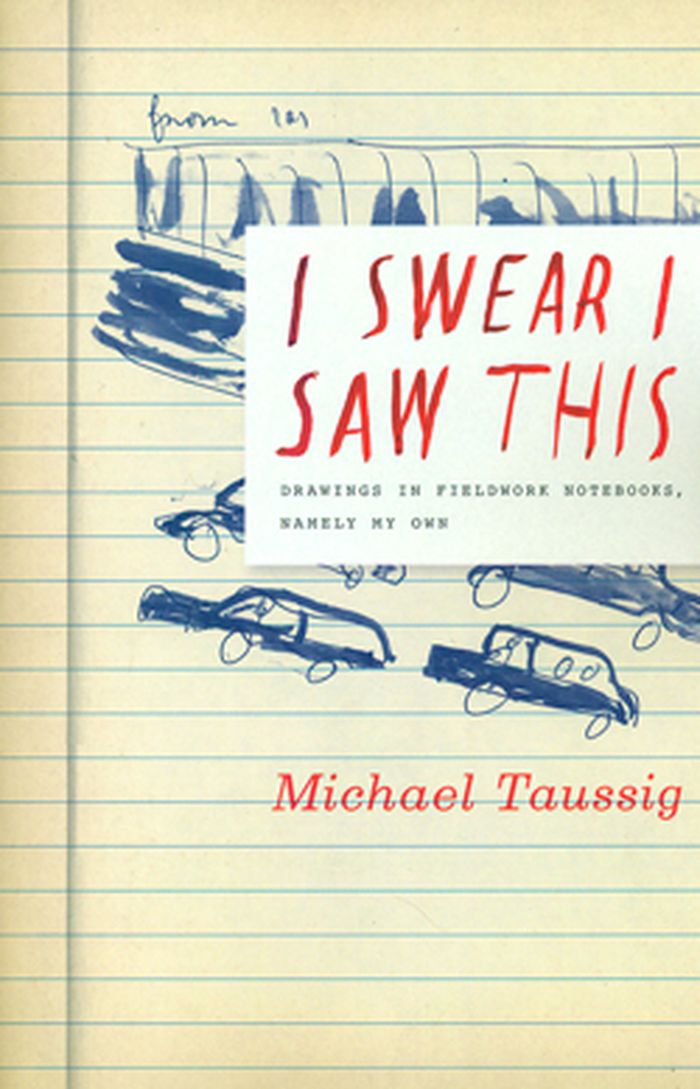
I swear I saw this: drawings in fieldwork notebooks, namely my own
Actions:
Price:
$18.00
(available to order)
Summary:
I Swear I Saw This records visionary anthropologist Michael Taussig’s reflections on the fieldwork notebooks he kept through forty years of travels in Colombia. Taking as a starting point a drawing he made in Medellin in 2006—as well as its caption, “I swear I saw this”—Taussig considers the fieldwork notebook as a type of modernist literature and the place where writers and other creators first work out the imaginative logic of discovery.
I swear I saw this: drawings in fieldwork notebooks, namely my own
Actions:
Price:
$18.00
(available to order)
Summary:
I Swear I Saw This records visionary anthropologist Michael Taussig’s reflections on the fieldwork notebooks he kept through forty years of travels in Colombia. Taking as a starting point a drawing he made in Medellin in 2006—as well as its caption, “I swear I saw this”—Taussig considers the fieldwork notebook as a type of modernist literature and the place where writers and other creators first work out the imaginative logic of discovery.
Form:
books
books
Publication:
December 2011
December 2011
Subject:
Art Theory
Art Theory
Form:
books
books
Actions:
Price:
$74.00
(available to order)
Summary:
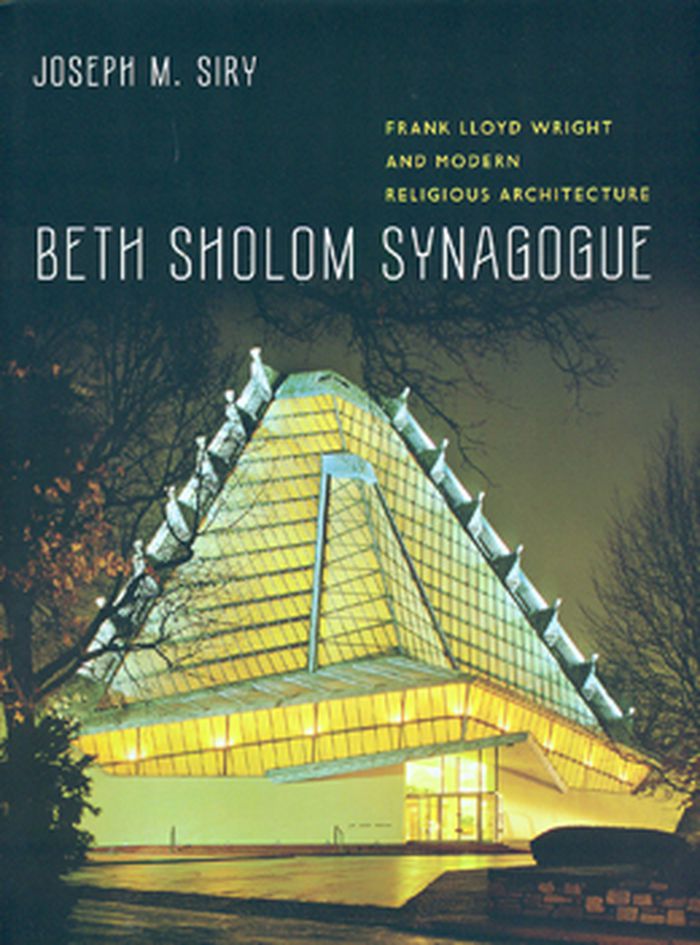
In a suburb just north of Philadelphia stands Beth Sholom Synagogue, Frank Lloyd Wright's only synagogue and among his finest religious buildings. Designated a National Historic Landmark in 2007, Beth Sholom was one of Wright's last completed projects, and for years it has been considered one of his greatest masterpieces.But its full story has never been told. Beth Sholom(...)
$74.00
(available to order)
Summary:
In a suburb just north of Philadelphia stands Beth Sholom Synagogue, Frank Lloyd Wright's only synagogue and among his finest religious buildings. Designated a National Historic Landmark in 2007, Beth Sholom was one of Wright's last completed projects, and for years it has been considered one of his greatest masterpieces.But its full story has never been told. Beth Sholom(...)
Title:
Beth Sholom synagogue : Frank Lloyd Wright and modern religious architecture
Actions:
Price:
$74.00
(available to order)
Summary:
In a suburb just north of Philadelphia stands Beth Sholom Synagogue, Frank Lloyd Wright's only synagogue and among his finest religious buildings. Designated a National Historic Landmark in 2007, Beth Sholom was one of Wright's last completed projects, and for years it has been considered one of his greatest masterpieces.But its full story has never been told. Beth Sholom Synagogue provides the first in-depth look at the synagogue's conception and realization in relation to Wright's other religious architecture. Filled with over three hundred illustrations, this book takes us deep inside the synagogue's design, construction, and reception to bring us an illuminating portrait of the crowning achievement of this important aspect of Wright's career.
Beth Sholom synagogue : Frank Lloyd Wright and modern religious architecture
Actions:
Price:
$74.00
(available to order)
Summary:
In a suburb just north of Philadelphia stands Beth Sholom Synagogue, Frank Lloyd Wright's only synagogue and among his finest religious buildings. Designated a National Historic Landmark in 2007, Beth Sholom was one of Wright's last completed projects, and for years it has been considered one of his greatest masterpieces.But its full story has never been told. Beth Sholom Synagogue provides the first in-depth look at the synagogue's conception and realization in relation to Wright's other religious architecture. Filled with over three hundred illustrations, this book takes us deep inside the synagogue's design, construction, and reception to bring us an illuminating portrait of the crowning achievement of this important aspect of Wright's career.
Form:
books
books
Publication:
December 2011
December 2011
Subject:
Architecture Monographs
Architecture Monographs
Form:
books
books
Title:
Touching photographs
Touching photographs
Actions:
Price:
$38.95
(available to order)
Summary:
Olin investigates the publication of photographs in mass media and literature, the hanging of exhibitions, the posting of photocopied photographs of lost loved ones in public spaces, and the intense photographic activity of tourists at their destinations. She moves from intimate relationships between viewers and photographs to interactions around larger communities,(...)
$38.95
(available to order)
Summary:
Olin investigates the publication of photographs in mass media and literature, the hanging of exhibitions, the posting of photocopied photographs of lost loved ones in public spaces, and the intense photographic activity of tourists at their destinations. She moves from intimate relationships between viewers and photographs to interactions around larger communities,(...)
Title:
Touching photographs
Actions:
Price:
$38.95
(available to order)
Summary:
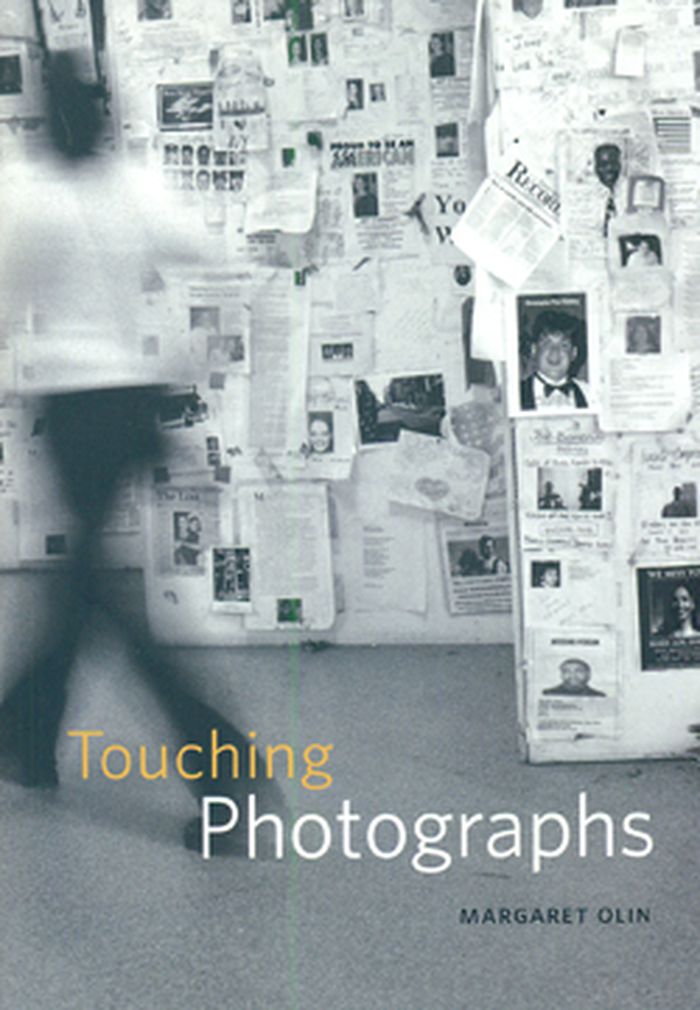
Olin investigates the publication of photographs in mass media and literature, the hanging of exhibitions, the posting of photocopied photographs of lost loved ones in public spaces, and the intense photographic activity of tourists at their destinations. She moves from intimate relationships between viewers and photographs to interactions around larger communities, analyzing how photography affects the way people handle cataclysmic events like 9/11. Along the way, she shows us James VanDerZee’s Harlem funeral portraits, dusts off Roland Barthes’s family album, takes us into Walker Evans and James Agee’s photo-text Let Us Now Praise Famous Men, and logs onto online photo albums. With over one hundred illustrations, Touching Photographs is an insightful contribution to the theory of photography, visual studies, and art history.
Touching photographs
Actions:
Price:
$38.95
(available to order)
Summary:
Olin investigates the publication of photographs in mass media and literature, the hanging of exhibitions, the posting of photocopied photographs of lost loved ones in public spaces, and the intense photographic activity of tourists at their destinations. She moves from intimate relationships between viewers and photographs to interactions around larger communities, analyzing how photography affects the way people handle cataclysmic events like 9/11. Along the way, she shows us James VanDerZee’s Harlem funeral portraits, dusts off Roland Barthes’s family album, takes us into Walker Evans and James Agee’s photo-text Let Us Now Praise Famous Men, and logs onto online photo albums. With over one hundred illustrations, Touching Photographs is an insightful contribution to the theory of photography, visual studies, and art history.
Form:
books
books
Publication:
February 2012
February 2012
Subject:
Theory of Photography
Theory of Photography


