


694 Results
Form:
books
books
Price:
$59.95
(available to order)
Summary:
"Suspensions of Perception" is a major historical study of human attention and its volatile role in modern Western culture. It argues that the ways in which we intently look at or listen to anything result from crucial changes in the nature of perception that can be traced back to(...)
$59.95
(available to order)
Summary:
"Suspensions of Perception" is a major historical study of human attention and its volatile role in modern Western culture. It argues that the ways in which we intently look at or listen to anything result from crucial changes in the nature of perception that can be traced back to(...)
Title:
Suspensions of perception : attention, spectacle, and modern culture
Actions:
Price:
$59.95
(available to order)
Summary:
"Suspensions of Perception" is a major historical study of human attention and its volatile role in modern Western culture. It argues that the ways in which we intently look at or listen to anything result from crucial changes in the nature of perception that can be traced back to the second half of the nineteenth century. Focusing on the period from about 1880 to 1905, Jonathan Crary examines the connections between the modernization of subjectivity and the dramatic expansion and industrialization of visual/auditory culture. At the core of his project is the paradoxical nature of modern attention, which was both a fundamental condition of individual freedom, creativity, and experience and a central element in the efficient functioning of economic and disciplinary institutions as well as the emerging spaces of mass consumption and spectacle. Crary approaches these issues through multiple analyses of single works by three key modernist painters--Manet, Seurat, and Cézanne--who each engaged in a singular confrontation with the disruptions, vacancies, and rifts within a perceptual field. Each in his own way discovered that sustained attentiveness, rather than fixing or securing the world, led to perceptual disintegration and loss of presence, and each used this discovery as the basis for a reinvention of representational practices. Suspensions of Perception decisively relocates the problem of aesthetic contemplation within a broader collective encounter with the unstable nature of perception--in psychology, philosophy, neurology, early cinema, and photography. In doing so, it provides a historical framework for understanding the current social crisis of attention amid the accelerating metamorphoses of our contemporary technological culture.
Suspensions of perception : attention, spectacle, and modern culture
Actions:
Price:
$59.95
(available to order)
Summary:
"Suspensions of Perception" is a major historical study of human attention and its volatile role in modern Western culture. It argues that the ways in which we intently look at or listen to anything result from crucial changes in the nature of perception that can be traced back to the second half of the nineteenth century. Focusing on the period from about 1880 to 1905, Jonathan Crary examines the connections between the modernization of subjectivity and the dramatic expansion and industrialization of visual/auditory culture. At the core of his project is the paradoxical nature of modern attention, which was both a fundamental condition of individual freedom, creativity, and experience and a central element in the efficient functioning of economic and disciplinary institutions as well as the emerging spaces of mass consumption and spectacle. Crary approaches these issues through multiple analyses of single works by three key modernist painters--Manet, Seurat, and Cézanne--who each engaged in a singular confrontation with the disruptions, vacancies, and rifts within a perceptual field. Each in his own way discovered that sustained attentiveness, rather than fixing or securing the world, led to perceptual disintegration and loss of presence, and each used this discovery as the basis for a reinvention of representational practices. Suspensions of Perception decisively relocates the problem of aesthetic contemplation within a broader collective encounter with the unstable nature of perception--in psychology, philosophy, neurology, early cinema, and photography. In doing so, it provides a historical framework for understanding the current social crisis of attention amid the accelerating metamorphoses of our contemporary technological culture.
Form:
books
books
Publication:
October 1999, Cambridge
October 1999, Cambridge
Subject:
Architectural Theory
Architectural Theory
Form:
books
books
Price:
$49.95
(available to order)
Summary:
"Suspensions of Perception" is a major historical study of human attention and its volatile role in modern Western culture. It argues that the ways in which we intently look at or listen to anything result from crucial changes in the nature of perception that can be traced back to(...)
$49.95
(available to order)
Summary:
"Suspensions of Perception" is a major historical study of human attention and its volatile role in modern Western culture. It argues that the ways in which we intently look at or listen to anything result from crucial changes in the nature of perception that can be traced back to(...)
Title:
Suspensions of perception: attention, spectacle, and modern culture
Actions:
Price:
$49.95
(available to order)
Summary:
"Suspensions of Perception" is a major historical study of human attention and its volatile role in modern Western culture. It argues that the ways in which we intently look at or listen to anything result from crucial changes in the nature of perception that can be traced back to the second half of the nineteenth century. Focusing on the period from about 1880 to 1905, Jonathan Crary examines the connections between the modernization of subjectivity and the dramatic expansion and industrialization of visual/auditory culture. At the core of his project is the paradoxical nature of modern attention, which was both a fundamental condition of individual freedom, creativity, and experience and a central element in the efficient functioning of economic and disciplinary institutions as well as the emerging spaces of mass consumption and spectacle. Crary approaches these issues through multiple analyses of single works by three key modernist painters--Manet, Seurat, and Cézanne--who each engaged in a singular confrontation with the disruptions, vacancies, and rifts within a perceptual field. Each in his own way discovered that sustained attentiveness, rather than fixing or securing the world, led to perceptual disintegration and loss of presence, and each used this discovery as the basis for a reinvention of representational practices. Suspensions of Perception decisively relocates the problem of aesthetic contemplation within a broader collective encounter with the unstable nature of perception--in psychology, philosophy, neurology, early cinema, and photography. In doing so, it provides a historical framework for understanding the current social crisis of attention amid the accelerating metamorphoses of our contemporary technological culture.
Suspensions of perception: attention, spectacle, and modern culture
Actions:
Price:
$49.95
(available to order)
Summary:
"Suspensions of Perception" is a major historical study of human attention and its volatile role in modern Western culture. It argues that the ways in which we intently look at or listen to anything result from crucial changes in the nature of perception that can be traced back to the second half of the nineteenth century. Focusing on the period from about 1880 to 1905, Jonathan Crary examines the connections between the modernization of subjectivity and the dramatic expansion and industrialization of visual/auditory culture. At the core of his project is the paradoxical nature of modern attention, which was both a fundamental condition of individual freedom, creativity, and experience and a central element in the efficient functioning of economic and disciplinary institutions as well as the emerging spaces of mass consumption and spectacle. Crary approaches these issues through multiple analyses of single works by three key modernist painters--Manet, Seurat, and Cézanne--who each engaged in a singular confrontation with the disruptions, vacancies, and rifts within a perceptual field. Each in his own way discovered that sustained attentiveness, rather than fixing or securing the world, led to perceptual disintegration and loss of presence, and each used this discovery as the basis for a reinvention of representational practices. Suspensions of Perception decisively relocates the problem of aesthetic contemplation within a broader collective encounter with the unstable nature of perception--in psychology, philosophy, neurology, early cinema, and photography. In doing so, it provides a historical framework for understanding the current social crisis of attention amid the accelerating metamorphoses of our contemporary technological culture.
Form:
books
books
Publication:
August 2001, Cambridge
August 2001, Cambridge
Subject:
Architectural Theory
Architectural Theory
Form:
books
books
Actions:
Price:
$49.95
(available in store)
Summary:
Point Saint-Charles, a historically white working-class neighbourhood with a strong Irish and French presence, and Little Burgundy, a multiracial neighbourhood that is home to the city’s English-speaking Black community, face each other across Montreal’s Lachine Canal, once an artery around which work and industry in Montreal were clustered and by which these two(...)
$49.95
(available in store)
Summary:
Point Saint-Charles, a historically white working-class neighbourhood with a strong Irish and French presence, and Little Burgundy, a multiracial neighbourhood that is home to the city’s English-speaking Black community, face each other across Montreal’s Lachine Canal, once an artery around which work and industry in Montreal were clustered and by which these two(...)
Title:
Deindustrializing Montreal: entangled histories of race, residence, and class
Actions:
Price:
$49.95
(available in store)
Summary:
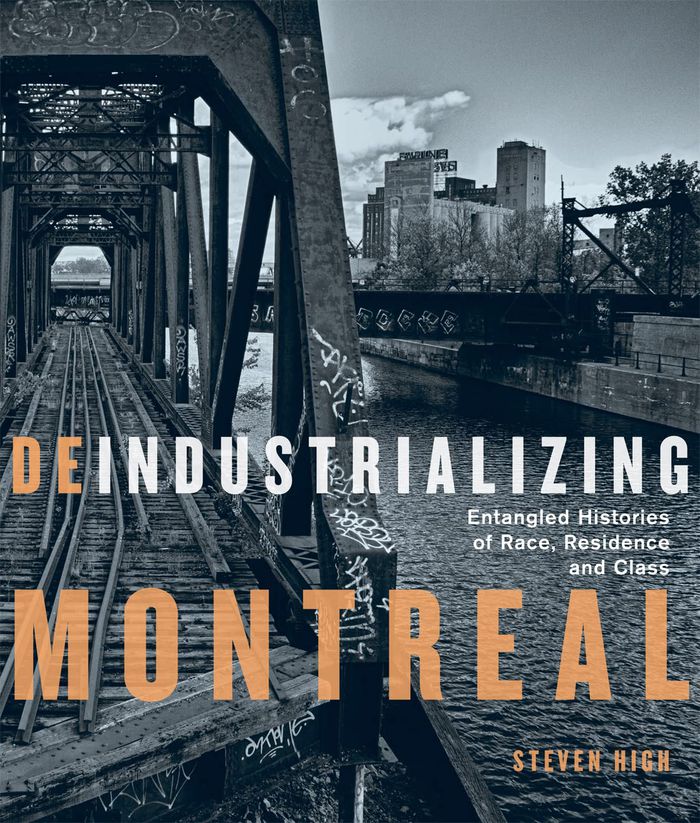
Point Saint-Charles, a historically white working-class neighbourhood with a strong Irish and French presence, and Little Burgundy, a multiracial neighbourhood that is home to the city’s English-speaking Black community, face each other across Montreal’s Lachine Canal, once an artery around which work and industry in Montreal were clustered and by which these two communities were formed and divided. ''Deindustrializing Montreal'' challenges the deepening divergence of class and race analysis by recognizing the intimate relationship between capitalism, class struggles, and racial inequality. Fundamentally, deindustrialization is a process of physical and social ruination as well as part of a wider political project that leaves working-class communities impoverished and demoralized. The structural violence of capitalism occurs gradually and out of sight, but it doesn’t play out the same for everyone. Point Saint-Charles was left to rot until it was revalorized by gentrification, whereas Little Burgundy was torn apart by urban renewal and highway construction. This historical divergence had profound consequences in how urban change has been experienced, understood, and remembered. Drawing extensive interviews, a massive and varied archive of imagery, and original photography by David Lewis into a complex chorus, Steven High brings these communities to life, tracing their history from their earliest years to their decline and their current reality. He extends the analysis of deindustrialization, often focused on single-industry towns, to cities that have seemingly made the post-industrial transition.
Deindustrializing Montreal: entangled histories of race, residence, and class
Actions:
Price:
$49.95
(available in store)
Summary:
Point Saint-Charles, a historically white working-class neighbourhood with a strong Irish and French presence, and Little Burgundy, a multiracial neighbourhood that is home to the city’s English-speaking Black community, face each other across Montreal’s Lachine Canal, once an artery around which work and industry in Montreal were clustered and by which these two communities were formed and divided. ''Deindustrializing Montreal'' challenges the deepening divergence of class and race analysis by recognizing the intimate relationship between capitalism, class struggles, and racial inequality. Fundamentally, deindustrialization is a process of physical and social ruination as well as part of a wider political project that leaves working-class communities impoverished and demoralized. The structural violence of capitalism occurs gradually and out of sight, but it doesn’t play out the same for everyone. Point Saint-Charles was left to rot until it was revalorized by gentrification, whereas Little Burgundy was torn apart by urban renewal and highway construction. This historical divergence had profound consequences in how urban change has been experienced, understood, and remembered. Drawing extensive interviews, a massive and varied archive of imagery, and original photography by David Lewis into a complex chorus, Steven High brings these communities to life, tracing their history from their earliest years to their decline and their current reality. He extends the analysis of deindustrialization, often focused on single-industry towns, to cities that have seemingly made the post-industrial transition.
Form:
books
books
Publication:
May 2022
May 2022
Subject:
Architecture de Montréal
Architecture de Montréal
Form:
books
books
Price:
$59.95
(available to order)
Summary:
SPOON is a comprehensive view of new product design, presenting the work of 100 international designers who have emerged on an international platform in the last five years, selected by 10 critics, designers and entrepreneurs who are highly respected for their informed opinion on the international contemporary design scene. It provides a unique opportunity to see a(...)
$59.95
(available to order)
Summary:
SPOON is a comprehensive view of new product design, presenting the work of 100 international designers who have emerged on an international platform in the last five years, selected by 10 critics, designers and entrepreneurs who are highly respected for their informed opinion on the international contemporary design scene. It provides a unique opportunity to see a(...)
Subject:
Interior Design
Interior Design
Publication:
September 2004, London, New York
September 2004, London, New York
Title:
Spoon
Actions:
Price:
$59.95
(available to order)
Summary:
SPOON is a comprehensive view of new product design, presenting the work of 100 international designers who have emerged on an international platform in the last five years, selected by 10 critics, designers and entrepreneurs who are highly respected for their informed opinion on the international contemporary design scene. It provides a unique opportunity to see a diverse collection of recent design projects that includes a whole range of objects: furniture, lighting, tools, utensils, high-tech products, machinery and so on. The designers are listed in alphabetical order featuring two double-page spreads for each, with recent, exemplary products accompanied with sketches, drawings, computer renderings, model and prototypes that help to explain, together with the extensive captions, the process behind each project. A short explanatory text by the curator explains the designers’ work and the characteristics that make his/her projects forward-looking and ground breaking. SPOON also features, at the end of the book, 10 ‘classic’, industrially manufactured product designs, chosen by the curators as best examples of the concept of ‘good design’. These ‘classics’ are accompanied by text written by the curators that explains their choice of designers and generally what they see to be the concept of ‘good design’. SPOON takes its place in a series of surveys identifying 100 of the most interesting, cutting-edge practitioners of key art forms. Earlier surveys include cream and Fresh Cream, for contemporary art, 10x10 for architecture and BLINK for photography.
Spoon
Actions:
Price:
$59.95
(available to order)
Summary:
SPOON is a comprehensive view of new product design, presenting the work of 100 international designers who have emerged on an international platform in the last five years, selected by 10 critics, designers and entrepreneurs who are highly respected for their informed opinion on the international contemporary design scene. It provides a unique opportunity to see a diverse collection of recent design projects that includes a whole range of objects: furniture, lighting, tools, utensils, high-tech products, machinery and so on. The designers are listed in alphabetical order featuring two double-page spreads for each, with recent, exemplary products accompanied with sketches, drawings, computer renderings, model and prototypes that help to explain, together with the extensive captions, the process behind each project. A short explanatory text by the curator explains the designers’ work and the characteristics that make his/her projects forward-looking and ground breaking. SPOON also features, at the end of the book, 10 ‘classic’, industrially manufactured product designs, chosen by the curators as best examples of the concept of ‘good design’. These ‘classics’ are accompanied by text written by the curators that explains their choice of designers and generally what they see to be the concept of ‘good design’. SPOON takes its place in a series of surveys identifying 100 of the most interesting, cutting-edge practitioners of key art forms. Earlier surveys include cream and Fresh Cream, for contemporary art, 10x10 for architecture and BLINK for photography.
Form:
books
books
Publication:
September 2004, London, New York
September 2004, London, New York
Subject:
Interior Design
Interior Design


