


6943 Results
Form:
books
books
Actions:
Price:
$50.00
(available to order)
Summary:
With "Edens lost & found", filmmakers Harry Wiland and Dale Bell herald a sea change in the relationship between ordinary citizens, environmental groups, and government. From across America they gather evidence of a new spirit of cooperation among neighbors, planners, architects and builders, city officials, and government agencies. Indeed, as urban issues have become(...)
$50.00
(available to order)
Summary:
With "Edens lost & found", filmmakers Harry Wiland and Dale Bell herald a sea change in the relationship between ordinary citizens, environmental groups, and government. From across America they gather evidence of a new spirit of cooperation among neighbors, planners, architects and builders, city officials, and government agencies. Indeed, as urban issues have become(...)
Subject:
Urban Landscapes
Urban Landscapes
Publication:
May 2006, White River Junction
May 2006, White River Junction
Title:
Edens lost and found : how ordinary citizens are restoring our great American cities
Actions:
Price:
$50.00
(available to order)
Summary:
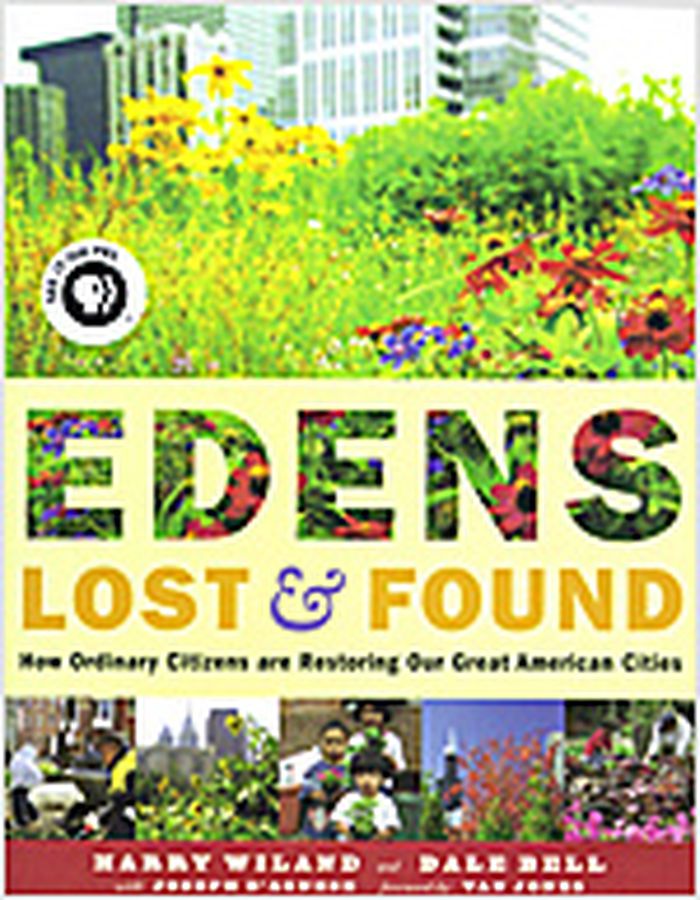
With "Edens lost & found", filmmakers Harry Wiland and Dale Bell herald a sea change in the relationship between ordinary citizens, environmental groups, and government. From across America they gather evidence of a new spirit of cooperation among neighbors, planners, architects and builders, city officials, and government agencies. Indeed, as urban issues have become undeniably urgent problems that demand answers, people from disparate backgrounds and political leanings are joining forces to recast life in American cities. As citizens take action where government has failed, they are finding support, encouragement, and help from their neighbors. Conversely, as progressive-minded government agencies and organizations explore nontraditional solutions, an energized community rallies to the cause. Neither exclusively top-down, nor grass roots, we are in the midst of an unprecedented movement that unites efforts from every quarter in a common cause. Focusing on Chicago, Los Angeles, Philadelphia, and Seattle-four cities that face vastly different challenges-"Edens lost & found" highlights the remarkable power of hope, pride, ingenuity, and chutzpah that characterize this era of collaboration. Bioengineering concepts-now increasingly understood by many to offer the most effective, cost-efficient solutions-are playing a central role. Working with-rather than in opposition to-nature is leading to such innovations as rooftop and urban gardens, restored parks, transformed vacant lots, the re-greening of city streets, and eco-friendly watershed management. Edens Lost & Found shows how working to reshape the land also transforms the relationships people have to one another.
Edens lost and found : how ordinary citizens are restoring our great American cities
Actions:
Price:
$50.00
(available to order)
Summary:
With "Edens lost & found", filmmakers Harry Wiland and Dale Bell herald a sea change in the relationship between ordinary citizens, environmental groups, and government. From across America they gather evidence of a new spirit of cooperation among neighbors, planners, architects and builders, city officials, and government agencies. Indeed, as urban issues have become undeniably urgent problems that demand answers, people from disparate backgrounds and political leanings are joining forces to recast life in American cities. As citizens take action where government has failed, they are finding support, encouragement, and help from their neighbors. Conversely, as progressive-minded government agencies and organizations explore nontraditional solutions, an energized community rallies to the cause. Neither exclusively top-down, nor grass roots, we are in the midst of an unprecedented movement that unites efforts from every quarter in a common cause. Focusing on Chicago, Los Angeles, Philadelphia, and Seattle-four cities that face vastly different challenges-"Edens lost & found" highlights the remarkable power of hope, pride, ingenuity, and chutzpah that characterize this era of collaboration. Bioengineering concepts-now increasingly understood by many to offer the most effective, cost-efficient solutions-are playing a central role. Working with-rather than in opposition to-nature is leading to such innovations as rooftop and urban gardens, restored parks, transformed vacant lots, the re-greening of city streets, and eco-friendly watershed management. Edens Lost & Found shows how working to reshape the land also transforms the relationships people have to one another.
Form:
books
books
Publication:
May 2006, White River Junction
May 2006, White River Junction
Subject:
Urban Landscapes
Urban Landscapes
Form:
books
books
Actions:
Price:
$56.00
(available to order)
Summary:
Originally published in 1983, ''Writings 1973-1983 on Works 1969-1979,'' by Los Angeles artist Michael Asher (1943-2012) presents select documentation of 33 works through writings, photographs, architectural floor plans, exhibition announcements and other ephemera. For most of his career, Asher did not create traditional art objects; instead, he altered the existing(...)
$56.00
(available to order)
Summary:
Originally published in 1983, ''Writings 1973-1983 on Works 1969-1979,'' by Los Angeles artist Michael Asher (1943-2012) presents select documentation of 33 works through writings, photographs, architectural floor plans, exhibition announcements and other ephemera. For most of his career, Asher did not create traditional art objects; instead, he altered the existing(...)
Title:
Michael Asher: writings 1973–1983 on works 1969–1979
Actions:
Price:
$56.00
(available to order)
Summary:
Originally published in 1983, ''Writings 1973-1983 on Works 1969-1979,'' by Los Angeles artist Michael Asher (1943-2012) presents select documentation of 33 works through writings, photographs, architectural floor plans, exhibition announcements and other ephemera. For most of his career, Asher did not create traditional art objects; instead, he altered the existing institutional apparatus through which art is presented, creating work that intervened in the architectural, social or economic systems that undergird how art is produced and experienced. For example, in 1974, he removed the partition wall dividing the office and gallery space of the Claire S. Copley Gallery in Los Angeles, revealing the day-to-day activities of the gallery to the public. In another work from 1979, Asher had a bronze replica of a late 18th-century sculpture of George Washington moved from the exterior of the Art Institute of Chicago to a museum gallery that housed 18th-century art, reintroducing the statue to its original period context and shifting its function from public monument to indoor sculpture. Due to its site- and time-specific nature, Asher’s work generally ceased to exist after an exhibition, which makes this highly sought-after book an invaluable resource. As the artist states in the introduction: ''This book as a finished product will have a material permanence that contradicts the actual impermanence of the art-work, yet paradoxically functions as a testimony to that impermanence of my production.''
Michael Asher: writings 1973–1983 on works 1969–1979
Actions:
Price:
$56.00
(available to order)
Summary:
Originally published in 1983, ''Writings 1973-1983 on Works 1969-1979,'' by Los Angeles artist Michael Asher (1943-2012) presents select documentation of 33 works through writings, photographs, architectural floor plans, exhibition announcements and other ephemera. For most of his career, Asher did not create traditional art objects; instead, he altered the existing institutional apparatus through which art is presented, creating work that intervened in the architectural, social or economic systems that undergird how art is produced and experienced. For example, in 1974, he removed the partition wall dividing the office and gallery space of the Claire S. Copley Gallery in Los Angeles, revealing the day-to-day activities of the gallery to the public. In another work from 1979, Asher had a bronze replica of a late 18th-century sculpture of George Washington moved from the exterior of the Art Institute of Chicago to a museum gallery that housed 18th-century art, reintroducing the statue to its original period context and shifting its function from public monument to indoor sculpture. Due to its site- and time-specific nature, Asher’s work generally ceased to exist after an exhibition, which makes this highly sought-after book an invaluable resource. As the artist states in the introduction: ''This book as a finished product will have a material permanence that contradicts the actual impermanence of the art-work, yet paradoxically functions as a testimony to that impermanence of my production.''
Form:
books
books
Publication:
November 2020
November 2020
Subject:
Art Theory
Art Theory
Form:
books
books
Actions:
Price:
$21.00
(available to order)
Summary:
For nearly twenty years now, Blair Kamin of the "Chicago Tribune" has explored how architecture captures our imagination and engages our deepest emotions. A winner of the Pulitzer Prize for criticism and writer of the widely read "Cityscapes" blog, Kamin treats his subjects not only as works of art but also as symbols of the cultural and political forces that inspire(...)
$21.00
(available to order)
Summary:
For nearly twenty years now, Blair Kamin of the "Chicago Tribune" has explored how architecture captures our imagination and engages our deepest emotions. A winner of the Pulitzer Prize for criticism and writer of the widely read "Cityscapes" blog, Kamin treats his subjects not only as works of art but also as symbols of the cultural and political forces that inspire(...)
Title:
Terror and wonder : architecture in a tumultuous age
Actions:
Price:
$21.00
(available to order)
Summary:
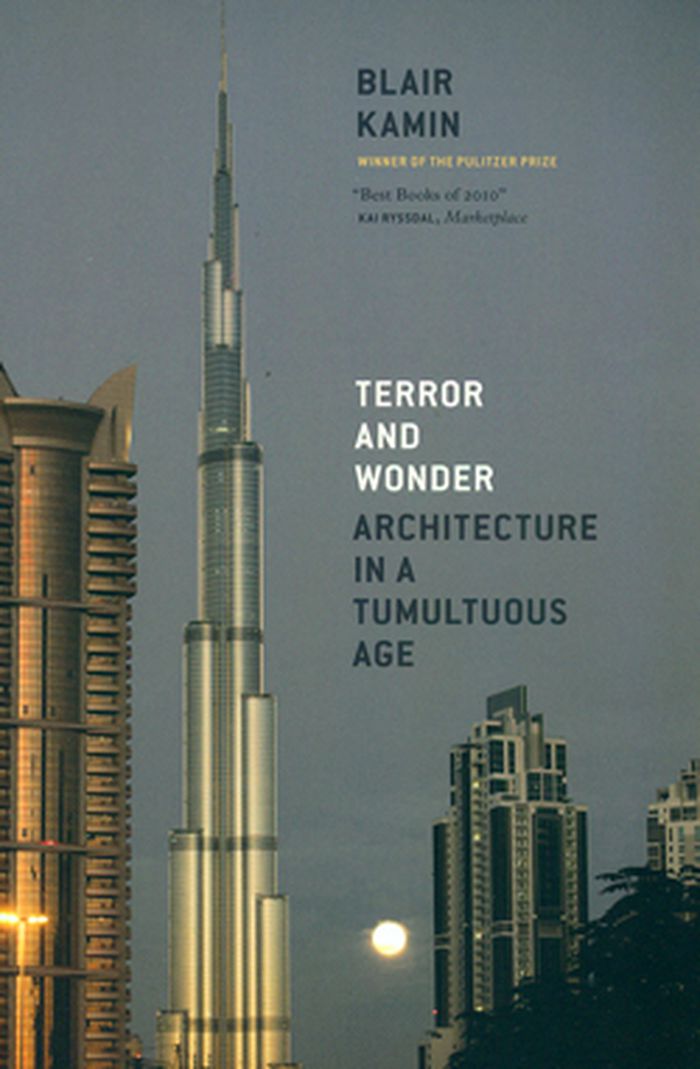
For nearly twenty years now, Blair Kamin of the "Chicago Tribune" has explored how architecture captures our imagination and engages our deepest emotions. A winner of the Pulitzer Prize for criticism and writer of the widely read "Cityscapes" blog, Kamin treats his subjects not only as works of art but also as symbols of the cultural and political forces that inspire them. Terror and Wonder gathers the best of Kamin's writings from the past decade along with new reflections on an era framed by the destruction of the World Trade Center and the opening of the world's tallest skyscraper. Assessing ordinary commercial structures as well as head-turning designs by some of the world's leading architects, Kamin paints a sweeping but finely textured portrait of a tumultuous age torn between the conflicting mandates of architectural spectacle and sustainability. For Kamin, the story of our built environment over the past ten years is, in tangible ways, the story of the decade itself. Terror and Wonder considers how architecture has been central to the main events and crosscurrents in American life since 2001: the devastating and debilitating consequences of 9/11 and Hurricane Katrina; the real estate boom and bust; the use of over-the-top cultural designs as engines of civic renewal; new challenges in saving old buildings; the unlikely rise of energy-saving, green architecture; and growing concern over our nation's crumbling infrastructure.
Terror and wonder : architecture in a tumultuous age
Actions:
Price:
$21.00
(available to order)
Summary:
For nearly twenty years now, Blair Kamin of the "Chicago Tribune" has explored how architecture captures our imagination and engages our deepest emotions. A winner of the Pulitzer Prize for criticism and writer of the widely read "Cityscapes" blog, Kamin treats his subjects not only as works of art but also as symbols of the cultural and political forces that inspire them. Terror and Wonder gathers the best of Kamin's writings from the past decade along with new reflections on an era framed by the destruction of the World Trade Center and the opening of the world's tallest skyscraper. Assessing ordinary commercial structures as well as head-turning designs by some of the world's leading architects, Kamin paints a sweeping but finely textured portrait of a tumultuous age torn between the conflicting mandates of architectural spectacle and sustainability. For Kamin, the story of our built environment over the past ten years is, in tangible ways, the story of the decade itself. Terror and Wonder considers how architecture has been central to the main events and crosscurrents in American life since 2001: the devastating and debilitating consequences of 9/11 and Hurricane Katrina; the real estate boom and bust; the use of over-the-top cultural designs as engines of civic renewal; new challenges in saving old buildings; the unlikely rise of energy-saving, green architecture; and growing concern over our nation's crumbling infrastructure.
Form:
books
books
Publication:
September 2011
September 2011
Subject:
Architectural Theory
Architectural Theory
Form:
books
books
Title:
The new downtown library
The new downtown library
Actions:
Price:
$45.00
(available to order)
Summary:
The past twenty years have seen a building boom for downtown public libraries. From Brooklyn to Seattle, architects, civic leaders, and citizens in major U.S. cities have worked to reassert the relevance of the central library. While the libraries’ primary functions—as public spaces where information is gathered, organized, preserved, and made available for use—have not(...)
$45.00
(available to order)
Summary:
The past twenty years have seen a building boom for downtown public libraries. From Brooklyn to Seattle, architects, civic leaders, and citizens in major U.S. cities have worked to reassert the relevance of the central library. While the libraries’ primary functions—as public spaces where information is gathered, organized, preserved, and made available for use—have not(...)
Subject:
Commercial interiors, Building types
Commercial interiors, Building types
Publication:
January 2007, Minneapolis / London
January 2007, Minneapolis / London
Title:
The new downtown library
Actions:
Price:
$45.00
(available to order)
Summary:
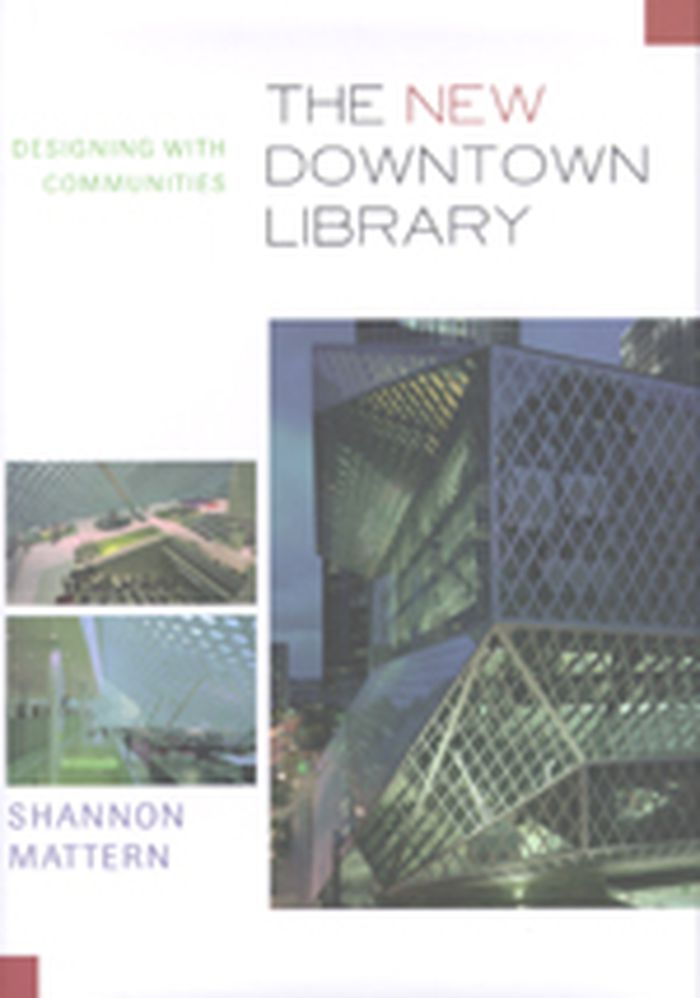
The past twenty years have seen a building boom for downtown public libraries. From Brooklyn to Seattle, architects, civic leaders, and citizens in major U.S. cities have worked to reassert the relevance of the central library. While the libraries’ primary functions—as public spaces where information is gathered, organized, preserved, and made available for use—have not changed over the years, the processes by which they accomplish these goals have. These new processes, and the public debates surrounding them, have radically influenced the utility and design of new library buildings. In The New Downtown Library, Shannon Mattern draws on a diverse range of sources to investigate how libraries serve as multiuse public spaces, anchors in urban redevelopment, civic icons, and showcases of renowned architects like Rem Koolhaas, Cesar Pelli, and Enrique Norton. Mattern’s clear and careful analysis reveals the complexity of contemporary dialogues in library design, highlighting the roles that staff, the public, and other special interest groups play. Mattern also describes how the libraries manifest changing demographics, new ways of organizing collections and delivering media, and current philosophies of librarianship. By identifying unifying themes as well as examining the differences among various design projects, Mattern brings to light the social forces, as well as their architectural expressions, that form the essence of new libraries and their vital place in public life. Featured libraries are located in Brooklyn, Cincinnati, Cleveland, Chicago, Denver, Los Angeles, Minneapolis, Nashville, New York, Phoenix, Salt Lake City, San Antonio, San Francisco, Seattle, and Toledo.
The new downtown library
Actions:
Price:
$45.00
(available to order)
Summary:
The past twenty years have seen a building boom for downtown public libraries. From Brooklyn to Seattle, architects, civic leaders, and citizens in major U.S. cities have worked to reassert the relevance of the central library. While the libraries’ primary functions—as public spaces where information is gathered, organized, preserved, and made available for use—have not changed over the years, the processes by which they accomplish these goals have. These new processes, and the public debates surrounding them, have radically influenced the utility and design of new library buildings. In The New Downtown Library, Shannon Mattern draws on a diverse range of sources to investigate how libraries serve as multiuse public spaces, anchors in urban redevelopment, civic icons, and showcases of renowned architects like Rem Koolhaas, Cesar Pelli, and Enrique Norton. Mattern’s clear and careful analysis reveals the complexity of contemporary dialogues in library design, highlighting the roles that staff, the public, and other special interest groups play. Mattern also describes how the libraries manifest changing demographics, new ways of organizing collections and delivering media, and current philosophies of librarianship. By identifying unifying themes as well as examining the differences among various design projects, Mattern brings to light the social forces, as well as their architectural expressions, that form the essence of new libraries and their vital place in public life. Featured libraries are located in Brooklyn, Cincinnati, Cleveland, Chicago, Denver, Los Angeles, Minneapolis, Nashville, New York, Phoenix, Salt Lake City, San Antonio, San Francisco, Seattle, and Toledo.
Form:
books
books
Publication:
January 2007, Minneapolis / London
January 2007, Minneapolis / London
Subject:
Commercial interiors, Building types
Commercial interiors, Building types
Form:
books
books
Actions:
Price:
$28.95
(available to order)
Summary:
The shift in the ideological winds toward a "free-market" economy has brought profound effects in urban areas. "The neoliberal city" presents an overview of the effect of these changes on today's cities. The term "neoliberalism" was originally used in reference to a set of practices that first-world institutions like the IMF and World Bank impose on third-world countries(...)
$28.95
(available to order)
Summary:
The shift in the ideological winds toward a "free-market" economy has brought profound effects in urban areas. "The neoliberal city" presents an overview of the effect of these changes on today's cities. The term "neoliberalism" was originally used in reference to a set of practices that first-world institutions like the IMF and World Bank impose on third-world countries(...)
Title:
The neoliberal city : governance, ideology, and development in american urbanism
Actions:
Price:
$28.95
(available to order)
Summary:
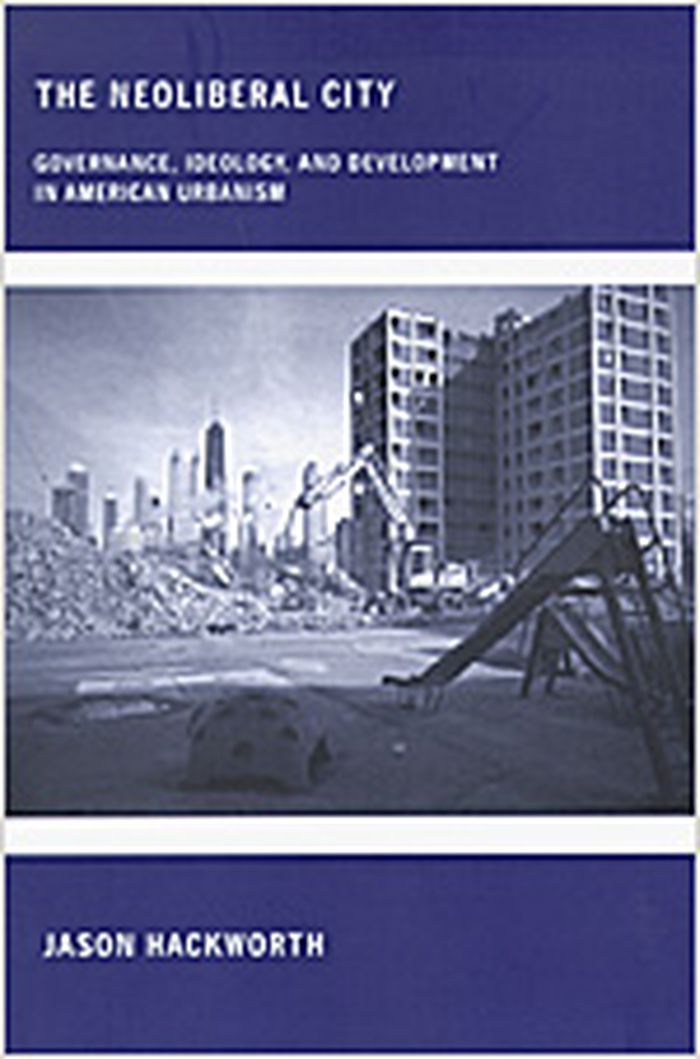
The shift in the ideological winds toward a "free-market" economy has brought profound effects in urban areas. "The neoliberal city" presents an overview of the effect of these changes on today's cities. The term "neoliberalism" was originally used in reference to a set of practices that first-world institutions like the IMF and World Bank impose on third-world countries and cities. The support of unimpeded trade and individual freedoms and the discouragement of state regulation and social spending are the putative centerpieces of this vision. More and more, though, people have come to recognize that first-world cities are undergoing the same processes. In "The neoliberal city", Jason Hackworth argues that neoliberal policies are in fact having a profound effect on the nature and direction of urbanization in the United States and other wealthy countries, and that much can be learned from studying its effect. He explores the impact that neoliberalism has had on three aspects of urbanization in the United States: governance, urban form, and social movements. The American inner city is seen as a crucial battle zone for the wider neoliberal transition primarily because it embodies neoliberalism's antithesis, Keynesian egalitarian liberalism. Focusing on issues such as gentrification in New York City; public-housing policy in New York, Chicago, and Seattle; downtown redevelopment in Phoenix; and urban-landscape change in New Brunswick, N.J., Hackworth shows us how material and symbolic changes to institutions, neighborhoods, and entire urban regions can be traced in part to the rise of neoliberalism.
The neoliberal city : governance, ideology, and development in american urbanism
Actions:
Price:
$28.95
(available to order)
Summary:
The shift in the ideological winds toward a "free-market" economy has brought profound effects in urban areas. "The neoliberal city" presents an overview of the effect of these changes on today's cities. The term "neoliberalism" was originally used in reference to a set of practices that first-world institutions like the IMF and World Bank impose on third-world countries and cities. The support of unimpeded trade and individual freedoms and the discouragement of state regulation and social spending are the putative centerpieces of this vision. More and more, though, people have come to recognize that first-world cities are undergoing the same processes. In "The neoliberal city", Jason Hackworth argues that neoliberal policies are in fact having a profound effect on the nature and direction of urbanization in the United States and other wealthy countries, and that much can be learned from studying its effect. He explores the impact that neoliberalism has had on three aspects of urbanization in the United States: governance, urban form, and social movements. The American inner city is seen as a crucial battle zone for the wider neoliberal transition primarily because it embodies neoliberalism's antithesis, Keynesian egalitarian liberalism. Focusing on issues such as gentrification in New York City; public-housing policy in New York, Chicago, and Seattle; downtown redevelopment in Phoenix; and urban-landscape change in New Brunswick, N.J., Hackworth shows us how material and symbolic changes to institutions, neighborhoods, and entire urban regions can be traced in part to the rise of neoliberalism.
Form:
books
books
Publication:
December 2006, Ithaca, London
December 2006, Ithaca, London
Subject:
Urban Theory
Urban Theory
Form:
books
books
Actions:
Price:
$19.95
(available to order)
Summary:
Architect Jong Soung Kimm has his roots in Korea, but he spent his formative years as an architect in Chicago. He was educated at the Illinois Institute of Technology and after graduation he worked in the studio of Ludwig Mies van der Rohe for over ten years until 1972. While working for the master, Kimm participated in, among others, the Toronto-Dominion Centre(...)
$19.95
(available to order)
Summary:
Architect Jong Soung Kimm has his roots in Korea, but he spent his formative years as an architect in Chicago. He was educated at the Illinois Institute of Technology and after graduation he worked in the studio of Ludwig Mies van der Rohe for over ten years until 1972. While working for the master, Kimm participated in, among others, the Toronto-Dominion Centre(...)
Title:
Tectonic logic and spatial imagination
Actions:
Price:
$19.95
(available to order)
Summary:
Architect Jong Soung Kimm has his roots in Korea, but he spent his formative years as an architect in Chicago. He was educated at the Illinois Institute of Technology and after graduation he worked in the studio of Ludwig Mies van der Rohe for over ten years until 1972. While working for the master, Kimm participated in, among others, the Toronto-Dominion Centre Banking Hal, the Reception Hall on the 54th floor of the T-D Centre, or the 1968 Mies van der Rohe Retrospective at the Akademie der Künste in Berlin; exhibition design proposal for the new Brown Wing of the Museum of Fine Arts in Houston. All these projects deal with a unique Miesian mode of creating space which Mies van der Rohe had pioneered since Barcelona Pavilion (1928/29) and Tugendhat House (1928-30). Over the last twenty some years after his return to Seoul in 1978, Jong Soung Kimm has produced a significant body of built work as the lead architect of SAC International, which grew and developed under his participation. Some of the more significant work of architecture will be presented in this exhibition. Kimm’s work is characterized not only by his obvious debt to the principles of Mies van der Rohe, but also by Kimm’s sensibility derived from the cultural milieu he hails from. Eight projects will be shown that encompass museums, university buildings, a long span gymnasium building, two high-rise structures, one a hotel, the other a headquarters office for a major global enterprise. It is timely to present the work of an architect with multi-cultural background such as Jong Soung Kimm in our increasingly global architectural scene today.
Tectonic logic and spatial imagination
Actions:
Price:
$19.95
(available to order)
Summary:
Architect Jong Soung Kimm has his roots in Korea, but he spent his formative years as an architect in Chicago. He was educated at the Illinois Institute of Technology and after graduation he worked in the studio of Ludwig Mies van der Rohe for over ten years until 1972. While working for the master, Kimm participated in, among others, the Toronto-Dominion Centre Banking Hal, the Reception Hall on the 54th floor of the T-D Centre, or the 1968 Mies van der Rohe Retrospective at the Akademie der Künste in Berlin; exhibition design proposal for the new Brown Wing of the Museum of Fine Arts in Houston. All these projects deal with a unique Miesian mode of creating space which Mies van der Rohe had pioneered since Barcelona Pavilion (1928/29) and Tugendhat House (1928-30). Over the last twenty some years after his return to Seoul in 1978, Jong Soung Kimm has produced a significant body of built work as the lead architect of SAC International, which grew and developed under his participation. Some of the more significant work of architecture will be presented in this exhibition. Kimm’s work is characterized not only by his obvious debt to the principles of Mies van der Rohe, but also by Kimm’s sensibility derived from the cultural milieu he hails from. Eight projects will be shown that encompass museums, university buildings, a long span gymnasium building, two high-rise structures, one a hotel, the other a headquarters office for a major global enterprise. It is timely to present the work of an architect with multi-cultural background such as Jong Soung Kimm in our increasingly global architectural scene today.
Form:
books
books
Publication:
October 2006, Berlin
October 2006, Berlin
Subject:
small format
small format
Form:
books
books
Title:
The gray cloth
The gray cloth
Actions:
Price:
$44.95
(available to order)
Summary:
The German expressionist, architectural visionary, author, inventor, and artist Paul Scheerbart (1863-1915) wrote several fictional utopian narratives related to glass architecture. In "The Gray Cloth", the first of his novels to be translated into English, Scheerbart uses subtle irony and the structural simplicity of a fairy tale to present the theories of coloured glass(...)
$44.95
(available to order)
Summary:
The German expressionist, architectural visionary, author, inventor, and artist Paul Scheerbart (1863-1915) wrote several fictional utopian narratives related to glass architecture. In "The Gray Cloth", the first of his novels to be translated into English, Scheerbart uses subtle irony and the structural simplicity of a fairy tale to present the theories of coloured glass(...)
Title:
The gray cloth
Actions:
Price:
$44.95
(available to order)
Summary:
The German expressionist, architectural visionary, author, inventor, and artist Paul Scheerbart (1863-1915) wrote several fictional utopian narratives related to glass architecture. In "The Gray Cloth", the first of his novels to be translated into English, Scheerbart uses subtle irony and the structural simplicity of a fairy tale to present the theories of coloured glass outlined in his well-known treatise "Glass Architecture". The novel is set forward in time to the mid-twentieth century. The protagonist, a Swiss architect named Edgar Krug, circumnavigates the globe by airship with his wife, constructing wildly varied, colored-glass buildings. His projects include a high-rise and exhibition/concert hall in Chicago, a retirement complex for air pilots on the Fiji Islands, the structure for an elevated train across a zoological park in northern India, and a suspended residential villa on the Kuria Muria Islands off the coast of Oman in the Arabian Sea. Fearing that his architecture is challenged by the colourfulness of women’s clothing, Krug insists that his wife wear all gray clothing with the addition of ten percent white. This odd demand brings him notoriety and sensationalizes his international building campaign. For the reader, it underlines the confluence of architecture with fashion, gender, and global media. In his introduction John Stuart surveys Scheerbart’s career and role in German avant-garde circles, as well as his architectural and social ideas. He shows how Scheerbart strove to integrate his spiritual and romantic leanings with the modern world, often relying on glass architecture to do so. In addition to discussing the novel’s reception and its rediscovery by contemporary architects and critics, Stuart shows fiction to be a resource for the study of architecture and places "The Gray Cloth" in the context of German Expressionism.
The gray cloth
Actions:
Price:
$44.95
(available to order)
Summary:
The German expressionist, architectural visionary, author, inventor, and artist Paul Scheerbart (1863-1915) wrote several fictional utopian narratives related to glass architecture. In "The Gray Cloth", the first of his novels to be translated into English, Scheerbart uses subtle irony and the structural simplicity of a fairy tale to present the theories of coloured glass outlined in his well-known treatise "Glass Architecture". The novel is set forward in time to the mid-twentieth century. The protagonist, a Swiss architect named Edgar Krug, circumnavigates the globe by airship with his wife, constructing wildly varied, colored-glass buildings. His projects include a high-rise and exhibition/concert hall in Chicago, a retirement complex for air pilots on the Fiji Islands, the structure for an elevated train across a zoological park in northern India, and a suspended residential villa on the Kuria Muria Islands off the coast of Oman in the Arabian Sea. Fearing that his architecture is challenged by the colourfulness of women’s clothing, Krug insists that his wife wear all gray clothing with the addition of ten percent white. This odd demand brings him notoriety and sensationalizes his international building campaign. For the reader, it underlines the confluence of architecture with fashion, gender, and global media. In his introduction John Stuart surveys Scheerbart’s career and role in German avant-garde circles, as well as his architectural and social ideas. He shows how Scheerbart strove to integrate his spiritual and romantic leanings with the modern world, often relying on glass architecture to do so. In addition to discussing the novel’s reception and its rediscovery by contemporary architects and critics, Stuart shows fiction to be a resource for the study of architecture and places "The Gray Cloth" in the context of German Expressionism.
Form:
books
books
Publication:
October 2001, Cambridge, Mass.
October 2001, Cambridge, Mass.
Subject:
Architectural Theory
Architectural Theory
Form:
books
books
Title:
The gray cloth
The gray cloth
Actions:
Price:
$24.95
(available to order)
Summary:
The German expressionist, architectural visionary, author, inventor, and artist Paul Scheerbart (1863-1915) wrote several fictional utopian narratives related to glass architecture. In "The Gray Cloth", the first of his novels to be translated into English, Scheerbart uses subtle irony and the structural simplicity of a fairy tale to present the theories of coloured glass(...)
$24.95
(available to order)
Summary:
The German expressionist, architectural visionary, author, inventor, and artist Paul Scheerbart (1863-1915) wrote several fictional utopian narratives related to glass architecture. In "The Gray Cloth", the first of his novels to be translated into English, Scheerbart uses subtle irony and the structural simplicity of a fairy tale to present the theories of coloured glass(...)
Title:
The gray cloth
Actions:
Price:
$24.95
(available to order)
Summary:
The German expressionist, architectural visionary, author, inventor, and artist Paul Scheerbart (1863-1915) wrote several fictional utopian narratives related to glass architecture. In "The Gray Cloth", the first of his novels to be translated into English, Scheerbart uses subtle irony and the structural simplicity of a fairy tale to present the theories of coloured glass outlined in his well-known treatise "Glass Architecture". The novel is set forward in time to the mid-twentieth century. The protagonist, a Swiss architect named Edgar Krug, circumnavigates the globe by airship with his wife, constructing wildly varied, colored-glass buildings. His projects include a high-rise and exhibition/concert hall in Chicago, a retirement complex for air pilots on the Fiji Islands, the structure for an elevated train across a zoological park in northern India, and a suspended residential villa on the Kuria Muria Islands off the coast of Oman in the Arabian Sea. Fearing that his architecture is challenged by the colourfulness of women’s clothing, Krug insists that his wife wear all gray clothing with the addition of ten percent white. This odd demand brings him notoriety and sensationalizes his international building campaign. For the reader, it underlines the confluence of architecture with fashion, gender, and global media. In his introduction John Stuart surveys Scheerbart’s career and role in German avant-garde circles, as well as his architectural and social ideas. He shows how Scheerbart strove to integrate his spiritual and romantic leanings with the modern world, often relying on glass architecture to do so. In addition to discussing the novel’s reception and its rediscovery by contemporary architects and critics, Stuart shows fiction to be a resource for the study of architecture and places "The Gray Cloth" in the context of German Expressionism.
The gray cloth
Actions:
Price:
$24.95
(available to order)
Summary:
The German expressionist, architectural visionary, author, inventor, and artist Paul Scheerbart (1863-1915) wrote several fictional utopian narratives related to glass architecture. In "The Gray Cloth", the first of his novels to be translated into English, Scheerbart uses subtle irony and the structural simplicity of a fairy tale to present the theories of coloured glass outlined in his well-known treatise "Glass Architecture". The novel is set forward in time to the mid-twentieth century. The protagonist, a Swiss architect named Edgar Krug, circumnavigates the globe by airship with his wife, constructing wildly varied, colored-glass buildings. His projects include a high-rise and exhibition/concert hall in Chicago, a retirement complex for air pilots on the Fiji Islands, the structure for an elevated train across a zoological park in northern India, and a suspended residential villa on the Kuria Muria Islands off the coast of Oman in the Arabian Sea. Fearing that his architecture is challenged by the colourfulness of women’s clothing, Krug insists that his wife wear all gray clothing with the addition of ten percent white. This odd demand brings him notoriety and sensationalizes his international building campaign. For the reader, it underlines the confluence of architecture with fashion, gender, and global media. In his introduction John Stuart surveys Scheerbart’s career and role in German avant-garde circles, as well as his architectural and social ideas. He shows how Scheerbart strove to integrate his spiritual and romantic leanings with the modern world, often relying on glass architecture to do so. In addition to discussing the novel’s reception and its rediscovery by contemporary architects and critics, Stuart shows fiction to be a resource for the study of architecture and places "The Gray Cloth" in the context of German Expressionism.
Form:
books
books
Publication:
October 2003, Cambridge / London
October 2003, Cambridge / London
Subject:
Architectural Theory
Architectural Theory
Form:
books
books
Actions:
Price:
$45.00
(available to order)
Summary:
From the summer of 1933 to the fall of 1934, more than 38 million fairgoers visited a 3-mile stretch along Lake Michigan, home to Chicago’s second World’s Fair. Millions more experienced the Century of Progress International Exposition through newspaper and magazine articles, newsreels, and souvenirs. Together, all marveled at the industrial, scientific, consumer, and(...)
$45.00
(available to order)
Summary:
From the summer of 1933 to the fall of 1934, more than 38 million fairgoers visited a 3-mile stretch along Lake Michigan, home to Chicago’s second World’s Fair. Millions more experienced the Century of Progress International Exposition through newspaper and magazine articles, newsreels, and souvenirs. Together, all marveled at the industrial, scientific, consumer, and(...)
Subject:
Museums and Universal Exhibitions
Museums and Universal Exhibitions
Publication:
August 2007, Minneapolis, London
August 2007, Minneapolis, London
Title:
Building a century of progress : the architecture of Chicago's 1933-34 World's Fair
Actions:
Price:
$45.00
(available to order)
Summary:
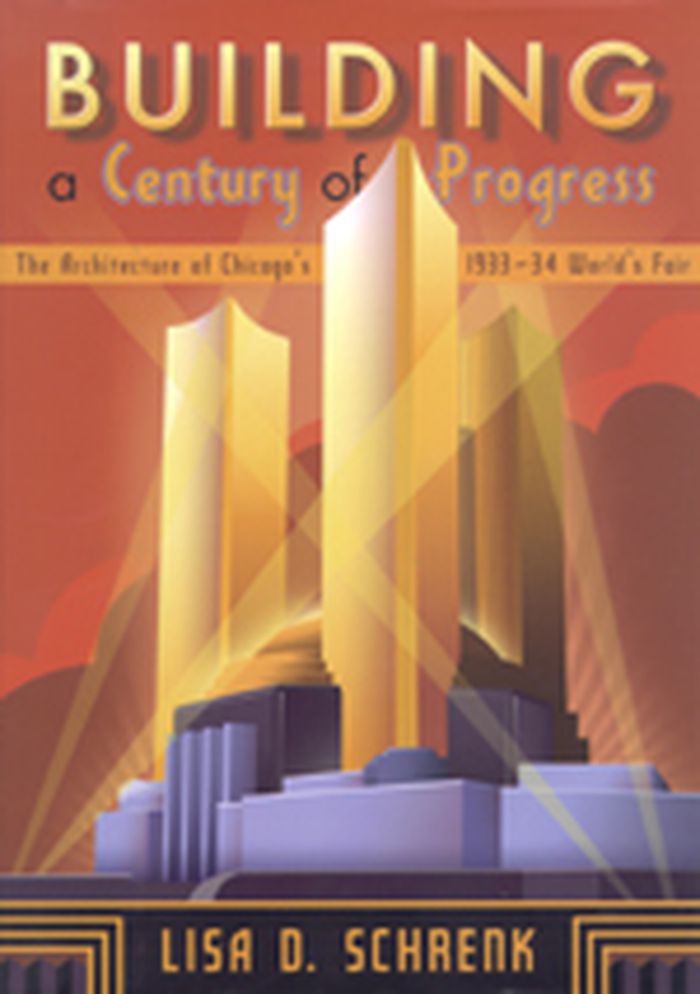
From the summer of 1933 to the fall of 1934, more than 38 million fairgoers visited a 3-mile stretch along Lake Michigan, home to Chicago’s second World’s Fair. Millions more experienced the Century of Progress International Exposition through newspaper and magazine articles, newsreels, and souvenirs. Together, all marveled at the industrial, scientific, consumer, and cultural displays, many of which were housed in fifty massive and colorful exhibition halls, the largest architectural project realized in the United States during the Great Depression. In the richly illustrated "Building a century of progress", Lisa D. Schrenk explores the pivotal role of the 1933 Chicago World’s Fair in modern American architecture. She recounts how the exposition’s architectural commission promoted a broad definition of modern architecture, not relying on purely aesthetic characteristics but instead focusing on new design solutions. The fair’s pavilions incorporated recently introduced building materials such as masonite and gypsum board; structural innovations (for example, the first thin-shell concrete roof and the first suspended roof structures built in the United States); and new construction processes, most notably the use of prefabrication. They also featured curiosities like the giant, constantly operating mayonnaise maker and the glass-walled House of Tomorrow, which had no operable windows. Schrenk shows how the halls’ designs reflected cultural and political developments of the period, including the expanding relationships between science, industry, and government; the rise of a corporate consumer culture; and the impact of the Great Depression. Many of the designs provoked intense responses from critics and other prominent architects, including Frank Lloyd Wright and Ralph Adams Cram, fueling heated debates over the appropriate direction for architecture in the United States. Demonstrating the rich diversity of progressive American building design seen at the fair, this book captures a crucial moment in American modernism.
Building a century of progress : the architecture of Chicago's 1933-34 World's Fair
Actions:
Price:
$45.00
(available to order)
Summary:
From the summer of 1933 to the fall of 1934, more than 38 million fairgoers visited a 3-mile stretch along Lake Michigan, home to Chicago’s second World’s Fair. Millions more experienced the Century of Progress International Exposition through newspaper and magazine articles, newsreels, and souvenirs. Together, all marveled at the industrial, scientific, consumer, and cultural displays, many of which were housed in fifty massive and colorful exhibition halls, the largest architectural project realized in the United States during the Great Depression. In the richly illustrated "Building a century of progress", Lisa D. Schrenk explores the pivotal role of the 1933 Chicago World’s Fair in modern American architecture. She recounts how the exposition’s architectural commission promoted a broad definition of modern architecture, not relying on purely aesthetic characteristics but instead focusing on new design solutions. The fair’s pavilions incorporated recently introduced building materials such as masonite and gypsum board; structural innovations (for example, the first thin-shell concrete roof and the first suspended roof structures built in the United States); and new construction processes, most notably the use of prefabrication. They also featured curiosities like the giant, constantly operating mayonnaise maker and the glass-walled House of Tomorrow, which had no operable windows. Schrenk shows how the halls’ designs reflected cultural and political developments of the period, including the expanding relationships between science, industry, and government; the rise of a corporate consumer culture; and the impact of the Great Depression. Many of the designs provoked intense responses from critics and other prominent architects, including Frank Lloyd Wright and Ralph Adams Cram, fueling heated debates over the appropriate direction for architecture in the United States. Demonstrating the rich diversity of progressive American building design seen at the fair, this book captures a crucial moment in American modernism.
Form:
books
books
Publication:
August 2007, Minneapolis, London
August 2007, Minneapolis, London
Subject:
Museums and Universal Exhibitions
Museums and Universal Exhibitions
Form:
books
books
Actions:
Price:
$42.95
(available to order)
Summary:
Aaron Swartz était programmeur informatique, essayiste, organisateur politique, et hacker-activiste américain. Adolescent, il était déjà un libre penseur, un programmeur, un écrivain et un militant profondément engagé en faveur de l’accès libre et gratuit à l’information contribuant au bien du public. Élevé dans la banlieue riche de Chicago, il atteint la majorité alors(...)
$42.95
(available to order)
Summary:
Aaron Swartz était programmeur informatique, essayiste, organisateur politique, et hacker-activiste américain. Adolescent, il était déjà un libre penseur, un programmeur, un écrivain et un militant profondément engagé en faveur de l’accès libre et gratuit à l’information contribuant au bien du public. Élevé dans la banlieue riche de Chicago, il atteint la majorité alors(...)
Subject:
Archive, library and the digital
Archive, library and the digital
Publication:
April 2017
April 2017
Title:
Celui qui pourrait changer le monde : écrits
Actions:
Price:
$42.95
(available to order)
Summary:
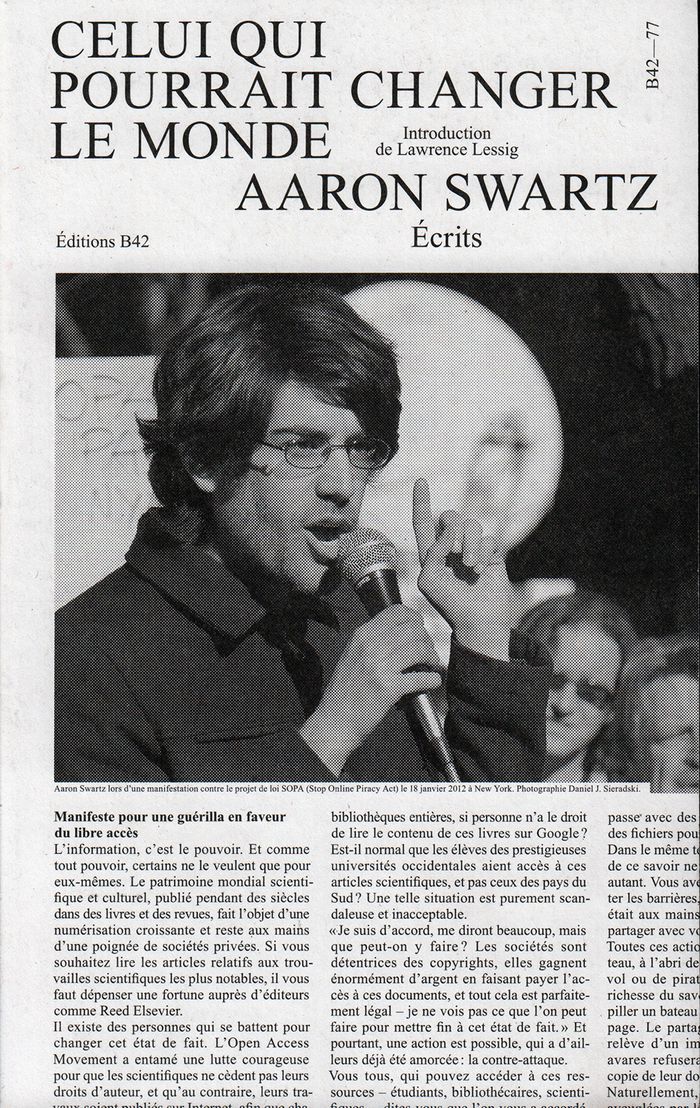
Aaron Swartz était programmeur informatique, essayiste, organisateur politique, et hacker-activiste américain. Adolescent, il était déjà un libre penseur, un programmeur, un écrivain et un militant profondément engagé en faveur de l’accès libre et gratuit à l’information contribuant au bien du public. Élevé dans la banlieue riche de Chicago, il atteint la majorité alors que la bataille relative au téléchargement illégal de musique bat son plein. Il devancera à cette occasion grand nombre des questions encore débattues aujourd’hui. Harcelé par le FBI suite au procès attenté à son égard, Aaron Swartz connaît une fin tragique en mettant fin à ses jours à l’âge de 26 ans alors qu’il faisait face à l’opposition entre son idéal de « free culture » et les lois relatives à la propriété intellectuelle aux États-Unis. Étant donné la terrible brièveté de son audacieuse vie intellectuelle "Celui qui pourrait changer le monde" est une remarquable et substantielle collection de ses écrits (articles, essais, conférences), qui soulignent la pluralité des intérêts du jeune homme, de son amour pour le code, à son idéal d’un monde collaboratif et virtuel. On y découvre un personnage curieux de tout, drôle, brillant, radical et visionnaire, mais aussi plein d’autodérision. Le livre est divisé en six chapitres, suivant ses centres d’intérêts : la culture libre, tout d’abord, les ordinateurs, la politique, les media, les livres et la culture et enfin l’éducation. Ses différents combats (pour la culture libre notamment, qui se politisèrent à la fin de sa vie) sont enracinés dans la croyance qu’accéder à la connaissance et la possibilité de l’utiliser constitue le meilleur moyen d’empowerment et de justice. L’activisme multi-facette de Swartz inclue l’orchestration de pétitions massives en ligne contre les lois relatives au droit d’auteur et la lutte contre le piratage. Swartz a également écrit avec passion sur les livres (Kafka et David Foster font partis de ses favoris), les magazines, les films, la musique et l’éducation.
Celui qui pourrait changer le monde : écrits
Actions:
Price:
$42.95
(available to order)
Summary:
Aaron Swartz était programmeur informatique, essayiste, organisateur politique, et hacker-activiste américain. Adolescent, il était déjà un libre penseur, un programmeur, un écrivain et un militant profondément engagé en faveur de l’accès libre et gratuit à l’information contribuant au bien du public. Élevé dans la banlieue riche de Chicago, il atteint la majorité alors que la bataille relative au téléchargement illégal de musique bat son plein. Il devancera à cette occasion grand nombre des questions encore débattues aujourd’hui. Harcelé par le FBI suite au procès attenté à son égard, Aaron Swartz connaît une fin tragique en mettant fin à ses jours à l’âge de 26 ans alors qu’il faisait face à l’opposition entre son idéal de « free culture » et les lois relatives à la propriété intellectuelle aux États-Unis. Étant donné la terrible brièveté de son audacieuse vie intellectuelle "Celui qui pourrait changer le monde" est une remarquable et substantielle collection de ses écrits (articles, essais, conférences), qui soulignent la pluralité des intérêts du jeune homme, de son amour pour le code, à son idéal d’un monde collaboratif et virtuel. On y découvre un personnage curieux de tout, drôle, brillant, radical et visionnaire, mais aussi plein d’autodérision. Le livre est divisé en six chapitres, suivant ses centres d’intérêts : la culture libre, tout d’abord, les ordinateurs, la politique, les media, les livres et la culture et enfin l’éducation. Ses différents combats (pour la culture libre notamment, qui se politisèrent à la fin de sa vie) sont enracinés dans la croyance qu’accéder à la connaissance et la possibilité de l’utiliser constitue le meilleur moyen d’empowerment et de justice. L’activisme multi-facette de Swartz inclue l’orchestration de pétitions massives en ligne contre les lois relatives au droit d’auteur et la lutte contre le piratage. Swartz a également écrit avec passion sur les livres (Kafka et David Foster font partis de ses favoris), les magazines, les films, la musique et l’éducation.
Form:
books
books
Publication:
April 2017
April 2017
Subject:
Archive, library and the digital
Archive, library and the digital


