


741 Results
Form:
books
books
Price:
$39.95
(available to order)
Summary:
How human behavior brought our world to the brink, and how human behavior can save us. The world is a mess. Our dire predicament, from collapsing social structures to the climate crisis, has been millennia in the making and can be traced back to the erroneous belief that the earth's resources are infinite. The key to change, says Don Norman, is human behavior, covered(...)
$39.95
(available to order)
Summary:
How human behavior brought our world to the brink, and how human behavior can save us. The world is a mess. Our dire predicament, from collapsing social structures to the climate crisis, has been millennia in the making and can be traced back to the erroneous belief that the earth's resources are infinite. The key to change, says Don Norman, is human behavior, covered(...)
Title:
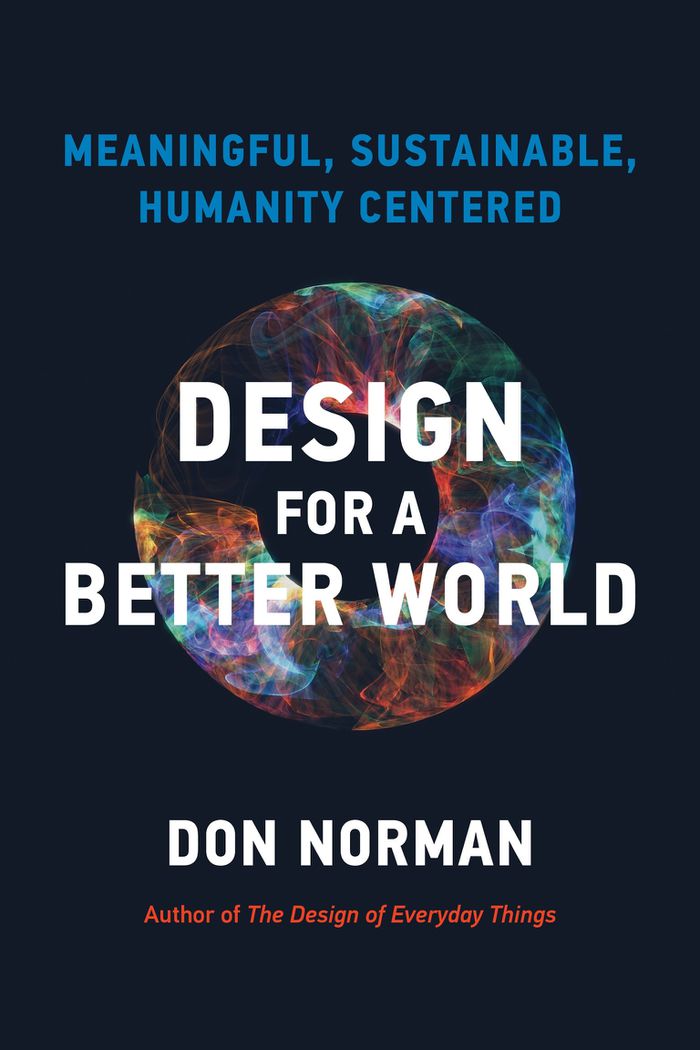
Design for a better world: meaningful, sustainable, humanity centered
Actions:
Price:
$39.95
(available to order)
Summary:
How human behavior brought our world to the brink, and how human behavior can save us. The world is a mess. Our dire predicament, from collapsing social structures to the climate crisis, has been millennia in the making and can be traced back to the erroneous belief that the earth's resources are infinite. The key to change, says Don Norman, is human behavior, covered in the book's three major themes: meaning, sustainability, and humanity-centeredness. Emphasize quality of life, not monetary rewards; restructure how we live to better protect the environment; and focus on all of humanity. ''Design for a better world'' presents an eye-opening diagnosis of where we've gone wrong and a clear prescription for making things better. Norman proposes a new way of thinking, one that recognizes our place in a complex global system where even simple behaviors affect the entire world. He identifies the economic metrics that contribute to the harmful effects of commerce and manufacturing and proposes a recalibration of what we consider important in life. His experience as both a scientist and business executive gives him the perspective to show how to make these changes while maintaining a thriving economy. Let the change begin with this book before it's too late.
Design for a better world: meaningful, sustainable, humanity centered
Actions:
Price:
$39.95
(available to order)
Summary:
How human behavior brought our world to the brink, and how human behavior can save us. The world is a mess. Our dire predicament, from collapsing social structures to the climate crisis, has been millennia in the making and can be traced back to the erroneous belief that the earth's resources are infinite. The key to change, says Don Norman, is human behavior, covered in the book's three major themes: meaning, sustainability, and humanity-centeredness. Emphasize quality of life, not monetary rewards; restructure how we live to better protect the environment; and focus on all of humanity. ''Design for a better world'' presents an eye-opening diagnosis of where we've gone wrong and a clear prescription for making things better. Norman proposes a new way of thinking, one that recognizes our place in a complex global system where even simple behaviors affect the entire world. He identifies the economic metrics that contribute to the harmful effects of commerce and manufacturing and proposes a recalibration of what we consider important in life. His experience as both a scientist and business executive gives him the perspective to show how to make these changes while maintaining a thriving economy. Let the change begin with this book before it's too late.
Form:
books
books
Publication:
March 2023
March 2023
Subject:
Design Theory
Design Theory
Form:
books
books
Actions:
Price:
$28.95
(available to order)
Summary:
In this volume of the Critical Spatial Practice series, Dennis Pohl locates the origin of Europe's dependency on carbon and nuclear power in the postwar architectural designs and energy policies of the European Community. Since the 1950s, architects have proposed territorial, regional, and urban development plans that served the European political project. They(...)
$28.95
(available to order)
Summary:
In this volume of the Critical Spatial Practice series, Dennis Pohl locates the origin of Europe's dependency on carbon and nuclear power in the postwar architectural designs and energy policies of the European Community. Since the 1950s, architects have proposed territorial, regional, and urban development plans that served the European political project. They(...)
Title:
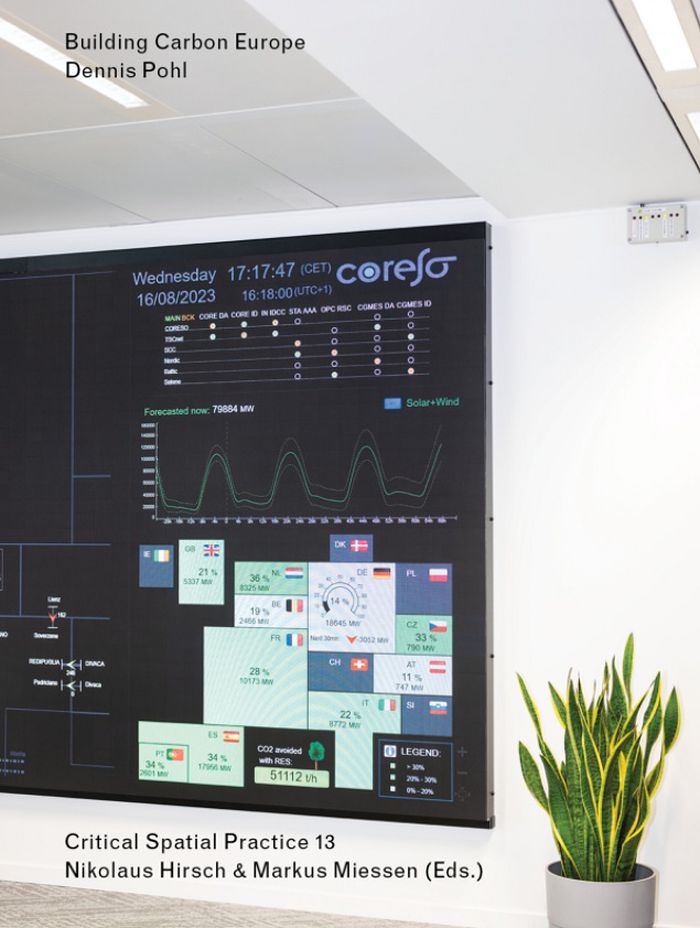
Building carbon europe: Coal, steel and nuclear power. Critical spatial practice
Actions:
Price:
$28.95
(available to order)
Summary:
In this volume of the Critical Spatial Practice series, Dennis Pohl locates the origin of Europe's dependency on carbon and nuclear power in the postwar architectural designs and energy policies of the European Community. Since the 1950s, architects have proposed territorial, regional, and urban development plans that served the European political project. They collaborated with the European Coal and Steel Community in an effort to render the steel building industry as efficient as the car industry; they incorporated the ideas of infinite nuclear energy, as promoted by the European Atomic Energy Community, into their designs. This book demonstrates how architecture served the political economy of postwar Europe as a means of turning coal, steel, and radioactivity into tools of European governance. Architectural design enabled EU institutions to support social policies and worker housing within the coal and steel industry as well as to promote a new pan-European lifestyle based on nuclear energy. In other words, architecture powered Europe's larger infrastructural, economic, and cultural network. Pohl's work not only sheds light on how architecture has contributed to the carbonization of Europe, it also highlights the environmental issue, which challenges both architectural criticism and historiography in the era of the Anthropocene.
Building carbon europe: Coal, steel and nuclear power. Critical spatial practice
Actions:
Price:
$28.95
(available to order)
Summary:
In this volume of the Critical Spatial Practice series, Dennis Pohl locates the origin of Europe's dependency on carbon and nuclear power in the postwar architectural designs and energy policies of the European Community. Since the 1950s, architects have proposed territorial, regional, and urban development plans that served the European political project. They collaborated with the European Coal and Steel Community in an effort to render the steel building industry as efficient as the car industry; they incorporated the ideas of infinite nuclear energy, as promoted by the European Atomic Energy Community, into their designs. This book demonstrates how architecture served the political economy of postwar Europe as a means of turning coal, steel, and radioactivity into tools of European governance. Architectural design enabled EU institutions to support social policies and worker housing within the coal and steel industry as well as to promote a new pan-European lifestyle based on nuclear energy. In other words, architecture powered Europe's larger infrastructural, economic, and cultural network. Pohl's work not only sheds light on how architecture has contributed to the carbonization of Europe, it also highlights the environmental issue, which challenges both architectural criticism and historiography in the era of the Anthropocene.
Form:
books
books
Publication:
April 2024
April 2024
Subject:
Architectural Theory
Architectural Theory
Form:
books
books
Price:
$24.95
(available to order)
Summary:
In New York for Sale, Tom Angotti tells some of the stories of community planning in New York City: how activists moved beyond simple protests and began to formulate community plans to protect neighborhoods against urban renewal, real estate mega-projects, gentrification, and environmental hazards. Angotti, both observer of and longtime participant in New York community(...)
$24.95
(available to order)
Summary:
In New York for Sale, Tom Angotti tells some of the stories of community planning in New York City: how activists moved beyond simple protests and began to formulate community plans to protect neighborhoods against urban renewal, real estate mega-projects, gentrification, and environmental hazards. Angotti, both observer of and longtime participant in New York community(...)
Title:
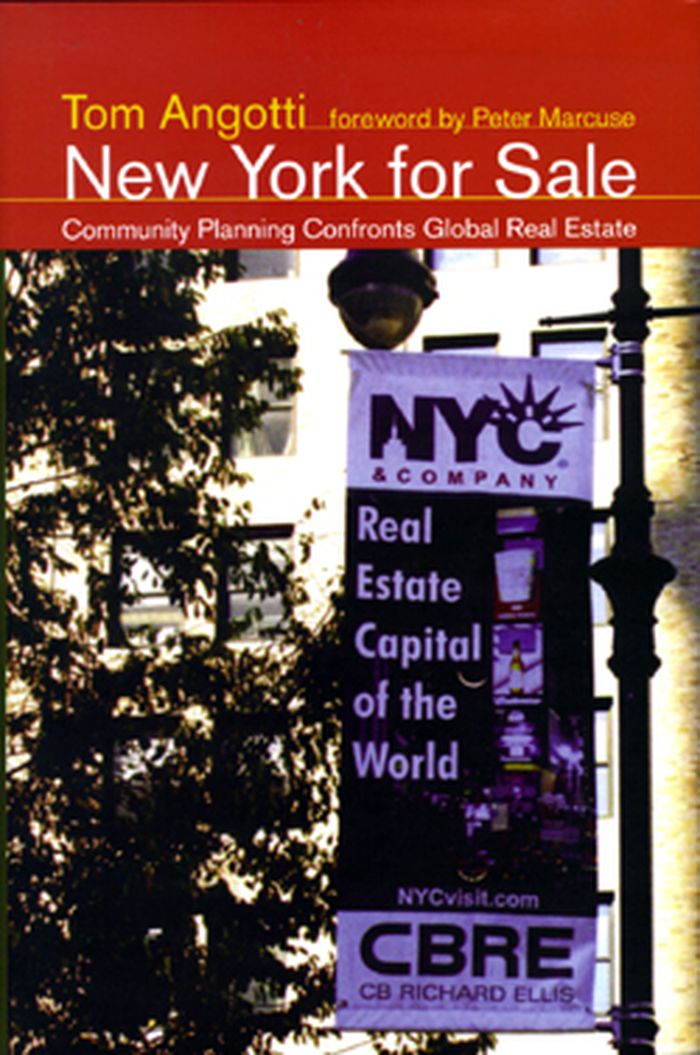
New York for sale: community planning confronts global real estate
Actions:
Price:
$24.95
(available to order)
Summary:
In New York for Sale, Tom Angotti tells some of the stories of community planning in New York City: how activists moved beyond simple protests and began to formulate community plans to protect neighborhoods against urban renewal, real estate mega-projects, gentrification, and environmental hazards. Angotti, both observer of and longtime participant in New York community planning, focuses on the close relationships among community planning, political strategy, and control over land. After describing the political economy of New York City real estate, its close ties to global financial capital, and the roots of community planning in social movements and community organizing, Angotti turns to specifics. He tells of two pioneering plans forged in reaction to urban renewal plans (including the first community plan in the city, the 1961 Cooper Square Alternate Plan—a response to a Robert Moses urban renewal scheme); struggles for environmental justice, including battles over incinerators, sludge, and garbage; plans officially adopted by the city; and plans dominated by powerful real estate interests. Finally, Angotti proposes strategies for progressive, inclusive community planning not only for New York City but for anywhere that neighborhoods want to protect themselves and their land. New York for Sale teaches the empowering lesson that community plans can challenge market-driven development even in global cities with powerful real estate industries.
New York for sale: community planning confronts global real estate
Actions:
Price:
$24.95
(available to order)
Summary:
In New York for Sale, Tom Angotti tells some of the stories of community planning in New York City: how activists moved beyond simple protests and began to formulate community plans to protect neighborhoods against urban renewal, real estate mega-projects, gentrification, and environmental hazards. Angotti, both observer of and longtime participant in New York community planning, focuses on the close relationships among community planning, political strategy, and control over land. After describing the political economy of New York City real estate, its close ties to global financial capital, and the roots of community planning in social movements and community organizing, Angotti turns to specifics. He tells of two pioneering plans forged in reaction to urban renewal plans (including the first community plan in the city, the 1961 Cooper Square Alternate Plan—a response to a Robert Moses urban renewal scheme); struggles for environmental justice, including battles over incinerators, sludge, and garbage; plans officially adopted by the city; and plans dominated by powerful real estate interests. Finally, Angotti proposes strategies for progressive, inclusive community planning not only for New York City but for anywhere that neighborhoods want to protect themselves and their land. New York for Sale teaches the empowering lesson that community plans can challenge market-driven development even in global cities with powerful real estate industries.
Form:
books
books
Publication:
November 2008, Cambridge, London
November 2008, Cambridge, London
Subject:
Urban Theory
Urban Theory
Form:
books
books
Title:
Loving the High Line
Loving the High Line
Actions:
Price:
$20.00
(available to order)
Summary:
As an elevated rail line, designed to lift freight trains serving the Hudson River docks above street level circulation, The High Line was originally constructed as material infrastructure for an industrial city. It was closed in 1960s and stood abandoned for the next forty years. In this time organic debris accumulated and decayed, and seeds landed on the newly forming(...)
$20.00
(available to order)
Summary:
As an elevated rail line, designed to lift freight trains serving the Hudson River docks above street level circulation, The High Line was originally constructed as material infrastructure for an industrial city. It was closed in 1960s and stood abandoned for the next forty years. In this time organic debris accumulated and decayed, and seeds landed on the newly forming(...)
Title:
Loving the High Line
Actions:
Price:
$20.00
(available to order)
Summary:
As an elevated rail line, designed to lift freight trains serving the Hudson River docks above street level circulation, The High Line was originally constructed as material infrastructure for an industrial city. It was closed in 1960s and stood abandoned for the next forty years. In this time organic debris accumulated and decayed, and seeds landed on the newly forming soil creating a meadow on the derelict railbed. This microcosmic biome then also became a heterotopic, other space, in the social ecology of the city as an efflorescence of new art forms and underground subcultures flourished in the evacuated post-industrial spaces of Chelsea. These processes would unfold as New York City was being transformed into a global center in an emerging political-economy defined by the integration of finance capital with media and information industries. In this, marginal spaces of the kind that developed in Chelsea, and the cultures that create them, became important sources of new aesthetic and cultural innovation, that offer an exploitable social ground from which to extract semiotic value. As the Bloomberg administration gave shape to this new regime, a project was initiated to convert the High Line into a publicly accessible, linear park. This would be realized through a convoluted process in which the manifold tensions and contradictions of the postmodern city would be dramatically played out and the disjunctions between ideal image regimes and the reality of the material substrates that support them would be brought to light, if only to be newly obscured. The High Line urban park has been both heralded as a definitive model for new urban development, and denounced as a driver, or at least a morbid symptom, of devastating gentrification, and the destructive financialization of urban space. This text, originally published in 2015 as part of the Deconstructing the High Line anthology, edited by Mark Linder and Brian Rosa, tracks a collection of interconnected historical treads that converge in the reconstruction of the High Line, and situates the project within architectural discourse and practice, and social and material conditions with which it struggles to engage.
Loving the High Line
Actions:
Price:
$20.00
(available to order)
Summary:
As an elevated rail line, designed to lift freight trains serving the Hudson River docks above street level circulation, The High Line was originally constructed as material infrastructure for an industrial city. It was closed in 1960s and stood abandoned for the next forty years. In this time organic debris accumulated and decayed, and seeds landed on the newly forming soil creating a meadow on the derelict railbed. This microcosmic biome then also became a heterotopic, other space, in the social ecology of the city as an efflorescence of new art forms and underground subcultures flourished in the evacuated post-industrial spaces of Chelsea. These processes would unfold as New York City was being transformed into a global center in an emerging political-economy defined by the integration of finance capital with media and information industries. In this, marginal spaces of the kind that developed in Chelsea, and the cultures that create them, became important sources of new aesthetic and cultural innovation, that offer an exploitable social ground from which to extract semiotic value. As the Bloomberg administration gave shape to this new regime, a project was initiated to convert the High Line into a publicly accessible, linear park. This would be realized through a convoluted process in which the manifold tensions and contradictions of the postmodern city would be dramatically played out and the disjunctions between ideal image regimes and the reality of the material substrates that support them would be brought to light, if only to be newly obscured. The High Line urban park has been both heralded as a definitive model for new urban development, and denounced as a driver, or at least a morbid symptom, of devastating gentrification, and the destructive financialization of urban space. This text, originally published in 2015 as part of the Deconstructing the High Line anthology, edited by Mark Linder and Brian Rosa, tracks a collection of interconnected historical treads that converge in the reconstruction of the High Line, and situates the project within architectural discourse and practice, and social and material conditions with which it struggles to engage.
Form:
books
books
Publication:
November 2022
November 2022
Subject:
Urban Landscapes
Urban Landscapes
Form:
books
books
Actions:
Price:
$47.95
(available to order)
Summary:
Builders, Housewives and the Construction of Modern Athens reassesses the explosive growth of postwar Athens through its most distinctive building type, the polykatoikía, and its different connotations through the decades: from a monotonous and ugly element of the city to the role it might play in the urban sustainability. Sprawling beneath the Acropolis, modern Athens(...)
$47.95
(available to order)
Summary:
Builders, Housewives and the Construction of Modern Athens reassesses the explosive growth of postwar Athens through its most distinctive building type, the polykatoikía, and its different connotations through the decades: from a monotonous and ugly element of the city to the role it might play in the urban sustainability. Sprawling beneath the Acropolis, modern Athens(...)
Title:
Builders, housewives, and the construction of modern Athens
Actions:
Price:
$47.95
(available to order)
Summary:
Builders, Housewives and the Construction of Modern Athens reassesses the explosive growth of postwar Athens through its most distinctive building type, the polykatoikía, and its different connotations through the decades: from a monotonous and ugly element of the city to the role it might play in the urban sustainability. Sprawling beneath the Acropolis, modern Athens is commonly viewed in negative terms: congested, ugly and monotonous. Builders, Housewives and the Construction of Modern Athens questions this stereotype, reassessing the explosive growth of postwar Athens through its most distinctive building type: the polykatoikía (a small-scale multistory apartment block). Theocharopoulou re-evaluates the polykatoikía as a low-tech, easily constructible innovation that stimulated the postwar urban economy, triggering the city's social mid-twentieth-century transformation. The interiors of the polykatoikía apartments reflect a desire for modernity as marketed to housewives through film and magazines. Regular builders became unlikely allies in designing these polykatoikía interiors, enabling inhabitants to exert agency over their daily lives and the shape of the postwar city. This revised edition of Theocharopoulou's study draws on popular media as well as urban and regional planning theory, cultural studies and anthropology to examine the evolution of this phenomenon. Written in the light of Greece's recent financial crisis, the book's updated Postscript considers the role polykatoikía might play in building an equitable and sustainable twenty-first-century city.
Builders, housewives, and the construction of modern Athens
Actions:
Price:
$47.95
(available to order)
Summary:
Builders, Housewives and the Construction of Modern Athens reassesses the explosive growth of postwar Athens through its most distinctive building type, the polykatoikía, and its different connotations through the decades: from a monotonous and ugly element of the city to the role it might play in the urban sustainability. Sprawling beneath the Acropolis, modern Athens is commonly viewed in negative terms: congested, ugly and monotonous. Builders, Housewives and the Construction of Modern Athens questions this stereotype, reassessing the explosive growth of postwar Athens through its most distinctive building type: the polykatoikía (a small-scale multistory apartment block). Theocharopoulou re-evaluates the polykatoikía as a low-tech, easily constructible innovation that stimulated the postwar urban economy, triggering the city's social mid-twentieth-century transformation. The interiors of the polykatoikía apartments reflect a desire for modernity as marketed to housewives through film and magazines. Regular builders became unlikely allies in designing these polykatoikía interiors, enabling inhabitants to exert agency over their daily lives and the shape of the postwar city. This revised edition of Theocharopoulou's study draws on popular media as well as urban and regional planning theory, cultural studies and anthropology to examine the evolution of this phenomenon. Written in the light of Greece's recent financial crisis, the book's updated Postscript considers the role polykatoikía might play in building an equitable and sustainable twenty-first-century city.
Form:
books
books
Publication:
September 2022
September 2022
Subject:
Urban Theory
Urban Theory
Form:
audio
audio
Title:
Apophanies.
Apophanies.
Actions:
Description:
1 online resource.
Author:
Subject:
Publication:
[Place of publication not identified] : Lateral Addition, 2022.
[Place of publication not identified] : Lateral Addition, 2022.
Form:
audio
audio
Publication:
[Place of publication not identified] : Lateral Addition, 2022.
[Place of publication not identified] : Lateral Addition, 2022.
Author:
Subject:
Form:
books
books
Price:
$37.50
(available to order)
Summary:
From as early as 1900 Finland, at that time ruled by Russia, was to see in architecture a political and social vehicle. Modern architecture, with the promises it held for social change and hopes for technological progress, was to become a cultural phenomenon over the course of the twentieth century. This book explores the shape of architecture from Finland’s independence(...)
$37.50
(available to order)
Summary:
From as early as 1900 Finland, at that time ruled by Russia, was to see in architecture a political and social vehicle. Modern architecture, with the promises it held for social change and hopes for technological progress, was to become a cultural phenomenon over the course of the twentieth century. This book explores the shape of architecture from Finland’s independence(...)
Title:
Finland
Actions:
Price:
$37.50
(available to order)
Summary:
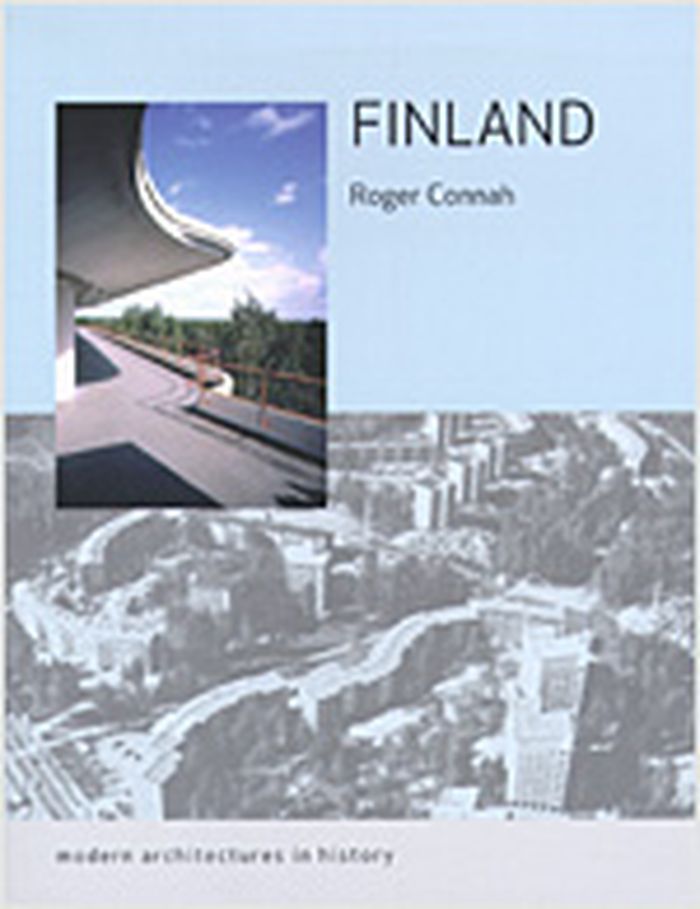
From as early as 1900 Finland, at that time ruled by Russia, was to see in architecture a political and social vehicle. Modern architecture, with the promises it held for social change and hopes for technological progress, was to become a cultural phenomenon over the course of the twentieth century. This book explores the shape of architecture from Finland’s independence in 1917 until the present day, and how the ‘modern agenda’ became a blueprint to advance the nation’s society and define its identity. Roger Connah assesses the work of well-known heroes of Finnish architecture such as Reima Pietila, Juhä Leiviskä and ‘modern master’ Alvar Aalto, as well as many other less familiar figures whose contribution is little known outside Finland. He discusses developments in architecture in relation to the culture and politics of the new independent Finland, as well as parallel movements in the arts, and also surveys the early part of the century, as Finland came into its own as a new nation state. He examines the rationalised developments of the 1930s, the ‘organic’ and vernacular tendencies of modern architecture, and how some of modernism’s devices were combined with a particular Nordic sensibility. He also looks at the reconstruction and urbanisation of the post-war years, the use of industrial building methods and prefabricated materials, the ‘golden age’ of Finnish modernism in the 1950s, and the developments thereafter. Connah also considers how architecture has been publicised in magazines, galleries and through exhibitions. By the end of the twentieth century Finland had transformed itself into a modern industrial economy at the cutting edge of the it world, and its buildings continue to be regarded as exemplary modern works. Roger Connah assesses Finnish modern architecture’s relation to the broader cultural and political conditions of Finland and modernity at large, making this study crucial to our understanding of Finland’s place in architecture and in culture today.
Finland
Actions:
Price:
$37.50
(available to order)
Summary:
From as early as 1900 Finland, at that time ruled by Russia, was to see in architecture a political and social vehicle. Modern architecture, with the promises it held for social change and hopes for technological progress, was to become a cultural phenomenon over the course of the twentieth century. This book explores the shape of architecture from Finland’s independence in 1917 until the present day, and how the ‘modern agenda’ became a blueprint to advance the nation’s society and define its identity. Roger Connah assesses the work of well-known heroes of Finnish architecture such as Reima Pietila, Juhä Leiviskä and ‘modern master’ Alvar Aalto, as well as many other less familiar figures whose contribution is little known outside Finland. He discusses developments in architecture in relation to the culture and politics of the new independent Finland, as well as parallel movements in the arts, and also surveys the early part of the century, as Finland came into its own as a new nation state. He examines the rationalised developments of the 1930s, the ‘organic’ and vernacular tendencies of modern architecture, and how some of modernism’s devices were combined with a particular Nordic sensibility. He also looks at the reconstruction and urbanisation of the post-war years, the use of industrial building methods and prefabricated materials, the ‘golden age’ of Finnish modernism in the 1950s, and the developments thereafter. Connah also considers how architecture has been publicised in magazines, galleries and through exhibitions. By the end of the twentieth century Finland had transformed itself into a modern industrial economy at the cutting edge of the it world, and its buildings continue to be regarded as exemplary modern works. Roger Connah assesses Finnish modern architecture’s relation to the broader cultural and political conditions of Finland and modernity at large, making this study crucial to our understanding of Finland’s place in architecture and in culture today.
Form:
books
books
Publication:
September 2005, London
September 2005, London
Subject:
Architecture since 1900, Europe
Architecture since 1900, Europe
Form:
books
books
Title:
Obsidian situations
Obsidian situations
Actions:
Price:
$20.00
(available in store)
Summary:
Tricia Middleton’s debut verse-novel brings the artist’s genius for summoning the psychic life of the object world to the page, here trading in the resonant material vocabulary that she has honed to perfection conjuring the wayward spirits of late-stage capitalism in sculptural form, for the equally resplendent wordplay of incisive observational poetry. Ostensibly set(...)
$20.00
(available in store)
Summary:
Tricia Middleton’s debut verse-novel brings the artist’s genius for summoning the psychic life of the object world to the page, here trading in the resonant material vocabulary that she has honed to perfection conjuring the wayward spirits of late-stage capitalism in sculptural form, for the equally resplendent wordplay of incisive observational poetry. Ostensibly set(...)
Title:
Obsidian situations
Actions:
Price:
$20.00
(available in store)
Summary:
Tricia Middleton’s debut verse-novel brings the artist’s genius for summoning the psychic life of the object world to the page, here trading in the resonant material vocabulary that she has honed to perfection conjuring the wayward spirits of late-stage capitalism in sculptural form, for the equally resplendent wordplay of incisive observational poetry. Ostensibly set in present-day Paris, ''Obsidian situations'' spans centuries, telling a story about the epigenetics of suffering, survival, and redemption in social and cultural form. Alternating between myriad personae—sometimes artist or artwork, poet or amorphous cloud—the anonymous, decidedly female, narrator that serves as our guide to the city of light channels the souls of works of art and ideas, of artists, philosophers, courtesans and, most heartrending of all, des Enfants-Trouvés through incantatory soliloquies that call to account the half-life of Enlightenment ideals propping up the soft and saggy moral economy of the L’age Anthropocentric. As a force of self-definition and a body objectified—and so subject to the same degradation as any and all things—our champion encounters ‘situations’ that are in equal parts hilarious and heartbreaking, horrifying and wretched, breathtakingly beautiful, poignant, and mad. It’s a world of museums and collectors, artists and curators, lovers and mothers, daughters and others, charged with desire and repulsion, longing and rejection, death and devastation that, ironically, can only be transformed in art and in poetry and in dreams.
Obsidian situations
Actions:
Price:
$20.00
(available in store)
Summary:
Tricia Middleton’s debut verse-novel brings the artist’s genius for summoning the psychic life of the object world to the page, here trading in the resonant material vocabulary that she has honed to perfection conjuring the wayward spirits of late-stage capitalism in sculptural form, for the equally resplendent wordplay of incisive observational poetry. Ostensibly set in present-day Paris, ''Obsidian situations'' spans centuries, telling a story about the epigenetics of suffering, survival, and redemption in social and cultural form. Alternating between myriad personae—sometimes artist or artwork, poet or amorphous cloud—the anonymous, decidedly female, narrator that serves as our guide to the city of light channels the souls of works of art and ideas, of artists, philosophers, courtesans and, most heartrending of all, des Enfants-Trouvés through incantatory soliloquies that call to account the half-life of Enlightenment ideals propping up the soft and saggy moral economy of the L’age Anthropocentric. As a force of self-definition and a body objectified—and so subject to the same degradation as any and all things—our champion encounters ‘situations’ that are in equal parts hilarious and heartbreaking, horrifying and wretched, breathtakingly beautiful, poignant, and mad. It’s a world of museums and collectors, artists and curators, lovers and mothers, daughters and others, charged with desire and repulsion, longing and rejection, death and devastation that, ironically, can only be transformed in art and in poetry and in dreams.
Form:
books
books
Publication:
January 2023
January 2023
Subject:
Literature and poetry
Literature and poetry
Form:
books
books
Actions:
Price:
$29.95
(available to order)
Summary:
What is a sustainable community? The pressing need to answer this simple question is what prompted John Pierce and Ann Dale to gather the essays in this volume. Communities, Development, and Sustainability across Canada is a timely synthesis of work on how Canadian communities can achieve sustainable development. It bridges the gap between theory and praxis and brings(...)
$29.95
(available to order)
Summary:
What is a sustainable community? The pressing need to answer this simple question is what prompted John Pierce and Ann Dale to gather the essays in this volume. Communities, Development, and Sustainability across Canada is a timely synthesis of work on how Canadian communities can achieve sustainable development. It bridges the gap between theory and praxis and brings(...)
Subject:
Architecture de Montréal
Architecture de Montréal
Publication:
January 1900, Vancouver
January 1900, Vancouver
Title:
Communities, development, and sustainability across Canada
Actions:
Price:
$29.95
(available to order)
Summary:
What is a sustainable community? The pressing need to answer this simple question is what prompted John Pierce and Ann Dale to gather the essays in this volume. Communities, Development, and Sustainability across Canada is a timely synthesis of work on how Canadian communities can achieve sustainable development. It bridges the gap between theory and praxis and brings together academics, policy makers, and community activists, all of whom have argued for increased local participation in sustainable community development. Communities have become the weak link in efforts to refashion relations between the environment and the economy. The goal of this book is not simply to describe problems but also to suggest answers, not simply to offer theory but also to promote action, so that Canadian communities can better achieve sustain-able development. The twelve essays are organized into four sections: Vision, Connections, Action, and Assessing Progress. The first and last sections discuss local sustainable development within the context of increasing globalization. The second section approaches sustainable development from the perspective of social evolution and urban systems. The third section, the heart of the book, is comprised of three community case studies, an assessment of the Pacific salmon fishery, and four general discussions of sustainable development. The conclusion reiterates the need to make communities stronger links in sustainable development. The message of "Communities, development, and sustainability across Canada" is clear: it is time for communities themselves to act if they are to achieve sustainable development. This book will prove to be a valuable guide to taking the first steps.
Communities, development, and sustainability across Canada
Actions:
Price:
$29.95
(available to order)
Summary:
What is a sustainable community? The pressing need to answer this simple question is what prompted John Pierce and Ann Dale to gather the essays in this volume. Communities, Development, and Sustainability across Canada is a timely synthesis of work on how Canadian communities can achieve sustainable development. It bridges the gap between theory and praxis and brings together academics, policy makers, and community activists, all of whom have argued for increased local participation in sustainable community development. Communities have become the weak link in efforts to refashion relations between the environment and the economy. The goal of this book is not simply to describe problems but also to suggest answers, not simply to offer theory but also to promote action, so that Canadian communities can better achieve sustain-able development. The twelve essays are organized into four sections: Vision, Connections, Action, and Assessing Progress. The first and last sections discuss local sustainable development within the context of increasing globalization. The second section approaches sustainable development from the perspective of social evolution and urban systems. The third section, the heart of the book, is comprised of three community case studies, an assessment of the Pacific salmon fishery, and four general discussions of sustainable development. The conclusion reiterates the need to make communities stronger links in sustainable development. The message of "Communities, development, and sustainability across Canada" is clear: it is time for communities themselves to act if they are to achieve sustainable development. This book will prove to be a valuable guide to taking the first steps.
Form:
books
books
Publication:
January 1900, Vancouver
January 1900, Vancouver
Subject:
Architecture de Montréal
Architecture de Montréal
Form:
books
books
Actions:
Price:
$14.00
(available to order)
Summary:
Admired by Marx and Engels, the Surrealists, the Situationists, Walter Benjamin and Roland Barthes, the great utopian socialist Charles Fourier (1772-1837) has been many things to many people: a proto-feminist, a Surrealist ancestor, a cantankerous cosmologist, a social critic and humorist and to this day one of France's truest visionary thinkers. He was also, as this(...)
$14.00
(available to order)
Summary:
Admired by Marx and Engels, the Surrealists, the Situationists, Walter Benjamin and Roland Barthes, the great utopian socialist Charles Fourier (1772-1837) has been many things to many people: a proto-feminist, a Surrealist ancestor, a cantankerous cosmologist, a social critic and humorist and to this day one of France's truest visionary thinkers. He was also, as this(...)
Title:
The hierarchies of cuckoldry and bankruptcy
Actions:
Price:
$14.00
(available to order)
Summary:
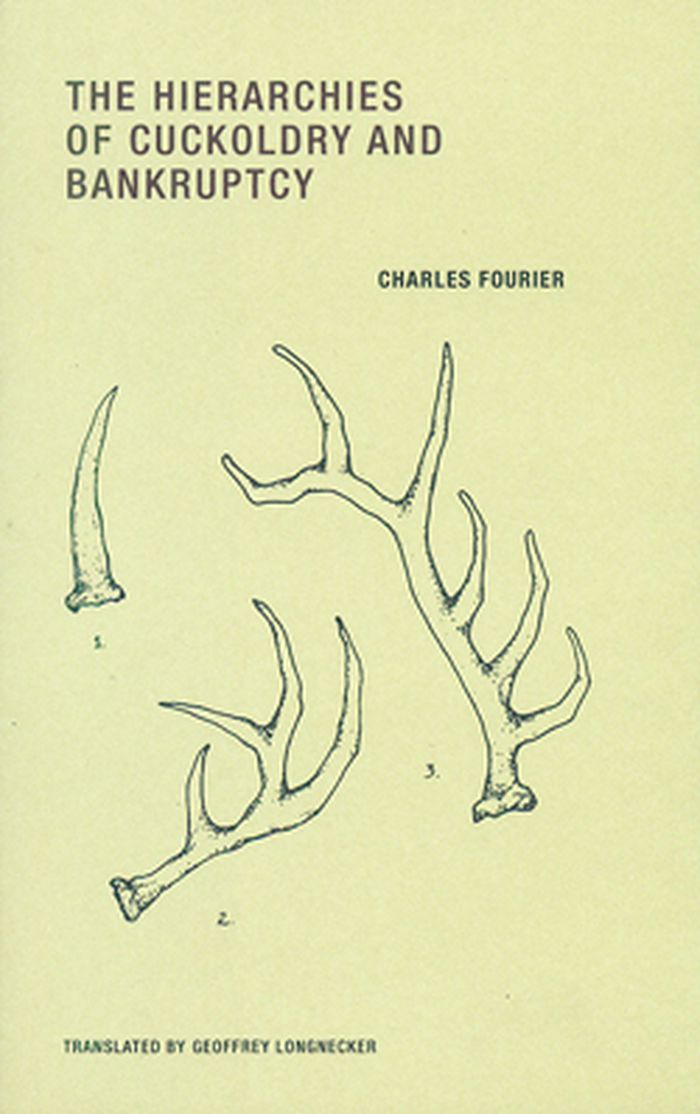
Admired by Marx and Engels, the Surrealists, the Situationists, Walter Benjamin and Roland Barthes, the great utopian socialist Charles Fourier (1772-1837) has been many things to many people: a proto-feminist, a Surrealist ancestor, a cantankerous cosmologist, a social critic and humorist and to this day one of France's truest visionary thinkers. He was also, as this volume demonstrates, a maniacal taxonomist. In this zoological guidebook to cuckoldry and commerce, Fourier offers a caustic critique of the bankruptcy of marriage and the prostitution of the economy, and the hypocrisies of a civilization that over-regulates sexual congress while allowing the financial sector to screw over the public. Gathered together here for the first time are Fourier's two “Hierarchies” --humorously regimented parades of civilization's cheaters and cheated-on in the domestic sphere of sex and the economic sphere of buying and selling commodities. “The Hierarchy of Cuckoldry” --translated into English for the first time--presents 72 species of the male cuckold, ranging from such “common class” cases as the Health-Conscious Cuckolds, to the short-horned Sympathetic, Optimist and Mystical Cuckolds, and the Long-horned varieties of the Irate, Disgraced and Posthumous Cuckolds. For Fourier, these amount to 72 manifestations of women's “secret insurrection” against the institution of marriage. “The Hierarchy of Bankruptcy” presents 36 species of the fraudulent bankrupt: a range of Light, Grandiose, and Contemptible shades of financial manipulators who force creditors, cities and even nations to bail them out of ultimately profitable bankruptcies. In these attacks on the morality of monogamy and the perils of laissez-faire capitalism, Fourier's “Hierarchies” resonate uncannily with our contemporary world.
The hierarchies of cuckoldry and bankruptcy
Actions:
Price:
$14.00
(available to order)
Summary:
Admired by Marx and Engels, the Surrealists, the Situationists, Walter Benjamin and Roland Barthes, the great utopian socialist Charles Fourier (1772-1837) has been many things to many people: a proto-feminist, a Surrealist ancestor, a cantankerous cosmologist, a social critic and humorist and to this day one of France's truest visionary thinkers. He was also, as this volume demonstrates, a maniacal taxonomist. In this zoological guidebook to cuckoldry and commerce, Fourier offers a caustic critique of the bankruptcy of marriage and the prostitution of the economy, and the hypocrisies of a civilization that over-regulates sexual congress while allowing the financial sector to screw over the public. Gathered together here for the first time are Fourier's two “Hierarchies” --humorously regimented parades of civilization's cheaters and cheated-on in the domestic sphere of sex and the economic sphere of buying and selling commodities. “The Hierarchy of Cuckoldry” --translated into English for the first time--presents 72 species of the male cuckold, ranging from such “common class” cases as the Health-Conscious Cuckolds, to the short-horned Sympathetic, Optimist and Mystical Cuckolds, and the Long-horned varieties of the Irate, Disgraced and Posthumous Cuckolds. For Fourier, these amount to 72 manifestations of women's “secret insurrection” against the institution of marriage. “The Hierarchy of Bankruptcy” presents 36 species of the fraudulent bankrupt: a range of Light, Grandiose, and Contemptible shades of financial manipulators who force creditors, cities and even nations to bail them out of ultimately profitable bankruptcies. In these attacks on the morality of monogamy and the perils of laissez-faire capitalism, Fourier's “Hierarchies” resonate uncannily with our contemporary world.
Form:
books
books
Publication:
October 2011
October 2011
Subject:
Critical Theory
Critical Theory


