


8407 Results
Form:
works of art
works of art
Actions:
Reference number:
DR1988:0321
Description:
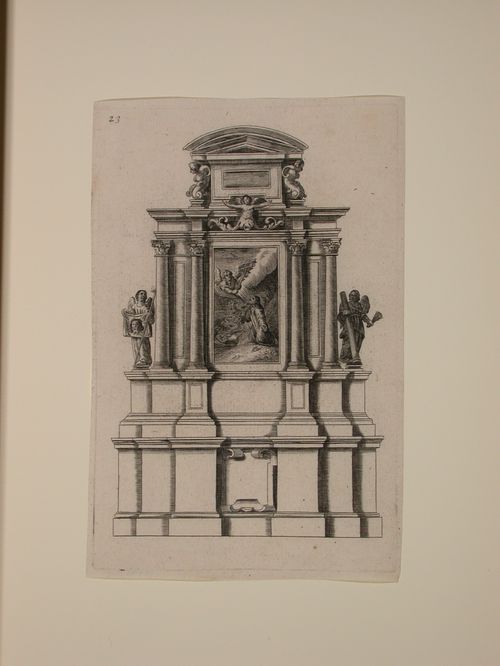
- This print depicts a design for an altarpiece, complete with statues and a painting. The painting showss the Agony in the Garden. Flanking this are two sculpted angels holding the instruments of the passion: the left angel holds a sudarium and a pike with a sponge, while the right angel holds a column and a bundle of sticks, signifying Christ's flagellation. At the top of the altar there are three sculpted ornamental half-figures. - The incomplete series of numbered prints, DR1988:0306 - DR1988:0331, shows Early Baroque church facades in Rome, altars, tombs, wall monuments, tabernacles and an antique temple.
DR1988:0321
Description:
- This print depicts a design for an altarpiece, complete with statues and a painting. The painting showss the Agony in the Garden. Flanking this are two sculpted angels holding the instruments of the passion: the left angel holds a sudarium and a pike with a sponge, while the right angel holds a column and a bundle of sticks, signifying Christ's flagellation. At the top of the altar there are three sculpted ornamental half-figures. - The incomplete series of numbered prints, DR1988:0306 - DR1988:0331, shows Early Baroque church facades in Rome, altars, tombs, wall monuments, tabernacles and an antique temple.
People:
Subject:
architecture
architecture
Date:
printed during the first half of the 17th century
printed during the first half of the 17th century
Title:
Design for an altar with an altarpiece showing the Agony in the Garden
Actions:
DR1988:0321
Description:
- This print depicts a design for an altarpiece, complete with statues and a painting. The painting showss the Agony in the Garden. Flanking this are two sculpted angels holding the instruments of the passion: the left angel holds a sudarium and a pike with a sponge, while the right angel holds a column and a bundle of sticks, signifying Christ's flagellation. At the top of the altar there are three sculpted ornamental half-figures. - The incomplete series of numbered prints, DR1988:0306 - DR1988:0331, shows Early Baroque church facades in Rome, altars, tombs, wall monuments, tabernacles and an antique temple.
Design for an altar with an altarpiece showing the Agony in the Garden
Actions:
DR1988:0321
Description:
- This print depicts a design for an altarpiece, complete with statues and a painting. The painting showss the Agony in the Garden. Flanking this are two sculpted angels holding the instruments of the passion: the left angel holds a sudarium and a pike with a sponge, while the right angel holds a column and a bundle of sticks, signifying Christ's flagellation. At the top of the altar there are three sculpted ornamental half-figures. - The incomplete series of numbered prints, DR1988:0306 - DR1988:0331, shows Early Baroque church facades in Rome, altars, tombs, wall monuments, tabernacles and an antique temple.
Form:
works of art
works of art
Date:
printed during the first half of the 17th century
printed during the first half of the 17th century
People:
Subject:
architecture
architecture
Level of archival description:
Sub-series
Sub-series
Reference number:
CI001.S2.D4
Description:
The CCA collection includes albums of drawings for some of Charles Rohault de Fleury's most important public architectural projects, built and unbuilt. They provide valuable insight into his design development process, construction techniques, and flexibility regarding building types and styles, as well as illuminating the larger issues of urban planning and the complex interaction between architect, contractor, and entrepreneur in mid-19th century France. The neo-Moorish Hippodrome National (DR1974:0002:017:001-060) - an ephemeral structure constructed of a wood frame with canvas sheathing- was built adjacent to the Place de l'Étoile in 1845 and destroyed in 1856. The documents and drawings in the album provide a highly detailed and complete overview of the project from the study of historical models to contract drawings. Written documentation, including cost estimates, a contract, daily accounts of construction, entrepreneur's accounts, and correspondence with the principal contractor, is particularly revealing of the working procedures on a large commercial project. In 1855 Charles and Auguste Joseph Pellechet constructed the Chambre des Notaires on the newly transformed Place du Chatelet - the intended centre point of Haussmann's 'Nouveau Paris' (1). The CCA album contains primarily transfer lithographed working and contract drawings signed by the entrepreneurs and/or contractors (DR1974:0002:022:001-021). The plans reflect Charles' sensitive integration of iron and masonry construction, which allowed for abundant fenestration on the side facades, while maintaining the traditional aspects of character and solidity required in a prominent urban building. Charles' approach to the design of more utilitarian structures is indicated in his album of competition drawings for a municipal slaughterhouse submitted to the city of Saint-Germain-en-Laye, 1846-1847 (DR1974:0002:023:001-012). His interpretation of the written programme (included in the album) and the resulting design, is strongly influenced by his father's previous slaughterhouse projects, as well as his own for La Villete, 1835-1836 (see DR1974:0002:014:001-104 in Hubert Rohault de Fleury's Public and Urban Architecture (file CI001.S3.D1)). The pared down Neoclassical style of the slaughterhouse is typical of both Charles and Hubert's utilitarian structures. Charles' largest public urban project outside of Paris was for an unexecuted Hôtel de Prefecture (Departement de la Vienne) and Hôtel de Ville for the city of Poitiers, 1859-1860 (DR1974:0002:020:001-050). The project for the Louis XIIIth style Hotel de Prefecture is fairly complete and includes many working drawings, while the Francis Ist style Hotel de Ville is much less developed and consists primarily of unbound sketches and finished drawings. A site plan indicates that Charles intended the Hôtel de Prefecture and Hôtel de Ville to be located nearly opposite each other and connected by a major thoroughfare. The placement of both structures in the western quarter of the city probably reflects an earlier urban renewal plan proposed by the architects Morandiere et Compaing in 1849. The Hôtel de Prefecture (1864-1868) and Hotel de Ville (1869-1876) were eventually built after designs by Antoine Guerinot, in the same style, and on sites close to those proposed by Charles. Drawings and engravings of antique and contemporary theatres, fountains, honorific monuments, and large public projects by other architects are collected in album DR1974:0002:010:001-048 for reference purposes (some of these may have been collected by his father Hubert). (1) David Van Zanten, "Building Paris: Architectural Institutions and the Transformation of the French Capital, 1830-1870" (Cambridge, Eng.: Cambridge University Press, 1994), p. 235 and pp. 233-241 for the development of the Place du Chatelet.
CI001.S2.D4
Description:
The CCA collection includes albums of drawings for some of Charles Rohault de Fleury's most important public architectural projects, built and unbuilt. They provide valuable insight into his design development process, construction techniques, and flexibility regarding building types and styles, as well as illuminating the larger issues of urban planning and the complex interaction between architect, contractor, and entrepreneur in mid-19th century France. The neo-Moorish Hippodrome National (DR1974:0002:017:001-060) - an ephemeral structure constructed of a wood frame with canvas sheathing- was built adjacent to the Place de l'Étoile in 1845 and destroyed in 1856. The documents and drawings in the album provide a highly detailed and complete overview of the project from the study of historical models to contract drawings. Written documentation, including cost estimates, a contract, daily accounts of construction, entrepreneur's accounts, and correspondence with the principal contractor, is particularly revealing of the working procedures on a large commercial project. In 1855 Charles and Auguste Joseph Pellechet constructed the Chambre des Notaires on the newly transformed Place du Chatelet - the intended centre point of Haussmann's 'Nouveau Paris' (1). The CCA album contains primarily transfer lithographed working and contract drawings signed by the entrepreneurs and/or contractors (DR1974:0002:022:001-021). The plans reflect Charles' sensitive integration of iron and masonry construction, which allowed for abundant fenestration on the side facades, while maintaining the traditional aspects of character and solidity required in a prominent urban building. Charles' approach to the design of more utilitarian structures is indicated in his album of competition drawings for a municipal slaughterhouse submitted to the city of Saint-Germain-en-Laye, 1846-1847 (DR1974:0002:023:001-012). His interpretation of the written programme (included in the album) and the resulting design, is strongly influenced by his father's previous slaughterhouse projects, as well as his own for La Villete, 1835-1836 (see DR1974:0002:014:001-104 in Hubert Rohault de Fleury's Public and Urban Architecture (file CI001.S3.D1)). The pared down Neoclassical style of the slaughterhouse is typical of both Charles and Hubert's utilitarian structures. Charles' largest public urban project outside of Paris was for an unexecuted Hôtel de Prefecture (Departement de la Vienne) and Hôtel de Ville for the city of Poitiers, 1859-1860 (DR1974:0002:020:001-050). The project for the Louis XIIIth style Hotel de Prefecture is fairly complete and includes many working drawings, while the Francis Ist style Hotel de Ville is much less developed and consists primarily of unbound sketches and finished drawings. A site plan indicates that Charles intended the Hôtel de Prefecture and Hôtel de Ville to be located nearly opposite each other and connected by a major thoroughfare. The placement of both structures in the western quarter of the city probably reflects an earlier urban renewal plan proposed by the architects Morandiere et Compaing in 1849. The Hôtel de Prefecture (1864-1868) and Hotel de Ville (1869-1876) were eventually built after designs by Antoine Guerinot, in the same style, and on sites close to those proposed by Charles. Drawings and engravings of antique and contemporary theatres, fountains, honorific monuments, and large public projects by other architects are collected in album DR1974:0002:010:001-048 for reference purposes (some of these may have been collected by his father Hubert). (1) David Van Zanten, "Building Paris: Architectural Institutions and the Transformation of the French Capital, 1830-1870" (Cambridge, Eng.: Cambridge University Press, 1994), p. 235 and pp. 233-241 for the development of the Place du Chatelet.
People:
Date:
[1840-1860]
[1840-1860]
Title:
Public and Urban Architecture
CI001.S2.D4
Description:
The CCA collection includes albums of drawings for some of Charles Rohault de Fleury's most important public architectural projects, built and unbuilt. They provide valuable insight into his design development process, construction techniques, and flexibility regarding building types and styles, as well as illuminating the larger issues of urban planning and the complex interaction between architect, contractor, and entrepreneur in mid-19th century France. The neo-Moorish Hippodrome National (DR1974:0002:017:001-060) - an ephemeral structure constructed of a wood frame with canvas sheathing- was built adjacent to the Place de l'Étoile in 1845 and destroyed in 1856. The documents and drawings in the album provide a highly detailed and complete overview of the project from the study of historical models to contract drawings. Written documentation, including cost estimates, a contract, daily accounts of construction, entrepreneur's accounts, and correspondence with the principal contractor, is particularly revealing of the working procedures on a large commercial project. In 1855 Charles and Auguste Joseph Pellechet constructed the Chambre des Notaires on the newly transformed Place du Chatelet - the intended centre point of Haussmann's 'Nouveau Paris' (1). The CCA album contains primarily transfer lithographed working and contract drawings signed by the entrepreneurs and/or contractors (DR1974:0002:022:001-021). The plans reflect Charles' sensitive integration of iron and masonry construction, which allowed for abundant fenestration on the side facades, while maintaining the traditional aspects of character and solidity required in a prominent urban building. Charles' approach to the design of more utilitarian structures is indicated in his album of competition drawings for a municipal slaughterhouse submitted to the city of Saint-Germain-en-Laye, 1846-1847 (DR1974:0002:023:001-012). His interpretation of the written programme (included in the album) and the resulting design, is strongly influenced by his father's previous slaughterhouse projects, as well as his own for La Villete, 1835-1836 (see DR1974:0002:014:001-104 in Hubert Rohault de Fleury's Public and Urban Architecture (file CI001.S3.D1)). The pared down Neoclassical style of the slaughterhouse is typical of both Charles and Hubert's utilitarian structures. Charles' largest public urban project outside of Paris was for an unexecuted Hôtel de Prefecture (Departement de la Vienne) and Hôtel de Ville for the city of Poitiers, 1859-1860 (DR1974:0002:020:001-050). The project for the Louis XIIIth style Hotel de Prefecture is fairly complete and includes many working drawings, while the Francis Ist style Hotel de Ville is much less developed and consists primarily of unbound sketches and finished drawings. A site plan indicates that Charles intended the Hôtel de Prefecture and Hôtel de Ville to be located nearly opposite each other and connected by a major thoroughfare. The placement of both structures in the western quarter of the city probably reflects an earlier urban renewal plan proposed by the architects Morandiere et Compaing in 1849. The Hôtel de Prefecture (1864-1868) and Hotel de Ville (1869-1876) were eventually built after designs by Antoine Guerinot, in the same style, and on sites close to those proposed by Charles. Drawings and engravings of antique and contemporary theatres, fountains, honorific monuments, and large public projects by other architects are collected in album DR1974:0002:010:001-048 for reference purposes (some of these may have been collected by his father Hubert). (1) David Van Zanten, "Building Paris: Architectural Institutions and the Transformation of the French Capital, 1830-1870" (Cambridge, Eng.: Cambridge University Press, 1994), p. 235 and pp. 233-241 for the development of the Place du Chatelet.
Public and Urban Architecture
CI001.S2.D4
Description:
The CCA collection includes albums of drawings for some of Charles Rohault de Fleury's most important public architectural projects, built and unbuilt. They provide valuable insight into his design development process, construction techniques, and flexibility regarding building types and styles, as well as illuminating the larger issues of urban planning and the complex interaction between architect, contractor, and entrepreneur in mid-19th century France. The neo-Moorish Hippodrome National (DR1974:0002:017:001-060) - an ephemeral structure constructed of a wood frame with canvas sheathing- was built adjacent to the Place de l'Étoile in 1845 and destroyed in 1856. The documents and drawings in the album provide a highly detailed and complete overview of the project from the study of historical models to contract drawings. Written documentation, including cost estimates, a contract, daily accounts of construction, entrepreneur's accounts, and correspondence with the principal contractor, is particularly revealing of the working procedures on a large commercial project. In 1855 Charles and Auguste Joseph Pellechet constructed the Chambre des Notaires on the newly transformed Place du Chatelet - the intended centre point of Haussmann's 'Nouveau Paris' (1). The CCA album contains primarily transfer lithographed working and contract drawings signed by the entrepreneurs and/or contractors (DR1974:0002:022:001-021). The plans reflect Charles' sensitive integration of iron and masonry construction, which allowed for abundant fenestration on the side facades, while maintaining the traditional aspects of character and solidity required in a prominent urban building. Charles' approach to the design of more utilitarian structures is indicated in his album of competition drawings for a municipal slaughterhouse submitted to the city of Saint-Germain-en-Laye, 1846-1847 (DR1974:0002:023:001-012). His interpretation of the written programme (included in the album) and the resulting design, is strongly influenced by his father's previous slaughterhouse projects, as well as his own for La Villete, 1835-1836 (see DR1974:0002:014:001-104 in Hubert Rohault de Fleury's Public and Urban Architecture (file CI001.S3.D1)). The pared down Neoclassical style of the slaughterhouse is typical of both Charles and Hubert's utilitarian structures. Charles' largest public urban project outside of Paris was for an unexecuted Hôtel de Prefecture (Departement de la Vienne) and Hôtel de Ville for the city of Poitiers, 1859-1860 (DR1974:0002:020:001-050). The project for the Louis XIIIth style Hotel de Prefecture is fairly complete and includes many working drawings, while the Francis Ist style Hotel de Ville is much less developed and consists primarily of unbound sketches and finished drawings. A site plan indicates that Charles intended the Hôtel de Prefecture and Hôtel de Ville to be located nearly opposite each other and connected by a major thoroughfare. The placement of both structures in the western quarter of the city probably reflects an earlier urban renewal plan proposed by the architects Morandiere et Compaing in 1849. The Hôtel de Prefecture (1864-1868) and Hotel de Ville (1869-1876) were eventually built after designs by Antoine Guerinot, in the same style, and on sites close to those proposed by Charles. Drawings and engravings of antique and contemporary theatres, fountains, honorific monuments, and large public projects by other architects are collected in album DR1974:0002:010:001-048 for reference purposes (some of these may have been collected by his father Hubert). (1) David Van Zanten, "Building Paris: Architectural Institutions and the Transformation of the French Capital, 1830-1870" (Cambridge, Eng.: Cambridge University Press, 1994), p. 235 and pp. 233-241 for the development of the Place du Chatelet.
Level of archival description:
File 4
File 4
Date:
[1840-1860]
[1840-1860]
People:
Form:
graphic materials
graphic materials
Actions:
Reference number:
DR2012:0012:050
Description:
File containing assorted posters and mailouts for the following events, etc.: - poster for Quebec release of For a few dollars more; - mailout for Robert Rauschenberg exhibition at Sonnabend Gallery; - poster for Robert Rauchenberg's White paintings at Leo Castelli Gallery; - posters for Melvin Charney: other monuments, six works exhibition at the Art Gallery of Ontario; - poster for Between observation and intervention: the painted photographs of Melvin Charney; - mailout for Frank Stella lithographs at Castelli Graphics [Leo Castelli Gallery]; - invitation for the opening of Montréal, plus ou moins?; - poster for Edward Rushca Liquid word series at the Alexandre Iolas Gallery; - poster for a conference at the Technische Hogeschool Eindhoven in which Melvin Charney participated; - poster and unfolded brochure for Corridart; - poster for James Rosenquist exhibition at Leo Castelli Gallery; - poster for Melvin Charney's exhibition Other monuments: 1970-1976 at Gund Hall, Harvard University; - poster for James Rosenquist exhibition at Leo Castelli Gallery; - poster for Jasper Johns exhibition at Leo Castelli Gallery; - colour and black-and-white publication dummies for a book about Melvin Charney by the Musée d'art contemporain de Montréal; - poster for exhibition for the 6th residential course of the Labratorio internazionale di Architettura e Disegno Urbano.
DR2012:0012:050
Description:
File containing assorted posters and mailouts for the following events, etc.: - poster for Quebec release of For a few dollars more; - mailout for Robert Rauschenberg exhibition at Sonnabend Gallery; - poster for Robert Rauchenberg's White paintings at Leo Castelli Gallery; - posters for Melvin Charney: other monuments, six works exhibition at the Art Gallery of Ontario; - poster for Between observation and intervention: the painted photographs of Melvin Charney; - mailout for Frank Stella lithographs at Castelli Graphics [Leo Castelli Gallery]; - invitation for the opening of Montréal, plus ou moins?; - poster for Edward Rushca Liquid word series at the Alexandre Iolas Gallery; - poster for a conference at the Technische Hogeschool Eindhoven in which Melvin Charney participated; - poster and unfolded brochure for Corridart; - poster for James Rosenquist exhibition at Leo Castelli Gallery; - poster for Melvin Charney's exhibition Other monuments: 1970-1976 at Gund Hall, Harvard University; - poster for James Rosenquist exhibition at Leo Castelli Gallery; - poster for Jasper Johns exhibition at Leo Castelli Gallery; - colour and black-and-white publication dummies for a book about Melvin Charney by the Musée d'art contemporain de Montréal; - poster for exhibition for the 6th residential course of the Labratorio internazionale di Architettura e Disegno Urbano.
People:
Date:
between 1965 and 2008, predominant 1976-1981
between 1965 and 2008, predominant 1976-1981
Title:
Posters and mailouts for various events
Actions:
DR2012:0012:050
Description:
File containing assorted posters and mailouts for the following events, etc.: - poster for Quebec release of For a few dollars more; - mailout for Robert Rauschenberg exhibition at Sonnabend Gallery; - poster for Robert Rauchenberg's White paintings at Leo Castelli Gallery; - posters for Melvin Charney: other monuments, six works exhibition at the Art Gallery of Ontario; - poster for Between observation and intervention: the painted photographs of Melvin Charney; - mailout for Frank Stella lithographs at Castelli Graphics [Leo Castelli Gallery]; - invitation for the opening of Montréal, plus ou moins?; - poster for Edward Rushca Liquid word series at the Alexandre Iolas Gallery; - poster for a conference at the Technische Hogeschool Eindhoven in which Melvin Charney participated; - poster and unfolded brochure for Corridart; - poster for James Rosenquist exhibition at Leo Castelli Gallery; - poster for Melvin Charney's exhibition Other monuments: 1970-1976 at Gund Hall, Harvard University; - poster for James Rosenquist exhibition at Leo Castelli Gallery; - poster for Jasper Johns exhibition at Leo Castelli Gallery; - colour and black-and-white publication dummies for a book about Melvin Charney by the Musée d'art contemporain de Montréal; - poster for exhibition for the 6th residential course of the Labratorio internazionale di Architettura e Disegno Urbano.
Posters and mailouts for various events
Actions:
DR2012:0012:050
Description:
File containing assorted posters and mailouts for the following events, etc.: - poster for Quebec release of For a few dollars more; - mailout for Robert Rauschenberg exhibition at Sonnabend Gallery; - poster for Robert Rauchenberg's White paintings at Leo Castelli Gallery; - posters for Melvin Charney: other monuments, six works exhibition at the Art Gallery of Ontario; - poster for Between observation and intervention: the painted photographs of Melvin Charney; - mailout for Frank Stella lithographs at Castelli Graphics [Leo Castelli Gallery]; - invitation for the opening of Montréal, plus ou moins?; - poster for Edward Rushca Liquid word series at the Alexandre Iolas Gallery; - poster for a conference at the Technische Hogeschool Eindhoven in which Melvin Charney participated; - poster and unfolded brochure for Corridart; - poster for James Rosenquist exhibition at Leo Castelli Gallery; - poster for Melvin Charney's exhibition Other monuments: 1970-1976 at Gund Hall, Harvard University; - poster for James Rosenquist exhibition at Leo Castelli Gallery; - poster for Jasper Johns exhibition at Leo Castelli Gallery; - colour and black-and-white publication dummies for a book about Melvin Charney by the Musée d'art contemporain de Montréal; - poster for exhibition for the 6th residential course of the Labratorio internazionale di Architettura e Disegno Urbano.
Form:
graphic materials
graphic materials
Date:
between 1965 and 2008, predominant 1976-1981
between 1965 and 2008, predominant 1976-1981
People:
Form:
works of art
works of art

Actions:
Reference number:
DR1988:0322
Description:
- This print depicts an altarpiece with painted and sculpted elements. The architectural framework consists of two pairs of columns, unfluted Corinthian and Solomonic, supporting an elaborate broken pediment. In the centre is a tall painting depicting the entombment of Christ in a diagonal composition, with Mary Magdalen kneeling prominently in the foreground. The top of the altar is adorned with angels holding instruments of the Passion - cross, nails, crown of thorns - and a staff with a cross symbolizing the Resurrection. - The incomplete series of numbered prints, DR1988:0306 - DR1988:0331, shows Early Baroque church facades in Rome, altars, tombs, wall monuments, tabernacles and an antique temple.
DR1988:0322
Description:
- This print depicts an altarpiece with painted and sculpted elements. The architectural framework consists of two pairs of columns, unfluted Corinthian and Solomonic, supporting an elaborate broken pediment. In the centre is a tall painting depicting the entombment of Christ in a diagonal composition, with Mary Magdalen kneeling prominently in the foreground. The top of the altar is adorned with angels holding instruments of the Passion - cross, nails, crown of thorns - and a staff with a cross symbolizing the Resurrection. - The incomplete series of numbered prints, DR1988:0306 - DR1988:0331, shows Early Baroque church facades in Rome, altars, tombs, wall monuments, tabernacles and an antique temple.
People:
Subject:
architecture
architecture
Date:
printed during the first half of the 17th century
printed during the first half of the 17th century
Title:
Design for an altar with an altarpiece showing the Entombment of Christ
Actions:
DR1988:0322
Description:
- This print depicts an altarpiece with painted and sculpted elements. The architectural framework consists of two pairs of columns, unfluted Corinthian and Solomonic, supporting an elaborate broken pediment. In the centre is a tall painting depicting the entombment of Christ in a diagonal composition, with Mary Magdalen kneeling prominently in the foreground. The top of the altar is adorned with angels holding instruments of the Passion - cross, nails, crown of thorns - and a staff with a cross symbolizing the Resurrection. - The incomplete series of numbered prints, DR1988:0306 - DR1988:0331, shows Early Baroque church facades in Rome, altars, tombs, wall monuments, tabernacles and an antique temple.
Design for an altar with an altarpiece showing the Entombment of Christ
Actions:
DR1988:0322
Description:
- This print depicts an altarpiece with painted and sculpted elements. The architectural framework consists of two pairs of columns, unfluted Corinthian and Solomonic, supporting an elaborate broken pediment. In the centre is a tall painting depicting the entombment of Christ in a diagonal composition, with Mary Magdalen kneeling prominently in the foreground. The top of the altar is adorned with angels holding instruments of the Passion - cross, nails, crown of thorns - and a staff with a cross symbolizing the Resurrection. - The incomplete series of numbered prints, DR1988:0306 - DR1988:0331, shows Early Baroque church facades in Rome, altars, tombs, wall monuments, tabernacles and an antique temple.
Form:
works of art
works of art
Date:
printed during the first half of the 17th century
printed during the first half of the 17th century
People:
Subject:
architecture
architecture
Form:
photographs
photographs
Actions:
Reference number:
PH1984:0711:001-040
Description:
Album of 40 photographs by Jules-Alphonse Terpereau of the ville d'hiver, Arcachon, France, ordered by the Compagnie du Midi owned by Emile Pereire, showing views of several villas, the casino, a belvedere, a castle, a theatre, a gymnasium, cottages, etc. The album is dedicated to Mr. Edouard Charton by Paul Regnauld, ingénieur en chef de la Compagnie du Midi et maître d'oeuvre de la ville d'hiver. Photographs are unidentified but are titled (documentation taken from an Internet source) as follows: .001 Le casino mauresque .002 Le chalet Pereire, lors de la visite de l'Empereur .003 Avenue Euphrosine (Avenue Gambetta) .004 .005 Le Chateau Deganne .006 Monument à la gloire de Brémontier .007 La première chapelle Saint Ferdinand .008 Notre Dame, deuxième version .009 .010 .011 Le buffet chinois de la gare .012 .013 Le casino vu de la ville d'été .014 Le théâtre Euterpe .015 La Passerelle avec le chariot de Terpereau .016 Le théâtre San Carlino .017 Gymnase Bertini .018 Villa du Moulin Rouge .019 Villa Newton, aujourd'hui Montfleuri .020 .021 Villa Faust .022 .023 .024 Villa Isabelle .025 Villa Napoléon .026 Villa Victoria .027 Villa Montaigne .028 La chapelle Ste-Cécile, devenue un temple protestant .029 Villa Graciosa, aujourd'hui Trocadero .030 Villa Grangeneuve .031 Villa Halévy, villa locative d'Emile Pereire, située Cours Desbiey, aujourd'hui disparue .032 Villa Marguerite .033 Villa Coecilia .034 Villa Montesquieu .035 Villa Noémi .036 Villa Montretout .037 Notre Dame des Passes .038 Villa Riquet .039 L'Établissement de bain, près du Grand Hotel .040 Une cabine de bain...
PH1984:0711:001-040
Description:
Album of 40 photographs by Jules-Alphonse Terpereau of the ville d'hiver, Arcachon, France, ordered by the Compagnie du Midi owned by Emile Pereire, showing views of several villas, the casino, a belvedere, a castle, a theatre, a gymnasium, cottages, etc. The album is dedicated to Mr. Edouard Charton by Paul Regnauld, ingénieur en chef de la Compagnie du Midi et maître d'oeuvre de la ville d'hiver. Photographs are unidentified but are titled (documentation taken from an Internet source) as follows: .001 Le casino mauresque .002 Le chalet Pereire, lors de la visite de l'Empereur .003 Avenue Euphrosine (Avenue Gambetta) .004 .005 Le Chateau Deganne .006 Monument à la gloire de Brémontier .007 La première chapelle Saint Ferdinand .008 Notre Dame, deuxième version .009 .010 .011 Le buffet chinois de la gare .012 .013 Le casino vu de la ville d'été .014 Le théâtre Euterpe .015 La Passerelle avec le chariot de Terpereau .016 Le théâtre San Carlino .017 Gymnase Bertini .018 Villa du Moulin Rouge .019 Villa Newton, aujourd'hui Montfleuri .020 .021 Villa Faust .022 .023 .024 Villa Isabelle .025 Villa Napoléon .026 Villa Victoria .027 Villa Montaigne .028 La chapelle Ste-Cécile, devenue un temple protestant .029 Villa Graciosa, aujourd'hui Trocadero .030 Villa Grangeneuve .031 Villa Halévy, villa locative d'Emile Pereire, située Cours Desbiey, aujourd'hui disparue .032 Villa Marguerite .033 Villa Coecilia .034 Villa Montesquieu .035 Villa Noémi .036 Villa Montretout .037 Notre Dame des Passes .038 Villa Riquet .039 L'Établissement de bain, près du Grand Hotel .040 Une cabine de bain...
People:
Subject:
architecture
architecture
Date:
ca. 1862-1864
ca. 1862-1864
Title:
Miscellaneous views, some large pavilions, smaller houses and buildings, a bathing establishment of the ville d'hiver, Arcachon, France
Actions:
PH1984:0711:001-040
Description:
Album of 40 photographs by Jules-Alphonse Terpereau of the ville d'hiver, Arcachon, France, ordered by the Compagnie du Midi owned by Emile Pereire, showing views of several villas, the casino, a belvedere, a castle, a theatre, a gymnasium, cottages, etc. The album is dedicated to Mr. Edouard Charton by Paul Regnauld, ingénieur en chef de la Compagnie du Midi et maître d'oeuvre de la ville d'hiver. Photographs are unidentified but are titled (documentation taken from an Internet source) as follows: .001 Le casino mauresque .002 Le chalet Pereire, lors de la visite de l'Empereur .003 Avenue Euphrosine (Avenue Gambetta) .004 .005 Le Chateau Deganne .006 Monument à la gloire de Brémontier .007 La première chapelle Saint Ferdinand .008 Notre Dame, deuxième version .009 .010 .011 Le buffet chinois de la gare .012 .013 Le casino vu de la ville d'été .014 Le théâtre Euterpe .015 La Passerelle avec le chariot de Terpereau .016 Le théâtre San Carlino .017 Gymnase Bertini .018 Villa du Moulin Rouge .019 Villa Newton, aujourd'hui Montfleuri .020 .021 Villa Faust .022 .023 .024 Villa Isabelle .025 Villa Napoléon .026 Villa Victoria .027 Villa Montaigne .028 La chapelle Ste-Cécile, devenue un temple protestant .029 Villa Graciosa, aujourd'hui Trocadero .030 Villa Grangeneuve .031 Villa Halévy, villa locative d'Emile Pereire, située Cours Desbiey, aujourd'hui disparue .032 Villa Marguerite .033 Villa Coecilia .034 Villa Montesquieu .035 Villa Noémi .036 Villa Montretout .037 Notre Dame des Passes .038 Villa Riquet .039 L'Établissement de bain, près du Grand Hotel .040 Une cabine de bain...
Miscellaneous views, some large pavilions, smaller houses and buildings, a bathing establishment of the ville d'hiver, Arcachon, France
Actions:
PH1984:0711:001-040
Description:
Album of 40 photographs by Jules-Alphonse Terpereau of the ville d'hiver, Arcachon, France, ordered by the Compagnie du Midi owned by Emile Pereire, showing views of several villas, the casino, a belvedere, a castle, a theatre, a gymnasium, cottages, etc. The album is dedicated to Mr. Edouard Charton by Paul Regnauld, ingénieur en chef de la Compagnie du Midi et maître d'oeuvre de la ville d'hiver. Photographs are unidentified but are titled (documentation taken from an Internet source) as follows: .001 Le casino mauresque .002 Le chalet Pereire, lors de la visite de l'Empereur .003 Avenue Euphrosine (Avenue Gambetta) .004 .005 Le Chateau Deganne .006 Monument à la gloire de Brémontier .007 La première chapelle Saint Ferdinand .008 Notre Dame, deuxième version .009 .010 .011 Le buffet chinois de la gare .012 .013 Le casino vu de la ville d'été .014 Le théâtre Euterpe .015 La Passerelle avec le chariot de Terpereau .016 Le théâtre San Carlino .017 Gymnase Bertini .018 Villa du Moulin Rouge .019 Villa Newton, aujourd'hui Montfleuri .020 .021 Villa Faust .022 .023 .024 Villa Isabelle .025 Villa Napoléon .026 Villa Victoria .027 Villa Montaigne .028 La chapelle Ste-Cécile, devenue un temple protestant .029 Villa Graciosa, aujourd'hui Trocadero .030 Villa Grangeneuve .031 Villa Halévy, villa locative d'Emile Pereire, située Cours Desbiey, aujourd'hui disparue .032 Villa Marguerite .033 Villa Coecilia .034 Villa Montesquieu .035 Villa Noémi .036 Villa Montretout .037 Notre Dame des Passes .038 Villa Riquet .039 L'Établissement de bain, près du Grand Hotel .040 Une cabine de bain...
Form:
photographs
photographs
Date:
ca. 1862-1864
ca. 1862-1864
People:
Subject:
architecture
architecture
Form:
drawings
drawings
Title:
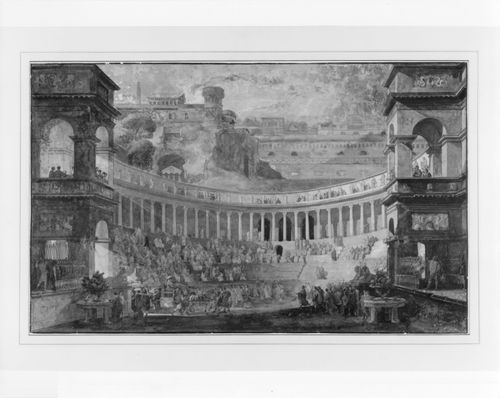
The Triumph of Hannibal
The Triumph of Hannibal
Actions:
Reference number:
DR1984:1641
Description:
- The turbaned figure being carried into the theatre seated on a litter certainly refers to a non-Roman figure, possibly Hannibal. Behind this figure is a theatre and an imaginary town on a hill. The town buildings recall the Sicilian monuments in the 'Voyage pittoresque ou description des royaumes de Naples et de Sicile' published by the Abbé de Saint-Non in Paris between 1781 and 1786. Desprez interrupted his studies at the French Academy in Rome from December 1777 to January 1779 to accompany Dominique Vivant Denon and several other artists to Naples and Sicily in order to make drawings for this publication. The town buildings also recall several buildings Desprez planned in Stockholm while stage designer and architect to Gustavus III of Sweden from 1784 to 1792.
DR1984:1641
Description:
- The turbaned figure being carried into the theatre seated on a litter certainly refers to a non-Roman figure, possibly Hannibal. Behind this figure is a theatre and an imaginary town on a hill. The town buildings recall the Sicilian monuments in the 'Voyage pittoresque ou description des royaumes de Naples et de Sicile' published by the Abbé de Saint-Non in Paris between 1781 and 1786. Desprez interrupted his studies at the French Academy in Rome from December 1777 to January 1779 to accompany Dominique Vivant Denon and several other artists to Naples and Sicily in order to make drawings for this publication. The town buildings also recall several buildings Desprez planned in Stockholm while stage designer and architect to Gustavus III of Sweden from 1784 to 1792.
People:
Subject:
theatre design
theatre design
Date:
ca. 1780-1790
ca. 1780-1790
Title:
The Triumph of Hannibal
Actions:
DR1984:1641
Description:
- The turbaned figure being carried into the theatre seated on a litter certainly refers to a non-Roman figure, possibly Hannibal. Behind this figure is a theatre and an imaginary town on a hill. The town buildings recall the Sicilian monuments in the 'Voyage pittoresque ou description des royaumes de Naples et de Sicile' published by the Abbé de Saint-Non in Paris between 1781 and 1786. Desprez interrupted his studies at the French Academy in Rome from December 1777 to January 1779 to accompany Dominique Vivant Denon and several other artists to Naples and Sicily in order to make drawings for this publication. The town buildings also recall several buildings Desprez planned in Stockholm while stage designer and architect to Gustavus III of Sweden from 1784 to 1792.
The Triumph of Hannibal
Actions:
DR1984:1641
Description:
- The turbaned figure being carried into the theatre seated on a litter certainly refers to a non-Roman figure, possibly Hannibal. Behind this figure is a theatre and an imaginary town on a hill. The town buildings recall the Sicilian monuments in the 'Voyage pittoresque ou description des royaumes de Naples et de Sicile' published by the Abbé de Saint-Non in Paris between 1781 and 1786. Desprez interrupted his studies at the French Academy in Rome from December 1777 to January 1779 to accompany Dominique Vivant Denon and several other artists to Naples and Sicily in order to make drawings for this publication. The town buildings also recall several buildings Desprez planned in Stockholm while stage designer and architect to Gustavus III of Sweden from 1784 to 1792.
Form:
drawings
drawings
Date:
ca. 1780-1790
ca. 1780-1790
People:
Subject:
theatre design
theatre design
Form:
photographs
Quantity:
16 album(s)
photographs
Quantity:
16 album(s)
Actions:
Reference number:
PH1986:0900.01-16
Description:
The 16 albums PH1986:0900.01-.16 comprises 849 photographs and 34 prints of works by Michel Roux-Spitz. The majority of the photographs show projects in Paris and Lyon, France, although Versailles and Fontainebleau, France, Brussels, Belgium, and Rome, Italy also feature. Amongst others, the photographs include views of La Croix-Rousse train station, Villa Weitz, Église Saint-François d'Assise, Salle des Fêtes De La Croix-Rousse, Banque Libre, Manufactures de Glaces de Saint-Gobain, and a housing project in Lyon; Les Galeries Lafayette, Boutique Roger Bal, the atelier de Monsieur Roger Bal, Bijouterie Kepta, a post-office, the Ford Building, Bibliothèque Nationale, Hôtel Roland Bonaparte, and various other buildings in Paris; The Bibliothèque Nationale in Versailles; and other furniture, interiors, fountains, monuments, tombs, vases, models and studies.
PH1986:0900.01-16
Description:
The 16 albums PH1986:0900.01-.16 comprises 849 photographs and 34 prints of works by Michel Roux-Spitz. The majority of the photographs show projects in Paris and Lyon, France, although Versailles and Fontainebleau, France, Brussels, Belgium, and Rome, Italy also feature. Amongst others, the photographs include views of La Croix-Rousse train station, Villa Weitz, Église Saint-François d'Assise, Salle des Fêtes De La Croix-Rousse, Banque Libre, Manufactures de Glaces de Saint-Gobain, and a housing project in Lyon; Les Galeries Lafayette, Boutique Roger Bal, the atelier de Monsieur Roger Bal, Bijouterie Kepta, a post-office, the Ford Building, Bibliothèque Nationale, Hôtel Roland Bonaparte, and various other buildings in Paris; The Bibliothèque Nationale in Versailles; and other furniture, interiors, fountains, monuments, tombs, vases, models and studies.
People:
Subject:
architecture, interior design, ornament, sculpture
architecture, interior design, ornament, sculpture
Date:
1920-1936
1920-1936
Title:
Albums of photographs of projects by Michel Roux-Spitz
Actions:
PH1986:0900.01-16
Description:
The 16 albums PH1986:0900.01-.16 comprises 849 photographs and 34 prints of works by Michel Roux-Spitz. The majority of the photographs show projects in Paris and Lyon, France, although Versailles and Fontainebleau, France, Brussels, Belgium, and Rome, Italy also feature. Amongst others, the photographs include views of La Croix-Rousse train station, Villa Weitz, Église Saint-François d'Assise, Salle des Fêtes De La Croix-Rousse, Banque Libre, Manufactures de Glaces de Saint-Gobain, and a housing project in Lyon; Les Galeries Lafayette, Boutique Roger Bal, the atelier de Monsieur Roger Bal, Bijouterie Kepta, a post-office, the Ford Building, Bibliothèque Nationale, Hôtel Roland Bonaparte, and various other buildings in Paris; The Bibliothèque Nationale in Versailles; and other furniture, interiors, fountains, monuments, tombs, vases, models and studies.
Albums of photographs of projects by Michel Roux-Spitz
Actions:
PH1986:0900.01-16
Description:
The 16 albums PH1986:0900.01-.16 comprises 849 photographs and 34 prints of works by Michel Roux-Spitz. The majority of the photographs show projects in Paris and Lyon, France, although Versailles and Fontainebleau, France, Brussels, Belgium, and Rome, Italy also feature. Amongst others, the photographs include views of La Croix-Rousse train station, Villa Weitz, Église Saint-François d'Assise, Salle des Fêtes De La Croix-Rousse, Banque Libre, Manufactures de Glaces de Saint-Gobain, and a housing project in Lyon; Les Galeries Lafayette, Boutique Roger Bal, the atelier de Monsieur Roger Bal, Bijouterie Kepta, a post-office, the Ford Building, Bibliothèque Nationale, Hôtel Roland Bonaparte, and various other buildings in Paris; The Bibliothèque Nationale in Versailles; and other furniture, interiors, fountains, monuments, tombs, vases, models and studies.
Form:
photographs
Quantity:
16 album(s)
photographs
Quantity:
16 album(s)
Date:
1920-1936
1920-1936
People:
Subject:
architecture, interior design, ornament, sculpture
architecture, interior design, ornament, sculpture
Form:
textual records
textual records
Reference number:
ARCH153531
Description:
Letters to PDE Folder Oppositions Magazine : - Correspondence with MIT Press and Rizzoli about distribution - Schedule and financial status - Memos from Julia Bloomfield (1981) - Minutes and action list of editors meeting, March 20, 1981 - Daniel Libeskind's manuscript "Deus ex Machina…" - Manuscript of the translation of Riegl's "The Modern Cult of Monuments…"; fragment (pages 26-42) of edited text - Subscription count as of 10 December 1974 Loose documents: - Correspondence with MIT Press and Rizzoli - Memos from Julia Bloomfield (1978-1981) - William Ellis's manuscript : "Grave Complications" - Georges Teyssot's C.V. - Article project on "Gruppo 7" by Ellen Shapiro - Job description Managing Editor - Draft manuscript of article by PDE (no title) - Manuscript of Rosemarie Haag Bletter : "Opaque Transparency" - Manuscript of Anthony Vidler : "Postscript to Dal Co on Rossi" - Photocopy of "Manhattan: Capital of the XXth Century, 1969", Oppositions 4
ARCH153531
Description:
Letters to PDE Folder Oppositions Magazine : - Correspondence with MIT Press and Rizzoli about distribution - Schedule and financial status - Memos from Julia Bloomfield (1981) - Minutes and action list of editors meeting, March 20, 1981 - Daniel Libeskind's manuscript "Deus ex Machina…" - Manuscript of the translation of Riegl's "The Modern Cult of Monuments…"; fragment (pages 26-42) of edited text - Subscription count as of 10 December 1974 Loose documents: - Correspondence with MIT Press and Rizzoli - Memos from Julia Bloomfield (1978-1981) - William Ellis's manuscript : "Grave Complications" - Georges Teyssot's C.V. - Article project on "Gruppo 7" by Ellen Shapiro - Job description Managing Editor - Draft manuscript of article by PDE (no title) - Manuscript of Rosemarie Haag Bletter : "Opaque Transparency" - Manuscript of Anthony Vidler : "Postscript to Dal Co on Rossi" - Photocopy of "Manhattan: Capital of the XXth Century, 1969", Oppositions 4
People:
Date:
1974-1981
1974-1981
Title:
D. Programmes and Publications, 1978-1981: 4. Oppositions Magazine
Actions:
ARCH153531
Description:
Letters to PDE Folder Oppositions Magazine : - Correspondence with MIT Press and Rizzoli about distribution - Schedule and financial status - Memos from Julia Bloomfield (1981) - Minutes and action list of editors meeting, March 20, 1981 - Daniel Libeskind's manuscript "Deus ex Machina…" - Manuscript of the translation of Riegl's "The Modern Cult of Monuments…"; fragment (pages 26-42) of edited text - Subscription count as of 10 December 1974 Loose documents: - Correspondence with MIT Press and Rizzoli - Memos from Julia Bloomfield (1978-1981) - William Ellis's manuscript : "Grave Complications" - Georges Teyssot's C.V. - Article project on "Gruppo 7" by Ellen Shapiro - Job description Managing Editor - Draft manuscript of article by PDE (no title) - Manuscript of Rosemarie Haag Bletter : "Opaque Transparency" - Manuscript of Anthony Vidler : "Postscript to Dal Co on Rossi" - Photocopy of "Manhattan: Capital of the XXth Century, 1969", Oppositions 4
D. Programmes and Publications, 1978-1981: 4. Oppositions Magazine
Actions:
ARCH153531
Description:
Letters to PDE Folder Oppositions Magazine : - Correspondence with MIT Press and Rizzoli about distribution - Schedule and financial status - Memos from Julia Bloomfield (1981) - Minutes and action list of editors meeting, March 20, 1981 - Daniel Libeskind's manuscript "Deus ex Machina…" - Manuscript of the translation of Riegl's "The Modern Cult of Monuments…"; fragment (pages 26-42) of edited text - Subscription count as of 10 December 1974 Loose documents: - Correspondence with MIT Press and Rizzoli - Memos from Julia Bloomfield (1978-1981) - William Ellis's manuscript : "Grave Complications" - Georges Teyssot's C.V. - Article project on "Gruppo 7" by Ellen Shapiro - Job description Managing Editor - Draft manuscript of article by PDE (no title) - Manuscript of Rosemarie Haag Bletter : "Opaque Transparency" - Manuscript of Anthony Vidler : "Postscript to Dal Co on Rossi" - Photocopy of "Manhattan: Capital of the XXth Century, 1969", Oppositions 4
Form:
textual records
textual records
Date:
1974-1981
1974-1981
People:
Actions:
Reference number:
PH1979:0508
Description:
This album depicts photographs, plans, sketches of Stonehenge and texts. Preface is signed by Sir Henry James, 29th May 1867, Southhampton. Album has appendix and List of Books inserted at the end. "Col. Sir Henry James, Director-General of the Ordnance Survey, was a strong believer that photography had to be utilized as a major tool for mapping and survey work and he employed the Royal Engineers for that purpose. Colonel James appears in several of the Stonehenge photographs published by the Ordnance Survey. [...] Stonehenge is the world's most famous, large megalithic stone circle and is usually designated as a site used for religious worship in Neolithic Britain. However, the first use of this locality for documented ritual activity goes back to the Mesolithic and the erection of several large totem poles perhaps as early as 8,000 BC (Stonehenge O). Lunar observations preceded the construction of a causeway c.3200 BC, followed by an earth circle and Heel Stones c.3100 BC (Stonehenge 1a) and the Aubrey Holes (Stonehenge 1b). The Stonehenge site was then abandoned for about 1,000 years when large bluestones quarried in Wales were brought to the site and made into the Double Bluestone Circle with Avenue. 2150 BC (Stonehenge II). Soon thereafter sarsen stones were brought in from Avebury to build the great Sarsen Circle and Trilithon Horseshoe, 2100 BC (Stonehenge IIIz). Bluestones were brought back and added as the Bluestone Circle and Bluestone Horseshoe to the sarsen monument, 1800 BC (Stonehenge IIId). The sacred avenue was extended to the River Avon, 1100 BC (Stonehenge IV), the last phase of megalithic construction at this site. Note that the great stone circle and all construction at the Stonehenge site was completed several hundred years before we can postulate Celtic druids in the vicinity. We can only mention in passing that Stonehenge was embedded within a large ritual complex, where several of the ten megalithic constructions were also monumental in scale. Integration between these structures may not have been well planned in advance, but assuredly was articulated as each was built." Neolithic Britian Online.
PH1979:0508
Description:
This album depicts photographs, plans, sketches of Stonehenge and texts. Preface is signed by Sir Henry James, 29th May 1867, Southhampton. Album has appendix and List of Books inserted at the end. "Col. Sir Henry James, Director-General of the Ordnance Survey, was a strong believer that photography had to be utilized as a major tool for mapping and survey work and he employed the Royal Engineers for that purpose. Colonel James appears in several of the Stonehenge photographs published by the Ordnance Survey. [...] Stonehenge is the world's most famous, large megalithic stone circle and is usually designated as a site used for religious worship in Neolithic Britain. However, the first use of this locality for documented ritual activity goes back to the Mesolithic and the erection of several large totem poles perhaps as early as 8,000 BC (Stonehenge O). Lunar observations preceded the construction of a causeway c.3200 BC, followed by an earth circle and Heel Stones c.3100 BC (Stonehenge 1a) and the Aubrey Holes (Stonehenge 1b). The Stonehenge site was then abandoned for about 1,000 years when large bluestones quarried in Wales were brought to the site and made into the Double Bluestone Circle with Avenue. 2150 BC (Stonehenge II). Soon thereafter sarsen stones were brought in from Avebury to build the great Sarsen Circle and Trilithon Horseshoe, 2100 BC (Stonehenge IIIz). Bluestones were brought back and added as the Bluestone Circle and Bluestone Horseshoe to the sarsen monument, 1800 BC (Stonehenge IIId). The sacred avenue was extended to the River Avon, 1100 BC (Stonehenge IV), the last phase of megalithic construction at this site. Note that the great stone circle and all construction at the Stonehenge site was completed several hundred years before we can postulate Celtic druids in the vicinity. We can only mention in passing that Stonehenge was embedded within a large ritual complex, where several of the ten megalithic constructions were also monumental in scale. Integration between these structures may not have been well planned in advance, but assuredly was articulated as each was built." Neolithic Britian Online.
People:
Subject:
sculpture, topographic
sculpture, topographic
Date:
1867
1867
Title:
Plans and Photographs of Stonehenge, and of Turusachan in the Island of Lewis; with Notes Relating to the Druids and Sketches of Cromlechs in Ireland
Actions:
PH1979:0508
Description:
This album depicts photographs, plans, sketches of Stonehenge and texts. Preface is signed by Sir Henry James, 29th May 1867, Southhampton. Album has appendix and List of Books inserted at the end. "Col. Sir Henry James, Director-General of the Ordnance Survey, was a strong believer that photography had to be utilized as a major tool for mapping and survey work and he employed the Royal Engineers for that purpose. Colonel James appears in several of the Stonehenge photographs published by the Ordnance Survey. [...] Stonehenge is the world's most famous, large megalithic stone circle and is usually designated as a site used for religious worship in Neolithic Britain. However, the first use of this locality for documented ritual activity goes back to the Mesolithic and the erection of several large totem poles perhaps as early as 8,000 BC (Stonehenge O). Lunar observations preceded the construction of a causeway c.3200 BC, followed by an earth circle and Heel Stones c.3100 BC (Stonehenge 1a) and the Aubrey Holes (Stonehenge 1b). The Stonehenge site was then abandoned for about 1,000 years when large bluestones quarried in Wales were brought to the site and made into the Double Bluestone Circle with Avenue. 2150 BC (Stonehenge II). Soon thereafter sarsen stones were brought in from Avebury to build the great Sarsen Circle and Trilithon Horseshoe, 2100 BC (Stonehenge IIIz). Bluestones were brought back and added as the Bluestone Circle and Bluestone Horseshoe to the sarsen monument, 1800 BC (Stonehenge IIId). The sacred avenue was extended to the River Avon, 1100 BC (Stonehenge IV), the last phase of megalithic construction at this site. Note that the great stone circle and all construction at the Stonehenge site was completed several hundred years before we can postulate Celtic druids in the vicinity. We can only mention in passing that Stonehenge was embedded within a large ritual complex, where several of the ten megalithic constructions were also monumental in scale. Integration between these structures may not have been well planned in advance, but assuredly was articulated as each was built." Neolithic Britian Online.
Plans and Photographs of Stonehenge, and of Turusachan in the Island of Lewis; with Notes Relating to the Druids and Sketches of Cromlechs in Ireland
Actions:
PH1979:0508
Description:
This album depicts photographs, plans, sketches of Stonehenge and texts. Preface is signed by Sir Henry James, 29th May 1867, Southhampton. Album has appendix and List of Books inserted at the end. "Col. Sir Henry James, Director-General of the Ordnance Survey, was a strong believer that photography had to be utilized as a major tool for mapping and survey work and he employed the Royal Engineers for that purpose. Colonel James appears in several of the Stonehenge photographs published by the Ordnance Survey. [...] Stonehenge is the world's most famous, large megalithic stone circle and is usually designated as a site used for religious worship in Neolithic Britain. However, the first use of this locality for documented ritual activity goes back to the Mesolithic and the erection of several large totem poles perhaps as early as 8,000 BC (Stonehenge O). Lunar observations preceded the construction of a causeway c.3200 BC, followed by an earth circle and Heel Stones c.3100 BC (Stonehenge 1a) and the Aubrey Holes (Stonehenge 1b). The Stonehenge site was then abandoned for about 1,000 years when large bluestones quarried in Wales were brought to the site and made into the Double Bluestone Circle with Avenue. 2150 BC (Stonehenge II). Soon thereafter sarsen stones were brought in from Avebury to build the great Sarsen Circle and Trilithon Horseshoe, 2100 BC (Stonehenge IIIz). Bluestones were brought back and added as the Bluestone Circle and Bluestone Horseshoe to the sarsen monument, 1800 BC (Stonehenge IIId). The sacred avenue was extended to the River Avon, 1100 BC (Stonehenge IV), the last phase of megalithic construction at this site. Note that the great stone circle and all construction at the Stonehenge site was completed several hundred years before we can postulate Celtic druids in the vicinity. We can only mention in passing that Stonehenge was embedded within a large ritual complex, where several of the ten megalithic constructions were also monumental in scale. Integration between these structures may not have been well planned in advance, but assuredly was articulated as each was built." Neolithic Britian Online.
Date:
1867
1867
People:
Subject:
sculpture, topographic
sculpture, topographic
Form:
photographs
Quantity:
82 photograph(s)
photographs
Quantity:
82 photograph(s)
Actions:
Reference number:
PH1996:0069:001-109
Description:
Group of 109 Polaroid photographs made by Aldo Rossi with some presented in the exhibition 'Luigi Ghirri - Aldo Rossi. Things Which Are Only Themselves' held at the CCA in 1996. The photographs represent several scenes from Rossi's travels in different countries: building façades, sacred images, billboards, houses from a Shaker village, baroque façades of churches (in Lecce, Italy), shops, street scenes, lakes, ports, showcases and furniture. Rossi's photography shows the interest he shares with photographer Luigi Ghirri in the belief in the autonomous eye of the photographer and in the potential of that eye to reveal something new to the architect. Ghirri sees in Rossi's Polaroids a "concealed passion, the 'secret' images of the architect, [...] puzzles that are solved with the heart". And according to his definition of photography, "a tangle of monuments, lights, thoughts, objects, moments and metaphors forming the landscape we are searching for in our minds... as would the points of an imaginary compass, which indicates a possible direction".
PH1996:0069:001-109
Description:
Group of 109 Polaroid photographs made by Aldo Rossi with some presented in the exhibition 'Luigi Ghirri - Aldo Rossi. Things Which Are Only Themselves' held at the CCA in 1996. The photographs represent several scenes from Rossi's travels in different countries: building façades, sacred images, billboards, houses from a Shaker village, baroque façades of churches (in Lecce, Italy), shops, street scenes, lakes, ports, showcases and furniture. Rossi's photography shows the interest he shares with photographer Luigi Ghirri in the belief in the autonomous eye of the photographer and in the potential of that eye to reveal something new to the architect. Ghirri sees in Rossi's Polaroids a "concealed passion, the 'secret' images of the architect, [...] puzzles that are solved with the heart". And according to his definition of photography, "a tangle of monuments, lights, thoughts, objects, moments and metaphors forming the landscape we are searching for in our minds... as would the points of an imaginary compass, which indicates a possible direction".
People:
Subject:
architecture, engineering, sculpture
architecture, engineering, sculpture
Date:
1980s-1990s
1980s-1990s
Title:
Group of views of architecture from Aldo Rossi's trips to Italy, France, Corsica, Greece, United States and unspecified countries
Actions:
PH1996:0069:001-109
Description:
Group of 109 Polaroid photographs made by Aldo Rossi with some presented in the exhibition 'Luigi Ghirri - Aldo Rossi. Things Which Are Only Themselves' held at the CCA in 1996. The photographs represent several scenes from Rossi's travels in different countries: building façades, sacred images, billboards, houses from a Shaker village, baroque façades of churches (in Lecce, Italy), shops, street scenes, lakes, ports, showcases and furniture. Rossi's photography shows the interest he shares with photographer Luigi Ghirri in the belief in the autonomous eye of the photographer and in the potential of that eye to reveal something new to the architect. Ghirri sees in Rossi's Polaroids a "concealed passion, the 'secret' images of the architect, [...] puzzles that are solved with the heart". And according to his definition of photography, "a tangle of monuments, lights, thoughts, objects, moments and metaphors forming the landscape we are searching for in our minds... as would the points of an imaginary compass, which indicates a possible direction".
Group of views of architecture from Aldo Rossi's trips to Italy, France, Corsica, Greece, United States and unspecified countries
Actions:
PH1996:0069:001-109
Description:
Group of 109 Polaroid photographs made by Aldo Rossi with some presented in the exhibition 'Luigi Ghirri - Aldo Rossi. Things Which Are Only Themselves' held at the CCA in 1996. The photographs represent several scenes from Rossi's travels in different countries: building façades, sacred images, billboards, houses from a Shaker village, baroque façades of churches (in Lecce, Italy), shops, street scenes, lakes, ports, showcases and furniture. Rossi's photography shows the interest he shares with photographer Luigi Ghirri in the belief in the autonomous eye of the photographer and in the potential of that eye to reveal something new to the architect. Ghirri sees in Rossi's Polaroids a "concealed passion, the 'secret' images of the architect, [...] puzzles that are solved with the heart". And according to his definition of photography, "a tangle of monuments, lights, thoughts, objects, moments and metaphors forming the landscape we are searching for in our minds... as would the points of an imaginary compass, which indicates a possible direction".
Form:
photographs
Quantity:
82 photograph(s)
photographs
Quantity:
82 photograph(s)
Date:
1980s-1990s
1980s-1990s
People:
Subject:
architecture, engineering, sculpture
architecture, engineering, sculpture


