


7518 Results
Level of archival description:
Project
Project
Reference number:
AP056.S1.1989.PR01
Description:
This project series documents an expansion of the Marc Laurent store at 110 Bloor Street West in Toronto in 1989. No project number was identifed. This project consisted of the eastward expansion and renovations to the existing high-end retail store. The original design of the store was completed prior to the founding of KPMB, by Bruce Kuwabara and Thomas Payne in 1986. The new space saw the addition of 1000 square feet to the store at the street level and relocation of the entrance doors to accommodate this expansion. An expansion of the lower concourse level also added 1,457 square feet. The new spaces extended the architectural style already established in earlier phases of the store's development. Materials used in this project, as in earlier projects, included steel, glass, rubber, and aluminum, combined with natural wood and stone. This project is considered Phase 3 of the store's development, with 2 future phases to be completed by KPMB Architects soon after. The project is recorded through original drawings and photographs dating from 1989-1991. The drawings consist primarily of sketches, plans, sections, and furnishing drawings. The photographs show the finished interiors.
AP056.S1.1989.PR01
Description:
This project series documents an expansion of the Marc Laurent store at 110 Bloor Street West in Toronto in 1989. No project number was identifed. This project consisted of the eastward expansion and renovations to the existing high-end retail store. The original design of the store was completed prior to the founding of KPMB, by Bruce Kuwabara and Thomas Payne in 1986. The new space saw the addition of 1000 square feet to the store at the street level and relocation of the entrance doors to accommodate this expansion. An expansion of the lower concourse level also added 1,457 square feet. The new spaces extended the architectural style already established in earlier phases of the store's development. Materials used in this project, as in earlier projects, included steel, glass, rubber, and aluminum, combined with natural wood and stone. This project is considered Phase 3 of the store's development, with 2 future phases to be completed by KPMB Architects soon after. The project is recorded through original drawings and photographs dating from 1989-1991. The drawings consist primarily of sketches, plans, sections, and furnishing drawings. The photographs show the finished interiors.
People:
Date:
1989-1991
1989-1991
Title:
Marc Laurent Store, Phase 3, Toronto (1989-1991)
Actions:
AP056.S1.1989.PR01
Description:
This project series documents an expansion of the Marc Laurent store at 110 Bloor Street West in Toronto in 1989. No project number was identifed. This project consisted of the eastward expansion and renovations to the existing high-end retail store. The original design of the store was completed prior to the founding of KPMB, by Bruce Kuwabara and Thomas Payne in 1986. The new space saw the addition of 1000 square feet to the store at the street level and relocation of the entrance doors to accommodate this expansion. An expansion of the lower concourse level also added 1,457 square feet. The new spaces extended the architectural style already established in earlier phases of the store's development. Materials used in this project, as in earlier projects, included steel, glass, rubber, and aluminum, combined with natural wood and stone. This project is considered Phase 3 of the store's development, with 2 future phases to be completed by KPMB Architects soon after. The project is recorded through original drawings and photographs dating from 1989-1991. The drawings consist primarily of sketches, plans, sections, and furnishing drawings. The photographs show the finished interiors.
Marc Laurent Store, Phase 3, Toronto (1989-1991)
Actions:
AP056.S1.1989.PR01
Description:
This project series documents an expansion of the Marc Laurent store at 110 Bloor Street West in Toronto in 1989. No project number was identifed. This project consisted of the eastward expansion and renovations to the existing high-end retail store. The original design of the store was completed prior to the founding of KPMB, by Bruce Kuwabara and Thomas Payne in 1986. The new space saw the addition of 1000 square feet to the store at the street level and relocation of the entrance doors to accommodate this expansion. An expansion of the lower concourse level also added 1,457 square feet. The new spaces extended the architectural style already established in earlier phases of the store's development. Materials used in this project, as in earlier projects, included steel, glass, rubber, and aluminum, combined with natural wood and stone. This project is considered Phase 3 of the store's development, with 2 future phases to be completed by KPMB Architects soon after. The project is recorded through original drawings and photographs dating from 1989-1991. The drawings consist primarily of sketches, plans, sections, and furnishing drawings. The photographs show the finished interiors.
Level of archival description:
Project
Project
Date:
1989-1991
1989-1991
People:
Form:
textual records
textual records
Actions:
Reference number:
AP075.S3.SS2.024
Description:
Original folder entitled: "War Memorial Toronto".
AP075.S3.SS2.024
Description:
Original folder entitled: "War Memorial Toronto".
People:
Date:
1994
1994
Title:
Design competition for World War II 50th Anniversary Memorial in Toronto
Actions:
AP075.S3.SS2.024
Description:
Original folder entitled: "War Memorial Toronto".
Design competition for World War II 50th Anniversary Memorial in Toronto
Actions:
AP075.S3.SS2.024
Description:
Original folder entitled: "War Memorial Toronto".
Form:
textual records
textual records
Date:
1994
1994
People:
Form:
textual records
textual records
Actions:
Reference number:
ARCH255582
Description:
1 miscellaneous folder of notes left on Erickson's desk from a previous Toronto trip - telephone messages, handwritten notes, design development sketches of various unidentified projects, two unidentified drawings of site plans.
ARCH255582
Description:
1 miscellaneous folder of notes left on Erickson's desk from a previous Toronto trip - telephone messages, handwritten notes, design development sketches of various unidentified projects, two unidentified drawings of site plans.
People:
Date:
1978-1980
1978-1980
Title:
Notes left on Erickson's desk from a previous Toronto trip
Actions:
ARCH255582
Description:
1 miscellaneous folder of notes left on Erickson's desk from a previous Toronto trip - telephone messages, handwritten notes, design development sketches of various unidentified projects, two unidentified drawings of site plans.
Notes left on Erickson's desk from a previous Toronto trip
Actions:
ARCH255582
Description:
1 miscellaneous folder of notes left on Erickson's desk from a previous Toronto trip - telephone messages, handwritten notes, design development sketches of various unidentified projects, two unidentified drawings of site plans.
Form:
textual records
textual records
Date:
1978-1980
1978-1980
People:
Level of archival description:
Project
Project
Actions:
Reference number:
AP018.S1.1977.PR10
Description:
This project series documents interior refurbishments to the Ontario Association of Architects headquarters in Toronto from 1977-1978. The office identified the project number as 7711. This project consisted of changes to the carpeting, drapes and furniture in the building's lounge. However, this project was cancelled by the client due to the possibility of expanding the lounge in the near future. The headquarters had been designed by John C. Parkin's previous firm, John B. Parkin Associates, in the 1950s and was located at 50 Park Road. The project is recorded through correspondence and cost planning records dating from 1977-1978.
AP018.S1.1977.PR10
Description:
This project series documents interior refurbishments to the Ontario Association of Architects headquarters in Toronto from 1977-1978. The office identified the project number as 7711. This project consisted of changes to the carpeting, drapes and furniture in the building's lounge. However, this project was cancelled by the client due to the possibility of expanding the lounge in the near future. The headquarters had been designed by John C. Parkin's previous firm, John B. Parkin Associates, in the 1950s and was located at 50 Park Road. The project is recorded through correspondence and cost planning records dating from 1977-1978.
People:
Date:
1977-1978
1977-1978
Title:
Ontario Association of Architects, Interior Refurbishment, Toronto (1977-1978)
Actions:
AP018.S1.1977.PR10
Description:
This project series documents interior refurbishments to the Ontario Association of Architects headquarters in Toronto from 1977-1978. The office identified the project number as 7711. This project consisted of changes to the carpeting, drapes and furniture in the building's lounge. However, this project was cancelled by the client due to the possibility of expanding the lounge in the near future. The headquarters had been designed by John C. Parkin's previous firm, John B. Parkin Associates, in the 1950s and was located at 50 Park Road. The project is recorded through correspondence and cost planning records dating from 1977-1978.
Ontario Association of Architects, Interior Refurbishment, Toronto (1977-1978)
Actions:
AP018.S1.1977.PR10
Description:
This project series documents interior refurbishments to the Ontario Association of Architects headquarters in Toronto from 1977-1978. The office identified the project number as 7711. This project consisted of changes to the carpeting, drapes and furniture in the building's lounge. However, this project was cancelled by the client due to the possibility of expanding the lounge in the near future. The headquarters had been designed by John C. Parkin's previous firm, John B. Parkin Associates, in the 1950s and was located at 50 Park Road. The project is recorded through correspondence and cost planning records dating from 1977-1978.
Level of archival description:
Project
Project
Date:
1977-1978
1977-1978
People:
Form:
textual records
textual records
Actions:
Reference number:
ARCH285504
ARCH285504
People:
Date:
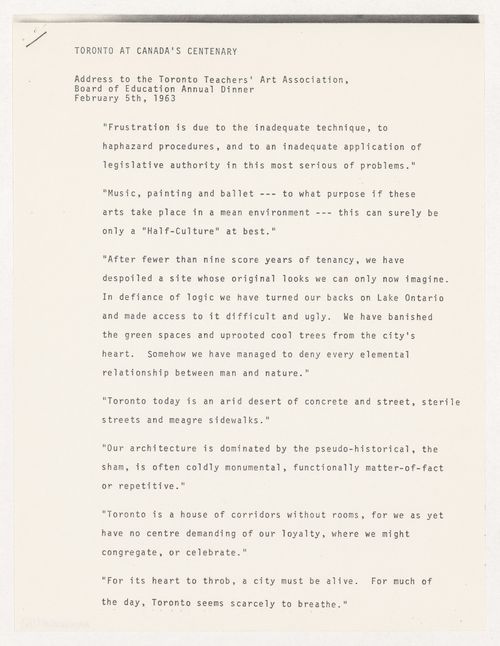
5 February 1963
5 February 1963
Form:
textual records
textual records
Date:
5 February 1963
5 February 1963
People:
Level of archival description:
Project
Project
Actions:
Reference number:
AP018.S1.1984.PR07
Description:
This project series documents additions of infrastructure for the handicapped to the new offices of the Canadian Red Cross Society at the corner of Jarvis Street and Wellesley Street, in Toronto, Ontario. The office identified the project number as 84017. The project is recorded through correspondence with the client dated in 1984.
AP018.S1.1984.PR07
Description:
This project series documents additions of infrastructure for the handicapped to the new offices of the Canadian Red Cross Society at the corner of Jarvis Street and Wellesley Street, in Toronto, Ontario. The office identified the project number as 84017. The project is recorded through correspondence with the client dated in 1984.
People:
Date:
1984
1984
Title:
Canadian Red Cross Society, Provisions for the handicapped, Toronto (1984)
Actions:
AP018.S1.1984.PR07
Description:
This project series documents additions of infrastructure for the handicapped to the new offices of the Canadian Red Cross Society at the corner of Jarvis Street and Wellesley Street, in Toronto, Ontario. The office identified the project number as 84017. The project is recorded through correspondence with the client dated in 1984.
Canadian Red Cross Society, Provisions for the handicapped, Toronto (1984)
Actions:
AP018.S1.1984.PR07
Description:
This project series documents additions of infrastructure for the handicapped to the new offices of the Canadian Red Cross Society at the corner of Jarvis Street and Wellesley Street, in Toronto, Ontario. The office identified the project number as 84017. The project is recorded through correspondence with the client dated in 1984.
Level of archival description:
Project
Project
Date:
1984
1984
People:
Form:
photographs
photographs
Actions:
Reference number:
AP075.S1.2000.PR07.003
Description:
Also contains photographs and plant list. Original folder entitled " Sheff".
AP075.S1.2000.PR07.003
Description:
Also contains photographs and plant list. Original folder entitled " Sheff".
People:
Date:
circa 2000
circa 2000
Title:
Research and correspondence for the Sheff Residence, Toronto, Ontario
Actions:
AP075.S1.2000.PR07.003
Description:
Also contains photographs and plant list. Original folder entitled " Sheff".
Research and correspondence for the Sheff Residence, Toronto, Ontario
Actions:
AP075.S1.2000.PR07.003
Description:
Also contains photographs and plant list. Original folder entitled " Sheff".
Form:
photographs
photographs
Date:
circa 2000
circa 2000
People:
Form:
textual records
textual records
Actions:
Reference number:
AP075.S1.1995.PR01.009
Description:
Contains also financial documents, meetings notes, landscape plan and research. Original folder entitled "Rotman - Specs / 3/97".
AP075.S1.1995.PR01.009
Description:
Contains also financial documents, meetings notes, landscape plan and research. Original folder entitled "Rotman - Specs / 3/97".
People:
Date:
1997
1997
Title:
Correspondence and specifications for the Rotman Residence, Toronto, Ontario
Actions:
AP075.S1.1995.PR01.009
Description:
Contains also financial documents, meetings notes, landscape plan and research. Original folder entitled "Rotman - Specs / 3/97".
Correspondence and specifications for the Rotman Residence, Toronto, Ontario
Actions:
AP075.S1.1995.PR01.009
Description:
Contains also financial documents, meetings notes, landscape plan and research. Original folder entitled "Rotman - Specs / 3/97".
Form:
textual records
textual records
Date:
1997
1997
People:
Level of archival description:
Project
Project
Actions:
Reference number:
AP018.S1.1973.PR03
Description:
This project series documents the design and construction of the Eaton’s store building at Dundas Square in Toronto from 1973-1977. The office identified the project number as 7303. This project, commissioned by The T. Eaton Co. Limited, consisted of a one million square foot department store with thirteen floors, ten above ground and three below. The building boasted nine floor of retail space, seamlessly connected through elevators and escalators. The remaining floors hosted office and storage spaces. Located at the corner of Yonge and Dundas streets, the Eaton’s store was connected to the Eaton Centre mall to its south. The mall, designed and built simultaneously with the Eaton’s store, was designed by the architecture firm Craig Zeidler Strong. For the Eaton’s store project, Parkin Architects Planners created a joint venture with architect C. Blakeway Millar, referred to as Parkin Millar in the documentation. Parkin Millar was the associate architects on this project, with the Eaton’s company architect, E.L. Hankinson, working as the primary architect. Each of the firms mentioned worked closely together to develop a cohesive design for the Eaton’s store and Eaton’s Centre mall, which is evident in the materials. The project is recorded through drawings, textual records, a book and presentation boards dating from 1973-1977. There are a large number of original drawings and sketches for the project. Most of the reprographic copies are arranged within the textual materials. There are presentation boards of the Vancouver Eaton's store in this project series that were likely used as reference by the architects. The textual records consist of correspondence, meeting minutes, site reports, change orders, consultancy records, inter-office letters, and specifications. Also in this project series is a special edition of the Eaton News, a monograph with in depth descriptions of the project.
AP018.S1.1973.PR03
Description:
This project series documents the design and construction of the Eaton’s store building at Dundas Square in Toronto from 1973-1977. The office identified the project number as 7303. This project, commissioned by The T. Eaton Co. Limited, consisted of a one million square foot department store with thirteen floors, ten above ground and three below. The building boasted nine floor of retail space, seamlessly connected through elevators and escalators. The remaining floors hosted office and storage spaces. Located at the corner of Yonge and Dundas streets, the Eaton’s store was connected to the Eaton Centre mall to its south. The mall, designed and built simultaneously with the Eaton’s store, was designed by the architecture firm Craig Zeidler Strong. For the Eaton’s store project, Parkin Architects Planners created a joint venture with architect C. Blakeway Millar, referred to as Parkin Millar in the documentation. Parkin Millar was the associate architects on this project, with the Eaton’s company architect, E.L. Hankinson, working as the primary architect. Each of the firms mentioned worked closely together to develop a cohesive design for the Eaton’s store and Eaton’s Centre mall, which is evident in the materials. The project is recorded through drawings, textual records, a book and presentation boards dating from 1973-1977. There are a large number of original drawings and sketches for the project. Most of the reprographic copies are arranged within the textual materials. There are presentation boards of the Vancouver Eaton's store in this project series that were likely used as reference by the architects. The textual records consist of correspondence, meeting minutes, site reports, change orders, consultancy records, inter-office letters, and specifications. Also in this project series is a special edition of the Eaton News, a monograph with in depth descriptions of the project.
People:
Date:
1973-1977
1973-1977
Title:
Eaton's Store Building, Dundas Square, Toronto (1973-1977)
Actions:
AP018.S1.1973.PR03
Description:
This project series documents the design and construction of the Eaton’s store building at Dundas Square in Toronto from 1973-1977. The office identified the project number as 7303. This project, commissioned by The T. Eaton Co. Limited, consisted of a one million square foot department store with thirteen floors, ten above ground and three below. The building boasted nine floor of retail space, seamlessly connected through elevators and escalators. The remaining floors hosted office and storage spaces. Located at the corner of Yonge and Dundas streets, the Eaton’s store was connected to the Eaton Centre mall to its south. The mall, designed and built simultaneously with the Eaton’s store, was designed by the architecture firm Craig Zeidler Strong. For the Eaton’s store project, Parkin Architects Planners created a joint venture with architect C. Blakeway Millar, referred to as Parkin Millar in the documentation. Parkin Millar was the associate architects on this project, with the Eaton’s company architect, E.L. Hankinson, working as the primary architect. Each of the firms mentioned worked closely together to develop a cohesive design for the Eaton’s store and Eaton’s Centre mall, which is evident in the materials. The project is recorded through drawings, textual records, a book and presentation boards dating from 1973-1977. There are a large number of original drawings and sketches for the project. Most of the reprographic copies are arranged within the textual materials. There are presentation boards of the Vancouver Eaton's store in this project series that were likely used as reference by the architects. The textual records consist of correspondence, meeting minutes, site reports, change orders, consultancy records, inter-office letters, and specifications. Also in this project series is a special edition of the Eaton News, a monograph with in depth descriptions of the project.
Eaton's Store Building, Dundas Square, Toronto (1973-1977)
Actions:
AP018.S1.1973.PR03
Description:
This project series documents the design and construction of the Eaton’s store building at Dundas Square in Toronto from 1973-1977. The office identified the project number as 7303. This project, commissioned by The T. Eaton Co. Limited, consisted of a one million square foot department store with thirteen floors, ten above ground and three below. The building boasted nine floor of retail space, seamlessly connected through elevators and escalators. The remaining floors hosted office and storage spaces. Located at the corner of Yonge and Dundas streets, the Eaton’s store was connected to the Eaton Centre mall to its south. The mall, designed and built simultaneously with the Eaton’s store, was designed by the architecture firm Craig Zeidler Strong. For the Eaton’s store project, Parkin Architects Planners created a joint venture with architect C. Blakeway Millar, referred to as Parkin Millar in the documentation. Parkin Millar was the associate architects on this project, with the Eaton’s company architect, E.L. Hankinson, working as the primary architect. Each of the firms mentioned worked closely together to develop a cohesive design for the Eaton’s store and Eaton’s Centre mall, which is evident in the materials. The project is recorded through drawings, textual records, a book and presentation boards dating from 1973-1977. There are a large number of original drawings and sketches for the project. Most of the reprographic copies are arranged within the textual materials. There are presentation boards of the Vancouver Eaton's store in this project series that were likely used as reference by the architects. The textual records consist of correspondence, meeting minutes, site reports, change orders, consultancy records, inter-office letters, and specifications. Also in this project series is a special edition of the Eaton News, a monograph with in depth descriptions of the project.
Level of archival description:
Project
Project
Date:
1973-1977
1973-1977
People:
Level of archival description:
Project
Project
Actions:
Reference number:
AP018.S1.1973.PR11
Description:
This project series documents a feasibility study for the Ontario Association of Architects headquarters in Toronto from 1973-1975. The office identified the project number as 7311. This project consisted of an investigation into the feasibility of purchasing an additional lot next to the headquarters building so an expansion could be completed. This study also looked at the possibility of an addition on the back of the building, and the state of the electrical and mechanical systems at that time. The headquarters had been designed by John C. Parkin's previous firm, John B. Parkin Associates, in the 1950s and was located at 50 Park Road. The project is recorded through textual records dating from 1973-1975, which consist of correspondence, conference reports, interoffice letters, and consultancy records.
AP018.S1.1973.PR11
Description:
This project series documents a feasibility study for the Ontario Association of Architects headquarters in Toronto from 1973-1975. The office identified the project number as 7311. This project consisted of an investigation into the feasibility of purchasing an additional lot next to the headquarters building so an expansion could be completed. This study also looked at the possibility of an addition on the back of the building, and the state of the electrical and mechanical systems at that time. The headquarters had been designed by John C. Parkin's previous firm, John B. Parkin Associates, in the 1950s and was located at 50 Park Road. The project is recorded through textual records dating from 1973-1975, which consist of correspondence, conference reports, interoffice letters, and consultancy records.
People:
Date:
1973-1975
1973-1975
Title:
Ontario Association of Architects, Feasibility Study, Toronto (1973-1975)
Actions:
AP018.S1.1973.PR11
Description:
This project series documents a feasibility study for the Ontario Association of Architects headquarters in Toronto from 1973-1975. The office identified the project number as 7311. This project consisted of an investigation into the feasibility of purchasing an additional lot next to the headquarters building so an expansion could be completed. This study also looked at the possibility of an addition on the back of the building, and the state of the electrical and mechanical systems at that time. The headquarters had been designed by John C. Parkin's previous firm, John B. Parkin Associates, in the 1950s and was located at 50 Park Road. The project is recorded through textual records dating from 1973-1975, which consist of correspondence, conference reports, interoffice letters, and consultancy records.
Ontario Association of Architects, Feasibility Study, Toronto (1973-1975)
Actions:
AP018.S1.1973.PR11
Description:
This project series documents a feasibility study for the Ontario Association of Architects headquarters in Toronto from 1973-1975. The office identified the project number as 7311. This project consisted of an investigation into the feasibility of purchasing an additional lot next to the headquarters building so an expansion could be completed. This study also looked at the possibility of an addition on the back of the building, and the state of the electrical and mechanical systems at that time. The headquarters had been designed by John C. Parkin's previous firm, John B. Parkin Associates, in the 1950s and was located at 50 Park Road. The project is recorded through textual records dating from 1973-1975, which consist of correspondence, conference reports, interoffice letters, and consultancy records.
Level of archival description:
Project
Project
Date:
1973-1975
1973-1975
People:


