


8417 Results
Form:
books
books
Actions:
Price:
$65.99
(available to order)
Summary:
Today, the physical scale model is a centrepiece for design education, celebrated practices and architecture’s public relations. The development of digital fabrication devices has made model manufacture even more pervasive. The physical model is the most accessible form of architectural communication. Clients and the general public seem to immediately respond to and(...)
$65.99
(available to order)
Summary:
Today, the physical scale model is a centrepiece for design education, celebrated practices and architecture’s public relations. The development of digital fabrication devices has made model manufacture even more pervasive. The physical model is the most accessible form of architectural communication. Clients and the general public seem to immediately respond to and(...)
Title:
Architecture and the miniature : models
Actions:
Price:
$65.99
(available to order)
Summary:
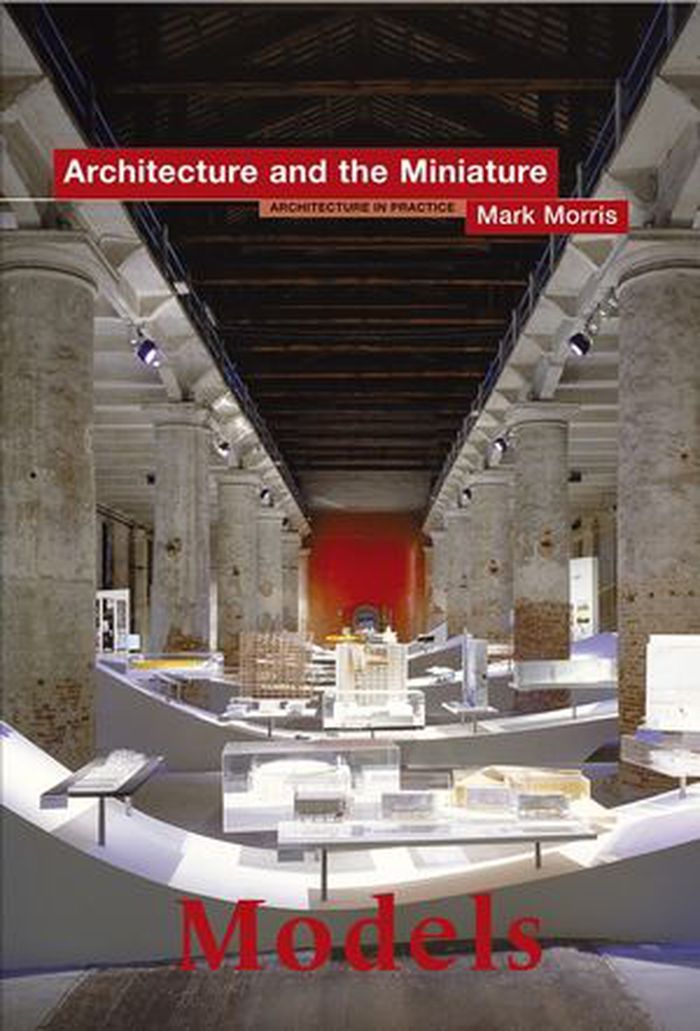
Today, the physical scale model is a centrepiece for design education, celebrated practices and architecture’s public relations. The development of digital fabrication devices has made model manufacture even more pervasive. The physical model is the most accessible form of architectural communication. Clients and the general public seem to immediately respond to and understand the model, over blueprints and computer simulations. Many architects use finished models for presentations, competitions and exhibitions. Others also embrace sketch models as quick, economic and flexible generative tools. It is only with the rise of the virtual that the advantages and disadvantages of more traditional models can be fully evaluated. As attested by this book, we are now at an important watershed for the model in architecture. Practitioners and educators alike are seeking to fully understand the multiplicity of model types and how they might be strategically deployed at appropriate stages in the design process. The historic role that the model has played is outlined with attention paid to Alberti, John Soane, the Bauhaus and education reforms. A cultural history is offered by examining models in the guise of toys, food, cinema, product design, souvenirs, narrative and art. Model theories are considered and tied to specific examples in the field. New technologies and creative combinations of traditional model-making techniques are evaluated. Kinetic, multi-media, nightscape and interdisciplinary models reveal the broad scope and exceptional versatility offered by this important tool. Models: Architecture and the Miniature focuses on current model use and experimentation by architects across the globe including David Chipperfield, Peter Eisenman, Frank Gehry, Zaha Hadid, Coop Himmelb(l)au, Daniel Libeskind, Greg Lynn and UN Studio.
Architecture and the miniature : models
Actions:
Price:
$65.99
(available to order)
Summary:
Today, the physical scale model is a centrepiece for design education, celebrated practices and architecture’s public relations. The development of digital fabrication devices has made model manufacture even more pervasive. The physical model is the most accessible form of architectural communication. Clients and the general public seem to immediately respond to and understand the model, over blueprints and computer simulations. Many architects use finished models for presentations, competitions and exhibitions. Others also embrace sketch models as quick, economic and flexible generative tools. It is only with the rise of the virtual that the advantages and disadvantages of more traditional models can be fully evaluated. As attested by this book, we are now at an important watershed for the model in architecture. Practitioners and educators alike are seeking to fully understand the multiplicity of model types and how they might be strategically deployed at appropriate stages in the design process. The historic role that the model has played is outlined with attention paid to Alberti, John Soane, the Bauhaus and education reforms. A cultural history is offered by examining models in the guise of toys, food, cinema, product design, souvenirs, narrative and art. Model theories are considered and tied to specific examples in the field. New technologies and creative combinations of traditional model-making techniques are evaluated. Kinetic, multi-media, nightscape and interdisciplinary models reveal the broad scope and exceptional versatility offered by this important tool. Models: Architecture and the Miniature focuses on current model use and experimentation by architects across the globe including David Chipperfield, Peter Eisenman, Frank Gehry, Zaha Hadid, Coop Himmelb(l)au, Daniel Libeskind, Greg Lynn and UN Studio.
Form:
books
books
Publication:
October 2005, Chichester
October 2005, Chichester
Subject:
Models
Models
Form:
journals and magazines
journals and magazines
Actions:
Price:
$18.00
(available to order)
Summary:
Text(e)s sur/ on : Franko B., David Cronenberg, Bruno Dumont, Philippe Grandrieux, Michael Haneke, Maria Marshall, Paul McCarthy, Shahryar Nashat, Orlan, Gina Pane, … Par / by : Christa Blümlinger, Tim Clark, Amelia Jones, Jean-Ernest Joos, Thomas Y. Levin, Thérèse St-Gelais, Giovanna Zapperi … '' Comment aborder le problème de la violence dans le monde quand on est(...)
$18.00
(available to order)
Summary:
Text(e)s sur/ on : Franko B., David Cronenberg, Bruno Dumont, Philippe Grandrieux, Michael Haneke, Maria Marshall, Paul McCarthy, Shahryar Nashat, Orlan, Gina Pane, … Par / by : Christa Blümlinger, Tim Clark, Amelia Jones, Jean-Ernest Joos, Thomas Y. Levin, Thérèse St-Gelais, Giovanna Zapperi … '' Comment aborder le problème de la violence dans le monde quand on est(...)
Title:
Parachute 123 : violence , psycho ,
Actions:
Price:
$18.00
(available to order)
Summary:
Text(e)s sur/ on : Franko B., David Cronenberg, Bruno Dumont, Philippe Grandrieux, Michael Haneke, Maria Marshall, Paul McCarthy, Shahryar Nashat, Orlan, Gina Pane, … Par / by : Christa Blümlinger, Tim Clark, Amelia Jones, Jean-Ernest Joos, Thomas Y. Levin, Thérèse St-Gelais, Giovanna Zapperi … '' Comment aborder le problème de la violence dans le monde quand on est artiste ? Est-ce que la violence est innommable, intraitable ? Le cinéma ou les médias nous la montrent pourtant à profusion : guerre, sexes, criminalité, tortures psychologiques et physiques. Quand est-il de la question de la représentation quand il s'agit de violence. La montrer, est-ce la recréer ou l'encourager ? Les pratiques artistiques des dernières années abordent la violence en photographie et en vidéo par exemple. L'exacerbation de la violence et sa propagation par les images provoquent des questionnements inédits. Retrouve-t-on ce questionnement en art contemporain ? Comment se montre-t-il ? Quelles formes prend-il ? /// How do artists broach the question of violence in the contemporary world? Is violence unutterable, untouchable? Cinema and the media do not cease to showcase violence in its most varied manifestations: war, sexuality, criminality, psychological and physical torture, etc. What is the status of representation when it comes to showing violence? Do representations of violent acts necessarily disseminate and recreate them? Many recent artistic practices address violence by means of photography or video. The exacerbation of violence and its dissemination by means of countless images raises new and important questions. How are such questions formulated in the field of contemporary art? How do they manifest themselves? What are their forms? '' Chantal Pontbriand.
Parachute 123 : violence , psycho ,
Actions:
Price:
$18.00
(available to order)
Summary:
Text(e)s sur/ on : Franko B., David Cronenberg, Bruno Dumont, Philippe Grandrieux, Michael Haneke, Maria Marshall, Paul McCarthy, Shahryar Nashat, Orlan, Gina Pane, … Par / by : Christa Blümlinger, Tim Clark, Amelia Jones, Jean-Ernest Joos, Thomas Y. Levin, Thérèse St-Gelais, Giovanna Zapperi … '' Comment aborder le problème de la violence dans le monde quand on est artiste ? Est-ce que la violence est innommable, intraitable ? Le cinéma ou les médias nous la montrent pourtant à profusion : guerre, sexes, criminalité, tortures psychologiques et physiques. Quand est-il de la question de la représentation quand il s'agit de violence. La montrer, est-ce la recréer ou l'encourager ? Les pratiques artistiques des dernières années abordent la violence en photographie et en vidéo par exemple. L'exacerbation de la violence et sa propagation par les images provoquent des questionnements inédits. Retrouve-t-on ce questionnement en art contemporain ? Comment se montre-t-il ? Quelles formes prend-il ? /// How do artists broach the question of violence in the contemporary world? Is violence unutterable, untouchable? Cinema and the media do not cease to showcase violence in its most varied manifestations: war, sexuality, criminality, psychological and physical torture, etc. What is the status of representation when it comes to showing violence? Do representations of violent acts necessarily disseminate and recreate them? Many recent artistic practices address violence by means of photography or video. The exacerbation of violence and its dissemination by means of countless images raises new and important questions. How are such questions formulated in the field of contemporary art? How do they manifest themselves? What are their forms? '' Chantal Pontbriand.
Form:
journals and magazines
journals and magazines
Publication:
June 2006, Montréal
June 2006, Montréal
Subject:
Magazines
Magazines
Form:
books
books
Title:
Building for hope
Building for hope
Actions:
Price:
$39.95
(available to order)
Summary:
This new book by Syrian architect Marwa al-Sabouni, seeks to understand how cities and buildings- scarred by conflict, blight, and pandemic- can be healed through design and urban mindfulness. When Marwa al-Sabouni published Battle for Home in 2016, she was a little-known architect, living in battle-ravaged Homs, Syria, unable to practice her profession. She turned her(...)
$39.95
(available to order)
Summary:
This new book by Syrian architect Marwa al-Sabouni, seeks to understand how cities and buildings- scarred by conflict, blight, and pandemic- can be healed through design and urban mindfulness. When Marwa al-Sabouni published Battle for Home in 2016, she was a little-known architect, living in battle-ravaged Homs, Syria, unable to practice her profession. She turned her(...)
Title:
Building for hope
Actions:
Price:
$39.95
(available to order)
Summary:
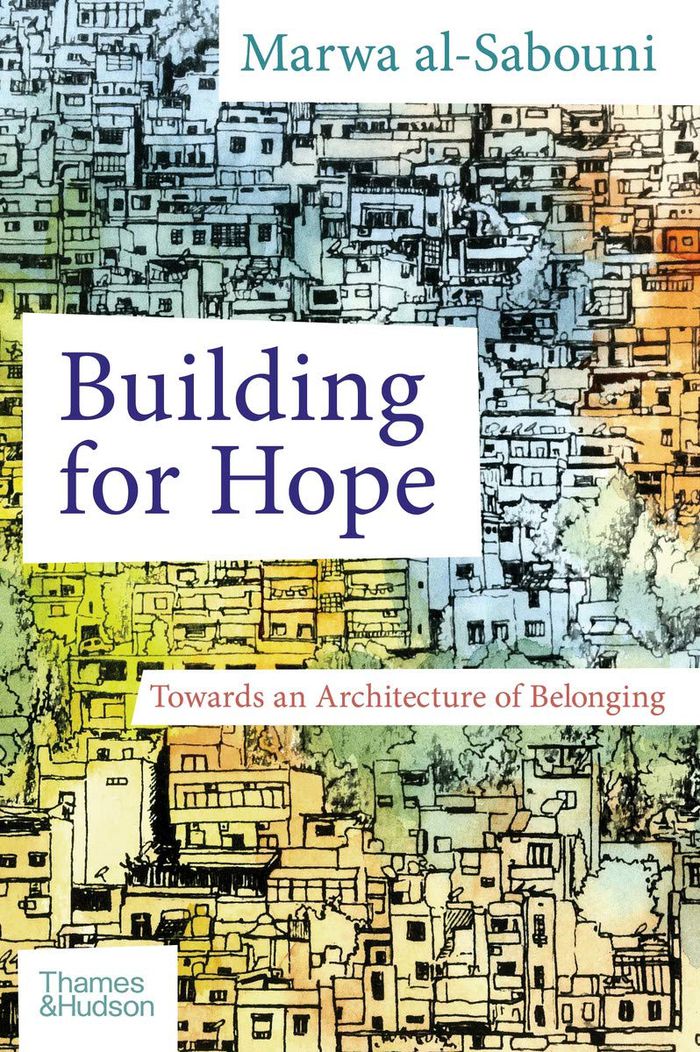
This new book by Syrian architect Marwa al-Sabouni, seeks to understand how cities and buildings- scarred by conflict, blight, and pandemic- can be healed through design and urban mindfulness. When Marwa al-Sabouni published Battle for Home in 2016, she was a little-known architect, living in battle-ravaged Homs, Syria, unable to practice her profession. She turned her fierce intelligence to chronicling how her city and country were undone through decades of architectural mismanagement and mistakes. Once published, Marwa al-Sabouni’s book and story attracted the attention of international media- CNN, The New York Times- and received critical acclaim worldwide. The United Nations called on her for insights and expertise. She became a TED fellow, was invited to speak to audiences around the world, and some suggested she be nominated for architecture’s highest honor, the Pritzker Prize. Al-Sabouni’s deep understanding of Middle Eastern heritage and architecture gives her insight into a wide range of cities, informing her views on how cities work best, how they might fail, and what can be done to harmonize the lives of all their inhabitants. In this new book, al-Sabouni draws together several narratives: her personal and professional observations of some of the world’s most fascinating cities, from Detroit to Helsinki; the lessons that Western societies might learn from Islamic culture and design; and philosophical reflections on how our personal and communal spaces can provide the basic foundations for happiness. Through this tapestry of personal experience, unblinking perspective, and insight, al-Sabouni offers real-world solutions- and hope- for how peace might be created through mindful urban planning.
Building for hope
Actions:
Price:
$39.95
(available to order)
Summary:
This new book by Syrian architect Marwa al-Sabouni, seeks to understand how cities and buildings- scarred by conflict, blight, and pandemic- can be healed through design and urban mindfulness. When Marwa al-Sabouni published Battle for Home in 2016, she was a little-known architect, living in battle-ravaged Homs, Syria, unable to practice her profession. She turned her fierce intelligence to chronicling how her city and country were undone through decades of architectural mismanagement and mistakes. Once published, Marwa al-Sabouni’s book and story attracted the attention of international media- CNN, The New York Times- and received critical acclaim worldwide. The United Nations called on her for insights and expertise. She became a TED fellow, was invited to speak to audiences around the world, and some suggested she be nominated for architecture’s highest honor, the Pritzker Prize. Al-Sabouni’s deep understanding of Middle Eastern heritage and architecture gives her insight into a wide range of cities, informing her views on how cities work best, how they might fail, and what can be done to harmonize the lives of all their inhabitants. In this new book, al-Sabouni draws together several narratives: her personal and professional observations of some of the world’s most fascinating cities, from Detroit to Helsinki; the lessons that Western societies might learn from Islamic culture and design; and philosophical reflections on how our personal and communal spaces can provide the basic foundations for happiness. Through this tapestry of personal experience, unblinking perspective, and insight, al-Sabouni offers real-world solutions- and hope- for how peace might be created through mindful urban planning.
Form:
books
books
Publication:
April 2021
April 2021
Subject:
Architectural Theory
Architectural Theory
Form:
books
books
Actions:
Price:
$39.99
(available to order)
Summary:
Event-Cities 4 is the latest in the Event-Cities series from Bernard Tschumi, documenting recent built and theoretical projects in the context of his evolving views on architecture, urbanism, and design. Event-Cities 4 follows directly from the work of Event-Cities 3, which examined the interaction of architectural content, concept, and context. This volume takes the(...)
$39.99
(available to order)
Summary:
Event-Cities 4 is the latest in the Event-Cities series from Bernard Tschumi, documenting recent built and theoretical projects in the context of his evolving views on architecture, urbanism, and design. Event-Cities 4 follows directly from the work of Event-Cities 3, which examined the interaction of architectural content, concept, and context. This volume takes the(...)
Title:
Bernard Tschumi : event-cities 4, concept - form
Actions:
Price:
$39.99
(available to order)
Summary:
Event-Cities 4 is the latest in the Event-Cities series from Bernard Tschumi, documenting recent built and theoretical projects in the context of his evolving views on architecture, urbanism, and design. Event-Cities 4 follows directly from the work of Event-Cities 3, which examined the interaction of architectural content, concept, and context. This volume takes the interaction a step further, looking at a series of projects for which program or context are insufficient as a generative conceptual strategy, hence requiring a different approach. Tschumi has said, "Over the past years, there is one word I have almost never used, except in order to attack it: 'form.'" In Event-Cities 4, Tschumi introduces the "concept-form": a concept generating a form, or a form generating a concept, so that one reinforces the other. The concept may be programmatic, technological, or social. The form may be singular or multiple, regular or irregular. Concept-forms act as organizing devices or common denominators for the multiple dimensions of programs and their evolution over time, and drive the projects featured in this book. Highlights include master plans for a pair of media-based work spaces and cultural campuses in Singapore and Abu Dhabi; a major master plan for a financial center with 40,000 projected inhabitants in the Dominican Republic; the innovative Blue Residential Tower in New York City; a group of museums and cultural buildings in France, Abu Dhabi, Dubai, and South Korea; a pedestrian bridge in France; and a "multi-programmatic" furniture piece, the TypoLounger. The book contains more than twenty of the Tschumi firm's recent projects.
Bernard Tschumi : event-cities 4, concept - form
Actions:
Price:
$39.99
(available to order)
Summary:
Event-Cities 4 is the latest in the Event-Cities series from Bernard Tschumi, documenting recent built and theoretical projects in the context of his evolving views on architecture, urbanism, and design. Event-Cities 4 follows directly from the work of Event-Cities 3, which examined the interaction of architectural content, concept, and context. This volume takes the interaction a step further, looking at a series of projects for which program or context are insufficient as a generative conceptual strategy, hence requiring a different approach. Tschumi has said, "Over the past years, there is one word I have almost never used, except in order to attack it: 'form.'" In Event-Cities 4, Tschumi introduces the "concept-form": a concept generating a form, or a form generating a concept, so that one reinforces the other. The concept may be programmatic, technological, or social. The form may be singular or multiple, regular or irregular. Concept-forms act as organizing devices or common denominators for the multiple dimensions of programs and their evolution over time, and drive the projects featured in this book. Highlights include master plans for a pair of media-based work spaces and cultural campuses in Singapore and Abu Dhabi; a major master plan for a financial center with 40,000 projected inhabitants in the Dominican Republic; the innovative Blue Residential Tower in New York City; a group of museums and cultural buildings in France, Abu Dhabi, Dubai, and South Korea; a pedestrian bridge in France; and a "multi-programmatic" furniture piece, the TypoLounger. The book contains more than twenty of the Tschumi firm's recent projects.
Form:
books
books
Publication:
September 2010
September 2010
Subject:
Architecture Monographs
Architecture Monographs
Form:
books
books
Actions:
Holdings:
Description:
xlix, 697 pages : illustrations, maps ; 32 cm
Description:
xlix, 697 pages : illustrations, maps ; 32 cm
Author:
Subject:
Publication:
Princeton, N.J. : Dept. of Art and Archaeology, Princeton University, ©1995.
Princeton, N.J. : Dept. of Art and Archaeology, Princeton University, ©1995.
Title:
Byzantine East, Latin West : art-historical studies in honor of Kurt Weitzmann / editorial board, Doula Mouriki [and others] ; edited by Christopher Moss, Katherine Kiefer.
Actions:
Holdings:
Description:
xlix, 697 pages : illustrations, maps ; 32 cm
Byzantine East, Latin West : art-historical studies in honor of Kurt Weitzmann / editorial board, Doula Mouriki [and others] ; edited by Christopher Moss, Katherine Kiefer.
Actions:
Holdings:
Description:
xlix, 697 pages : illustrations, maps ; 32 cm
Form:
books
books
Publication:
Princeton, N.J. : Dept. of Art and Archaeology, Princeton University, ©1995.
Princeton, N.J. : Dept. of Art and Archaeology, Princeton University, ©1995.
Author:
Subject:
Form:
books
books
Actions:
Holdings:
Description:
xxxvi, 905 pages : illustrations, music ; 24 cm + 1 DVD (4 3/4 in.)
Description:
xxxvi, 905 pages : illustrations, music ; 24 cm + 1 DVD (4 3/4 in.)
Author:
Subject:
Publication:
Toronto ; Buffalo : University of Toronto Press, [2006], ©2006
Toronto ; Buffalo : University of Toronto Press, [2006], ©2006
Title:
The Jesuits II : cultures, sciences, and the arts, 1540-1773 / edited by John W. O'Malley [and others].
Actions:
Holdings:
Description:
xxxvi, 905 pages : illustrations, music ; 24 cm + 1 DVD (4 3/4 in.)
The Jesuits II : cultures, sciences, and the arts, 1540-1773 / edited by John W. O'Malley [and others].
Actions:
Holdings:
Description:
xxxvi, 905 pages : illustrations, music ; 24 cm + 1 DVD (4 3/4 in.)
Form:
books
books
Publication:
Toronto ; Buffalo : University of Toronto Press, [2006], ©2006
Toronto ; Buffalo : University of Toronto Press, [2006], ©2006
Author:
Subject:
Form:
books
books
Title:
The gray cloth
The gray cloth
Actions:
Price:
$44.95
(available to order)
Summary:
The German expressionist, architectural visionary, author, inventor, and artist Paul Scheerbart (1863-1915) wrote several fictional utopian narratives related to glass architecture. In "The Gray Cloth", the first of his novels to be translated into English, Scheerbart uses subtle irony and the structural simplicity of a fairy tale to present the theories of coloured glass(...)
$44.95
(available to order)
Summary:
The German expressionist, architectural visionary, author, inventor, and artist Paul Scheerbart (1863-1915) wrote several fictional utopian narratives related to glass architecture. In "The Gray Cloth", the first of his novels to be translated into English, Scheerbart uses subtle irony and the structural simplicity of a fairy tale to present the theories of coloured glass(...)
Title:
The gray cloth
Actions:
Price:
$44.95
(available to order)
Summary:
The German expressionist, architectural visionary, author, inventor, and artist Paul Scheerbart (1863-1915) wrote several fictional utopian narratives related to glass architecture. In "The Gray Cloth", the first of his novels to be translated into English, Scheerbart uses subtle irony and the structural simplicity of a fairy tale to present the theories of coloured glass outlined in his well-known treatise "Glass Architecture". The novel is set forward in time to the mid-twentieth century. The protagonist, a Swiss architect named Edgar Krug, circumnavigates the globe by airship with his wife, constructing wildly varied, colored-glass buildings. His projects include a high-rise and exhibition/concert hall in Chicago, a retirement complex for air pilots on the Fiji Islands, the structure for an elevated train across a zoological park in northern India, and a suspended residential villa on the Kuria Muria Islands off the coast of Oman in the Arabian Sea. Fearing that his architecture is challenged by the colourfulness of women’s clothing, Krug insists that his wife wear all gray clothing with the addition of ten percent white. This odd demand brings him notoriety and sensationalizes his international building campaign. For the reader, it underlines the confluence of architecture with fashion, gender, and global media. In his introduction John Stuart surveys Scheerbart’s career and role in German avant-garde circles, as well as his architectural and social ideas. He shows how Scheerbart strove to integrate his spiritual and romantic leanings with the modern world, often relying on glass architecture to do so. In addition to discussing the novel’s reception and its rediscovery by contemporary architects and critics, Stuart shows fiction to be a resource for the study of architecture and places "The Gray Cloth" in the context of German Expressionism.
The gray cloth
Actions:
Price:
$44.95
(available to order)
Summary:
The German expressionist, architectural visionary, author, inventor, and artist Paul Scheerbart (1863-1915) wrote several fictional utopian narratives related to glass architecture. In "The Gray Cloth", the first of his novels to be translated into English, Scheerbart uses subtle irony and the structural simplicity of a fairy tale to present the theories of coloured glass outlined in his well-known treatise "Glass Architecture". The novel is set forward in time to the mid-twentieth century. The protagonist, a Swiss architect named Edgar Krug, circumnavigates the globe by airship with his wife, constructing wildly varied, colored-glass buildings. His projects include a high-rise and exhibition/concert hall in Chicago, a retirement complex for air pilots on the Fiji Islands, the structure for an elevated train across a zoological park in northern India, and a suspended residential villa on the Kuria Muria Islands off the coast of Oman in the Arabian Sea. Fearing that his architecture is challenged by the colourfulness of women’s clothing, Krug insists that his wife wear all gray clothing with the addition of ten percent white. This odd demand brings him notoriety and sensationalizes his international building campaign. For the reader, it underlines the confluence of architecture with fashion, gender, and global media. In his introduction John Stuart surveys Scheerbart’s career and role in German avant-garde circles, as well as his architectural and social ideas. He shows how Scheerbart strove to integrate his spiritual and romantic leanings with the modern world, often relying on glass architecture to do so. In addition to discussing the novel’s reception and its rediscovery by contemporary architects and critics, Stuart shows fiction to be a resource for the study of architecture and places "The Gray Cloth" in the context of German Expressionism.
Form:
books
books
Publication:
October 2001, Cambridge, Mass.
October 2001, Cambridge, Mass.
Subject:
Architectural Theory
Architectural Theory
Form:
journals and magazines
journals and magazines
Title:
e-flux index #3
e-flux index #3
Actions:
Price:
$65.00
(available in store)
Summary:
Today we are accustomed to the apophatic gesture of free-speech fundamentalists and far-right demagogues, who use the flimsy legal cover of “just asking questions” to broadcast ever more widely the most violent and reactionary forms of hate speech. In resisting this enclosure of thought, art and theory continue to be instructive, if not essential activities. The late(...)
$65.00
(available in store)
Summary:
Today we are accustomed to the apophatic gesture of free-speech fundamentalists and far-right demagogues, who use the flimsy legal cover of “just asking questions” to broadcast ever more widely the most violent and reactionary forms of hate speech. In resisting this enclosure of thought, art and theory continue to be instructive, if not essential activities. The late(...)
Title:
e-flux index #3
Actions:
Price:
$65.00
(available in store)
Summary:
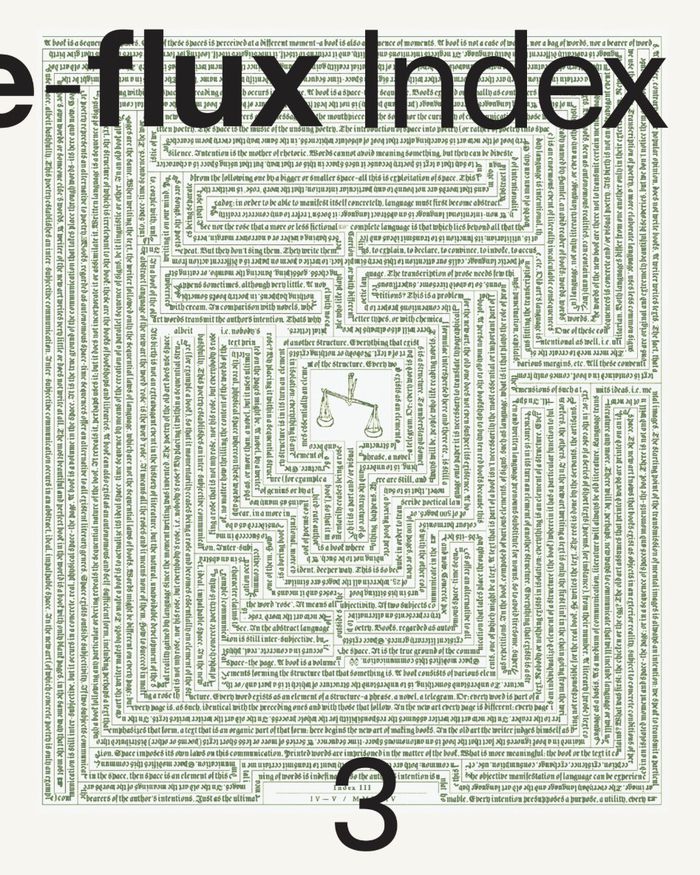
Today we are accustomed to the apophatic gesture of free-speech fundamentalists and far-right demagogues, who use the flimsy legal cover of “just asking questions” to broadcast ever more widely the most violent and reactionary forms of hate speech. In resisting this enclosure of thought, art and theory continue to be instructive, if not essential activities. The late Lawrence Weiner memorably declared that “the purpose of art is to ask questions… it doesn’t answer anybody’s question but gives them the means to answer a particular question at a particular moment.” All the better when those questions can provoke a certain illuminating friction with the contradictions of one’s environment and disrupt the automaticity of one’s learned responses, remaining themselves ambiguous or unanswered—because unanswerable. This third issue of e-flux Index, bringing together all the content commissioned and published by e-flux between April and May 2024, contains many such unexpected and unanswered (or unanswerable) questions across its 76 contributions, each of which cut across and reach beyond existing disciplines and borders: “Who is willing to care?”; “Who is the addressee at the end of the regulated pipelines of the English language?”; “Yes, but is it edible?”; “Why does everyone hate college students?”; “Is some form of suffering the condition for the emergence of an organic type of intelligence?”; “What does it mean to make a film today, in 2024, when most of our image consumption has been transferred to other (smaller) screens and other media?; “How to represent history?”; “Whose lives are worth remembering—or even, living?”; “How is it possible to speak the language of imperial renaissance and decolonization in the same breath?”; “Today is which day of the revolution?”—“Are these all just notes for a poem?”
e-flux index #3
Actions:
Price:
$65.00
(available in store)
Summary:
Today we are accustomed to the apophatic gesture of free-speech fundamentalists and far-right demagogues, who use the flimsy legal cover of “just asking questions” to broadcast ever more widely the most violent and reactionary forms of hate speech. In resisting this enclosure of thought, art and theory continue to be instructive, if not essential activities. The late Lawrence Weiner memorably declared that “the purpose of art is to ask questions… it doesn’t answer anybody’s question but gives them the means to answer a particular question at a particular moment.” All the better when those questions can provoke a certain illuminating friction with the contradictions of one’s environment and disrupt the automaticity of one’s learned responses, remaining themselves ambiguous or unanswered—because unanswerable. This third issue of e-flux Index, bringing together all the content commissioned and published by e-flux between April and May 2024, contains many such unexpected and unanswered (or unanswerable) questions across its 76 contributions, each of which cut across and reach beyond existing disciplines and borders: “Who is willing to care?”; “Who is the addressee at the end of the regulated pipelines of the English language?”; “Yes, but is it edible?”; “Why does everyone hate college students?”; “Is some form of suffering the condition for the emergence of an organic type of intelligence?”; “What does it mean to make a film today, in 2024, when most of our image consumption has been transferred to other (smaller) screens and other media?; “How to represent history?”; “Whose lives are worth remembering—or even, living?”; “How is it possible to speak the language of imperial renaissance and decolonization in the same breath?”; “Today is which day of the revolution?”—“Are these all just notes for a poem?”
Form:
journals and magazines
journals and magazines
Publication:
December 2024
December 2024
Subject:
Magazines
Magazines
Form:
books
books
Price:
$59.99
(available to order)
Summary:
Featuring 40 essays by U.S. and European historians, designers, cultural critics, geographers and social scientists, illustrated with over 250 color images in extensive visual "gazetteers" — including specially-commissioned portfolios by artists and designers — "Else/where mapping" investigates : how new technologies of navigation and location are emerging to chart(...)
$59.99
(available to order)
Summary:
Featuring 40 essays by U.S. and European historians, designers, cultural critics, geographers and social scientists, illustrated with over 250 color images in extensive visual "gazetteers" — including specially-commissioned portfolios by artists and designers — "Else/where mapping" investigates : how new technologies of navigation and location are emerging to chart(...)
Subject:
Architectural Plans and Cartography
Architectural Plans and Cartography
Publication:
October 2005, Minneapolis
October 2005, Minneapolis
Title:
Else/where : mapping new cartographies of networks and territories
Actions:
Price:
$59.99
(available to order)
Summary:
Featuring 40 essays by U.S. and European historians, designers, cultural critics, geographers and social scientists, illustrated with over 250 color images in extensive visual "gazetteers" — including specially-commissioned portfolios by artists and designers — "Else/where mapping" investigates : how new technologies of navigation and location are emerging to chart "virtual" terrain such as social networks and online conversations; how these new mapping strategies borrow and reinvent metaphors adapted from the cartography of physical terrain, considered at various scales — urban, regional, continental, global ; how new modes of representation of spatial data are evolving to explore the potential for collective "bottom-up" (rather than "top-down") mapping ; how cities, communities and social networks are being re-envisioned, as artists and designers use technologies such as GPS, GIS and digital interface design to devise alternative mappings of social and spatial relationships. Authors : Janet Abrams, Ole Bouman, Andrea Codrington, Denis Cosgrove, Steve Dietz, Paul Elliman, Yuri Engelhardt, Peter Hall, Brian Holmes, J.J. King, Cathy Lang Ho, Andrea Moed, David Pescovitz, Rebecca Ross, Ben Schouten, Alex Terzich, Alice Twemlow, Dirk van Weelden, Tom Vanderbilt, Peter Walsh and Stephen Zacks. Featured artists and designers included : Antenna Design New York, Julian Bleecker, Bureau d'Etudes, Sulki Choi, Layla Curtis, Judith Donath, Entropy8Zuper!, Michael Frumin, Ben Fry, De Geuzen, govcom.org, Marti Guixe, Mark Hansen, Robert Horn, Natalie Jeremijenko, Lisa Jevbratt, Nina Katchadourian, Valdis Krebs, Laura Kurgan, Mark Lombardi, The London Particular, Lumeta.org, Barrett Lyon, Brian McGrath, Julie Mehretu, Paul Mijksenaar, Sigi Moeslinger, MUST Architects, MVRDV, Josh On, W. Bradford Paley, Scott Paterson, Esther Polak, Richard Rogers, Ben Rubin, Warren Sack, Mike Silver, Marco Susani, Terraswarm, UN Studio, Urban Tapestries, Waag Society for Old and New Media, Ronald Wall, Kimberlee Whaley, Jeremy Wood and Marina Zurkow. Book design : Deborah Littlejohn.
Else/where : mapping new cartographies of networks and territories
Actions:
Price:
$59.99
(available to order)
Summary:
Featuring 40 essays by U.S. and European historians, designers, cultural critics, geographers and social scientists, illustrated with over 250 color images in extensive visual "gazetteers" — including specially-commissioned portfolios by artists and designers — "Else/where mapping" investigates : how new technologies of navigation and location are emerging to chart "virtual" terrain such as social networks and online conversations; how these new mapping strategies borrow and reinvent metaphors adapted from the cartography of physical terrain, considered at various scales — urban, regional, continental, global ; how new modes of representation of spatial data are evolving to explore the potential for collective "bottom-up" (rather than "top-down") mapping ; how cities, communities and social networks are being re-envisioned, as artists and designers use technologies such as GPS, GIS and digital interface design to devise alternative mappings of social and spatial relationships. Authors : Janet Abrams, Ole Bouman, Andrea Codrington, Denis Cosgrove, Steve Dietz, Paul Elliman, Yuri Engelhardt, Peter Hall, Brian Holmes, J.J. King, Cathy Lang Ho, Andrea Moed, David Pescovitz, Rebecca Ross, Ben Schouten, Alex Terzich, Alice Twemlow, Dirk van Weelden, Tom Vanderbilt, Peter Walsh and Stephen Zacks. Featured artists and designers included : Antenna Design New York, Julian Bleecker, Bureau d'Etudes, Sulki Choi, Layla Curtis, Judith Donath, Entropy8Zuper!, Michael Frumin, Ben Fry, De Geuzen, govcom.org, Marti Guixe, Mark Hansen, Robert Horn, Natalie Jeremijenko, Lisa Jevbratt, Nina Katchadourian, Valdis Krebs, Laura Kurgan, Mark Lombardi, The London Particular, Lumeta.org, Barrett Lyon, Brian McGrath, Julie Mehretu, Paul Mijksenaar, Sigi Moeslinger, MUST Architects, MVRDV, Josh On, W. Bradford Paley, Scott Paterson, Esther Polak, Richard Rogers, Ben Rubin, Warren Sack, Mike Silver, Marco Susani, Terraswarm, UN Studio, Urban Tapestries, Waag Society for Old and New Media, Ronald Wall, Kimberlee Whaley, Jeremy Wood and Marina Zurkow. Book design : Deborah Littlejohn.
Form:
books
books
Publication:
October 2005, Minneapolis
October 2005, Minneapolis
Subject:
Architectural Plans and Cartography
Architectural Plans and Cartography
Form:
books
books
Title:
The gray cloth
The gray cloth
Actions:
Price:
$24.95
(available to order)
Summary:
The German expressionist, architectural visionary, author, inventor, and artist Paul Scheerbart (1863-1915) wrote several fictional utopian narratives related to glass architecture. In "The Gray Cloth", the first of his novels to be translated into English, Scheerbart uses subtle irony and the structural simplicity of a fairy tale to present the theories of coloured glass(...)
$24.95
(available to order)
Summary:
The German expressionist, architectural visionary, author, inventor, and artist Paul Scheerbart (1863-1915) wrote several fictional utopian narratives related to glass architecture. In "The Gray Cloth", the first of his novels to be translated into English, Scheerbart uses subtle irony and the structural simplicity of a fairy tale to present the theories of coloured glass(...)
Title:
The gray cloth
Actions:
Price:
$24.95
(available to order)
Summary:
The German expressionist, architectural visionary, author, inventor, and artist Paul Scheerbart (1863-1915) wrote several fictional utopian narratives related to glass architecture. In "The Gray Cloth", the first of his novels to be translated into English, Scheerbart uses subtle irony and the structural simplicity of a fairy tale to present the theories of coloured glass outlined in his well-known treatise "Glass Architecture". The novel is set forward in time to the mid-twentieth century. The protagonist, a Swiss architect named Edgar Krug, circumnavigates the globe by airship with his wife, constructing wildly varied, colored-glass buildings. His projects include a high-rise and exhibition/concert hall in Chicago, a retirement complex for air pilots on the Fiji Islands, the structure for an elevated train across a zoological park in northern India, and a suspended residential villa on the Kuria Muria Islands off the coast of Oman in the Arabian Sea. Fearing that his architecture is challenged by the colourfulness of women’s clothing, Krug insists that his wife wear all gray clothing with the addition of ten percent white. This odd demand brings him notoriety and sensationalizes his international building campaign. For the reader, it underlines the confluence of architecture with fashion, gender, and global media. In his introduction John Stuart surveys Scheerbart’s career and role in German avant-garde circles, as well as his architectural and social ideas. He shows how Scheerbart strove to integrate his spiritual and romantic leanings with the modern world, often relying on glass architecture to do so. In addition to discussing the novel’s reception and its rediscovery by contemporary architects and critics, Stuart shows fiction to be a resource for the study of architecture and places "The Gray Cloth" in the context of German Expressionism.
The gray cloth
Actions:
Price:
$24.95
(available to order)
Summary:
The German expressionist, architectural visionary, author, inventor, and artist Paul Scheerbart (1863-1915) wrote several fictional utopian narratives related to glass architecture. In "The Gray Cloth", the first of his novels to be translated into English, Scheerbart uses subtle irony and the structural simplicity of a fairy tale to present the theories of coloured glass outlined in his well-known treatise "Glass Architecture". The novel is set forward in time to the mid-twentieth century. The protagonist, a Swiss architect named Edgar Krug, circumnavigates the globe by airship with his wife, constructing wildly varied, colored-glass buildings. His projects include a high-rise and exhibition/concert hall in Chicago, a retirement complex for air pilots on the Fiji Islands, the structure for an elevated train across a zoological park in northern India, and a suspended residential villa on the Kuria Muria Islands off the coast of Oman in the Arabian Sea. Fearing that his architecture is challenged by the colourfulness of women’s clothing, Krug insists that his wife wear all gray clothing with the addition of ten percent white. This odd demand brings him notoriety and sensationalizes his international building campaign. For the reader, it underlines the confluence of architecture with fashion, gender, and global media. In his introduction John Stuart surveys Scheerbart’s career and role in German avant-garde circles, as well as his architectural and social ideas. He shows how Scheerbart strove to integrate his spiritual and romantic leanings with the modern world, often relying on glass architecture to do so. In addition to discussing the novel’s reception and its rediscovery by contemporary architects and critics, Stuart shows fiction to be a resource for the study of architecture and places "The Gray Cloth" in the context of German Expressionism.
Form:
books
books
Publication:
October 2003, Cambridge / London
October 2003, Cambridge / London
Subject:
Architectural Theory
Architectural Theory


