


8452 Results
Form:
books
books
Actions:
Holdings:
Description:
xxxvi, 905 pages : illustrations, music ; 24 cm + 1 DVD (4 3/4 in.)
Description:
xxxvi, 905 pages : illustrations, music ; 24 cm + 1 DVD (4 3/4 in.)
Author:
Subject:
Publication:
Toronto ; Buffalo : University of Toronto Press, [2006], ©2006
Toronto ; Buffalo : University of Toronto Press, [2006], ©2006
Title:
The Jesuits II : cultures, sciences, and the arts, 1540-1773 / edited by John W. O'Malley [and others].
Actions:
Holdings:
Description:
xxxvi, 905 pages : illustrations, music ; 24 cm + 1 DVD (4 3/4 in.)
The Jesuits II : cultures, sciences, and the arts, 1540-1773 / edited by John W. O'Malley [and others].
Actions:
Holdings:
Description:
xxxvi, 905 pages : illustrations, music ; 24 cm + 1 DVD (4 3/4 in.)
Form:
books
books
Publication:
Toronto ; Buffalo : University of Toronto Press, [2006], ©2006
Toronto ; Buffalo : University of Toronto Press, [2006], ©2006
Author:
Subject:
Form:
journals and magazines
journals and magazines
Title:
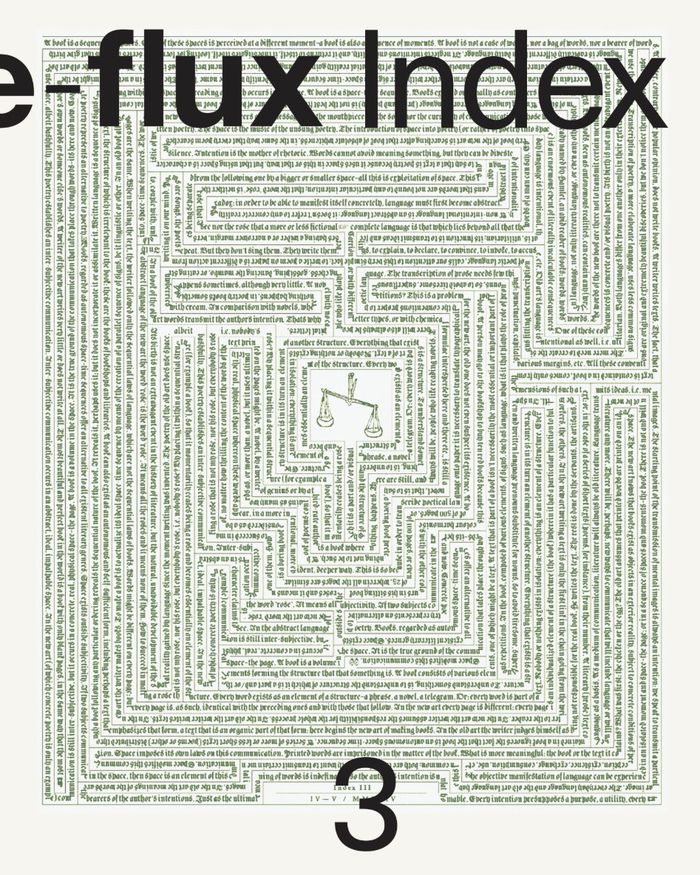
e-flux index #3
e-flux index #3
Actions:
Price:
$65.00
(available in store)
Summary:
Today we are accustomed to the apophatic gesture of free-speech fundamentalists and far-right demagogues, who use the flimsy legal cover of “just asking questions” to broadcast ever more widely the most violent and reactionary forms of hate speech. In resisting this enclosure of thought, art and theory continue to be instructive, if not essential activities. The late(...)
Title:
e-flux index #3
Actions:
Price:
$65.00
(available in store)
Summary:
Today we are accustomed to the apophatic gesture of free-speech fundamentalists and far-right demagogues, who use the flimsy legal cover of “just asking questions” to broadcast ever more widely the most violent and reactionary forms of hate speech. In resisting this enclosure of thought, art and theory continue to be instructive, if not essential activities. The late Lawrence Weiner memorably declared that “the purpose of art is to ask questions… it doesn’t answer anybody’s question but gives them the means to answer a particular question at a particular moment.” All the better when those questions can provoke a certain illuminating friction with the contradictions of one’s environment and disrupt the automaticity of one’s learned responses, remaining themselves ambiguous or unanswered—because unanswerable. This third issue of e-flux Index, bringing together all the content commissioned and published by e-flux between April and May 2024, contains many such unexpected and unanswered (or unanswerable) questions across its 76 contributions, each of which cut across and reach beyond existing disciplines and borders: “Who is willing to care?”; “Who is the addressee at the end of the regulated pipelines of the English language?”; “Yes, but is it edible?”; “Why does everyone hate college students?”; “Is some form of suffering the condition for the emergence of an organic type of intelligence?”; “What does it mean to make a film today, in 2024, when most of our image consumption has been transferred to other (smaller) screens and other media?; “How to represent history?”; “Whose lives are worth remembering—or even, living?”; “How is it possible to speak the language of imperial renaissance and decolonization in the same breath?”; “Today is which day of the revolution?”—“Are these all just notes for a poem?”
Form:
journals and magazines
journals and magazines
Publication:
December 2024
December 2024
Subject:
Magazines
Magazines
Form:
books
books
Title:
The gray cloth
The gray cloth
Actions:
Price:
$44.95
(available to order)
Summary:
The German expressionist, architectural visionary, author, inventor, and artist Paul Scheerbart (1863-1915) wrote several fictional utopian narratives related to glass architecture. In "The Gray Cloth", the first of his novels to be translated into English, Scheerbart uses subtle irony and the structural simplicity of a fairy tale to present the theories of coloured glass(...)
Title:
The gray cloth
Actions:
Price:
$44.95
(available to order)
Summary:
The German expressionist, architectural visionary, author, inventor, and artist Paul Scheerbart (1863-1915) wrote several fictional utopian narratives related to glass architecture. In "The Gray Cloth", the first of his novels to be translated into English, Scheerbart uses subtle irony and the structural simplicity of a fairy tale to present the theories of coloured glass outlined in his well-known treatise "Glass Architecture". The novel is set forward in time to the mid-twentieth century. The protagonist, a Swiss architect named Edgar Krug, circumnavigates the globe by airship with his wife, constructing wildly varied, colored-glass buildings. His projects include a high-rise and exhibition/concert hall in Chicago, a retirement complex for air pilots on the Fiji Islands, the structure for an elevated train across a zoological park in northern India, and a suspended residential villa on the Kuria Muria Islands off the coast of Oman in the Arabian Sea. Fearing that his architecture is challenged by the colourfulness of women’s clothing, Krug insists that his wife wear all gray clothing with the addition of ten percent white. This odd demand brings him notoriety and sensationalizes his international building campaign. For the reader, it underlines the confluence of architecture with fashion, gender, and global media. In his introduction John Stuart surveys Scheerbart’s career and role in German avant-garde circles, as well as his architectural and social ideas. He shows how Scheerbart strove to integrate his spiritual and romantic leanings with the modern world, often relying on glass architecture to do so. In addition to discussing the novel’s reception and its rediscovery by contemporary architects and critics, Stuart shows fiction to be a resource for the study of architecture and places "The Gray Cloth" in the context of German Expressionism.
Form:
books
books
Publication:
October 2001, Cambridge, Mass.
October 2001, Cambridge, Mass.
Subject:
Architectural Theory
Architectural Theory
Form:
books
books
Price:
$59.99
(available to order)
Summary:
Featuring 40 essays by U.S. and European historians, designers, cultural critics, geographers and social scientists, illustrated with over 250 color images in extensive visual "gazetteers" — including specially-commissioned portfolios by artists and designers — "Else/where mapping" investigates : how new technologies of navigation and location are emerging to chart(...)
Subject:
Architectural Plans and Cartography
Architectural Plans and Cartography
Publication:
October 2005, Minneapolis
October 2005, Minneapolis
Title:
Else/where : mapping new cartographies of networks and territories
Actions:
Price:
$59.99
(available to order)
Summary:
Featuring 40 essays by U.S. and European historians, designers, cultural critics, geographers and social scientists, illustrated with over 250 color images in extensive visual "gazetteers" — including specially-commissioned portfolios by artists and designers — "Else/where mapping" investigates : how new technologies of navigation and location are emerging to chart "virtual" terrain such as social networks and online conversations; how these new mapping strategies borrow and reinvent metaphors adapted from the cartography of physical terrain, considered at various scales — urban, regional, continental, global ; how new modes of representation of spatial data are evolving to explore the potential for collective "bottom-up" (rather than "top-down") mapping ; how cities, communities and social networks are being re-envisioned, as artists and designers use technologies such as GPS, GIS and digital interface design to devise alternative mappings of social and spatial relationships. Authors : Janet Abrams, Ole Bouman, Andrea Codrington, Denis Cosgrove, Steve Dietz, Paul Elliman, Yuri Engelhardt, Peter Hall, Brian Holmes, J.J. King, Cathy Lang Ho, Andrea Moed, David Pescovitz, Rebecca Ross, Ben Schouten, Alex Terzich, Alice Twemlow, Dirk van Weelden, Tom Vanderbilt, Peter Walsh and Stephen Zacks. Featured artists and designers included : Antenna Design New York, Julian Bleecker, Bureau d'Etudes, Sulki Choi, Layla Curtis, Judith Donath, Entropy8Zuper!, Michael Frumin, Ben Fry, De Geuzen, govcom.org, Marti Guixe, Mark Hansen, Robert Horn, Natalie Jeremijenko, Lisa Jevbratt, Nina Katchadourian, Valdis Krebs, Laura Kurgan, Mark Lombardi, The London Particular, Lumeta.org, Barrett Lyon, Brian McGrath, Julie Mehretu, Paul Mijksenaar, Sigi Moeslinger, MUST Architects, MVRDV, Josh On, W. Bradford Paley, Scott Paterson, Esther Polak, Richard Rogers, Ben Rubin, Warren Sack, Mike Silver, Marco Susani, Terraswarm, UN Studio, Urban Tapestries, Waag Society for Old and New Media, Ronald Wall, Kimberlee Whaley, Jeremy Wood and Marina Zurkow. Book design : Deborah Littlejohn.
Form:
books
books
Publication:
October 2005, Minneapolis
October 2005, Minneapolis
Subject:
Architectural Plans and Cartography
Architectural Plans and Cartography
Form:
books
books
Title:
The gray cloth
The gray cloth
Actions:
Price:
$24.95
(available to order)
Summary:
The German expressionist, architectural visionary, author, inventor, and artist Paul Scheerbart (1863-1915) wrote several fictional utopian narratives related to glass architecture. In "The Gray Cloth", the first of his novels to be translated into English, Scheerbart uses subtle irony and the structural simplicity of a fairy tale to present the theories of coloured glass(...)
Title:
The gray cloth
Actions:
Price:
$24.95
(available to order)
Summary:
The German expressionist, architectural visionary, author, inventor, and artist Paul Scheerbart (1863-1915) wrote several fictional utopian narratives related to glass architecture. In "The Gray Cloth", the first of his novels to be translated into English, Scheerbart uses subtle irony and the structural simplicity of a fairy tale to present the theories of coloured glass outlined in his well-known treatise "Glass Architecture". The novel is set forward in time to the mid-twentieth century. The protagonist, a Swiss architect named Edgar Krug, circumnavigates the globe by airship with his wife, constructing wildly varied, colored-glass buildings. His projects include a high-rise and exhibition/concert hall in Chicago, a retirement complex for air pilots on the Fiji Islands, the structure for an elevated train across a zoological park in northern India, and a suspended residential villa on the Kuria Muria Islands off the coast of Oman in the Arabian Sea. Fearing that his architecture is challenged by the colourfulness of women’s clothing, Krug insists that his wife wear all gray clothing with the addition of ten percent white. This odd demand brings him notoriety and sensationalizes his international building campaign. For the reader, it underlines the confluence of architecture with fashion, gender, and global media. In his introduction John Stuart surveys Scheerbart’s career and role in German avant-garde circles, as well as his architectural and social ideas. He shows how Scheerbart strove to integrate his spiritual and romantic leanings with the modern world, often relying on glass architecture to do so. In addition to discussing the novel’s reception and its rediscovery by contemporary architects and critics, Stuart shows fiction to be a resource for the study of architecture and places "The Gray Cloth" in the context of German Expressionism.
Form:
books
books
Publication:
October 2003, Cambridge / London
October 2003, Cambridge / London
Subject:
Architectural Theory
Architectural Theory
Form:
books
books
Actions:
Price:
$22.99
(available to order)
Summary:
In 1923, a group of young radical German thinkers and intellectuals came together to at Victoria Alle 7, Frankfurt, determined to explain the workings of the modern world. Among the most prominent members of what became the Frankfurt School were the philosophers Walter Benjamin, Theodor Adorno, Max Horkheimer, and Herbert Marcuse. Not only would they change the way we(...)
Title:
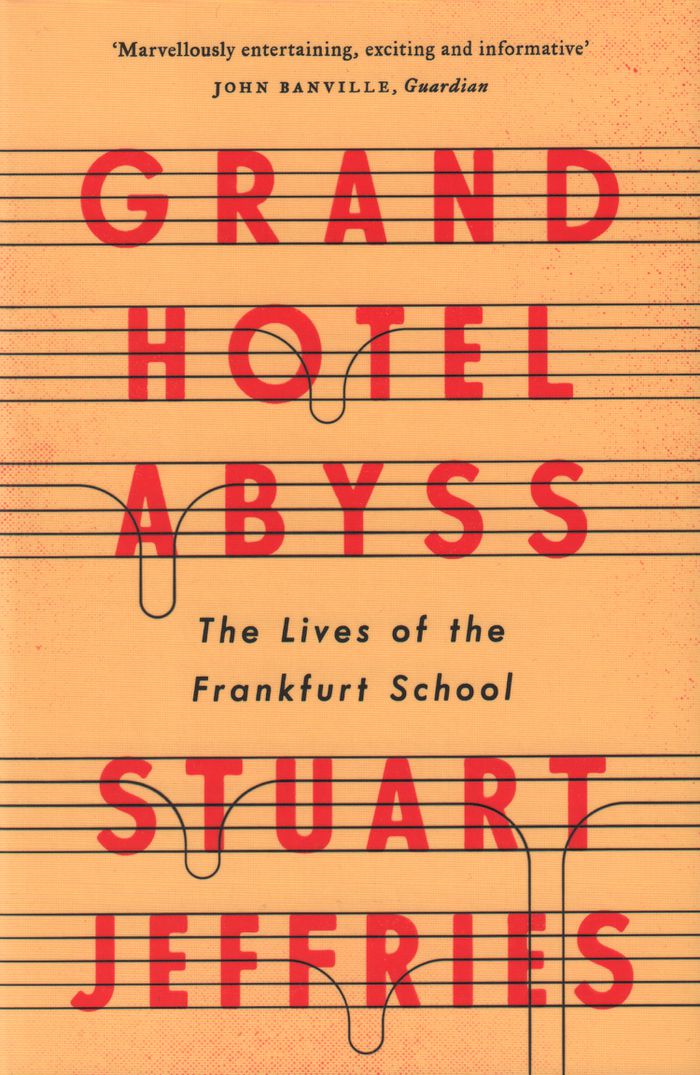
Grand Hotel Abyss: the lives of the Frankfurt school
Actions:
Price:
$22.99
(available to order)
Summary:
In 1923, a group of young radical German thinkers and intellectuals came together to at Victoria Alle 7, Frankfurt, determined to explain the workings of the modern world. Among the most prominent members of what became the Frankfurt School were the philosophers Walter Benjamin, Theodor Adorno, Max Horkheimer, and Herbert Marcuse. Not only would they change the way we think, but also the subjects we deem worthy of intellectual investigation. Their lives, like their ideas, profoundly, sometimes tragically, reflected and shaped the shattering events of the twentieth century. "Grand Hotel Abyss" combines biography, philosophy, and storytelling to reveal how the Frankfurt thinkers gathered in hopes of understanding the politics of culture during the rise of fascism. Some of them, forced to escape the horrors of Nazi Germany, later found exile in the United States. Benjamin, with his last great work—the incomplete Arcades Project—in his suitcase, was arrested in Spain and committed suicide when threatened with deportation to Nazi-occupied France. On the other side of the Atlantic, Adorno failed in his bid to become a Hollywood screenwriter, denounced jazz, and even met Charlie Chaplin in Malibu. After the war, there was a resurgence of interest in the School. From the relative comfort of sun-drenched California, Herbert Marcuse wrote the classic One Dimensional Man, which influenced the 1960s counterculture and thinkers such as Angela Davis; while in a tragic coda, Adorno died from a heart attack following confrontations with student radicals in Berlin. By taking popular culture seriously as an object of study—whether it was film, music, ideas, or consumerism—the Frankfurt School elaborated upon the nature and crisis of our mass-produced, mechanised society. Grand Hotel Abyss shows how much these ideas still tell us about our age of social media and runaway consumption.
Form:
books
books
Publication:
September 2017
September 2017
Subject:
Critical Theory
Critical Theory
Form:
books
books
Actions:
Price:
$25.95
(available to order)
Summary:
Finally, we are learning that simplicity equals sanity. We're rebelling against technology that's too complicated, DVD players with too many menus, and software accompanied by 75-megabyte "read me" manuals. The iPod's clean gadgetry has made simplicity hip. But sometimes we find ourselves caught up in the simplicity paradox: we want something that's simple and easy to(...)
Title:
The laws of simplicity : design, technology, business, life
Actions:
Price:
$25.95
(available to order)
Summary:
Finally, we are learning that simplicity equals sanity. We're rebelling against technology that's too complicated, DVD players with too many menus, and software accompanied by 75-megabyte "read me" manuals. The iPod's clean gadgetry has made simplicity hip. But sometimes we find ourselves caught up in the simplicity paradox: we want something that's simple and easy to use, but also does all the complex things we might ever want it to do. In "The laws of simplicity", John Maeda offers ten laws for balancing simplicity and complexity in business, technology, and design -guidelines for needing less and actually getting more. Maeda - a professor in MIT's Media Lab and a world-renowned graphic designer - explores the question of how we can redefine the notion of "improved" so that it doesn't always mean something more, something added on. Maeda's first law of simplicity is "Reduce." It's not necessarily beneficial to add technology features just because we can. And the features that we do have must be organized (Law 2) in a sensible hierarchy so users aren't distracted by features and functions they don't need. But simplicity is not less just for the sake of less. Skip ahead to Law 9: "Failure : accept the fact that some things can never be made simple." Maeda's concise guide to simplicity in the digital age shows us how this idea can be a cornerstone of organizations and their products -how it can drive both business and technology. We can learn to simplify without sacrificing comfort and meaning, and we can achieve the balance described in Law 10. This law, which Maeda calls "The One," tells us: "Simplicity is about subtracting the obvious, and adding the meaningful."
Form:
books
books
Publication:
September 2006, Cambridge (MA)
September 2006, Cambridge (MA)
Subject:
Design Theory
Design Theory
Form:
books
books
Title:
London the biography
London the biography
Actions:
Price:
$37.95
(available to order)
Summary:
Novelist and biographer Ackroyd (The Plato Papers; T.S. Eliot; etc.) offers a huge, enthralling "biography" of the city of London. The reader segues through this litany of lists and anthology of anecdotes via the sketchiest of topical linkages, but no matter not a page is dull, until brief closing chapters in which Ackroyd succumbs to bathos, for which he's(...)
Title:
London the biography
Actions:
Price:
$37.95
(available to order)
Summary:
Novelist and biographer Ackroyd (The Plato Papers; T.S. Eliot; etc.) offers a huge, enthralling "biography" of the city of London. The reader segues through this litany of lists and anthology of anecdotes via the sketchiest of topical linkages, but no matter not a page is dull, until brief closing chapters in which Ackroyd succumbs to bathos, for which he's instantaneously redeemed by the preceding chapters. He admits to using no original research, openly crediting his printed sources. Ackroyd examines London from its pre-history through today, artfully selecting, organizing and pacing stories, and rendering the past in witty and imaginative ways. "The opium quarter of Limehouse," he tells readers, for example, "is now represented by a Chinese take-away." Fast food, it seems, was always part of the London scene. When poet Thomas Southey asked a pastry cook why she kept her shop open in the worst weather, she told him that otherwise she would lose business, "so many were the persons who took up buns or biscuits as they passed by and threw their pence in, not allowing themselves time to enter." Ackroyd covers unrest and peace, fires and ruins, river and rail transport, crime and punishment, wealth and poverty, markets and churches, uncontrolled growth and barely controlled filth. If there is a hero among the throngs, it may be engineer Joseph Bazalgette, who in 1855 began building 1,265 miles of sewers to contain the Stygian odor of progress and keep the huge, ugly metropolis livable. No one should mind the extraordinary price of this extraordinary achievement. B illus., maps not seen by PW. (On sale Oct. 16)Forecast: Published to acclaim in England, this is virtually guaranteed major review coverage here, and the publisher will also shoot for national media. Anglophiles and others will rejoice.
Form:
books
books
Publication:
September 2001, London
September 2001, London
Subject:
Urban Theory
Urban Theory
Form:
books
books
Actions:
Price:
$71.95
(available to order)
Summary:
Although many people view virtual reality as a totally new phenomenon, it has its foundations in an unrecognized history of immersive images. Indeed, the search for illusionary visual space can be traced back to antiquity. In this book Oliver Grau shows how virtual art fits into the art history of illusion and immersion. He describes the metamorphosis of the concepts of(...)
Title:
Virtual art from illusion to immersion
Actions:
Price:
$71.95
(available to order)
Summary:
Although many people view virtual reality as a totally new phenomenon, it has its foundations in an unrecognized history of immersive images. Indeed, the search for illusionary visual space can be traced back to antiquity. In this book Oliver Grau shows how virtual art fits into the art history of illusion and immersion. He describes the metamorphosis of the concepts of art and the image and relates those concepts to interactive art, interface design, agents, telepresence, and image evolution. Grau retells art history as media history, helping us to understand the phenomenon of virtual reality beyond the hype. Grau shows how each epoch used the technical means available to produce maximum illusion. He discusses frescoes such as those in the Villa dei Misteri in Pompeii and the gardens of the Villa Livia near Primaporta, Renaissance and Baroque illusion spaces, and panoramas, which were the most developed form of illusion achieved through traditional methods of painting and the mass image medium before film. Through a detailed analysis of perhaps the most important German panorama, Anton von Werner's 1883 The Battle of Sedan, Grau shows how immersion produced emotional responses. He traces immersive cinema through Cinerama, Sensorama, Expanded Cinema, 3-D, Omnimax and IMAX, and the head mounted display with its military origins. He also examines those characteristics of virtual reality that distinguish it from earlier forms of illusionary art. His analysis draws on the work of contemporary artists and groups ART+COM, Maurice Benayoun, Charlotte Davies, Monika Fleischmann, Ken Goldberg, Agnes Hegedues, Eduardo Kac, Knowbotic Research, Laurent Mignonneau, Michael Naimark, Simon Penny, Daniela Plewe, Paul Sermon, Jeffrey Shaw, Karl Sims, Christa Sommerer, and Wolfgang Strauss. Grau offers not just a history of illusionary space but also a theoretical framework for analyzing its phenomenologies, functions, and strategies throughout history and into the future.
Form:
books
books
Publication:
January 1900, Cambridge, Mass.
January 1900, Cambridge, Mass.
Subject:
Epistemology
Epistemology
Form:
books
books
Actions:
Price:
$31.95
(available to order)
Summary:
L'architecture, son évolution comme sa connaissance, dépend en grande partie de la circulation et de la transmission dans l'espace et le temps d'une accumulation d'expériences, de règles ou de modèles. Voilà pourquoi ce livre examine les moyens de communication utilisés par les architectes occidentaux, de Vitruve à l'époque moderne, en montrant comment chaque média influe(...)
Title:
L'architecture à l'âge de l'imprimerie
Actions:
Price:
$31.95
(available to order)
Summary:
L'architecture, son évolution comme sa connaissance, dépend en grande partie de la circulation et de la transmission dans l'espace et le temps d'une accumulation d'expériences, de règles ou de modèles. Voilà pourquoi ce livre examine les moyens de communication utilisés par les architectes occidentaux, de Vitruve à l'époque moderne, en montrant comment chaque média influe sur les formes spécifiques de la pensée architecturale et sur les modalités de la diffusion des savoirs.
Form:
books
books
Publication:
April 2009, Paris
April 2009, Paris
Subject:
Archive, library and the digital
Archive, library and the digital


