


1523 Results
Form:
books
books
Actions:
Price:
$27.00
(available to order)
Summary:
In Wanderlust: A History of Walking, Rebecca Solnit draws together many histories, of anatomical evolution and city design, of treadmills and labyriths, of walking clubs and sexual mores, to create a portrait of the range of possibilities for this most basic act. Arguing that walking as history signifies walking for pleasure and for political, aesthetic, and social(...)
$27.00
(available to order)
Summary:
In Wanderlust: A History of Walking, Rebecca Solnit draws together many histories, of anatomical evolution and city design, of treadmills and labyriths, of walking clubs and sexual mores, to create a portrait of the range of possibilities for this most basic act. Arguing that walking as history signifies walking for pleasure and for political, aesthetic, and social(...)
Title:
Wanderlust: a history of walking
Actions:
Price:
$27.00
(available to order)
Summary:
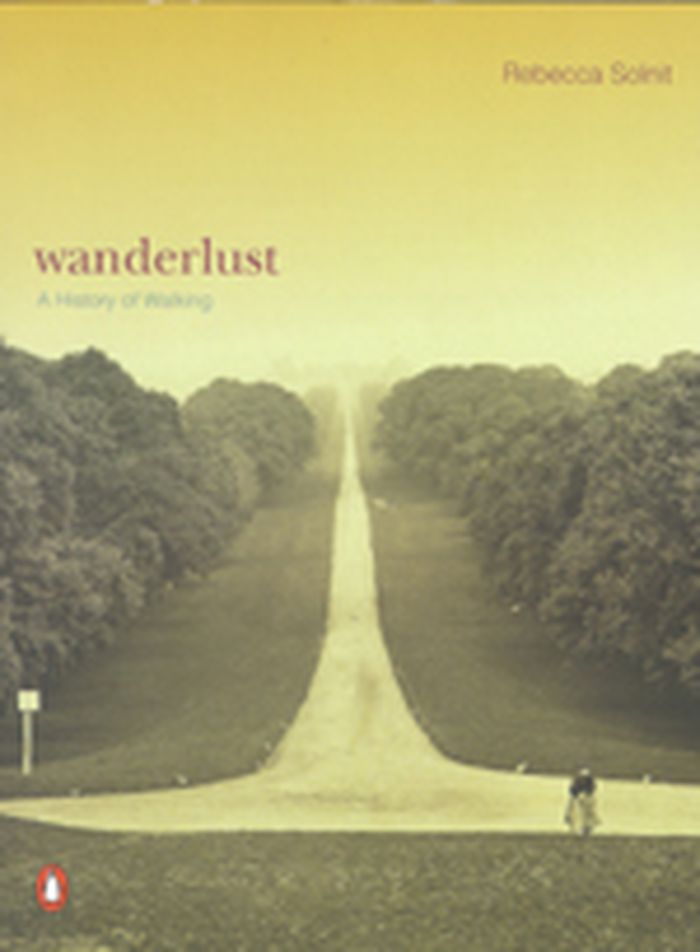
In Wanderlust: A History of Walking, Rebecca Solnit draws together many histories, of anatomical evolution and city design, of treadmills and labyriths, of walking clubs and sexual mores, to create a portrait of the range of possibilities for this most basic act. Arguing that walking as history signifies walking for pleasure and for political, aesthetic, and social meaning, Solnit hones in on the walkers whose everyday and extreme acts have shaped our culture, from the peripatetic philosophers of ancient Greece to the poets of the romantic Age, from the perambulations of the Surrealists to the ascents of the mountaineers. Solnit's book finds a profound relationship between walking and thinking, walking and culture, and argues for the necessity of preserving the time and space in which to walk in an evermore automobile-dependent and accelerated world.
Wanderlust: a history of walking
Actions:
Price:
$27.00
(available to order)
Summary:
In Wanderlust: A History of Walking, Rebecca Solnit draws together many histories, of anatomical evolution and city design, of treadmills and labyriths, of walking clubs and sexual mores, to create a portrait of the range of possibilities for this most basic act. Arguing that walking as history signifies walking for pleasure and for political, aesthetic, and social meaning, Solnit hones in on the walkers whose everyday and extreme acts have shaped our culture, from the peripatetic philosophers of ancient Greece to the poets of the romantic Age, from the perambulations of the Surrealists to the ascents of the mountaineers. Solnit's book finds a profound relationship between walking and thinking, walking and culture, and argues for the necessity of preserving the time and space in which to walk in an evermore automobile-dependent and accelerated world.
Form:
books
books
Publication:
June 2001, New York
June 2001, New York
Subject:
Journeys
Journeys
Form:
books
books
Title:
Walking in Berlin
Walking in Berlin
Actions:
Price:
$32.95
(available to order)
Summary:
In 'Walking in Berlin', Hessel captures the rhythm of Weimar-era Berlin, recording the seismic shifts in German culture. Nearly all of the essays take the form of a walk or outing, focusing on either a theme or part of the city, and many end at a theater, cinema, or club. 'Walking in Berlin' was a central model for Benjamin’s Arcades Project and remains a classic of(...)
$32.95
(available to order)
Summary:
In 'Walking in Berlin', Hessel captures the rhythm of Weimar-era Berlin, recording the seismic shifts in German culture. Nearly all of the essays take the form of a walk or outing, focusing on either a theme or part of the city, and many end at a theater, cinema, or club. 'Walking in Berlin' was a central model for Benjamin’s Arcades Project and remains a classic of(...)
Title:
Walking in Berlin
Actions:
Price:
$32.95
(available to order)
Summary:
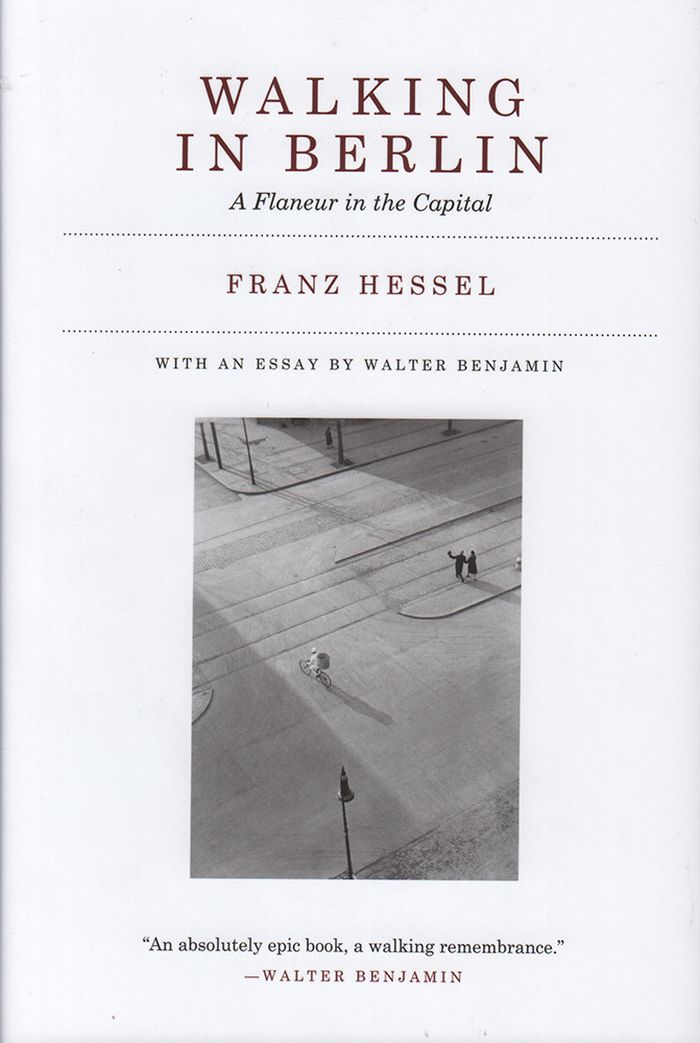
In 'Walking in Berlin', Hessel captures the rhythm of Weimar-era Berlin, recording the seismic shifts in German culture. Nearly all of the essays take the form of a walk or outing, focusing on either a theme or part of the city, and many end at a theater, cinema, or club. 'Walking in Berlin' was a central model for Benjamin’s Arcades Project and remains a classic of “walking literature” that ranges from Surrealist perambulation to Situationist “psychogeography.” This MIT Press edition includes the complete text in translation as well as Benjamin’s essay on 'Walking in Berlin', originally written as a review of the book’s original edition.
Walking in Berlin
Actions:
Price:
$32.95
(available to order)
Summary:
In 'Walking in Berlin', Hessel captures the rhythm of Weimar-era Berlin, recording the seismic shifts in German culture. Nearly all of the essays take the form of a walk or outing, focusing on either a theme or part of the city, and many end at a theater, cinema, or club. 'Walking in Berlin' was a central model for Benjamin’s Arcades Project and remains a classic of “walking literature” that ranges from Surrealist perambulation to Situationist “psychogeography.” This MIT Press edition includes the complete text in translation as well as Benjamin’s essay on 'Walking in Berlin', originally written as a review of the book’s original edition.
Form:
books
books
Publication:
May 2017
May 2017
Subject:
Journeys
Journeys
Form:
books
books
Title:
Space colonies
Space colonies
Actions:
Price:
$21.50
(available to order)
Summary:
At the beginning of the 1970s, American physicist Gerard K. O’Neill developed the first ideas for colonizing space. Shortly thereafter, Stewart Brand, cyber-communard and editor of the Whole Earth Catalog, took up these ideas and published the book Space Colonies in 1977. Space Colonies, an edition of Brand’s CoEvolution Quarterly, funded by the proceeds of the Whole(...)
$21.50
(available to order)
Summary:
At the beginning of the 1970s, American physicist Gerard K. O’Neill developed the first ideas for colonizing space. Shortly thereafter, Stewart Brand, cyber-communard and editor of the Whole Earth Catalog, took up these ideas and published the book Space Colonies in 1977. Space Colonies, an edition of Brand’s CoEvolution Quarterly, funded by the proceeds of the Whole(...)
Title:
Space colonies
Actions:
Price:
$21.50
(available to order)
Summary:
At the beginning of the 1970s, American physicist Gerard K. O’Neill developed the first ideas for colonizing space. Shortly thereafter, Stewart Brand, cyber-communard and editor of the Whole Earth Catalog, took up these ideas and published the book Space Colonies in 1977. Space Colonies, an edition of Brand’s CoEvolution Quarterly, funded by the proceeds of the Whole Earth Catalog, took up the question of whether space might be colonized by the year 2000. Artist Fabian Reimann takes up Brand and O’Neill’s particular strain of techno-utopianism in Space Colonies: A Galactic Freeman’s Journal. In his photo-essay Reimann assembles historical, present-day and speculative material, combining these with fictional and factual stories to create a composite of different images of the world. With global ecological disaster an even more pressing issue than it was in 1977, and the colonization of space still touted by some as a last-ditch resort, Reimann looks back at the dreams and nightmares of the 1970s with a sophisticated visual humor.
Space colonies
Actions:
Price:
$21.50
(available to order)
Summary:
At the beginning of the 1970s, American physicist Gerard K. O’Neill developed the first ideas for colonizing space. Shortly thereafter, Stewart Brand, cyber-communard and editor of the Whole Earth Catalog, took up these ideas and published the book Space Colonies in 1977. Space Colonies, an edition of Brand’s CoEvolution Quarterly, funded by the proceeds of the Whole Earth Catalog, took up the question of whether space might be colonized by the year 2000. Artist Fabian Reimann takes up Brand and O’Neill’s particular strain of techno-utopianism in Space Colonies: A Galactic Freeman’s Journal. In his photo-essay Reimann assembles historical, present-day and speculative material, combining these with fictional and factual stories to create a composite of different images of the world. With global ecological disaster an even more pressing issue than it was in 1977, and the colonization of space still touted by some as a last-ditch resort, Reimann looks back at the dreams and nightmares of the 1970s with a sophisticated visual humor.
Form:
books
books
Publication:
August 2017
August 2017
Subject:
Journeys
Journeys
Form:
books
books
Title:
Manuel de l'antitourisme
Manuel de l'antitourisme
Actions:
Price:
$15.00
(available in store)
Summary:
Le tourisme est la première industrie mondiale, même s’il est pratiqué par seulement 3,5 % de la population…Un luxe réservé aux occidentaux qui, depuis l’avènement des congés payés, ont intégré « un devoir d’ailleurs et de loisirs ». Mais qui n’a pas senti ce malaise, dans une boutique de souvenirs ou sur une plage des Caraïbes couvertes de baigneurs blancs ? Qui n’a(...)
$15.00
(available in store)
Summary:
Le tourisme est la première industrie mondiale, même s’il est pratiqué par seulement 3,5 % de la population…Un luxe réservé aux occidentaux qui, depuis l’avènement des congés payés, ont intégré « un devoir d’ailleurs et de loisirs ». Mais qui n’a pas senti ce malaise, dans une boutique de souvenirs ou sur une plage des Caraïbes couvertes de baigneurs blancs ? Qui n’a(...)
Title:
Manuel de l'antitourisme
Actions:
Price:
$15.00
(available in store)
Summary:
Le tourisme est la première industrie mondiale, même s’il est pratiqué par seulement 3,5 % de la population…Un luxe réservé aux occidentaux qui, depuis l’avènement des congés payés, ont intégré « un devoir d’ailleurs et de loisirs ». Mais qui n’a pas senti ce malaise, dans une boutique de souvenirs ou sur une plage des Caraïbes couvertes de baigneurs blancs ? Qui n’a jamais ramené de vacances le sentiment de l’absurde ? Aujourd’hui, même les mieux intentionnés des voyageurs contribuent malgré eux à la mondophagie touristique. Et rien ne semble pouvoir arrêter cette conquête démesurée des quatre coins du monde : ni la pollution qu’elle impose, ni la disparition des spécificités culturelles qu’elle vient niveler et encore moins la conscience de l’Autre qu’elle réduit à une relation marchande. Pouvons-nous nous évader du tourisme ? Rodolphe Christin nous invite à retrouver l’essence du voyage : préférer le chemin à la destination, et « disparaître » plutôt qu’apparaître partout.
Manuel de l'antitourisme
Actions:
Price:
$15.00
(available in store)
Summary:
Le tourisme est la première industrie mondiale, même s’il est pratiqué par seulement 3,5 % de la population…Un luxe réservé aux occidentaux qui, depuis l’avènement des congés payés, ont intégré « un devoir d’ailleurs et de loisirs ». Mais qui n’a pas senti ce malaise, dans une boutique de souvenirs ou sur une plage des Caraïbes couvertes de baigneurs blancs ? Qui n’a jamais ramené de vacances le sentiment de l’absurde ? Aujourd’hui, même les mieux intentionnés des voyageurs contribuent malgré eux à la mondophagie touristique. Et rien ne semble pouvoir arrêter cette conquête démesurée des quatre coins du monde : ni la pollution qu’elle impose, ni la disparition des spécificités culturelles qu’elle vient niveler et encore moins la conscience de l’Autre qu’elle réduit à une relation marchande. Pouvons-nous nous évader du tourisme ? Rodolphe Christin nous invite à retrouver l’essence du voyage : préférer le chemin à la destination, et « disparaître » plutôt qu’apparaître partout.
Form:
books
books
Publication:
August 2017
August 2017
Subject:
Journeys
Journeys
Form:
books
books
Title:
A walk through Paris
A walk through Paris
Actions:
Price:
$29.95
(available to order)
Summary:
Eric Hazan takes the reader on a walk from Ivry to Saint-Denis, roughly following the meridian that divides Paris into east and west, and passing such familiar landmarks as the Luxembourg Gardens, the Pompidou Centre, the Gare du Nord and Montmartre, as well as forgotten alleyways and arcades. Weaving historical anecdotes, geographical observations, and literary(...)
$29.95
(available to order)
Summary:
Eric Hazan takes the reader on a walk from Ivry to Saint-Denis, roughly following the meridian that divides Paris into east and west, and passing such familiar landmarks as the Luxembourg Gardens, the Pompidou Centre, the Gare du Nord and Montmartre, as well as forgotten alleyways and arcades. Weaving historical anecdotes, geographical observations, and literary(...)
Title:
A walk through Paris
Actions:
Price:
$29.95
(available to order)
Summary:
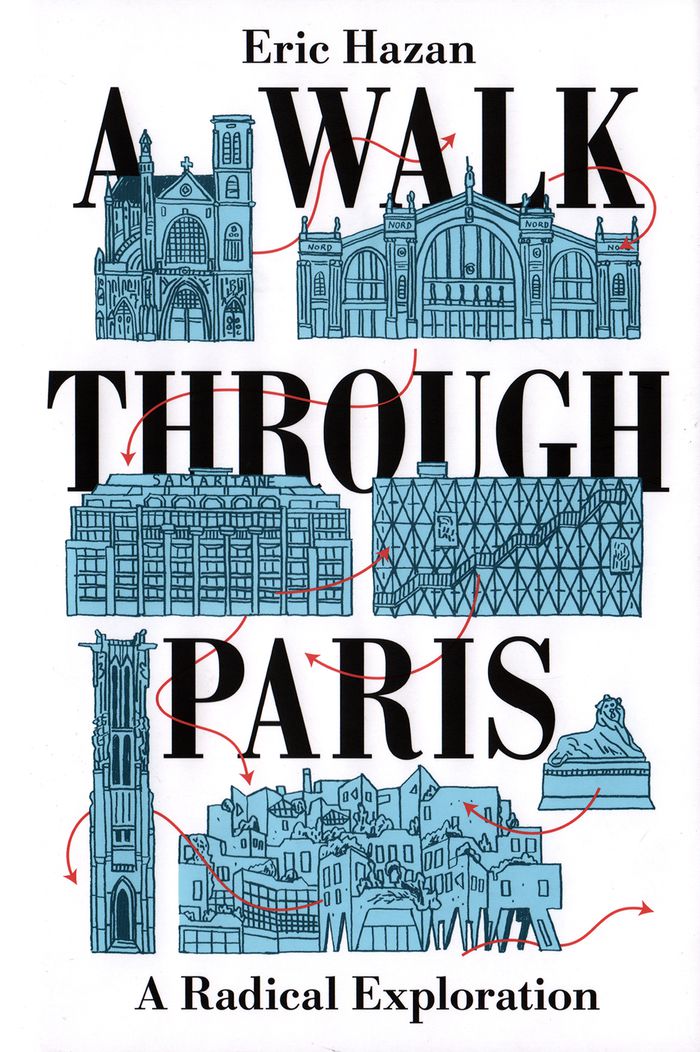
Eric Hazan takes the reader on a walk from Ivry to Saint-Denis, roughly following the meridian that divides Paris into east and west, and passing such familiar landmarks as the Luxembourg Gardens, the Pompidou Centre, the Gare du Nord and Montmartre, as well as forgotten alleyways and arcades. Weaving historical anecdotes, geographical observations, and literary references, Hazan’s walk guides us through an unknown Paris. With the aid of maps, he delineates the most fascinating and forgotten parts of the city’s past and present. Planning and modernization have accelerated the erasure of its revolutionary history, yet through walking and observation, Hazan shows how we can regain our knowledge of the city of Robespierre, the Commune, Sartre, and the May ’68 uprising.
A walk through Paris
Actions:
Price:
$29.95
(available to order)
Summary:
Eric Hazan takes the reader on a walk from Ivry to Saint-Denis, roughly following the meridian that divides Paris into east and west, and passing such familiar landmarks as the Luxembourg Gardens, the Pompidou Centre, the Gare du Nord and Montmartre, as well as forgotten alleyways and arcades. Weaving historical anecdotes, geographical observations, and literary references, Hazan’s walk guides us through an unknown Paris. With the aid of maps, he delineates the most fascinating and forgotten parts of the city’s past and present. Planning and modernization have accelerated the erasure of its revolutionary history, yet through walking and observation, Hazan shows how we can regain our knowledge of the city of Robespierre, the Commune, Sartre, and the May ’68 uprising.
Form:
books
books
Publication:
March 2018
March 2018
Subject:
Journeys
Journeys
Form:
books
books
Title:
L'art de marcher
L'art de marcher
Actions:
Price:
$18.95
(available to order)
Summary:
Au fil de son étude, Rebecca Solnit évoque les pèlerinages, les marches de protestation, les flâneries urbaines, les promenades propices à la réflexion des écrivains ou des philosophes, le nomadisme des comédiens et des musiciens, les voyages à pied des compagnons du devoir et différentes pérégrinations qui, parfois, constituent de véritables rites de passage. S'appuyant(...)
$18.95
(available to order)
Summary:
Au fil de son étude, Rebecca Solnit évoque les pèlerinages, les marches de protestation, les flâneries urbaines, les promenades propices à la réflexion des écrivains ou des philosophes, le nomadisme des comédiens et des musiciens, les voyages à pied des compagnons du devoir et différentes pérégrinations qui, parfois, constituent de véritables rites de passage. S'appuyant(...)
Title:
L'art de marcher
Actions:
Price:
$18.95
(available to order)
Summary:
Au fil de son étude, Rebecca Solnit évoque les pèlerinages, les marches de protestation, les flâneries urbaines, les promenades propices à la réflexion des écrivains ou des philosophes, le nomadisme des comédiens et des musiciens, les voyages à pied des compagnons du devoir et différentes pérégrinations qui, parfois, constituent de véritables rites de passage. S'appuyant sur des citations et des anecdotes, elle montre à quel point on saisit le monde à travers le corps, et le corps à travers le monde.
L'art de marcher
Actions:
Price:
$18.95
(available to order)
Summary:
Au fil de son étude, Rebecca Solnit évoque les pèlerinages, les marches de protestation, les flâneries urbaines, les promenades propices à la réflexion des écrivains ou des philosophes, le nomadisme des comédiens et des musiciens, les voyages à pied des compagnons du devoir et différentes pérégrinations qui, parfois, constituent de véritables rites de passage. S'appuyant sur des citations et des anecdotes, elle montre à quel point on saisit le monde à travers le corps, et le corps à travers le monde.
Form:
books
books
Publication:
October 2002, Arles
October 2002, Arles
Subject:
Journeys
Journeys
Form:
books
books

Actions:
Price:
$9.95
(available to order)
Summary:
En octobre 1974 Georges Perec s'est installé pendant trois jours consécutifs place Saint-Sulpice à Paris. À différents moments de la journée, il a noté ce qu'il voyait: les événements ordinaires de la rue, les gens, véhicules, animaux, nuages et le passage du temps. Des listes. Les faits insignifiants de la vie quotidienne. Rien, ou presque rien. Mais un regard, une(...)
$9.95
(available to order)
Summary:
En octobre 1974 Georges Perec s'est installé pendant trois jours consécutifs place Saint-Sulpice à Paris. À différents moments de la journée, il a noté ce qu'il voyait: les événements ordinaires de la rue, les gens, véhicules, animaux, nuages et le passage du temps. Des listes. Les faits insignifiants de la vie quotidienne. Rien, ou presque rien. Mais un regard, une(...)
Title:
Tentative d'épuisement d'un lieu parisien
Actions:
Price:
$9.95
(available to order)
Summary:
En octobre 1974 Georges Perec s'est installé pendant trois jours consécutifs place Saint-Sulpice à Paris. À différents moments de la journée, il a noté ce qu'il voyait: les événements ordinaires de la rue, les gens, véhicules, animaux, nuages et le passage du temps. Des listes. Les faits insignifiants de la vie quotidienne. Rien, ou presque rien. Mais un regard, une perception humaine, unique, vibrante, impressionniste, variable, comme celle de Monet devant la cathédrale de Rouen. Les mille petits détails inaperçu qui font la vie d'une grande cité, d'un quartier dans une grande cité. Les innombrables variations imperceptibles du temps, de la lumière, du décor, du vivant. Autobus, chiens, passants, touristes. «Ce qui se passe quand il ne se passe rien, sinon du temps, des gens, des voitures et des nuages.» Ce texte magistral dans l'oeuvre de Perec figure à présent au rang des classiques.
Tentative d'épuisement d'un lieu parisien
Actions:
Price:
$9.95
(available to order)
Summary:
En octobre 1974 Georges Perec s'est installé pendant trois jours consécutifs place Saint-Sulpice à Paris. À différents moments de la journée, il a noté ce qu'il voyait: les événements ordinaires de la rue, les gens, véhicules, animaux, nuages et le passage du temps. Des listes. Les faits insignifiants de la vie quotidienne. Rien, ou presque rien. Mais un regard, une perception humaine, unique, vibrante, impressionniste, variable, comme celle de Monet devant la cathédrale de Rouen. Les mille petits détails inaperçu qui font la vie d'une grande cité, d'un quartier dans une grande cité. Les innombrables variations imperceptibles du temps, de la lumière, du décor, du vivant. Autobus, chiens, passants, touristes. «Ce qui se passe quand il ne se passe rien, sinon du temps, des gens, des voitures et des nuages.» Ce texte magistral dans l'oeuvre de Perec figure à présent au rang des classiques.
Form:
books
books
Publication:
March 2008
March 2008
Subject:
Journeys
Journeys
Form:
books
books
Title:
Psychogeography
Psychogeography
Actions:
Price:
$12.95
(available to order)
Summary:
This book examines the origins of Psychogeography in the Situationist Movement of the 1950s, exploring the theoretical background and its political applications as well as the work of early practitioners such as Guy Debord and Raoul Vaneigem. Elsewhere, psychogeographic ideas continue to find retrospective validation in much earlier traditions from the visionary writing(...)
$12.95
(available to order)
Summary:
This book examines the origins of Psychogeography in the Situationist Movement of the 1950s, exploring the theoretical background and its political applications as well as the work of early practitioners such as Guy Debord and Raoul Vaneigem. Elsewhere, psychogeographic ideas continue to find retrospective validation in much earlier traditions from the visionary writing(...)
Title:
Psychogeography
Actions:
Price:
$12.95
(available to order)
Summary:
This book examines the origins of Psychogeography in the Situationist Movement of the 1950s, exploring the theoretical background and its political applications as well as the work of early practitioners such as Guy Debord and Raoul Vaneigem. Elsewhere, psychogeographic ideas continue to find retrospective validation in much earlier traditions from the visionary writing of William Blake and Thomas De Quincey to the rise of the flâneur on the streets of 19th century Paris and on through the avant-garde experimentation of the Surrealists. These precursors to Psychogeography are discussed here alongside their modern counterparts, for today these ideas hold greater currency than ever through the popularity of writers and filmmakers such as Iain Sinclair and Peter Ackroyd, Stewart Home and Patrick Keiller.
Psychogeography
Actions:
Price:
$12.95
(available to order)
Summary:
This book examines the origins of Psychogeography in the Situationist Movement of the 1950s, exploring the theoretical background and its political applications as well as the work of early practitioners such as Guy Debord and Raoul Vaneigem. Elsewhere, psychogeographic ideas continue to find retrospective validation in much earlier traditions from the visionary writing of William Blake and Thomas De Quincey to the rise of the flâneur on the streets of 19th century Paris and on through the avant-garde experimentation of the Surrealists. These precursors to Psychogeography are discussed here alongside their modern counterparts, for today these ideas hold greater currency than ever through the popularity of writers and filmmakers such as Iain Sinclair and Peter Ackroyd, Stewart Home and Patrick Keiller.
Form:
books
books
Publication:
March 2008
March 2008
Subject:
Journeys
Journeys
Form:
books
books

Title:
Nairn's Paris
Nairn's Paris
Actions:
Price:
$24.95
(available to order)
Summary:
Illustrated with the author's black and white snaps of the city, Nairn shows his eye for detail - whether it is stonework on an archway, shadows cast by a railing, or an empty chair in a Paris park, in this book which celebrates the City of Light. Nairn's Paris captures the city on the cusp of great changes and provides a glimpse of a city that is about to disappear. Here(...)
$24.95
(available to order)
Summary:
Illustrated with the author's black and white snaps of the city, Nairn shows his eye for detail - whether it is stonework on an archway, shadows cast by a railing, or an empty chair in a Paris park, in this book which celebrates the City of Light. Nairn's Paris captures the city on the cusp of great changes and provides a glimpse of a city that is about to disappear. Here(...)
Title:
Nairn's Paris
Actions:
Price:
$24.95
(available to order)
Summary:
Illustrated with the author's black and white snaps of the city, Nairn shows his eye for detail - whether it is stonework on an archway, shadows cast by a railing, or an empty chair in a Paris park, in this book which celebrates the City of Light. Nairn's Paris captures the city on the cusp of great changes and provides a glimpse of a city that is about to disappear. Here is an idiosyncratic and unpretentious portrait of the 'collective masterpiece' that is Paris. Introduced by writer and BBC presenter Andrew Hussey, author of the popular ''Paris: The Secret History.''
Nairn's Paris
Actions:
Price:
$24.95
(available to order)
Summary:
Illustrated with the author's black and white snaps of the city, Nairn shows his eye for detail - whether it is stonework on an archway, shadows cast by a railing, or an empty chair in a Paris park, in this book which celebrates the City of Light. Nairn's Paris captures the city on the cusp of great changes and provides a glimpse of a city that is about to disappear. Here is an idiosyncratic and unpretentious portrait of the 'collective masterpiece' that is Paris. Introduced by writer and BBC presenter Andrew Hussey, author of the popular ''Paris: The Secret History.''
Form:
books
books
Publication:
April 2018
April 2018
Subject:
Journeys
Journeys
Form:
books
books
Title:
Le voyage de l'architecte
Le voyage de l'architecte
Actions:
Price:
$45.95
(available in store)
Summary:
L’ouvrage de Philippe Potié invite le lecteur à explorer, à travers un angle très singulier – le voyage – la genèse de la pensée de quelques-unes des grandes figures emblématiques de l’architecture occidentale – théoriciens et constructeurs. On y découvre les grands maîtres en apprentissage, leurs cheminements intellectuels après leur confrontation avec des monuments(...)
$45.95
(available in store)
Summary:
L’ouvrage de Philippe Potié invite le lecteur à explorer, à travers un angle très singulier – le voyage – la genèse de la pensée de quelques-unes des grandes figures emblématiques de l’architecture occidentale – théoriciens et constructeurs. On y découvre les grands maîtres en apprentissage, leurs cheminements intellectuels après leur confrontation avec des monuments(...)
Title:
Le voyage de l'architecte
Actions:
Price:
$45.95
(available in store)
Summary:
L’ouvrage de Philippe Potié invite le lecteur à explorer, à travers un angle très singulier – le voyage – la genèse de la pensée de quelques-unes des grandes figures emblématiques de l’architecture occidentale – théoriciens et constructeurs. On y découvre les grands maîtres en apprentissage, leurs cheminements intellectuels après leur confrontation avec des monuments célèbres, des ambiances, des lumières, des formes, des cultures différentes. On y perçoit la révélation, l’émerveillement... Ces voyages initiatiques racontés par Philippe Potié donnent une dimension sensible et profondément humaine à ces maîtres, devenus des icônes, et permettent du même coup d’appréhender leur oeuvre avec un regard neuf et ému... et prouvent qu’il est encore possible de découvrir Brunelleschi ou Louis Kahn.
Le voyage de l'architecte
Actions:
Price:
$45.95
(available in store)
Summary:
L’ouvrage de Philippe Potié invite le lecteur à explorer, à travers un angle très singulier – le voyage – la genèse de la pensée de quelques-unes des grandes figures emblématiques de l’architecture occidentale – théoriciens et constructeurs. On y découvre les grands maîtres en apprentissage, leurs cheminements intellectuels après leur confrontation avec des monuments célèbres, des ambiances, des lumières, des formes, des cultures différentes. On y perçoit la révélation, l’émerveillement... Ces voyages initiatiques racontés par Philippe Potié donnent une dimension sensible et profondément humaine à ces maîtres, devenus des icônes, et permettent du même coup d’appréhender leur oeuvre avec un regard neuf et ému... et prouvent qu’il est encore possible de découvrir Brunelleschi ou Louis Kahn.
Form:
books
books
Publication:
August 2018
August 2018
Subject:
Journeys
Journeys


