


158 Results
Form:
audio
audio
Actions:
Description:
1 online resource.
Author:
Subject:
Publication:
[Place of publication not identified] : e-flux, 2024.
[Place of publication not identified] : e-flux, 2024.
Form:
audio
audio
Publication:
[Place of publication not identified] : e-flux, 2024.
[Place of publication not identified] : e-flux, 2024.
Author:
Subject:
Form:
audio
audio
Description:
1 online resource.
Author:
Subject:
Publication:
[Place of publication not identified] : Secession, 2025.
[Place of publication not identified] : Secession, 2025.
Title:
Artists: Jeremy Shaw in conversation with Damian Lentini.
Actions:
Description:
1 online resource.
Artists: Jeremy Shaw in conversation with Damian Lentini.
Actions:
Description:
1 online resource.
Form:
audio
audio
Publication:
[Place of publication not identified] : Secession, 2025.
[Place of publication not identified] : Secession, 2025.
Author:
Subject:
Form:
audio
audio
Description:
1 online resource.
Author:
Subject:
Publication:
[Place of publication not identified] : Raven Row, 2016.
[Place of publication not identified] : Raven Row, 2016.
Title:
A Night at the Pictures: An evening for Larry Johnson at Tate Modern.
Actions:
Description:
1 online resource.
A Night at the Pictures: An evening for Larry Johnson at Tate Modern.
Actions:
Description:
1 online resource.
Form:
audio
audio
Publication:
[Place of publication not identified] : Raven Row, 2016.
[Place of publication not identified] : Raven Row, 2016.
Author:
Subject:
Form:
books
books
Actions:
Subject:
Publication:
Full Unemployment Cinema 2014
Full Unemployment Cinema 2014
Form:
books
books
Publication:
Full Unemployment Cinema 2014
Full Unemployment Cinema 2014
Subject:
Form:
books
books
Actions:
Price:
$39.95
(available to order)
Summary:
In this contribution to contemporary media studies, acclaimed theorist Francesco Casetti advances a provocative hypothesis: instead of being prostheses that expand or extend our perceptions, modern screen-based media are in fact apparatuses that shelter and protect us from exposure to the world. Rather than bringing us closer to external reality, dominant forms of visual(...)
Title:
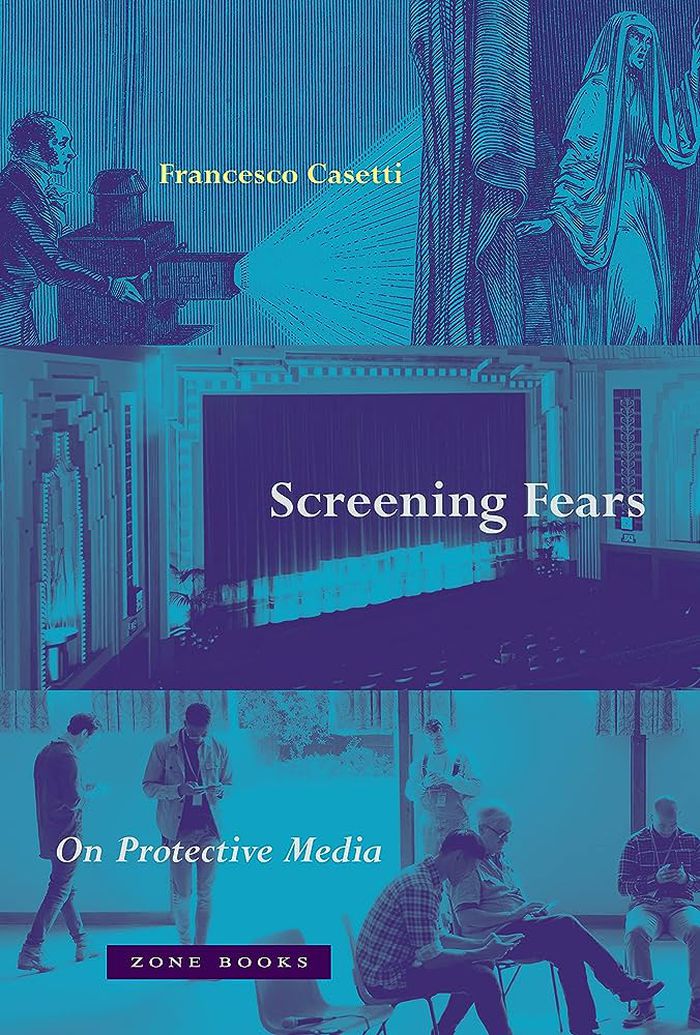
Screening fears: On protective media
Actions:
Price:
$39.95
(available to order)
Summary:
In this contribution to contemporary media studies, acclaimed theorist Francesco Casetti advances a provocative hypothesis: instead of being prostheses that expand or extend our perceptions, modern screen-based media are in fact apparatuses that shelter and protect us from exposure to the world. Rather than bringing us closer to external reality, dominant forms of visual media function as barriers or enclosures that defend against the apparent threats and dangers that seem increasingly to surround us. Working with an original historical overview that begins with the Phantasmagoria of the late eighteenth century, then the shared interior spaces of the movie theater in the early to mid-twentieth century, and finally the solitary digital milieus of the present, Casetti traces the outlines of the protective 'bubbles' that disconnect us from our immediate surroundings. To be provided with a shield of immunity to the hazards and uncertainties of the world while experiencing them at a safe remove might seem a positive development. But, he asks, what if these media, instead of providing invulnerability, ensnare individuals in a suffocating enclosure? What if, in their effort to keep reality under control, they exercise a violence equal to that of the dangers they resist? In a dialectical exercise, and through a vivid range of cultural artifacts, ''Screening fears'' traces the emergence of modern protective media and the way they changed our forms of mediation with the world in which we live.
Form:
books
books
Publication:
August 2023
August 2023
Subject:
Critical Theory
Critical Theory
Form:
books
books
Form:
books
books
Publication:
V2_ 2011
V2_ 2011
Subject:
Form:
books
books
Actions:
Subject:
Publication:
Open File 2012
Open File 2012
Form:
books
books
Publication:
Open File 2012
Open File 2012
Subject:
Form:
books
books

Title:
Stefan Koppelkamm: Screening
Stefan Koppelkamm: Screening
Actions:
Price:
$59.00
(available to order)
Summary:
Taken together, the photographs in this book represent a visual commentary on our present-day lifestyle. All the pictures were taken in the centre of Berlin - but the same scenes can be seen all over the world. The buildings are just as interchangeable as the monumental images of sex and consumerism. Stefan Koppelkamm's photographs are accompanied by selected monologues(...)
Title:
Stefan Koppelkamm: Screening
Actions:
Price:
$59.00
(available to order)
Summary:
Taken together, the photographs in this book represent a visual commentary on our present-day lifestyle. All the pictures were taken in the centre of Berlin - but the same scenes can be seen all over the world. The buildings are just as interchangeable as the monumental images of sex and consumerism. Stefan Koppelkamm's photographs are accompanied by selected monologues from Roland Schimmelpfennig's drama Push Up 1-3, which give the ideal inhabitants of this world a voice. These are people who fully subscribe to the images of success and beauty taken from adverts and from the media.
Form:
books
books
Publication:
July 2010
July 2010
Subject:
Photography monographs
Photography monographs
Form:
audio
audio
Description:
1 online resource.
Author:
Subject:
Publication:
[Place of publication not identified] : e-flux, 2024.
[Place of publication not identified] : e-flux, 2024.
Title:
African Film Institute: Ahmed El Maanouni, Omar Berrada.
Actions:
Description:
1 online resource.
African Film Institute: Ahmed El Maanouni, Omar Berrada.
Actions:
Description:
1 online resource.
Form:
audio
audio
Publication:
[Place of publication not identified] : e-flux, 2024.
[Place of publication not identified] : e-flux, 2024.
Author:
Subject:
Form:
books
books
Title:
Screening the city
Screening the city
Actions:
Price:
$29.00
(available to order)
Summary:
In this provocative collection of essays, films as diverse as "The Man with a Movie Camera", "Annie Hall", "Street of Crocodiles", "Boyz N the Hood", "Three Colors Red", and "Crash" are examined in terms of the relationship between cinema and the changing urban experience in Europe and the United States since the early twentieth century. Peter Jelavich, for example, links(...)
Subject:
Urban Theory
Urban Theory
Publication:
March 2003, London / New York
March 2003, London / New York
Title:
Screening the city
Actions:
Price:
$29.00
(available to order)
Summary:
In this provocative collection of essays, films as diverse as "The Man with a Movie Camera", "Annie Hall", "Street of Crocodiles", "Boyz N the Hood", "Three Colors Red", and "Crash" are examined in terms of the relationship between cinema and the changing urban experience in Europe and the United States since the early twentieth century. Peter Jelavich, for example, links the suppression of the creative, liberal Weimar Berlin in the 1931 film "Berlin Alexanderplatz" to the rise of the Nazi regime and the end of one of the great eras of modernist experimentation in German visual culture; Jessie Labov considers Kieslowski’s treatment of the Warsaw housing blok in "Dekalog" in terms of Solidarity’s strategy of resisting totalitarianism in 1980's Poland; Allan Siegel examines the motif of the city in a broad range of American and international cinema to demonstrate how film and society since the 1960's have been driven by the fading of mass political radicalism and the triumph of privatization and capital; Paula Massood uses the socially illuminating theories of Mikhail Bakhtin to examine the representation of the ghetto and urban underclass in recent African-American films such as "Menace II Society"; and Matthew Gandy examines the focus on disease in Todd Haynes’s "[Safe]" as a metaphor for social and spatial breakdown in contemporary Los Angeles.
Form:
books
books
Publication:
March 2003, London / New York
March 2003, London / New York
Subject:
Urban Theory
Urban Theory


