


931 Results
Form:
books
books
Actions:
Price:
$39.95
(available in store)
Summary:
In "The Zone," Justinien Tribillon takes the reader on a tour of an eponymous Parisian hinterland. The site of dreams and nightmares, from Van Gogh’s paintings to the cinematic violence of La Haine, the Zone, so often misunderstood, is the key to understanding today’s Paris, and even France itself. Originally the site of defensive walls, alongside which mushroomed(...)
Title:
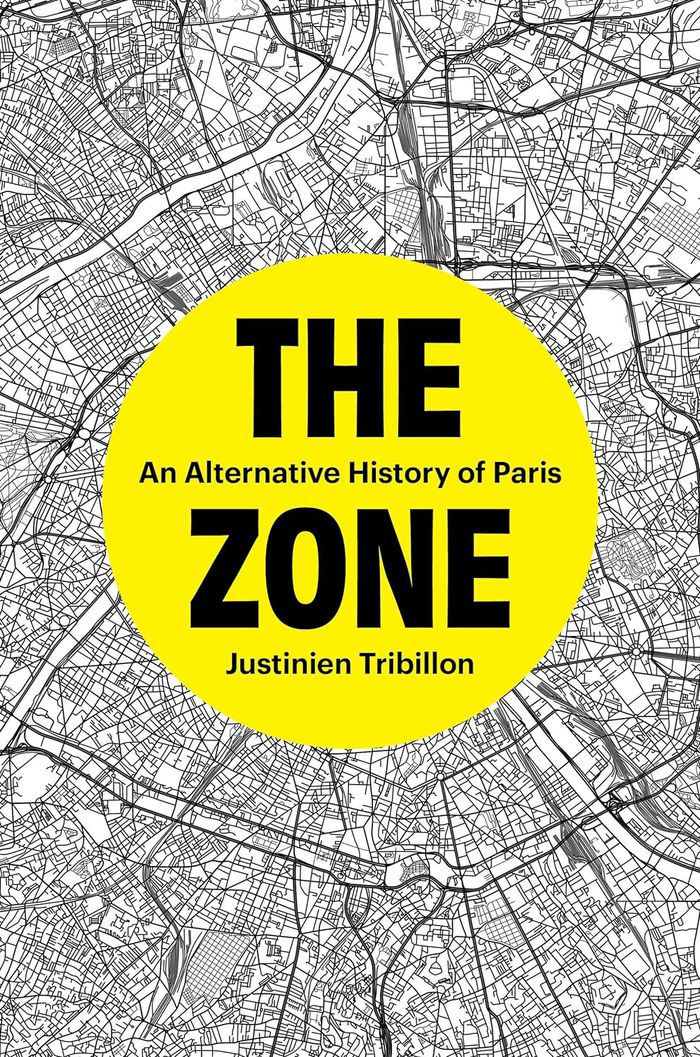
The zone: An alternative history of Paris
Actions:
Price:
$39.95
(available in store)
Summary:
In "The Zone," Justinien Tribillon takes the reader on a tour of an eponymous Parisian hinterland. The site of dreams and nightmares, from Van Gogh’s paintings to the cinematic violence of La Haine, the Zone, so often misunderstood, is the key to understanding today’s Paris, and even France itself. Originally the site of defensive walls, alongside which mushroomed makeshift housing, allotments, and dancehalls in the nineteenth century, the Zone has performed many functions and been a place of contention for two centuries. Dismantled in the 1920s, the fortifications were first replaced with gardens, stadia and homes. After the war came the Boulevard Périphérique, a ring road promising seamless travel in a futuristic car-centric Paris. With the ring road came new dreams of modernity in reinvented suburbs: new towns, high-rise architecture and social housing built at record speed. Yesterday’s Paris made way for tomorrow’s banlieue. But the metropolitan dream was never realised. The Zone became a symbol of division: between inner and outer cities; between the bourgeois centre and the working-class immigrant outskirts; between ‘us’ and ‘them’. The Zone, both a physical space and a powerful myth, came to crystallise the social, spatial and ethno-racial differences between Paris and the banlieue.
Form:
books
books
Publication:
July 2024
July 2024
Subject:
Urban Theory
Urban Theory
Form:
books
books
Actions:
Price:
$58.00
(available in store)
Summary:
This is the second publication in ''The Walther Collection Books series'' at Steidl, focusing on a dialogue between two of the most important South African photographers of the twentieth century—David Goldblatt (1930–2018) and Santu Mofokeng (1956–2020). There are both profound similarities and differences between the two artists’ work. Goldblatt documented the ways in(...)
Title:
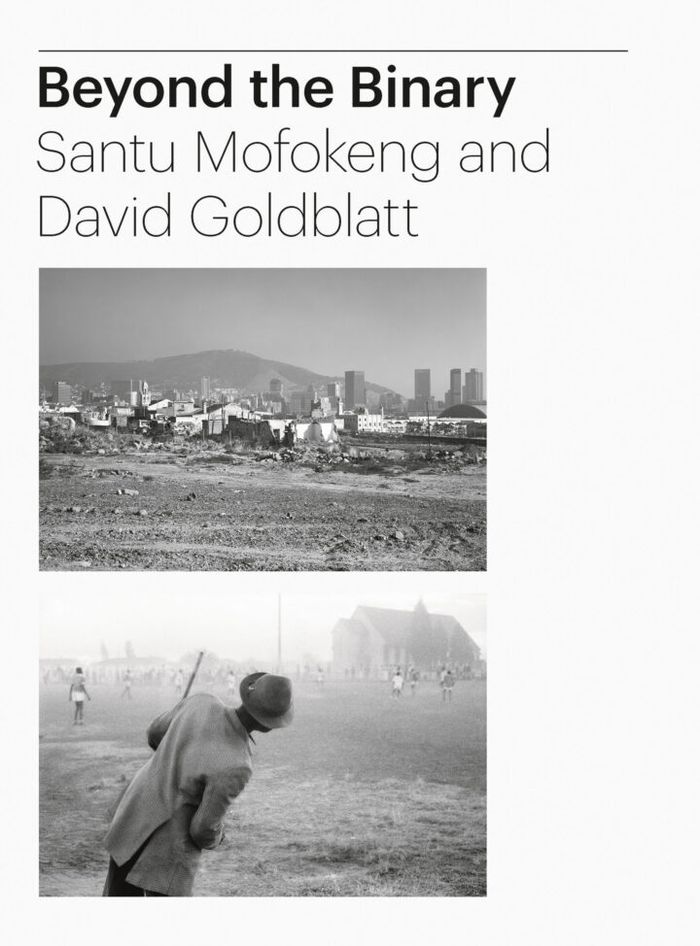
Beyond the binary: Santu Mofokeng and David Goldblatt
Actions:
Price:
$58.00
(available in store)
Summary:
This is the second publication in ''The Walther Collection Books series'' at Steidl, focusing on a dialogue between two of the most important South African photographers of the twentieth century—David Goldblatt (1930–2018) and Santu Mofokeng (1956–2020). There are both profound similarities and differences between the two artists’ work. Goldblatt documented the ways in which architecture and spatial planning reflect the ideology of apartheid, and how the land continues to bear its legacy in post-apartheid South Africa. His investigations explore both actual structures and how mental constructs reveal how ideology has shaped our landscape. Mofokeng’s photo essays shed light on everyday life in South Africa, beyond the stereotypical news pictures of Soweto depicting violence or poverty. Deeply personal, they record communities in townships and rural areas, religious rituals and landscapes imbued not only with historical significance but spiritual meaning, memory and trauma. The approach of Tamar Garb in Beyond the Binary is both daring and inquisitive—she “scrambles” and reassembles Mofokeng’s and Goldblatt’s photographs, blurring the boundaries between them and creates juxtapositions and insights that challenge prevailing views of these established images. By delineating 15 viewpoints around the themes of “Earthscapes,” “Edifices,” and “Sociality,” Garb decontextualizes the work and creates a platform for comparing and rethinking the artists’ practices.
Form:
books
books
Publication:
September 2024
September 2024
Subject:
Photography monographs
Photography monographs
Form:
books
books

Actions:
Price:
$140.00
(available in store)
Summary:
The past seventy-five years have been a time of extreme social and cultural transformations worldwide. Political and social upheaval, often contentious, disorienting and polarizing, is now a daily reality. Whether migration crises, territorial disputes, gender inequity, class divisions, racism, war, gun violence or environmental concerns, we live in a world rife with(...)
Title:
Flashpoint! Protest photography in print, 1950-present
Actions:
Price:
$140.00
(available in store)
Summary:
The past seventy-five years have been a time of extreme social and cultural transformations worldwide. Political and social upheaval, often contentious, disorienting and polarizing, is now a daily reality. Whether migration crises, territorial disputes, gender inequity, class divisions, racism, war, gun violence or environmental concerns, we live in a world rife with ideological and tribal conflicts. Since its inception, photography has captured defining historical moments, serving as either a tool or a document of protest—or both. In placing photobooks next to posters, DIY zines and independent journals, ''Flashpoint!'' explores the diverse roles and varying aesthetics that photography in print undertakes in its support of protest and resistance. Is it a “tool” conceived through an “aesthetic of urgency” to be used during events as they unfold, as in an anonymously designed poster or ink-stained fliers plastered on street walls? Or an elegantly designed photobook, published a year or more later, often with the help of well-known photographers, writers and designers, to document a past uprising? Whether outright rage or a more subtle artist-driven commentary, protest photography in print covers all of these formats and sometimes transcends rigid media definitions, as it blurs the lines between what constitutes a book, zine, journal, poster or newspaper.
Form:
books
books
Publication:
April 2025
April 2025
Subject:
Photography Collections
Photography Collections
Form:
books
books
Actions:
Price:
$36.95
(available to order)
Summary:
''Cultures of contagion'' recounts episodes in the history of contagions, from ancient times to the twenty-first century. It considers contagion not only in the medical sense but also as a process, a metaphor, and an interpretive model–as a term that describes not only the transmission of a virus but also the propagation of a phenomenon. The authors describe a wide range(...)
Title:
Cultures of contagion: A glossary
Actions:
Price:
$36.95
(available to order)
Summary:
''Cultures of contagion'' recounts episodes in the history of contagions, from ancient times to the twenty-first century. It considers contagion not only in the medical sense but also as a process, a metaphor, and an interpretive model–as a term that describes not only the transmission of a virus but also the propagation of a phenomenon. The authors describe a wide range of social, cultural, political, and anthropological instances through the prism of contagion–from anti-Semitism to migration, from the nuclear contamination of the planet to the violence of Mao’s Red Guard. The book proceeds glossary style, with a series of short texts arranged alphabetically, beginning with an entry on aluminum and ''environmental contagion'' and ending with a discussion of writing and ''textual resemblance'' caused by influence, imitation, borrowing, and plagiarism. The authors–leading scholars associated with the Center for Historical Research (CRH, Centre de recherches historiques), Paris–consider such topics as the connection between contagion and suggestion, ''waltzmania'' in post-Terror Paris, the effect of reading on sensitive imaginations, and the contagiousness of yawning. They take two distinct approaches: either examining contagion and what it signified contemporaneously, or deploying contagion as an interpretive tool. Both perspectives illuminate unexpected connections, unnoticed configurations, and invisible interactions.
Form:
books
books
Publication:
October 2021
October 2021
Subject:
Social
Social
Form:
books
books
Price:
$67.95
(available to order)
Summary:
In the mid-nineteenth century, Napoleon III and his prefect, Georges-Eugène Haussmann, adapted Paris to the requirements of industrial capitalism, endowing the old city with elegant boulevards, an enhanced water supply, modern sewers, and public greenery. Esther da Costa Meyer provides a major reassessment of this ambitious project, which resulted in widespread(...)
Title:
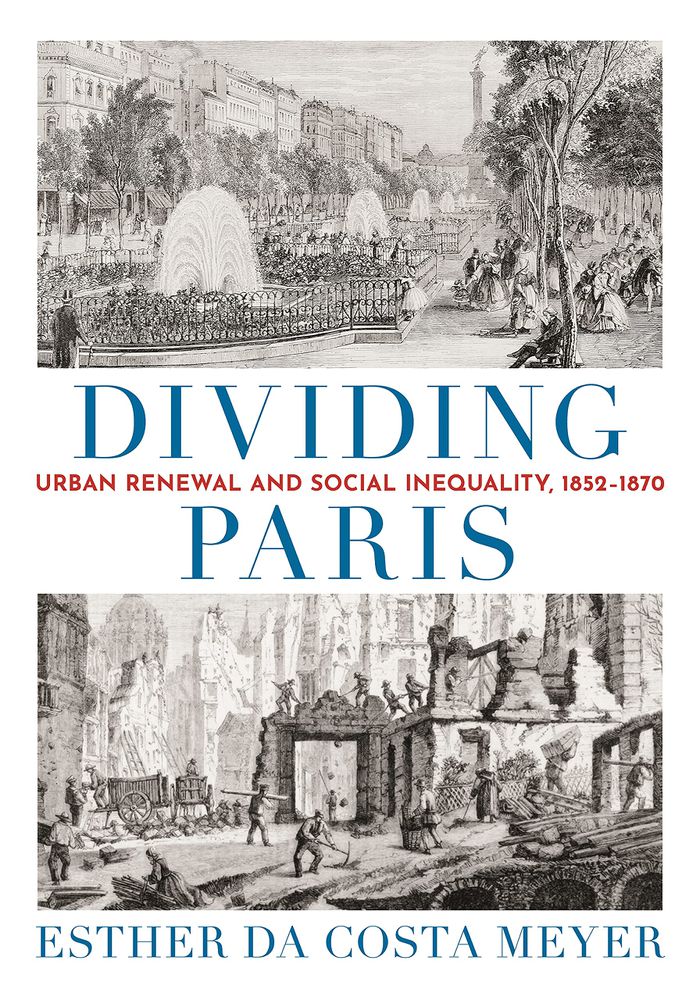
Dividing Paris: Urban renewal and social inequality 1852-1870
Actions:
Price:
$67.95
(available to order)
Summary:
In the mid-nineteenth century, Napoleon III and his prefect, Georges-Eugène Haussmann, adapted Paris to the requirements of industrial capitalism, endowing the old city with elegant boulevards, an enhanced water supply, modern sewers, and public greenery. Esther da Costa Meyer provides a major reassessment of this ambitious project, which resulted in widespread destruction in the historic center, displacing thousands of poor residents and polarizing the urban fabric. Drawing on newspapers, memoirs, and other archival materials, da Costa Meyer explores how people from different social strata?both women and men?experienced the urban reforms implemented by the Second Empire. As hundreds of tenements were destroyed to make way for upscale apartment buildings, thousands of impoverished residents were forced to the periphery, which lacked the services enjoyed by wealthier parts of the city. Challenging the idea of Paris as the capital of modernity, da Costa Meyer shows how the city was the hub of a sprawling colonial empire extending from the Caribbean to Asia, and exposes the underlying violence that enriched it at the expense of overseas territories. This book brings to light the contributions of those who actually built and maintained the impressive infrastructure of Paris, and reveals the consequences of colonial practices for the city's cultural, economic, and political life.
Form:
books
books
Publication:
February 2022
February 2022
Subject:
Urban Theory
Urban Theory
Form:
books
books

Title:
Loving Frank
Loving Frank
Actions:
Price:
$45.95
(available to order)
Summary:
Au début du XXe siècle, la bonne société de Chicago resta foudroyée par le soufre d'un scandale sans précédent. Pour l'amour éperdu d'un homme, une femme osa l'impensable et commit l'irréparable. Elle en paya le prix toute sa vie. Elle s'appelait Mamah Borthwick Cheney. Lui n'était autre que Frank Lloyd Wright, l'enfant génial et rebelle de l'architecture américaine à(...)
Title:
Loving Frank
Actions:
Price:
$45.95
(available to order)
Summary:
Au début du XXe siècle, la bonne société de Chicago resta foudroyée par le soufre d'un scandale sans précédent. Pour l'amour éperdu d'un homme, une femme osa l'impensable et commit l'irréparable. Elle en paya le prix toute sa vie. Elle s'appelait Mamah Borthwick Cheney. Lui n'était autre que Frank Lloyd Wright, l'enfant génial et rebelle de l'architecture américaine à qui Mamah et son mari Edwin Cheney avaient demandé, en 1903, de construire leur nouvelle maison. En 1909, tombée entre-temps follement amoureuse du célèbre architecte, Mamah choqua une époque pudibonde et dévote en quittant son mari et ses deux jeunes enfants pour suivre Frank Lloyd Wright en Europe. Ce dernier, tout aussi épris, laissait derrière lui une Amérique stupéfaite, une épouse et six enfants... Enchaînés par la passion, mais hantés par une culpabilité intolérable, ils firent la une de la presse américaine durant leurs séjours en Allemagne, en Italie et à Paris, lors de la grande crue de 1910... Mais aucun journal à sensation n'aurait pu prévoir ce qui adviendrait à ce couple maudit de retour aux Etats-Unis, en 1914. La violence du dénouement verra ? au-delà du déchirement des familles Cheney et Wright ? le monde pétrifié. Pour la première fois nous est contée l'histoire de l'émancipation très en avance sur son temps de Mamah Borthwick, et de son amour pour l'un des plus grands maîtres de l'architecture moderne.
Form:
books
books
Publication:
November 2009
November 2009
Subject:
Architecture Monographs
Architecture Monographs
Form:
books
books
Title:
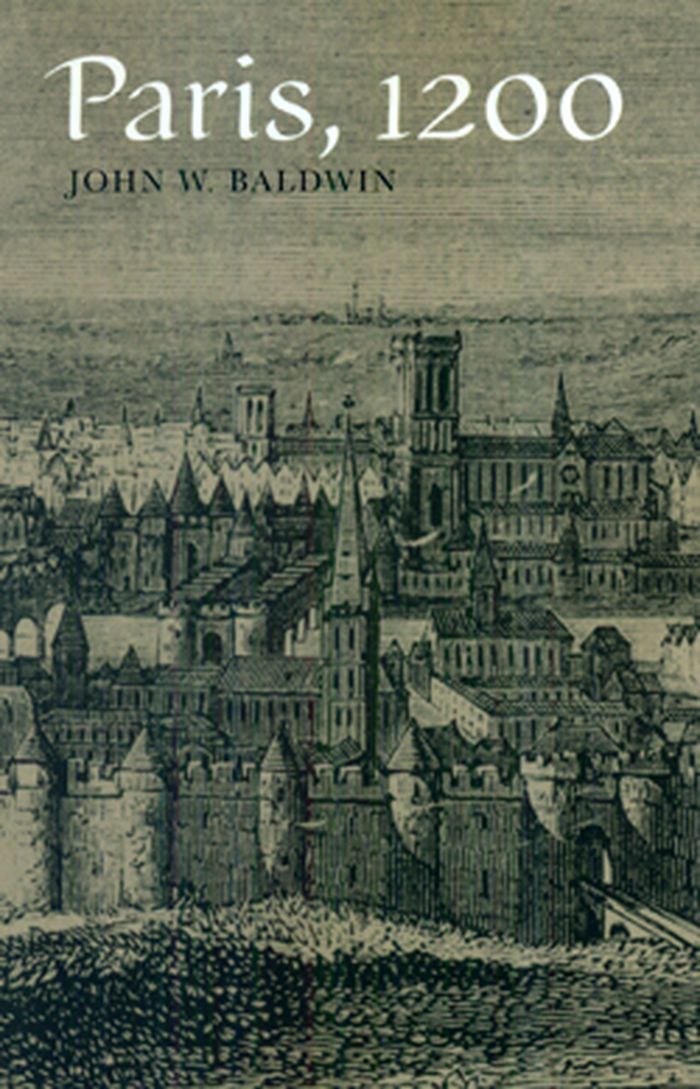
Paris, 1200
Paris, 1200
Actions:
Price:
$27.95
(available in store)
Summary:
Paris in 1200 was a city in transition. The great cathedral of Notre Dame was halfway through its construction and walls were being built to enclose the new, larger limits of the city. Pope Innocent III ordered all French churches closed to punish King Philip Augustus for his remarriage; the king himself negotiated an unprecedented truce with the English; and the students(...)
Title:
Paris, 1200
Actions:
Price:
$27.95
(available in store)
Summary:
Paris in 1200 was a city in transition. The great cathedral of Notre Dame was halfway through its construction and walls were being built to enclose the new, larger limits of the city. Pope Innocent III ordered all French churches closed to punish King Philip Augustus for his remarriage; the king himself negotiated an unprecedented truce with the English; and the students of Paris threatened a general strike, punctuated with incidents of violence, to protest infringements of their rights. John W. Baldwin resurrects this key moment in Parisian history using documents only from 1190 to 1210 — a narrow focus made possible by the availability of collections of the Capetian monarchy and the medieval scholastic thinkers. This unique approach results in a vivid snapshot of the city at the turn of the thirteenth century. "Paris, 1200" introduces the reader to the city itself and its inhabitants. Three "faces" exemplify these inhabitants : that of the celebrated scholar Pierre the Chanter, of King Philip Augustus, and of the more deeply hidden visages of women. The book examines the city's primary institutions : the royal government, the Church, and its celebrated schools that evolved into the university at Paris. Finally, it offers an account of the delights and pleasures, as well as the fears and sorrows, of Parisian life in this period.
Form:
books
books
Publication:
October 2010
October 2010
Subject:
History until 1900, France
History until 1900, France
Form:
books
books

Title:
L'empire des signes
L'empire des signes
Actions:
Price:
$17.95
(available to order)
Summary:
Pourquoi le Japon ? Parce que c'est le pays de l'écriture: de tous les pays que l'auteur a pu connaître, le Japon est celui où il a rencontré le travail du signe le plus proche de ses convictions et de ses fantasmes, ou, si l'on préfère, le plus éloigné des dégoûts, des irritations et des refus que suscite en lui la sémiocratie occidentale. Le signe japonais est fort :(...)
Title:
L'empire des signes
Actions:
Price:
$17.95
(available to order)
Summary:
Pourquoi le Japon ? Parce que c'est le pays de l'écriture: de tous les pays que l'auteur a pu connaître, le Japon est celui où il a rencontré le travail du signe le plus proche de ses convictions et de ses fantasmes, ou, si l'on préfère, le plus éloigné des dégoûts, des irritations et des refus que suscite en lui la sémiocratie occidentale. Le signe japonais est fort : admirablement réglé, agencé, affiché, jamais naturalisé ou rationalisé. Le signe japonais est vide: son signifié fuit, point de dieu, de vérité, de morale au fond de ces signifiants qui règnent sans contrepartie. Et surtout, la qualité supérieure de ce signe, la noblesse de son affirmation et la grâce érotique dont il se dessine sont apposées partout, sur les objets et sur les conduites les plus futiles, celles que nous renvoyons ordinairement dans l'insignifiance ou la vulgarité. Le lieu du signe ne sera donc pas cherché ici du côté de ses domaines institutionnels: il ne sera question ni d'art, ni de folklore, ni même de «civilisation» (on n'opposera pas le Japon féodal au Japon technique). Il sera question de la ville, du magasin, du théâtre, de la politesse, des jardins, de la violence; il sera question de quelques gestes, de quelques nourritures, de quelques poèmes; il sera question des visages, des yeux et des pinceaux avec quoi tout cela s'écrit mais ne se peint pas.
Form:
books
books
Publication:
November 2007, Paris
November 2007, Paris
Subject:
Critical Theory
Critical Theory
Form:
books
books

Title:
Planet of slums
Planet of slums
Actions:
Price:
$25.00
(available to order)
Summary:
Urban theorist Davis takes a global approach to documenting the astonishing depth of squalid poverty that dominates the lives of the planet's increasingly urban population, detailing poor urban communities from Cape Town and Caracas to Casablanca and Khartoum. Davis argues health, justice and social issues associated with gargantuan slums (the largest, in Mexico City, has(...)
Title:
Planet of slums
Actions:
Price:
$25.00
(available to order)
Summary:
Urban theorist Davis takes a global approach to documenting the astonishing depth of squalid poverty that dominates the lives of the planet's increasingly urban population, detailing poor urban communities from Cape Town and Caracas to Casablanca and Khartoum. Davis argues health, justice and social issues associated with gargantuan slums (the largest, in Mexico City, has an estimated population of 4 million) get overlooked in world politics: "The demonizing rhetorics of the various international 'wars' on terrorism, drugs, and crime are so much semantic apartheid: they construct epistemological walls around gecekondus, favelas, and chawls that disable any honest debate about the daily violence of economic exclusion." Though Davis focuses on individual communities, he presents statistics showing the skyrocketing population and number of "megaslums" (informally, "stinking mountains of shit" or, formally, "when shanty-towns and squatter communities merge in continuous belts of informal housing and poverty, usually on the urban periphery") since the 1960s. Layered over the hard numbers are a fascinating grid of specific area studies and sub-topics ranging from how the Olympics has spurred the forceful relocation of thousands (and, sometimes, hundreds of thousands) of the urban poor, to the conversion of formerly second world countries to third world status. Davis paints a bleak picture of the upward trend in urbanization and maintains a stark outlook for slum-dwellers' futures
Form:
books
books
Publication:
August 2007, London New York
August 2007, London New York
Subject:
Urban Theory
Urban Theory
Form:
books
books

Actions:
Price:
$47.00
(available to order)
Summary:
After the success of the recent touring exhibition "My Complement, My Enemy, My Oppressor, My Love", Kara Walker's silhouetted cut-out figures are a now-familiar but still pungent presence in contemporary art, reenacting uncomfortable, often violent episodes in American race relations and reprising, in their formal simplicity, the ways in which marginalized identities are(...)
Title:
Kara Walker : bureau of refugees
Actions:
Price:
$47.00
(available to order)
Summary:
After the success of the recent touring exhibition "My Complement, My Enemy, My Oppressor, My Love", Kara Walker's silhouetted cut-out figures are a now-familiar but still pungent presence in contemporary art, reenacting uncomfortable, often violent episodes in American race relations and reprising, in their formal simplicity, the ways in which marginalized identities are reduced and distorted into readily legible, caricatured forms. Walker's art continues, in other words, to pose awkward questions straightforwardly. Her imagery derives from the visual language of the antebellum South and the tradition of the minstrel show, which she directs to more disquieting ends. Where her source material parodied African-American culture with a terrifyingly casual jocularity - permitting white Americans to vicariously transgress their own taboos by depicting social chaos and unbridled sexuality - Walker applies that jocularity to her depictions of violence against African-Americans, lending them a hollow, almost slapstick character that is very much at odds with their original function. This latest book features work from a new series that addresses, among other themes, the atrocities committed against former slaves after the Emancipation Proclamation of 1863 and the Reconstruction program implemented by Congress between 1866 and 1877. These narratives are elaborated into or against geometric scenarios more abstract and compacted than previous sequences by Walker, and with a more extensive use of color.
Form:
books
books
Publication:
September 2008, Milano
September 2008, Milano
Subject:
Contemporary Art Monographs
Contemporary Art Monographs


