


10284 Results
Form:
books
books
Price:
$28.95
(available to order)
Summary:
American ruins have become increasingly prominent, whether in discussions of “urban blight” and home foreclosures, in commemorations of 9/11, or in postapocalyptic movies. In this book, Nick Yablon argues that the association between American cities and ruins dates back to a much earlier period in the nation’s history. Recovering numerous scenes of urban desolation—from(...)
$28.95
(available to order)
Summary:
American ruins have become increasingly prominent, whether in discussions of “urban blight” and home foreclosures, in commemorations of 9/11, or in postapocalyptic movies. In this book, Nick Yablon argues that the association between American cities and ruins dates back to a much earlier period in the nation’s history. Recovering numerous scenes of urban desolation—from(...)
Title:
Untimely ruins : an archaeology of American urban modernity, 1819-1919
Actions:
Price:
$28.95
(available to order)
Summary:
American ruins have become increasingly prominent, whether in discussions of “urban blight” and home foreclosures, in commemorations of 9/11, or in postapocalyptic movies. In this book, Nick Yablon argues that the association between American cities and ruins dates back to a much earlier period in the nation’s history. Recovering numerous scenes of urban desolation—from failed banks, abandoned towns, and dilapidated tenements to the crumbling skyscrapers and bridges envisioned in science fiction and cartoons—this publication challenges the myth that ruins were absent or insignificant objects in nineteenth-century America. The first book to document an American cult of the ruin, it traces its deviations as well as derivations from European conventions. Unlike classical and Gothic ruins, which decayed gracefully over centuries and inspired philosophical meditations about the fate of civilizations, America’s ruins were often “untimely,” appearing unpredictably and disappearing before they could accrue an aura of age. As modern ruins of steel and iron, they stimulated critical reflections about contemporary cities, and the unfamiliar kinds of experience they enabled. Unearthing evocative sources everywhere from the archives of amateur photographers to the contents of time-capsules, this title exposes crucial debates about the economic, technological, and cultural transformations known as urban modernity.
Untimely ruins : an archaeology of American urban modernity, 1819-1919
Actions:
Price:
$28.95
(available to order)
Summary:
American ruins have become increasingly prominent, whether in discussions of “urban blight” and home foreclosures, in commemorations of 9/11, or in postapocalyptic movies. In this book, Nick Yablon argues that the association between American cities and ruins dates back to a much earlier period in the nation’s history. Recovering numerous scenes of urban desolation—from failed banks, abandoned towns, and dilapidated tenements to the crumbling skyscrapers and bridges envisioned in science fiction and cartoons—this publication challenges the myth that ruins were absent or insignificant objects in nineteenth-century America. The first book to document an American cult of the ruin, it traces its deviations as well as derivations from European conventions. Unlike classical and Gothic ruins, which decayed gracefully over centuries and inspired philosophical meditations about the fate of civilizations, America’s ruins were often “untimely,” appearing unpredictably and disappearing before they could accrue an aura of age. As modern ruins of steel and iron, they stimulated critical reflections about contemporary cities, and the unfamiliar kinds of experience they enabled. Unearthing evocative sources everywhere from the archives of amateur photographers to the contents of time-capsules, this title exposes crucial debates about the economic, technological, and cultural transformations known as urban modernity.
Form:
books
books
Publication:
February 2010, Chicago
February 2010, Chicago
Subject:
Urban Theory
Urban Theory
Form:
books
books
Price:
$41.95
(available to order)
Summary:
The Urban Spectator is a lively and utterly fascinating exploration of the ways in which technologies have influenced our collective conception of the American city, as well as our relationship with urban space and architecture. Eric Gordon argues that the city, developing late and in conjunction with a range of modern media, produced a particular way of seeing--what he(...)
$41.95
(available to order)
Summary:
The Urban Spectator is a lively and utterly fascinating exploration of the ways in which technologies have influenced our collective conception of the American city, as well as our relationship with urban space and architecture. Eric Gordon argues that the city, developing late and in conjunction with a range of modern media, produced a particular way of seeing--what he(...)
Title:
The urban spectator: American concept-cities from Kodak to Google
Actions:
Price:
$41.95
(available to order)
Summary:
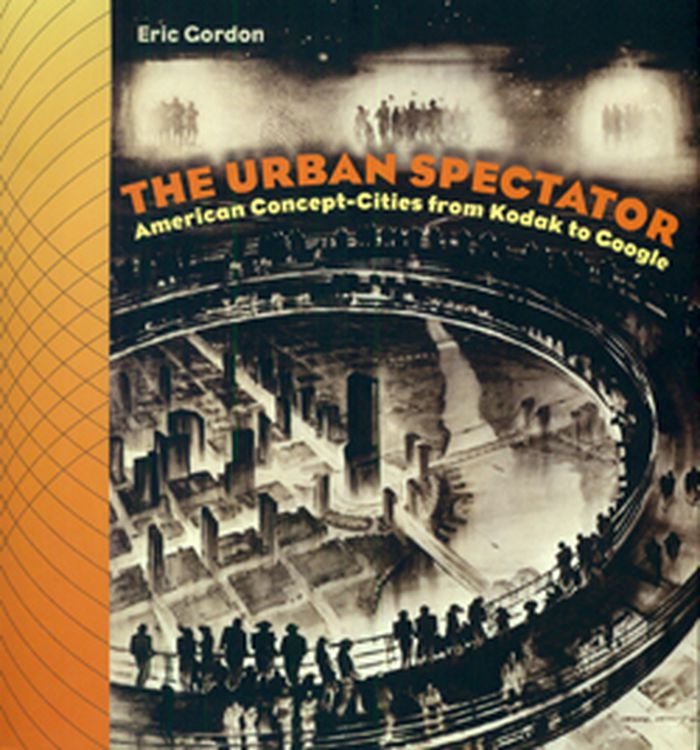
The Urban Spectator is a lively and utterly fascinating exploration of the ways in which technologies have influenced our collective conception of the American city, as well as our relationship with urban space and architecture. Eric Gordon argues that the city, developing late and in conjunction with a range of modern media, produced a particular way of seeing--what he labels "possessive spectatorship." Lacking the historical rootedness of European cities, the American city was open to individual interpretation, definition, and ownership. Beginning with the White City of the Chicago World's Fair of 1893 and the efforts to commodify the concept city through photography, Gordon shows how the American city has always been a product of the collision between the dominant conceptualization, shaped by contemporary media, and the spectator. From the viewfinder of the Kodak camera, to the public display of early cinema, to the speculative desire of network radio, all the way to machine-age utopianism, nostalgia, and America's "rerun" culture, the city is an amalgam of practice and concept. All of this comes to a head in the "database city" where urban spectatorship takes on the characteristics of a Google search. In new urban developments, the spectator searches, retrieves, and combines urban references to construct each experience of the city.
The urban spectator: American concept-cities from Kodak to Google
Actions:
Price:
$41.95
(available to order)
Summary:
The Urban Spectator is a lively and utterly fascinating exploration of the ways in which technologies have influenced our collective conception of the American city, as well as our relationship with urban space and architecture. Eric Gordon argues that the city, developing late and in conjunction with a range of modern media, produced a particular way of seeing--what he labels "possessive spectatorship." Lacking the historical rootedness of European cities, the American city was open to individual interpretation, definition, and ownership. Beginning with the White City of the Chicago World's Fair of 1893 and the efforts to commodify the concept city through photography, Gordon shows how the American city has always been a product of the collision between the dominant conceptualization, shaped by contemporary media, and the spectator. From the viewfinder of the Kodak camera, to the public display of early cinema, to the speculative desire of network radio, all the way to machine-age utopianism, nostalgia, and America's "rerun" culture, the city is an amalgam of practice and concept. All of this comes to a head in the "database city" where urban spectatorship takes on the characteristics of a Google search. In new urban developments, the spectator searches, retrieves, and combines urban references to construct each experience of the city.
Form:
books
books
Publication:
February 2010
February 2010
Subject:
Urban Theory
Urban Theory
Form:
books
books
Actions:
Price:
$54.95
(available to order)
Summary:
An early version of the slide projector and an immediate predecessor of narrative cinema, the magic lantern provided the lens through which late-nineteenth century Europe and America viewed and imagined the world. Magic lantern slide shows were a popular, entertaining and educational way for people to learn about the world beyond their own horizons, and from Cairo to(...)
$54.95
(available to order)
Summary:
An early version of the slide projector and an immediate predecessor of narrative cinema, the magic lantern provided the lens through which late-nineteenth century Europe and America viewed and imagined the world. Magic lantern slide shows were a popular, entertaining and educational way for people to learn about the world beyond their own horizons, and from Cairo to(...)
Title:
Memories of a lost world : travels through the magic lantern
Actions:
Price:
$54.95
(available to order)
Summary:
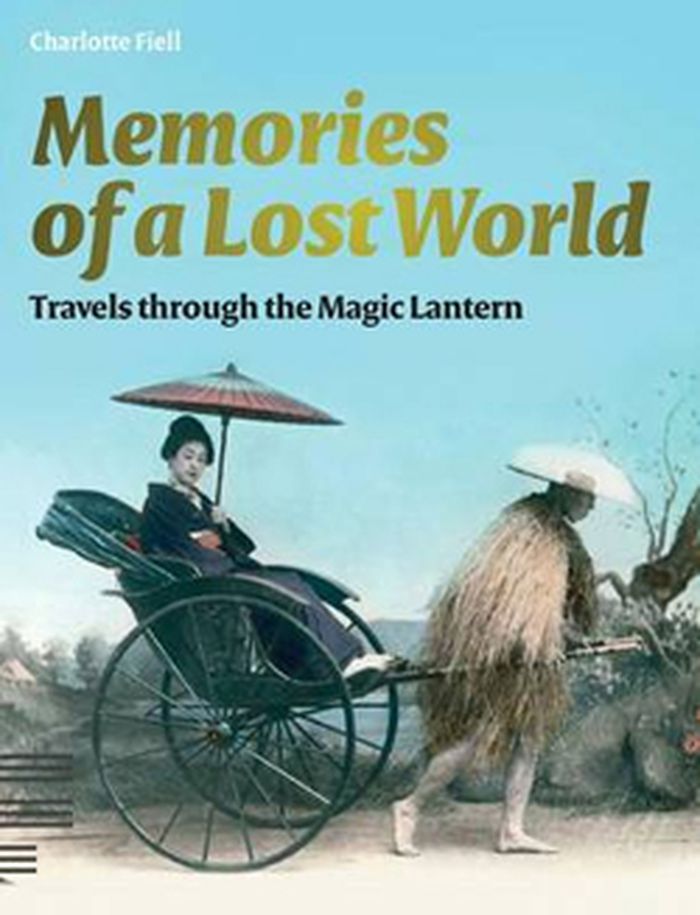
An early version of the slide projector and an immediate predecessor of narrative cinema, the magic lantern provided the lens through which late-nineteenth century Europe and America viewed and imagined the world. Magic lantern slide shows were a popular, entertaining and educational way for people to learn about the world beyond their own horizons, and from Cairo to Delhi to Adelaide and Cape Town, intrepid European and American photographers traveled to all corners of the world to document its peoples and customs. Now, for the first time, images of original magic lantern slides have been brought together in a single publication. Memories of a Lost World: Travels through the Magic Latern takes the reader back to a pre-globalised world in which regional customs and national cultures were as distinctive as they were diverse. From the bustling streets of Victorian London and the ruins of ancient Egypt to the temples of Japan and the tribesmen of New Guinea, Memories of a Lost World explores the world through a captivating collection of over 800 magic lantern slide images. This volume is not only an important source of primary historical information, but also conveys something of what the world was like before the advent of television and mass travel.
Memories of a lost world : travels through the magic lantern
Actions:
Price:
$54.95
(available to order)
Summary:
An early version of the slide projector and an immediate predecessor of narrative cinema, the magic lantern provided the lens through which late-nineteenth century Europe and America viewed and imagined the world. Magic lantern slide shows were a popular, entertaining and educational way for people to learn about the world beyond their own horizons, and from Cairo to Delhi to Adelaide and Cape Town, intrepid European and American photographers traveled to all corners of the world to document its peoples and customs. Now, for the first time, images of original magic lantern slides have been brought together in a single publication. Memories of a Lost World: Travels through the Magic Latern takes the reader back to a pre-globalised world in which regional customs and national cultures were as distinctive as they were diverse. From the bustling streets of Victorian London and the ruins of ancient Egypt to the temples of Japan and the tribesmen of New Guinea, Memories of a Lost World explores the world through a captivating collection of over 800 magic lantern slide images. This volume is not only an important source of primary historical information, but also conveys something of what the world was like before the advent of television and mass travel.
Form:
books
books
Publication:
November 2012
November 2012
Subject:
Transportation, Tourism, Migration
Transportation, Tourism, Migration
Form:
books
books
Title:
2 G Eduardo Arroyo
2 G Eduardo Arroyo
Actions:
Price:
$46.95
(available in store)
Summary:
In recent years the Madrid school has gone through a renewal that is generating an architecture which is especially interested in what is done on the other side of the Spanish frontier. Without losing sight of a rich local tradition, the many different architecture studios of Madrid -like Ábalos and Herreros, Tuñón and Mansilla, Soriano and Palacios, Cero9, Acebo and(...)
$46.95
(available in store)
Summary:
In recent years the Madrid school has gone through a renewal that is generating an architecture which is especially interested in what is done on the other side of the Spanish frontier. Without losing sight of a rich local tradition, the many different architecture studios of Madrid -like Ábalos and Herreros, Tuñón and Mansilla, Soriano and Palacios, Cero9, Acebo and(...)
Subject:
Architecture Monographs
Architecture Monographs
Publication:
April 2007, Barcelona
April 2007, Barcelona
Title:
2 G Eduardo Arroyo
Actions:
Price:
$46.95
(available in store)
Summary:
In recent years the Madrid school has gone through a renewal that is generating an architecture which is especially interested in what is done on the other side of the Spanish frontier. Without losing sight of a rich local tradition, the many different architecture studios of Madrid -like Ábalos and Herreros, Tuñón and Mansilla, Soriano and Palacios, Cero9, Acebo and Alonso, Aranguren and Gallegos, Nieto and Sobejano- are displaying a much fresher and more active approach in terms of defining new advances for contemporary Spanish architecture than their compatriots of the Barcelona School. As part of this, Eduardo Arroyo and the members of the Madrid studio no.mad arquitectos occupy an important place within the new Spanish architecture. Despite having built very little (a day nursery in Sondika, a square and a stadium in Barakaldo, and a single-family house on the outskirts of Madrid), Eduardo Arroyo is a key figure for understanding the new directions that not only Spanish, but also European, architecture is taking. This new 41st issue of the magazine 2G presents all his studio’s built work and some of its more recent projects, a total oeuvre that moves between the fiercest pragmatism and rigour, a playful geometry, the value of architecture as part of the landscape, and constructional responsibility.
2 G Eduardo Arroyo
Actions:
Price:
$46.95
(available in store)
Summary:
In recent years the Madrid school has gone through a renewal that is generating an architecture which is especially interested in what is done on the other side of the Spanish frontier. Without losing sight of a rich local tradition, the many different architecture studios of Madrid -like Ábalos and Herreros, Tuñón and Mansilla, Soriano and Palacios, Cero9, Acebo and Alonso, Aranguren and Gallegos, Nieto and Sobejano- are displaying a much fresher and more active approach in terms of defining new advances for contemporary Spanish architecture than their compatriots of the Barcelona School. As part of this, Eduardo Arroyo and the members of the Madrid studio no.mad arquitectos occupy an important place within the new Spanish architecture. Despite having built very little (a day nursery in Sondika, a square and a stadium in Barakaldo, and a single-family house on the outskirts of Madrid), Eduardo Arroyo is a key figure for understanding the new directions that not only Spanish, but also European, architecture is taking. This new 41st issue of the magazine 2G presents all his studio’s built work and some of its more recent projects, a total oeuvre that moves between the fiercest pragmatism and rigour, a playful geometry, the value of architecture as part of the landscape, and constructional responsibility.
Form:
books
books
Publication:
April 2007, Barcelona
April 2007, Barcelona
Subject:
Architecture Monographs
Architecture Monographs
Form:
journals and magazines
journals and magazines
Actions:
Price:
$48.95
(available to order)
Summary:
AV monographs dedicates each issue to a theme involving a city, a country, a tendency or an architect, featuring essays by prominent scholars and commentaries on built works and projects illustrated in detail. With edorial text "The fatigue of Europe" by Luis Fernandez-Galiano : (...) " Europeans vaunt about their tenacious experimental tradition in the field of housing,(...)
$48.95
(available to order)
Summary:
AV monographs dedicates each issue to a theme involving a city, a country, a tendency or an architect, featuring essays by prominent scholars and commentaries on built works and projects illustrated in detail. With edorial text "The fatigue of Europe" by Luis Fernandez-Galiano : (...) " Europeans vaunt about their tenacious experimental tradition in the field of housing,(...)
Title:
AV 116 : formal housing - vivienda formal
Actions:
Price:
$48.95
(available to order)
Summary:
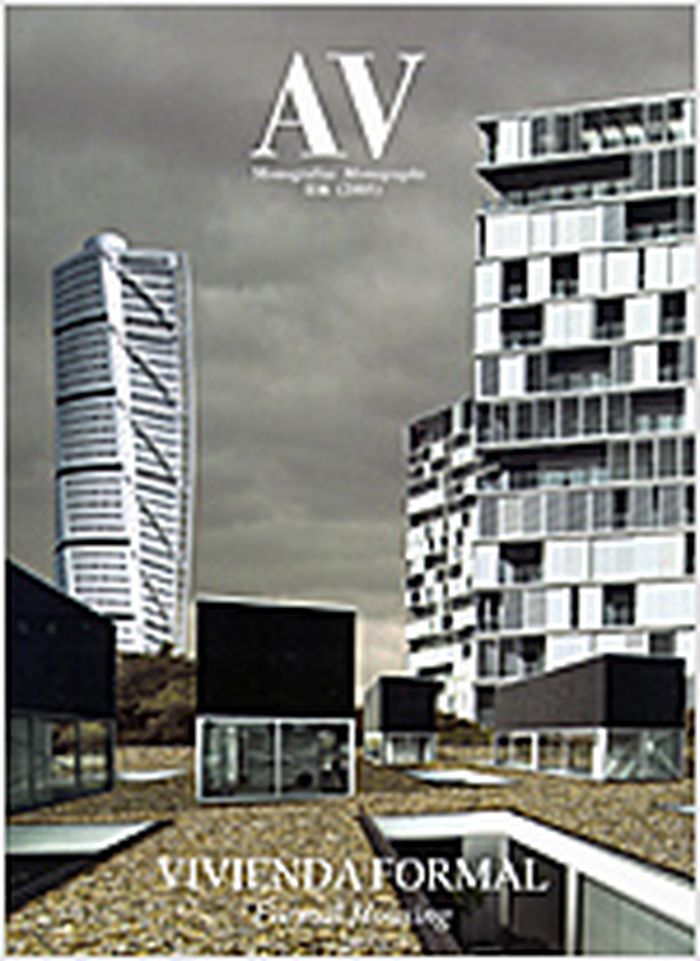
AV monographs dedicates each issue to a theme involving a city, a country, a tendency or an architect, featuring essays by prominent scholars and commentaries on built works and projects illustrated in detail. With edorial text "The fatigue of Europe" by Luis Fernandez-Galiano : (...) " Europeans vaunt about their tenacious experimental tradition in the field of housing, but a distracted review of the latest residential projects leaves a bittersweet aftertaste. Apart from some odd technical displays and a few typological novelties, the majority of the projects presented in this issue stand out for their geometric rigor, their material sophistication and their compositional elegance. Rather than a product of the Welfare State, they are a consequence of the welfare of the State – promoter of a large number of them – and also of the social prosperity made evident by the boom of private real-estate development. Examples of the refinement of the European elites, these works also bear witness to the creative fatigue of a continent that finds itself demographically aged, economically less and less competitive, and with a knowledge industry that continues to lag behind the universities and laboratories of the American north, and now also in comparison with the dynamic surge of Asia.(...)"
AV 116 : formal housing - vivienda formal
Actions:
Price:
$48.95
(available to order)
Summary:
AV monographs dedicates each issue to a theme involving a city, a country, a tendency or an architect, featuring essays by prominent scholars and commentaries on built works and projects illustrated in detail. With edorial text "The fatigue of Europe" by Luis Fernandez-Galiano : (...) " Europeans vaunt about their tenacious experimental tradition in the field of housing, but a distracted review of the latest residential projects leaves a bittersweet aftertaste. Apart from some odd technical displays and a few typological novelties, the majority of the projects presented in this issue stand out for their geometric rigor, their material sophistication and their compositional elegance. Rather than a product of the Welfare State, they are a consequence of the welfare of the State – promoter of a large number of them – and also of the social prosperity made evident by the boom of private real-estate development. Examples of the refinement of the European elites, these works also bear witness to the creative fatigue of a continent that finds itself demographically aged, economically less and less competitive, and with a knowledge industry that continues to lag behind the universities and laboratories of the American north, and now also in comparison with the dynamic surge of Asia.(...)"
Form:
journals and magazines
journals and magazines
Publication:
September 2006, Madrid
September 2006, Madrid
Subject:
Magazines
Magazines
Form:
books
books
Price:
$27.99
(available to order)
Summary:
The architecture of Britain is an art gallery all around us. From our streets to squares, through our cities, suburbs and villages, we are surrounded by magnificent buildings of eclectic styles. ''A Short History of British Architecture'' is story of why Britain looks the way it does, from prehistoric Stonehenge to the lofty towers of today. Historian Simon Jenkins(...)
$27.99
(available to order)
Summary:
The architecture of Britain is an art gallery all around us. From our streets to squares, through our cities, suburbs and villages, we are surrounded by magnificent buildings of eclectic styles. ''A Short History of British Architecture'' is story of why Britain looks the way it does, from prehistoric Stonehenge to the lofty towers of today. Historian Simon Jenkins(...)
Title:
A short history of British architecture: From Stonehenge to The Shard
Actions:
Price:
$27.99
(available to order)
Summary:
The architecture of Britain is an art gallery all around us. From our streets to squares, through our cities, suburbs and villages, we are surrounded by magnificent buildings of eclectic styles. ''A Short History of British Architecture'' is story of why Britain looks the way it does, from prehistoric Stonehenge to the lofty towers of today. Historian Simon Jenkins traces the relentless battles over the European traditions of classicism and gothic- from the gothic cathedrals of Lincoln, Ely and Wells to the ‘'prodigy'’ houses of the Tudor renaissance, and visits the great estates of Georgian London, the docks of Liverpool, the mills of Yorkshire and the chapels of south Wales. The arrival of modernism in the twentieth century politicised public taste, upheaved communities and sought to reconstruct entire cities. It produced Coventry Cathedral and Lloyd’s of London, but also the brutalist monoliths of Sheffield’s Park Hill, Glasgow’s Cumbernauld and London’s South Bank. Only in the 1970s did the public at last give voice to what became the conservation revolution – a movement in which Jenkins played a leading role, both as deputy chairman of English Heritage and chairman of the National Trust, and in the saving of iconic buildings such as St Pancras International and Covent Garden.
A short history of British architecture: From Stonehenge to The Shard
Actions:
Price:
$27.99
(available to order)
Summary:
The architecture of Britain is an art gallery all around us. From our streets to squares, through our cities, suburbs and villages, we are surrounded by magnificent buildings of eclectic styles. ''A Short History of British Architecture'' is story of why Britain looks the way it does, from prehistoric Stonehenge to the lofty towers of today. Historian Simon Jenkins traces the relentless battles over the European traditions of classicism and gothic- from the gothic cathedrals of Lincoln, Ely and Wells to the ‘'prodigy'’ houses of the Tudor renaissance, and visits the great estates of Georgian London, the docks of Liverpool, the mills of Yorkshire and the chapels of south Wales. The arrival of modernism in the twentieth century politicised public taste, upheaved communities and sought to reconstruct entire cities. It produced Coventry Cathedral and Lloyd’s of London, but also the brutalist monoliths of Sheffield’s Park Hill, Glasgow’s Cumbernauld and London’s South Bank. Only in the 1970s did the public at last give voice to what became the conservation revolution – a movement in which Jenkins played a leading role, both as deputy chairman of English Heritage and chairman of the National Trust, and in the saving of iconic buildings such as St Pancras International and Covent Garden.
Form:
books
books
Publication:
January 2026
January 2026
Subject:
History until 1900, Great Britain
History until 1900, Great Britain
Form:
books
books
Actions:
Price:
$54.00
(available to order)
Summary:
First published by Oxford University Press in 1969, "A view of early typography" has long been out of print. It is a wonderful summary of what can be known about the production and use of type in the first 150 years of printing. By focusing on type, Carter goes to the heart of the matter: this is the point at which the material processes of printing meet the intellectual(...)
$54.00
(available to order)
Summary:
First published by Oxford University Press in 1969, "A view of early typography" has long been out of print. It is a wonderful summary of what can be known about the production and use of type in the first 150 years of printing. By focusing on type, Carter goes to the heart of the matter: this is the point at which the material processes of printing meet the intellectual(...)
Title:
A view of early typography up to about 1600
Actions:
Price:
$54.00
(available to order)
Summary:
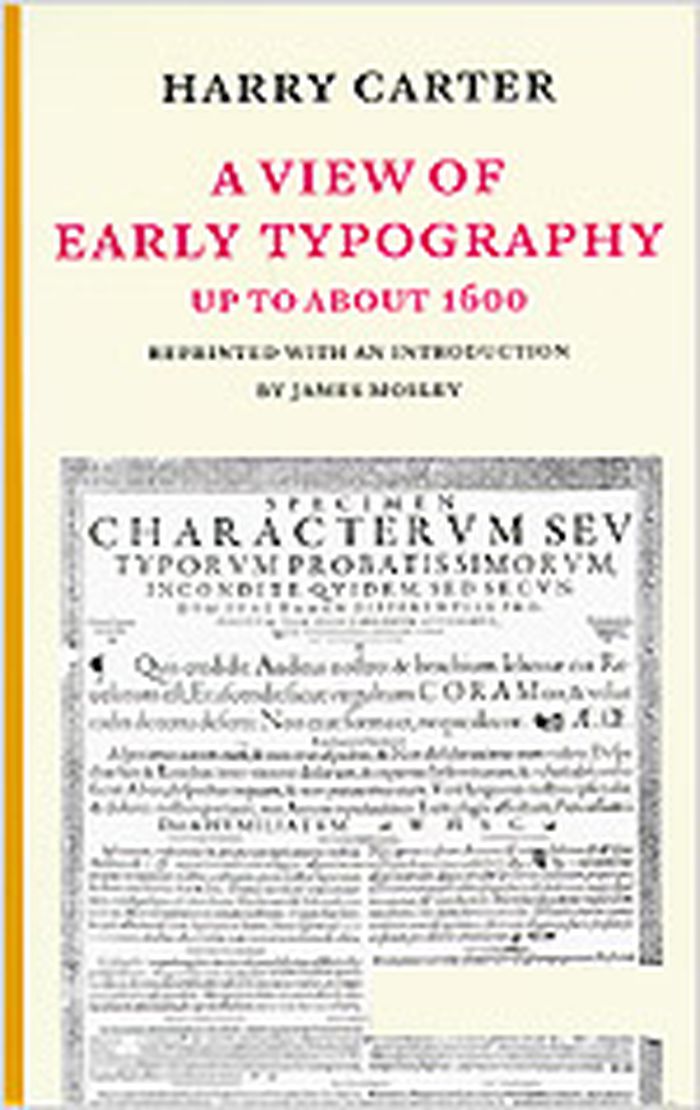
First published by Oxford University Press in 1969, "A view of early typography" has long been out of print. It is a wonderful summary of what can be known about the production and use of type in the first 150 years of printing. By focusing on type, Carter goes to the heart of the matter: this is the point at which the material processes of printing meet the intellectual concerns of the publishers and the nature of the texts that they published. Among the topics covered are the technicalities of type production, and the passage from craft to industrial manufacture; the diversity of letterforms (blackletter, roman, italic, and more); the tensions between Latin and the vernacular languages; the establishment of standards and norms in type design. Carter ranges widely and deftly over the field of European printing in the period 1450—1600, drawing principally on his own long experience of the materials surviving from that time in libraries and archives. The argument is illustrated with a large gathering of pictures, mainly of details from books, freshly taken for this purpose. This is a photo-reprint of the first edition, augmented by a new introduction in which James Mosley explains the significance of the book and gives a short account a Carter’s life and work.
A view of early typography up to about 1600
Actions:
Price:
$54.00
(available to order)
Summary:
First published by Oxford University Press in 1969, "A view of early typography" has long been out of print. It is a wonderful summary of what can be known about the production and use of type in the first 150 years of printing. By focusing on type, Carter goes to the heart of the matter: this is the point at which the material processes of printing meet the intellectual concerns of the publishers and the nature of the texts that they published. Among the topics covered are the technicalities of type production, and the passage from craft to industrial manufacture; the diversity of letterforms (blackletter, roman, italic, and more); the tensions between Latin and the vernacular languages; the establishment of standards and norms in type design. Carter ranges widely and deftly over the field of European printing in the period 1450—1600, drawing principally on his own long experience of the materials surviving from that time in libraries and archives. The argument is illustrated with a large gathering of pictures, mainly of details from books, freshly taken for this purpose. This is a photo-reprint of the first edition, augmented by a new introduction in which James Mosley explains the significance of the book and gives a short account a Carter’s life and work.
Form:
books
books
Publication:
August 2002, London
August 2002, London
Subject:
Graphic Design and Typography
Graphic Design and Typography
Form:
books
books
Title:
Proto-Habitat
Proto-Habitat
Actions:
Price:
$52.00
(available in store)
Summary:
Proto-Habitat is a name composed of the prefix proto-, which comes from the ancient Greek protos, meaning "the first", but also its inscription in a series of events of which it is the trigger. Proto-Habitat evokes a return to basics, where "living" resonates in harmony with nature and awakens to the idea of ??human communities in which the social pact is characterized by(...)
$52.00
(available in store)
Summary:
Proto-Habitat is a name composed of the prefix proto-, which comes from the ancient Greek protos, meaning "the first", but also its inscription in a series of events of which it is the trigger. Proto-Habitat evokes a return to basics, where "living" resonates in harmony with nature and awakens to the idea of ??human communities in which the social pact is characterized by(...)
Title:
Proto-Habitat
Actions:
Price:
$52.00
(available in store)
Summary:
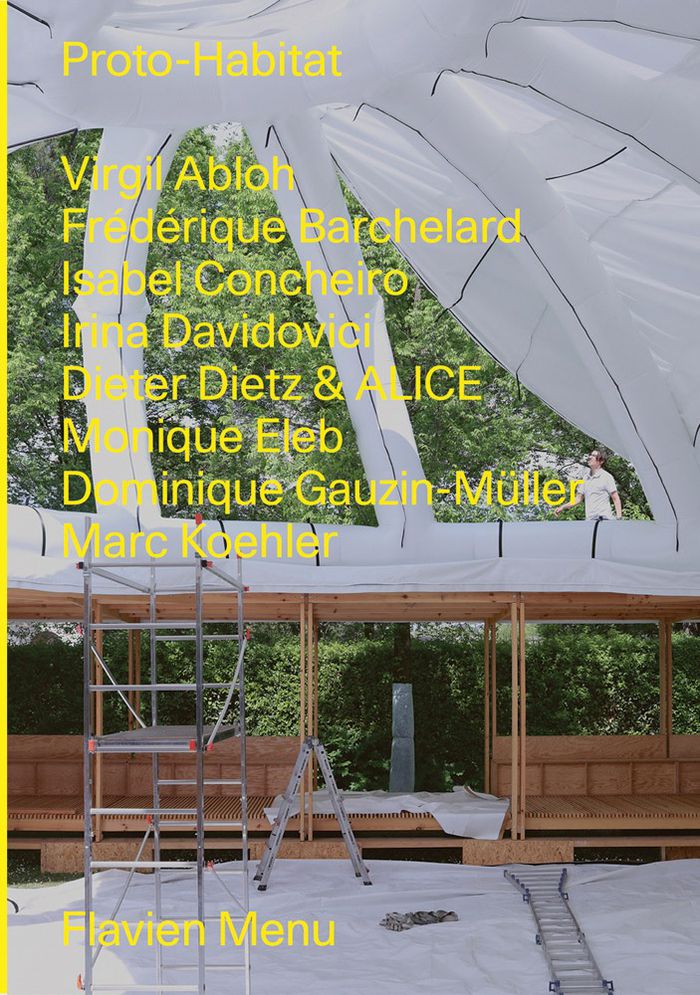
Proto-Habitat is a name composed of the prefix proto-, which comes from the ancient Greek protos, meaning "the first", but also its inscription in a series of events of which it is the trigger. Proto-Habitat evokes a return to basics, where "living" resonates in harmony with nature and awakens to the idea of ??human communities in which the social pact is characterized by diversity, solidarity and the common good. The book "Proto-Habitat" retraces a reflection combining interviews, visits, paintings, objects, images and architecture exploring the imagination of our ways of existing as well as their means of production. This reflection gave rise to and participated in several exhibitions: Fabricating differently: from the prototype to inhabiting it at the Arc en Rêve architecture center, Tiny Lives at the Collection. Lambert and Home Made at CID Grand Hornu. The Proto-Habitat was installed in Bordeaux, in Chamonix for the Artocène festival and Clermont-Ferrand as part of the candidacy for European Capital of Culture 2028. In the meantime two other demonstrator prototypes were built, assembled then dismantled: the protoCAMPO - an events venue for 300 people in the Gardens of the Villa Medici in Rome - and the SOLARproto - an autonomous water and electricity exhibition space on a polder in the Netherlands.
Proto-Habitat
Actions:
Price:
$52.00
(available in store)
Summary:
Proto-Habitat is a name composed of the prefix proto-, which comes from the ancient Greek protos, meaning "the first", but also its inscription in a series of events of which it is the trigger. Proto-Habitat evokes a return to basics, where "living" resonates in harmony with nature and awakens to the idea of ??human communities in which the social pact is characterized by diversity, solidarity and the common good. The book "Proto-Habitat" retraces a reflection combining interviews, visits, paintings, objects, images and architecture exploring the imagination of our ways of existing as well as their means of production. This reflection gave rise to and participated in several exhibitions: Fabricating differently: from the prototype to inhabiting it at the Arc en Rêve architecture center, Tiny Lives at the Collection. Lambert and Home Made at CID Grand Hornu. The Proto-Habitat was installed in Bordeaux, in Chamonix for the Artocène festival and Clermont-Ferrand as part of the candidacy for European Capital of Culture 2028. In the meantime two other demonstrator prototypes were built, assembled then dismantled: the protoCAMPO - an events venue for 300 people in the Gardens of the Villa Medici in Rome - and the SOLARproto - an autonomous water and electricity exhibition space on a polder in the Netherlands.
Form:
books
books
Publication:
November 2023
November 2023
Subject:
Experimentale architecture
Experimentale architecture
Form:
books
books
Price:
$74.00
(available in store)
Summary:
Created between 1787 and 1823 by George IV, the ''Royal Pavilion in Brighton'' is perhaps the most daring and enchanting example of a building that expresses the European fascination with what in the early nineteenth century was considered the “Orient,” in particular China and India. The building, with its Indian-inspired exterior, was the work of the renowned architect(...)
$74.00
(available in store)
Summary:
Created between 1787 and 1823 by George IV, the ''Royal Pavilion in Brighton'' is perhaps the most daring and enchanting example of a building that expresses the European fascination with what in the early nineteenth century was considered the “Orient,” in particular China and India. The building, with its Indian-inspired exterior, was the work of the renowned architect(...)
Title:
The Royal Pavilion, Brighton: A Regency palace of colour and sensation
Actions:
Price:
$74.00
(available in store)
Summary:
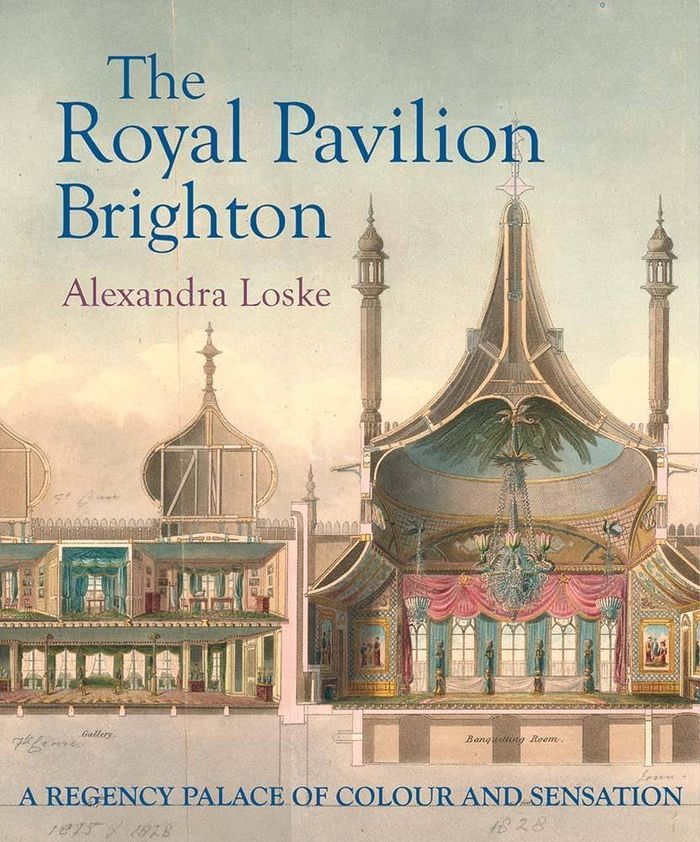
Created between 1787 and 1823 by George IV, the ''Royal Pavilion in Brighton'' is perhaps the most daring and enchanting example of a building that expresses the European fascination with what in the early nineteenth century was considered the “Orient,” in particular China and India. The building, with its Indian-inspired exterior, was the work of the renowned architect John Nash, who with the contributions of several other gifted and inventive architects, artists, and designers, created a building that draws you in, takes you on a journey, and plays with your senses. Featuring new photography, this lavishly illustrated book will provide a fresh look at the sumptuous Chinoiserie interiors of the Royal Pavilion and their enduring appeal. Drawing on recent research, conservation projects, and the unprecedented loan exhibition A Prince’s Treasure: From Buckingham Palace to the Royal Pavilion (2019–22), this book celebrates the colours and sensual beauty of these interiors while situating the Royal Pavilion in the context of the time of its creation and development under royal ownership, from its beginning in the wake of the French Revolution, through its transformation and extension during and just after the Napoleonic Wars, to its fate and legacy in the early Victorian era.
The Royal Pavilion, Brighton: A Regency palace of colour and sensation
Actions:
Price:
$74.00
(available in store)
Summary:
Created between 1787 and 1823 by George IV, the ''Royal Pavilion in Brighton'' is perhaps the most daring and enchanting example of a building that expresses the European fascination with what in the early nineteenth century was considered the “Orient,” in particular China and India. The building, with its Indian-inspired exterior, was the work of the renowned architect John Nash, who with the contributions of several other gifted and inventive architects, artists, and designers, created a building that draws you in, takes you on a journey, and plays with your senses. Featuring new photography, this lavishly illustrated book will provide a fresh look at the sumptuous Chinoiserie interiors of the Royal Pavilion and their enduring appeal. Drawing on recent research, conservation projects, and the unprecedented loan exhibition A Prince’s Treasure: From Buckingham Palace to the Royal Pavilion (2019–22), this book celebrates the colours and sensual beauty of these interiors while situating the Royal Pavilion in the context of the time of its creation and development under royal ownership, from its beginning in the wake of the French Revolution, through its transformation and extension during and just after the Napoleonic Wars, to its fate and legacy in the early Victorian era.
Form:
books
books
Publication:
July 2025
July 2025
Subject:
History until 1900, Great Britain
History until 1900, Great Britain
Form:
books
books
Price:
$39.95
(available to order)
Summary:
The five physical senses of seeing, hearing, smelling, tasting and touching have been held to underpin the complexity of human experience ever since Aristotle first theorised about how they worked. Classical and scholastic philosophy up to the time of the European Enlightenment relegated their operations to its margins, viewing them as at best a distraction from higher(...)
$39.95
(available to order)
Summary:
The five physical senses of seeing, hearing, smelling, tasting and touching have been held to underpin the complexity of human experience ever since Aristotle first theorised about how they worked. Classical and scholastic philosophy up to the time of the European Enlightenment relegated their operations to its margins, viewing them as at best a distraction from higher(...)
Title:
In the realm of the senses: a materialist theory of seeing and feeling
Actions:
Price:
$39.95
(available to order)
Summary:
The five physical senses of seeing, hearing, smelling, tasting and touching have been held to underpin the complexity of human experience ever since Aristotle first theorised about how they worked. Classical and scholastic philosophy up to the time of the European Enlightenment relegated their operations to its margins, viewing them as at best a distraction from higher thinking, and at worst a positive deception. Paradoxically, what one could not objectively know, the products of the mind, were accorded precedence over the concrete. From the Romantic era onwards, the senses moved to the centre of speculative thought, and the various dialectical currents of philosophy after Hegel made them interdependent with the intellectual function, which was held to derive most or all of its authority from them. This tendency has continued down to the sensualist, hedonist and anti-intellectual currents of our own day. In this theoretical consideration of what has been done to the senses in modern experience, Stuart Walton subjects the life of the senses to a further materialist turn, one that refuses a spiritualisation of the material realm, to which contemporary discourses of the body have often fallen prey, while at the same time preserving sensuality from being delivered once again to a sterile idealism.
In the realm of the senses: a materialist theory of seeing and feeling
Actions:
Price:
$39.95
(available to order)
Summary:
The five physical senses of seeing, hearing, smelling, tasting and touching have been held to underpin the complexity of human experience ever since Aristotle first theorised about how they worked. Classical and scholastic philosophy up to the time of the European Enlightenment relegated their operations to its margins, viewing them as at best a distraction from higher thinking, and at worst a positive deception. Paradoxically, what one could not objectively know, the products of the mind, were accorded precedence over the concrete. From the Romantic era onwards, the senses moved to the centre of speculative thought, and the various dialectical currents of philosophy after Hegel made them interdependent with the intellectual function, which was held to derive most or all of its authority from them. This tendency has continued down to the sensualist, hedonist and anti-intellectual currents of our own day. In this theoretical consideration of what has been done to the senses in modern experience, Stuart Walton subjects the life of the senses to a further materialist turn, one that refuses a spiritualisation of the material realm, to which contemporary discourses of the body have often fallen prey, while at the same time preserving sensuality from being delivered once again to a sterile idealism.
Form:
books
books
Publication:
March 2016
March 2016
Subject:
Critical Theory
Critical Theory


