


36051 Results
Form:
books
books

Price:
$51.95
(available in store)
Summary:
British architect Tony fretton (b. 1945) is internationally recognized for both his critical writing about architecture and his building and design projects. His first major building project was the Lisson Gallery in London in 1990, and his most recent are two apartment towers in Antwerp Harbor and the City Hall in Deinze, Belgium. from 1999 to 2013, fretton was a(...)
$51.95
(available in store)
Summary:
British architect Tony fretton (b. 1945) is internationally recognized for both his critical writing about architecture and his building and design projects. His first major building project was the Lisson Gallery in London in 1990, and his most recent are two apartment towers in Antwerp Harbor and the City Hall in Deinze, Belgium. from 1999 to 2013, fretton was a(...)
Subject:
Architecture Monographs
Architecture Monographs
Publication:
May 2018
May 2018
Title:
A E I OU: articles, essays, interviews and out-takes by Tony Fretton
Actions:
Price:
$51.95
(available in store)
Summary:
British architect Tony fretton (b. 1945) is internationally recognized for both his critical writing about architecture and his building and design projects. His first major building project was the Lisson Gallery in London in 1990, and his most recent are two apartment towers in Antwerp Harbor and the City Hall in Deinze, Belgium. from 1999 to 2013, fretton was a professor and chair of Architecture and Interiors at Delft University of Technology, the netherlands. He was also visiting professor at Harvard Graduate School of Design from 2005 to 2006. "A E I OU: Articles, Essays, Interviews and Out-takes" is his new collection of writing from 1986 to 2017.
A E I OU: articles, essays, interviews and out-takes by Tony Fretton
Actions:
Price:
$51.95
(available in store)
Summary:
British architect Tony fretton (b. 1945) is internationally recognized for both his critical writing about architecture and his building and design projects. His first major building project was the Lisson Gallery in London in 1990, and his most recent are two apartment towers in Antwerp Harbor and the City Hall in Deinze, Belgium. from 1999 to 2013, fretton was a professor and chair of Architecture and Interiors at Delft University of Technology, the netherlands. He was also visiting professor at Harvard Graduate School of Design from 2005 to 2006. "A E I OU: Articles, Essays, Interviews and Out-takes" is his new collection of writing from 1986 to 2017.
Form:
books
books
Publication:
May 2018
May 2018
Subject:
Architecture Monographs
Architecture Monographs
Form:
books
books

Actions:
Price:
$80.00
(available to order)
Summary:
"Sleeping by the Mississippi" by Alec Soth is one of the defining publications in the photobook era. First published by Steidl in 2004, it was Soth’s first book, sold through three editions, and established him as one of the leading lights of contemporary photographic practice. This MACK edition launches to coincide with the first exhibition in London dedicated to the(...)
$80.00
(available to order)
Summary:
"Sleeping by the Mississippi" by Alec Soth is one of the defining publications in the photobook era. First published by Steidl in 2004, it was Soth’s first book, sold through three editions, and established him as one of the leading lights of contemporary photographic practice. This MACK edition launches to coincide with the first exhibition in London dedicated to the(...)
Title:
Alec Soth : sleeping by the Mississippi
Actions:
Price:
$80.00
(available to order)
Summary:
"Sleeping by the Mississippi" by Alec Soth is one of the defining publications in the photobook era. First published by Steidl in 2004, it was Soth’s first book, sold through three editions, and established him as one of the leading lights of contemporary photographic practice. This MACK edition launches to coincide with the first exhibition in London dedicated to the series at Beetles+Huxley gallery, and includes two new photographs that were not included in the previous versions of the book. Evolving from a series of road trips along the Mississippi River, "Sleeping by the Mississippi" captures America’s iconic yet oft-neglected ‘third coast’. Soth’s richly descriptive, large-format colour photographs present an eclectic mix of individuals, landscapes, and interiors. Sensuous in detail and raw in subject, Sleeping by the Mississippi elicits a consistent mood of loneliness, longing, and reverie. ‘In the book’s 46 ruthlessly edited pictures’, writes Anne Wilkes Tucker in the original essay published in the book, ‘Soth alludes to illness, procreation, race, crime, learning, art, music, death, religion, redemption, politics, and cheap sex.’ Like Robert Frank’s classic "The Americans", "Sleeping by the Mississippi" merges a documentary style with poetic sensibility. The Mississippi is less the subject of the book than its organizing structure. Not bound by a rigid concept or ideology, the series is created out of a quintessentially American spirit of wanderlust. Thirteen years since the book was first published, the artist’s lyrical view has undoubtedly acquired a nuanced significance – one in which hope, fear, desire and regret coalesce in the evocative journey along this mythic river.
Alec Soth : sleeping by the Mississippi
Actions:
Price:
$80.00
(available to order)
Summary:
"Sleeping by the Mississippi" by Alec Soth is one of the defining publications in the photobook era. First published by Steidl in 2004, it was Soth’s first book, sold through three editions, and established him as one of the leading lights of contemporary photographic practice. This MACK edition launches to coincide with the first exhibition in London dedicated to the series at Beetles+Huxley gallery, and includes two new photographs that were not included in the previous versions of the book. Evolving from a series of road trips along the Mississippi River, "Sleeping by the Mississippi" captures America’s iconic yet oft-neglected ‘third coast’. Soth’s richly descriptive, large-format colour photographs present an eclectic mix of individuals, landscapes, and interiors. Sensuous in detail and raw in subject, Sleeping by the Mississippi elicits a consistent mood of loneliness, longing, and reverie. ‘In the book’s 46 ruthlessly edited pictures’, writes Anne Wilkes Tucker in the original essay published in the book, ‘Soth alludes to illness, procreation, race, crime, learning, art, music, death, religion, redemption, politics, and cheap sex.’ Like Robert Frank’s classic "The Americans", "Sleeping by the Mississippi" merges a documentary style with poetic sensibility. The Mississippi is less the subject of the book than its organizing structure. Not bound by a rigid concept or ideology, the series is created out of a quintessentially American spirit of wanderlust. Thirteen years since the book was first published, the artist’s lyrical view has undoubtedly acquired a nuanced significance – one in which hope, fear, desire and regret coalesce in the evocative journey along this mythic river.
Form:
books
books
Publication:
September 2017
September 2017
Subject:
Photography monographs
Photography monographs
Form:
books
books

Title:
Muriel Cooper
Muriel Cooper
Actions:
Price:
$76.50
(available to order)
Summary:
Muriel Cooper (1925–1994) was the pioneering designer who created the MIT Press colophon (or logo)—seven bars that represent the lowercase letters “mitp” as abstracted books on a shelf. She designed a modernist monument, the encyclopedic volume The Bauhaus (1969), and the controversial first edition of Learning from Las Vegas (1972). She used an offset press as an(...)
$76.50
(available to order)
Summary:
Muriel Cooper (1925–1994) was the pioneering designer who created the MIT Press colophon (or logo)—seven bars that represent the lowercase letters “mitp” as abstracted books on a shelf. She designed a modernist monument, the encyclopedic volume The Bauhaus (1969), and the controversial first edition of Learning from Las Vegas (1972). She used an offset press as an(...)
Subject:
Graphic Designers, Monographs
Graphic Designers, Monographs
Publication:
September 2017
September 2017
Title:
Muriel Cooper
Actions:
Price:
$76.50
(available to order)
Summary:
Muriel Cooper (1925–1994) was the pioneering designer who created the MIT Press colophon (or logo)—seven bars that represent the lowercase letters “mitp” as abstracted books on a shelf. She designed a modernist monument, the encyclopedic volume The Bauhaus (1969), and the controversial first edition of Learning from Las Vegas (1972). She used an offset press as an artistic tool, worked with a large-format Polaroid camera, and had an early vision of e-books. Cooper began her four-decade career at MIT by designing printed flyers for the Office of Publications; her final projects were digital. This illustrated volume documents Cooper’s career in abundant detail, with prints, sketches, book covers, posters, mechanicals, student projects, and photographs, from her work in design, teaching, and research at MIT.
Muriel Cooper
Actions:
Price:
$76.50
(available to order)
Summary:
Muriel Cooper (1925–1994) was the pioneering designer who created the MIT Press colophon (or logo)—seven bars that represent the lowercase letters “mitp” as abstracted books on a shelf. She designed a modernist monument, the encyclopedic volume The Bauhaus (1969), and the controversial first edition of Learning from Las Vegas (1972). She used an offset press as an artistic tool, worked with a large-format Polaroid camera, and had an early vision of e-books. Cooper began her four-decade career at MIT by designing printed flyers for the Office of Publications; her final projects were digital. This illustrated volume documents Cooper’s career in abundant detail, with prints, sketches, book covers, posters, mechanicals, student projects, and photographs, from her work in design, teaching, and research at MIT.
Form:
books
books
Publication:
September 2017
September 2017
Subject:
Graphic Designers, Monographs
Graphic Designers, Monographs
Form:
books
books
Actions:
Price:
$131.00
(available in store)
Summary:
Upon its publication by the MIT Press in 1972, "Learning from Las Vegas" was immediately influential and controversial. The authors made an argument that was revolutionary for its time—that the billboards and casinos of Las Vegas were worthy of architectural attention—and offered a challenge for contemporary architects obsessed with the heroic and monumental. The physical(...)
$131.00
(available in store)
Summary:
Upon its publication by the MIT Press in 1972, "Learning from Las Vegas" was immediately influential and controversial. The authors made an argument that was revolutionary for its time—that the billboards and casinos of Las Vegas were worthy of architectural attention—and offered a challenge for contemporary architects obsessed with the heroic and monumental. The physical(...)
Subject:
Architectural Theory
Architectural Theory
Publication:
September 2017
September 2017
Title:
Learning from Las Vegas, facsimile edition
Actions:
Price:
$131.00
(available in store)
Summary:
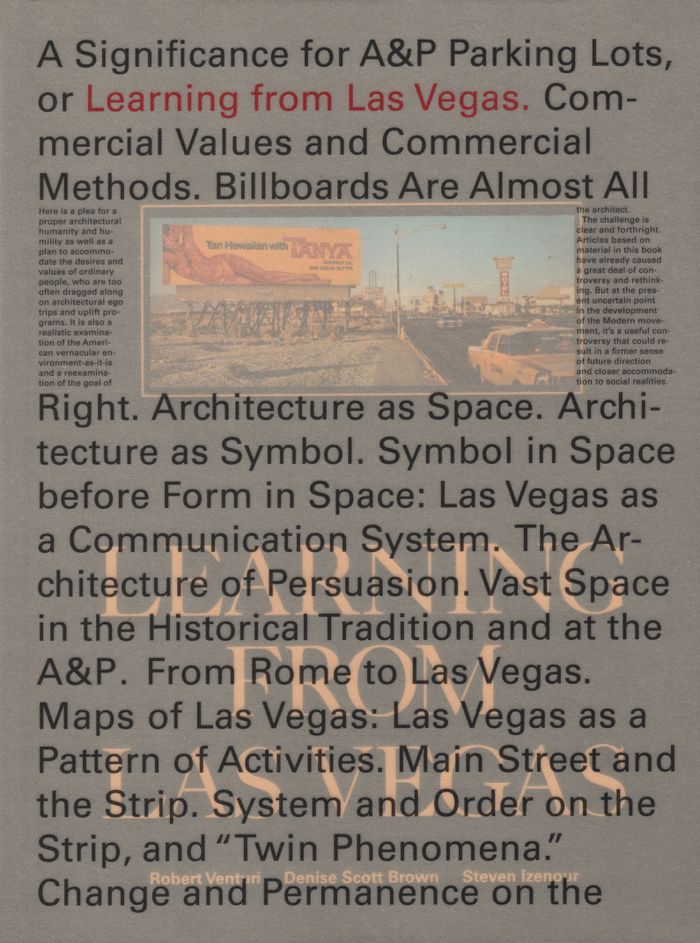
Upon its publication by the MIT Press in 1972, "Learning from Las Vegas" was immediately influential and controversial. The authors made an argument that was revolutionary for its time—that the billboards and casinos of Las Vegas were worthy of architectural attention—and offered a challenge for contemporary architects obsessed with the heroic and monumental. The physical book itself, designed by MIT’s iconic designer Muriel Cooper, was hailed as a masterpiece of modernist design, but the book’s design struck the authors as too monumental for a text that praised the ugly and ordinary over the heroic and monumental. The MIT Press published a revised version in 1977—a modest paperback that the authors felt was more in keeping with the argument of the book—and the original Cooper-designed book fell out of print and became a highly sought-after collectors’ item; it now sells for thousands of dollars in the rare book market, while the author-redesigned paperback has remained continuously in print at a price affordable to students. Now, decades after the original hardcover edition sold out, the MIT Press is publishing a facsimile edition of the original large-format Cooper-designed edition of Learning from Las Vegas, complete with translucent glassine wrap. This edition also features a spirited preface by Denise Scott Brown, looking back on the creation of the book and explaining her and Robert Venturi’s reservations about the original design.
Learning from Las Vegas, facsimile edition
Actions:
Price:
$131.00
(available in store)
Summary:
Upon its publication by the MIT Press in 1972, "Learning from Las Vegas" was immediately influential and controversial. The authors made an argument that was revolutionary for its time—that the billboards and casinos of Las Vegas were worthy of architectural attention—and offered a challenge for contemporary architects obsessed with the heroic and monumental. The physical book itself, designed by MIT’s iconic designer Muriel Cooper, was hailed as a masterpiece of modernist design, but the book’s design struck the authors as too monumental for a text that praised the ugly and ordinary over the heroic and monumental. The MIT Press published a revised version in 1977—a modest paperback that the authors felt was more in keeping with the argument of the book—and the original Cooper-designed book fell out of print and became a highly sought-after collectors’ item; it now sells for thousands of dollars in the rare book market, while the author-redesigned paperback has remained continuously in print at a price affordable to students. Now, decades after the original hardcover edition sold out, the MIT Press is publishing a facsimile edition of the original large-format Cooper-designed edition of Learning from Las Vegas, complete with translucent glassine wrap. This edition also features a spirited preface by Denise Scott Brown, looking back on the creation of the book and explaining her and Robert Venturi’s reservations about the original design.
Form:
books
books
Publication:
September 2017
September 2017
Subject:
Architectural Theory
Architectural Theory
Form:
books
books

Price:
$23.00
(available to order)
Summary:
On a visit to Auschwitz-Birkenau, Georges Didi-Huberman tears three pieces of bark from birch trees on the edge of the site. Looking at these pieces after his return home, he sees them as letters, a flood, a path, time, memory, flesh. The bark serves as a springboard to Didi-Huberman’s meditations on his visit, recorded in this spare, poetic, and powerful book. Bark is a(...)
$23.00
(available to order)
Summary:
On a visit to Auschwitz-Birkenau, Georges Didi-Huberman tears three pieces of bark from birch trees on the edge of the site. Looking at these pieces after his return home, he sees them as letters, a flood, a path, time, memory, flesh. The bark serves as a springboard to Didi-Huberman’s meditations on his visit, recorded in this spare, poetic, and powerful book. Bark is a(...)
Title:
Bark
Actions:
Price:
$23.00
(available to order)
Summary:
On a visit to Auschwitz-Birkenau, Georges Didi-Huberman tears three pieces of bark from birch trees on the edge of the site. Looking at these pieces after his return home, he sees them as letters, a flood, a path, time, memory, flesh. The bark serves as a springboard to Didi-Huberman’s meditations on his visit, recorded in this spare, poetic, and powerful book. Bark is a personal account, drawing not on the theoretical apparatus of scholarship but on Didi-Huberman’s own history, memory, and knowledge. The text proceeds as a series of reflections, accompanied by Didi-Huberman’s photographs of the visit. The photographs are not meant to be art—Didi-Huberman confesses that he “photographed practically everything without looking”—but approach it nevertheless. Didi-Huberman tells us that his grandparents died at Auschwitz, but his account is more universal than biographical. As he walks from place to place, he observes that in German birches are birken; Birkenau designates the meadow where the birches grow. Didi-Huberman sees and photographs the “reconstructed” execution wall; the floors of the crematorium, forgotten witnesses to killing; and the birch trees, lovely but also resembling prison bars. Taking his own photographs, he thinks of the famous photographs taken in 1944 by a member of the Sonderkommando, the only photographic documentation of the camp before the Germans destroyed it, hoping to hide the evidence of their crimes. Didi-Huberman notices a “bizarre proliferation of white flowers on the exact spot of the cremation pits.” The dead are not departed.
Bark
Actions:
Price:
$23.00
(available to order)
Summary:
On a visit to Auschwitz-Birkenau, Georges Didi-Huberman tears three pieces of bark from birch trees on the edge of the site. Looking at these pieces after his return home, he sees them as letters, a flood, a path, time, memory, flesh. The bark serves as a springboard to Didi-Huberman’s meditations on his visit, recorded in this spare, poetic, and powerful book. Bark is a personal account, drawing not on the theoretical apparatus of scholarship but on Didi-Huberman’s own history, memory, and knowledge. The text proceeds as a series of reflections, accompanied by Didi-Huberman’s photographs of the visit. The photographs are not meant to be art—Didi-Huberman confesses that he “photographed practically everything without looking”—but approach it nevertheless. Didi-Huberman tells us that his grandparents died at Auschwitz, but his account is more universal than biographical. As he walks from place to place, he observes that in German birches are birken; Birkenau designates the meadow where the birches grow. Didi-Huberman sees and photographs the “reconstructed” execution wall; the floors of the crematorium, forgotten witnesses to killing; and the birch trees, lovely but also resembling prison bars. Taking his own photographs, he thinks of the famous photographs taken in 1944 by a member of the Sonderkommando, the only photographic documentation of the camp before the Germans destroyed it, hoping to hide the evidence of their crimes. Didi-Huberman notices a “bizarre proliferation of white flowers on the exact spot of the cremation pits.” The dead are not departed.
Form:
books
books
Publication:
October 2017
October 2017
Subject:
Critical Theory
Critical Theory
Form:
books
books
Title:
The future
The future
Actions:
Price:
$21.95
(available to order)
Summary:
The future is like an unwritten book. It is not something we see in a crystal ball, or can only hope to predict, like the weather. In this volume of the MIT Press's Essential Knowledge series, Nick Montfort argues that the future is something to be made, not predicted. Montfort offers what he considers essential knowledge about the future, as seen in the work of writers,(...)
$21.95
(available to order)
Summary:
The future is like an unwritten book. It is not something we see in a crystal ball, or can only hope to predict, like the weather. In this volume of the MIT Press's Essential Knowledge series, Nick Montfort argues that the future is something to be made, not predicted. Montfort offers what he considers essential knowledge about the future, as seen in the work of writers,(...)
Title:
The future
Actions:
Price:
$21.95
(available to order)
Summary:
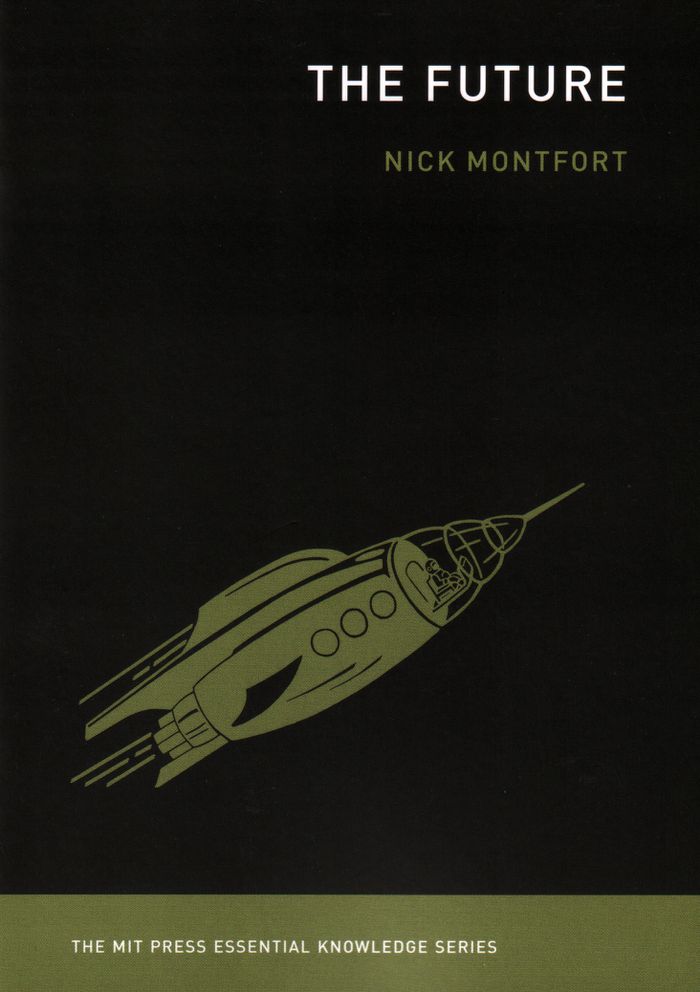
The future is like an unwritten book. It is not something we see in a crystal ball, or can only hope to predict, like the weather. In this volume of the MIT Press's Essential Knowledge series, Nick Montfort argues that the future is something to be made, not predicted. Montfort offers what he considers essential knowledge about the future, as seen in the work of writers, artists, inventors, and designers (mainly in Western culture) who developed and described the core components of the futures they envisioned. Montfort's approach is not that of futurology or scenario planning; instead, he reports on the work of making the future -- the thinkers who devoted themselves to writing pages in the unwritten book.
The future
Actions:
Price:
$21.95
(available to order)
Summary:
The future is like an unwritten book. It is not something we see in a crystal ball, or can only hope to predict, like the weather. In this volume of the MIT Press's Essential Knowledge series, Nick Montfort argues that the future is something to be made, not predicted. Montfort offers what he considers essential knowledge about the future, as seen in the work of writers, artists, inventors, and designers (mainly in Western culture) who developed and described the core components of the futures they envisioned. Montfort's approach is not that of futurology or scenario planning; instead, he reports on the work of making the future -- the thinkers who devoted themselves to writing pages in the unwritten book.
Form:
books
books
Publication:
December 2017
December 2017
Subject:
Architectural Theory
Architectural Theory
Form:
books
books
Actions:
Price:
$46.95
(available to order)
Summary:
In Architectural Intelligence, Molly Wright Steenson explores the work of four architects in the 1960s and 1970s who incorporated elements of interactivity into their work. Christopher Alexander, Richard Saul Wurman, Cedric Price, and Nicholas Negroponte and the MIT Architecture Machine Group all incorporated technologies—including cybernetics and artificial(...)
$46.95
(available to order)
Summary:
In Architectural Intelligence, Molly Wright Steenson explores the work of four architects in the 1960s and 1970s who incorporated elements of interactivity into their work. Christopher Alexander, Richard Saul Wurman, Cedric Price, and Nicholas Negroponte and the MIT Architecture Machine Group all incorporated technologies—including cybernetics and artificial(...)
Publication:
December 2017
December 2017
Title:
Architectural intelligence: how designers and architects created the digital landscape
Actions:
Price:
$46.95
(available to order)
Summary:
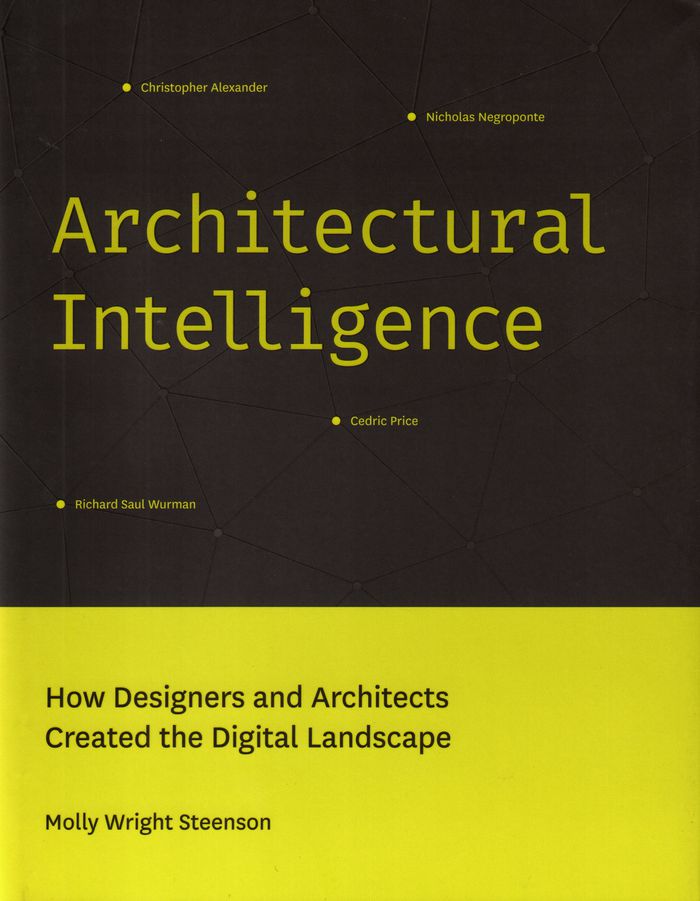
In Architectural Intelligence, Molly Wright Steenson explores the work of four architects in the 1960s and 1970s who incorporated elements of interactivity into their work. Christopher Alexander, Richard Saul Wurman, Cedric Price, and Nicholas Negroponte and the MIT Architecture Machine Group all incorporated technologies—including cybernetics and artificial intelligence—into their work and influenced digital design practices from the late 1980s to the present day.
Architectural intelligence: how designers and architects created the digital landscape
Actions:
Price:
$46.95
(available to order)
Summary:
In Architectural Intelligence, Molly Wright Steenson explores the work of four architects in the 1960s and 1970s who incorporated elements of interactivity into their work. Christopher Alexander, Richard Saul Wurman, Cedric Price, and Nicholas Negroponte and the MIT Architecture Machine Group all incorporated technologies—including cybernetics and artificial intelligence—into their work and influenced digital design practices from the late 1980s to the present day.
Form:
books
books
Publication:
December 2017
December 2017
Form:
books
books
Title:
The second digital turn
The second digital turn
Actions:
Price:
$33.95
(available to order)
Summary:
Almost a generation ago, the early software for computer aided design and manufacturing (CAD/CAM) spawned a style of smooth and curving lines and surfaces that gave visible form to the first digital age, and left an indelible mark on contemporary architecture. But today's digitally intelligent architecture no longer looks that way. In The Second Digital Turn, Mario Carpo(...)
$33.95
(available to order)
Summary:
Almost a generation ago, the early software for computer aided design and manufacturing (CAD/CAM) spawned a style of smooth and curving lines and surfaces that gave visible form to the first digital age, and left an indelible mark on contemporary architecture. But today's digitally intelligent architecture no longer looks that way. In The Second Digital Turn, Mario Carpo(...)
Title:
The second digital turn
Actions:
Price:
$33.95
(available to order)
Summary:
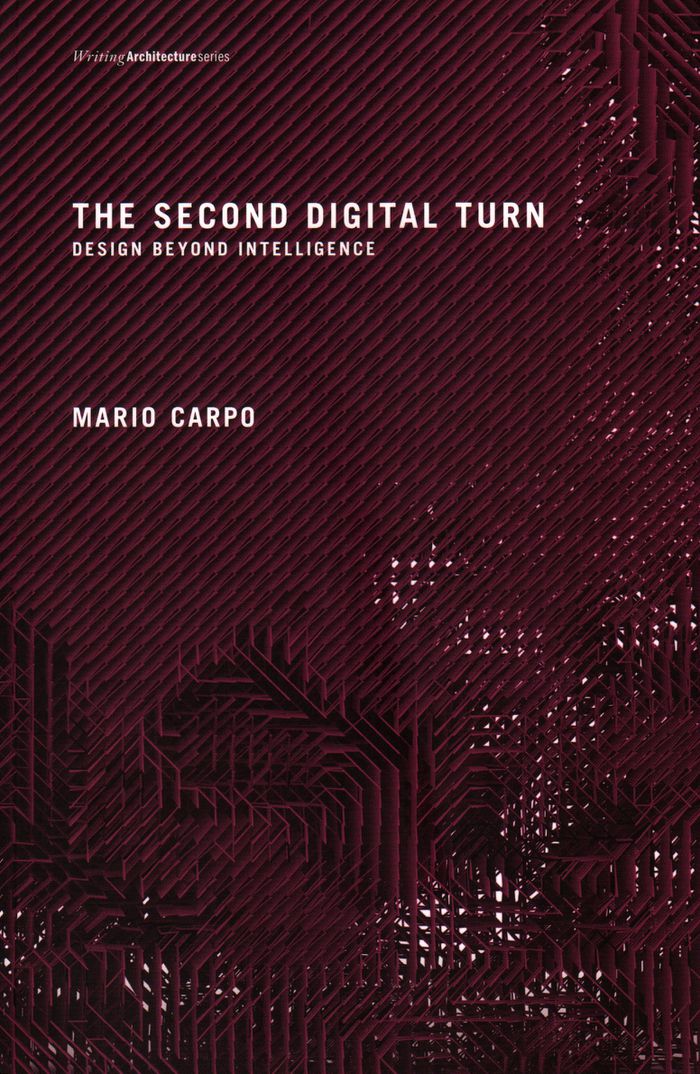
Almost a generation ago, the early software for computer aided design and manufacturing (CAD/CAM) spawned a style of smooth and curving lines and surfaces that gave visible form to the first digital age, and left an indelible mark on contemporary architecture. But today's digitally intelligent architecture no longer looks that way. In The Second Digital Turn, Mario Carpo explains that this is because the design professions are now coming to terms with a new kind of digital tools they have adopted—no longer tools for making but tools for thinking. In the early 1990s the design professions were the first to intuit and interpret the new technical logic of the digital age: digital mass-customization (the use of digital tools to mass-produce variations at no extra cost) has already changed the way we produce and consume almost everything, and the same technology applied to commerce at large is now heralding a new society without scale—a flat marginal cost society where bigger markets will not make anything cheaper. But today, the unprecedented power of computation also favors a new kind of science where prediction can be based on sheer information retrieval, and form finding by simulation and optimization can replace deduction from mathematical formulas. Designers have been toying with machine thinking and machine learning for some time, and the apparently unfathomable complexity of the physical shapes they are now creating already expresses a new form of artificial intelligence, outside the tradition of modern science and alien to the organic logic of our mind.
The second digital turn
Actions:
Price:
$33.95
(available to order)
Summary:
Almost a generation ago, the early software for computer aided design and manufacturing (CAD/CAM) spawned a style of smooth and curving lines and surfaces that gave visible form to the first digital age, and left an indelible mark on contemporary architecture. But today's digitally intelligent architecture no longer looks that way. In The Second Digital Turn, Mario Carpo explains that this is because the design professions are now coming to terms with a new kind of digital tools they have adopted—no longer tools for making but tools for thinking. In the early 1990s the design professions were the first to intuit and interpret the new technical logic of the digital age: digital mass-customization (the use of digital tools to mass-produce variations at no extra cost) has already changed the way we produce and consume almost everything, and the same technology applied to commerce at large is now heralding a new society without scale—a flat marginal cost society where bigger markets will not make anything cheaper. But today, the unprecedented power of computation also favors a new kind of science where prediction can be based on sheer information retrieval, and form finding by simulation and optimization can replace deduction from mathematical formulas. Designers have been toying with machine thinking and machine learning for some time, and the apparently unfathomable complexity of the physical shapes they are now creating already expresses a new form of artificial intelligence, outside the tradition of modern science and alien to the organic logic of our mind.
Form:
books
books
Publication:
October 2017
October 2017
Subject:
Digital Architecture
Digital Architecture
Form:
books
books
Actions:
Price:
$21.95
(available to order)
Summary:
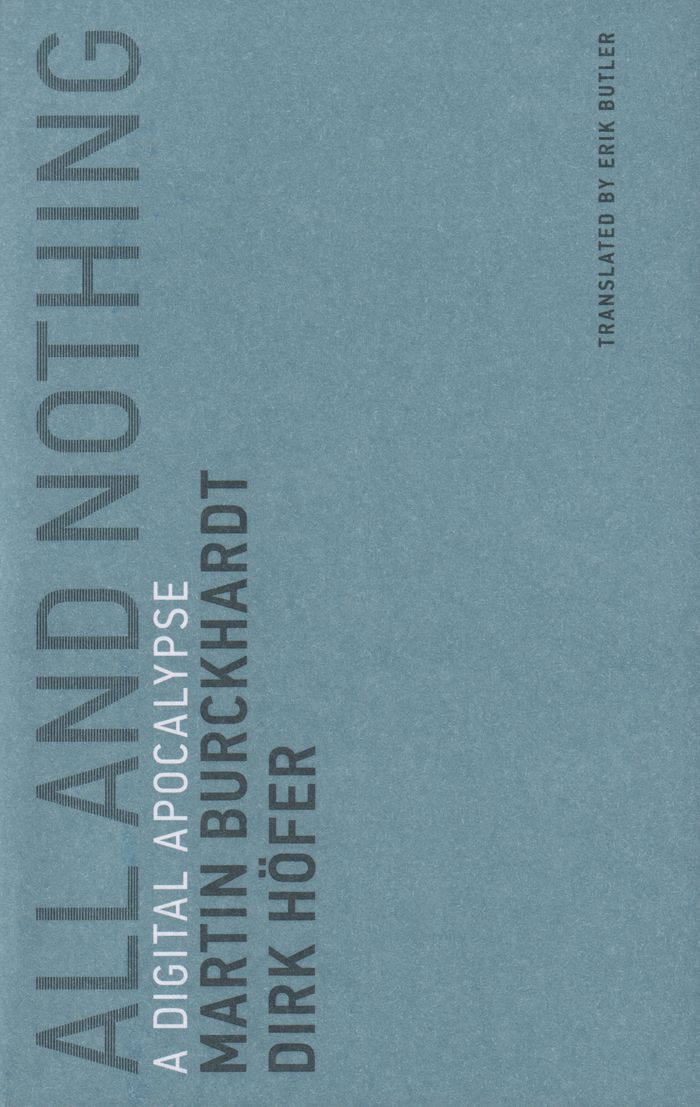
In 1854, the British mathematician George Boole presented the idea of a universe the elements of which could be understood in terms of the logic of absence and presence: 0 and 1, all and nothing—the foundation of binary code. The Boolean digits 0 and 1 do not designate a quantity. In the Boolean world, x times x always equals x; all and nothing meet in the formula x = xn.(...)
$21.95
(available to order)
Summary:
In 1854, the British mathematician George Boole presented the idea of a universe the elements of which could be understood in terms of the logic of absence and presence: 0 and 1, all and nothing—the foundation of binary code. The Boolean digits 0 and 1 do not designate a quantity. In the Boolean world, x times x always equals x; all and nothing meet in the formula x = xn.(...)
Title:
All and nothing : a digital apocalypse
Actions:
Price:
$21.95
(available to order)
Summary:
In 1854, the British mathematician George Boole presented the idea of a universe the elements of which could be understood in terms of the logic of absence and presence: 0 and 1, all and nothing—the foundation of binary code. The Boolean digits 0 and 1 do not designate a quantity. In the Boolean world, x times x always equals x; all and nothing meet in the formula x = xn. As everything becomes digitized, God the clockmaker is replaced by God the programmer. This book–described by its authors as “a theology for the digital world”—explores meaning in a digital age of infinite replication, in a world that has dissolved into information and achieved immortality by turning into a pure sign.
All and nothing : a digital apocalypse
Actions:
Price:
$21.95
(available to order)
Summary:
In 1854, the British mathematician George Boole presented the idea of a universe the elements of which could be understood in terms of the logic of absence and presence: 0 and 1, all and nothing—the foundation of binary code. The Boolean digits 0 and 1 do not designate a quantity. In the Boolean world, x times x always equals x; all and nothing meet in the formula x = xn. As everything becomes digitized, God the clockmaker is replaced by God the programmer. This book–described by its authors as “a theology for the digital world”—explores meaning in a digital age of infinite replication, in a world that has dissolved into information and achieved immortality by turning into a pure sign.
Form:
books
books
Publication:
September 2017
September 2017
Subject:
Digital Architecture
Digital Architecture
Form:
books
books

Actions:
Price:
$40.50
(available to order)
Summary:
The contributors investigate the discriminatory implementation of rules, with gentrified hipsters often receiving preferential treatment over traditional immigrants; food trucks as part of community economic development; and food trucks’ role in cultural identity formation. They describe, among other things, mobile food vending in Portland, Oregon, where relaxed(...)
$40.50
(available to order)
Summary:
The contributors investigate the discriminatory implementation of rules, with gentrified hipsters often receiving preferential treatment over traditional immigrants; food trucks as part of community economic development; and food trucks’ role in cultural identity formation. They describe, among other things, mobile food vending in Portland, Oregon, where relaxed(...)
Title:
Food trucks, cultural identity and social justice
Actions:
Price:
$40.50
(available to order)
Summary:
The contributors investigate the discriminatory implementation of rules, with gentrified hipsters often receiving preferential treatment over traditional immigrants; food trucks as part of community economic development; and food trucks’ role in cultural identity formation. They describe, among other things, mobile food vending in Portland, Oregon, where relaxed permitting encourages street food; the criminalization of food trucks by Los Angeles and New York City health codes; food as cultural currency in Montreal; social and spatial bifurcation of food trucks in Chicago and Durham, North Carolina; and food trucks as a part of Vancouver, Canada’s, self-branding as the “Greenest City.”
Food trucks, cultural identity and social justice
Actions:
Price:
$40.50
(available to order)
Summary:
The contributors investigate the discriminatory implementation of rules, with gentrified hipsters often receiving preferential treatment over traditional immigrants; food trucks as part of community economic development; and food trucks’ role in cultural identity formation. They describe, among other things, mobile food vending in Portland, Oregon, where relaxed permitting encourages street food; the criminalization of food trucks by Los Angeles and New York City health codes; food as cultural currency in Montreal; social and spatial bifurcation of food trucks in Chicago and Durham, North Carolina; and food trucks as a part of Vancouver, Canada’s, self-branding as the “Greenest City.”
Form:
books
books
Publication:
August 2017
August 2017
Subject:
Food
Food


