


1897 Results
Form:
books
books
Title:
Paul Rudolph : the late work
Paul Rudolph : the late work
Actions:
Price:
$62.00
(available to order)
Summary:
The light- and breeze-filled modern houses in Florida of the 1950s -- featured in Paul Rudolph: The Florida Houses -- and the hard-lined silhouette of Yale's Art and Architecture Building (1962) are the two images that come to mind when one thinks of Paul Rudolph. Yet few people know the work of the last decades of his life, from the 1970s through the 90s. Published here(...)
$62.00
(available to order)
Summary:
The light- and breeze-filled modern houses in Florida of the 1950s -- featured in Paul Rudolph: The Florida Houses -- and the hard-lined silhouette of Yale's Art and Architecture Building (1962) are the two images that come to mind when one thinks of Paul Rudolph. Yet few people know the work of the last decades of his life, from the 1970s through the 90s. Published here(...)
Title:
Paul Rudolph : the late work
Actions:
Price:
$62.00
(available to order)
Summary:
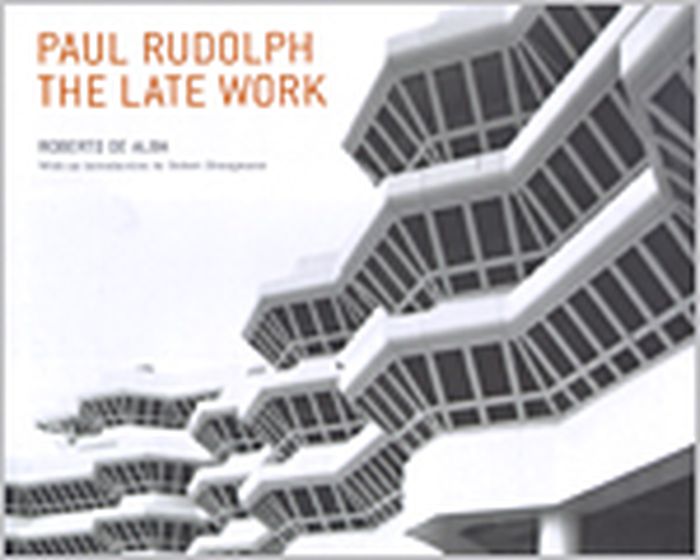
The light- and breeze-filled modern houses in Florida of the 1950s -- featured in Paul Rudolph: The Florida Houses -- and the hard-lined silhouette of Yale's Art and Architecture Building (1962) are the two images that come to mind when one thinks of Paul Rudolph. Yet few people know the work of the last decades of his life, from the 1970s through the 90s. Published here for the first time, Rudolph's final works are explored through his masterful pencil drawings, models, and photographs, as well as the last interview of his life with architect Peter Blake. In a book that considers these projects in the context of his early success, Roberto de Alba explores the architect's buildings designed from 1969 to 1996 and includes an astonishing variety of projects, many built, such as houses, towers, bungalows, chapels, corporate buildings, and urban plans of a monumental scale. All show the complicated interplay of space, light, and mass that are the trademarks of Rudolph's genius. Through de Alba's close contact with the architect before his death, Rudolph's own vision is conveyed in descriptive texts and accompanying images. Paul Rudolph: The Late Work is designed as a companion volume to The Florida Houses, and is the second in a planned three-volume set of the complete works of this legendary architect.
Paul Rudolph : the late work
Actions:
Price:
$62.00
(available to order)
Summary:
The light- and breeze-filled modern houses in Florida of the 1950s -- featured in Paul Rudolph: The Florida Houses -- and the hard-lined silhouette of Yale's Art and Architecture Building (1962) are the two images that come to mind when one thinks of Paul Rudolph. Yet few people know the work of the last decades of his life, from the 1970s through the 90s. Published here for the first time, Rudolph's final works are explored through his masterful pencil drawings, models, and photographs, as well as the last interview of his life with architect Peter Blake. In a book that considers these projects in the context of his early success, Roberto de Alba explores the architect's buildings designed from 1969 to 1996 and includes an astonishing variety of projects, many built, such as houses, towers, bungalows, chapels, corporate buildings, and urban plans of a monumental scale. All show the complicated interplay of space, light, and mass that are the trademarks of Rudolph's genius. Through de Alba's close contact with the architect before his death, Rudolph's own vision is conveyed in descriptive texts and accompanying images. Paul Rudolph: The Late Work is designed as a companion volume to The Florida Houses, and is the second in a planned three-volume set of the complete works of this legendary architect.
Form:
books
books
Publication:
February 2003, New York
February 2003, New York
Subject:
Architecture Monographs
Architecture Monographs
Form:
books
books
Title:
Aalto: Alvar, Aino, Elissa
Aalto: Alvar, Aino, Elissa
Actions:
Price:
$85.00
(available to order)
Summary:
To mark the 50th anniversary of the death of Alvar Aalto, one of the most important figures in architectural history, this exhibition will showcase the extensive body of work he created with his two wives, Aino and Elissa. The Aaltos revolutionised the humanist aspect of modern architecture by grounding it in an organic connection to nature, producing countless designs in(...)
$85.00
(available to order)
Summary:
To mark the 50th anniversary of the death of Alvar Aalto, one of the most important figures in architectural history, this exhibition will showcase the extensive body of work he created with his two wives, Aino and Elissa. The Aaltos revolutionised the humanist aspect of modern architecture by grounding it in an organic connection to nature, producing countless designs in(...)
Subject:
Architecture Monographs
Architecture Monographs
Publication:
January 2025
January 2025
Title:
Aalto: Alvar, Aino, Elissa
Actions:
Price:
$85.00
(available to order)
Summary:
To mark the 50th anniversary of the death of Alvar Aalto, one of the most important figures in architectural history, this exhibition will showcase the extensive body of work he created with his two wives, Aino and Elissa. The Aaltos revolutionised the humanist aspect of modern architecture by grounding it in an organic connection to nature, producing countless designs in the process. Between the two world wars, the Aaltos helped to create an identity for the young Finnish nation. They participated in the International Congresses of Modern Architecture and the Paris and New York exhibitions and designed masterpieces such as the Viipuri Library (now in Russia), Villa Mairea in Finland, Baker House in the United States and Maison Carré in France. Following the introduction of antibiotics, their Paimio Sanatorium set an example to the world by demonstrating how spaces could be made healthier and more accessible, through studies of solar incidence, natural ventilation and silent washbasins. Sanatorium is one of the thirteen Aalto-designed projects currently proposed as UNESCO World Heritage Sites. The book accompanying the exhibition features a preface by António Choupina, director of the Architecture Department at the Serralves Foundation and curator of the exhibition, and Jukka Savolainen, director of the Alvar Aalto Museum. It also includes contributions from architect Álvaro Siza and Juhani Pallasmaa, architect, professor emeritus at Aalto University, Helsinki, and writer.
Aalto: Alvar, Aino, Elissa
Actions:
Price:
$85.00
(available to order)
Summary:
To mark the 50th anniversary of the death of Alvar Aalto, one of the most important figures in architectural history, this exhibition will showcase the extensive body of work he created with his two wives, Aino and Elissa. The Aaltos revolutionised the humanist aspect of modern architecture by grounding it in an organic connection to nature, producing countless designs in the process. Between the two world wars, the Aaltos helped to create an identity for the young Finnish nation. They participated in the International Congresses of Modern Architecture and the Paris and New York exhibitions and designed masterpieces such as the Viipuri Library (now in Russia), Villa Mairea in Finland, Baker House in the United States and Maison Carré in France. Following the introduction of antibiotics, their Paimio Sanatorium set an example to the world by demonstrating how spaces could be made healthier and more accessible, through studies of solar incidence, natural ventilation and silent washbasins. Sanatorium is one of the thirteen Aalto-designed projects currently proposed as UNESCO World Heritage Sites. The book accompanying the exhibition features a preface by António Choupina, director of the Architecture Department at the Serralves Foundation and curator of the exhibition, and Jukka Savolainen, director of the Alvar Aalto Museum. It also includes contributions from architect Álvaro Siza and Juhani Pallasmaa, architect, professor emeritus at Aalto University, Helsinki, and writer.
Form:
books
books
Publication:
January 2025
January 2025
Subject:
Architecture Monographs
Architecture Monographs
Form:
books
books
Actions:
Price:
$34.95
(available to order)
Summary:
In this second volume in the Chora series, contributing authors take an interdisciplinary approach to architecture and other cultural concerns, challenging readers to consider alternatives to conventional aesthetic and technological reductions. Karsten Harris provides a new and long-overdue reading of Martin Heidegger's well-known(...)
$34.95
(available to order)
Summary:
In this second volume in the Chora series, contributing authors take an interdisciplinary approach to architecture and other cultural concerns, challenging readers to consider alternatives to conventional aesthetic and technological reductions. Karsten Harris provides a new and long-overdue reading of Martin Heidegger's well-known(...)
Subject:
Architectural Theory
Architectural Theory
Publication:
September 1996, Montréal
September 1996, Montréal
Title:
Chora 2 : intervals in the philosophy of architecture
Actions:
Price:
$34.95
(available to order)
Summary:
In this second volume in the Chora series, contributing authors take an interdisciplinary approach to architecture and other cultural concerns, challenging readers to consider alternatives to conventional aesthetic and technological reductions. Karsten Harris provides a new and long-overdue reading of Martin Heidegger's well-known essay "Building Dwelling Thinking." Donald Kunze and Stephen Parcell consider possibilities of meaningful architectural space for a visual culture, continuing themes they addressed in Chora 1. Further reflections on the spaces of literature, cinema, and architecture include an interview with French writer and film maker Alain Robbe-Grillet and articles by Dagmar Motycka Weston on the surrealist city, Tracey Eve Winton on the museum as a paradigmatic modern building, and Terrance Galvin on spiritual space in the works of Jean Cocteau. Jean-Pierre Chupin and Bram Ratner explore historical themes in their essays on French Renaissance architect Philibert de l'Orme and the Jewish myth of the Golem. Gregory Caicco addresses ethical questions in his essay on the Greek agora and the death of Socrates, as does Lily Chi in her meditation on the critical issue of use in architectural works. A concern with architectural representation and generative strategies for the making of architecture is present throughout, especially in the essay by Joanna Merwood on the provocative House by British artist Rachel Whiteread.
Chora 2 : intervals in the philosophy of architecture
Actions:
Price:
$34.95
(available to order)
Summary:
In this second volume in the Chora series, contributing authors take an interdisciplinary approach to architecture and other cultural concerns, challenging readers to consider alternatives to conventional aesthetic and technological reductions. Karsten Harris provides a new and long-overdue reading of Martin Heidegger's well-known essay "Building Dwelling Thinking." Donald Kunze and Stephen Parcell consider possibilities of meaningful architectural space for a visual culture, continuing themes they addressed in Chora 1. Further reflections on the spaces of literature, cinema, and architecture include an interview with French writer and film maker Alain Robbe-Grillet and articles by Dagmar Motycka Weston on the surrealist city, Tracey Eve Winton on the museum as a paradigmatic modern building, and Terrance Galvin on spiritual space in the works of Jean Cocteau. Jean-Pierre Chupin and Bram Ratner explore historical themes in their essays on French Renaissance architect Philibert de l'Orme and the Jewish myth of the Golem. Gregory Caicco addresses ethical questions in his essay on the Greek agora and the death of Socrates, as does Lily Chi in her meditation on the critical issue of use in architectural works. A concern with architectural representation and generative strategies for the making of architecture is present throughout, especially in the essay by Joanna Merwood on the provocative House by British artist Rachel Whiteread.
Form:
books
books
Publication:
September 1996, Montréal
September 1996, Montréal
Subject:
Architectural Theory
Architectural Theory
Form:
books
books
Actions:
Price:
$42.00
(available to order)
Summary:
Art historian Hans Belting proposes a new anthropological theory for interpreting human picture making. Rather than focus exclusively on pictures as they are embodied in various media such as painting, sculpture, or photography, he links pictures to our mental images and therefore our bodies. The body is understood as a "living medium" that produces, perceives, or(...)
$42.00
(available to order)
Summary:
Art historian Hans Belting proposes a new anthropological theory for interpreting human picture making. Rather than focus exclusively on pictures as they are embodied in various media such as painting, sculpture, or photography, he links pictures to our mental images and therefore our bodies. The body is understood as a "living medium" that produces, perceives, or(...)
Title:
An anthropology of images: picture, medium, body
Actions:
Price:
$42.00
(available to order)
Summary:
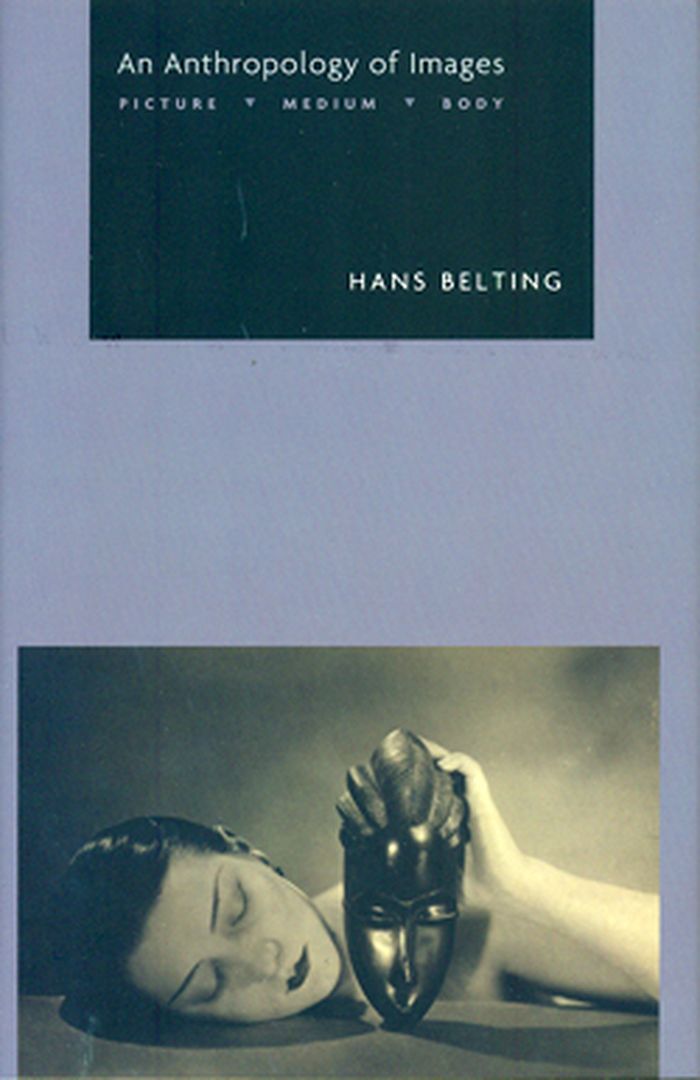
Art historian Hans Belting proposes a new anthropological theory for interpreting human picture making. Rather than focus exclusively on pictures as they are embodied in various media such as painting, sculpture, or photography, he links pictures to our mental images and therefore our bodies. The body is understood as a "living medium" that produces, perceives, or remembers images that are different from the images we encounter through handmade or technical pictures. Refusing to reduce images to their material embodiment yet acknowledging the importance of the historical media in which images are manifested, this publication presents a challenging and provocative new account of what pictures are and how they function. The book demonstrates these ideas with a series of case studies, ranging from Dante's picture theory to post-photography. One chapter explores the tension between image and medium in two "media of the body," the coat of arms and the portrait painting. Another, central chapter looks at the relationship between image and death, tracing picture production, including the first use of the mask, to early funerary rituals in which pictures served to represent the missing bodies of the dead. Pictures were tools to re-embody the deceased, to make them present again, a fact that offers a surprising clue to the riddle of presence and absence in most pictures and that reveals a genealogy of pictures obscured by Platonic picture theory.
An anthropology of images: picture, medium, body
Actions:
Price:
$42.00
(available to order)
Summary:
Art historian Hans Belting proposes a new anthropological theory for interpreting human picture making. Rather than focus exclusively on pictures as they are embodied in various media such as painting, sculpture, or photography, he links pictures to our mental images and therefore our bodies. The body is understood as a "living medium" that produces, perceives, or remembers images that are different from the images we encounter through handmade or technical pictures. Refusing to reduce images to their material embodiment yet acknowledging the importance of the historical media in which images are manifested, this publication presents a challenging and provocative new account of what pictures are and how they function. The book demonstrates these ideas with a series of case studies, ranging from Dante's picture theory to post-photography. One chapter explores the tension between image and medium in two "media of the body," the coat of arms and the portrait painting. Another, central chapter looks at the relationship between image and death, tracing picture production, including the first use of the mask, to early funerary rituals in which pictures served to represent the missing bodies of the dead. Pictures were tools to re-embody the deceased, to make them present again, a fact that offers a surprising clue to the riddle of presence and absence in most pictures and that reveals a genealogy of pictures obscured by Platonic picture theory.
Form:
books
books
Publication:
September 2011
September 2011
Subject:
Art Theory
Art Theory
Form:
journals and magazines
journals and magazines
Price:
$35.00
(available to order)
Summary:
The October issue of Domus focuses on the theme of affordable housing, tackling the question of what "minimum subsistence dwelling" could mean in the 21st century. It builds on the investigation started at the Min to Max international architecture symposium in Berlin. Guest edited by Ilka and Andreas Ruby, it starts with Berlin-based architecture studio Something(...)
$35.00
(available to order)
Summary:
The October issue of Domus focuses on the theme of affordable housing, tackling the question of what "minimum subsistence dwelling" could mean in the 21st century. It builds on the investigation started at the Min to Max international architecture symposium in Berlin. Guest edited by Ilka and Andreas Ruby, it starts with Berlin-based architecture studio Something(...)
Title:
Domus 962
Actions:
Price:
$35.00
(available to order)
Summary:
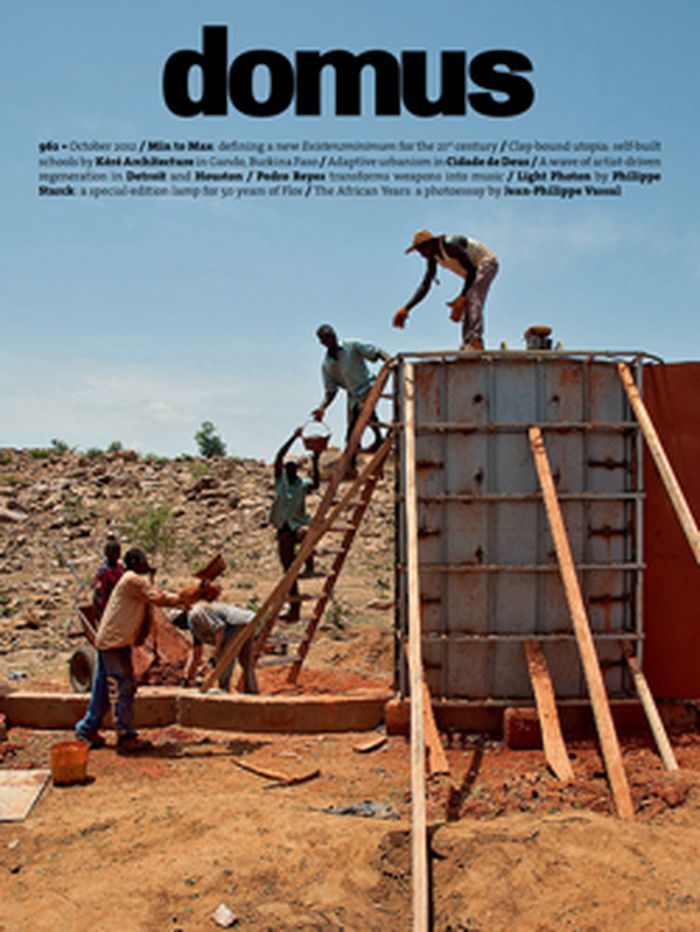
The October issue of Domus focuses on the theme of affordable housing, tackling the question of what "minimum subsistence dwelling" could mean in the 21st century. It builds on the investigation started at the Min to Max international architecture symposium in Berlin. Guest edited by Ilka and Andreas Ruby, it starts with Berlin-based architecture studio Something Fantastic's manifesto on the creative opportunities and innovation allowed by the world recession. Domus then surveys the globe in search of positive strategies where design is subjected to constant experimentation, from Burkina Faso — where, in Gando, Diébédo Francis Kéré runs his experimental architecture workshop —, to Athens — where a group of teachers and researchers finds in the typical Greek polykatoikia the possibility of generating a host of collective and shared spaces —, passing through Detroit, Houston, New York City, Berlin, and Rio de Janeiro. Fresh after the opening of the Venice Architecture Biennale, issue 962 presents Gabriele Basilico's photographic survey of the Biennale's national pavilions, empty and waiting for their annual occupation. Jean-Philippe Vassal's photo essay captures extraordinary moments in the production of everyday space in Africa, and, in Mexico, artist Pedro Reyes transforms agents of death into instruments of life: by converting half a tonne of confiscated weapons into musical instruments, Reyes challenges us to imagine a change for the better.
Domus 962
Actions:
Price:
$35.00
(available to order)
Summary:
The October issue of Domus focuses on the theme of affordable housing, tackling the question of what "minimum subsistence dwelling" could mean in the 21st century. It builds on the investigation started at the Min to Max international architecture symposium in Berlin. Guest edited by Ilka and Andreas Ruby, it starts with Berlin-based architecture studio Something Fantastic's manifesto on the creative opportunities and innovation allowed by the world recession. Domus then surveys the globe in search of positive strategies where design is subjected to constant experimentation, from Burkina Faso — where, in Gando, Diébédo Francis Kéré runs his experimental architecture workshop —, to Athens — where a group of teachers and researchers finds in the typical Greek polykatoikia the possibility of generating a host of collective and shared spaces —, passing through Detroit, Houston, New York City, Berlin, and Rio de Janeiro. Fresh after the opening of the Venice Architecture Biennale, issue 962 presents Gabriele Basilico's photographic survey of the Biennale's national pavilions, empty and waiting for their annual occupation. Jean-Philippe Vassal's photo essay captures extraordinary moments in the production of everyday space in Africa, and, in Mexico, artist Pedro Reyes transforms agents of death into instruments of life: by converting half a tonne of confiscated weapons into musical instruments, Reyes challenges us to imagine a change for the better.
Form:
journals and magazines
journals and magazines
Publication:
November 2012
November 2012
Subject:
Magazines
Magazines
Form:
books
books
Title:
The Sweetsburg archives
The Sweetsburg archives
Actions:
Price:
$25.00
(available in store)
Summary:
Jonathan Reid Sévigny was born and raised in Cowansville, in the Eastern Townships of Quebec, a culture so unique and full of rare and local treasures that become significant to those who grew up there but perhaps seem completely foreign and often tacky to outsiders. It isn’t the most glamorous town, nor does it have any particular sites or landmarks that one would go out(...)
$25.00
(available in store)
Summary:
Jonathan Reid Sévigny was born and raised in Cowansville, in the Eastern Townships of Quebec, a culture so unique and full of rare and local treasures that become significant to those who grew up there but perhaps seem completely foreign and often tacky to outsiders. It isn’t the most glamorous town, nor does it have any particular sites or landmarks that one would go out(...)
Title:
The Sweetsburg archives
Actions:
Price:
$25.00
(available in store)
Summary:
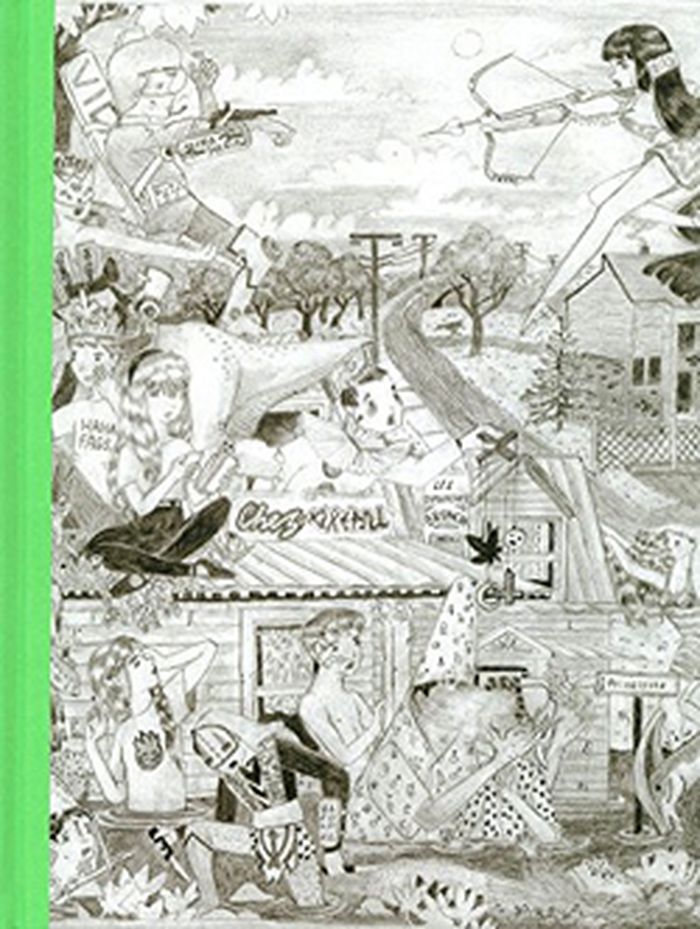
Jonathan Reid Sévigny was born and raised in Cowansville, in the Eastern Townships of Quebec, a culture so unique and full of rare and local treasures that become significant to those who grew up there but perhaps seem completely foreign and often tacky to outsiders. It isn’t the most glamorous town, nor does it have any particular sites or landmarks that one would go out of his / her way to visit. In The Sweetsburg Archives Sévigny is attempting to use his Quebeçois boyhood as an archetype for the relationship between the individual, the hometown, and the bewildering beauty that connects the two. As adults, we tend to romanticize our youth, we try and remember the best things about our coming of age, but we’re also scarred by certain events which we wish we could go back and change; fight back, kiss back. At a glance Sévigny’s depictions of Cowansville seem crisply utopian, a neat little playground of nice boys and girls. However, a closer look reveals their human forms are corrupt, splayed, eaten, and absorbed by animal fraternities, by swords of ritualistic death, by minute veils of the macrocosmic sky in all its unknown intricacies. The scene becomes otherworldly in the kid’s play, pushing us to remember that what is around and inside is both innocent and dirty, violent and soft, and constantly revised.
The Sweetsburg archives
Actions:
Price:
$25.00
(available in store)
Summary:
Jonathan Reid Sévigny was born and raised in Cowansville, in the Eastern Townships of Quebec, a culture so unique and full of rare and local treasures that become significant to those who grew up there but perhaps seem completely foreign and often tacky to outsiders. It isn’t the most glamorous town, nor does it have any particular sites or landmarks that one would go out of his / her way to visit. In The Sweetsburg Archives Sévigny is attempting to use his Quebeçois boyhood as an archetype for the relationship between the individual, the hometown, and the bewildering beauty that connects the two. As adults, we tend to romanticize our youth, we try and remember the best things about our coming of age, but we’re also scarred by certain events which we wish we could go back and change; fight back, kiss back. At a glance Sévigny’s depictions of Cowansville seem crisply utopian, a neat little playground of nice boys and girls. However, a closer look reveals their human forms are corrupt, splayed, eaten, and absorbed by animal fraternities, by swords of ritualistic death, by minute veils of the macrocosmic sky in all its unknown intricacies. The scene becomes otherworldly in the kid’s play, pushing us to remember that what is around and inside is both innocent and dirty, violent and soft, and constantly revised.
Form:
books
books
Publication:
July 2014
July 2014
Subject:
Illustration
Illustration
Form:
books
books
Title:
Obsidian situations
Obsidian situations
Actions:
Price:
$20.00
(available in store)
Summary:
Tricia Middleton’s debut verse-novel brings the artist’s genius for summoning the psychic life of the object world to the page, here trading in the resonant material vocabulary that she has honed to perfection conjuring the wayward spirits of late-stage capitalism in sculptural form, for the equally resplendent wordplay of incisive observational poetry. Ostensibly set(...)
$20.00
(available in store)
Summary:
Tricia Middleton’s debut verse-novel brings the artist’s genius for summoning the psychic life of the object world to the page, here trading in the resonant material vocabulary that she has honed to perfection conjuring the wayward spirits of late-stage capitalism in sculptural form, for the equally resplendent wordplay of incisive observational poetry. Ostensibly set(...)
Title:
Obsidian situations
Actions:
Price:
$20.00
(available in store)
Summary:
Tricia Middleton’s debut verse-novel brings the artist’s genius for summoning the psychic life of the object world to the page, here trading in the resonant material vocabulary that she has honed to perfection conjuring the wayward spirits of late-stage capitalism in sculptural form, for the equally resplendent wordplay of incisive observational poetry. Ostensibly set in present-day Paris, ''Obsidian situations'' spans centuries, telling a story about the epigenetics of suffering, survival, and redemption in social and cultural form. Alternating between myriad personae—sometimes artist or artwork, poet or amorphous cloud—the anonymous, decidedly female, narrator that serves as our guide to the city of light channels the souls of works of art and ideas, of artists, philosophers, courtesans and, most heartrending of all, des Enfants-Trouvés through incantatory soliloquies that call to account the half-life of Enlightenment ideals propping up the soft and saggy moral economy of the L’age Anthropocentric. As a force of self-definition and a body objectified—and so subject to the same degradation as any and all things—our champion encounters ‘situations’ that are in equal parts hilarious and heartbreaking, horrifying and wretched, breathtakingly beautiful, poignant, and mad. It’s a world of museums and collectors, artists and curators, lovers and mothers, daughters and others, charged with desire and repulsion, longing and rejection, death and devastation that, ironically, can only be transformed in art and in poetry and in dreams.
Obsidian situations
Actions:
Price:
$20.00
(available in store)
Summary:
Tricia Middleton’s debut verse-novel brings the artist’s genius for summoning the psychic life of the object world to the page, here trading in the resonant material vocabulary that she has honed to perfection conjuring the wayward spirits of late-stage capitalism in sculptural form, for the equally resplendent wordplay of incisive observational poetry. Ostensibly set in present-day Paris, ''Obsidian situations'' spans centuries, telling a story about the epigenetics of suffering, survival, and redemption in social and cultural form. Alternating between myriad personae—sometimes artist or artwork, poet or amorphous cloud—the anonymous, decidedly female, narrator that serves as our guide to the city of light channels the souls of works of art and ideas, of artists, philosophers, courtesans and, most heartrending of all, des Enfants-Trouvés through incantatory soliloquies that call to account the half-life of Enlightenment ideals propping up the soft and saggy moral economy of the L’age Anthropocentric. As a force of self-definition and a body objectified—and so subject to the same degradation as any and all things—our champion encounters ‘situations’ that are in equal parts hilarious and heartbreaking, horrifying and wretched, breathtakingly beautiful, poignant, and mad. It’s a world of museums and collectors, artists and curators, lovers and mothers, daughters and others, charged with desire and repulsion, longing and rejection, death and devastation that, ironically, can only be transformed in art and in poetry and in dreams.
Form:
books
books
Publication:
January 2023
January 2023
Subject:
Literature and poetry
Literature and poetry
Form:
books
books
Actions:
Price:
$67.95
(available to order)
Summary:
Upon his death, Stéphane Mallarmé (1842–98) left hundreds of notes on an unrealized great work he called ''The Book.'' Housed in a clear Plexiglas box, this card-deck conception of his project draws from that material, and from other writings alluding to its possible forms, including a letter in which he describes ''a book that is architectural... The orphic explanation(...)
$67.95
(available to order)
Summary:
Upon his death, Stéphane Mallarmé (1842–98) left hundreds of notes on an unrealized great work he called ''The Book.'' Housed in a clear Plexiglas box, this card-deck conception of his project draws from that material, and from other writings alluding to its possible forms, including a letter in which he describes ''a book that is architectural... The orphic explanation(...)
Title:
The glorious lie/The gloy of the lie : A poetry card game inspired by Stéphane Mallarmé's ''The Book''
Actions:
Price:
$67.95
(available to order)
Summary:
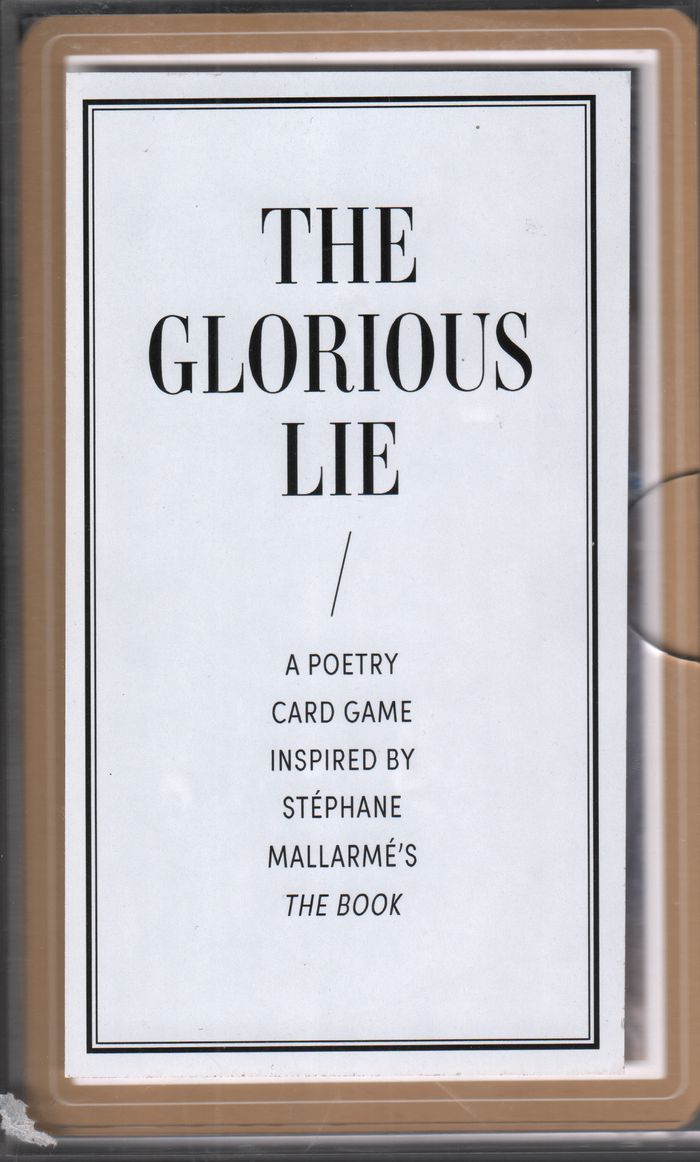
Upon his death, Stéphane Mallarmé (1842–98) left hundreds of notes on an unrealized great work he called ''The Book.'' Housed in a clear Plexiglas box, this card-deck conception of his project draws from that material, and from other writings alluding to its possible forms, including a letter in which he describes ''a book that is architectural... The orphic explanation of the Earth, which is the sole duty of the poet, and the literary game par excellence.'' The title of this game derives from another letter in which Mallarmé writes, ''perhaps the title of my volume of lyric poetry will be 'The Glory of the Lie, or The Glorious Lie.' ” Each deck contains 48 cards: three with artwork on each side, and 45 with words or phrases on each side. The size of the cards, their gold edging and the physical housing of the decks in the box reflect descriptions and clues in Mallarmé’s notes. The manner of playing the game is left open, but quotes and diagrams by Mallarmé in the accompanying 20-page booklet point to the idea of pulling cards from each of the four decks and laying them out for one reading, then flipping the cards over for a second reading. The image cards function like the Arcana of Tarot, providing a visual language equal to the word cards. The readings might be used to create poetry or, like Tarot, to divine or illuminate.
The glorious lie/The gloy of the lie : A poetry card game inspired by Stéphane Mallarmé's ''The Book''
Actions:
Price:
$67.95
(available to order)
Summary:
Upon his death, Stéphane Mallarmé (1842–98) left hundreds of notes on an unrealized great work he called ''The Book.'' Housed in a clear Plexiglas box, this card-deck conception of his project draws from that material, and from other writings alluding to its possible forms, including a letter in which he describes ''a book that is architectural... The orphic explanation of the Earth, which is the sole duty of the poet, and the literary game par excellence.'' The title of this game derives from another letter in which Mallarmé writes, ''perhaps the title of my volume of lyric poetry will be 'The Glory of the Lie, or The Glorious Lie.' ” Each deck contains 48 cards: three with artwork on each side, and 45 with words or phrases on each side. The size of the cards, their gold edging and the physical housing of the decks in the box reflect descriptions and clues in Mallarmé’s notes. The manner of playing the game is left open, but quotes and diagrams by Mallarmé in the accompanying 20-page booklet point to the idea of pulling cards from each of the four decks and laying them out for one reading, then flipping the cards over for a second reading. The image cards function like the Arcana of Tarot, providing a visual language equal to the word cards. The readings might be used to create poetry or, like Tarot, to divine or illuminate.
Form:
books
books
Publication:
July 2022
July 2022
Subject:
Literature and poetry
Literature and poetry
Form:
books
books
Actions:
Price:
$54.95
(available in store)
Summary:
After living for several years in the chaos of influences that is New York, the visual artist Satoshi Tsuchiyama realized that it is Israel that is the world’s hub for contemporary dance. His experiences of working with both dance and Jewish artefacts fused together. Questions arose in his head: Since the political situation has long been unstable in this religiously and(...)
$54.95
(available in store)
Summary:
After living for several years in the chaos of influences that is New York, the visual artist Satoshi Tsuchiyama realized that it is Israel that is the world’s hub for contemporary dance. His experiences of working with both dance and Jewish artefacts fused together. Questions arose in his head: Since the political situation has long been unstable in this religiously and(...)
Title:
Satoshi Tsuchiyama: Heat of sand
Actions:
Price:
$54.95
(available in store)
Summary:
After living for several years in the chaos of influences that is New York, the visual artist Satoshi Tsuchiyama realized that it is Israel that is the world’s hub for contemporary dance. His experiences of working with both dance and Jewish artefacts fused together. Questions arose in his head: Since the political situation has long been unstable in this religiously and culturally rich region, what kind of normal everyday life can be found there? What colours and scents does a country like this retain, and how do the dancers appear and move under the influence of an environment like this? He decided to go there to witness the extraordinary on a daily basis. During his four visits to Israel and Palestine in 2017–19, he wandered in scorching sand and graffiti-filled streets, climbed to the collapsing top floor of the art school. He followed the desires of his eyes. The dancers he met came from all over the world, but they seemed to share the same mood, the same force that oozed out of the ground. And one and the same aura accompanied their bodies in a common direction. He avoided all the areas at high risk of terror, but death and the random character of life were present wherever he went. The energy of the inhabitants to survive was strong, and he experienced a singular beauty in this raw, tough and vulnerable ordeal of perseverance and adaptation.
Satoshi Tsuchiyama: Heat of sand
Actions:
Price:
$54.95
(available in store)
Summary:
After living for several years in the chaos of influences that is New York, the visual artist Satoshi Tsuchiyama realized that it is Israel that is the world’s hub for contemporary dance. His experiences of working with both dance and Jewish artefacts fused together. Questions arose in his head: Since the political situation has long been unstable in this religiously and culturally rich region, what kind of normal everyday life can be found there? What colours and scents does a country like this retain, and how do the dancers appear and move under the influence of an environment like this? He decided to go there to witness the extraordinary on a daily basis. During his four visits to Israel and Palestine in 2017–19, he wandered in scorching sand and graffiti-filled streets, climbed to the collapsing top floor of the art school. He followed the desires of his eyes. The dancers he met came from all over the world, but they seemed to share the same mood, the same force that oozed out of the ground. And one and the same aura accompanied their bodies in a common direction. He avoided all the areas at high risk of terror, but death and the random character of life were present wherever he went. The energy of the inhabitants to survive was strong, and he experienced a singular beauty in this raw, tough and vulnerable ordeal of perseverance and adaptation.
Form:
books
books
Publication:
September 2022
September 2022
Form:
books
books
Actions:
Price:
$48.00
(available to order)
Summary:
The Space Race was an exhilirating moment in history, alternately frighten-ing, thrilling, awe-inspiring, and ultimately, sublime. Its most enigmatic element was the competition. The Soviets seemed less technologically sophisticated (at least from the American perspective) but in fact won many of the races: first satellite to orbit the earth; first man in space; first(...)
$48.00
(available to order)
Summary:
The Space Race was an exhilirating moment in history, alternately frighten-ing, thrilling, awe-inspiring, and ultimately, sublime. Its most enigmatic element was the competition. The Soviets seemed less technologically sophisticated (at least from the American perspective) but in fact won many of the races: first satellite to orbit the earth; first man in space; first(...)
Title:
Kosmos: a portrait of the Russian Space Age
Actions:
Price:
$48.00
(available to order)
Summary:
The Space Race was an exhilirating moment in history, alternately frighten-ing, thrilling, awe-inspiring, and ultimately, sublime. Its most enigmatic element was the competition. The Soviets seemed less technologically sophisticated (at least from the American perspective) but in fact won many of the races: first satellite to orbit the earth; first man in space; first unmanned landings on Mars, Venus, and the Moon; first woman in space; most powerful rockets; and, until its recent fiery death, the most long-lived space station to name but a few. The inherent contradictions of the age--the mixture of technologies high and low, of nostalgia and progress, of pathos and promise--are revealed in Kosmos, Adam Bartos's astonishing photographic survey of the Soviet space program. Bartos' fascination with this subject led him to seek out places like the bedroom where Yuri Gagarian slept the night before his history-making flight into space, located in the Baiknour Cosmodrome, the one-time top-secret space complex in the Kazakh desert. Bartos also takes us inside the cockpit of the Merkur space capsule, used to ferry crew members and supplies to the super-secret Almaz orbital space stations, and behind the changing screens cosmonauts used before being fitted for their space suits at Zvezda, the chief manufacturer of Soviet life-support systems. In total, Kosmos presents over 100 of Bartos's photographs, rich with the incongruities of the history, science, culture, and politics of the Space Age.
Kosmos: a portrait of the Russian Space Age
Actions:
Price:
$48.00
(available to order)
Summary:
The Space Race was an exhilirating moment in history, alternately frighten-ing, thrilling, awe-inspiring, and ultimately, sublime. Its most enigmatic element was the competition. The Soviets seemed less technologically sophisticated (at least from the American perspective) but in fact won many of the races: first satellite to orbit the earth; first man in space; first unmanned landings on Mars, Venus, and the Moon; first woman in space; most powerful rockets; and, until its recent fiery death, the most long-lived space station to name but a few. The inherent contradictions of the age--the mixture of technologies high and low, of nostalgia and progress, of pathos and promise--are revealed in Kosmos, Adam Bartos's astonishing photographic survey of the Soviet space program. Bartos' fascination with this subject led him to seek out places like the bedroom where Yuri Gagarian slept the night before his history-making flight into space, located in the Baiknour Cosmodrome, the one-time top-secret space complex in the Kazakh desert. Bartos also takes us inside the cockpit of the Merkur space capsule, used to ferry crew members and supplies to the super-secret Almaz orbital space stations, and behind the changing screens cosmonauts used before being fitted for their space suits at Zvezda, the chief manufacturer of Soviet life-support systems. In total, Kosmos presents over 100 of Bartos's photographs, rich with the incongruities of the history, science, culture, and politics of the Space Age.
Form:
books
books
Publication:
November 2001
November 2001
Subject:
Photography monographs
Photography monographs


