


14 Résultats
Classification:
livres
livres
Prix:
$36.00
(disponible sur commande)
Résumé:
Housing speaks directly to the challenges that define our times: social inequality, ecological crisis, displacement, asylum, migration and privatization. Framing the neo-liberal context as a defining condition of contemporary housing, International Case Studies consists of two parts: a series of essays by authors from architecture, anthropology, economy and literature,(...)
$36.00
(disponible sur commande)
Résumé:
Housing speaks directly to the challenges that define our times: social inequality, ecological crisis, displacement, asylum, migration and privatization. Framing the neo-liberal context as a defining condition of contemporary housing, International Case Studies consists of two parts: a series of essays by authors from architecture, anthropology, economy and literature,(...)
Sujet:
Logements collectifs
Logements collectifs
Publication:
juillet 2016
juillet 2016
Titre:
Housing after the neoliberal turn: international case studies
Actions:
Prix:
$36.00
(disponible sur commande)
Résumé:
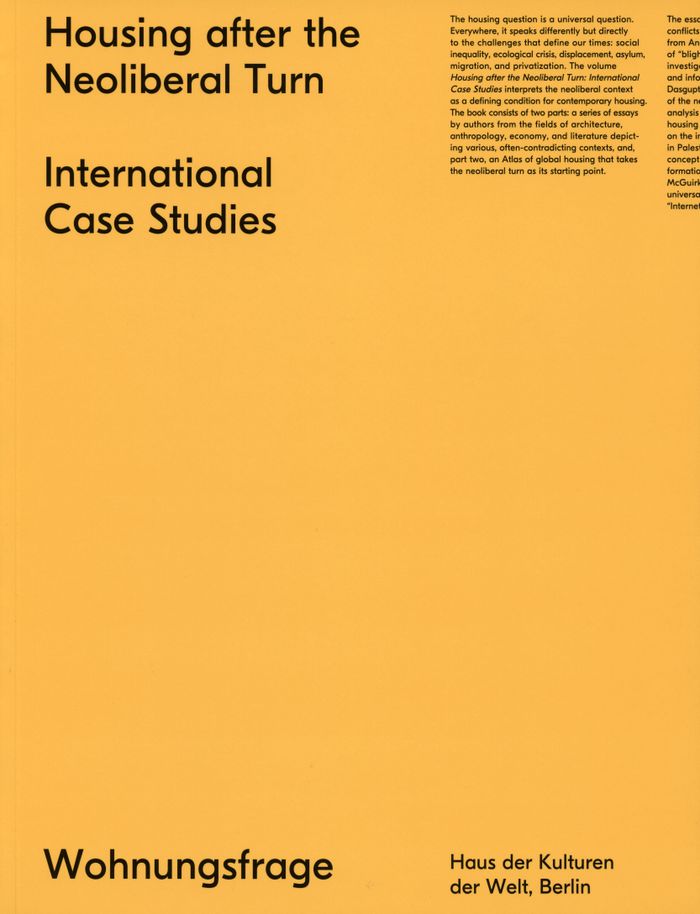
Housing speaks directly to the challenges that define our times: social inequality, ecological crisis, displacement, asylum, migration and privatization. Framing the neo-liberal context as a defining condition of contemporary housing, International Case Studies consists of two parts: a series of essays by authors from architecture, anthropology, economy and literature, and an “atlas” of global housing that takes neo-liberalism as its starting point. The essays shed light on the challenges and conflicts of contemporary housing production from Andrew Herscher’s research on the politics of “blight” in Detroit to Justin McGuirk’s text on domesticity as data and universal housing questions eclipse by the “Internet of Things.” Conceptualized and compiled by architectural critic-historian Anne Kockelkorn and Columbia professor Reinhold Martin, the illustrated “atlas” presents 33 housing examples rarely seen together and invites readers to think of housing as an unstable constellation evolving within the power relations of territorial processes.
Housing after the neoliberal turn: international case studies
Actions:
Prix:
$36.00
(disponible sur commande)
Résumé:
Housing speaks directly to the challenges that define our times: social inequality, ecological crisis, displacement, asylum, migration and privatization. Framing the neo-liberal context as a defining condition of contemporary housing, International Case Studies consists of two parts: a series of essays by authors from architecture, anthropology, economy and literature, and an “atlas” of global housing that takes neo-liberalism as its starting point. The essays shed light on the challenges and conflicts of contemporary housing production from Andrew Herscher’s research on the politics of “blight” in Detroit to Justin McGuirk’s text on domesticity as data and universal housing questions eclipse by the “Internet of Things.” Conceptualized and compiled by architectural critic-historian Anne Kockelkorn and Columbia professor Reinhold Martin, the illustrated “atlas” presents 33 housing examples rarely seen together and invites readers to think of housing as an unstable constellation evolving within the power relations of territorial processes.
Classification:
livres
livres
Publication:
juillet 2016
juillet 2016
Sujet:
Logements collectifs
Logements collectifs
Classification:
livres
livres
Titre:
Hannes Meyer: Co-op interior
Hannes Meyer: Co-op interior
Actions:
Prix:
$45.00
(disponible sur commande)
Résumé:
In his Co-op Interieur (1926)—a simple corner of a room known only in a photograph— Swiss architect Hannes Meyer (1889–1954) gave expression to a radical, antibourgeois style of interior. Comprised only of a bed, a lamp, two chairs and a gramophone on a table, he imagined this room for the nomadic urban worker. Through the absence of people, objects and spatial features(...)
$45.00
(disponible sur commande)
Résumé:
In his Co-op Interieur (1926)—a simple corner of a room known only in a photograph— Swiss architect Hannes Meyer (1889–1954) gave expression to a radical, antibourgeois style of interior. Comprised only of a bed, a lamp, two chairs and a gramophone on a table, he imagined this room for the nomadic urban worker. Through the absence of people, objects and spatial features(...)
Sujet:
Théorie de l’architecture
Théorie de l’architecture
Publication:
juillet 2016
juillet 2016
Titre:
Hannes Meyer: Co-op interior
Actions:
Prix:
$45.00
(disponible sur commande)
Résumé:
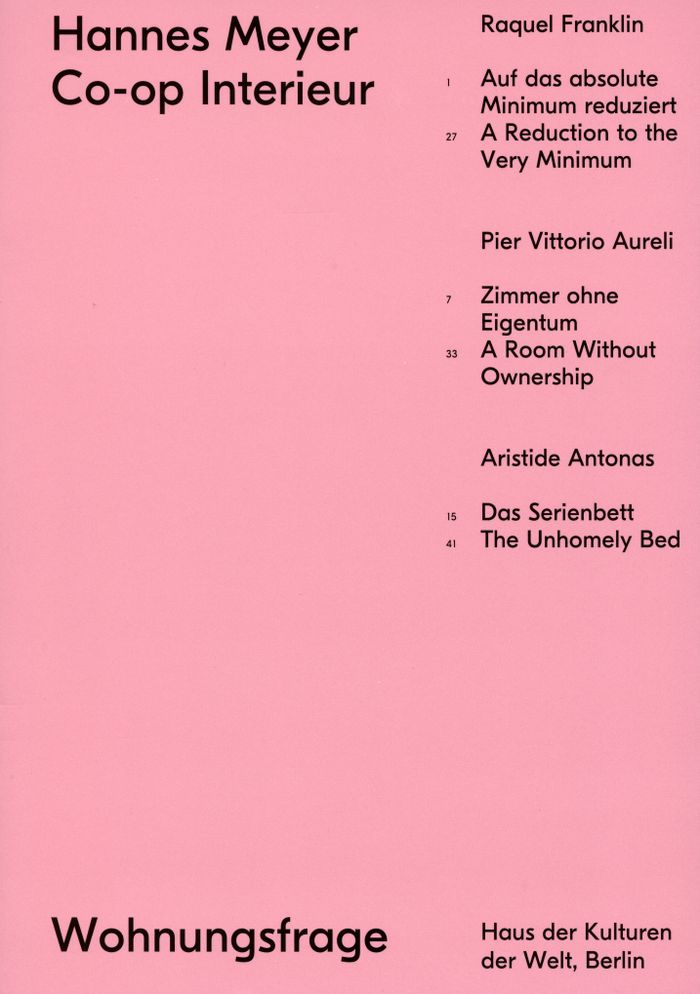
In his Co-op Interieur (1926)—a simple corner of a room known only in a photograph— Swiss architect Hannes Meyer (1889–1954) gave expression to a radical, antibourgeois style of interior. Comprised only of a bed, a lamp, two chairs and a gramophone on a table, he imagined this room for the nomadic urban worker. Through the absence of people, objects and spatial features as much as by the distinctiveness of its design, Meyer was proclaiming an alternative principle for housing, proposing that architecture and design were intended not to fulfill historically determined needs but to overcome their constraints. Historical photographs of the interior and three provocative essays on ownership, minimalism and the “unhomely,” by Brussels-based architecy Pier Vittrio, Mexican architect Raquel Franklin, and Gree architect Aristide Antonas, respectively, explore the layers of meaning within Meyer’s mise-en-scène manifesto on collectivity and utility as a counterpoint to ownership and private property.
Hannes Meyer: Co-op interior
Actions:
Prix:
$45.00
(disponible sur commande)
Résumé:
In his Co-op Interieur (1926)—a simple corner of a room known only in a photograph— Swiss architect Hannes Meyer (1889–1954) gave expression to a radical, antibourgeois style of interior. Comprised only of a bed, a lamp, two chairs and a gramophone on a table, he imagined this room for the nomadic urban worker. Through the absence of people, objects and spatial features as much as by the distinctiveness of its design, Meyer was proclaiming an alternative principle for housing, proposing that architecture and design were intended not to fulfill historically determined needs but to overcome their constraints. Historical photographs of the interior and three provocative essays on ownership, minimalism and the “unhomely,” by Brussels-based architecy Pier Vittrio, Mexican architect Raquel Franklin, and Gree architect Aristide Antonas, respectively, explore the layers of meaning within Meyer’s mise-en-scène manifesto on collectivity and utility as a counterpoint to ownership and private property.
Classification:
livres
livres
Publication:
juillet 2016
juillet 2016
Sujet:
Théorie de l’architecture
Théorie de l’architecture
Classification:
livres
livres

Actions:
Prix:
$29.00
(disponible en magasin)
Résumé:
The twelfth volume of the Critical Spatial Practices series focuses on 'Don't Follow the Wind,' the acclaimed collaborative project situated in the radioactive Fukushima exclusion zone. The exhibition is located inside the exclusion zone, an evacuated radioactive area established after the nuclear disaster that forcibly separated residents from their homes, land, and(...)
$29.00
(disponible en magasin)
Résumé:
The twelfth volume of the Critical Spatial Practices series focuses on 'Don't Follow the Wind,' the acclaimed collaborative project situated in the radioactive Fukushima exclusion zone. The exhibition is located inside the exclusion zone, an evacuated radioactive area established after the nuclear disaster that forcibly separated residents from their homes, land, and(...)
Titre:
Don't follow the wind: critical spatial practice 12
Actions:
Prix:
$29.00
(disponible en magasin)
Résumé:
The twelfth volume of the Critical Spatial Practices series focuses on 'Don't Follow the Wind,' the acclaimed collaborative project situated in the radioactive Fukushima exclusion zone. The exhibition is located inside the exclusion zone, an evacuated radioactive area established after the nuclear disaster that forcibly separated residents from their homes, land, and community. In cooperation with former residents, participating artists installed newly commissioned works at sites in the exclusion zone. Although the exhibition opened in March 2015, the zone is still inaccessible to the public — the exhibition, like the radiation, is virtually invisible. The exhibition can only be viewed when restrictions are lifted and people are permitted to return. This might take several years or decades — a period that could extend beyond our lifetime. The book includes new texts by feminist theorist Silvia Federici, art historians Noi Sawaragi and Sven Lütticken, and political philosopher Jodi Dean.
Don't follow the wind: critical spatial practice 12
Actions:
Prix:
$29.00
(disponible en magasin)
Résumé:
The twelfth volume of the Critical Spatial Practices series focuses on 'Don't Follow the Wind,' the acclaimed collaborative project situated in the radioactive Fukushima exclusion zone. The exhibition is located inside the exclusion zone, an evacuated radioactive area established after the nuclear disaster that forcibly separated residents from their homes, land, and community. In cooperation with former residents, participating artists installed newly commissioned works at sites in the exclusion zone. Although the exhibition opened in March 2015, the zone is still inaccessible to the public — the exhibition, like the radiation, is virtually invisible. The exhibition can only be viewed when restrictions are lifted and people are permitted to return. This might take several years or decades — a period that could extend beyond our lifetime. The book includes new texts by feminist theorist Silvia Federici, art historians Noi Sawaragi and Sven Lütticken, and political philosopher Jodi Dean.
Classification:
livres
livres
Publication:
juin 2021
juin 2021
Sujet:
Théorie/ philosophie
Théorie/ philosophie
Classification:
livres
livres
Prix:
$41.99
(disponible sur commande)
Résumé:
The current epoch is one of accumulation: not only of capital but also of raw, often unruly material, from plastic in the ocean and carbon in the atmosphere to people, buildings, and cities. Alongside this material growth, image-making practices embedded within the fields of art and architecture have proven to be fertile, mobile, and capacious. Images of accumulation help(...)
$41.99
(disponible sur commande)
Résumé:
The current epoch is one of accumulation: not only of capital but also of raw, often unruly material, from plastic in the ocean and carbon in the atmosphere to people, buildings, and cities. Alongside this material growth, image-making practices embedded within the fields of art and architecture have proven to be fertile, mobile, and capacious. Images of accumulation help(...)
Sujet:
Théorie de l’architecture
Théorie de l’architecture
Publication:
avril 2022
avril 2022
Titre:
Accumulation: the art, architecture and media of climate change
Actions:
Prix:
$41.99
(disponible sur commande)
Résumé:
The current epoch is one of accumulation: not only of capital but also of raw, often unruly material, from plastic in the ocean and carbon in the atmosphere to people, buildings, and cities. Alongside this material growth, image-making practices embedded within the fields of art and architecture have proven to be fertile, mobile, and capacious. Images of accumulation help open up the climate to cultural inquiry and political mobilization and have formed a cultural infrastructure focused on the relationships between humans, other species, and their environments. The essays in ''Accumulation'' address this cultural infrastructure and the methodological challenges of its analysis. They offer a response to the relative invisibility of the climate now seen as material manifestations of social behavior. Contributors outline opportunities and ambitions of visual scholarship as a means to encounter the challenges emergent in the current moment: how can climate become visible, culturally and politically? Knowledge of climatic instability can change collective behavior and offer other trajectories, counteraccumulations that draw the present into a different, more livable, future.
Accumulation: the art, architecture and media of climate change
Actions:
Prix:
$41.99
(disponible sur commande)
Résumé:
The current epoch is one of accumulation: not only of capital but also of raw, often unruly material, from plastic in the ocean and carbon in the atmosphere to people, buildings, and cities. Alongside this material growth, image-making practices embedded within the fields of art and architecture have proven to be fertile, mobile, and capacious. Images of accumulation help open up the climate to cultural inquiry and political mobilization and have formed a cultural infrastructure focused on the relationships between humans, other species, and their environments. The essays in ''Accumulation'' address this cultural infrastructure and the methodological challenges of its analysis. They offer a response to the relative invisibility of the climate now seen as material manifestations of social behavior. Contributors outline opportunities and ambitions of visual scholarship as a means to encounter the challenges emergent in the current moment: how can climate become visible, culturally and politically? Knowledge of climatic instability can change collective behavior and offer other trajectories, counteraccumulations that draw the present into a different, more livable, future.
Classification:
livres
livres
Publication:
avril 2022
avril 2022
Sujet:
Théorie de l’architecture
Théorie de l’architecture


