


2227 Résultats
Classification:
livres
livres
Prix:
$65.99
(disponible sur commande)
Résumé:
"Mastering architecture" draws on the research of approximately fifty architects who have taken a close look at the nature of their own mastery. This research into mastery reveals things that every practicioner should know about their creative practice - things which most architects are only aware of at an intuitive level. The book flags up personal attributes, such as(...)
$65.99
(disponible sur commande)
Résumé:
"Mastering architecture" draws on the research of approximately fifty architects who have taken a close look at the nature of their own mastery. This research into mastery reveals things that every practicioner should know about their creative practice - things which most architects are only aware of at an intuitive level. The book flags up personal attributes, such as(...)
Titre:
Mastering architecture : becoming a creative innovator in practice
Actions:
Prix:
$65.99
(disponible sur commande)
Résumé:
"Mastering architecture" draws on the research of approximately fifty architects who have taken a close look at the nature of their own mastery. This research into mastery reveals things that every practicioner should know about their creative practice - things which most architects are only aware of at an intuitive level. The book flags up personal attributes, such as stamina, creative energy and intellectual capital, which are intrinsic to dynamic practice.
Mastering architecture : becoming a creative innovator in practice
Actions:
Prix:
$65.99
(disponible sur commande)
Résumé:
"Mastering architecture" draws on the research of approximately fifty architects who have taken a close look at the nature of their own mastery. This research into mastery reveals things that every practicioner should know about their creative practice - things which most architects are only aware of at an intuitive level. The book flags up personal attributes, such as stamina, creative energy and intellectual capital, which are intrinsic to dynamic practice.
Classification:
livres
livres
Publication:
novembre 2004, Chichester
novembre 2004, Chichester
Sujet:
Théorie de l’architecture
Théorie de l’architecture
Classification:
livres
livres
Prix:
$38.95
(disponible en magasin)
Résumé:
The international architecture symposium "space condition" initiated by Roger Riewe at Graz University of Technology accompanied the exhibition "Latent Utopia" curated by Zaha Hadid and Patrick Schumacher. Renowed contemporary architects, designers and architecture critics were invited to elaborate upon the most important issues concerning architectureof today and(...)
$38.95
(disponible en magasin)
Résumé:
The international architecture symposium "space condition" initiated by Roger Riewe at Graz University of Technology accompanied the exhibition "Latent Utopia" curated by Zaha Hadid and Patrick Schumacher. Renowed contemporary architects, designers and architecture critics were invited to elaborate upon the most important issues concerning architectureof today and(...)
Titre:
Space condition : international architecture symposium
Actions:
Prix:
$38.95
(disponible en magasin)
Résumé:
The international architecture symposium "space condition" initiated by Roger Riewe at Graz University of Technology accompanied the exhibition "Latent Utopia" curated by Zaha Hadid and Patrick Schumacher. Renowed contemporary architects, designers and architecture critics were invited to elaborate upon the most important issues concerning architectureof today and tomorrow. This publication documents the various positions in discussion minutes, pictures and interviews and provides an in-depth insight into current architectural theory discussions.
Space condition : international architecture symposium
Actions:
Prix:
$38.95
(disponible en magasin)
Résumé:
The international architecture symposium "space condition" initiated by Roger Riewe at Graz University of Technology accompanied the exhibition "Latent Utopia" curated by Zaha Hadid and Patrick Schumacher. Renowed contemporary architects, designers and architecture critics were invited to elaborate upon the most important issues concerning architectureof today and tomorrow. This publication documents the various positions in discussion minutes, pictures and interviews and provides an in-depth insight into current architectural theory discussions.
Classification:
livres
livres
Publication:
septembre 2004, Wien, New York
septembre 2004, Wien, New York
Sujet:
Théorie de l’architecture
Théorie de l’architecture
Classification:
livres
livres
Actions:
Prix:
$15.00
(disponible sur commande)
Résumé:
Parce qu'il n'y a aucune raison que la seule bonne architecture soit celle d'hier. Parce qu'il n'y a aucune raison que la qualité, le rêve, et l'audace courbent l'échine devant les seuls impératifs de rentabilité. Parce qu'il n'y a pas de raison que notre architecture témoigne moins de notre identité que nos joueuses de tennis, nos chorégraphes ou notre enrobé drainant. (...)
$15.00
(disponible sur commande)
Résumé:
Parce qu'il n'y a aucune raison que la seule bonne architecture soit celle d'hier. Parce qu'il n'y a aucune raison que la qualité, le rêve, et l'audace courbent l'échine devant les seuls impératifs de rentabilité. Parce qu'il n'y a pas de raison que notre architecture témoigne moins de notre identité que nos joueuses de tennis, nos chorégraphes ou notre enrobé drainant. (...)
Titre:
Qui a peur de l'architecture? : livre blanc de l'architecture contemporaine en communauté française de Belgique
Actions:
Prix:
$15.00
(disponible sur commande)
Résumé:
Parce qu'il n'y a aucune raison que la seule bonne architecture soit celle d'hier. Parce qu'il n'y a aucune raison que la qualité, le rêve, et l'audace courbent l'échine devant les seuls impératifs de rentabilité. Parce qu'il n'y a pas de raison que notre architecture témoigne moins de notre identité que nos joueuses de tennis, nos chorégraphes ou notre enrobé drainant. En somme, parce qu'il n'y a aucune raison que nous soyons les seuls au monde à qui l'architecture fait peur. -Juan d'Oultremont
Qui a peur de l'architecture? : livre blanc de l'architecture contemporaine en communauté française de Belgique
Actions:
Prix:
$15.00
(disponible sur commande)
Résumé:
Parce qu'il n'y a aucune raison que la seule bonne architecture soit celle d'hier. Parce qu'il n'y a aucune raison que la qualité, le rêve, et l'audace courbent l'échine devant les seuls impératifs de rentabilité. Parce qu'il n'y a pas de raison que notre architecture témoigne moins de notre identité que nos joueuses de tennis, nos chorégraphes ou notre enrobé drainant. En somme, parce qu'il n'y a aucune raison que nous soyons les seuls au monde à qui l'architecture fait peur. -Juan d'Oultremont
Classification:
livres
livres
Publication:
avril 2004
avril 2004
Sujet:
Théorie de l’architecture
Théorie de l’architecture
Classification:
livres
livres
Actions:
Prix:
$85.00
(disponible sur commande)
Résumé:
Alexander examines the kinds of process that are capable of generating living structure. The unfolding of living structure in natural systems is first compared to the unfolding of buildings and town plans in traditional society, and then contrasted with present day processes. The comparison reveals deep and shocking problems which pervade the present day planning and(...)
$85.00
(disponible sur commande)
Résumé:
Alexander examines the kinds of process that are capable of generating living structure. The unfolding of living structure in natural systems is first compared to the unfolding of buildings and town plans in traditional society, and then contrasted with present day processes. The comparison reveals deep and shocking problems which pervade the present day planning and(...)
Titre:
The nature of order - an essay on the art of building and the nature of the universe. Book two : the process of creating life
Actions:
Prix:
$85.00
(disponible sur commande)
Résumé:
Alexander examines the kinds of process that are capable of generating living structure. The unfolding of living structure in natural systems is first compared to the unfolding of buildings and town plans in traditional society, and then contrasted with present day processes. The comparison reveals deep and shocking problems which pervade the present day planning and construction of buildings. He describes the detailed character of living process needed to generate, design, plan, and build buildings with living structure. The character of living process is contrasted, repeatedly, with the character of present-day professional process, which departs, again and again, from present process, in order to meet the necessities inherent in any truly life-creating process. Pervasive changes needed to create a world in which living process – and hence living structure – are attainable only through a transformation of society. The dynamic methods of Book 2, focusing on process, give an entirely different picture of the facts and concepts presented in Book 1.
The nature of order - an essay on the art of building and the nature of the universe. Book two : the process of creating life
Actions:
Prix:
$85.00
(disponible sur commande)
Résumé:
Alexander examines the kinds of process that are capable of generating living structure. The unfolding of living structure in natural systems is first compared to the unfolding of buildings and town plans in traditional society, and then contrasted with present day processes. The comparison reveals deep and shocking problems which pervade the present day planning and construction of buildings. He describes the detailed character of living process needed to generate, design, plan, and build buildings with living structure. The character of living process is contrasted, repeatedly, with the character of present-day professional process, which departs, again and again, from present process, in order to meet the necessities inherent in any truly life-creating process. Pervasive changes needed to create a world in which living process – and hence living structure – are attainable only through a transformation of society. The dynamic methods of Book 2, focusing on process, give an entirely different picture of the facts and concepts presented in Book 1.
Classification:
livres
livres
Publication:
août 2003, Berkeley
août 2003, Berkeley
Sujet:
Théorie de l’architecture
Théorie de l’architecture
Classification:
livres
livres
Actions:
Prix:
$85.00
(disponible sur commande)
Résumé:
Alexander addresses the cosmological implications of the theory he has constructed and presented. The book begins with a critique of current cosmological thinking, and its separation from personal feeling and value. The outline of a theory in which matter itself is more spirit-like, more personal in character, is sketched. The cosmological modifications presented in Book(...)
$85.00
(disponible sur commande)
Résumé:
Alexander addresses the cosmological implications of the theory he has constructed and presented. The book begins with a critique of current cosmological thinking, and its separation from personal feeling and value. The outline of a theory in which matter itself is more spirit-like, more personal in character, is sketched. The cosmological modifications presented in Book(...)
Titre:
The nature of order - an essay on the art of building and the nature of the universe. Book four : the luminous ground
Actions:
Prix:
$85.00
(disponible sur commande)
Résumé:
Alexander addresses the cosmological implications of the theory he has constructed and presented. The book begins with a critique of current cosmological thinking, and its separation from personal feeling and value. The outline of a theory in which matter itself is more spirit-like, more personal in character, is sketched. The cosmological modifications presented in Book 4, are needed, to supplement the definition of the personal nature of matter, design, and form, and acts as a substrate for an attempt to implement living process. The book contains a long chapter, nearly one hundred pages long — almost a book in itself — in which Alexander presents his theory of color, as one ingredient of the new cosmological picture which he puts forward. This volume draws attention to new ways of looking at consciousness, and modifies physical theory so that the human person – what we know as self, and what Alexander calls the “I” — enters in as a fundamental and necessary ingredient of all matter.
The nature of order - an essay on the art of building and the nature of the universe. Book four : the luminous ground
Actions:
Prix:
$85.00
(disponible sur commande)
Résumé:
Alexander addresses the cosmological implications of the theory he has constructed and presented. The book begins with a critique of current cosmological thinking, and its separation from personal feeling and value. The outline of a theory in which matter itself is more spirit-like, more personal in character, is sketched. The cosmological modifications presented in Book 4, are needed, to supplement the definition of the personal nature of matter, design, and form, and acts as a substrate for an attempt to implement living process. The book contains a long chapter, nearly one hundred pages long — almost a book in itself — in which Alexander presents his theory of color, as one ingredient of the new cosmological picture which he puts forward. This volume draws attention to new ways of looking at consciousness, and modifies physical theory so that the human person – what we know as self, and what Alexander calls the “I” — enters in as a fundamental and necessary ingredient of all matter.
Classification:
livres
livres
Publication:
novembre 2003, Berkeley
novembre 2003, Berkeley
Sujet:
Théorie de l’architecture
Théorie de l’architecture
Classification:
livres
livres
Titre:
A history of writing
A history of writing
Actions:
Prix:
$23.50
(disponible sur commande)
Résumé:
From the earliest scratches on stone and bone to the languages of computers and the internet, "A History of Writing" offers a fascinating investigation into the origin and development of writing throughout the world. Commencing with the first stages of information storage, Fischer focuses on the emergence of complete writing systems in Mesopotamia in the fourth(...)
$23.50
(disponible sur commande)
Résumé:
From the earliest scratches on stone and bone to the languages of computers and the internet, "A History of Writing" offers a fascinating investigation into the origin and development of writing throughout the world. Commencing with the first stages of information storage, Fischer focuses on the emergence of complete writing systems in Mesopotamia in the fourth(...)
Titre:
A history of writing
Actions:
Prix:
$23.50
(disponible sur commande)
Résumé:
From the earliest scratches on stone and bone to the languages of computers and the internet, "A History of Writing" offers a fascinating investigation into the origin and development of writing throughout the world. Commencing with the first stages of information storage, Fischer focuses on the emergence of complete writing systems in Mesopotamia in the fourth millennium BC. He documents the rise of Phoenician and its effect on the Greek alphabet, generating the many alphabetic scripts of the West. Chinese, Vietnamese, Korean and Japanese writing systems are dealt with in depth, as is writing in pre-Columbian America. Also explored are Western Europe's medieval manuscripts and the history of printing, leading to the innovations in technology and spelling rules of the 19th and 20th centuries.
A history of writing
Actions:
Prix:
$23.50
(disponible sur commande)
Résumé:
From the earliest scratches on stone and bone to the languages of computers and the internet, "A History of Writing" offers a fascinating investigation into the origin and development of writing throughout the world. Commencing with the first stages of information storage, Fischer focuses on the emergence of complete writing systems in Mesopotamia in the fourth millennium BC. He documents the rise of Phoenician and its effect on the Greek alphabet, generating the many alphabetic scripts of the West. Chinese, Vietnamese, Korean and Japanese writing systems are dealt with in depth, as is writing in pre-Columbian America. Also explored are Western Europe's medieval manuscripts and the history of printing, leading to the innovations in technology and spelling rules of the 19th and 20th centuries.
Classification:
livres
livres
Publication:
avril 2004, London
avril 2004, London
Sujet:
Théorie de l’architecture
Théorie de l’architecture
Classification:
livres
livres
Prix:
$41.95
(disponible en magasin)
Résumé:
Architects, artists and designers are on a quest for legitimacy for their work and for socially relevant activities. Professional journals are calling for reflection and reconsideration of how one carries out one's craft. In other words, a debate is clearly underway about a new form of engagement by the design and visual disciplines toward the current problems of(...)
$41.95
(disponible en magasin)
Résumé:
Architects, artists and designers are on a quest for legitimacy for their work and for socially relevant activities. Professional journals are calling for reflection and reconsideration of how one carries out one's craft. In other words, a debate is clearly underway about a new form of engagement by the design and visual disciplines toward the current problems of(...)
Titre:
Reflect #01 : new commitment in architecture, art and design
Actions:
Prix:
$41.95
(disponible en magasin)
Résumé:
Architects, artists and designers are on a quest for legitimacy for their work and for socially relevant activities. Professional journals are calling for reflection and reconsideration of how one carries out one's craft. In other words, a debate is clearly underway about a new form of engagement by the design and visual disciplines toward the current problems of society. As a contribution to this debate, this book offers a collection of articles by leading authors who hold this 'new commitment' up to the light.
Reflect #01 : new commitment in architecture, art and design
Actions:
Prix:
$41.95
(disponible en magasin)
Résumé:
Architects, artists and designers are on a quest for legitimacy for their work and for socially relevant activities. Professional journals are calling for reflection and reconsideration of how one carries out one's craft. In other words, a debate is clearly underway about a new form of engagement by the design and visual disciplines toward the current problems of society. As a contribution to this debate, this book offers a collection of articles by leading authors who hold this 'new commitment' up to the light.
Classification:
livres
livres
Publication:
octobre 2003, Rotterdam
octobre 2003, Rotterdam
Sujet:
Théorie de l’architecture
Théorie de l’architecture
Classification:
livres
livres
Prix:
$39.95
(disponible en magasin)
Résumé:
'Modernism and modernity : the Vancouver conference papers' was originally published as the proceedings from a conference held in Vancouver, B.C., in 1983. This publication constitutes a major contribution to the rethinking of the history and debates concerning modernism and modernity.
$39.95
(disponible en magasin)
Résumé:
'Modernism and modernity : the Vancouver conference papers' was originally published as the proceedings from a conference held in Vancouver, B.C., in 1983. This publication constitutes a major contribution to the rethinking of the history and debates concerning modernism and modernity.
Sujet:
Théorie de l’architecture
Théorie de l’architecture
Publication:
juin 2004, Halifax
juin 2004, Halifax
Titre:
Modernism and modernity : the Vancouver conference papers
Actions:
Prix:
$39.95
(disponible en magasin)
Résumé:
'Modernism and modernity : the Vancouver conference papers' was originally published as the proceedings from a conference held in Vancouver, B.C., in 1983. This publication constitutes a major contribution to the rethinking of the history and debates concerning modernism and modernity.
Modernism and modernity : the Vancouver conference papers
Actions:
Prix:
$39.95
(disponible en magasin)
Résumé:
'Modernism and modernity : the Vancouver conference papers' was originally published as the proceedings from a conference held in Vancouver, B.C., in 1983. This publication constitutes a major contribution to the rethinking of the history and debates concerning modernism and modernity.
Classification:
livres
livres
Publication:
juin 2004, Halifax
juin 2004, Halifax
Sujet:
Théorie de l’architecture
Théorie de l’architecture
Classification:
livres
livres
Actions:
Prix:
$34.95
(disponible sur commande)
Résumé:
Sur le modèle des Documents relatifs à la fondation de l’Internationale situationniste, ce volume rassemble tous les écrits, tracts, documents, monographies publiés entre 1957 et 1960 par les membres de l’Internationale situationniste et qui ne figurent pas dans la revue du même nom. On y trouve plusieurs textes de Debord restés jusqu’à présent inaccessibles comme les(...)
$34.95
(disponible sur commande)
Résumé:
Sur le modèle des Documents relatifs à la fondation de l’Internationale situationniste, ce volume rassemble tous les écrits, tracts, documents, monographies publiés entre 1957 et 1960 par les membres de l’Internationale situationniste et qui ne figurent pas dans la revue du même nom. On y trouve plusieurs textes de Debord restés jusqu’à présent inaccessibles comme les(...)
Titre:
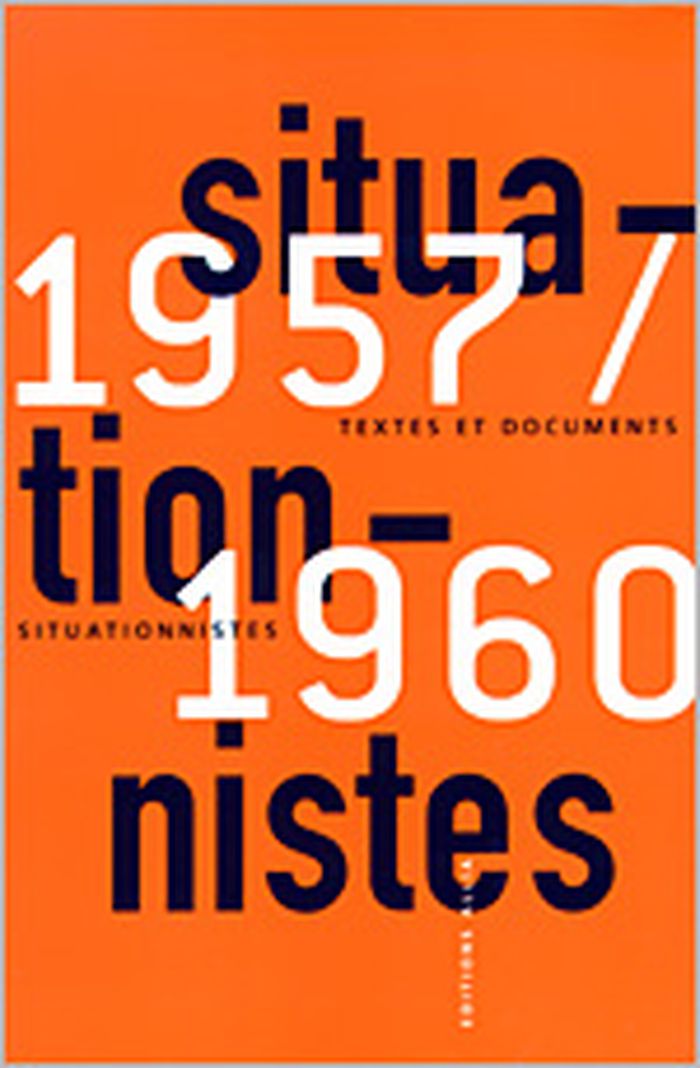
Textes et documents situationnistes 1957-1960
Actions:
Prix:
$34.95
(disponible sur commande)
Résumé:
Sur le modèle des Documents relatifs à la fondation de l’Internationale situationniste, ce volume rassemble tous les écrits, tracts, documents, monographies publiés entre 1957 et 1960 par les membres de l’Internationale situationniste et qui ne figurent pas dans la revue du même nom. On y trouve plusieurs textes de Debord restés jusqu’à présent inaccessibles comme les Remarques sur le concept d’art expérimental ou Préliminaires pour une définition de l’unité de programme révolutionnaire, ainsi que les tracts dont la violence est une des marques de l’IS (Aux producteurs de l’art moderne, Défendez la liberté partout). Mais surtout, ce volume permettra de découvrir quelques aspects ignorés de la production situationniste comme la revue de la section allemande de l’IS Spur, dont le graphisme révolutionnaire annonce tous les fanzines underground et les réalisations artistiques situationnistes, particulièrement importantes au cours de ces trois années, en particulier l’étonnante tapisserie d’Asger Jorn intitulée Le Long Voyage.
Textes et documents situationnistes 1957-1960
Actions:
Prix:
$34.95
(disponible sur commande)
Résumé:
Sur le modèle des Documents relatifs à la fondation de l’Internationale situationniste, ce volume rassemble tous les écrits, tracts, documents, monographies publiés entre 1957 et 1960 par les membres de l’Internationale situationniste et qui ne figurent pas dans la revue du même nom. On y trouve plusieurs textes de Debord restés jusqu’à présent inaccessibles comme les Remarques sur le concept d’art expérimental ou Préliminaires pour une définition de l’unité de programme révolutionnaire, ainsi que les tracts dont la violence est une des marques de l’IS (Aux producteurs de l’art moderne, Défendez la liberté partout). Mais surtout, ce volume permettra de découvrir quelques aspects ignorés de la production situationniste comme la revue de la section allemande de l’IS Spur, dont le graphisme révolutionnaire annonce tous les fanzines underground et les réalisations artistiques situationnistes, particulièrement importantes au cours de ces trois années, en particulier l’étonnante tapisserie d’Asger Jorn intitulée Le Long Voyage.
Classification:
livres
livres
Publication:
février 2004, Paris
février 2004, Paris
Sujet:
Théorie de l’architecture
Théorie de l’architecture
Classification:
livres
livres
Titre:
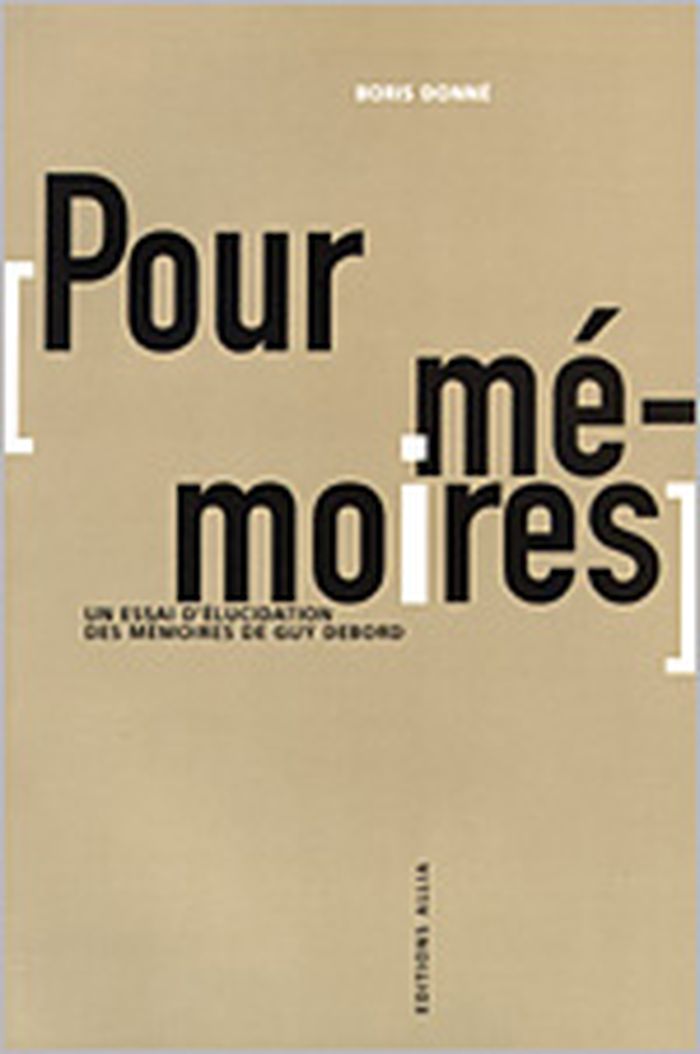
Pour mémoires
Pour mémoires
Actions:
Prix:
$27.95
(disponible sur commande)
Résumé:
Réédition en fac-similé du premier livre de Guy Debord, Mémoires, apparemment une œuvre de pure provocation où pas un mot n’est de l’auteur…L’histoire racontée secrètement dans ces Mémoires s’éclaire peu à peu : c’est celle des années décisives où Debord, âgé de 22 ans, oriente son énergie de révolte et son insatisfaction existentielle vers une critique radicale de la(...)
$27.95
(disponible sur commande)
Résumé:
Réédition en fac-similé du premier livre de Guy Debord, Mémoires, apparemment une œuvre de pure provocation où pas un mot n’est de l’auteur…L’histoire racontée secrètement dans ces Mémoires s’éclaire peu à peu : c’est celle des années décisives où Debord, âgé de 22 ans, oriente son énergie de révolte et son insatisfaction existentielle vers une critique radicale de la(...)
Titre:
Pour mémoires
Actions:
Prix:
$27.95
(disponible sur commande)
Résumé:
Réédition en fac-similé du premier livre de Guy Debord, Mémoires, apparemment une œuvre de pure provocation où pas un mot n’est de l’auteur…L’histoire racontée secrètement dans ces Mémoires s’éclaire peu à peu : c’est celle des années décisives où Debord, âgé de 22 ans, oriente son énergie de révolte et son insatisfaction existentielle vers une critique radicale de la société dont l’insurrection situationniste ne sera que le développement. Cet essai révèle enfin la pleine charge de sens, de provocation et d’émotion de ce qui est rien moins que le livre des origines profondes et intimes de l’aventure situationniste.
Pour mémoires
Actions:
Prix:
$27.95
(disponible sur commande)
Résumé:
Réédition en fac-similé du premier livre de Guy Debord, Mémoires, apparemment une œuvre de pure provocation où pas un mot n’est de l’auteur…L’histoire racontée secrètement dans ces Mémoires s’éclaire peu à peu : c’est celle des années décisives où Debord, âgé de 22 ans, oriente son énergie de révolte et son insatisfaction existentielle vers une critique radicale de la société dont l’insurrection situationniste ne sera que le développement. Cet essai révèle enfin la pleine charge de sens, de provocation et d’émotion de ce qui est rien moins que le livre des origines profondes et intimes de l’aventure situationniste.
Classification:
livres
livres
Publication:
février 2004, Paris
février 2004, Paris
Sujet:
Théorie de l’architecture
Théorie de l’architecture


