


125 Résultats
Classification:
livres
livres
Actions:
Prix:
$12.00
(disponible sur commande)
Résumé:
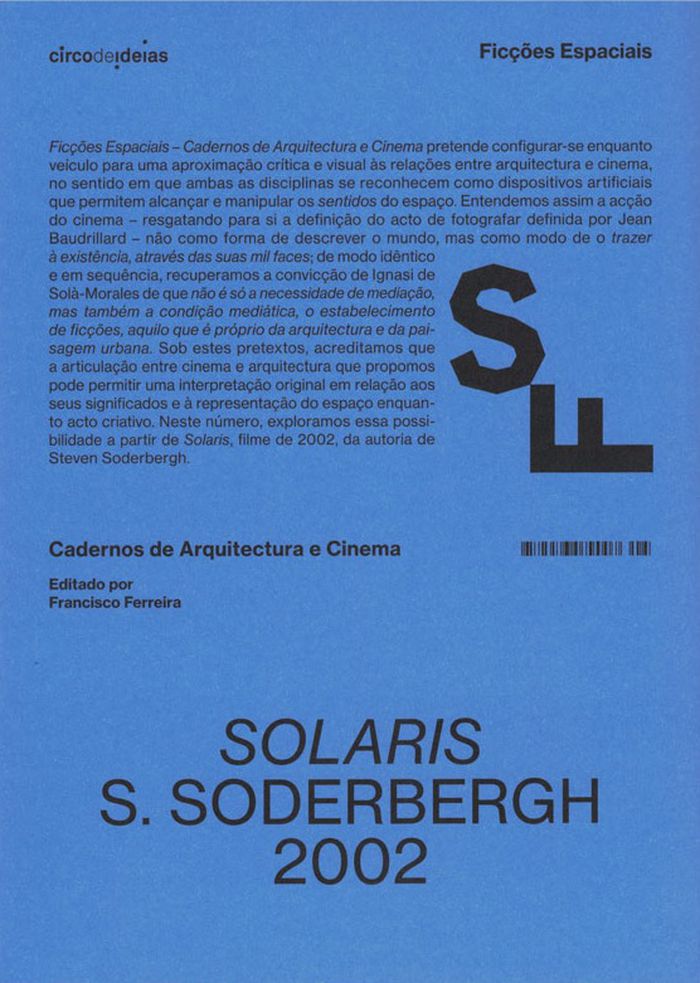
This book, published by Circo de Ideias and edited by Francisco Ferreira, with an essay by Dietrich Neumann, presents a critical and visual approach to Steven Soderbergh’s 2002 film Solaris. "Space Fictions – Booklets on Architecture and Cinema (Solaris. S. Soderbergh, 2002)" is part of a collection developed as a space for reflection on the relationship between(...)
$12.00
(disponible sur commande)
Résumé:
This book, published by Circo de Ideias and edited by Francisco Ferreira, with an essay by Dietrich Neumann, presents a critical and visual approach to Steven Soderbergh’s 2002 film Solaris. "Space Fictions – Booklets on Architecture and Cinema (Solaris. S. Soderbergh, 2002)" is part of a collection developed as a space for reflection on the relationship between(...)
Titre:
Space Fictions: Booklets on architecture and cinema (Solaris. S. Soderbergh, 2002)
Actions:
Prix:
$12.00
(disponible sur commande)
Résumé:
This book, published by Circo de Ideias and edited by Francisco Ferreira, with an essay by Dietrich Neumann, presents a critical and visual approach to Steven Soderbergh’s 2002 film Solaris. "Space Fictions – Booklets on Architecture and Cinema (Solaris. S. Soderbergh, 2002)" is part of a collection developed as a space for reflection on the relationship between architecture and cinema, in the sense that both disciplines recognise themselves as artificial devices that make it possible to reach and manipulate the senses of space.
Space Fictions: Booklets on architecture and cinema (Solaris. S. Soderbergh, 2002)
Actions:
Prix:
$12.00
(disponible sur commande)
Résumé:
This book, published by Circo de Ideias and edited by Francisco Ferreira, with an essay by Dietrich Neumann, presents a critical and visual approach to Steven Soderbergh’s 2002 film Solaris. "Space Fictions – Booklets on Architecture and Cinema (Solaris. S. Soderbergh, 2002)" is part of a collection developed as a space for reflection on the relationship between architecture and cinema, in the sense that both disciplines recognise themselves as artificial devices that make it possible to reach and manipulate the senses of space.
Classification:
livres
livres
Publication:
mars 2025
mars 2025
Classification:
livres
livres
Actions:
Prix:
$12.00
(disponible sur commande)
Résumé:
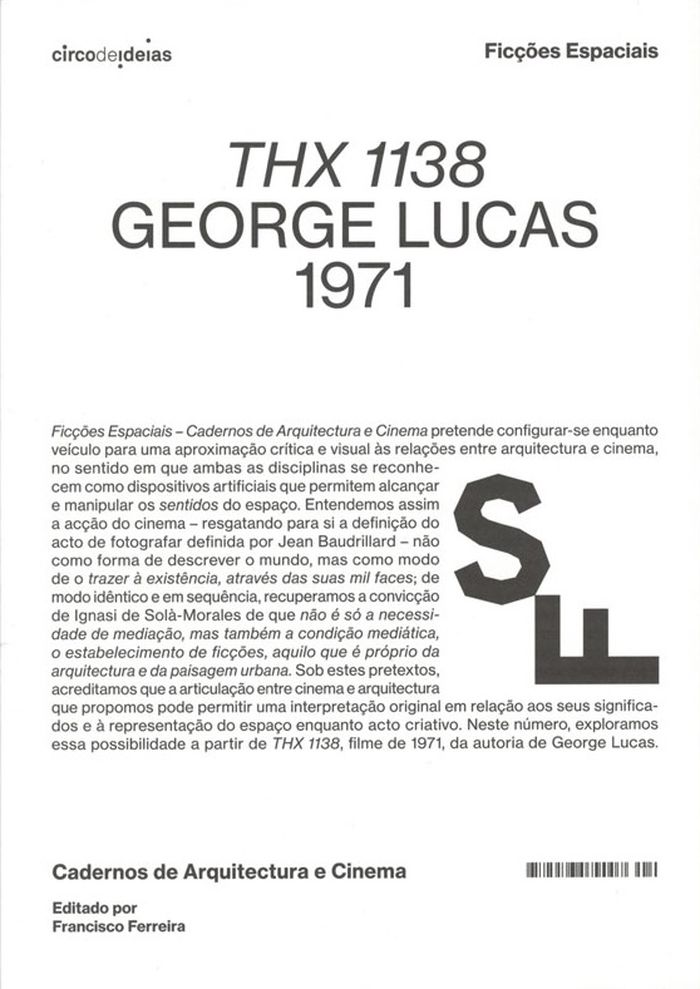
This book, published by Circo de Ideias, edited and authored by Francisco Ferreira, presents a critical and visual approach to George Lucas’s 1971 film THX 1138. "Space Fictions – Booklets on Architecture and Cinema (THX 1138. George Lucas, 1971)" is part of a collection developed as a space for reflection on the relationship between architecture and cinema, in the sense(...)
$12.00
(disponible sur commande)
Résumé:
This book, published by Circo de Ideias, edited and authored by Francisco Ferreira, presents a critical and visual approach to George Lucas’s 1971 film THX 1138. "Space Fictions – Booklets on Architecture and Cinema (THX 1138. George Lucas, 1971)" is part of a collection developed as a space for reflection on the relationship between architecture and cinema, in the sense(...)
Titre:
Space Fictions: Booklets on architecture and cinema (THX 1138. George Lucas, 1971)
Actions:
Prix:
$12.00
(disponible sur commande)
Résumé:
This book, published by Circo de Ideias, edited and authored by Francisco Ferreira, presents a critical and visual approach to George Lucas’s 1971 film THX 1138. "Space Fictions – Booklets on Architecture and Cinema (THX 1138. George Lucas, 1971)" is part of a collection developed as a space for reflection on the relationship between architecture and cinema, in the sense that both disciplines recognise themselves as artificial devices that make it possible to reach and manipulate the senses of space.
Space Fictions: Booklets on architecture and cinema (THX 1138. George Lucas, 1971)
Actions:
Prix:
$12.00
(disponible sur commande)
Résumé:
This book, published by Circo de Ideias, edited and authored by Francisco Ferreira, presents a critical and visual approach to George Lucas’s 1971 film THX 1138. "Space Fictions – Booklets on Architecture and Cinema (THX 1138. George Lucas, 1971)" is part of a collection developed as a space for reflection on the relationship between architecture and cinema, in the sense that both disciplines recognise themselves as artificial devices that make it possible to reach and manipulate the senses of space.
Classification:
livres
livres
Publication:
mars 2025
mars 2025
Classification:
livres
livres
Titre:
Space Fictions: Booklets on architecture and cinema (Being John Malkovich. Spike Jonze, 1999)
Space Fictions: Booklets on architecture and cinema (Being John Malkovich. Spike Jonze, 1999)
Actions:
Prix:
$12.00
(disponible sur commande)
Résumé:
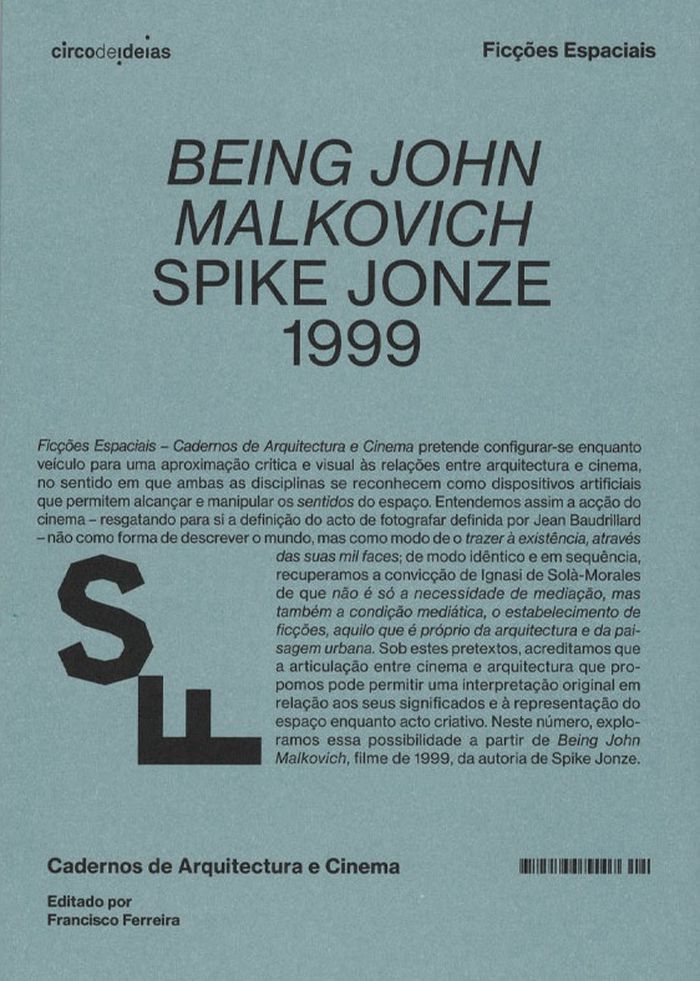
This book, published by Circo de Ideias and edited by Francisco Ferreira, with an essay by Susana Ventura, presents a critical and visual approach to Spike Jonze’s 1999 film Being John Malkovich. "Space Fictions – Booklets on Architecture and Cinema (Being John Malkovich. Spike Jonze, 1999)" is part of a collection developed as a space for reflection on the relationship(...)
$12.00
(disponible sur commande)
Résumé:
This book, published by Circo de Ideias and edited by Francisco Ferreira, with an essay by Susana Ventura, presents a critical and visual approach to Spike Jonze’s 1999 film Being John Malkovich. "Space Fictions – Booklets on Architecture and Cinema (Being John Malkovich. Spike Jonze, 1999)" is part of a collection developed as a space for reflection on the relationship(...)
Titre:
Space Fictions: Booklets on architecture and cinema (Being John Malkovich. Spike Jonze, 1999)
Actions:
Prix:
$12.00
(disponible sur commande)
Résumé:
This book, published by Circo de Ideias and edited by Francisco Ferreira, with an essay by Susana Ventura, presents a critical and visual approach to Spike Jonze’s 1999 film Being John Malkovich. "Space Fictions – Booklets on Architecture and Cinema (Being John Malkovich. Spike Jonze, 1999)" is part of a collection developed as a space for reflection on the relationship between architecture and cinema, in the sense that both disciplines recognise themselves as artificial devices that make it possible to reach and manipulate the senses of space.
Space Fictions: Booklets on architecture and cinema (Being John Malkovich. Spike Jonze, 1999)
Actions:
Prix:
$12.00
(disponible sur commande)
Résumé:
This book, published by Circo de Ideias and edited by Francisco Ferreira, with an essay by Susana Ventura, presents a critical and visual approach to Spike Jonze’s 1999 film Being John Malkovich. "Space Fictions – Booklets on Architecture and Cinema (Being John Malkovich. Spike Jonze, 1999)" is part of a collection developed as a space for reflection on the relationship between architecture and cinema, in the sense that both disciplines recognise themselves as artificial devices that make it possible to reach and manipulate the senses of space.
Classification:
livres
livres
Publication:
mars 2025
mars 2025
Classification:
livres
livres
Actions:
Prix:
$12.00
(disponible en magasin)
Résumé:
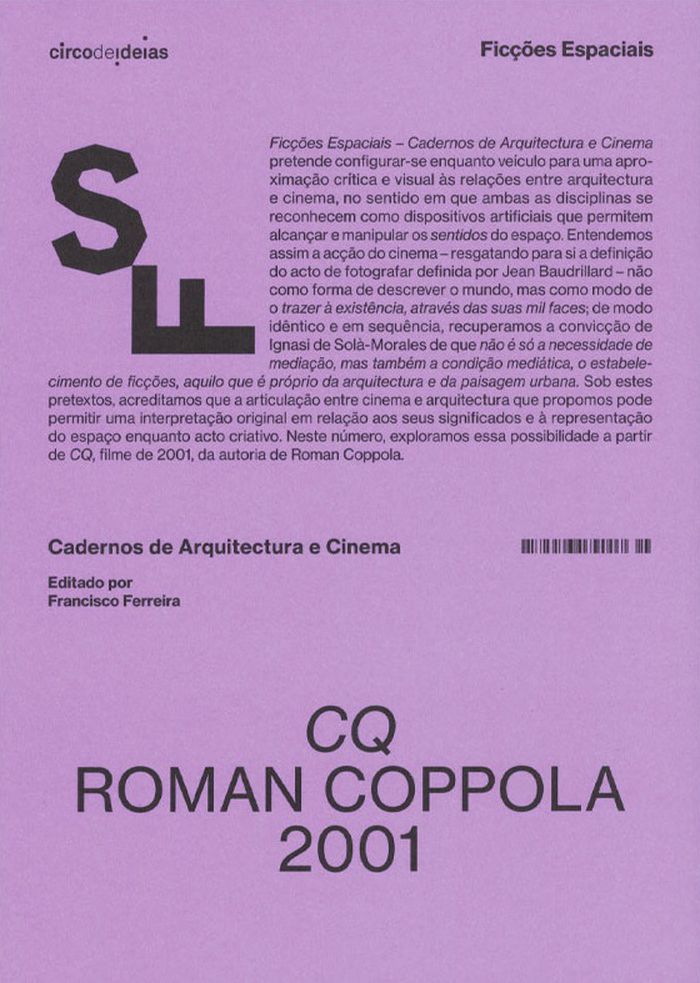
This book, published by Circo de Ideias and edited by Francisco Ferreira, with an essay by Alexandra Areia, presents a critical and visual approach to Roman Coppola’s 2001 film CQ. "Space Fictions – Booklets on Architecture and Cinema (CQ. Roman Coppola, 2001)" is part of a collection developed as a space for reflection on the relationship between architecture and(...)
$12.00
(disponible en magasin)
Résumé:
This book, published by Circo de Ideias and edited by Francisco Ferreira, with an essay by Alexandra Areia, presents a critical and visual approach to Roman Coppola’s 2001 film CQ. "Space Fictions – Booklets on Architecture and Cinema (CQ. Roman Coppola, 2001)" is part of a collection developed as a space for reflection on the relationship between architecture and(...)
Titre:
Space Fictions: Booklets on architecture and cinema (CQ. Roman Coppola, 2001)
Actions:
Prix:
$12.00
(disponible en magasin)
Résumé:
This book, published by Circo de Ideias and edited by Francisco Ferreira, with an essay by Alexandra Areia, presents a critical and visual approach to Roman Coppola’s 2001 film CQ. "Space Fictions – Booklets on Architecture and Cinema (CQ. Roman Coppola, 2001)" is part of a collection developed as a space for reflection on the relationship between architecture and cinema, in the sense that both disciplines recognise themselves as artificial devices that make it possible to reach and manipulate the senses of space.
Space Fictions: Booklets on architecture and cinema (CQ. Roman Coppola, 2001)
Actions:
Prix:
$12.00
(disponible en magasin)
Résumé:
This book, published by Circo de Ideias and edited by Francisco Ferreira, with an essay by Alexandra Areia, presents a critical and visual approach to Roman Coppola’s 2001 film CQ. "Space Fictions – Booklets on Architecture and Cinema (CQ. Roman Coppola, 2001)" is part of a collection developed as a space for reflection on the relationship between architecture and cinema, in the sense that both disciplines recognise themselves as artificial devices that make it possible to reach and manipulate the senses of space.
Classification:
livres
livres
Publication:
mars 2025
mars 2025
Classification:
livres
livres
Actions:
Prix:
$12.00
(disponible sur commande)
Résumé:
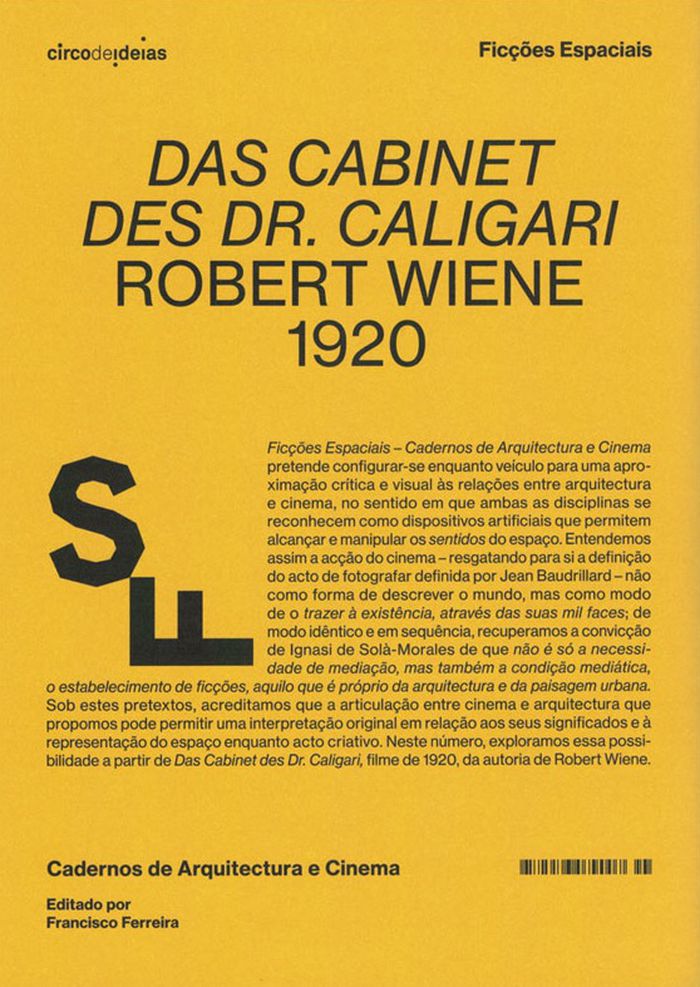
This book, published by Circo de Ideias and edited by Francisco Ferreira, with an essay by Joaquim Sapinho, presents a critical and visual approach to Robert Wiene’s 1920 film Das Cabinet des Dr. Caligari. "Space Fictions – Booklets on Architecture and Cinema (Das Cabinet des Dr. Caligari. Robert Wiene, 1920)" is part of a collection developed as a space for reflection(...)
$12.00
(disponible sur commande)
Résumé:
This book, published by Circo de Ideias and edited by Francisco Ferreira, with an essay by Joaquim Sapinho, presents a critical and visual approach to Robert Wiene’s 1920 film Das Cabinet des Dr. Caligari. "Space Fictions – Booklets on Architecture and Cinema (Das Cabinet des Dr. Caligari. Robert Wiene, 1920)" is part of a collection developed as a space for reflection(...)
Titre:
Space Fictions: Booklets on architecture and cinema (Das Cabinet des Dr. Caligari. Robert Wiene, 1920)
Actions:
Prix:
$12.00
(disponible sur commande)
Résumé:
This book, published by Circo de Ideias and edited by Francisco Ferreira, with an essay by Joaquim Sapinho, presents a critical and visual approach to Robert Wiene’s 1920 film Das Cabinet des Dr. Caligari. "Space Fictions – Booklets on Architecture and Cinema (Das Cabinet des Dr. Caligari. Robert Wiene, 1920)" is part of a collection developed as a space for reflection on the relationship between architecture and cinema, in the sense that both disciplines recognise themselves as artificial devices that make it possible to reach and manipulate the senses of space.
Space Fictions: Booklets on architecture and cinema (Das Cabinet des Dr. Caligari. Robert Wiene, 1920)
Actions:
Prix:
$12.00
(disponible sur commande)
Résumé:
This book, published by Circo de Ideias and edited by Francisco Ferreira, with an essay by Joaquim Sapinho, presents a critical and visual approach to Robert Wiene’s 1920 film Das Cabinet des Dr. Caligari. "Space Fictions – Booklets on Architecture and Cinema (Das Cabinet des Dr. Caligari. Robert Wiene, 1920)" is part of a collection developed as a space for reflection on the relationship between architecture and cinema, in the sense that both disciplines recognise themselves as artificial devices that make it possible to reach and manipulate the senses of space.
Classification:
livres
livres
Publication:
mars 2025
mars 2025
Classification:
livres
livres
Titre:
The Darkroom
The Darkroom
Actions:
Prix:
$24.00
(disponible sur commande)
Résumé:
"The darkroom" contains the script for Marguerite Duras's 1977 radically experimental film "Le camion" ("The Truck"). Between images of a truck in motion, juxtaposed voiceovers, and cutaways to Duras in conversation with Gérard Depardieu, Le camion turns the art of film into a means of enabling the viewer to engage multiple faculties--not only the visual and the aural,(...)
$24.00
(disponible sur commande)
Résumé:
"The darkroom" contains the script for Marguerite Duras's 1977 radically experimental film "Le camion" ("The Truck"). Between images of a truck in motion, juxtaposed voiceovers, and cutaways to Duras in conversation with Gérard Depardieu, Le camion turns the art of film into a means of enabling the viewer to engage multiple faculties--not only the visual and the aural,(...)
Publication:
mars 2025
mars 2025
Titre:
The Darkroom
Actions:
Prix:
$24.00
(disponible sur commande)
Résumé:
"The darkroom" contains the script for Marguerite Duras's 1977 radically experimental film "Le camion" ("The Truck"). Between images of a truck in motion, juxtaposed voiceovers, and cutaways to Duras in conversation with Gérard Depardieu, Le camion turns the art of film into a means of enabling the viewer to engage multiple faculties--not only the visual and the aural, but also memory, imagination, and desire. Also included here is a series of short essays in which Duras makes provocative connections between film and textuality, as well as a fascinating dialogue with Michelle Porte. Together amounting to a crucial contribution to the field of film theory, these texts make brilliantly apparent the depth and integrity of Duras's aesthetic, philosophical, and political thinking.
The Darkroom
Actions:
Prix:
$24.00
(disponible sur commande)
Résumé:
"The darkroom" contains the script for Marguerite Duras's 1977 radically experimental film "Le camion" ("The Truck"). Between images of a truck in motion, juxtaposed voiceovers, and cutaways to Duras in conversation with Gérard Depardieu, Le camion turns the art of film into a means of enabling the viewer to engage multiple faculties--not only the visual and the aural, but also memory, imagination, and desire. Also included here is a series of short essays in which Duras makes provocative connections between film and textuality, as well as a fascinating dialogue with Michelle Porte. Together amounting to a crucial contribution to the field of film theory, these texts make brilliantly apparent the depth and integrity of Duras's aesthetic, philosophical, and political thinking.
Classification:
livres
livres
Publication:
mars 2025
mars 2025
Classification:
livres
livres
Prix:
$24.95
(disponible sur commande)
Résumé:
Comment décrire la rencontre qui s'opère avec un film ? En s'appuyant sur la phénoménologie de Maurice Merleau-Ponty, Vivian Sobchack repart de notre expérience de la rencontre avec autrui : lorsque je rencontre un autre humain, je vois bien son corps visible mais je ne peux que déduire, deviner, imaginer, supposer ce que celui-ci voit et ressent. Cet autre sujet qu'est(...)
$24.95
(disponible sur commande)
Résumé:
Comment décrire la rencontre qui s'opère avec un film ? En s'appuyant sur la phénoménologie de Maurice Merleau-Ponty, Vivian Sobchack repart de notre expérience de la rencontre avec autrui : lorsque je rencontre un autre humain, je vois bien son corps visible mais je ne peux que déduire, deviner, imaginer, supposer ce que celui-ci voit et ressent. Cet autre sujet qu'est(...)
Publication:
mai 2025
mai 2025
Titre:
Les corps du film : Une phéménologie de l'expérience filmique
Actions:
Prix:
$24.95
(disponible sur commande)
Résumé:
Comment décrire la rencontre qui s'opère avec un film ? En s'appuyant sur la phénoménologie de Maurice Merleau-Ponty, Vivian Sobchack repart de notre expérience de la rencontre avec autrui : lorsque je rencontre un autre humain, je vois bien son corps visible mais je ne peux que déduire, deviner, imaginer, supposer ce que celui-ci voit et ressent. Cet autre sujet qu'est le film inaugure un geste différent et inédit : il se présente à moi en me montrant ce qu'il voit, il me montre l'activité perceptive de son corps voyant. Comment qualifier un tel corps ? Et la relation qui s'offre alors à nous ? Ce parcours dans l'essai fondateur de la philosophe des médias Vivian Sobchack nous permet de saisir son approche radicale du cinéma et renouvelle notre regard sur les flux d'images contemporains, avec lesquels nous vivons actuellement.
Les corps du film : Une phéménologie de l'expérience filmique
Actions:
Prix:
$24.95
(disponible sur commande)
Résumé:
Comment décrire la rencontre qui s'opère avec un film ? En s'appuyant sur la phénoménologie de Maurice Merleau-Ponty, Vivian Sobchack repart de notre expérience de la rencontre avec autrui : lorsque je rencontre un autre humain, je vois bien son corps visible mais je ne peux que déduire, deviner, imaginer, supposer ce que celui-ci voit et ressent. Cet autre sujet qu'est le film inaugure un geste différent et inédit : il se présente à moi en me montrant ce qu'il voit, il me montre l'activité perceptive de son corps voyant. Comment qualifier un tel corps ? Et la relation qui s'offre alors à nous ? Ce parcours dans l'essai fondateur de la philosophe des médias Vivian Sobchack nous permet de saisir son approche radicale du cinéma et renouvelle notre regard sur les flux d'images contemporains, avec lesquels nous vivons actuellement.
Classification:
livres
livres
Publication:
mai 2025
mai 2025
Classification:
livres
livres
Actions:
Prix:
$68.95
(disponible sur commande)
Résumé:
Published to complement the 14th Shanghai Biennale, entitled Cosmos Cinema and curated by Anton Vidokle, this illustrated catalogue extends the exhibition's proposal that the methodologies of filmmaking might offer one way of representing and reimagining our entanglement in time and space. The book presents the work of artists from the early twentieth century to the(...)
$68.95
(disponible sur commande)
Résumé:
Published to complement the 14th Shanghai Biennale, entitled Cosmos Cinema and curated by Anton Vidokle, this illustrated catalogue extends the exhibition's proposal that the methodologies of filmmaking might offer one way of representing and reimagining our entanglement in time and space. The book presents the work of artists from the early twentieth century to the(...)
Titre:
14th Shanghai Biennale: Cosmos cinema
Actions:
Prix:
$68.95
(disponible sur commande)
Résumé:
Published to complement the 14th Shanghai Biennale, entitled Cosmos Cinema and curated by Anton Vidokle, this illustrated catalogue extends the exhibition's proposal that the methodologies of filmmaking might offer one way of representing and reimagining our entanglement in time and space. The book presents the work of artists from the early twentieth century to the present alongside a series of specially commissioned essays on subjects ranging from the history of Shanghai cinema to the possibility of communicating with nonhuman intelligence. Arranged according to the Nine Palaces of traditional Chinese cosmology, and reproduced here in a design that recreates the consciously cinematic experience of the exhibition, these works of art and their accompanying texts encourage us to reflect on our place within the systems that shape our lives at every scale.
14th Shanghai Biennale: Cosmos cinema
Actions:
Prix:
$68.95
(disponible sur commande)
Résumé:
Published to complement the 14th Shanghai Biennale, entitled Cosmos Cinema and curated by Anton Vidokle, this illustrated catalogue extends the exhibition's proposal that the methodologies of filmmaking might offer one way of representing and reimagining our entanglement in time and space. The book presents the work of artists from the early twentieth century to the present alongside a series of specially commissioned essays on subjects ranging from the history of Shanghai cinema to the possibility of communicating with nonhuman intelligence. Arranged according to the Nine Palaces of traditional Chinese cosmology, and reproduced here in a design that recreates the consciously cinematic experience of the exhibition, these works of art and their accompanying texts encourage us to reflect on our place within the systems that shape our lives at every scale.
Classification:
livres
livres
Publication:
février 2025
février 2025
Classification:
livres
livres
Actions:
Prix:
$54.00
(disponible sur commande)
Résumé:
Video (television, film, the moving image generally) is today's most popular information medium. Two-thirds of the world's internet traffic is video. Americans get their news and information more often from screens and speakers than through any other means. "The moving image" is the first authoritative account of how we have arrived here, together with the first(...)
$54.00
(disponible sur commande)
Résumé:
Video (television, film, the moving image generally) is today's most popular information medium. Two-thirds of the world's internet traffic is video. Americans get their news and information more often from screens and speakers than through any other means. "The moving image" is the first authoritative account of how we have arrived here, together with the first(...)
Titre:
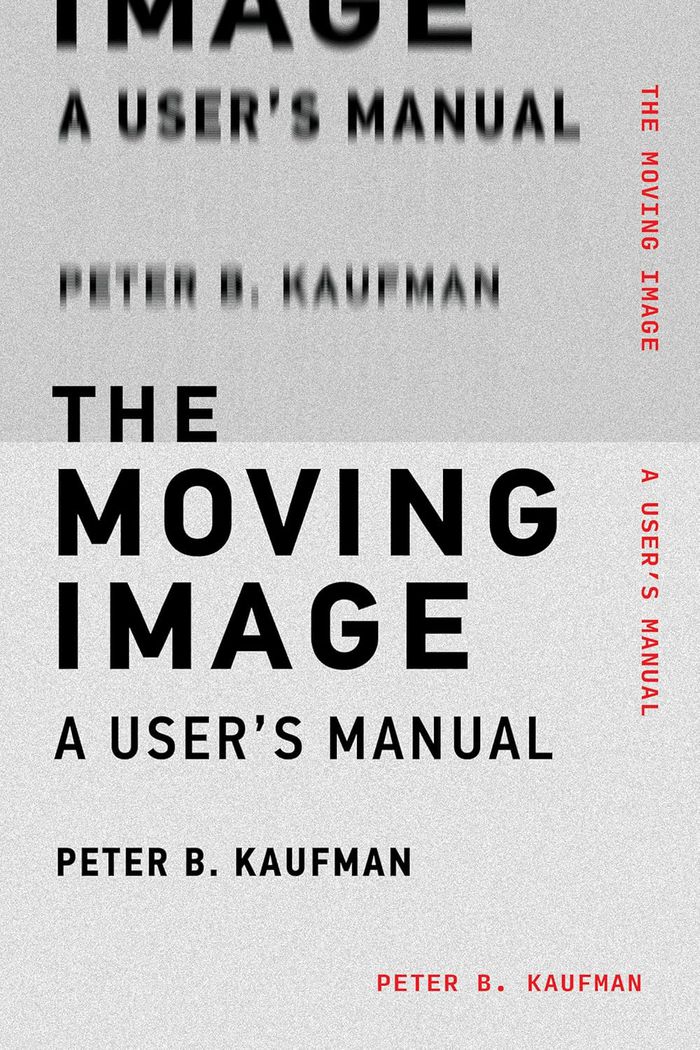
The moving image: A user's manual
Actions:
Prix:
$54.00
(disponible sur commande)
Résumé:
Video (television, film, the moving image generally) is today's most popular information medium. Two-thirds of the world's internet traffic is video. Americans get their news and information more often from screens and speakers than through any other means. "The moving image" is the first authoritative account of how we have arrived here, together with the first definitive manual to help writers, educators, and publishers use video more effectively. Drawing on decades as an educator, publisher, and producer, MIT's Peter Kaufman presents new tools, best practices, and community resources for integrating film and sound into media that matters.
The moving image: A user's manual
Actions:
Prix:
$54.00
(disponible sur commande)
Résumé:
Video (television, film, the moving image generally) is today's most popular information medium. Two-thirds of the world's internet traffic is video. Americans get their news and information more often from screens and speakers than through any other means. "The moving image" is the first authoritative account of how we have arrived here, together with the first definitive manual to help writers, educators, and publishers use video more effectively. Drawing on decades as an educator, publisher, and producer, MIT's Peter Kaufman presents new tools, best practices, and community resources for integrating film and sound into media that matters.
Classification:
livres
livres
Publication:
février 2025
février 2025
Classification:
livres
livres
Actions:
Prix:
$41.95
(disponible sur commande)
Résumé:
Although a few among us are intrepid architectural tourists, visiting buildings and landscapes our cameras at the ready, most of us experience architecture through the windshield of a moving vehicle, the architectural experience reduced to a blurry and momentary drive-by. And the rest of our architectural "tourism" is through the images of cameras, movies, and television(...)
$41.95
(disponible sur commande)
Résumé:
Although a few among us are intrepid architectural tourists, visiting buildings and landscapes our cameras at the ready, most of us experience architecture through the windshield of a moving vehicle, the architectural experience reduced to a blurry and momentary drive-by. And the rest of our architectural "tourism" is through the images of cameras, movies, and television(...)
Publication:
mai 2004, New York
mai 2004, New York
Titre:
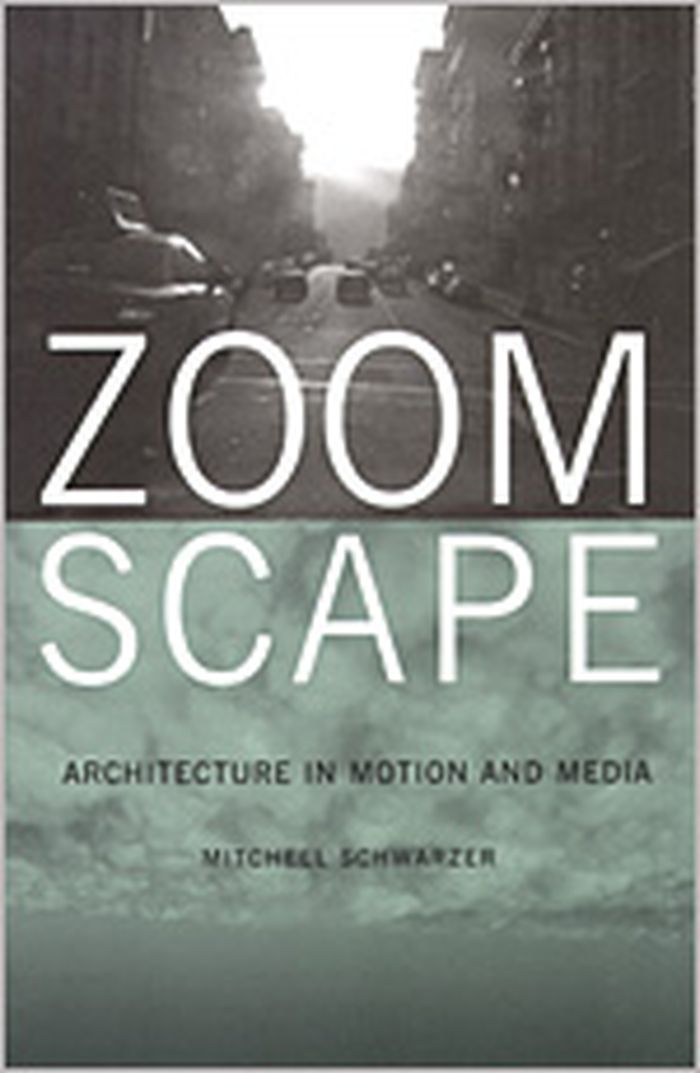
Zoomscape : architecture and motion in media
Actions:
Prix:
$41.95
(disponible sur commande)
Résumé:
Although a few among us are intrepid architectural tourists, visiting buildings and landscapes our cameras at the ready, most of us experience architecture through the windshield of a moving vehicle, the architectural experience reduced to a blurry and momentary drive-by. And the rest of our architectural "tourism" is through the images of cameras, movies, and television programs—that is, through the lens of another's eye. Architectural historian Mitchell Schwarzer calls this new mediated architectural experience the "zoomscape." In this thought-provoking book, he argues that the perception of architecture has been fundamentally altered by the technologies of transportation and the camera - we now look at buildings, neighborhoods, cities, and even entire continents as we ride in trains, cars, and planes, and/or as we view photographs, movies, and television. "Zoomscape" shows how we now perceive buildings and places at high speeds, across great distances, through edited and multiple reproductions. Nowadays, our views of the architectural landscape are modulated by the accelerator pedal and the remote control, by studio production techniques and airplane flight paths. Using examples from high art and popular culture - from the novels of Don DeLillo to the opening credits of "The Sopranos" - Mitchell Schwarzer shows that the zoomscape has brought about unprecedented and often marvelous new ways of perceiving the built environment.
Zoomscape : architecture and motion in media
Actions:
Prix:
$41.95
(disponible sur commande)
Résumé:
Although a few among us are intrepid architectural tourists, visiting buildings and landscapes our cameras at the ready, most of us experience architecture through the windshield of a moving vehicle, the architectural experience reduced to a blurry and momentary drive-by. And the rest of our architectural "tourism" is through the images of cameras, movies, and television programs—that is, through the lens of another's eye. Architectural historian Mitchell Schwarzer calls this new mediated architectural experience the "zoomscape." In this thought-provoking book, he argues that the perception of architecture has been fundamentally altered by the technologies of transportation and the camera - we now look at buildings, neighborhoods, cities, and even entire continents as we ride in trains, cars, and planes, and/or as we view photographs, movies, and television. "Zoomscape" shows how we now perceive buildings and places at high speeds, across great distances, through edited and multiple reproductions. Nowadays, our views of the architectural landscape are modulated by the accelerator pedal and the remote control, by studio production techniques and airplane flight paths. Using examples from high art and popular culture - from the novels of Don DeLillo to the opening credits of "The Sopranos" - Mitchell Schwarzer shows that the zoomscape has brought about unprecedented and often marvelous new ways of perceiving the built environment.
Classification:
livres
livres
Publication:
mai 2004, New York
mai 2004, New York


