


884 Résultats
Classification:
livres
livres
Actions:
Prix:
$20.95
(disponible sur commande)
Résumé:
In On Comopolitanism and Forgiveness, Jacques Derrida confronts two pressing problems: the explosive tensions between refugee and asylum rights and the ethic of hospitality; and the dilemma of reconciliation and amnesty where the bloody traumas of history demand forgiveness.
$20.95
(disponible sur commande)
Résumé:
In On Comopolitanism and Forgiveness, Jacques Derrida confronts two pressing problems: the explosive tensions between refugee and asylum rights and the ethic of hospitality; and the dilemma of reconciliation and amnesty where the bloody traumas of history demand forgiveness.
Titre:
Cosmopolitanism and Forgiveness
Actions:
Prix:
$20.95
(disponible sur commande)
Résumé:
In On Comopolitanism and Forgiveness, Jacques Derrida confronts two pressing problems: the explosive tensions between refugee and asylum rights and the ethic of hospitality; and the dilemma of reconciliation and amnesty where the bloody traumas of history demand forgiveness.
Cosmopolitanism and Forgiveness
Actions:
Prix:
$20.95
(disponible sur commande)
Résumé:
In On Comopolitanism and Forgiveness, Jacques Derrida confronts two pressing problems: the explosive tensions between refugee and asylum rights and the ethic of hospitality; and the dilemma of reconciliation and amnesty where the bloody traumas of history demand forgiveness.
Classification:
livres
livres
Publication:
janvier 1900, London and New York
janvier 1900, London and New York
Sujet:
Théorie/ philosophie
Théorie/ philosophie
Classification:
livres
livres
Actions:
Prix:
$18.95
(disponible sur commande)
Résumé:
In 1971, at the height of the Vietnam War and at a time of great political and social instability, two of the world’s leading intellectuals, Noam Chomsky and Michel Foucault, were invited by Dutch philosopher Fons Elders to debate an age-old question: is there such a thing as "innate" human nature independent of our experiences and external influences? The resulting(...)
$18.95
(disponible sur commande)
Résumé:
In 1971, at the height of the Vietnam War and at a time of great political and social instability, two of the world’s leading intellectuals, Noam Chomsky and Michel Foucault, were invited by Dutch philosopher Fons Elders to debate an age-old question: is there such a thing as "innate" human nature independent of our experiences and external influences? The resulting(...)
Sujet:
Théorie/ philosophie
Théorie/ philosophie
Publication:
janvier 1900, New York, London
janvier 1900, New York, London
Titre:
The Chomsky - Foucault debate on human nature
Actions:
Prix:
$18.95
(disponible sur commande)
Résumé:
In 1971, at the height of the Vietnam War and at a time of great political and social instability, two of the world’s leading intellectuals, Noam Chomsky and Michel Foucault, were invited by Dutch philosopher Fons Elders to debate an age-old question: is there such a thing as "innate" human nature independent of our experiences and external influences? The resulting dialogue is one of the most original, provocative, and spontaneous exchanges to have occurred between contemporary philosophers, and above all serves as a concise introduction to their basic theories. What begins as a philosophical argument rooted in linguistics (Chomsky) and the theory of knowledge (Foucault), soon evolves into a broader discussion encompassing a wide range of topics, from science, history, and behaviorism to creativity, freedom, and the struggle for justice in the realm of politics. In addition to the debate itself, this volume features a newly written introduction by Foucault scholar John Rajchman and includes substantial additional texts by Chomsky and Foucault.
The Chomsky - Foucault debate on human nature
Actions:
Prix:
$18.95
(disponible sur commande)
Résumé:
In 1971, at the height of the Vietnam War and at a time of great political and social instability, two of the world’s leading intellectuals, Noam Chomsky and Michel Foucault, were invited by Dutch philosopher Fons Elders to debate an age-old question: is there such a thing as "innate" human nature independent of our experiences and external influences? The resulting dialogue is one of the most original, provocative, and spontaneous exchanges to have occurred between contemporary philosophers, and above all serves as a concise introduction to their basic theories. What begins as a philosophical argument rooted in linguistics (Chomsky) and the theory of knowledge (Foucault), soon evolves into a broader discussion encompassing a wide range of topics, from science, history, and behaviorism to creativity, freedom, and the struggle for justice in the realm of politics. In addition to the debate itself, this volume features a newly written introduction by Foucault scholar John Rajchman and includes substantial additional texts by Chomsky and Foucault.
Classification:
livres
livres
Publication:
janvier 1900, New York, London
janvier 1900, New York, London
Sujet:
Théorie/ philosophie
Théorie/ philosophie
Classification:
livres
livres
Actions:
Prix:
$23.50
(disponible sur commande)
Résumé:
This one-volume gathering of Benjamin's dialectical writing on media of all kinds, ranging from children's literature to cinema, has at its heart the second, most expansive version of his path-breaking essay 'The Work of Art in the Age of Its Technological Reproducibility.' Readers familiar only with partial versions of this piece, where Benjamin began to record the(...)
$23.50
(disponible sur commande)
Résumé:
This one-volume gathering of Benjamin's dialectical writing on media of all kinds, ranging from children's literature to cinema, has at its heart the second, most expansive version of his path-breaking essay 'The Work of Art in the Age of Its Technological Reproducibility.' Readers familiar only with partial versions of this piece, where Benjamin began to record the(...)
Titre:
The work of art in the age of its technological reproducibility and other writings on media
Actions:
Prix:
$23.50
(disponible sur commande)
Résumé:
This one-volume gathering of Benjamin's dialectical writing on media of all kinds, ranging from children's literature to cinema, has at its heart the second, most expansive version of his path-breaking essay 'The Work of Art in the Age of Its Technological Reproducibility.' Readers familiar only with partial versions of this piece, where Benjamin began to record the melancholy loss of aesthetic presence at the turn of the twentieth century, will find their understanding transformed-- for this second version, like all the essays and supplemental texts included here, explores a set of latent, utopian possibilities inherent in mechanical means of art-making. Benjamin, the visionary magus of particulars, reveals profoundly, and repeatedly, both the grounds and the consequences of our ever-changing image of the made world. --Susan Stewart
The work of art in the age of its technological reproducibility and other writings on media
Actions:
Prix:
$23.50
(disponible sur commande)
Résumé:
This one-volume gathering of Benjamin's dialectical writing on media of all kinds, ranging from children's literature to cinema, has at its heart the second, most expansive version of his path-breaking essay 'The Work of Art in the Age of Its Technological Reproducibility.' Readers familiar only with partial versions of this piece, where Benjamin began to record the melancholy loss of aesthetic presence at the turn of the twentieth century, will find their understanding transformed-- for this second version, like all the essays and supplemental texts included here, explores a set of latent, utopian possibilities inherent in mechanical means of art-making. Benjamin, the visionary magus of particulars, reveals profoundly, and repeatedly, both the grounds and the consequences of our ever-changing image of the made world. --Susan Stewart
Classification:
livres
livres
Publication:
mai 2008, Cambridge, London
mai 2008, Cambridge, London
Sujet:
Théorie/ philosophie
Théorie/ philosophie
Classification:
livres
livres
Actions:
Prix:
$35.00
(disponible sur commande)
Résumé:
The Critique of Everyday Life is perhaps the richest, most prescient work by one of the twentieth century's greatest philosophers. The trilogy which provided the philosophy behind the 1968 student revolution in France, it is considered to be the founding text of what we now know as cultural studies. Whether discussing sport, household gadgets, the countryside, surrealism,(...)
$35.00
(disponible sur commande)
Résumé:
The Critique of Everyday Life is perhaps the richest, most prescient work by one of the twentieth century's greatest philosophers. The trilogy which provided the philosophy behind the 1968 student revolution in France, it is considered to be the founding text of what we now know as cultural studies. Whether discussing sport, household gadgets, the countryside, surrealism,(...)
Titre:
Critique of Everyday Life volume 1
Actions:
Prix:
$35.00
(disponible sur commande)
Résumé:
The Critique of Everyday Life is perhaps the richest, most prescient work by one of the twentieth century's greatest philosophers. The trilogy which provided the philosophy behind the 1968 student revolution in France, it is considered to be the founding text of what we now know as cultural studies. Whether discussing sport, household gadgets, the countryside, surrealism, Charlie Chaplin or religion, Lefebvre always concentrates on the minutiae of lived experience in work and leisure, daydreams, and festivities. Denounced by both the right and left when it was first published in France in 1947, today this text is recognized as a path-breaking, radical, and hugely influential book. Volume 3, From Modernity to Modernism (Towards a Metaphilosophy of Daily Life), explores the crisis of modernity and the decisive assertion of technological modernism.
Critique of Everyday Life volume 1
Actions:
Prix:
$35.00
(disponible sur commande)
Résumé:
The Critique of Everyday Life is perhaps the richest, most prescient work by one of the twentieth century's greatest philosophers. The trilogy which provided the philosophy behind the 1968 student revolution in France, it is considered to be the founding text of what we now know as cultural studies. Whether discussing sport, household gadgets, the countryside, surrealism, Charlie Chaplin or religion, Lefebvre always concentrates on the minutiae of lived experience in work and leisure, daydreams, and festivities. Denounced by both the right and left when it was first published in France in 1947, today this text is recognized as a path-breaking, radical, and hugely influential book. Volume 3, From Modernity to Modernism (Towards a Metaphilosophy of Daily Life), explores the crisis of modernity and the decisive assertion of technological modernism.
Classification:
livres
livres
Publication:
janvier 2008, London, New York
janvier 2008, London, New York
Sujet:
Théorie/ philosophie
Théorie/ philosophie
Classification:
livres
livres

Actions:
Prix:
$33.00
(disponible en magasin)
Résumé:
"The more needs a human being has, the more he exists," quips Lefebvre in a savage critique of consumerist society, first published in 1947. The French philosopher, historian and Marxist sociologist, who died this summer at age 90, meditates on the dehumanization and ugliness smuggled into daily life under cover of purity, utility, beauty. He deconstructs leisure as a(...)
$33.00
(disponible en magasin)
Résumé:
"The more needs a human being has, the more he exists," quips Lefebvre in a savage critique of consumerist society, first published in 1947. The French philosopher, historian and Marxist sociologist, who died this summer at age 90, meditates on the dehumanization and ugliness smuggled into daily life under cover of purity, utility, beauty. He deconstructs leisure as a(...)
Titre:
Critique of everyday life volume 2
Actions:
Prix:
$33.00
(disponible en magasin)
Résumé:
"The more needs a human being has, the more he exists," quips Lefebvre in a savage critique of consumerist society, first published in 1947. The French philosopher, historian and Marxist sociologist, who died this summer at age 90, meditates on the dehumanization and ugliness smuggled into daily life under cover of purity, utility, beauty. He deconstructs leisure as a form of social control, spanks surrealism for its turning away from reality, and attempts to get past the "mystification" inherent in bourgeois life by analyzing Chaplin's films, Brecht's epic theater, peasant festivals, daydreams, Rimbaud and the rhythms of work and relaxation. Rejecting the inauthentic, which he perceives in a church service or in rote work from which one is alienated, Lefebvre nevertheless seeks to unearth the human potential that may be inherent in such rituals.
Critique of everyday life volume 2
Actions:
Prix:
$33.00
(disponible en magasin)
Résumé:
"The more needs a human being has, the more he exists," quips Lefebvre in a savage critique of consumerist society, first published in 1947. The French philosopher, historian and Marxist sociologist, who died this summer at age 90, meditates on the dehumanization and ugliness smuggled into daily life under cover of purity, utility, beauty. He deconstructs leisure as a form of social control, spanks surrealism for its turning away from reality, and attempts to get past the "mystification" inherent in bourgeois life by analyzing Chaplin's films, Brecht's epic theater, peasant festivals, daydreams, Rimbaud and the rhythms of work and relaxation. Rejecting the inauthentic, which he perceives in a church service or in rote work from which one is alienated, Lefebvre nevertheless seeks to unearth the human potential that may be inherent in such rituals.
Classification:
livres
livres
Publication:
janvier 2008, London, New York
janvier 2008, London, New York
Sujet:
Théorie/ philosophie
Théorie/ philosophie
Classification:
livres
livres
Actions:
Prix:
$27.50
(disponible en magasin)
Résumé:
The Critique of Everyday Life is perhaps the richest, most prescient work by one of the twentieth century's greatest philosophers. The trilogy which provided the philosophy behind the 1968 student revolution in France, it is considered to be the founding text of what we now know as cultural studies. Whether discussing sport, household gadgets, the countryside, surrealism,(...)
$27.50
(disponible en magasin)
Résumé:
The Critique of Everyday Life is perhaps the richest, most prescient work by one of the twentieth century's greatest philosophers. The trilogy which provided the philosophy behind the 1968 student revolution in France, it is considered to be the founding text of what we now know as cultural studies. Whether discussing sport, household gadgets, the countryside, surrealism,(...)
Titre:
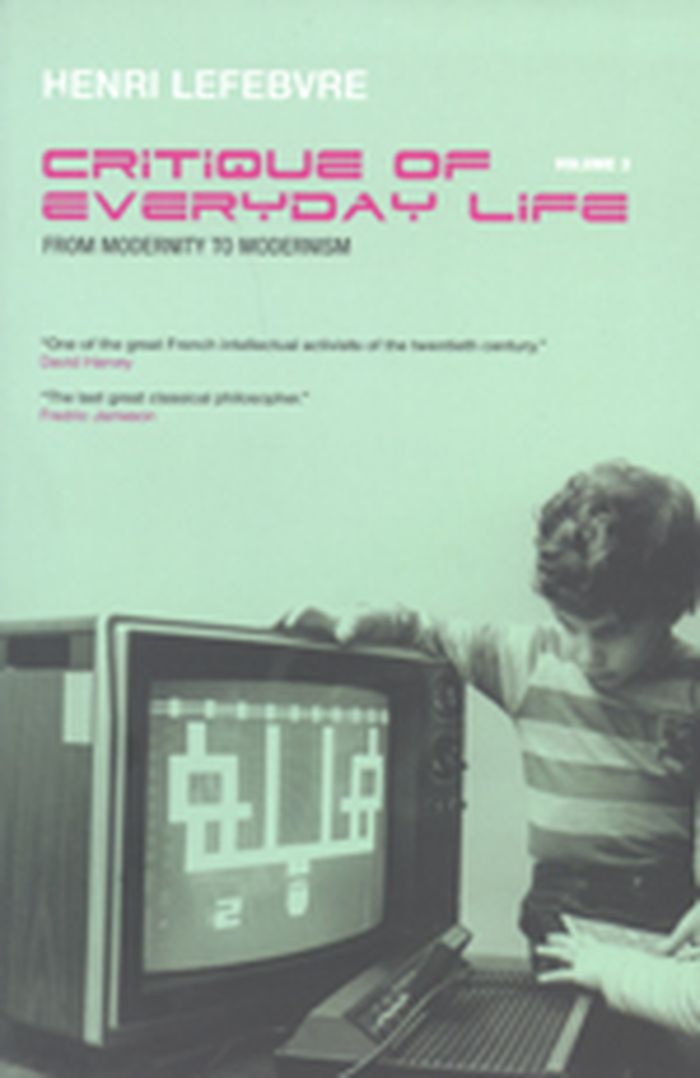
Critique of everyday life volume 3
Actions:
Prix:
$27.50
(disponible en magasin)
Résumé:
The Critique of Everyday Life is perhaps the richest, most prescient work by one of the twentieth century's greatest philosophers. The trilogy which provided the philosophy behind the 1968 student revolution in France, it is considered to be the founding text of what we now know as cultural studies. Whether discussing sport, household gadgets, the countryside, surrealism, Charlie Chaplin or religion, Lefebvre always concentrates on the minutiae of lived experience in work and leisure, daydreams, and festivities. Denounced by both the right and left when it was first published in France in 1947, today this text is recognized as a path-breaking, radical, and hugely influential book. Volume 3, From Modernity to Modernism (Towards a Metaphilosophy of Daily Life), explores the crisis of modernity and the decisive assertion of technological modernism.
Critique of everyday life volume 3
Actions:
Prix:
$27.50
(disponible en magasin)
Résumé:
The Critique of Everyday Life is perhaps the richest, most prescient work by one of the twentieth century's greatest philosophers. The trilogy which provided the philosophy behind the 1968 student revolution in France, it is considered to be the founding text of what we now know as cultural studies. Whether discussing sport, household gadgets, the countryside, surrealism, Charlie Chaplin or religion, Lefebvre always concentrates on the minutiae of lived experience in work and leisure, daydreams, and festivities. Denounced by both the right and left when it was first published in France in 1947, today this text is recognized as a path-breaking, radical, and hugely influential book. Volume 3, From Modernity to Modernism (Towards a Metaphilosophy of Daily Life), explores the crisis of modernity and the decisive assertion of technological modernism.
Classification:
livres
livres
Publication:
janvier 2008, London, New York
janvier 2008, London, New York
Sujet:
Théorie/ philosophie
Théorie/ philosophie
Classification:
livres
livres
Titre:
Being and Event
Being and Event
Actions:
Prix:
$21.95
(disponible sur commande)
Résumé:
Being and Event is the greatest work of Alain Badiou, France's most important living philosopher. Long-awaited in translation, Being and Event makes available to an English-speaking readership Badiou's groundbreaking work on set theory - the cornerstone of his whole philosophy. The book makes the scope and aim of Badiou's whole philosophical project clear, enabling full(...)
$21.95
(disponible sur commande)
Résumé:
Being and Event is the greatest work of Alain Badiou, France's most important living philosopher. Long-awaited in translation, Being and Event makes available to an English-speaking readership Badiou's groundbreaking work on set theory - the cornerstone of his whole philosophy. The book makes the scope and aim of Badiou's whole philosophical project clear, enabling full(...)
Titre:
Being and Event
Actions:
Prix:
$21.95
(disponible sur commande)
Résumé:
Being and Event is the greatest work of Alain Badiou, France's most important living philosopher. Long-awaited in translation, Being and Event makes available to an English-speaking readership Badiou's groundbreaking work on set theory - the cornerstone of his whole philosophy. The book makes the scope and aim of Badiou's whole philosophical project clear, enabling full comprehension of Badiou's significance for contemporary philosophy. Badiou draws upon and is fully engaged with the European philosophical tradition from Plato onwards; Being and Event deals with such key figures as Descartes, Spinoza, Leibniz, Hegel, Rousseau, Heidegger and Lacan.
Being and Event
Actions:
Prix:
$21.95
(disponible sur commande)
Résumé:
Being and Event is the greatest work of Alain Badiou, France's most important living philosopher. Long-awaited in translation, Being and Event makes available to an English-speaking readership Badiou's groundbreaking work on set theory - the cornerstone of his whole philosophy. The book makes the scope and aim of Badiou's whole philosophical project clear, enabling full comprehension of Badiou's significance for contemporary philosophy. Badiou draws upon and is fully engaged with the European philosophical tradition from Plato onwards; Being and Event deals with such key figures as Descartes, Spinoza, Leibniz, Hegel, Rousseau, Heidegger and Lacan.
Classification:
livres
livres
Publication:
juillet 2007, London, New York
juillet 2007, London, New York
Sujet:
Théorie/ philosophie
Théorie/ philosophie
Classification:
livres
livres
Titre:
Handbook of inaesthetics
Handbook of inaesthetics
Actions:
Prix:
$24.95
(disponible sur commande)
Résumé:
Didacticism, romanticism, and classicism are the possible schemata for the knotting of art and philosophy, the third term in this knot being the education of subjects, youth in particular. What characterizes the century that has just come to a close is that, while it underwent the saturation of these three schemata, it failed to introduce a new one. Today, this(...)
$24.95
(disponible sur commande)
Résumé:
Didacticism, romanticism, and classicism are the possible schemata for the knotting of art and philosophy, the third term in this knot being the education of subjects, youth in particular. What characterizes the century that has just come to a close is that, while it underwent the saturation of these three schemata, it failed to introduce a new one. Today, this(...)
Titre:
Handbook of inaesthetics
Actions:
Prix:
$24.95
(disponible sur commande)
Résumé:
Didacticism, romanticism, and classicism are the possible schemata for the knotting of art and philosophy, the third term in this knot being the education of subjects, youth in particular. What characterizes the century that has just come to a close is that, while it underwent the saturation of these three schemata, it failed to introduce a new one. Today, this predicament tends to produce a kind of unknotting of terms, a desperate dis-relation between art and philosophy, together with the pure and simple collapse of what circulated between them: the theme of education.
Handbook of inaesthetics
Actions:
Prix:
$24.95
(disponible sur commande)
Résumé:
Didacticism, romanticism, and classicism are the possible schemata for the knotting of art and philosophy, the third term in this knot being the education of subjects, youth in particular. What characterizes the century that has just come to a close is that, while it underwent the saturation of these three schemata, it failed to introduce a new one. Today, this predicament tends to produce a kind of unknotting of terms, a desperate dis-relation between art and philosophy, together with the pure and simple collapse of what circulated between them: the theme of education.
Classification:
livres
livres
Publication:
octobre 2004, Stanford
octobre 2004, Stanford
Sujet:
Théorie/ philosophie
Théorie/ philosophie
Classification:
livres
livres
Titre:
Number and numbers
Number and numbers
Actions:
Prix:
$26.99
(disponible sur commande)
Résumé:
In Number and Numbers Alain Badiou offers an philosophically penetrating account with a powerful political subtext of the attempts that have been made over the last century to define the special status of number. Badiou argues that number cannot be defined by the multiform calculative uses to which numbers are put, nor is it exhausted by the various species described by(...)
$26.99
(disponible sur commande)
Résumé:
In Number and Numbers Alain Badiou offers an philosophically penetrating account with a powerful political subtext of the attempts that have been made over the last century to define the special status of number. Badiou argues that number cannot be defined by the multiform calculative uses to which numbers are put, nor is it exhausted by the various species described by(...)
Titre:
Number and numbers
Actions:
Prix:
$26.99
(disponible sur commande)
Résumé:
In Number and Numbers Alain Badiou offers an philosophically penetrating account with a powerful political subtext of the attempts that have been made over the last century to define the special status of number. Badiou argues that number cannot be defined by the multiform calculative uses to which numbers are put, nor is it exhausted by the various species described by number theory. Drawing on the mathematical theory of surreal numbers, he develops a unified theory of Number as a particular form of being, an infinite expanse to which our access remains limited. This understanding of Number as being harbours important philosophical truths about the structure of the world in which we live. In Badiou's view, only by rigorously thinking through Number can philosophy offer us some hope of breaking through the dense and apparently impenetrable capitalist fabric of numerical relations. For this will finally allow us to point to that which cannot be numbered: the possibility of an event that would deliver us from our unthinking subordination of number. First published in French as Le nombre et les nombres, éditions du Seuil, 1990.
Number and numbers
Actions:
Prix:
$26.99
(disponible sur commande)
Résumé:
In Number and Numbers Alain Badiou offers an philosophically penetrating account with a powerful political subtext of the attempts that have been made over the last century to define the special status of number. Badiou argues that number cannot be defined by the multiform calculative uses to which numbers are put, nor is it exhausted by the various species described by number theory. Drawing on the mathematical theory of surreal numbers, he develops a unified theory of Number as a particular form of being, an infinite expanse to which our access remains limited. This understanding of Number as being harbours important philosophical truths about the structure of the world in which we live. In Badiou's view, only by rigorously thinking through Number can philosophy offer us some hope of breaking through the dense and apparently impenetrable capitalist fabric of numerical relations. For this will finally allow us to point to that which cannot be numbered: the possibility of an event that would deliver us from our unthinking subordination of number. First published in French as Le nombre et les nombres, éditions du Seuil, 1990.
Classification:
livres
livres
Publication:
avril 2008, Cambridge, Malden
avril 2008, Cambridge, Malden
Sujet:
Théorie/ philosophie
Théorie/ philosophie
Classification:
livres
livres

Titre:
The original accident
The original accident
Actions:
Prix:
$21.99
(disponible sur commande)
Résumé:
Urging us to face up to the consequences of our braves-new-world technologies, Virilio calls for the creation of a Museum of the Accident to fight our habituation to horror and violence, and our daily overexposure to terror, in the name, not of some preventive war, but of a preventive intelligence that would help us deal with both natural and artificial disasters.
$21.99
(disponible sur commande)
Résumé:
Urging us to face up to the consequences of our braves-new-world technologies, Virilio calls for the creation of a Museum of the Accident to fight our habituation to horror and violence, and our daily overexposure to terror, in the name, not of some preventive war, but of a preventive intelligence that would help us deal with both natural and artificial disasters.
Titre:
The original accident
Actions:
Prix:
$21.99
(disponible sur commande)
Résumé:
Urging us to face up to the consequences of our braves-new-world technologies, Virilio calls for the creation of a Museum of the Accident to fight our habituation to horror and violence, and our daily overexposure to terror, in the name, not of some preventive war, but of a preventive intelligence that would help us deal with both natural and artificial disasters.
The original accident
Actions:
Prix:
$21.99
(disponible sur commande)
Résumé:
Urging us to face up to the consequences of our braves-new-world technologies, Virilio calls for the creation of a Museum of the Accident to fight our habituation to horror and violence, and our daily overexposure to terror, in the name, not of some preventive war, but of a preventive intelligence that would help us deal with both natural and artificial disasters.
Classification:
livres
livres
Publication:
novembre 2006, Cambridge
novembre 2006, Cambridge
Sujet:
Théorie/ philosophie
Théorie/ philosophie


