


884 Résultats
Classification:
livres
livres

Titre:
Post-histoire
Post-histoire
Actions:
Prix:
$40.50
(disponible sur commande)
Résumé:
Cette pulbication rassemble une vingtaine d’essais qui ont été initialement des conférences données par le philosophe Vilém Flusser (1920-1991) dans des universités de Marseille, Jérusalem et Sao Paulo. Initialement écrit en anglais, puis traduit en allemand et en portugais, Post-Histoire a été édité pour la première fois au Brésil en 1983. Cette version française n’a(...)
$40.50
(disponible sur commande)
Résumé:
Cette pulbication rassemble une vingtaine d’essais qui ont été initialement des conférences données par le philosophe Vilém Flusser (1920-1991) dans des universités de Marseille, Jérusalem et Sao Paulo. Initialement écrit en anglais, puis traduit en allemand et en portugais, Post-Histoire a été édité pour la première fois au Brésil en 1983. Cette version française n’a(...)
Titre:
Post-histoire
Actions:
Prix:
$40.50
(disponible sur commande)
Résumé:
Cette pulbication rassemble une vingtaine d’essais qui ont été initialement des conférences données par le philosophe Vilém Flusser (1920-1991) dans des universités de Marseille, Jérusalem et Sao Paulo. Initialement écrit en anglais, puis traduit en allemand et en portugais, Post-Histoire a été édité pour la première fois au Brésil en 1983. Cette version française n’a encore jamais été publiée. Ce texte se veut être, pour l’auteur, le « miroir de la condition humaine aujourd’hui », et offre au lecteur une critique féroce de la société tout en posant la question de la place laissée à la liberté dans un monde programmé.
Post-histoire
Actions:
Prix:
$40.50
(disponible sur commande)
Résumé:
Cette pulbication rassemble une vingtaine d’essais qui ont été initialement des conférences données par le philosophe Vilém Flusser (1920-1991) dans des universités de Marseille, Jérusalem et Sao Paulo. Initialement écrit en anglais, puis traduit en allemand et en portugais, Post-Histoire a été édité pour la première fois au Brésil en 1983. Cette version française n’a encore jamais été publiée. Ce texte se veut être, pour l’auteur, le « miroir de la condition humaine aujourd’hui », et offre au lecteur une critique féroce de la société tout en posant la question de la place laissée à la liberté dans un monde programmé.
Classification:
livres
livres
Publication:
mars 2019
mars 2019
Sujet:
Théorie/ philosophie
Théorie/ philosophie
Classification:
livres
livres

Actions:
Prix:
$6.75
(disponible sur commande)
Résumé:
Amateurs de luxe, critiques sans goût, femme cruelle, mari inconstant... Dans ces textes brefs, Diderot dépeint moeurs et travers de ses contemporains d'une plume qui, si elle est infiniment acérée, ne cède pourtant jamais au jugement.
$6.75
(disponible sur commande)
Résumé:
Amateurs de luxe, critiques sans goût, femme cruelle, mari inconstant... Dans ces textes brefs, Diderot dépeint moeurs et travers de ses contemporains d'une plume qui, si elle est infiniment acérée, ne cède pourtant jamais au jugement.
Titre:
Regrets sur ma vieille robe de chambre
Actions:
Prix:
$6.75
(disponible sur commande)
Résumé:
Amateurs de luxe, critiques sans goût, femme cruelle, mari inconstant... Dans ces textes brefs, Diderot dépeint moeurs et travers de ses contemporains d'une plume qui, si elle est infiniment acérée, ne cède pourtant jamais au jugement.
Regrets sur ma vieille robe de chambre
Actions:
Prix:
$6.75
(disponible sur commande)
Résumé:
Amateurs de luxe, critiques sans goût, femme cruelle, mari inconstant... Dans ces textes brefs, Diderot dépeint moeurs et travers de ses contemporains d'une plume qui, si elle est infiniment acérée, ne cède pourtant jamais au jugement.
Classification:
livres
livres
Publication:
février 2019
février 2019
Sujet:
Théorie/ philosophie
Théorie/ philosophie
Classification:
livres
livres
Prix:
$54.00
(disponible sur commande)
Résumé:
The pace of modern life is undoubtedly speeding up, yet this acceleration does not seem to have made us any happier or more content. If acceleration is the problem, then the solution, argues Hartmut Rosa in this major new work, lies in “resonance.” The quality of a human life cannot be measured simply in terms of resources, options, and moments of happiness; instead, we(...)
$54.00
(disponible sur commande)
Résumé:
The pace of modern life is undoubtedly speeding up, yet this acceleration does not seem to have made us any happier or more content. If acceleration is the problem, then the solution, argues Hartmut Rosa in this major new work, lies in “resonance.” The quality of a human life cannot be measured simply in terms of resources, options, and moments of happiness; instead, we(...)
Titre:
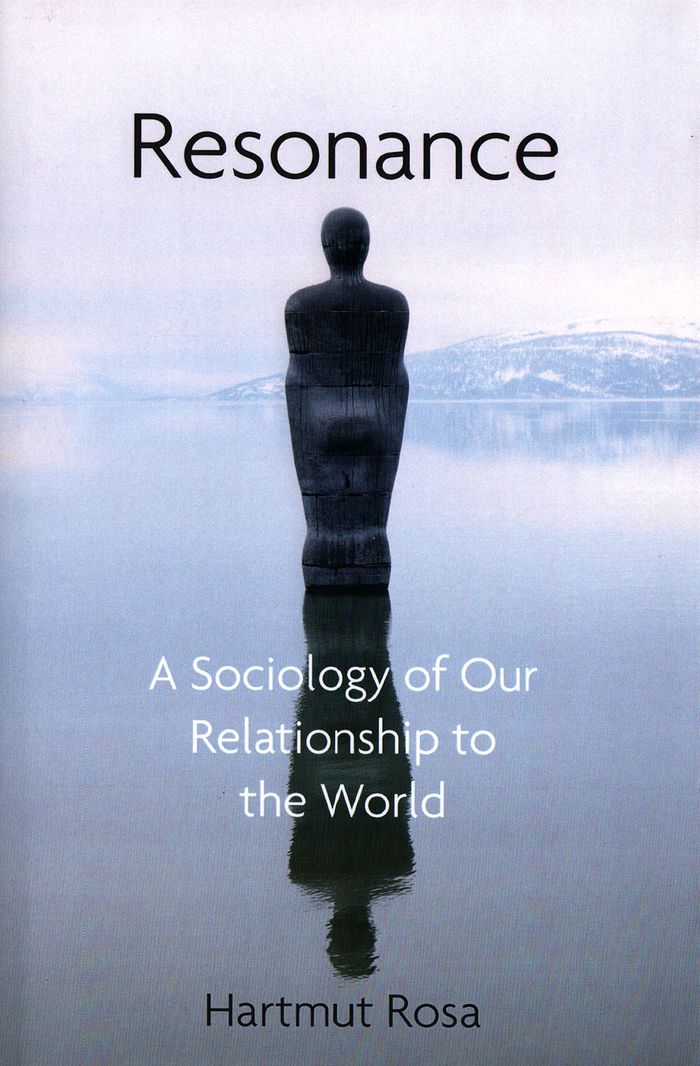
Resonance: a sociology of the relationship to the world
Actions:
Prix:
$54.00
(disponible sur commande)
Résumé:
The pace of modern life is undoubtedly speeding up, yet this acceleration does not seem to have made us any happier or more content. If acceleration is the problem, then the solution, argues Hartmut Rosa in this major new work, lies in “resonance.” The quality of a human life cannot be measured simply in terms of resources, options, and moments of happiness; instead, we must consider our relationship to, or resonance with, the world. Applying his theory of resonance to many domains of human activity, Rosa describesthe full spectrum of ways in which we establish our relationship to the world, from the act of breathing to the adoption of culturally distinct worldviews. He then turns to therealms of concrete experience and action – family and politics, work and sports, religion and art – in which we as late modern subjects seek out resonance.
Resonance: a sociology of the relationship to the world
Actions:
Prix:
$54.00
(disponible sur commande)
Résumé:
The pace of modern life is undoubtedly speeding up, yet this acceleration does not seem to have made us any happier or more content. If acceleration is the problem, then the solution, argues Hartmut Rosa in this major new work, lies in “resonance.” The quality of a human life cannot be measured simply in terms of resources, options, and moments of happiness; instead, we must consider our relationship to, or resonance with, the world. Applying his theory of resonance to many domains of human activity, Rosa describesthe full spectrum of ways in which we establish our relationship to the world, from the act of breathing to the adoption of culturally distinct worldviews. He then turns to therealms of concrete experience and action – family and politics, work and sports, religion and art – in which we as late modern subjects seek out resonance.
Classification:
livres
livres
Publication:
septembre 2019
septembre 2019
Sujet:
Théorie/ philosophie
Théorie/ philosophie
Classification:
livres
livres

Titre:
Phenomenology: the basics
Phenomenology: the basics
Actions:
Prix:
$35.95
(disponible sur commande)
Résumé:
''Phenomenology: The Basics'' is a concise and engaging introduction to one of the dominant philosophical movements of the 20th century. This book provides an introduction to the essential phenomenological concepts that are crucial for understanding great thinkers such as Husserl, Heidegger, and Merleau-Ponty. Written by a leading expert in the field, Dan Zahavi examines(...)
$35.95
(disponible sur commande)
Résumé:
''Phenomenology: The Basics'' is a concise and engaging introduction to one of the dominant philosophical movements of the 20th century. This book provides an introduction to the essential phenomenological concepts that are crucial for understanding great thinkers such as Husserl, Heidegger, and Merleau-Ponty. Written by a leading expert in the field, Dan Zahavi examines(...)
Titre:
Phenomenology: the basics
Actions:
Prix:
$35.95
(disponible sur commande)
Résumé:
''Phenomenology: The Basics'' is a concise and engaging introduction to one of the dominant philosophical movements of the 20th century. This book provides an introduction to the essential phenomenological concepts that are crucial for understanding great thinkers such as Husserl, Heidegger, and Merleau-Ponty. Written by a leading expert in the field, Dan Zahavi examines and explains key questions.
Phenomenology: the basics
Actions:
Prix:
$35.95
(disponible sur commande)
Résumé:
''Phenomenology: The Basics'' is a concise and engaging introduction to one of the dominant philosophical movements of the 20th century. This book provides an introduction to the essential phenomenological concepts that are crucial for understanding great thinkers such as Husserl, Heidegger, and Merleau-Ponty. Written by a leading expert in the field, Dan Zahavi examines and explains key questions.
Classification:
livres
livres
Publication:
octobre 2018
octobre 2018
Sujet:
Théorie/ philosophie
Théorie/ philosophie
Classification:
livres
livres
Actions:
Prix:
$23.95
(disponible sur commande)
Résumé:
'Essential Essays' showcases Adrienne Rich’s singular ability to unite the political, personal, and poetical. The essays selected here by feminist scholar Sandra M. Gilbert range from the 1960s to 2006, emphasizing Rich’s lifelong intellectual engagement and fearless prose exploration of feminism, social justice, poetry, race, homosexuality, and identity.
$23.95
(disponible sur commande)
Résumé:
'Essential Essays' showcases Adrienne Rich’s singular ability to unite the political, personal, and poetical. The essays selected here by feminist scholar Sandra M. Gilbert range from the 1960s to 2006, emphasizing Rich’s lifelong intellectual engagement and fearless prose exploration of feminism, social justice, poetry, race, homosexuality, and identity.
Titre:
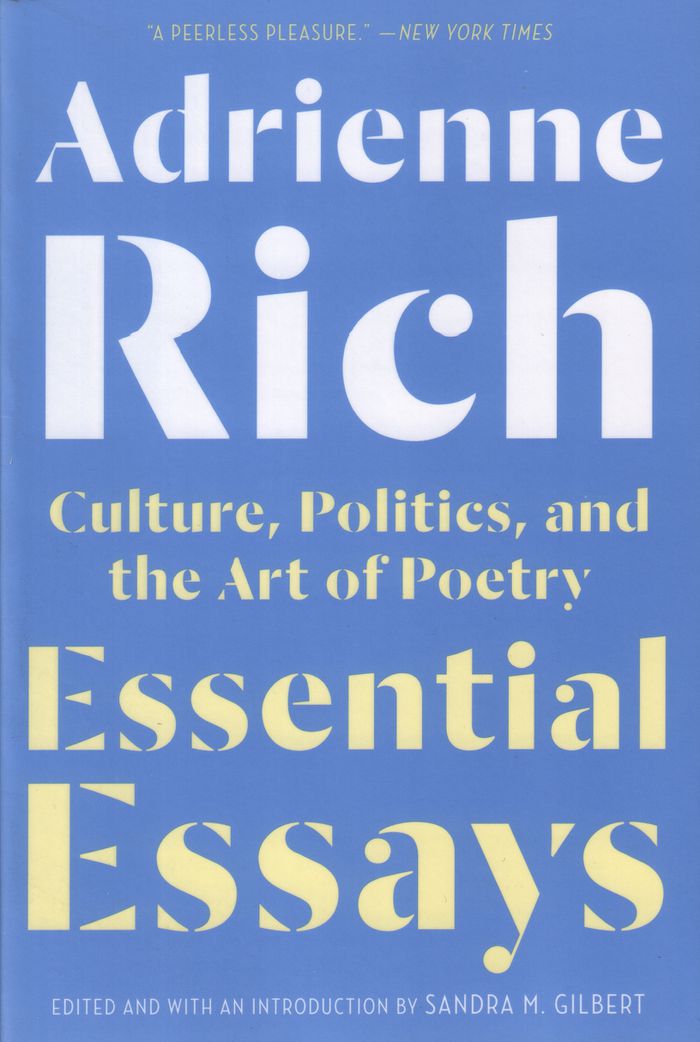
Adrienne Rich: Essential essays. Culture politics and the art of poetry
Actions:
Prix:
$23.95
(disponible sur commande)
Résumé:
'Essential Essays' showcases Adrienne Rich’s singular ability to unite the political, personal, and poetical. The essays selected here by feminist scholar Sandra M. Gilbert range from the 1960s to 2006, emphasizing Rich’s lifelong intellectual engagement and fearless prose exploration of feminism, social justice, poetry, race, homosexuality, and identity.
Adrienne Rich: Essential essays. Culture politics and the art of poetry
Actions:
Prix:
$23.95
(disponible sur commande)
Résumé:
'Essential Essays' showcases Adrienne Rich’s singular ability to unite the political, personal, and poetical. The essays selected here by feminist scholar Sandra M. Gilbert range from the 1960s to 2006, emphasizing Rich’s lifelong intellectual engagement and fearless prose exploration of feminism, social justice, poetry, race, homosexuality, and identity.
Classification:
livres
livres
Publication:
août 2019
août 2019
Sujet:
Théorie/ philosophie
Théorie/ philosophie
Classification:
livres
livres

Actions:
Prix:
$32.95
(disponible sur commande)
Résumé:
Ce livre propose un pari audacieux : prendre notre relation avec les chiens au sérieux et apprendre «une éthique et une politique dévolues à la prolifération de relations avec des êtres autres qui comptent». Car la catégorie des espèces compagnes est bien plus vaste que celle des animaux de compagnie, elle inclut en effet le riz, les abeilles, la flore intestinale, les(...)
$32.95
(disponible sur commande)
Résumé:
Ce livre propose un pari audacieux : prendre notre relation avec les chiens au sérieux et apprendre «une éthique et une politique dévolues à la prolifération de relations avec des êtres autres qui comptent». Car la catégorie des espèces compagnes est bien plus vaste que celle des animaux de compagnie, elle inclut en effet le riz, les abeilles, la flore intestinale, les(...)
Titre:
Manifeste des espèces compagnies
Actions:
Prix:
$32.95
(disponible sur commande)
Résumé:
Ce livre propose un pari audacieux : prendre notre relation avec les chiens au sérieux et apprendre «une éthique et une politique dévolues à la prolifération de relations avec des êtres autres qui comptent». Car la catégorie des espèces compagnes est bien plus vaste que celle des animaux de compagnie, elle inclut en effet le riz, les abeilles, la flore intestinale, les tulipes… «Vivre avec les animaux, investir leurs histoires et les nôtres, essayer de dire la vérité au sujet de ces relations, cohabiter au sein d’une histoire active : voilà la tâche des espèces compagnes.» Pas de grands récits, donc, mais des histoires, dont le but est avant tout, dit Donna Haraway, de mettre des bâtons dans les roues au projet humain d’écrire seuls cette histoire.
Manifeste des espèces compagnies
Actions:
Prix:
$32.95
(disponible sur commande)
Résumé:
Ce livre propose un pari audacieux : prendre notre relation avec les chiens au sérieux et apprendre «une éthique et une politique dévolues à la prolifération de relations avec des êtres autres qui comptent». Car la catégorie des espèces compagnes est bien plus vaste que celle des animaux de compagnie, elle inclut en effet le riz, les abeilles, la flore intestinale, les tulipes… «Vivre avec les animaux, investir leurs histoires et les nôtres, essayer de dire la vérité au sujet de ces relations, cohabiter au sein d’une histoire active : voilà la tâche des espèces compagnes.» Pas de grands récits, donc, mais des histoires, dont le but est avant tout, dit Donna Haraway, de mettre des bâtons dans les roues au projet humain d’écrire seuls cette histoire.
Classification:
livres
livres
Publication:
janvier 2019
janvier 2019
Sujet:
Théorie/ philosophie
Théorie/ philosophie
Classification:
livres
livres

Actions:
Prix:
$32.95
(disponible en magasin)
Résumé:
To mark the birthday of the world's most renowned evolutionary biologist, Oxford University Press has reissued the definitive edition of Darwin's classic - a brilliantly entertaining and accessible exploration of human and animal behavior. Psychologist Paul Ekman's edited version of this book is the first to appear the way Darwin ultimately intended, with all of the(...)
$32.95
(disponible en magasin)
Résumé:
To mark the birthday of the world's most renowned evolutionary biologist, Oxford University Press has reissued the definitive edition of Darwin's classic - a brilliantly entertaining and accessible exploration of human and animal behavior. Psychologist Paul Ekman's edited version of this book is the first to appear the way Darwin ultimately intended, with all of the(...)
Titre:
The expression of emotions in man and animals, 200th anniversary edition
Actions:
Prix:
$32.95
(disponible en magasin)
Résumé:
To mark the birthday of the world's most renowned evolutionary biologist, Oxford University Press has reissued the definitive edition of Darwin's classic - a brilliantly entertaining and accessible exploration of human and animal behavior. Psychologist Paul Ekman's edited version of this book is the first to appear the way Darwin ultimately intended, with all of the corrections and additions that were in Darwin's notes for a revision that was never published during his lifetime.
The expression of emotions in man and animals, 200th anniversary edition
Actions:
Prix:
$32.95
(disponible en magasin)
Résumé:
To mark the birthday of the world's most renowned evolutionary biologist, Oxford University Press has reissued the definitive edition of Darwin's classic - a brilliantly entertaining and accessible exploration of human and animal behavior. Psychologist Paul Ekman's edited version of this book is the first to appear the way Darwin ultimately intended, with all of the corrections and additions that were in Darwin's notes for a revision that was never published during his lifetime.
Classification:
livres
livres
Publication:
avril 2009
avril 2009
Sujet:
Théorie/ philosophie
Théorie/ philosophie
Classification:
livres
livres
Titre:
La désobéissance civile
La désobéissance civile
Actions:
Prix:
$5.95
(disponible sur commande)
Résumé:
Dans la continuité du passage de Walden en poche, nous mettons à portée de tous les lecteurs les écrits de cet auteur incontournable. Par un travail de réhabilitation de ses textes d’abord, par la déclinaison de chacun de ses essais en format de poche ensuite. À l’image du recueil 'Essais' chaque volume sera rehaussé d’un appareillage critique assuré par le spécialiste(...)
$5.95
(disponible sur commande)
Résumé:
Dans la continuité du passage de Walden en poche, nous mettons à portée de tous les lecteurs les écrits de cet auteur incontournable. Par un travail de réhabilitation de ses textes d’abord, par la déclinaison de chacun de ses essais en format de poche ensuite. À l’image du recueil 'Essais' chaque volume sera rehaussé d’un appareillage critique assuré par le spécialiste(...)
Titre:
La désobéissance civile
Actions:
Prix:
$5.95
(disponible sur commande)
Résumé:
Dans la continuité du passage de Walden en poche, nous mettons à portée de tous les lecteurs les écrits de cet auteur incontournable. Par un travail de réhabilitation de ses textes d’abord, par la déclinaison de chacun de ses essais en format de poche ensuite. À l’image du recueil 'Essais' chaque volume sera rehaussé d’un appareillage critique assuré par le spécialiste Michel Granger. Cinquième d'une série de douze ouvrages, 'La Désobéissance civile' est un essai à charge contre le gouvernement et sa politique esclavagiste. À partir de 1842, Thoreau fait le geste symbolique de ne plus payer ses impôts locaux en signe de protestation et sera brièvement emprisonné en réponse à cet acte de résistance. Un ouvrage qui exhorte les citoyens à une résistance réfléchie face au gouvernement.
La désobéissance civile
Actions:
Prix:
$5.95
(disponible sur commande)
Résumé:
Dans la continuité du passage de Walden en poche, nous mettons à portée de tous les lecteurs les écrits de cet auteur incontournable. Par un travail de réhabilitation de ses textes d’abord, par la déclinaison de chacun de ses essais en format de poche ensuite. À l’image du recueil 'Essais' chaque volume sera rehaussé d’un appareillage critique assuré par le spécialiste Michel Granger. Cinquième d'une série de douze ouvrages, 'La Désobéissance civile' est un essai à charge contre le gouvernement et sa politique esclavagiste. À partir de 1842, Thoreau fait le geste symbolique de ne plus payer ses impôts locaux en signe de protestation et sera brièvement emprisonné en réponse à cet acte de résistance. Un ouvrage qui exhorte les citoyens à une résistance réfléchie face au gouvernement.
Classification:
livres
livres
Publication:
avril 2019
avril 2019
Sujet:
Théorie/ philosophie
Théorie/ philosophie
Classification:
livres
livres

Prix:
$24.95
(disponible sur commande)
Résumé:
Dans ce livre, Bertrand Binoche montre combien les auteurs des Lumières, aujourd’hui vénérés, furent tout sauf consensuels en leur temps – au point de passer pour certains quelque temps en prison... Il éclaire les luttes, souvent violentes, qu'ils ont menées contre ce qu'ils nomment les «préjugés", contre la superstition qui nourrit «l'idolâtrie et le despotisme», contre(...)
$24.95
(disponible sur commande)
Résumé:
Dans ce livre, Bertrand Binoche montre combien les auteurs des Lumières, aujourd’hui vénérés, furent tout sauf consensuels en leur temps – au point de passer pour certains quelque temps en prison... Il éclaire les luttes, souvent violentes, qu'ils ont menées contre ce qu'ils nomment les «préjugés", contre la superstition qui nourrit «l'idolâtrie et le despotisme», contre(...)
Titre:
«Écrasez l'infâme !» : philosopher à l'âge des Lumieres
Actions:
Prix:
$24.95
(disponible sur commande)
Résumé:
Dans ce livre, Bertrand Binoche montre combien les auteurs des Lumières, aujourd’hui vénérés, furent tout sauf consensuels en leur temps – au point de passer pour certains quelque temps en prison... Il éclaire les luttes, souvent violentes, qu'ils ont menées contre ce qu'ils nomment les «préjugés", contre la superstition qui nourrit «l'idolâtrie et le despotisme», contre l'esclavage - et l'on est esclave de ses préjugés comme de ses tyrans. Les Lumières, « effervescence générale des esprits» disait d'Alembert. «On n'y trouve certes pas une philosophie en bonne et due forme, mais l'infatigable agitation d'intelligences se mouvant en tous sens avec audace et agilité», écrit Binoche. «Qu'est-ce donc que les Lumières ? Une nouvelle appréhension de l'activité philosophique tout entière ordonnée à détruire collectivement le «préjugé» et contrainte de ce fait à s'inventer de nouveaux modes d'existence. Il y en eut beaucoup. C'est pourquoi l'on dit les Lumières. Et ce pluriel est une merveille. »
«Écrasez l'infâme !» : philosopher à l'âge des Lumieres
Actions:
Prix:
$24.95
(disponible sur commande)
Résumé:
Dans ce livre, Bertrand Binoche montre combien les auteurs des Lumières, aujourd’hui vénérés, furent tout sauf consensuels en leur temps – au point de passer pour certains quelque temps en prison... Il éclaire les luttes, souvent violentes, qu'ils ont menées contre ce qu'ils nomment les «préjugés", contre la superstition qui nourrit «l'idolâtrie et le despotisme», contre l'esclavage - et l'on est esclave de ses préjugés comme de ses tyrans. Les Lumières, « effervescence générale des esprits» disait d'Alembert. «On n'y trouve certes pas une philosophie en bonne et due forme, mais l'infatigable agitation d'intelligences se mouvant en tous sens avec audace et agilité», écrit Binoche. «Qu'est-ce donc que les Lumières ? Une nouvelle appréhension de l'activité philosophique tout entière ordonnée à détruire collectivement le «préjugé» et contrainte de ce fait à s'inventer de nouveaux modes d'existence. Il y en eut beaucoup. C'est pourquoi l'on dit les Lumières. Et ce pluriel est une merveille. »
Classification:
livres
livres
Publication:
avril 2019
avril 2019
Sujet:
Théorie/ philosophie
Théorie/ philosophie
Classification:
livres
livres

Actions:
Prix:
$12.95
(disponible sur commande)
Résumé:
Voici un ouvrage d'un genre nouveau, dans lequel Walter Benjamin pratique le collage à la manière de ces amoureux des télescopages poétiques que furent Dada et les surréalistes. 'Rue à sens unique' se compose de notes autobiographiques, de souvenirs d'enfance, d'aphorismes, de scènes de la vie urbaine, de considérations acérées sur l'état du monde, et de l'Allemagne en(...)
$12.95
(disponible sur commande)
Résumé:
Voici un ouvrage d'un genre nouveau, dans lequel Walter Benjamin pratique le collage à la manière de ces amoureux des télescopages poétiques que furent Dada et les surréalistes. 'Rue à sens unique' se compose de notes autobiographiques, de souvenirs d'enfance, d'aphorismes, de scènes de la vie urbaine, de considérations acérées sur l'état du monde, et de l'Allemagne en(...)
Titre:
Rue à sens unique, deuxième édition
Actions:
Prix:
$12.95
(disponible sur commande)
Résumé:
Voici un ouvrage d'un genre nouveau, dans lequel Walter Benjamin pratique le collage à la manière de ces amoureux des télescopages poétiques que furent Dada et les surréalistes. 'Rue à sens unique' se compose de notes autobiographiques, de souvenirs d'enfance, d'aphorismes, de scènes de la vie urbaine, de considérations acérées sur l'état du monde, et de l'Allemagne en particulier, mais aussi de réflexions sur l'écriture elle-même, sur la graphologie.
Rue à sens unique, deuxième édition
Actions:
Prix:
$12.95
(disponible sur commande)
Résumé:
Voici un ouvrage d'un genre nouveau, dans lequel Walter Benjamin pratique le collage à la manière de ces amoureux des télescopages poétiques que furent Dada et les surréalistes. 'Rue à sens unique' se compose de notes autobiographiques, de souvenirs d'enfance, d'aphorismes, de scènes de la vie urbaine, de considérations acérées sur l'état du monde, et de l'Allemagne en particulier, mais aussi de réflexions sur l'écriture elle-même, sur la graphologie.
Classification:
livres
livres
Publication:
avril 2019
avril 2019
Sujet:
Théorie/ philosophie
Théorie/ philosophie


