


536 Résultats
Classification:
articles
articles
Titre:
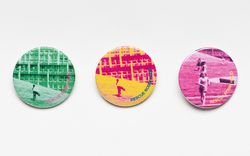
Sauver le Robin Hood
Sauver le Robin Hood
Actions:
Lisa Belabed à propos d’un effort pour contrer la démolition dans le contexte d’une ville mondialisée
Mot(s)-clé(s):
Robin Hood Gardens, Londres, Smithson, habitation, logements sociaux, démolition, embourgeoisement
Robin Hood Gardens, Londres, Smithson, habitation, logements sociaux, démolition, embourgeoisement
Publié:
2 juin 2025
2 juin 2025
Titre:
Sauver le Robin Hood
Lisa Belabed à propos d’un effort pour contrer la démolition dans le contexte d’une ville mondialisée
Actions:
Sauver le Robin Hood
Lisa Belabed à propos d’un effort pour contrer la démolition dans le contexte d’une ville mondialisée
Actions:
Niveau de description archivistique:
Projet
Projet
Titre:
University Art Museum
University Art Museum
Numéro de référence:
AP143.S4.D65
Description:
File documents the unexecuted project for the University Art Museum, Long Beach, California. Material in this file was produced between 1986 and 1988. California State University, Long Beach (CSULB), commissioned Eisenman/Robertson Architects to design an art museum adjacent to the main campus entrance. The 67,500-square-foot building was to comprise four galleries, a black-box theater, an auditorium, a cafe, conference rooms, a library, offices, preparation spaces, and storage vaults. The project, sited on a 23-acre arboretum, included landscaping; terraced sculpture courtyards, botanical gardens, and a two-acre pond. Eisenman linked the northern and southern parts of the arboretum by an elevated public walkway through the museum. Sets of drawings were presented on 8 and 30 April, 2 June, and 5 Aug. In the first design phase Eisenman explores the cartographic figures which form the basis of his artificial excavation when superposed: a series of sketches establishes the analogical relationships which fix the relative scales of the plans and produce the superpositions; another series contextualizes the superposed figures by placing them within the museum site (DR1987:0859:087-090). The second phase concerns the building; the working model shows the building carved out of a square pit, from which spring an oil derrick and a reconstruction of a recreational pier (Rainbow Pier, 1920s) used here as circulatory bridge (DR1987:0859:160). In the third phase the architect systematizes his archeological procedure by using five significant cartographic dates - 1849, 1889, 1949, 1989, 2049 - each corresponding to a specific superposition (see DR1987:0859:274-277). In the fourth phase, Eisenman simplifies the superposition of 2049 to a few iconic colour-coded forms: ranch (green), ranch house (blue), campus site (red), and water forms (river and pond) (gold). Material for the fourth phase includes three relief models, four presentation drawings, and a model (property of the CSULB) (relief models: DR1987:0859:001-003; drawings: DR1987:0859:004-008). Eisenman "inhabits" his artifical archeology by detailed planning of interior spaces, and gives substance to the cartographic traces in a series of sketch sections, perspectives, and working models. Working models reveal how the central "canal" area gradually became the museum's access point (DR1987:0859:484-490); the museum, galleries, offices, and preparation areas are on one side of this deep cut, while the cafeteria and black-box theater are on the other. The upper level was to house offices, meeting rooms, and the library. File contains audiovisual material, conceptual drawings, design development drawings, presentation drawings, reference drawings, working drawings, photographic materials, and textual records.
AP143.S4.D65
Description:
File documents the unexecuted project for the University Art Museum, Long Beach, California. Material in this file was produced between 1986 and 1988. California State University, Long Beach (CSULB), commissioned Eisenman/Robertson Architects to design an art museum adjacent to the main campus entrance. The 67,500-square-foot building was to comprise four galleries, a black-box theater, an auditorium, a cafe, conference rooms, a library, offices, preparation spaces, and storage vaults. The project, sited on a 23-acre arboretum, included landscaping; terraced sculpture courtyards, botanical gardens, and a two-acre pond. Eisenman linked the northern and southern parts of the arboretum by an elevated public walkway through the museum. Sets of drawings were presented on 8 and 30 April, 2 June, and 5 Aug. In the first design phase Eisenman explores the cartographic figures which form the basis of his artificial excavation when superposed: a series of sketches establishes the analogical relationships which fix the relative scales of the plans and produce the superpositions; another series contextualizes the superposed figures by placing them within the museum site (DR1987:0859:087-090). The second phase concerns the building; the working model shows the building carved out of a square pit, from which spring an oil derrick and a reconstruction of a recreational pier (Rainbow Pier, 1920s) used here as circulatory bridge (DR1987:0859:160). In the third phase the architect systematizes his archeological procedure by using five significant cartographic dates - 1849, 1889, 1949, 1989, 2049 - each corresponding to a specific superposition (see DR1987:0859:274-277). In the fourth phase, Eisenman simplifies the superposition of 2049 to a few iconic colour-coded forms: ranch (green), ranch house (blue), campus site (red), and water forms (river and pond) (gold). Material for the fourth phase includes three relief models, four presentation drawings, and a model (property of the CSULB) (relief models: DR1987:0859:001-003; drawings: DR1987:0859:004-008). Eisenman "inhabits" his artifical archeology by detailed planning of interior spaces, and gives substance to the cartographic traces in a series of sketch sections, perspectives, and working models. Working models reveal how the central "canal" area gradually became the museum's access point (DR1987:0859:484-490); the museum, galleries, offices, and preparation areas are on one side of this deep cut, while the cafeteria and black-box theater are on the other. The upper level was to house offices, meeting rooms, and the library. File contains audiovisual material, conceptual drawings, design development drawings, presentation drawings, reference drawings, working drawings, photographic materials, and textual records.
Personnes et institutions:
Date:
1986-1988
1986-1988
Titre:
University Art Museum
Actions:
AP143.S4.D65
Description:
File documents the unexecuted project for the University Art Museum, Long Beach, California. Material in this file was produced between 1986 and 1988. California State University, Long Beach (CSULB), commissioned Eisenman/Robertson Architects to design an art museum adjacent to the main campus entrance. The 67,500-square-foot building was to comprise four galleries, a black-box theater, an auditorium, a cafe, conference rooms, a library, offices, preparation spaces, and storage vaults. The project, sited on a 23-acre arboretum, included landscaping; terraced sculpture courtyards, botanical gardens, and a two-acre pond. Eisenman linked the northern and southern parts of the arboretum by an elevated public walkway through the museum. Sets of drawings were presented on 8 and 30 April, 2 June, and 5 Aug. In the first design phase Eisenman explores the cartographic figures which form the basis of his artificial excavation when superposed: a series of sketches establishes the analogical relationships which fix the relative scales of the plans and produce the superpositions; another series contextualizes the superposed figures by placing them within the museum site (DR1987:0859:087-090). The second phase concerns the building; the working model shows the building carved out of a square pit, from which spring an oil derrick and a reconstruction of a recreational pier (Rainbow Pier, 1920s) used here as circulatory bridge (DR1987:0859:160). In the third phase the architect systematizes his archeological procedure by using five significant cartographic dates - 1849, 1889, 1949, 1989, 2049 - each corresponding to a specific superposition (see DR1987:0859:274-277). In the fourth phase, Eisenman simplifies the superposition of 2049 to a few iconic colour-coded forms: ranch (green), ranch house (blue), campus site (red), and water forms (river and pond) (gold). Material for the fourth phase includes three relief models, four presentation drawings, and a model (property of the CSULB) (relief models: DR1987:0859:001-003; drawings: DR1987:0859:004-008). Eisenman "inhabits" his artifical archeology by detailed planning of interior spaces, and gives substance to the cartographic traces in a series of sketch sections, perspectives, and working models. Working models reveal how the central "canal" area gradually became the museum's access point (DR1987:0859:484-490); the museum, galleries, offices, and preparation areas are on one side of this deep cut, while the cafeteria and black-box theater are on the other. The upper level was to house offices, meeting rooms, and the library. File contains audiovisual material, conceptual drawings, design development drawings, presentation drawings, reference drawings, working drawings, photographic materials, and textual records.
University Art Museum
Actions:
AP143.S4.D65
Description:
File documents the unexecuted project for the University Art Museum, Long Beach, California. Material in this file was produced between 1986 and 1988. California State University, Long Beach (CSULB), commissioned Eisenman/Robertson Architects to design an art museum adjacent to the main campus entrance. The 67,500-square-foot building was to comprise four galleries, a black-box theater, an auditorium, a cafe, conference rooms, a library, offices, preparation spaces, and storage vaults. The project, sited on a 23-acre arboretum, included landscaping; terraced sculpture courtyards, botanical gardens, and a two-acre pond. Eisenman linked the northern and southern parts of the arboretum by an elevated public walkway through the museum. Sets of drawings were presented on 8 and 30 April, 2 June, and 5 Aug. In the first design phase Eisenman explores the cartographic figures which form the basis of his artificial excavation when superposed: a series of sketches establishes the analogical relationships which fix the relative scales of the plans and produce the superpositions; another series contextualizes the superposed figures by placing them within the museum site (DR1987:0859:087-090). The second phase concerns the building; the working model shows the building carved out of a square pit, from which spring an oil derrick and a reconstruction of a recreational pier (Rainbow Pier, 1920s) used here as circulatory bridge (DR1987:0859:160). In the third phase the architect systematizes his archeological procedure by using five significant cartographic dates - 1849, 1889, 1949, 1989, 2049 - each corresponding to a specific superposition (see DR1987:0859:274-277). In the fourth phase, Eisenman simplifies the superposition of 2049 to a few iconic colour-coded forms: ranch (green), ranch house (blue), campus site (red), and water forms (river and pond) (gold). Material for the fourth phase includes three relief models, four presentation drawings, and a model (property of the CSULB) (relief models: DR1987:0859:001-003; drawings: DR1987:0859:004-008). Eisenman "inhabits" his artifical archeology by detailed planning of interior spaces, and gives substance to the cartographic traces in a series of sketch sections, perspectives, and working models. Working models reveal how the central "canal" area gradually became the museum's access point (DR1987:0859:484-490); the museum, galleries, offices, and preparation areas are on one side of this deep cut, while the cafeteria and black-box theater are on the other. The upper level was to house offices, meeting rooms, and the library. File contains audiovisual material, conceptual drawings, design development drawings, presentation drawings, reference drawings, working drawings, photographic materials, and textual records.
Niveau de description archivistique:
File 65
File 65
Date:
1986-1988
1986-1988
Personnes et institutions:
Niveau de description archivistique:
Série(s)
Série(s)
Numéro de référence:
AP193.S2
Description:
Series 2, I’ve heard about and Hypnosis chamber, 2004-2006, relates to the conception of the urban structure “I’ve heard about”. The records contain algorithmically-generated images, renderings, pictures of models and exhibitions. There are also photographs of the contour crafting process, 3D models and animated renderings illustrating the construction process of the structure. The project is a conceptual, unbuilt project that is meant to be a habitable organism, an adaptive landscape in a constant state of evolution. By means of transitory scenarios in which the operational mode is entropy and uncertainty, it develops open algorithms based on growth scripts permeable not only to human expressions, but also to the most discrete data such as the chemical emissions (for example due to stress or anxiety) of those who inhabit it. The chemical information is harvested through nanoreceptors feeding the VIAB machine with information. This biostructure becomes the visible part of human contingencies and their negotiation in real time. The structure is conceptualized to be in constant construction through the VIAB machine which is also a constituent of the structure itself. It secretes fiber cement, shaping the landscape where it is located and through which it moves. It generates the reticular structure using a process modelled on contour crafting. The VIAB machine was developed with Robotics Research Lab of the University of Southern California and takes its name from the terms viability and variability. R&Sie(n) considers that due to its mode of emergence “I’ve heard about” fabrication is not subjugated to any political power. Hypnosis chamber is a component of “I’ve heard about”. It consists of an indoor chamber, which was realized as a full-scale sample constructed through automated machinery. The chamber is situated as a part of the whole urban structure presented by “I’ve heard about,” and its goal is to immerse the audience into the project, into a fictional environment only reachable by hypnosis. In this context, hypnosis is a way to help citizens escape from their social condition and experience the new condition of citizenship imagined in “I’ve heard about”, where democracy is re-evaluated as a process of self-determination. Both parts of the projects were shown in contemporary art museums. First at Musée d’art de la ville de Paris in Paris (2005), the Hypnotic chamber is permanently on view at Towada Art Center in Towanda, Japan. AP193.S4 contains a video orienting the project into François Roche theoretical stance, research as speculation, that can be summarize as the use of technological tools to take a critical and political position through esthetic in order to open new lines of thoughts. AP193.S4 contains an updated version of the VIAB machine
AP193.S2
Description:
Series 2, I’ve heard about and Hypnosis chamber, 2004-2006, relates to the conception of the urban structure “I’ve heard about”. The records contain algorithmically-generated images, renderings, pictures of models and exhibitions. There are also photographs of the contour crafting process, 3D models and animated renderings illustrating the construction process of the structure. The project is a conceptual, unbuilt project that is meant to be a habitable organism, an adaptive landscape in a constant state of evolution. By means of transitory scenarios in which the operational mode is entropy and uncertainty, it develops open algorithms based on growth scripts permeable not only to human expressions, but also to the most discrete data such as the chemical emissions (for example due to stress or anxiety) of those who inhabit it. The chemical information is harvested through nanoreceptors feeding the VIAB machine with information. This biostructure becomes the visible part of human contingencies and their negotiation in real time. The structure is conceptualized to be in constant construction through the VIAB machine which is also a constituent of the structure itself. It secretes fiber cement, shaping the landscape where it is located and through which it moves. It generates the reticular structure using a process modelled on contour crafting. The VIAB machine was developed with Robotics Research Lab of the University of Southern California and takes its name from the terms viability and variability. R&Sie(n) considers that due to its mode of emergence “I’ve heard about” fabrication is not subjugated to any political power. Hypnosis chamber is a component of “I’ve heard about”. It consists of an indoor chamber, which was realized as a full-scale sample constructed through automated machinery. The chamber is situated as a part of the whole urban structure presented by “I’ve heard about,” and its goal is to immerse the audience into the project, into a fictional environment only reachable by hypnosis. In this context, hypnosis is a way to help citizens escape from their social condition and experience the new condition of citizenship imagined in “I’ve heard about”, where democracy is re-evaluated as a process of self-determination. Both parts of the projects were shown in contemporary art museums. First at Musée d’art de la ville de Paris in Paris (2005), the Hypnotic chamber is permanently on view at Towada Art Center in Towanda, Japan. AP193.S4 contains a video orienting the project into François Roche theoretical stance, research as speculation, that can be summarize as the use of technological tools to take a critical and political position through esthetic in order to open new lines of thoughts. AP193.S4 contains an updated version of the VIAB machine
Personnes et institutions:
Date:
2004-2006
2004-2006
Titre:
I’ve heard about and Hypnosis chamber
Actions:
AP193.S2
Description:
Series 2, I’ve heard about and Hypnosis chamber, 2004-2006, relates to the conception of the urban structure “I’ve heard about”. The records contain algorithmically-generated images, renderings, pictures of models and exhibitions. There are also photographs of the contour crafting process, 3D models and animated renderings illustrating the construction process of the structure. The project is a conceptual, unbuilt project that is meant to be a habitable organism, an adaptive landscape in a constant state of evolution. By means of transitory scenarios in which the operational mode is entropy and uncertainty, it develops open algorithms based on growth scripts permeable not only to human expressions, but also to the most discrete data such as the chemical emissions (for example due to stress or anxiety) of those who inhabit it. The chemical information is harvested through nanoreceptors feeding the VIAB machine with information. This biostructure becomes the visible part of human contingencies and their negotiation in real time. The structure is conceptualized to be in constant construction through the VIAB machine which is also a constituent of the structure itself. It secretes fiber cement, shaping the landscape where it is located and through which it moves. It generates the reticular structure using a process modelled on contour crafting. The VIAB machine was developed with Robotics Research Lab of the University of Southern California and takes its name from the terms viability and variability. R&Sie(n) considers that due to its mode of emergence “I’ve heard about” fabrication is not subjugated to any political power. Hypnosis chamber is a component of “I’ve heard about”. It consists of an indoor chamber, which was realized as a full-scale sample constructed through automated machinery. The chamber is situated as a part of the whole urban structure presented by “I’ve heard about,” and its goal is to immerse the audience into the project, into a fictional environment only reachable by hypnosis. In this context, hypnosis is a way to help citizens escape from their social condition and experience the new condition of citizenship imagined in “I’ve heard about”, where democracy is re-evaluated as a process of self-determination. Both parts of the projects were shown in contemporary art museums. First at Musée d’art de la ville de Paris in Paris (2005), the Hypnotic chamber is permanently on view at Towada Art Center in Towanda, Japan. AP193.S4 contains a video orienting the project into François Roche theoretical stance, research as speculation, that can be summarize as the use of technological tools to take a critical and political position through esthetic in order to open new lines of thoughts. AP193.S4 contains an updated version of the VIAB machine
I’ve heard about and Hypnosis chamber
Actions:
AP193.S2
Description:
Series 2, I’ve heard about and Hypnosis chamber, 2004-2006, relates to the conception of the urban structure “I’ve heard about”. The records contain algorithmically-generated images, renderings, pictures of models and exhibitions. There are also photographs of the contour crafting process, 3D models and animated renderings illustrating the construction process of the structure. The project is a conceptual, unbuilt project that is meant to be a habitable organism, an adaptive landscape in a constant state of evolution. By means of transitory scenarios in which the operational mode is entropy and uncertainty, it develops open algorithms based on growth scripts permeable not only to human expressions, but also to the most discrete data such as the chemical emissions (for example due to stress or anxiety) of those who inhabit it. The chemical information is harvested through nanoreceptors feeding the VIAB machine with information. This biostructure becomes the visible part of human contingencies and their negotiation in real time. The structure is conceptualized to be in constant construction through the VIAB machine which is also a constituent of the structure itself. It secretes fiber cement, shaping the landscape where it is located and through which it moves. It generates the reticular structure using a process modelled on contour crafting. The VIAB machine was developed with Robotics Research Lab of the University of Southern California and takes its name from the terms viability and variability. R&Sie(n) considers that due to its mode of emergence “I’ve heard about” fabrication is not subjugated to any political power. Hypnosis chamber is a component of “I’ve heard about”. It consists of an indoor chamber, which was realized as a full-scale sample constructed through automated machinery. The chamber is situated as a part of the whole urban structure presented by “I’ve heard about,” and its goal is to immerse the audience into the project, into a fictional environment only reachable by hypnosis. In this context, hypnosis is a way to help citizens escape from their social condition and experience the new condition of citizenship imagined in “I’ve heard about”, where democracy is re-evaluated as a process of self-determination. Both parts of the projects were shown in contemporary art museums. First at Musée d’art de la ville de Paris in Paris (2005), the Hypnotic chamber is permanently on view at Towada Art Center in Towanda, Japan. AP193.S4 contains a video orienting the project into François Roche theoretical stance, research as speculation, that can be summarize as the use of technological tools to take a critical and political position through esthetic in order to open new lines of thoughts. AP193.S4 contains an updated version of the VIAB machine
Niveau de description archivistique:
Series
Series
Date:
2004-2006
2004-2006
Personnes et institutions:
Classification:
événements
événements
Titre:
La connaissance du bâti
La connaissance du bâti
Actions:
Description:
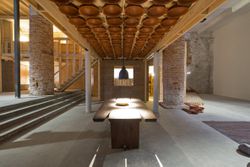
Au cours de cette conférence, Madame Kundoo parlera d’un éventail de projets tirés de sa pratique, de sa recherche et de son enseignement. Dans ces sphères de travail distinctes mais complémentaires, elle tente de bâtir un savoir collectif, en collaboration avec des ingénieurs, des maçons, des dessinateurs, des producteurs d’infrastructure, des résidents, des fournisseurs(...)
Au cours de cette conférence, Madame Kundoo parlera d’un éventail de projets tirés de sa pratique, de sa recherche et de son enseignement. Dans ces sphères de travail distinctes mais complémentaires, elle tente de bâtir un savoir collectif, en collaboration avec des ingénieurs, des maçons, des dessinateurs, des producteurs d’infrastructure, des résidents, des fournisseurs(...)
Localisation:
Théâtre Paul-Desmarais
Théâtre Paul-Desmarais
Date:
16 avril 2015 , 18h
16 avril 2015 , 18h
Titre:
La connaissance du bâti
Actions:
Description:
Au cours de cette conférence, Madame Kundoo parlera d’un éventail de projets tirés de sa pratique, de sa recherche et de son enseignement. Dans ces sphères de travail distinctes mais complémentaires, elle tente de bâtir un savoir collectif, en collaboration avec des ingénieurs, des maçons, des dessinateurs, des producteurs d’infrastructure, des résidents, des fournisseurs(...)
La connaissance du bâti
Actions:
Description:
Au cours de cette conférence, Madame Kundoo parlera d’un éventail de projets tirés de sa pratique, de sa recherche et de son enseignement. Dans ces sphères de travail distinctes mais complémentaires, elle tente de bâtir un savoir collectif, en collaboration avec des ingénieurs, des maçons, des dessinateurs, des producteurs d’infrastructure, des résidents, des fournisseurs(...)
Classification:
événements
événements
Date:
16 avril 2015
18h
16 avril 2015
18h
Localisation:
Théâtre Paul-Desmarais
Théâtre Paul-Desmarais
Niveau de description archivistique:
Série(s)
Série(s)
Numéro de référence:
AP189.S2
Description:
Series 2, Software for producing the projection and narration, 2007-2008, is composed of ten different versions of the module that generates the projection and narration in the open gallery. Seven of the versions were among the files saved to a compact disc following the CCA exhibition and have been kept together as group ARCH275207. Three of the versions were on a hard drive that was used in Rovereto and comprise group ARCH275212. The core elements of each module are two application files. One of these, whose name begins with "VE1" uses parameters contained in a file called "config.txt". The other application file, called "VECalibration" displays the entire volume of the projected architectural space. The geometric parameters for a room are recorded in a separate image file called "ecan-angles.jpg". A readme file in each module explains how the different files interact with one another. It also identifies the version of the "VE1" application files and any issues that may be related to the version. Each module includes hundreds of Shockwave Flash files (.swf), each containing an animated or still image of a person or persons and/or one or more pieces of furniture. Some of the .swf files contain an image of one or more furnished rooms inhabited by one or more persons. In most versions, the config.txt file contains a URL that accesses the database containing the sensor data. The URL references the file "captorsxml.aspx". As mentioned earlier, the config.txt file also contains parameters for the projected image, including scene geometry, colors and space occupation, and lists of the .swf files for persons and objects. Most versions of the module also include twenty-one .mp3 files, one of which is "empty". The other twenty each contain an audio recording of a female voice that states values for temperature, illumination and relative humidity and narrates a scenario written by Alain Robbe-Grillet. There is a French- and English-language version of each scenario
AP189.S2
Description:
Series 2, Software for producing the projection and narration, 2007-2008, is composed of ten different versions of the module that generates the projection and narration in the open gallery. Seven of the versions were among the files saved to a compact disc following the CCA exhibition and have been kept together as group ARCH275207. Three of the versions were on a hard drive that was used in Rovereto and comprise group ARCH275212. The core elements of each module are two application files. One of these, whose name begins with "VE1" uses parameters contained in a file called "config.txt". The other application file, called "VECalibration" displays the entire volume of the projected architectural space. The geometric parameters for a room are recorded in a separate image file called "ecan-angles.jpg". A readme file in each module explains how the different files interact with one another. It also identifies the version of the "VE1" application files and any issues that may be related to the version. Each module includes hundreds of Shockwave Flash files (.swf), each containing an animated or still image of a person or persons and/or one or more pieces of furniture. Some of the .swf files contain an image of one or more furnished rooms inhabited by one or more persons. In most versions, the config.txt file contains a URL that accesses the database containing the sensor data. The URL references the file "captorsxml.aspx". As mentioned earlier, the config.txt file also contains parameters for the projected image, including scene geometry, colors and space occupation, and lists of the .swf files for persons and objects. Most versions of the module also include twenty-one .mp3 files, one of which is "empty". The other twenty each contain an audio recording of a female voice that states values for temperature, illumination and relative humidity and narrates a scenario written by Alain Robbe-Grillet. There is a French- and English-language version of each scenario
Personnes et institutions:
Date:
2007-2008
2007-2008
Titre:
Software for producing the projection and narration
Actions:
AP189.S2
Description:
Series 2, Software for producing the projection and narration, 2007-2008, is composed of ten different versions of the module that generates the projection and narration in the open gallery. Seven of the versions were among the files saved to a compact disc following the CCA exhibition and have been kept together as group ARCH275207. Three of the versions were on a hard drive that was used in Rovereto and comprise group ARCH275212. The core elements of each module are two application files. One of these, whose name begins with "VE1" uses parameters contained in a file called "config.txt". The other application file, called "VECalibration" displays the entire volume of the projected architectural space. The geometric parameters for a room are recorded in a separate image file called "ecan-angles.jpg". A readme file in each module explains how the different files interact with one another. It also identifies the version of the "VE1" application files and any issues that may be related to the version. Each module includes hundreds of Shockwave Flash files (.swf), each containing an animated or still image of a person or persons and/or one or more pieces of furniture. Some of the .swf files contain an image of one or more furnished rooms inhabited by one or more persons. In most versions, the config.txt file contains a URL that accesses the database containing the sensor data. The URL references the file "captorsxml.aspx". As mentioned earlier, the config.txt file also contains parameters for the projected image, including scene geometry, colors and space occupation, and lists of the .swf files for persons and objects. Most versions of the module also include twenty-one .mp3 files, one of which is "empty". The other twenty each contain an audio recording of a female voice that states values for temperature, illumination and relative humidity and narrates a scenario written by Alain Robbe-Grillet. There is a French- and English-language version of each scenario
Software for producing the projection and narration
Actions:
AP189.S2
Description:
Series 2, Software for producing the projection and narration, 2007-2008, is composed of ten different versions of the module that generates the projection and narration in the open gallery. Seven of the versions were among the files saved to a compact disc following the CCA exhibition and have been kept together as group ARCH275207. Three of the versions were on a hard drive that was used in Rovereto and comprise group ARCH275212. The core elements of each module are two application files. One of these, whose name begins with "VE1" uses parameters contained in a file called "config.txt". The other application file, called "VECalibration" displays the entire volume of the projected architectural space. The geometric parameters for a room are recorded in a separate image file called "ecan-angles.jpg". A readme file in each module explains how the different files interact with one another. It also identifies the version of the "VE1" application files and any issues that may be related to the version. Each module includes hundreds of Shockwave Flash files (.swf), each containing an animated or still image of a person or persons and/or one or more pieces of furniture. Some of the .swf files contain an image of one or more furnished rooms inhabited by one or more persons. In most versions, the config.txt file contains a URL that accesses the database containing the sensor data. The URL references the file "captorsxml.aspx". As mentioned earlier, the config.txt file also contains parameters for the projected image, including scene geometry, colors and space occupation, and lists of the .swf files for persons and objects. Most versions of the module also include twenty-one .mp3 files, one of which is "empty". The other twenty each contain an audio recording of a female voice that states values for temperature, illumination and relative humidity and narrates a scenario written by Alain Robbe-Grillet. There is a French- and English-language version of each scenario
Niveau de description archivistique:
Series 2
Series 2
Date:
2007-2008
2007-2008
Personnes et institutions:
Classification:
oeuvres d'art
oeuvres d'art
Numéro de référence:
DR1988:0437:014
Description:
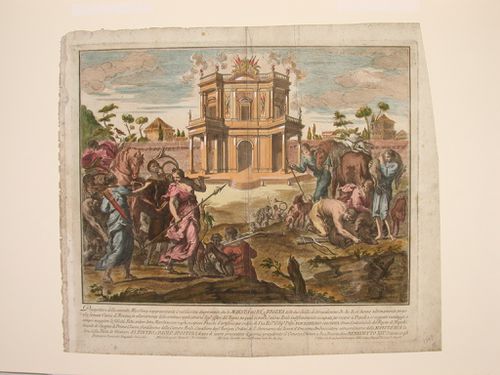
- This etching for a fireworks construction or macchina consists of a two-storey tempietto set in a inhabited landscape. Men and women in classical dress participate in a hunt in the foreground.
DR1988:0437:014
Description:
- This etching for a fireworks construction or macchina consists of a two-storey tempietto set in a inhabited landscape. Men and women in classical dress participate in a hunt in the foreground.
Personnes et institutions:
Sujet:
architecture temporaire
architecture temporaire
Date:
printed 1748
printed 1748
Titre:
Etching of the design for the "seconda macchina" of 1748
Actions:
DR1988:0437:014
Description:
- This etching for a fireworks construction or macchina consists of a two-storey tempietto set in a inhabited landscape. Men and women in classical dress participate in a hunt in the foreground.
Etching of the design for the "seconda macchina" of 1748
Actions:
DR1988:0437:014
Description:
- This etching for a fireworks construction or macchina consists of a two-storey tempietto set in a inhabited landscape. Men and women in classical dress participate in a hunt in the foreground.
Classification:
oeuvres d'art
oeuvres d'art
Date:
printed 1748
printed 1748
Personnes et institutions:
Sujet:
architecture temporaire
architecture temporaire
Classification:
événements
événements
Titre:
Isola et Norzi : Conshelf II
Isola et Norzi : Conshelf II
Actions:
Description:
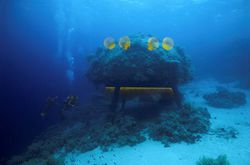
Les artistes Hilario Isola et Matteo Norzi parlent de la base sous-marine Précontinent II de Jacques Cousteau et de leur propre projet Liquid Door qui propose de réanimer le rêve d’une vie sous-marine en rendant la maison « Étoile de mer » de Cousteau habitable. Basés à New York, les Italiens Hilario Isola et Matteo Norzi collaborent depuis 2003, mettant en commun leurs(...)
Les artistes Hilario Isola et Matteo Norzi parlent de la base sous-marine Précontinent II de Jacques Cousteau et de leur propre projet Liquid Door qui propose de réanimer le rêve d’une vie sous-marine en rendant la maison « Étoile de mer » de Cousteau habitable. Basés à New York, les Italiens Hilario Isola et Matteo Norzi collaborent depuis 2003, mettant en commun leurs(...)
Localisation:
Théâtre Paul-Desmarais
Théâtre Paul-Desmarais
Date:
13 mai 2010 , 19h
13 mai 2010 , 19h
Titre:
Isola et Norzi : Conshelf II
Actions:
Description:
Les artistes Hilario Isola et Matteo Norzi parlent de la base sous-marine Précontinent II de Jacques Cousteau et de leur propre projet Liquid Door qui propose de réanimer le rêve d’une vie sous-marine en rendant la maison « Étoile de mer » de Cousteau habitable. Basés à New York, les Italiens Hilario Isola et Matteo Norzi collaborent depuis 2003, mettant en commun leurs(...)
Isola et Norzi : Conshelf II
Actions:
Description:
Les artistes Hilario Isola et Matteo Norzi parlent de la base sous-marine Précontinent II de Jacques Cousteau et de leur propre projet Liquid Door qui propose de réanimer le rêve d’une vie sous-marine en rendant la maison « Étoile de mer » de Cousteau habitable. Basés à New York, les Italiens Hilario Isola et Matteo Norzi collaborent depuis 2003, mettant en commun leurs(...)
Classification:
événements
événements
Date:
13 mai 2010
19h
13 mai 2010
19h
Localisation:
Théâtre Paul-Desmarais
Théâtre Paul-Desmarais
Classification:
oeuvres d'art
oeuvres d'art
Numéro de référence:
DR1988:0437:004
Description:
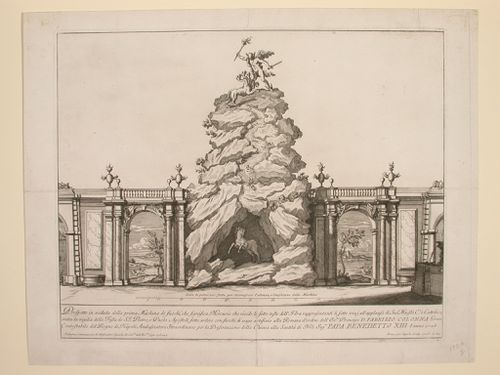
- This etching for a fireworks construction or macchina is set against the wall of a courtyard. The central motif is a mountain surmounted by a representation of Mercury slaying a monster. The bottom of the mountain contains a cave inhabited by the Chinea, or white mare.
DR1988:0437:004
Description:
- This etching for a fireworks construction or macchina is set against the wall of a courtyard. The central motif is a mountain surmounted by a representation of Mercury slaying a monster. The bottom of the mountain contains a cave inhabited by the Chinea, or white mare.
Personnes et institutions:
Sujet:
architecture temporaire
architecture temporaire
Date:
printed 1726
printed 1726
Titre:
Etching of Specchi's design for the "prima macchina" of 1726
Actions:
DR1988:0437:004
Description:
- This etching for a fireworks construction or macchina is set against the wall of a courtyard. The central motif is a mountain surmounted by a representation of Mercury slaying a monster. The bottom of the mountain contains a cave inhabited by the Chinea, or white mare.
Etching of Specchi's design for the "prima macchina" of 1726
Actions:
DR1988:0437:004
Description:
- This etching for a fireworks construction or macchina is set against the wall of a courtyard. The central motif is a mountain surmounted by a representation of Mercury slaying a monster. The bottom of the mountain contains a cave inhabited by the Chinea, or white mare.
Classification:
oeuvres d'art
oeuvres d'art
Date:
printed 1726
printed 1726
Personnes et institutions:
Sujet:
architecture temporaire
architecture temporaire
Classification:
événements
événements
Titre:
L'enseignement de... Madrid
L'enseignement de... Madrid
Actions:
Description:
Au lendemain de la tragique crise économique mondiale, l’Espagne fait actuellement les frais d’une absence totale de politique urbanistique, particulièrement en ce qui concerne les réglementations visant l’industrie de la construction. Le resserrement du crédit qui freina la frénésie de construction laissa dans son sillage un vaste territoire de construction inachevées.(...)
Au lendemain de la tragique crise économique mondiale, l’Espagne fait actuellement les frais d’une absence totale de politique urbanistique, particulièrement en ce qui concerne les réglementations visant l’industrie de la construction. Le resserrement du crédit qui freina la frénésie de construction laissa dans son sillage un vaste territoire de construction inachevées.(...)
Localisation:
Théâtre Paul-Desmarais
Théâtre Paul-Desmarais
Date:
4 décembre 2014 , 18h
4 décembre 2014 , 18h
Titre:
L'enseignement de... Madrid
Actions:
Description:
Au lendemain de la tragique crise économique mondiale, l’Espagne fait actuellement les frais d’une absence totale de politique urbanistique, particulièrement en ce qui concerne les réglementations visant l’industrie de la construction. Le resserrement du crédit qui freina la frénésie de construction laissa dans son sillage un vaste territoire de construction inachevées.(...)
L'enseignement de... Madrid
Actions:
Description:
Au lendemain de la tragique crise économique mondiale, l’Espagne fait actuellement les frais d’une absence totale de politique urbanistique, particulièrement en ce qui concerne les réglementations visant l’industrie de la construction. Le resserrement du crédit qui freina la frénésie de construction laissa dans son sillage un vaste territoire de construction inachevées.(...)
Classification:
événements
événements
Date:
4 décembre 2014
18h
4 décembre 2014
18h
Localisation:
Théâtre Paul-Desmarais
Théâtre Paul-Desmarais
Classification:
archives
Niveau de description archivistique:
Fonds
archives
Niveau de description archivistique:
Fonds
Numéro de référence:
AP189
Résumé:
L’installation Météorologie d’intérieur fut présentée au Centre Canadien d’Architecture (CCA) lors de l’exposition Environ(ne)ment (18 octobre 2006-10 juin 2007) et à Rovereto en Italie lors de l’exposition Manifesta 7 (19 juillet-2 novembre 2008). Les documents d’archives de l’installation comprennent le logiciel développé pour l’installation et une sélection des objets installés dans les deux espaces d’exposition. *** The installation Interior Weather was presented at the Candian Centre for Architecture (CCA) as part of the exhibition Environ(ne)ment (October 18, 2006-June 10, 2007) and in Rovereto, Italy as part of Manifesta 7 (July 19-November 2, 2008). The records of the installation Interior Weather include the software developed for the installation and a selection of objects installed in the exhibition spaces.
AP189
Résumé:
L’installation Météorologie d’intérieur fut présentée au Centre Canadien d’Architecture (CCA) lors de l’exposition Environ(ne)ment (18 octobre 2006-10 juin 2007) et à Rovereto en Italie lors de l’exposition Manifesta 7 (19 juillet-2 novembre 2008). Les documents d’archives de l’installation comprennent le logiciel développé pour l’installation et une sélection des objets installés dans les deux espaces d’exposition. *** The installation Interior Weather was presented at the Candian Centre for Architecture (CCA) as part of the exhibition Environ(ne)ment (October 18, 2006-June 10, 2007) and in Rovereto, Italy as part of Manifesta 7 (July 19-November 2, 2008). The records of the installation Interior Weather include the software developed for the installation and a selection of objects installed in the exhibition spaces.
Personnes et institutions:
Date:
2000-2008
2000-2008
Titre:
Documents d'archives de l'installation "Météorologie d'intérieur" de Philippe Rahm
Actions:
AP189
Résumé:
L’installation Météorologie d’intérieur fut présentée au Centre Canadien d’Architecture (CCA) lors de l’exposition Environ(ne)ment (18 octobre 2006-10 juin 2007) et à Rovereto en Italie lors de l’exposition Manifesta 7 (19 juillet-2 novembre 2008). Les documents d’archives de l’installation comprennent le logiciel développé pour l’installation et une sélection des objets installés dans les deux espaces d’exposition. *** The installation Interior Weather was presented at the Candian Centre for Architecture (CCA) as part of the exhibition Environ(ne)ment (October 18, 2006-June 10, 2007) and in Rovereto, Italy as part of Manifesta 7 (July 19-November 2, 2008). The records of the installation Interior Weather include the software developed for the installation and a selection of objects installed in the exhibition spaces.
Documents d'archives de l'installation "Météorologie d'intérieur" de Philippe Rahm
Actions:
AP189
Résumé:
L’installation Météorologie d’intérieur fut présentée au Centre Canadien d’Architecture (CCA) lors de l’exposition Environ(ne)ment (18 octobre 2006-10 juin 2007) et à Rovereto en Italie lors de l’exposition Manifesta 7 (19 juillet-2 novembre 2008). Les documents d’archives de l’installation comprennent le logiciel développé pour l’installation et une sélection des objets installés dans les deux espaces d’exposition. *** The installation Interior Weather was presented at the Candian Centre for Architecture (CCA) as part of the exhibition Environ(ne)ment (October 18, 2006-June 10, 2007) and in Rovereto, Italy as part of Manifesta 7 (July 19-November 2, 2008). The records of the installation Interior Weather include the software developed for the installation and a selection of objects installed in the exhibition spaces.
Classification:
archives
Niveau de description archivistique:
Fonds
archives
Niveau de description archivistique:
Fonds
Date:
2000-2008
2000-2008
Personnes et institutions:


