


1053 Résultats
Classification:
livres
livres
Actions:
Exemplaires:
Description:
150 pages : illustrations ; 23 cm
Description:
150 pages : illustrations ; 23 cm
Auteur:
Sujet:
Publication:
Bristol, UK ; Chicago : Intellect, 2009.
Bristol, UK ; Chicago : Intellect, 2009.
Titre:
Public spheres after socialism / edited by Angela Harutyunyan, Kathrin Hörschelmann, and Malcolm Miles ; editorial assistant, Karen Roulstone.
Actions:
Exemplaires:
Description:
150 pages : illustrations ; 23 cm
Public spheres after socialism / edited by Angela Harutyunyan, Kathrin Hörschelmann, and Malcolm Miles ; editorial assistant, Karen Roulstone.
Actions:
Exemplaires:
Description:
150 pages : illustrations ; 23 cm
Classification:
livres
livres
Publication:
Bristol, UK ; Chicago : Intellect, 2009.
Bristol, UK ; Chicago : Intellect, 2009.
Auteur:
Sujet:
Classification:
livres
livres
Actions:
Exemplaires:
Description:
462 pages : illustrations (some color) ; 27 cm
Description:
462 pages : illustrations (some color) ; 27 cm
Auteur:
Sujet:
Publication:
México : Universidad Nacional Autónoma de México, Instituto de Investigaciones Estéticas : Instituto Nacional de Antropología e Historia, 2011.
México : Universidad Nacional Autónoma de México, Instituto de Investigaciones Estéticas : Instituto Nacional de Antropología e Historia, 2011.
Titre:
Estudios sobre el simbolismo en la arquitectura novohispana / Martha Fernández.
Actions:
Exemplaires:
Description:
462 pages : illustrations (some color) ; 27 cm
Estudios sobre el simbolismo en la arquitectura novohispana / Martha Fernández.
Actions:
Exemplaires:
Description:
462 pages : illustrations (some color) ; 27 cm
Classification:
livres
livres
Publication:
México : Universidad Nacional Autónoma de México, Instituto de Investigaciones Estéticas : Instituto Nacional de Antropología e Historia, 2011.
México : Universidad Nacional Autónoma de México, Instituto de Investigaciones Estéticas : Instituto Nacional de Antropología e Historia, 2011.
Auteur:
Sujet:
Classification:
livres
livres
Actions:
Exemplaires:
Description:
xvii, 281 pages, 8 unnumbered pages of plates : illustrations (some color), map ; 24 cm.
Description:
xvii, 281 pages, 8 unnumbered pages of plates : illustrations (some color), map ; 24 cm.
Auteur:
Sujet:
Publication:
Oxford ; New York : Oxford University Press, 2012.
Oxford ; New York : Oxford University Press, 2012.
Titre:
Antiquity on display : regimes of the authentic in Berlin's Pergamon Museum / Can Bilsel.
Actions:
Exemplaires:
Description:
xvii, 281 pages, 8 unnumbered pages of plates : illustrations (some color), map ; 24 cm.
Antiquity on display : regimes of the authentic in Berlin's Pergamon Museum / Can Bilsel.
Actions:
Exemplaires:
Description:
xvii, 281 pages, 8 unnumbered pages of plates : illustrations (some color), map ; 24 cm.
Classification:
livres
livres
Publication:
Oxford ; New York : Oxford University Press, 2012.
Oxford ; New York : Oxford University Press, 2012.
Auteur:
Sujet:
Classification:
livres
livres
Actions:
Exemplaires:
Description:
261 pages : illustrations (some color), map ; 23 cm
Description:
261 pages : illustrations (some color), map ; 23 cm
Auteur:
Sujet:
Publication:
Liverpool : Liverpool University Press : Tate Liverpool, [2002]
Liverpool : Liverpool University Press : Tate Liverpool, [2002]
Titre:
Urban visions : experiencing and envisioning the city / edited by Steven Spier.
Actions:
Exemplaires:
Description:
261 pages : illustrations (some color), map ; 23 cm
Urban visions : experiencing and envisioning the city / edited by Steven Spier.
Actions:
Exemplaires:
Description:
261 pages : illustrations (some color), map ; 23 cm
Classification:
livres
livres
Publication:
Liverpool : Liverpool University Press : Tate Liverpool, [2002]
Liverpool : Liverpool University Press : Tate Liverpool, [2002]
Auteur:
Sujet:
Classification:
livres
livres
Actions:
Prix:
$50.00
(disponible sur commande)
Résumé:
How did the great architects of this century reconcile their vision of architecture with the realities of building? "The details of modern architecture" provides comprehensive analysis of both the technical and the aesthetic importance of details in the development of architecture. With more than 500 illustrations, this book is providing a valuable collective(...)
$50.00
(disponible sur commande)
Résumé:
How did the great architects of this century reconcile their vision of architecture with the realities of building? "The details of modern architecture" provides comprehensive analysis of both the technical and the aesthetic importance of details in the development of architecture. With more than 500 illustrations, this book is providing a valuable collective(...)
Titre:
The details of modern architecture volume 1
Actions:
Prix:
$50.00
(disponible sur commande)
Résumé:
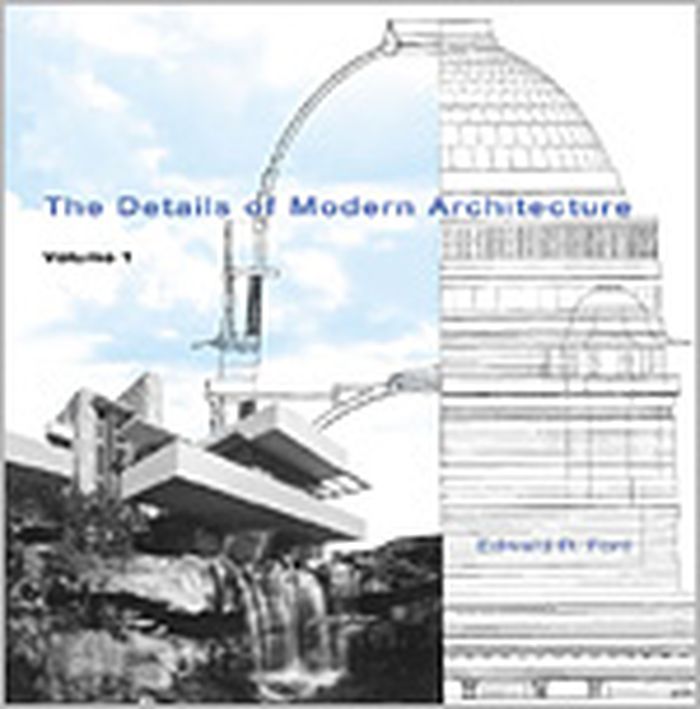
How did the great architects of this century reconcile their vision of architecture with the realities of building? "The details of modern architecture" provides comprehensive analysis of both the technical and the aesthetic importance of details in the development of architecture. With more than 500 illustrations, this book is providing a valuable collective resource. They present the details of notable architectural works drawn in similar styles and formats, allowing comparisons between works of different scales, periods, and styles. Covering the period 1890-1932, Ford focuses on various recognized masters, explaining the detailing and construction techniques that distort, camouflage, or enhance a building. He looks at the source of each architect's ideas, the translation of those ideas into practice, and the success or failure of the technical execution. Ford examines Frank Lloyd Wright's Robie House and Fallingwater Le Corbusier's Villa Savoye, and buildings by McKim, Mead & White, Lutyens, Mies van der Rohe, and Schindler from a point of view that acknowledges the importance of tradition, precedent, style, and ideology in architectural construction. He discusses critical details from a technical and contextual standpoint, considering how they perform how they add to or detract from the building as a whole, and how some have persisted and been adapted through time.
The details of modern architecture volume 1
Actions:
Prix:
$50.00
(disponible sur commande)
Résumé:
How did the great architects of this century reconcile their vision of architecture with the realities of building? "The details of modern architecture" provides comprehensive analysis of both the technical and the aesthetic importance of details in the development of architecture. With more than 500 illustrations, this book is providing a valuable collective resource. They present the details of notable architectural works drawn in similar styles and formats, allowing comparisons between works of different scales, periods, and styles. Covering the period 1890-1932, Ford focuses on various recognized masters, explaining the detailing and construction techniques that distort, camouflage, or enhance a building. He looks at the source of each architect's ideas, the translation of those ideas into practice, and the success or failure of the technical execution. Ford examines Frank Lloyd Wright's Robie House and Fallingwater Le Corbusier's Villa Savoye, and buildings by McKim, Mead & White, Lutyens, Mies van der Rohe, and Schindler from a point of view that acknowledges the importance of tradition, precedent, style, and ideology in architectural construction. He discusses critical details from a technical and contextual standpoint, considering how they perform how they add to or detract from the building as a whole, and how some have persisted and been adapted through time.
Classification:
livres
livres
Publication:
octobre 2003, Cambridge, Mass.
octobre 2003, Cambridge, Mass.
Sujet:
Modernisme
Modernisme
Classification:
livres
livres

Titre:
Radical intimacy
Radical intimacy
Actions:
Prix:
$29.95
(disponible en magasin)
Résumé:
Capitalist ideology wants us to believe that there is an optimal way to live. 'Making connections' means networking for work. Our emotional needs are to be fulfilled by a single romantic partner, and self-care equates to taking personal responsibility for our suffering. We must be productive and heterosexual, we must have babies and buy a house. But the kicker is most(...)
$29.95
(disponible en magasin)
Résumé:
Capitalist ideology wants us to believe that there is an optimal way to live. 'Making connections' means networking for work. Our emotional needs are to be fulfilled by a single romantic partner, and self-care equates to taking personal responsibility for our suffering. We must be productive and heterosexual, we must have babies and buy a house. But the kicker is most(...)
Titre:
Radical intimacy
Actions:
Prix:
$29.95
(disponible en magasin)
Résumé:
Capitalist ideology wants us to believe that there is an optimal way to live. 'Making connections' means networking for work. Our emotional needs are to be fulfilled by a single romantic partner, and self-care equates to taking personal responsibility for our suffering. We must be productive and heterosexual, we must have babies and buy a house. But the kicker is most people cannot and do not want to achieve all, or any of these life goals. Instead we are left feeling atomised, exhausted and disempowered. ''Radical intimacy'' shows that it doesn't need to be this way. A punchy and impassioned account of inspiring ideas about alternative ways to live, Sophie K Rosa demands we use our radical imagination to discover a new form of intimacy and to transform our personal lives and in turn society as a whole. Including critiques of the 'wellness' industry that ignores rising poverty rates, the mental health crisis and racist and misogynist state violence; transcending love and sex under capitalism to move towards feminist, decolonial and queer thinking; asking whether we should abolish the family; interrogating the framing of ageing and death and much more, ''Radical intimacy'' is the compassionate antidote to a callous society.
Radical intimacy
Actions:
Prix:
$29.95
(disponible en magasin)
Résumé:
Capitalist ideology wants us to believe that there is an optimal way to live. 'Making connections' means networking for work. Our emotional needs are to be fulfilled by a single romantic partner, and self-care equates to taking personal responsibility for our suffering. We must be productive and heterosexual, we must have babies and buy a house. But the kicker is most people cannot and do not want to achieve all, or any of these life goals. Instead we are left feeling atomised, exhausted and disempowered. ''Radical intimacy'' shows that it doesn't need to be this way. A punchy and impassioned account of inspiring ideas about alternative ways to live, Sophie K Rosa demands we use our radical imagination to discover a new form of intimacy and to transform our personal lives and in turn society as a whole. Including critiques of the 'wellness' industry that ignores rising poverty rates, the mental health crisis and racist and misogynist state violence; transcending love and sex under capitalism to move towards feminist, decolonial and queer thinking; asking whether we should abolish the family; interrogating the framing of ageing and death and much more, ''Radical intimacy'' is the compassionate antidote to a callous society.
Classification:
livres
livres
Publication:
avril 2023
avril 2023
Sujet:
Social
Social
Classification:
livres
livres
Actions:
Prix:
$56.00
(disponible en magasin)
Résumé:
''Collective Intelligence'' is an innovative monograph that documents the last ten years of Polish-born conceptual artist Agnieszka Kurant’s interdisciplinary practice. It includes newly commissioned texts by renowned thinkers in science, philosophy, art, technology, anthropology, and economics. Kurant’s experimental work investigates collective and nonhuman(...)
$56.00
(disponible en magasin)
Résumé:
''Collective Intelligence'' is an innovative monograph that documents the last ten years of Polish-born conceptual artist Agnieszka Kurant’s interdisciplinary practice. It includes newly commissioned texts by renowned thinkers in science, philosophy, art, technology, anthropology, and economics. Kurant’s experimental work investigates collective and nonhuman(...)
Publication:
décembre 2025
décembre 2025
Titre:
Agnieszka Kurant: Collective intelligence
Actions:
Prix:
$56.00
(disponible en magasin)
Résumé:
''Collective Intelligence'' is an innovative monograph that documents the last ten years of Polish-born conceptual artist Agnieszka Kurant’s interdisciplinary practice. It includes newly commissioned texts by renowned thinkers in science, philosophy, art, technology, anthropology, and economics. Kurant’s experimental work investigates collective and nonhuman intelligences and their impact on transformations of the human, the future of labor and creativity, and the exploitations within digital capitalism. Questioning the ideology of individualism, Kurant proposes that we rethink human and more-than-human worlds from a perspective of plural subjectivity, and, through this fundamental shift in perspective, posits the possibility of alternative political imaginaries. Her work probes the replacement of individual authorship with collective intelligence—a phenomenon observed in slime molds, termite colonies, social movements, cities, the internet, and inside our brains. In her collaborative practice, the artist investigates artificial intelligence, emergence, cybernetics, automation, artificial life, mining industries, and energy circuits to explore our collective evolution and the shifting status of objects in relation to agency, value, circulation, and redistribution. Through crowdsourcing the production of her artworks to thousands of humans and nonhumans, Kurant creates unstable, hybrid forms that constantly evolve. Her works, oscillating between biological, digital, and geological, embody the crumbling distinctions between what is natural and artificial, real and synthetic, and life and nonlife.
Agnieszka Kurant: Collective intelligence
Actions:
Prix:
$56.00
(disponible en magasin)
Résumé:
''Collective Intelligence'' is an innovative monograph that documents the last ten years of Polish-born conceptual artist Agnieszka Kurant’s interdisciplinary practice. It includes newly commissioned texts by renowned thinkers in science, philosophy, art, technology, anthropology, and economics. Kurant’s experimental work investigates collective and nonhuman intelligences and their impact on transformations of the human, the future of labor and creativity, and the exploitations within digital capitalism. Questioning the ideology of individualism, Kurant proposes that we rethink human and more-than-human worlds from a perspective of plural subjectivity, and, through this fundamental shift in perspective, posits the possibility of alternative political imaginaries. Her work probes the replacement of individual authorship with collective intelligence—a phenomenon observed in slime molds, termite colonies, social movements, cities, the internet, and inside our brains. In her collaborative practice, the artist investigates artificial intelligence, emergence, cybernetics, automation, artificial life, mining industries, and energy circuits to explore our collective evolution and the shifting status of objects in relation to agency, value, circulation, and redistribution. Through crowdsourcing the production of her artworks to thousands of humans and nonhumans, Kurant creates unstable, hybrid forms that constantly evolve. Her works, oscillating between biological, digital, and geological, embody the crumbling distinctions between what is natural and artificial, real and synthetic, and life and nonlife.
Classification:
livres
livres
Publication:
décembre 2025
décembre 2025
Classification:
livres
livres

Actions:
Prix:
$60.50
(disponible sur commande)
Résumé:
If this were a novel, the tales of astounding wealth, sexual perversion, murder, munificence, rape, insanity, brutality, slavery, religious mania, selfishness, snobbery, charity, suicide, generosity, theft, madness, wickedness, failure and eccentricity which unfold in these pages would be too concentrated to allow for the willing suspension of disbelief. All these sins(...)
$60.50
(disponible sur commande)
Résumé:
If this were a novel, the tales of astounding wealth, sexual perversion, murder, munificence, rape, insanity, brutality, slavery, religious mania, selfishness, snobbery, charity, suicide, generosity, theft, madness, wickedness, failure and eccentricity which unfold in these pages would be too concentrated to allow for the willing suspension of disbelief. All these sins(...)
Publication:
octobre 2020
octobre 2020
Titre:
The English folly: the edifice complex
Actions:
Prix:
$60.50
(disponible sur commande)
Résumé:
If this were a novel, the tales of astounding wealth, sexual perversion, murder, munificence, rape, insanity, brutality, slavery, religious mania, selfishness, snobbery, charity, suicide, generosity, theft, madness, wickedness, failure and eccentricity which unfold in these pages would be too concentrated to allow for the willing suspension of disbelief. All these sins and virtues, and more, are displayed by the characters in this book, some exhibiting several of them simultaneously. Folly builders were not as we are. They never built what we now call follies. They built for beauty, utility, improvement; it is only we, struggling after them with our imperfect understanding, who dismiss their prodigious constructions as follies. Follies can be found around the world, but England is their spiritual home. Having written the definitive books on follies in Great Britain, Benelux and the USA, Headley & Meulenkamp have turned their attention to the folly builders themselves, people so blinded by fashion or driven by some nameless ideology that they expended great fortunes on making their point in brick, stone and flint. Most follies are simply misunderstood buildings, and this book studies the motives, characters, decisions and delusions of their builders. If there was madness in their building, fortunately there was no method in it.
The English folly: the edifice complex
Actions:
Prix:
$60.50
(disponible sur commande)
Résumé:
If this were a novel, the tales of astounding wealth, sexual perversion, murder, munificence, rape, insanity, brutality, slavery, religious mania, selfishness, snobbery, charity, suicide, generosity, theft, madness, wickedness, failure and eccentricity which unfold in these pages would be too concentrated to allow for the willing suspension of disbelief. All these sins and virtues, and more, are displayed by the characters in this book, some exhibiting several of them simultaneously. Folly builders were not as we are. They never built what we now call follies. They built for beauty, utility, improvement; it is only we, struggling after them with our imperfect understanding, who dismiss their prodigious constructions as follies. Follies can be found around the world, but England is their spiritual home. Having written the definitive books on follies in Great Britain, Benelux and the USA, Headley & Meulenkamp have turned their attention to the folly builders themselves, people so blinded by fashion or driven by some nameless ideology that they expended great fortunes on making their point in brick, stone and flint. Most follies are simply misunderstood buildings, and this book studies the motives, characters, decisions and delusions of their builders. If there was madness in their building, fortunately there was no method in it.
Classification:
livres
livres
Publication:
octobre 2020
octobre 2020
Classification:
livres
livres

Prix:
$48.99
(disponible sur commande)
Résumé:
During the 1920s and 1930s, proponents of Soviet architecture looked to various principles within the human sciences in their efforts to formulate a methodological and theoretical basis for their modernist project. ''Architecture of life'' delves into the foundations of this transdisciplinary and transnational endeavor, analyzing many facets of their radical approach and(...)
$48.99
(disponible sur commande)
Résumé:
During the 1920s and 1930s, proponents of Soviet architecture looked to various principles within the human sciences in their efforts to formulate a methodological and theoretical basis for their modernist project. ''Architecture of life'' delves into the foundations of this transdisciplinary and transnational endeavor, analyzing many facets of their radical approach and(...)
Titre:
Architecture of life: Soviet modernism and the human sciences
Actions:
Prix:
$48.99
(disponible sur commande)
Résumé:
During the 1920s and 1930s, proponents of Soviet architecture looked to various principles within the human sciences in their efforts to formulate a methodological and theoretical basis for their modernist project. ''Architecture of life'' delves into the foundations of this transdisciplinary and transnational endeavor, analyzing many facets of their radical approach and situating it within the context of other modernist movements that were developing concurrently across the globe. Examining the theories advanced by El Lissitzky, Moisei Ginzburg, and Nikolay Ladovsky, as well as those of their lesser-known colleagues, this illuminating study demonstrates how Soviet architects of the interwar period sought to mitigate Fordist production methods with other, ostensibly more human-oriented approaches that drew on the biological and psychological sciences. Envisioning the built environment as innately connected to social evolution, their methods incorporated aspects of psychoanalysis, personality theory, and studies in spatial perception, all of which were integrated into an ideology that grounded functional design firmly within the attributes of the individual. A comprehensive overview of the ideals that permeated its expanded project, ''Architecture of life'' explicates the underlying impulses that motivated Soviet modernism, highlighting the deep interconnections among the ways in which it viewed all aspects of life, both natural and manufactured.
Architecture of life: Soviet modernism and the human sciences
Actions:
Prix:
$48.99
(disponible sur commande)
Résumé:
During the 1920s and 1930s, proponents of Soviet architecture looked to various principles within the human sciences in their efforts to formulate a methodological and theoretical basis for their modernist project. ''Architecture of life'' delves into the foundations of this transdisciplinary and transnational endeavor, analyzing many facets of their radical approach and situating it within the context of other modernist movements that were developing concurrently across the globe. Examining the theories advanced by El Lissitzky, Moisei Ginzburg, and Nikolay Ladovsky, as well as those of their lesser-known colleagues, this illuminating study demonstrates how Soviet architects of the interwar period sought to mitigate Fordist production methods with other, ostensibly more human-oriented approaches that drew on the biological and psychological sciences. Envisioning the built environment as innately connected to social evolution, their methods incorporated aspects of psychoanalysis, personality theory, and studies in spatial perception, all of which were integrated into an ideology that grounded functional design firmly within the attributes of the individual. A comprehensive overview of the ideals that permeated its expanded project, ''Architecture of life'' explicates the underlying impulses that motivated Soviet modernism, highlighting the deep interconnections among the ways in which it viewed all aspects of life, both natural and manufactured.
Classification:
livres
livres
Publication:
août 2022
août 2022
Sujet:
Théorie de l’architecture
Théorie de l’architecture
Classification:
livres
livres
Prix:
$35.95
(disponible sur commande)
Résumé:
Economic growth isn’t working, and it cannot be made to work. Offering a counter-history of how economic growth emerged in the context of colonialism, fossil-fueled industrialization, and capitalist modernity, ''The future is degrowth'' argues that the ideology of growth conceals the rising inequalities and ecological destructions associated with capitalism, and points to(...)
$35.95
(disponible sur commande)
Résumé:
Economic growth isn’t working, and it cannot be made to work. Offering a counter-history of how economic growth emerged in the context of colonialism, fossil-fueled industrialization, and capitalist modernity, ''The future is degrowth'' argues that the ideology of growth conceals the rising inequalities and ecological destructions associated with capitalism, and points to(...)
Titre:
The future is degrowth: A guide to a world beyond capitalism
Actions:
Prix:
$35.95
(disponible sur commande)
Résumé:
Economic growth isn’t working, and it cannot be made to work. Offering a counter-history of how economic growth emerged in the context of colonialism, fossil-fueled industrialization, and capitalist modernity, ''The future is degrowth'' argues that the ideology of growth conceals the rising inequalities and ecological destructions associated with capitalism, and points to desirable alternatives to it. Not only in society at large, but also on the left, we are held captive by the hegemony of growth. Even proposals for emancipatory Green New Deals or postcapitalism base their utopian hopes on the development of productive forces, on redistributing the fruits of economic growth and technological progress. Yet growing evidence shows that continued economic growth cannot be made compatible with sustaining life and is not necessary for a good life for all. This book provides a vision for postcapitalism beyond growth. Building on a vibrant field of research, it discusses the political economy and the politics of a non-growing economy. It charts a path forward through policies that democratise the economy, ''now-topias'' that create free spaces for experimentation, and counter-hegemonic movements that make it possible to break with the logic of growth. Degrowth perspectives offer a way to step off the treadmill of an alienating, expansionist, and hierarchical system.
The future is degrowth: A guide to a world beyond capitalism
Actions:
Prix:
$35.95
(disponible sur commande)
Résumé:
Economic growth isn’t working, and it cannot be made to work. Offering a counter-history of how economic growth emerged in the context of colonialism, fossil-fueled industrialization, and capitalist modernity, ''The future is degrowth'' argues that the ideology of growth conceals the rising inequalities and ecological destructions associated with capitalism, and points to desirable alternatives to it. Not only in society at large, but also on the left, we are held captive by the hegemony of growth. Even proposals for emancipatory Green New Deals or postcapitalism base their utopian hopes on the development of productive forces, on redistributing the fruits of economic growth and technological progress. Yet growing evidence shows that continued economic growth cannot be made compatible with sustaining life and is not necessary for a good life for all. This book provides a vision for postcapitalism beyond growth. Building on a vibrant field of research, it discusses the political economy and the politics of a non-growing economy. It charts a path forward through policies that democratise the economy, ''now-topias'' that create free spaces for experimentation, and counter-hegemonic movements that make it possible to break with the logic of growth. Degrowth perspectives offer a way to step off the treadmill of an alienating, expansionist, and hierarchical system.
Classification:
livres
livres
Publication:
juin 2022
juin 2022
Sujet:
Social
Social


