


538 Résultats
Niveau de description archivistique:
Projet
Projet
Numéro de référence:
AP075.S1.2016.PR01
Description:
Project series documents Cornelia Hahn Oberlander's work as a consulting landscape architect for the restauration of the landscape of the Canada Pavilion at Venice Biennale site, in Venice, Italy. Oberlander worked on this project in 2016 with Enns Gauthier Landscape Architects and in collaboration with the National Gallery of Canada. Oberlander's first goal in the redesigning of the landscape was to give better accessibility to the site. Her design consisted in creating paths to connect the Canadian Pavilion to the neighbouring British and German Pavilions, and also paths and plateforms to give access to the site that includes a cafe and a belvedere. The restored pavilion was unveiled at the 16th Venice Biennale in 2018 The project series contains predominantly presentation drawings, such as site plans, grading plants, plating plans, and details. The project is also documented through correspondence with landscape architects, proposal by Oberlander, reports, minutes of meetings, and documentation.
AP075.S1.2016.PR01
Description:
Project series documents Cornelia Hahn Oberlander's work as a consulting landscape architect for the restauration of the landscape of the Canada Pavilion at Venice Biennale site, in Venice, Italy. Oberlander worked on this project in 2016 with Enns Gauthier Landscape Architects and in collaboration with the National Gallery of Canada. Oberlander's first goal in the redesigning of the landscape was to give better accessibility to the site. Her design consisted in creating paths to connect the Canadian Pavilion to the neighbouring British and German Pavilions, and also paths and plateforms to give access to the site that includes a cafe and a belvedere. The restored pavilion was unveiled at the 16th Venice Biennale in 2018 The project series contains predominantly presentation drawings, such as site plans, grading plants, plating plans, and details. The project is also documented through correspondence with landscape architects, proposal by Oberlander, reports, minutes of meetings, and documentation.
Personnes et institutions:
Date:
2011-2018
2011-2018
Titre:
Venice Biennale Canada Pavilion, Venice, Italy (2016)
Actions:
AP075.S1.2016.PR01
Description:
Project series documents Cornelia Hahn Oberlander's work as a consulting landscape architect for the restauration of the landscape of the Canada Pavilion at Venice Biennale site, in Venice, Italy. Oberlander worked on this project in 2016 with Enns Gauthier Landscape Architects and in collaboration with the National Gallery of Canada. Oberlander's first goal in the redesigning of the landscape was to give better accessibility to the site. Her design consisted in creating paths to connect the Canadian Pavilion to the neighbouring British and German Pavilions, and also paths and plateforms to give access to the site that includes a cafe and a belvedere. The restored pavilion was unveiled at the 16th Venice Biennale in 2018 The project series contains predominantly presentation drawings, such as site plans, grading plants, plating plans, and details. The project is also documented through correspondence with landscape architects, proposal by Oberlander, reports, minutes of meetings, and documentation.
Venice Biennale Canada Pavilion, Venice, Italy (2016)
Actions:
AP075.S1.2016.PR01
Description:
Project series documents Cornelia Hahn Oberlander's work as a consulting landscape architect for the restauration of the landscape of the Canada Pavilion at Venice Biennale site, in Venice, Italy. Oberlander worked on this project in 2016 with Enns Gauthier Landscape Architects and in collaboration with the National Gallery of Canada. Oberlander's first goal in the redesigning of the landscape was to give better accessibility to the site. Her design consisted in creating paths to connect the Canadian Pavilion to the neighbouring British and German Pavilions, and also paths and plateforms to give access to the site that includes a cafe and a belvedere. The restored pavilion was unveiled at the 16th Venice Biennale in 2018 The project series contains predominantly presentation drawings, such as site plans, grading plants, plating plans, and details. The project is also documented through correspondence with landscape architects, proposal by Oberlander, reports, minutes of meetings, and documentation.
Niveau de description archivistique:
Project
Project
Date:
2011-2018
2011-2018
Personnes et institutions:
Niveau de description archivistique:
Projet
Projet
Numéro de référence:
AP056.S1.1993.PR03
Description:
This project series documents a proposal for the headquarters of TV Ontario (TVO) in Toronto from 1993-1994. The office identified the project number as 9305. This project proposed a seven-storey office building located at the corner of Simcoe and Nelson Streets. The site eventually changed to the corner of Sherbourne and King Streets. The TVO headquarters would include several television studios, a café, theatre, retail space, terrace and leasable areas. A tape library and parking would be provided below grade. A prominent spiral staircase from the ground floor to the second floor would be the focal point of the main lobby. The building's exterior would be primarily glass, with brick used at the ground floor. This project was never built. The project is recorded through original and reprographic copies of drawings dating from 1993-1994. The drawings consist of sketches, presentation drawings, plans, elevations, sections and axonometric drawings.
AP056.S1.1993.PR03
Description:
This project series documents a proposal for the headquarters of TV Ontario (TVO) in Toronto from 1993-1994. The office identified the project number as 9305. This project proposed a seven-storey office building located at the corner of Simcoe and Nelson Streets. The site eventually changed to the corner of Sherbourne and King Streets. The TVO headquarters would include several television studios, a café, theatre, retail space, terrace and leasable areas. A tape library and parking would be provided below grade. A prominent spiral staircase from the ground floor to the second floor would be the focal point of the main lobby. The building's exterior would be primarily glass, with brick used at the ground floor. This project was never built. The project is recorded through original and reprographic copies of drawings dating from 1993-1994. The drawings consist of sketches, presentation drawings, plans, elevations, sections and axonometric drawings.
Personnes et institutions:
Date:
1993-1994
1993-1994
Titre:
TV Ontario Headquarters Competition, Toronto (1993-1994)
Actions:
AP056.S1.1993.PR03
Description:
This project series documents a proposal for the headquarters of TV Ontario (TVO) in Toronto from 1993-1994. The office identified the project number as 9305. This project proposed a seven-storey office building located at the corner of Simcoe and Nelson Streets. The site eventually changed to the corner of Sherbourne and King Streets. The TVO headquarters would include several television studios, a café, theatre, retail space, terrace and leasable areas. A tape library and parking would be provided below grade. A prominent spiral staircase from the ground floor to the second floor would be the focal point of the main lobby. The building's exterior would be primarily glass, with brick used at the ground floor. This project was never built. The project is recorded through original and reprographic copies of drawings dating from 1993-1994. The drawings consist of sketches, presentation drawings, plans, elevations, sections and axonometric drawings.
TV Ontario Headquarters Competition, Toronto (1993-1994)
Actions:
AP056.S1.1993.PR03
Description:
This project series documents a proposal for the headquarters of TV Ontario (TVO) in Toronto from 1993-1994. The office identified the project number as 9305. This project proposed a seven-storey office building located at the corner of Simcoe and Nelson Streets. The site eventually changed to the corner of Sherbourne and King Streets. The TVO headquarters would include several television studios, a café, theatre, retail space, terrace and leasable areas. A tape library and parking would be provided below grade. A prominent spiral staircase from the ground floor to the second floor would be the focal point of the main lobby. The building's exterior would be primarily glass, with brick used at the ground floor. This project was never built. The project is recorded through original and reprographic copies of drawings dating from 1993-1994. The drawings consist of sketches, presentation drawings, plans, elevations, sections and axonometric drawings.
Niveau de description archivistique:
Project
Project
Date:
1993-1994
1993-1994
Personnes et institutions:
Classification:
photographies
photographies
Numéro de référence:
ARCH256512
Description:
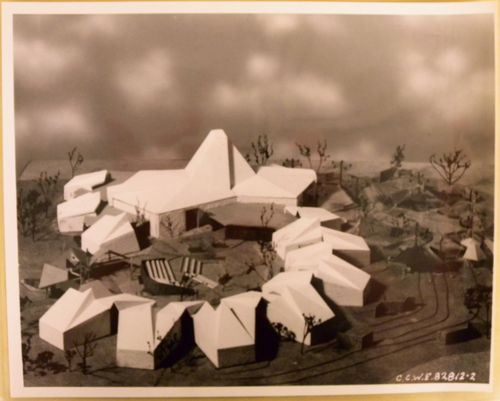
"Légende / Douze éléments thématiques, répartis autour d'une esplanade carrée, appelée l'agora, serviront à présenter le thème du Pavillon de la Jeunesse à l'Expo 67. Le pavillon aura également un théâtre de 250 places, un amphithéâtre en plein air et un café-dansant. Ces installations serviront à présenter une gamme très variée d'activités culturelles, sportives et divertissantes, qui seront toutes commanditées par Steinberg Limitée."--Description.
ARCH256512
Description:
"Légende / Douze éléments thématiques, répartis autour d'une esplanade carrée, appelée l'agora, serviront à présenter le thème du Pavillon de la Jeunesse à l'Expo 67. Le pavillon aura également un théâtre de 250 places, un amphithéâtre en plein air et un café-dansant. Ces installations serviront à présenter une gamme très variée d'activités culturelles, sportives et divertissantes, qui seront toutes commanditées par Steinberg Limitée."--Description.
Personnes et institutions:
Date:
ca. 1967
ca. 1967
Titre:
View of a model of the Youth Pavilion, Expo 67, Montréal, Québec
Actions:
ARCH256512
Description:
"Légende / Douze éléments thématiques, répartis autour d'une esplanade carrée, appelée l'agora, serviront à présenter le thème du Pavillon de la Jeunesse à l'Expo 67. Le pavillon aura également un théâtre de 250 places, un amphithéâtre en plein air et un café-dansant. Ces installations serviront à présenter une gamme très variée d'activités culturelles, sportives et divertissantes, qui seront toutes commanditées par Steinberg Limitée."--Description.
View of a model of the Youth Pavilion, Expo 67, Montréal, Québec
Actions:
ARCH256512
Description:
"Légende / Douze éléments thématiques, répartis autour d'une esplanade carrée, appelée l'agora, serviront à présenter le thème du Pavillon de la Jeunesse à l'Expo 67. Le pavillon aura également un théâtre de 250 places, un amphithéâtre en plein air et un café-dansant. Ces installations serviront à présenter une gamme très variée d'activités culturelles, sportives et divertissantes, qui seront toutes commanditées par Steinberg Limitée."--Description.
Classification:
photographies
photographies
Date:
ca. 1967
ca. 1967
Personnes et institutions:
Niveau de description archivistique:
Projet
Projet
Actions:
Numéro de référence:
CI005.S1.1942.PR2
Description:
In the early 1900s, Hofplein became problematic for its traffic gridlock. In 1942 Allied bombing demolished some of the area's surrounding buildings and paved the way for re-planning. Architect W.G. Witteveen proposed a reconstruction plan, as did J.A. Ringers, but Oud subsequently was delegated as supervisor of the Hofplein reconstruction plan with Jos Klijnen as architect. Oud's proposal was drawn up by 1943. Oud planned to divide Hofplein into three parts, including a circular traffic loop, an oval entertainment plaza, and an outdoor space with a café. He also proposed replacing an older tower building with a new town hall. Witteveen proposed an entirely different design and was unable to reconcile Oud to his plan; however, the city adopted an entirely new plan that was favoured by influential Rotterdam businessmen, one designed by Witteveen's assistant (Taverne et al. 2001, 429-432). Project series includes drawings of site plans for Hofplein as well as photographs of perspective drawings.
CI005.S1.1942.PR2
Description:
In the early 1900s, Hofplein became problematic for its traffic gridlock. In 1942 Allied bombing demolished some of the area's surrounding buildings and paved the way for re-planning. Architect W.G. Witteveen proposed a reconstruction plan, as did J.A. Ringers, but Oud subsequently was delegated as supervisor of the Hofplein reconstruction plan with Jos Klijnen as architect. Oud's proposal was drawn up by 1943. Oud planned to divide Hofplein into three parts, including a circular traffic loop, an oval entertainment plaza, and an outdoor space with a café. He also proposed replacing an older tower building with a new town hall. Witteveen proposed an entirely different design and was unable to reconcile Oud to his plan; however, the city adopted an entirely new plan that was favoured by influential Rotterdam businessmen, one designed by Witteveen's assistant (Taverne et al. 2001, 429-432). Project series includes drawings of site plans for Hofplein as well as photographs of perspective drawings.
Personnes et institutions:
Date:
1942-1945
1942-1945
Titre:
Hofplein Design (City Centre), Rotterdam, Netherlands (1942-1945)
Actions:
CI005.S1.1942.PR2
Description:
In the early 1900s, Hofplein became problematic for its traffic gridlock. In 1942 Allied bombing demolished some of the area's surrounding buildings and paved the way for re-planning. Architect W.G. Witteveen proposed a reconstruction plan, as did J.A. Ringers, but Oud subsequently was delegated as supervisor of the Hofplein reconstruction plan with Jos Klijnen as architect. Oud's proposal was drawn up by 1943. Oud planned to divide Hofplein into three parts, including a circular traffic loop, an oval entertainment plaza, and an outdoor space with a café. He also proposed replacing an older tower building with a new town hall. Witteveen proposed an entirely different design and was unable to reconcile Oud to his plan; however, the city adopted an entirely new plan that was favoured by influential Rotterdam businessmen, one designed by Witteveen's assistant (Taverne et al. 2001, 429-432). Project series includes drawings of site plans for Hofplein as well as photographs of perspective drawings.
Hofplein Design (City Centre), Rotterdam, Netherlands (1942-1945)
Actions:
CI005.S1.1942.PR2
Description:
In the early 1900s, Hofplein became problematic for its traffic gridlock. In 1942 Allied bombing demolished some of the area's surrounding buildings and paved the way for re-planning. Architect W.G. Witteveen proposed a reconstruction plan, as did J.A. Ringers, but Oud subsequently was delegated as supervisor of the Hofplein reconstruction plan with Jos Klijnen as architect. Oud's proposal was drawn up by 1943. Oud planned to divide Hofplein into three parts, including a circular traffic loop, an oval entertainment plaza, and an outdoor space with a café. He also proposed replacing an older tower building with a new town hall. Witteveen proposed an entirely different design and was unable to reconcile Oud to his plan; however, the city adopted an entirely new plan that was favoured by influential Rotterdam businessmen, one designed by Witteveen's assistant (Taverne et al. 2001, 429-432). Project series includes drawings of site plans for Hofplein as well as photographs of perspective drawings.
Niveau de description archivistique:
project
project
Date:
1942-1945
1942-1945
Personnes et institutions:
Classification:
photographies
photographies
Numéro de référence:
ARCH256346
Description:
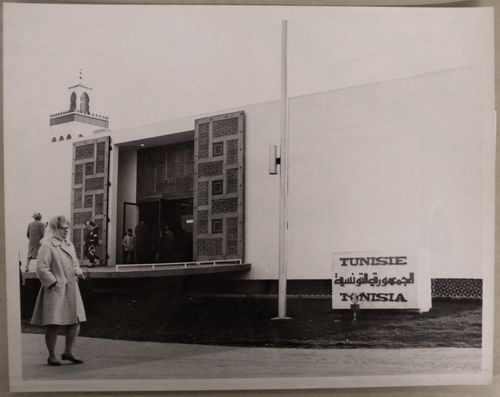
"Le Pavillon de la Tunisie à l'Expo '67 / Le Pavillon de la Tunisie est de forme rectangulaire. Sa façade est blanche, ornée à la base de carreaux de faïence bleue. Les sections intérieures de ce bâtiment, se groupent autour d'un patio à colonnades, dont le sol est recouvert d'une mosaïque romaine authentique. L'artisanat, le tourisme, l'agriculture et l'industrie composent le thème de ce pavillon qui est aussi doté d'un restaurant où sont servis des mets tunisiens, ainsi que d'un café maure. / Tunisian Pavilion at Expo '67 / The white facade and blue porcelain tile flooring of the Tunisian pavilion are reminiscent of Tunisia's ancient Arab palaces. In this authentic setting craftsmen perform traditional trades, beating copper and making carpets by hand. A Moorish cafe and restaurant are also features of the pavilion."--Description.
ARCH256346
Description:
"Le Pavillon de la Tunisie à l'Expo '67 / Le Pavillon de la Tunisie est de forme rectangulaire. Sa façade est blanche, ornée à la base de carreaux de faïence bleue. Les sections intérieures de ce bâtiment, se groupent autour d'un patio à colonnades, dont le sol est recouvert d'une mosaïque romaine authentique. L'artisanat, le tourisme, l'agriculture et l'industrie composent le thème de ce pavillon qui est aussi doté d'un restaurant où sont servis des mets tunisiens, ainsi que d'un café maure. / Tunisian Pavilion at Expo '67 / The white facade and blue porcelain tile flooring of the Tunisian pavilion are reminiscent of Tunisia's ancient Arab palaces. In this authentic setting craftsmen perform traditional trades, beating copper and making carpets by hand. A Moorish cafe and restaurant are also features of the pavilion."--Description.
Personnes et institutions:
Date:
1967
1967
Titre:
View of the Tunisian Pavilion, Expo 67, Montréal, Québec
Actions:
ARCH256346
Description:
"Le Pavillon de la Tunisie à l'Expo '67 / Le Pavillon de la Tunisie est de forme rectangulaire. Sa façade est blanche, ornée à la base de carreaux de faïence bleue. Les sections intérieures de ce bâtiment, se groupent autour d'un patio à colonnades, dont le sol est recouvert d'une mosaïque romaine authentique. L'artisanat, le tourisme, l'agriculture et l'industrie composent le thème de ce pavillon qui est aussi doté d'un restaurant où sont servis des mets tunisiens, ainsi que d'un café maure. / Tunisian Pavilion at Expo '67 / The white facade and blue porcelain tile flooring of the Tunisian pavilion are reminiscent of Tunisia's ancient Arab palaces. In this authentic setting craftsmen perform traditional trades, beating copper and making carpets by hand. A Moorish cafe and restaurant are also features of the pavilion."--Description.
View of the Tunisian Pavilion, Expo 67, Montréal, Québec
Actions:
ARCH256346
Description:
"Le Pavillon de la Tunisie à l'Expo '67 / Le Pavillon de la Tunisie est de forme rectangulaire. Sa façade est blanche, ornée à la base de carreaux de faïence bleue. Les sections intérieures de ce bâtiment, se groupent autour d'un patio à colonnades, dont le sol est recouvert d'une mosaïque romaine authentique. L'artisanat, le tourisme, l'agriculture et l'industrie composent le thème de ce pavillon qui est aussi doté d'un restaurant où sont servis des mets tunisiens, ainsi que d'un café maure. / Tunisian Pavilion at Expo '67 / The white facade and blue porcelain tile flooring of the Tunisian pavilion are reminiscent of Tunisia's ancient Arab palaces. In this authentic setting craftsmen perform traditional trades, beating copper and making carpets by hand. A Moorish cafe and restaurant are also features of the pavilion."--Description.
Classification:
photographies
photographies
Date:
1967
1967
Personnes et institutions:
Niveau de description archivistique:
Projet
Projet
Numéro de référence:
AP164.S1.1999.D2
Description:
The project series documents an open competition. Abalos & Herreros, in collaboration with Queca Ortiz and Empty, S.L., won second place for their design. The firm identified this project as number 115. The intention of their entry was to “[…] answer to the task with an authentic installation, a mellowed and independent equipment independent of the container, which absolutely never provokes a conflict or pretends to improve it, which accepts the value of its configuration and extracts the maximum possibilities of the spatial qualities that the intervention has pretended to enhance. Therefore, it is pretended to develop a program which adds an offer of pedagogic-cultural piece of the town to the basic spaces of the museum. The challenge is to make people live together with the scientific aspects, which interests the cultivated popular-pedagogy visitor, connoisseurs of, and which acts with the intention of excinting, surprising and attracting attention of a mostly youthful and infantile audience. […] The museum’s basic program is completed with temporary exhibition halls, library, lecture room and didactic workshops, assembly hall, café, gift shop and offices.” (ARCH270975) Documenting this project are digital and reference materials, project descriptions, and specifications.
AP164.S1.1999.D2
Description:
The project series documents an open competition. Abalos & Herreros, in collaboration with Queca Ortiz and Empty, S.L., won second place for their design. The firm identified this project as number 115. The intention of their entry was to “[…] answer to the task with an authentic installation, a mellowed and independent equipment independent of the container, which absolutely never provokes a conflict or pretends to improve it, which accepts the value of its configuration and extracts the maximum possibilities of the spatial qualities that the intervention has pretended to enhance. Therefore, it is pretended to develop a program which adds an offer of pedagogic-cultural piece of the town to the basic spaces of the museum. The challenge is to make people live together with the scientific aspects, which interests the cultivated popular-pedagogy visitor, connoisseurs of, and which acts with the intention of excinting, surprising and attracting attention of a mostly youthful and infantile audience. […] The museum’s basic program is completed with temporary exhibition halls, library, lecture room and didactic workshops, assembly hall, café, gift shop and offices.” (ARCH270975) Documenting this project are digital and reference materials, project descriptions, and specifications.
Personnes et institutions:
Date:
1996-2009, predominant 1999
1996-2009, predominant 1999
Titre:
Museo arqueológico Alicante, Spain (1999)
Actions:
AP164.S1.1999.D2
Description:
The project series documents an open competition. Abalos & Herreros, in collaboration with Queca Ortiz and Empty, S.L., won second place for their design. The firm identified this project as number 115. The intention of their entry was to “[…] answer to the task with an authentic installation, a mellowed and independent equipment independent of the container, which absolutely never provokes a conflict or pretends to improve it, which accepts the value of its configuration and extracts the maximum possibilities of the spatial qualities that the intervention has pretended to enhance. Therefore, it is pretended to develop a program which adds an offer of pedagogic-cultural piece of the town to the basic spaces of the museum. The challenge is to make people live together with the scientific aspects, which interests the cultivated popular-pedagogy visitor, connoisseurs of, and which acts with the intention of excinting, surprising and attracting attention of a mostly youthful and infantile audience. […] The museum’s basic program is completed with temporary exhibition halls, library, lecture room and didactic workshops, assembly hall, café, gift shop and offices.” (ARCH270975) Documenting this project are digital and reference materials, project descriptions, and specifications.
Museo arqueológico Alicante, Spain (1999)
Actions:
AP164.S1.1999.D2
Description:
The project series documents an open competition. Abalos & Herreros, in collaboration with Queca Ortiz and Empty, S.L., won second place for their design. The firm identified this project as number 115. The intention of their entry was to “[…] answer to the task with an authentic installation, a mellowed and independent equipment independent of the container, which absolutely never provokes a conflict or pretends to improve it, which accepts the value of its configuration and extracts the maximum possibilities of the spatial qualities that the intervention has pretended to enhance. Therefore, it is pretended to develop a program which adds an offer of pedagogic-cultural piece of the town to the basic spaces of the museum. The challenge is to make people live together with the scientific aspects, which interests the cultivated popular-pedagogy visitor, connoisseurs of, and which acts with the intention of excinting, surprising and attracting attention of a mostly youthful and infantile audience. […] The museum’s basic program is completed with temporary exhibition halls, library, lecture room and didactic workshops, assembly hall, café, gift shop and offices.” (ARCH270975) Documenting this project are digital and reference materials, project descriptions, and specifications.
Niveau de description archivistique:
Project
Project
Date:
1996-2009, predominant 1999
1996-2009, predominant 1999
Personnes et institutions:
Niveau de description archivistique:
Projet
Projet
Numéro de référence:
AP075.S1.2004.PR01
Description:
Project series documents Cornelia Hahn Oberlander's landscape project for the renovations of Buchanan Building at the University of British Columbia, Vancouver. Oberlander worked on this project in 2004 with architectural firm Busby, Perkins + Will Architects. The project consisted in a redesign of the landscaping for the two coutyards separated by a central pavilion and surrounded by the four other blocks of the Buchanan Building. The concept was to created a courtyard for ceremonies and activities and a courtyard for scultpure and contemplation. The east courtyard, designed for sitting and contemplation, included paved pathways circulating amount patches of grass and flower beds, with seating alvoces under the preserved trees to add shade. The west courtyard, designed for activities, consisted in a large parved area with a curving edge along the east side of the courtyard to provide seating and includes a covered café and a water feature. The project series contains sketches by Oberlander, design development drawings, including site plans, landscape plans and concept plans for the courtyards, and presentations drawings, including renderings. The project is also documented through correspondence, including correspondence with architects and consultants, research material, contract, financial documents, specifications, meeting notes, and photographs of existing landscaping.
AP075.S1.2004.PR01
Description:
Project series documents Cornelia Hahn Oberlander's landscape project for the renovations of Buchanan Building at the University of British Columbia, Vancouver. Oberlander worked on this project in 2004 with architectural firm Busby, Perkins + Will Architects. The project consisted in a redesign of the landscaping for the two coutyards separated by a central pavilion and surrounded by the four other blocks of the Buchanan Building. The concept was to created a courtyard for ceremonies and activities and a courtyard for scultpure and contemplation. The east courtyard, designed for sitting and contemplation, included paved pathways circulating amount patches of grass and flower beds, with seating alvoces under the preserved trees to add shade. The west courtyard, designed for activities, consisted in a large parved area with a curving edge along the east side of the courtyard to provide seating and includes a covered café and a water feature. The project series contains sketches by Oberlander, design development drawings, including site plans, landscape plans and concept plans for the courtyards, and presentations drawings, including renderings. The project is also documented through correspondence, including correspondence with architects and consultants, research material, contract, financial documents, specifications, meeting notes, and photographs of existing landscaping.
Personnes et institutions:
Date:
2004-2009
2004-2009
Titre:
Buchanan Building renovations, University of British Columbia, Vancouver, British Columbia (2004-2009)
Actions:
AP075.S1.2004.PR01
Description:
Project series documents Cornelia Hahn Oberlander's landscape project for the renovations of Buchanan Building at the University of British Columbia, Vancouver. Oberlander worked on this project in 2004 with architectural firm Busby, Perkins + Will Architects. The project consisted in a redesign of the landscaping for the two coutyards separated by a central pavilion and surrounded by the four other blocks of the Buchanan Building. The concept was to created a courtyard for ceremonies and activities and a courtyard for scultpure and contemplation. The east courtyard, designed for sitting and contemplation, included paved pathways circulating amount patches of grass and flower beds, with seating alvoces under the preserved trees to add shade. The west courtyard, designed for activities, consisted in a large parved area with a curving edge along the east side of the courtyard to provide seating and includes a covered café and a water feature. The project series contains sketches by Oberlander, design development drawings, including site plans, landscape plans and concept plans for the courtyards, and presentations drawings, including renderings. The project is also documented through correspondence, including correspondence with architects and consultants, research material, contract, financial documents, specifications, meeting notes, and photographs of existing landscaping.
Buchanan Building renovations, University of British Columbia, Vancouver, British Columbia (2004-2009)
Actions:
AP075.S1.2004.PR01
Description:
Project series documents Cornelia Hahn Oberlander's landscape project for the renovations of Buchanan Building at the University of British Columbia, Vancouver. Oberlander worked on this project in 2004 with architectural firm Busby, Perkins + Will Architects. The project consisted in a redesign of the landscaping for the two coutyards separated by a central pavilion and surrounded by the four other blocks of the Buchanan Building. The concept was to created a courtyard for ceremonies and activities and a courtyard for scultpure and contemplation. The east courtyard, designed for sitting and contemplation, included paved pathways circulating amount patches of grass and flower beds, with seating alvoces under the preserved trees to add shade. The west courtyard, designed for activities, consisted in a large parved area with a curving edge along the east side of the courtyard to provide seating and includes a covered café and a water feature. The project series contains sketches by Oberlander, design development drawings, including site plans, landscape plans and concept plans for the courtyards, and presentations drawings, including renderings. The project is also documented through correspondence, including correspondence with architects and consultants, research material, contract, financial documents, specifications, meeting notes, and photographs of existing landscaping.
Niveau de description archivistique:
Project
Project
Date:
2004-2009
2004-2009
Personnes et institutions:
Niveau de description archivistique:
Projet
Projet
Numéro de référence:
AP056.S1.1993.PR08
Description:
This project series documents a competition entry for the University of Waterloo Student Centre in Waterloo, Ontario in 1993. The project number assigned by the office is unidentifiable. This project proposed a two-storey building composed of rectangular spaces, a round central rotunda, four courtyards and terraces on the roof and sides. The building's exterior would be clad in split-faced limestone with a copper roof, wood doors and windows, and glazed walls comprising the top floor of the rotunda. Inside the rotunda would be cafe seating and information areas on the main floor and more casual reading and lounging spaces on the second level which were open to below. The main focus of the design was its relationship to the four courtyards, including a central courtyard at the building's centre that had bleachers overlooking it from above. Areas for a gym, bomb shelter and student government were also included. This was not the winning competition entry and the project was eventually realized by Cravit Ortved Architects. The project is recorded through drawings, presentation paintings, an aerial photograph and model dating from around 1993. The drawings are mostly originals of sketches, presentation drawings, plans, elevations and perspectives.
AP056.S1.1993.PR08
Description:
This project series documents a competition entry for the University of Waterloo Student Centre in Waterloo, Ontario in 1993. The project number assigned by the office is unidentifiable. This project proposed a two-storey building composed of rectangular spaces, a round central rotunda, four courtyards and terraces on the roof and sides. The building's exterior would be clad in split-faced limestone with a copper roof, wood doors and windows, and glazed walls comprising the top floor of the rotunda. Inside the rotunda would be cafe seating and information areas on the main floor and more casual reading and lounging spaces on the second level which were open to below. The main focus of the design was its relationship to the four courtyards, including a central courtyard at the building's centre that had bleachers overlooking it from above. Areas for a gym, bomb shelter and student government were also included. This was not the winning competition entry and the project was eventually realized by Cravit Ortved Architects. The project is recorded through drawings, presentation paintings, an aerial photograph and model dating from around 1993. The drawings are mostly originals of sketches, presentation drawings, plans, elevations and perspectives.
Personnes et institutions:
Date:
circa 1993
circa 1993
Titre:
Student Centre, University of Waterloo, Waterloo, Ontario (1993)
Actions:
AP056.S1.1993.PR08
Description:
This project series documents a competition entry for the University of Waterloo Student Centre in Waterloo, Ontario in 1993. The project number assigned by the office is unidentifiable. This project proposed a two-storey building composed of rectangular spaces, a round central rotunda, four courtyards and terraces on the roof and sides. The building's exterior would be clad in split-faced limestone with a copper roof, wood doors and windows, and glazed walls comprising the top floor of the rotunda. Inside the rotunda would be cafe seating and information areas on the main floor and more casual reading and lounging spaces on the second level which were open to below. The main focus of the design was its relationship to the four courtyards, including a central courtyard at the building's centre that had bleachers overlooking it from above. Areas for a gym, bomb shelter and student government were also included. This was not the winning competition entry and the project was eventually realized by Cravit Ortved Architects. The project is recorded through drawings, presentation paintings, an aerial photograph and model dating from around 1993. The drawings are mostly originals of sketches, presentation drawings, plans, elevations and perspectives.
Student Centre, University of Waterloo, Waterloo, Ontario (1993)
Actions:
AP056.S1.1993.PR08
Description:
This project series documents a competition entry for the University of Waterloo Student Centre in Waterloo, Ontario in 1993. The project number assigned by the office is unidentifiable. This project proposed a two-storey building composed of rectangular spaces, a round central rotunda, four courtyards and terraces on the roof and sides. The building's exterior would be clad in split-faced limestone with a copper roof, wood doors and windows, and glazed walls comprising the top floor of the rotunda. Inside the rotunda would be cafe seating and information areas on the main floor and more casual reading and lounging spaces on the second level which were open to below. The main focus of the design was its relationship to the four courtyards, including a central courtyard at the building's centre that had bleachers overlooking it from above. Areas for a gym, bomb shelter and student government were also included. This was not the winning competition entry and the project was eventually realized by Cravit Ortved Architects. The project is recorded through drawings, presentation paintings, an aerial photograph and model dating from around 1993. The drawings are mostly originals of sketches, presentation drawings, plans, elevations and perspectives.
Niveau de description archivistique:
Project
Project
Date:
circa 1993
circa 1993
Personnes et institutions:
Classification:
articles
articles

Titre:
Les dimensions d’une idée
Les dimensions d’une idée
Actions:
Carla Juaçaba et Marina Oba en conversation
Dossier:
Forces de friction
Forces de friction
Publié:
16 juin 2025
16 juin 2025
Dossier:
Forces de friction
Forces de friction
Niveau de description archivistique:
Série(s)
Série(s)
Numéro de référence:
AP175.S1
Description:
Series 1, Erasmus Bridge, Rotterdam, Netherlands, 1990-1996, documents the design, conception and construction of a third bridge for Rotterdam over the Nieuwe Maas River. The bridge connects the Kop van Zuid neighborhood, located on the south side of the river, to Willemsplein, located on the north side. The bridge is considered as a landmark in Rotterdam’s landscape. The Erasmus Bridge was a formative project in the thinking of UNStudio. It was originally supposed to be designed by architect Maarten Struijs who was the city of Rotterdam principal architect and who is responsible for the concept of the neighboring Willem Bridge. Ben van Berkel came later into the project and was hired as a designing consultant along with architect Wim Quist. Ben van Berkel proposed design was selected allowing him and his firm, which was called Van Berkel & Bos Architectuurbureau at that time, to supervise the conception and construction of the project, from the original concept to piers design to the selection of every item of bridge furniture such as traffic lights, bridge camera and handrails. The bridge was designed to fit the distinct character and industrial past of Rotterdam. The construction of this landmark was one component of a larger redevelopment project, coinciding with other major developments in the city of Rotterdam. The goal was to develop a dense urban intervention on the southern shore of the Nieuwe Maas, in the Kop van Zuid neighborhood. This explains the implication of UNStudio in the planning of urban configuration of the neighborhoods on both sides of the river and their work for Spido, a ferry company operating on the Nieuwe Maas, work spaces and parking garage. This commercial building was designed by the firm and also hosts The Grand Café and Jazz Café. This commercial building is integrated to one of the bridge pillar on the north shore of the river. For the design the firm used AutoCAD to work along with engineers and to conceptualize 3D models. They also used the software to evaluate the circulation flow of drivers, pedestrians and streetcars, measuring its impact on the structure and the urban configuration of the neighborhoods on both sides of the river. The records contain sketches for bridge and pier design, plans and sections for pier, Spido and bridge, architectural and construction details created by engineering companies for every component of the bridge, from drawbridge, to cable car system, to bridge furnitures such as traffic light, handrails and cameras and photographs documenting the research for precedent and the original configuration of the neighborhoods on both sides of the river. The record contains AutoCAD plans, details and sections for both the bridge and Spido parking garage. The records also contain one physical model: a small scale plastic, glass and metal model of the bridge.
AP175.S1
Description:
Series 1, Erasmus Bridge, Rotterdam, Netherlands, 1990-1996, documents the design, conception and construction of a third bridge for Rotterdam over the Nieuwe Maas River. The bridge connects the Kop van Zuid neighborhood, located on the south side of the river, to Willemsplein, located on the north side. The bridge is considered as a landmark in Rotterdam’s landscape. The Erasmus Bridge was a formative project in the thinking of UNStudio. It was originally supposed to be designed by architect Maarten Struijs who was the city of Rotterdam principal architect and who is responsible for the concept of the neighboring Willem Bridge. Ben van Berkel came later into the project and was hired as a designing consultant along with architect Wim Quist. Ben van Berkel proposed design was selected allowing him and his firm, which was called Van Berkel & Bos Architectuurbureau at that time, to supervise the conception and construction of the project, from the original concept to piers design to the selection of every item of bridge furniture such as traffic lights, bridge camera and handrails. The bridge was designed to fit the distinct character and industrial past of Rotterdam. The construction of this landmark was one component of a larger redevelopment project, coinciding with other major developments in the city of Rotterdam. The goal was to develop a dense urban intervention on the southern shore of the Nieuwe Maas, in the Kop van Zuid neighborhood. This explains the implication of UNStudio in the planning of urban configuration of the neighborhoods on both sides of the river and their work for Spido, a ferry company operating on the Nieuwe Maas, work spaces and parking garage. This commercial building was designed by the firm and also hosts The Grand Café and Jazz Café. This commercial building is integrated to one of the bridge pillar on the north shore of the river. For the design the firm used AutoCAD to work along with engineers and to conceptualize 3D models. They also used the software to evaluate the circulation flow of drivers, pedestrians and streetcars, measuring its impact on the structure and the urban configuration of the neighborhoods on both sides of the river. The records contain sketches for bridge and pier design, plans and sections for pier, Spido and bridge, architectural and construction details created by engineering companies for every component of the bridge, from drawbridge, to cable car system, to bridge furnitures such as traffic light, handrails and cameras and photographs documenting the research for precedent and the original configuration of the neighborhoods on both sides of the river. The record contains AutoCAD plans, details and sections for both the bridge and Spido parking garage. The records also contain one physical model: a small scale plastic, glass and metal model of the bridge.
Personnes et institutions:
Date:
1990-1996
1990-1996
Titre:
Erasmus Bridge, Rotterdam, Netherlands, 1990-1996
Actions:
AP175.S1
Description:
Series 1, Erasmus Bridge, Rotterdam, Netherlands, 1990-1996, documents the design, conception and construction of a third bridge for Rotterdam over the Nieuwe Maas River. The bridge connects the Kop van Zuid neighborhood, located on the south side of the river, to Willemsplein, located on the north side. The bridge is considered as a landmark in Rotterdam’s landscape. The Erasmus Bridge was a formative project in the thinking of UNStudio. It was originally supposed to be designed by architect Maarten Struijs who was the city of Rotterdam principal architect and who is responsible for the concept of the neighboring Willem Bridge. Ben van Berkel came later into the project and was hired as a designing consultant along with architect Wim Quist. Ben van Berkel proposed design was selected allowing him and his firm, which was called Van Berkel & Bos Architectuurbureau at that time, to supervise the conception and construction of the project, from the original concept to piers design to the selection of every item of bridge furniture such as traffic lights, bridge camera and handrails. The bridge was designed to fit the distinct character and industrial past of Rotterdam. The construction of this landmark was one component of a larger redevelopment project, coinciding with other major developments in the city of Rotterdam. The goal was to develop a dense urban intervention on the southern shore of the Nieuwe Maas, in the Kop van Zuid neighborhood. This explains the implication of UNStudio in the planning of urban configuration of the neighborhoods on both sides of the river and their work for Spido, a ferry company operating on the Nieuwe Maas, work spaces and parking garage. This commercial building was designed by the firm and also hosts The Grand Café and Jazz Café. This commercial building is integrated to one of the bridge pillar on the north shore of the river. For the design the firm used AutoCAD to work along with engineers and to conceptualize 3D models. They also used the software to evaluate the circulation flow of drivers, pedestrians and streetcars, measuring its impact on the structure and the urban configuration of the neighborhoods on both sides of the river. The records contain sketches for bridge and pier design, plans and sections for pier, Spido and bridge, architectural and construction details created by engineering companies for every component of the bridge, from drawbridge, to cable car system, to bridge furnitures such as traffic light, handrails and cameras and photographs documenting the research for precedent and the original configuration of the neighborhoods on both sides of the river. The record contains AutoCAD plans, details and sections for both the bridge and Spido parking garage. The records also contain one physical model: a small scale plastic, glass and metal model of the bridge.
Erasmus Bridge, Rotterdam, Netherlands, 1990-1996
Actions:
AP175.S1
Description:
Series 1, Erasmus Bridge, Rotterdam, Netherlands, 1990-1996, documents the design, conception and construction of a third bridge for Rotterdam over the Nieuwe Maas River. The bridge connects the Kop van Zuid neighborhood, located on the south side of the river, to Willemsplein, located on the north side. The bridge is considered as a landmark in Rotterdam’s landscape. The Erasmus Bridge was a formative project in the thinking of UNStudio. It was originally supposed to be designed by architect Maarten Struijs who was the city of Rotterdam principal architect and who is responsible for the concept of the neighboring Willem Bridge. Ben van Berkel came later into the project and was hired as a designing consultant along with architect Wim Quist. Ben van Berkel proposed design was selected allowing him and his firm, which was called Van Berkel & Bos Architectuurbureau at that time, to supervise the conception and construction of the project, from the original concept to piers design to the selection of every item of bridge furniture such as traffic lights, bridge camera and handrails. The bridge was designed to fit the distinct character and industrial past of Rotterdam. The construction of this landmark was one component of a larger redevelopment project, coinciding with other major developments in the city of Rotterdam. The goal was to develop a dense urban intervention on the southern shore of the Nieuwe Maas, in the Kop van Zuid neighborhood. This explains the implication of UNStudio in the planning of urban configuration of the neighborhoods on both sides of the river and their work for Spido, a ferry company operating on the Nieuwe Maas, work spaces and parking garage. This commercial building was designed by the firm and also hosts The Grand Café and Jazz Café. This commercial building is integrated to one of the bridge pillar on the north shore of the river. For the design the firm used AutoCAD to work along with engineers and to conceptualize 3D models. They also used the software to evaluate the circulation flow of drivers, pedestrians and streetcars, measuring its impact on the structure and the urban configuration of the neighborhoods on both sides of the river. The records contain sketches for bridge and pier design, plans and sections for pier, Spido and bridge, architectural and construction details created by engineering companies for every component of the bridge, from drawbridge, to cable car system, to bridge furnitures such as traffic light, handrails and cameras and photographs documenting the research for precedent and the original configuration of the neighborhoods on both sides of the river. The record contains AutoCAD plans, details and sections for both the bridge and Spido parking garage. The records also contain one physical model: a small scale plastic, glass and metal model of the bridge.
Niveau de description archivistique:
Series
Series
Date:
1990-1996
1990-1996
Personnes et institutions:


