


5180 Résultats
Numéro de référence:
PH2007:0012:001-005
Description:
Series shows a scale model of Tokyo at the Mori Building in Tokyo, Japan. Series is one of an edition of six. Commissioned by the Canadian Centre for Architecture, Montréal, for "Tangent," 2002-2006.
PH2007:0012:001-005
Description:
Series shows a scale model of Tokyo at the Mori Building in Tokyo, Japan. Series is one of an edition of six. Commissioned by the Canadian Centre for Architecture, Montréal, for "Tangent," 2002-2006.
Personnes et institutions:
Date:
2003
2003
Titre:
Tokyo/Mori Building, Japan, from the series "Scales"
Actions:
PH2007:0012:001-005
Description:
Series shows a scale model of Tokyo at the Mori Building in Tokyo, Japan. Series is one of an edition of six. Commissioned by the Canadian Centre for Architecture, Montréal, for "Tangent," 2002-2006.
Tokyo/Mori Building, Japan, from the series "Scales"
Actions:
PH2007:0012:001-005
Description:
Series shows a scale model of Tokyo at the Mori Building in Tokyo, Japan. Series is one of an edition of six. Commissioned by the Canadian Centre for Architecture, Montréal, for "Tangent," 2002-2006.
Date:
2003
2003
Personnes et institutions:
Classification:
photographies
Quantité:
15 photograph(s)
photographies
Quantité:
15 photograph(s)
Numéro de référence:
PH2014:0004
Description:
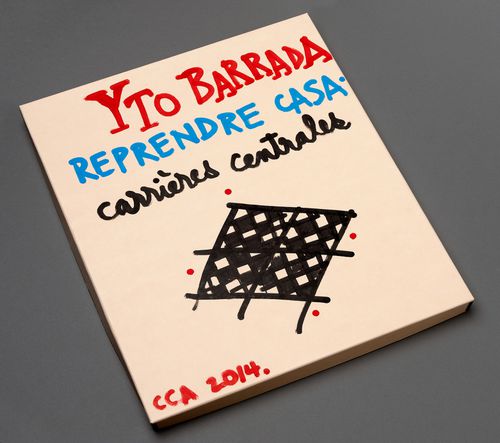
Group consists of a box, handpainted by the artist, containing 15 colour photographic prints of modern urban planning and architecture in Casablanca, Morocco. Commissioned by the Canadian Centre for Architecture, Montréal, for "Casablanca/Chandigarh," 2013-2014.
PH2014:0004
Description:
Group consists of a box, handpainted by the artist, containing 15 colour photographic prints of modern urban planning and architecture in Casablanca, Morocco. Commissioned by the Canadian Centre for Architecture, Montréal, for "Casablanca/Chandigarh," 2013-2014.
Personnes et institutions:
Date:
August 2013
August 2013
Titre:
Box for Reprendre Casa, Carrieres Centrales, Casablanca
Actions:
PH2014:0004
Description:
Group consists of a box, handpainted by the artist, containing 15 colour photographic prints of modern urban planning and architecture in Casablanca, Morocco. Commissioned by the Canadian Centre for Architecture, Montréal, for "Casablanca/Chandigarh," 2013-2014.
Box for Reprendre Casa, Carrieres Centrales, Casablanca
Actions:
PH2014:0004
Description:
Group consists of a box, handpainted by the artist, containing 15 colour photographic prints of modern urban planning and architecture in Casablanca, Morocco. Commissioned by the Canadian Centre for Architecture, Montréal, for "Casablanca/Chandigarh," 2013-2014.
Classification:
photographies
Quantité:
15 photograph(s)
photographies
Quantité:
15 photograph(s)
Date:
August 2013
August 2013
Personnes et institutions:
Niveau de description archivistique:
Projet
Projet
Titre:
University Art Museum
University Art Museum
Numéro de référence:
AP143.S4.D65
Description:
File documents the unexecuted project for the University Art Museum, Long Beach, California. Material in this file was produced between 1986 and 1988. California State University, Long Beach (CSULB), commissioned Eisenman/Robertson Architects to design an art museum adjacent to the main campus entrance. The 67,500-square-foot building was to comprise four galleries, a black-box theater, an auditorium, a cafe, conference rooms, a library, offices, preparation spaces, and storage vaults. The project, sited on a 23-acre arboretum, included landscaping; terraced sculpture courtyards, botanical gardens, and a two-acre pond. Eisenman linked the northern and southern parts of the arboretum by an elevated public walkway through the museum. Sets of drawings were presented on 8 and 30 April, 2 June, and 5 Aug. In the first design phase Eisenman explores the cartographic figures which form the basis of his artificial excavation when superposed: a series of sketches establishes the analogical relationships which fix the relative scales of the plans and produce the superpositions; another series contextualizes the superposed figures by placing them within the museum site (DR1987:0859:087-090). The second phase concerns the building; the working model shows the building carved out of a square pit, from which spring an oil derrick and a reconstruction of a recreational pier (Rainbow Pier, 1920s) used here as circulatory bridge (DR1987:0859:160). In the third phase the architect systematizes his archeological procedure by using five significant cartographic dates - 1849, 1889, 1949, 1989, 2049 - each corresponding to a specific superposition (see DR1987:0859:274-277). In the fourth phase, Eisenman simplifies the superposition of 2049 to a few iconic colour-coded forms: ranch (green), ranch house (blue), campus site (red), and water forms (river and pond) (gold). Material for the fourth phase includes three relief models, four presentation drawings, and a model (property of the CSULB) (relief models: DR1987:0859:001-003; drawings: DR1987:0859:004-008). Eisenman "inhabits" his artifical archeology by detailed planning of interior spaces, and gives substance to the cartographic traces in a series of sketch sections, perspectives, and working models. Working models reveal how the central "canal" area gradually became the museum's access point (DR1987:0859:484-490); the museum, galleries, offices, and preparation areas are on one side of this deep cut, while the cafeteria and black-box theater are on the other. The upper level was to house offices, meeting rooms, and the library. File contains audiovisual material, conceptual drawings, design development drawings, presentation drawings, reference drawings, working drawings, photographic materials, and textual records.
AP143.S4.D65
Description:
File documents the unexecuted project for the University Art Museum, Long Beach, California. Material in this file was produced between 1986 and 1988. California State University, Long Beach (CSULB), commissioned Eisenman/Robertson Architects to design an art museum adjacent to the main campus entrance. The 67,500-square-foot building was to comprise four galleries, a black-box theater, an auditorium, a cafe, conference rooms, a library, offices, preparation spaces, and storage vaults. The project, sited on a 23-acre arboretum, included landscaping; terraced sculpture courtyards, botanical gardens, and a two-acre pond. Eisenman linked the northern and southern parts of the arboretum by an elevated public walkway through the museum. Sets of drawings were presented on 8 and 30 April, 2 June, and 5 Aug. In the first design phase Eisenman explores the cartographic figures which form the basis of his artificial excavation when superposed: a series of sketches establishes the analogical relationships which fix the relative scales of the plans and produce the superpositions; another series contextualizes the superposed figures by placing them within the museum site (DR1987:0859:087-090). The second phase concerns the building; the working model shows the building carved out of a square pit, from which spring an oil derrick and a reconstruction of a recreational pier (Rainbow Pier, 1920s) used here as circulatory bridge (DR1987:0859:160). In the third phase the architect systematizes his archeological procedure by using five significant cartographic dates - 1849, 1889, 1949, 1989, 2049 - each corresponding to a specific superposition (see DR1987:0859:274-277). In the fourth phase, Eisenman simplifies the superposition of 2049 to a few iconic colour-coded forms: ranch (green), ranch house (blue), campus site (red), and water forms (river and pond) (gold). Material for the fourth phase includes three relief models, four presentation drawings, and a model (property of the CSULB) (relief models: DR1987:0859:001-003; drawings: DR1987:0859:004-008). Eisenman "inhabits" his artifical archeology by detailed planning of interior spaces, and gives substance to the cartographic traces in a series of sketch sections, perspectives, and working models. Working models reveal how the central "canal" area gradually became the museum's access point (DR1987:0859:484-490); the museum, galleries, offices, and preparation areas are on one side of this deep cut, while the cafeteria and black-box theater are on the other. The upper level was to house offices, meeting rooms, and the library. File contains audiovisual material, conceptual drawings, design development drawings, presentation drawings, reference drawings, working drawings, photographic materials, and textual records.
Personnes et institutions:
Date:
1986-1988
1986-1988
Titre:
University Art Museum
Actions:
AP143.S4.D65
Description:
File documents the unexecuted project for the University Art Museum, Long Beach, California. Material in this file was produced between 1986 and 1988. California State University, Long Beach (CSULB), commissioned Eisenman/Robertson Architects to design an art museum adjacent to the main campus entrance. The 67,500-square-foot building was to comprise four galleries, a black-box theater, an auditorium, a cafe, conference rooms, a library, offices, preparation spaces, and storage vaults. The project, sited on a 23-acre arboretum, included landscaping; terraced sculpture courtyards, botanical gardens, and a two-acre pond. Eisenman linked the northern and southern parts of the arboretum by an elevated public walkway through the museum. Sets of drawings were presented on 8 and 30 April, 2 June, and 5 Aug. In the first design phase Eisenman explores the cartographic figures which form the basis of his artificial excavation when superposed: a series of sketches establishes the analogical relationships which fix the relative scales of the plans and produce the superpositions; another series contextualizes the superposed figures by placing them within the museum site (DR1987:0859:087-090). The second phase concerns the building; the working model shows the building carved out of a square pit, from which spring an oil derrick and a reconstruction of a recreational pier (Rainbow Pier, 1920s) used here as circulatory bridge (DR1987:0859:160). In the third phase the architect systematizes his archeological procedure by using five significant cartographic dates - 1849, 1889, 1949, 1989, 2049 - each corresponding to a specific superposition (see DR1987:0859:274-277). In the fourth phase, Eisenman simplifies the superposition of 2049 to a few iconic colour-coded forms: ranch (green), ranch house (blue), campus site (red), and water forms (river and pond) (gold). Material for the fourth phase includes three relief models, four presentation drawings, and a model (property of the CSULB) (relief models: DR1987:0859:001-003; drawings: DR1987:0859:004-008). Eisenman "inhabits" his artifical archeology by detailed planning of interior spaces, and gives substance to the cartographic traces in a series of sketch sections, perspectives, and working models. Working models reveal how the central "canal" area gradually became the museum's access point (DR1987:0859:484-490); the museum, galleries, offices, and preparation areas are on one side of this deep cut, while the cafeteria and black-box theater are on the other. The upper level was to house offices, meeting rooms, and the library. File contains audiovisual material, conceptual drawings, design development drawings, presentation drawings, reference drawings, working drawings, photographic materials, and textual records.
University Art Museum
Actions:
AP143.S4.D65
Description:
File documents the unexecuted project for the University Art Museum, Long Beach, California. Material in this file was produced between 1986 and 1988. California State University, Long Beach (CSULB), commissioned Eisenman/Robertson Architects to design an art museum adjacent to the main campus entrance. The 67,500-square-foot building was to comprise four galleries, a black-box theater, an auditorium, a cafe, conference rooms, a library, offices, preparation spaces, and storage vaults. The project, sited on a 23-acre arboretum, included landscaping; terraced sculpture courtyards, botanical gardens, and a two-acre pond. Eisenman linked the northern and southern parts of the arboretum by an elevated public walkway through the museum. Sets of drawings were presented on 8 and 30 April, 2 June, and 5 Aug. In the first design phase Eisenman explores the cartographic figures which form the basis of his artificial excavation when superposed: a series of sketches establishes the analogical relationships which fix the relative scales of the plans and produce the superpositions; another series contextualizes the superposed figures by placing them within the museum site (DR1987:0859:087-090). The second phase concerns the building; the working model shows the building carved out of a square pit, from which spring an oil derrick and a reconstruction of a recreational pier (Rainbow Pier, 1920s) used here as circulatory bridge (DR1987:0859:160). In the third phase the architect systematizes his archeological procedure by using five significant cartographic dates - 1849, 1889, 1949, 1989, 2049 - each corresponding to a specific superposition (see DR1987:0859:274-277). In the fourth phase, Eisenman simplifies the superposition of 2049 to a few iconic colour-coded forms: ranch (green), ranch house (blue), campus site (red), and water forms (river and pond) (gold). Material for the fourth phase includes three relief models, four presentation drawings, and a model (property of the CSULB) (relief models: DR1987:0859:001-003; drawings: DR1987:0859:004-008). Eisenman "inhabits" his artifical archeology by detailed planning of interior spaces, and gives substance to the cartographic traces in a series of sketch sections, perspectives, and working models. Working models reveal how the central "canal" area gradually became the museum's access point (DR1987:0859:484-490); the museum, galleries, offices, and preparation areas are on one side of this deep cut, while the cafeteria and black-box theater are on the other. The upper level was to house offices, meeting rooms, and the library. File contains audiovisual material, conceptual drawings, design development drawings, presentation drawings, reference drawings, working drawings, photographic materials, and textual records.
Niveau de description archivistique:
File 65
File 65
Date:
1986-1988
1986-1988
Personnes et institutions:
Niveau de description archivistique:
Projet
Projet
Titre:
Fun Palace Project
Fun Palace Project
Numéro de référence:
AP144.S2.D46
Description:
File documents the various unexecuted proposals for the Fun Palace Project, an interactive and adaptable, educational and cultural complex to be located in London, England. The project was commissioned by Joan Littlewood, to be erected on disused public land slated for redevelopment and intended to be dismantled after 10 years. Conceptual and design development drawings were created for a typical Fun Palace that could be erected on any suitable site, and several sites were considered, some belonging to the Civic Trust. Presentation drawings were elaborated for a Fun Palace in the Lea Valley at Mill Meads and for a later modified Pilot Project in Camden Town. Publication drawings were also created for an article in Price, Cedric. "Fun Palace Project." 'Architectural Review'. (January 1965), 74-75. The Fun Palace Trust was created to oversee the project and the file contains material from related activities of the Trust which was active until the 1970's. Existing conditions drawings begin in 1961 and include regional, zoning, and transportation maps of Greater London and a photocollage of the site. Conceptual and diagrammatic drawings include: perspectives for the structural system; plans for site access; charts for modular systems; axonometrics for modules; preliminary drawings for escalators and service towers; and studies for activity areas. A "Table of Kindred and Affinity" separates modular components physically and visually by means of activity types, circulation, and individual/group accommodations. Design development drawings for the Fun Palace Project include: plans for activity areas, site plans, typical plans, site movement/circulation plans, theatre seating plans, diagrammatic sections, volumetric structural diagrams, perspectives, charts for services for mass activities, typical mass activity enclosure types, charts for required equipment for activities, and "clamp" structural systems and studies for three dimensional versatility and modular feasibility. Design development drawings for the 1963 Camden Town Pilot Project include: site plans; diagrammatic plans showing circulation patterns; drawings showing basic cubes with components and structural panel types; details for component connections; charts for individual activity module requirements; and network analysis charts. Presentation material includes: aerial photographs mounted on board; enlargements of clippings; reprographic copies of photographs of the design models. Material in this file was created between 1961 and 1985 but predominantly between 1961 and 1974. File contains conceptual drawings, design development drawings, presentation drawings and panels, publication drawings, reference drawings, an artefact, a film reel, models, photographic material, and textual records.
AP144.S2.D46
Description:
File documents the various unexecuted proposals for the Fun Palace Project, an interactive and adaptable, educational and cultural complex to be located in London, England. The project was commissioned by Joan Littlewood, to be erected on disused public land slated for redevelopment and intended to be dismantled after 10 years. Conceptual and design development drawings were created for a typical Fun Palace that could be erected on any suitable site, and several sites were considered, some belonging to the Civic Trust. Presentation drawings were elaborated for a Fun Palace in the Lea Valley at Mill Meads and for a later modified Pilot Project in Camden Town. Publication drawings were also created for an article in Price, Cedric. "Fun Palace Project." 'Architectural Review'. (January 1965), 74-75. The Fun Palace Trust was created to oversee the project and the file contains material from related activities of the Trust which was active until the 1970's. Existing conditions drawings begin in 1961 and include regional, zoning, and transportation maps of Greater London and a photocollage of the site. Conceptual and diagrammatic drawings include: perspectives for the structural system; plans for site access; charts for modular systems; axonometrics for modules; preliminary drawings for escalators and service towers; and studies for activity areas. A "Table of Kindred and Affinity" separates modular components physically and visually by means of activity types, circulation, and individual/group accommodations. Design development drawings for the Fun Palace Project include: plans for activity areas, site plans, typical plans, site movement/circulation plans, theatre seating plans, diagrammatic sections, volumetric structural diagrams, perspectives, charts for services for mass activities, typical mass activity enclosure types, charts for required equipment for activities, and "clamp" structural systems and studies for three dimensional versatility and modular feasibility. Design development drawings for the 1963 Camden Town Pilot Project include: site plans; diagrammatic plans showing circulation patterns; drawings showing basic cubes with components and structural panel types; details for component connections; charts for individual activity module requirements; and network analysis charts. Presentation material includes: aerial photographs mounted on board; enlargements of clippings; reprographic copies of photographs of the design models. Material in this file was created between 1961 and 1985 but predominantly between 1961 and 1974. File contains conceptual drawings, design development drawings, presentation drawings and panels, publication drawings, reference drawings, an artefact, a film reel, models, photographic material, and textual records.
Personnes et institutions:
Date:
1961-1985, predominant 1961-1974
1961-1985, predominant 1961-1974
Titre:
Fun Palace Project
Actions:
AP144.S2.D46
Description:
File documents the various unexecuted proposals for the Fun Palace Project, an interactive and adaptable, educational and cultural complex to be located in London, England. The project was commissioned by Joan Littlewood, to be erected on disused public land slated for redevelopment and intended to be dismantled after 10 years. Conceptual and design development drawings were created for a typical Fun Palace that could be erected on any suitable site, and several sites were considered, some belonging to the Civic Trust. Presentation drawings were elaborated for a Fun Palace in the Lea Valley at Mill Meads and for a later modified Pilot Project in Camden Town. Publication drawings were also created for an article in Price, Cedric. "Fun Palace Project." 'Architectural Review'. (January 1965), 74-75. The Fun Palace Trust was created to oversee the project and the file contains material from related activities of the Trust which was active until the 1970's. Existing conditions drawings begin in 1961 and include regional, zoning, and transportation maps of Greater London and a photocollage of the site. Conceptual and diagrammatic drawings include: perspectives for the structural system; plans for site access; charts for modular systems; axonometrics for modules; preliminary drawings for escalators and service towers; and studies for activity areas. A "Table of Kindred and Affinity" separates modular components physically and visually by means of activity types, circulation, and individual/group accommodations. Design development drawings for the Fun Palace Project include: plans for activity areas, site plans, typical plans, site movement/circulation plans, theatre seating plans, diagrammatic sections, volumetric structural diagrams, perspectives, charts for services for mass activities, typical mass activity enclosure types, charts for required equipment for activities, and "clamp" structural systems and studies for three dimensional versatility and modular feasibility. Design development drawings for the 1963 Camden Town Pilot Project include: site plans; diagrammatic plans showing circulation patterns; drawings showing basic cubes with components and structural panel types; details for component connections; charts for individual activity module requirements; and network analysis charts. Presentation material includes: aerial photographs mounted on board; enlargements of clippings; reprographic copies of photographs of the design models. Material in this file was created between 1961 and 1985 but predominantly between 1961 and 1974. File contains conceptual drawings, design development drawings, presentation drawings and panels, publication drawings, reference drawings, an artefact, a film reel, models, photographic material, and textual records.
Fun Palace Project
Actions:
AP144.S2.D46
Description:
File documents the various unexecuted proposals for the Fun Palace Project, an interactive and adaptable, educational and cultural complex to be located in London, England. The project was commissioned by Joan Littlewood, to be erected on disused public land slated for redevelopment and intended to be dismantled after 10 years. Conceptual and design development drawings were created for a typical Fun Palace that could be erected on any suitable site, and several sites were considered, some belonging to the Civic Trust. Presentation drawings were elaborated for a Fun Palace in the Lea Valley at Mill Meads and for a later modified Pilot Project in Camden Town. Publication drawings were also created for an article in Price, Cedric. "Fun Palace Project." 'Architectural Review'. (January 1965), 74-75. The Fun Palace Trust was created to oversee the project and the file contains material from related activities of the Trust which was active until the 1970's. Existing conditions drawings begin in 1961 and include regional, zoning, and transportation maps of Greater London and a photocollage of the site. Conceptual and diagrammatic drawings include: perspectives for the structural system; plans for site access; charts for modular systems; axonometrics for modules; preliminary drawings for escalators and service towers; and studies for activity areas. A "Table of Kindred and Affinity" separates modular components physically and visually by means of activity types, circulation, and individual/group accommodations. Design development drawings for the Fun Palace Project include: plans for activity areas, site plans, typical plans, site movement/circulation plans, theatre seating plans, diagrammatic sections, volumetric structural diagrams, perspectives, charts for services for mass activities, typical mass activity enclosure types, charts for required equipment for activities, and "clamp" structural systems and studies for three dimensional versatility and modular feasibility. Design development drawings for the 1963 Camden Town Pilot Project include: site plans; diagrammatic plans showing circulation patterns; drawings showing basic cubes with components and structural panel types; details for component connections; charts for individual activity module requirements; and network analysis charts. Presentation material includes: aerial photographs mounted on board; enlargements of clippings; reprographic copies of photographs of the design models. Material in this file was created between 1961 and 1985 but predominantly between 1961 and 1974. File contains conceptual drawings, design development drawings, presentation drawings and panels, publication drawings, reference drawings, an artefact, a film reel, models, photographic material, and textual records.
Niveau de description archivistique:
File 46
File 46
Date:
1961-1985, predominant 1961-1974
1961-1985, predominant 1961-1974
Personnes et institutions:
Classification:
photographies
photographies
Actions:
Numéro de référence:
PH1990:0022:001-003
Description:
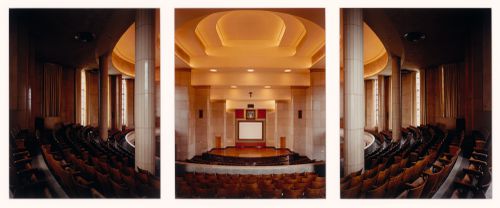
Group consists of three colour photographic prints that form a panorama of the auditorium at Université de Montréal, Montréal, Québec. Commissioned by the Canadian Centre for Architecture, Montréal, for "Ernest Cormier: Université de Montréal," 1988-1990
PH1990:0022:001-003
Description:
Group consists of three colour photographic prints that form a panorama of the auditorium at Université de Montréal, Montréal, Québec. Commissioned by the Canadian Centre for Architecture, Montréal, for "Ernest Cormier: Université de Montréal," 1988-1990
Personnes et institutions:
Date:
June 1989
June 1989
Titre:
Panorama of the auditorium, Université de Montréal, Montréal, Québec
Actions:
PH1990:0022:001-003
Description:
Group consists of three colour photographic prints that form a panorama of the auditorium at Université de Montréal, Montréal, Québec. Commissioned by the Canadian Centre for Architecture, Montréal, for "Ernest Cormier: Université de Montréal," 1988-1990
Panorama of the auditorium, Université de Montréal, Montréal, Québec
Actions:
PH1990:0022:001-003
Description:
Group consists of three colour photographic prints that form a panorama of the auditorium at Université de Montréal, Montréal, Québec. Commissioned by the Canadian Centre for Architecture, Montréal, for "Ernest Cormier: Université de Montréal," 1988-1990
Classification:
photographies
photographies
Date:
June 1989
June 1989
Personnes et institutions:
Classification:
photographies
photographies
Actions:
Numéro de référence:
PH2006:0214
Description:
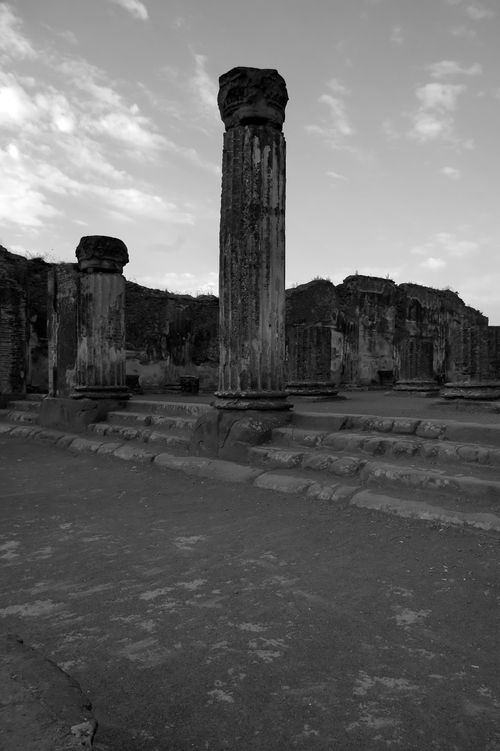
Basilica II consists of 17 black and white photographic prints of the ruins of Pompeii in Napoli, Italy. Basilica II comprises PH2006:0214 to PH2006:0231. Commissioned by the Canadian Centre for Architecture, Montréal, for "Tangent," 2006
PH2006:0214
Description:
Basilica II consists of 17 black and white photographic prints of the ruins of Pompeii in Napoli, Italy. Basilica II comprises PH2006:0214 to PH2006:0231. Commissioned by the Canadian Centre for Architecture, Montréal, for "Tangent," 2006
Personnes et institutions:
Date:
2006
2006
Titre:
Basilica II, Pompeii, Napoli, Italy
Actions:
PH2006:0214
Description:
Basilica II consists of 17 black and white photographic prints of the ruins of Pompeii in Napoli, Italy. Basilica II comprises PH2006:0214 to PH2006:0231. Commissioned by the Canadian Centre for Architecture, Montréal, for "Tangent," 2006
Basilica II, Pompeii, Napoli, Italy
Actions:
PH2006:0214
Description:
Basilica II consists of 17 black and white photographic prints of the ruins of Pompeii in Napoli, Italy. Basilica II comprises PH2006:0214 to PH2006:0231. Commissioned by the Canadian Centre for Architecture, Montréal, for "Tangent," 2006
Classification:
photographies
photographies
Date:
2006
2006
Personnes et institutions:
Classification:
livres
livres
Titre:
Stones
Stones
Actions:
Numéro de référence:
PH2023:0012
Description:
Copy of the mock-up for the book "Stones," which was commissioned by the CCA for the exhibition The Lives of Documents—Photography as Project, on view from 3 May 2023 to 7 April 2024.
PH2023:0012
Description:
Copy of the mock-up for the book "Stones," which was commissioned by the CCA for the exhibition The Lives of Documents—Photography as Project, on view from 3 May 2023 to 7 April 2024.
Personnes et institutions:
Date:
2023
2023
Titre:
Stones
Actions:
PH2023:0012
Description:
Copy of the mock-up for the book "Stones," which was commissioned by the CCA for the exhibition The Lives of Documents—Photography as Project, on view from 3 May 2023 to 7 April 2024.
Stones
Actions:
PH2023:0012
Description:
Copy of the mock-up for the book "Stones," which was commissioned by the CCA for the exhibition The Lives of Documents—Photography as Project, on view from 3 May 2023 to 7 April 2024.
Classification:
livres
livres
Date:
2023
2023
Personnes et institutions:
Classification:
dessins, documents textuels
dessins, documents textuels
Actions:
Numéro de référence:
DR1974:0002:038:001-029
Description:
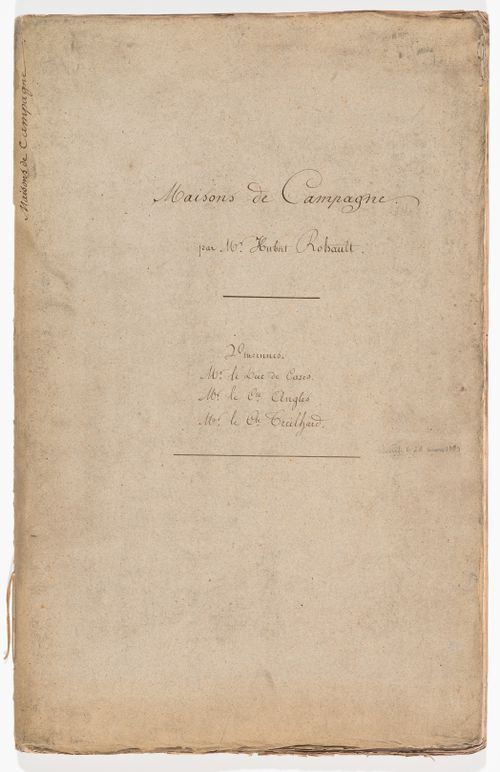
- This album consists of drawings - mostly plans, elevations and sections - for several country houses in a classical style with Palladian influences, and nine garden pavilions, either classical or Chinese-inspired. The inscribed album title indicates that the houses were commissioned by duc Decazes, comte Anglès, and comte Treilhard. Drawings are inscribed with the names of duc Decazes and comte Anglès, but none are inscribed with the name of comte Treilhard. The drawings range from rough preliminary sketches and design development drawings - mostly line drawings - to presentation drawings, primarily finished drawings and renderings. Also included are preliminary designs for buildings near Vincennes commissioned by M. Brodelet (DR1974:0002:038:001 R/V - DR1974:0002:038:005) and a design for a greenhouse commissioned by comte Anglès (DR1974:0002:038:026 R).
DR1974:0002:038:001-029
Description:
- This album consists of drawings - mostly plans, elevations and sections - for several country houses in a classical style with Palladian influences, and nine garden pavilions, either classical or Chinese-inspired. The inscribed album title indicates that the houses were commissioned by duc Decazes, comte Anglès, and comte Treilhard. Drawings are inscribed with the names of duc Decazes and comte Anglès, but none are inscribed with the name of comte Treilhard. The drawings range from rough preliminary sketches and design development drawings - mostly line drawings - to presentation drawings, primarily finished drawings and renderings. Also included are preliminary designs for buildings near Vincennes commissioned by M. Brodelet (DR1974:0002:038:001 R/V - DR1974:0002:038:005) and a design for a greenhouse commissioned by comte Anglès (DR1974:0002:038:026 R).
Personnes et institutions:
Sujet:
architecture, architecture de paysage
architecture, architecture de paysage
Date:
first half of the 19th century
first half of the 19th century
Titre:
Album of drawings for country houses and garden structures, France
Actions:
DR1974:0002:038:001-029
Description:
- This album consists of drawings - mostly plans, elevations and sections - for several country houses in a classical style with Palladian influences, and nine garden pavilions, either classical or Chinese-inspired. The inscribed album title indicates that the houses were commissioned by duc Decazes, comte Anglès, and comte Treilhard. Drawings are inscribed with the names of duc Decazes and comte Anglès, but none are inscribed with the name of comte Treilhard. The drawings range from rough preliminary sketches and design development drawings - mostly line drawings - to presentation drawings, primarily finished drawings and renderings. Also included are preliminary designs for buildings near Vincennes commissioned by M. Brodelet (DR1974:0002:038:001 R/V - DR1974:0002:038:005) and a design for a greenhouse commissioned by comte Anglès (DR1974:0002:038:026 R).
Album of drawings for country houses and garden structures, France
Actions:
DR1974:0002:038:001-029
Description:
- This album consists of drawings - mostly plans, elevations and sections - for several country houses in a classical style with Palladian influences, and nine garden pavilions, either classical or Chinese-inspired. The inscribed album title indicates that the houses were commissioned by duc Decazes, comte Anglès, and comte Treilhard. Drawings are inscribed with the names of duc Decazes and comte Anglès, but none are inscribed with the name of comte Treilhard. The drawings range from rough preliminary sketches and design development drawings - mostly line drawings - to presentation drawings, primarily finished drawings and renderings. Also included are preliminary designs for buildings near Vincennes commissioned by M. Brodelet (DR1974:0002:038:001 R/V - DR1974:0002:038:005) and a design for a greenhouse commissioned by comte Anglès (DR1974:0002:038:026 R).
Classification:
dessins, documents textuels
dessins, documents textuels
Date:
first half of the 19th century
first half of the 19th century
Personnes et institutions:
Sujet:
architecture, architecture de paysage
architecture, architecture de paysage
Classification:
photographies
photographies
Actions:
Numéro de référence:
PH1990:0019:001-003
Description:
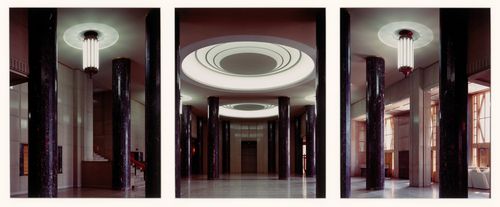
Group consists of three colour photographic prints that form a panorama of the entrance hall at Université de Montréal, Montréal, Québec. Commissioned by the Canadian Centre for Architecture, Montréal, for "Ernest Cormier: Université de Montréal," 1988-1990
PH1990:0019:001-003
Description:
Group consists of three colour photographic prints that form a panorama of the entrance hall at Université de Montréal, Montréal, Québec. Commissioned by the Canadian Centre for Architecture, Montréal, for "Ernest Cormier: Université de Montréal," 1988-1990
Personnes et institutions:
Date:
June 1989
June 1989
Titre:
Panorama of the entrance hall, looking west, Université de Montréal, Montréal, Québec
Actions:
PH1990:0019:001-003
Description:
Group consists of three colour photographic prints that form a panorama of the entrance hall at Université de Montréal, Montréal, Québec. Commissioned by the Canadian Centre for Architecture, Montréal, for "Ernest Cormier: Université de Montréal," 1988-1990
Panorama of the entrance hall, looking west, Université de Montréal, Montréal, Québec
Actions:
PH1990:0019:001-003
Description:
Group consists of three colour photographic prints that form a panorama of the entrance hall at Université de Montréal, Montréal, Québec. Commissioned by the Canadian Centre for Architecture, Montréal, for "Ernest Cormier: Université de Montréal," 1988-1990
Classification:
photographies
photographies
Date:
June 1989
June 1989
Personnes et institutions:
Classification:
photographies
photographies
Actions:
Numéro de référence:
PH1986:0901:017
Description:
- The inscription accompanying this photograph refers to events between 18 September and 14 October 1860. On 18 September 1860, during the Second Opium War (1858-1860), 39 British and French civilians and soldiers were taken hostage by the Chinese. Among the hostages were Harry Smith Parkes, the British commissioner in Canton (now Guangzhou) and Henry Loch, private secretary to Lord Elgin, who were later released, and Captain Brabazon of the Royal Artillery, who was killed (Harris, p. 153).
PH1986:0901:017
Description:
- The inscription accompanying this photograph refers to events between 18 September and 14 October 1860. On 18 September 1860, during the Second Opium War (1858-1860), 39 British and French civilians and soldiers were taken hostage by the Chinese. Among the hostages were Harry Smith Parkes, the British commissioner in Canton (now Guangzhou) and Henry Loch, private secretary to Lord Elgin, who were later released, and Captain Brabazon of the Royal Artillery, who was killed (Harris, p. 153).
Personnes et institutions:
Sujet:
ingénierie
ingénierie
Date:
between 21 September and 2 October 1860
between 21 September and 2 October 1860
Titre:
View of the Palichao (now Baliqiao) bridge, Tung-chow (Tongzhou, also now known as Tongxian), near Peking (now Beijing), China
Actions:
PH1986:0901:017
Description:
- The inscription accompanying this photograph refers to events between 18 September and 14 October 1860. On 18 September 1860, during the Second Opium War (1858-1860), 39 British and French civilians and soldiers were taken hostage by the Chinese. Among the hostages were Harry Smith Parkes, the British commissioner in Canton (now Guangzhou) and Henry Loch, private secretary to Lord Elgin, who were later released, and Captain Brabazon of the Royal Artillery, who was killed (Harris, p. 153).
View of the Palichao (now Baliqiao) bridge, Tung-chow (Tongzhou, also now known as Tongxian), near Peking (now Beijing), China
Actions:
PH1986:0901:017
Description:
- The inscription accompanying this photograph refers to events between 18 September and 14 October 1860. On 18 September 1860, during the Second Opium War (1858-1860), 39 British and French civilians and soldiers were taken hostage by the Chinese. Among the hostages were Harry Smith Parkes, the British commissioner in Canton (now Guangzhou) and Henry Loch, private secretary to Lord Elgin, who were later released, and Captain Brabazon of the Royal Artillery, who was killed (Harris, p. 153).
Classification:
photographies
photographies
Date:
between 21 September and 2 October 1860
between 21 September and 2 October 1860
Personnes et institutions:
Sujet:
ingénierie
ingénierie


