


12622 Résultats
Classification:
archives
Niveau de description archivistique:
Fonds
archives
Niveau de description archivistique:
Fonds
Titre:
Bernard Cache fonds
Bernard Cache fonds
Numéro de référence:
AP169
Résumé:
Bernard Cache, fonds, 1991-2011, document the development and design process for the Objectile firm and its decorative panels and furniture. The records focus mostly on daily activities of the firm, the collaboration of principal Bernard Cache with TopSolid software, and his parallel academic work. The records consist solely of original born-digital material.
AP169
Résumé:
Bernard Cache, fonds, 1991-2011, document the development and design process for the Objectile firm and its decorative panels and furniture. The records focus mostly on daily activities of the firm, the collaboration of principal Bernard Cache with TopSolid software, and his parallel academic work. The records consist solely of original born-digital material.
Personnes et institutions:
Date:
1992-2011
1992-2011
Titre:
Bernard Cache fonds
Actions:
AP169
Résumé:
Bernard Cache, fonds, 1991-2011, document the development and design process for the Objectile firm and its decorative panels and furniture. The records focus mostly on daily activities of the firm, the collaboration of principal Bernard Cache with TopSolid software, and his parallel academic work. The records consist solely of original born-digital material.
Bernard Cache fonds
Actions:
AP169
Résumé:
Bernard Cache, fonds, 1991-2011, document the development and design process for the Objectile firm and its decorative panels and furniture. The records focus mostly on daily activities of the firm, the collaboration of principal Bernard Cache with TopSolid software, and his parallel academic work. The records consist solely of original born-digital material.
Classification:
archives
Niveau de description archivistique:
Fonds
archives
Niveau de description archivistique:
Fonds
Date:
1992-2011
1992-2011
Personnes et institutions:
Classification:
archives
Niveau de description archivistique:
Fonds
archives
Niveau de description archivistique:
Fonds
Titre:
Fonds Maxwell Levinson
Fonds Maxwell Levinson
Numéro de référence:
AP037
Résumé:
The Maxwell Levison fonds (Shelter, T. Square) illustrates primarily the activities of Maxwell Levinson as editor of T-Square Club Journal, T-Square, Shelter and USA Tomorrow. It documents the various aspects of the publication of these magazines. It includes editorial, production and promotional material as well as documentation and research files. The fonds also contains records pertaining to the professional practice of Maxwell Levinson as architect and city planning consultant.
AP037
Résumé:
The Maxwell Levison fonds (Shelter, T. Square) illustrates primarily the activities of Maxwell Levinson as editor of T-Square Club Journal, T-Square, Shelter and USA Tomorrow. It documents the various aspects of the publication of these magazines. It includes editorial, production and promotional material as well as documentation and research files. The fonds also contains records pertaining to the professional practice of Maxwell Levinson as architect and city planning consultant.
Personnes et institutions:
Date:
1926-1990
1926-1990
Titre:
Fonds Maxwell Levinson
Actions:
AP037
Résumé:
The Maxwell Levison fonds (Shelter, T. Square) illustrates primarily the activities of Maxwell Levinson as editor of T-Square Club Journal, T-Square, Shelter and USA Tomorrow. It documents the various aspects of the publication of these magazines. It includes editorial, production and promotional material as well as documentation and research files. The fonds also contains records pertaining to the professional practice of Maxwell Levinson as architect and city planning consultant.
Fonds Maxwell Levinson
Actions:
AP037
Résumé:
The Maxwell Levison fonds (Shelter, T. Square) illustrates primarily the activities of Maxwell Levinson as editor of T-Square Club Journal, T-Square, Shelter and USA Tomorrow. It documents the various aspects of the publication of these magazines. It includes editorial, production and promotional material as well as documentation and research files. The fonds also contains records pertaining to the professional practice of Maxwell Levinson as architect and city planning consultant.
Classification:
archives
Niveau de description archivistique:
Fonds
archives
Niveau de description archivistique:
Fonds
Date:
1926-1990
1926-1990
Personnes et institutions:
Classification:
expositions
expositions
Actions:
Description:
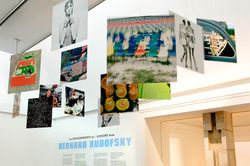
Les enseignements de Bernard Rudofsky est la première rétrospective qui examine la vie et l’œuvre de l’architecte, designer et critique controversé, dont les constructions, les expositions et les concepts de mode ont remis en question les idées mêmes de confort et de culture dans le monde occidental. L’exposition jette un regard sur la diversité des contributions d’un(...)
Les enseignements de Bernard Rudofsky est la première rétrospective qui examine la vie et l’œuvre de l’architecte, designer et critique controversé, dont les constructions, les expositions et les concepts de mode ont remis en question les idées mêmes de confort et de culture dans le monde occidental. L’exposition jette un regard sur la diversité des contributions d’un(...)
Localisation:
Salles principales
Salles principales
Date:
4 juillet 2007 au 30 septembre 2007
4 juillet 2007 au 30 septembre 2007
Titre:
Les enseignements de Bernard Rudofsky
Actions:
Description:
Les enseignements de Bernard Rudofsky est la première rétrospective qui examine la vie et l’œuvre de l’architecte, designer et critique controversé, dont les constructions, les expositions et les concepts de mode ont remis en question les idées mêmes de confort et de culture dans le monde occidental. L’exposition jette un regard sur la diversité des contributions d’un(...)
Les enseignements de Bernard Rudofsky
Actions:
Description:
Les enseignements de Bernard Rudofsky est la première rétrospective qui examine la vie et l’œuvre de l’architecte, designer et critique controversé, dont les constructions, les expositions et les concepts de mode ont remis en question les idées mêmes de confort et de culture dans le monde occidental. L’exposition jette un regard sur la diversité des contributions d’un(...)
Classification:
expositions
expositions
Date:
4 juillet 2007 au
30 septembre 2007
4 juillet 2007 au
30 septembre 2007
Localisation:
Salles principales
Salles principales
Classification:
expositions
expositions
Actions:
Description:
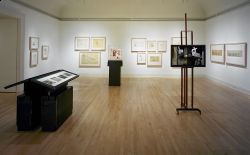
L’exposition se concentre sur un aspect déterminant et actuel de l’œuvre de Scarpa : l’approche originale qu’il utilisait pour composer avec les strates historiques qui forment le tissu d’une ville ou d’un bâtiment. En se concentrant sur l’habileté avec laquelle Scarpa pouvait développer une nouvelle œuvre à l’intérieur même, et souvent à partir, de fragments disparates(...)
L’exposition se concentre sur un aspect déterminant et actuel de l’œuvre de Scarpa : l’approche originale qu’il utilisait pour composer avec les strates historiques qui forment le tissu d’une ville ou d’un bâtiment. En se concentrant sur l’habileté avec laquelle Scarpa pouvait développer une nouvelle œuvre à l’intérieur même, et souvent à partir, de fragments disparates(...)
Localisation:
Salles principales
Salles principales
Date:
26 mai 1999 au 31 octobre 1999
26 mai 1999 au 31 octobre 1999
Titre:
Carlo Scarpa, architecte : composer avec l’histoire
Actions:
Description:
L’exposition se concentre sur un aspect déterminant et actuel de l’œuvre de Scarpa : l’approche originale qu’il utilisait pour composer avec les strates historiques qui forment le tissu d’une ville ou d’un bâtiment. En se concentrant sur l’habileté avec laquelle Scarpa pouvait développer une nouvelle œuvre à l’intérieur même, et souvent à partir, de fragments disparates(...)
Carlo Scarpa, architecte : composer avec l’histoire
Actions:
Description:
L’exposition se concentre sur un aspect déterminant et actuel de l’œuvre de Scarpa : l’approche originale qu’il utilisait pour composer avec les strates historiques qui forment le tissu d’une ville ou d’un bâtiment. En se concentrant sur l’habileté avec laquelle Scarpa pouvait développer une nouvelle œuvre à l’intérieur même, et souvent à partir, de fragments disparates(...)
Classification:
expositions
expositions
Date:
26 mai 1999 au
31 octobre 1999
26 mai 1999 au
31 octobre 1999
Localisation:
Salles principales
Salles principales
Niveau de description archivistique:
Projet
Projet
Numéro de référence:
AP018.S1.1982.PR19
Description:
This project series documents the design and construction of the Hôtel de la Délégation in Algiers, Algeria from 1982-1985. The office identified the project number as 8220. This hotel was designed with inspiration from traditional Maghrebian and Middle Eastern architecture but made in the modern style. The site for the project consisted of the hotel, a neighbouring villa, a separate office complex, a roundabout at the entrance, two pools, tennis courts, gardens and, an arcade. The project proposed several variations on the design for the hotel, including an eight-level option and a ten-level option, the latter adding two levels of parking to the bottom of the building. The hotel was built into a hill so floors that were subterranean on one side of the building were above ground on the other. This latter side had terraced pergolas at every level with views over the pool. The hotel had a multi-level atrium that contained elaborate indoor gardens and trees. While the ground floor was made up of conference rooms, banquet halls and the reception area, the other levels mostly contained hotel rooms. This project was commissioned by Lavalin International Inc. for the Algerian government, who are referred to in the records as the Présidence de la République, République Algérienne, Démocratique et Populaire. The project is also referred to as Hôtel Alger in the project documentation. The project is recorded through drawings, photographic materials and textual records dating from 1982-1985. Almost all of the records are in French, with the exception of a few interoffice communications. While there are construction drawings in the project materials, there are also a large number of design drawings showing different schemes and ideas for the hotel. The photographic materials include construction progress photos of the hotel. The textual records consist of correspondence, meeting reports, pre-design records and the project scope, financial documentation, schedules, interoffice letters, construction and detail planning records, specifications and progress reports. Box AP018.S1.1982.PR19.041 in this project series includes an index to the textual materials, which was created by the office.
AP018.S1.1982.PR19
Description:
This project series documents the design and construction of the Hôtel de la Délégation in Algiers, Algeria from 1982-1985. The office identified the project number as 8220. This hotel was designed with inspiration from traditional Maghrebian and Middle Eastern architecture but made in the modern style. The site for the project consisted of the hotel, a neighbouring villa, a separate office complex, a roundabout at the entrance, two pools, tennis courts, gardens and, an arcade. The project proposed several variations on the design for the hotel, including an eight-level option and a ten-level option, the latter adding two levels of parking to the bottom of the building. The hotel was built into a hill so floors that were subterranean on one side of the building were above ground on the other. This latter side had terraced pergolas at every level with views over the pool. The hotel had a multi-level atrium that contained elaborate indoor gardens and trees. While the ground floor was made up of conference rooms, banquet halls and the reception area, the other levels mostly contained hotel rooms. This project was commissioned by Lavalin International Inc. for the Algerian government, who are referred to in the records as the Présidence de la République, République Algérienne, Démocratique et Populaire. The project is also referred to as Hôtel Alger in the project documentation. The project is recorded through drawings, photographic materials and textual records dating from 1982-1985. Almost all of the records are in French, with the exception of a few interoffice communications. While there are construction drawings in the project materials, there are also a large number of design drawings showing different schemes and ideas for the hotel. The photographic materials include construction progress photos of the hotel. The textual records consist of correspondence, meeting reports, pre-design records and the project scope, financial documentation, schedules, interoffice letters, construction and detail planning records, specifications and progress reports. Box AP018.S1.1982.PR19.041 in this project series includes an index to the textual materials, which was created by the office.
Personnes et institutions:
Date:
1982-1985
1982-1985
Titre:
Hôtel de la Délégation, Algiers, Algeria (1982-1985)
Actions:
AP018.S1.1982.PR19
Description:
This project series documents the design and construction of the Hôtel de la Délégation in Algiers, Algeria from 1982-1985. The office identified the project number as 8220. This hotel was designed with inspiration from traditional Maghrebian and Middle Eastern architecture but made in the modern style. The site for the project consisted of the hotel, a neighbouring villa, a separate office complex, a roundabout at the entrance, two pools, tennis courts, gardens and, an arcade. The project proposed several variations on the design for the hotel, including an eight-level option and a ten-level option, the latter adding two levels of parking to the bottom of the building. The hotel was built into a hill so floors that were subterranean on one side of the building were above ground on the other. This latter side had terraced pergolas at every level with views over the pool. The hotel had a multi-level atrium that contained elaborate indoor gardens and trees. While the ground floor was made up of conference rooms, banquet halls and the reception area, the other levels mostly contained hotel rooms. This project was commissioned by Lavalin International Inc. for the Algerian government, who are referred to in the records as the Présidence de la République, République Algérienne, Démocratique et Populaire. The project is also referred to as Hôtel Alger in the project documentation. The project is recorded through drawings, photographic materials and textual records dating from 1982-1985. Almost all of the records are in French, with the exception of a few interoffice communications. While there are construction drawings in the project materials, there are also a large number of design drawings showing different schemes and ideas for the hotel. The photographic materials include construction progress photos of the hotel. The textual records consist of correspondence, meeting reports, pre-design records and the project scope, financial documentation, schedules, interoffice letters, construction and detail planning records, specifications and progress reports. Box AP018.S1.1982.PR19.041 in this project series includes an index to the textual materials, which was created by the office.
Hôtel de la Délégation, Algiers, Algeria (1982-1985)
Actions:
AP018.S1.1982.PR19
Description:
This project series documents the design and construction of the Hôtel de la Délégation in Algiers, Algeria from 1982-1985. The office identified the project number as 8220. This hotel was designed with inspiration from traditional Maghrebian and Middle Eastern architecture but made in the modern style. The site for the project consisted of the hotel, a neighbouring villa, a separate office complex, a roundabout at the entrance, two pools, tennis courts, gardens and, an arcade. The project proposed several variations on the design for the hotel, including an eight-level option and a ten-level option, the latter adding two levels of parking to the bottom of the building. The hotel was built into a hill so floors that were subterranean on one side of the building were above ground on the other. This latter side had terraced pergolas at every level with views over the pool. The hotel had a multi-level atrium that contained elaborate indoor gardens and trees. While the ground floor was made up of conference rooms, banquet halls and the reception area, the other levels mostly contained hotel rooms. This project was commissioned by Lavalin International Inc. for the Algerian government, who are referred to in the records as the Présidence de la République, République Algérienne, Démocratique et Populaire. The project is also referred to as Hôtel Alger in the project documentation. The project is recorded through drawings, photographic materials and textual records dating from 1982-1985. Almost all of the records are in French, with the exception of a few interoffice communications. While there are construction drawings in the project materials, there are also a large number of design drawings showing different schemes and ideas for the hotel. The photographic materials include construction progress photos of the hotel. The textual records consist of correspondence, meeting reports, pre-design records and the project scope, financial documentation, schedules, interoffice letters, construction and detail planning records, specifications and progress reports. Box AP018.S1.1982.PR19.041 in this project series includes an index to the textual materials, which was created by the office.
Niveau de description archivistique:
Project
Project
Date:
1982-1985
1982-1985
Personnes et institutions:
Niveau de description archivistique:
Projet
Projet
Numéro de référence:
AP018.S1.1973.PR03
Description:
This project series documents the design and construction of the Eaton’s store building at Dundas Square in Toronto from 1973-1977. The office identified the project number as 7303. This project, commissioned by The T. Eaton Co. Limited, consisted of a one million square foot department store with thirteen floors, ten above ground and three below. The building boasted nine floor of retail space, seamlessly connected through elevators and escalators. The remaining floors hosted office and storage spaces. Located at the corner of Yonge and Dundas streets, the Eaton’s store was connected to the Eaton Centre mall to its south. The mall, designed and built simultaneously with the Eaton’s store, was designed by the architecture firm Craig Zeidler Strong. For the Eaton’s store project, Parkin Architects Planners created a joint venture with architect C. Blakeway Millar, referred to as Parkin Millar in the documentation. Parkin Millar was the associate architects on this project, with the Eaton’s company architect, E.L. Hankinson, working as the primary architect. Each of the firms mentioned worked closely together to develop a cohesive design for the Eaton’s store and Eaton’s Centre mall, which is evident in the materials. The project is recorded through drawings, textual records, a book and presentation boards dating from 1973-1977. There are a large number of original drawings and sketches for the project. Most of the reprographic copies are arranged within the textual materials. There are presentation boards of the Vancouver Eaton's store in this project series that were likely used as reference by the architects. The textual records consist of correspondence, meeting minutes, site reports, change orders, consultancy records, inter-office letters, and specifications. Also in this project series is a special edition of the Eaton News, a monograph with in depth descriptions of the project.
AP018.S1.1973.PR03
Description:
This project series documents the design and construction of the Eaton’s store building at Dundas Square in Toronto from 1973-1977. The office identified the project number as 7303. This project, commissioned by The T. Eaton Co. Limited, consisted of a one million square foot department store with thirteen floors, ten above ground and three below. The building boasted nine floor of retail space, seamlessly connected through elevators and escalators. The remaining floors hosted office and storage spaces. Located at the corner of Yonge and Dundas streets, the Eaton’s store was connected to the Eaton Centre mall to its south. The mall, designed and built simultaneously with the Eaton’s store, was designed by the architecture firm Craig Zeidler Strong. For the Eaton’s store project, Parkin Architects Planners created a joint venture with architect C. Blakeway Millar, referred to as Parkin Millar in the documentation. Parkin Millar was the associate architects on this project, with the Eaton’s company architect, E.L. Hankinson, working as the primary architect. Each of the firms mentioned worked closely together to develop a cohesive design for the Eaton’s store and Eaton’s Centre mall, which is evident in the materials. The project is recorded through drawings, textual records, a book and presentation boards dating from 1973-1977. There are a large number of original drawings and sketches for the project. Most of the reprographic copies are arranged within the textual materials. There are presentation boards of the Vancouver Eaton's store in this project series that were likely used as reference by the architects. The textual records consist of correspondence, meeting minutes, site reports, change orders, consultancy records, inter-office letters, and specifications. Also in this project series is a special edition of the Eaton News, a monograph with in depth descriptions of the project.
Personnes et institutions:
Date:
1973-1977
1973-1977
Titre:
Eaton's Store Building, Dundas Square, Toronto (1973-1977)
Actions:
AP018.S1.1973.PR03
Description:
This project series documents the design and construction of the Eaton’s store building at Dundas Square in Toronto from 1973-1977. The office identified the project number as 7303. This project, commissioned by The T. Eaton Co. Limited, consisted of a one million square foot department store with thirteen floors, ten above ground and three below. The building boasted nine floor of retail space, seamlessly connected through elevators and escalators. The remaining floors hosted office and storage spaces. Located at the corner of Yonge and Dundas streets, the Eaton’s store was connected to the Eaton Centre mall to its south. The mall, designed and built simultaneously with the Eaton’s store, was designed by the architecture firm Craig Zeidler Strong. For the Eaton’s store project, Parkin Architects Planners created a joint venture with architect C. Blakeway Millar, referred to as Parkin Millar in the documentation. Parkin Millar was the associate architects on this project, with the Eaton’s company architect, E.L. Hankinson, working as the primary architect. Each of the firms mentioned worked closely together to develop a cohesive design for the Eaton’s store and Eaton’s Centre mall, which is evident in the materials. The project is recorded through drawings, textual records, a book and presentation boards dating from 1973-1977. There are a large number of original drawings and sketches for the project. Most of the reprographic copies are arranged within the textual materials. There are presentation boards of the Vancouver Eaton's store in this project series that were likely used as reference by the architects. The textual records consist of correspondence, meeting minutes, site reports, change orders, consultancy records, inter-office letters, and specifications. Also in this project series is a special edition of the Eaton News, a monograph with in depth descriptions of the project.
Eaton's Store Building, Dundas Square, Toronto (1973-1977)
Actions:
AP018.S1.1973.PR03
Description:
This project series documents the design and construction of the Eaton’s store building at Dundas Square in Toronto from 1973-1977. The office identified the project number as 7303. This project, commissioned by The T. Eaton Co. Limited, consisted of a one million square foot department store with thirteen floors, ten above ground and three below. The building boasted nine floor of retail space, seamlessly connected through elevators and escalators. The remaining floors hosted office and storage spaces. Located at the corner of Yonge and Dundas streets, the Eaton’s store was connected to the Eaton Centre mall to its south. The mall, designed and built simultaneously with the Eaton’s store, was designed by the architecture firm Craig Zeidler Strong. For the Eaton’s store project, Parkin Architects Planners created a joint venture with architect C. Blakeway Millar, referred to as Parkin Millar in the documentation. Parkin Millar was the associate architects on this project, with the Eaton’s company architect, E.L. Hankinson, working as the primary architect. Each of the firms mentioned worked closely together to develop a cohesive design for the Eaton’s store and Eaton’s Centre mall, which is evident in the materials. The project is recorded through drawings, textual records, a book and presentation boards dating from 1973-1977. There are a large number of original drawings and sketches for the project. Most of the reprographic copies are arranged within the textual materials. There are presentation boards of the Vancouver Eaton's store in this project series that were likely used as reference by the architects. The textual records consist of correspondence, meeting minutes, site reports, change orders, consultancy records, inter-office letters, and specifications. Also in this project series is a special edition of the Eaton News, a monograph with in depth descriptions of the project.
Niveau de description archivistique:
Project
Project
Date:
1973-1977
1973-1977
Personnes et institutions:
Classification:
dessins
dessins
Actions:
Numéro de référence:
DR1988:0400
Description:
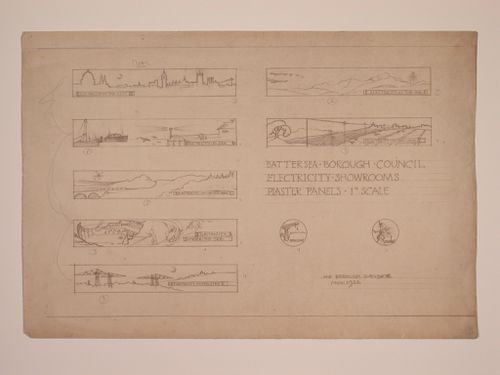
- This reprographic copy shows designs for seven rectangular and two circular plaster panels for the showrooms in Electric House. Each of the rectangular panels highlights a different aspect of electricity consumption. For example, the upper left panel, titled "ELECTRICITY.IN.THE.CITY"; depicts the London skyline at night. - This work is part of an incomplete group of possibly working reprographic copies for Electric House, Battersea Borough, designed by the borough architect, Henry Hyams. The group also includes some reprographic copies which may have been used for publication purposes. - The style of many of these drawings and reprographic copies by Henry Hyams (DR1988:0332 - DR1988:0414) suggests that they were possibly for periodical illustrations. Hyams contributed articles to the periodicals 'The Builder' and 'The Architect'. Two objects in the CCA collections can be directly linked to an article published prior to 1926 in 'The Architect'; a reprographic copy (DR1988:0357) and a drawing (DR1988:0364) (Who's Who in Architecture, 161).
DR1988:0400
Description:
- This reprographic copy shows designs for seven rectangular and two circular plaster panels for the showrooms in Electric House. Each of the rectangular panels highlights a different aspect of electricity consumption. For example, the upper left panel, titled "ELECTRICITY.IN.THE.CITY"; depicts the London skyline at night. - This work is part of an incomplete group of possibly working reprographic copies for Electric House, Battersea Borough, designed by the borough architect, Henry Hyams. The group also includes some reprographic copies which may have been used for publication purposes. - The style of many of these drawings and reprographic copies by Henry Hyams (DR1988:0332 - DR1988:0414) suggests that they were possibly for periodical illustrations. Hyams contributed articles to the periodicals 'The Builder' and 'The Architect'. Two objects in the CCA collections can be directly linked to an article published prior to 1926 in 'The Architect'; a reprographic copy (DR1988:0357) and a drawing (DR1988:0364) (Who's Who in Architecture, 161).
Personnes et institutions:
Sujet:
design d'intérieur
design d'intérieur
Date:
printed November 1926
printed November 1926
Titre:
Designs for plaster panels for showrooms, Electric House, Battersea Borough
Actions:
DR1988:0400
Description:
- This reprographic copy shows designs for seven rectangular and two circular plaster panels for the showrooms in Electric House. Each of the rectangular panels highlights a different aspect of electricity consumption. For example, the upper left panel, titled "ELECTRICITY.IN.THE.CITY"; depicts the London skyline at night. - This work is part of an incomplete group of possibly working reprographic copies for Electric House, Battersea Borough, designed by the borough architect, Henry Hyams. The group also includes some reprographic copies which may have been used for publication purposes. - The style of many of these drawings and reprographic copies by Henry Hyams (DR1988:0332 - DR1988:0414) suggests that they were possibly for periodical illustrations. Hyams contributed articles to the periodicals 'The Builder' and 'The Architect'. Two objects in the CCA collections can be directly linked to an article published prior to 1926 in 'The Architect'; a reprographic copy (DR1988:0357) and a drawing (DR1988:0364) (Who's Who in Architecture, 161).
Designs for plaster panels for showrooms, Electric House, Battersea Borough
Actions:
DR1988:0400
Description:
- This reprographic copy shows designs for seven rectangular and two circular plaster panels for the showrooms in Electric House. Each of the rectangular panels highlights a different aspect of electricity consumption. For example, the upper left panel, titled "ELECTRICITY.IN.THE.CITY"; depicts the London skyline at night. - This work is part of an incomplete group of possibly working reprographic copies for Electric House, Battersea Borough, designed by the borough architect, Henry Hyams. The group also includes some reprographic copies which may have been used for publication purposes. - The style of many of these drawings and reprographic copies by Henry Hyams (DR1988:0332 - DR1988:0414) suggests that they were possibly for periodical illustrations. Hyams contributed articles to the periodicals 'The Builder' and 'The Architect'. Two objects in the CCA collections can be directly linked to an article published prior to 1926 in 'The Architect'; a reprographic copy (DR1988:0357) and a drawing (DR1988:0364) (Who's Who in Architecture, 161).
Classification:
dessins
dessins
Date:
printed November 1926
printed November 1926
Personnes et institutions:
Sujet:
design d'intérieur
design d'intérieur
Niveau de description archivistique:
Sous-série
Sous-série
Numéro de référence:
AP104.S1.SS4
Description:
La sous-série contient 6 carnets de croquis. 3 carnets contiennent des croquis d'architecture en Bretagne et Paris et un portrait d'homme. Deux cahiers spirales et un cahier "Drawing Block" contiennent des croquis de plans et détails architecturaux, des mobiliers, des vues perspectives urbaines, des paysages et d'autres sujets. Ces croquis ont probablement été exécutés en Europe entre 1923 et 1933.
AP104.S1.SS4
Description:
La sous-série contient 6 carnets de croquis. 3 carnets contiennent des croquis d'architecture en Bretagne et Paris et un portrait d'homme. Deux cahiers spirales et un cahier "Drawing Block" contiennent des croquis de plans et détails architecturaux, des mobiliers, des vues perspectives urbaines, des paysages et d'autres sujets. Ces croquis ont probablement été exécutés en Europe entre 1923 et 1933.
Personnes et institutions:
Date:
between 1923 and 1933?
between 1923 and 1933?
Titre:
Carnets et cahiers de Marcel Parizeau
Actions:
AP104.S1.SS4
Description:
La sous-série contient 6 carnets de croquis. 3 carnets contiennent des croquis d'architecture en Bretagne et Paris et un portrait d'homme. Deux cahiers spirales et un cahier "Drawing Block" contiennent des croquis de plans et détails architecturaux, des mobiliers, des vues perspectives urbaines, des paysages et d'autres sujets. Ces croquis ont probablement été exécutés en Europe entre 1923 et 1933.
Carnets et cahiers de Marcel Parizeau
Actions:
AP104.S1.SS4
Description:
La sous-série contient 6 carnets de croquis. 3 carnets contiennent des croquis d'architecture en Bretagne et Paris et un portrait d'homme. Deux cahiers spirales et un cahier "Drawing Block" contiennent des croquis de plans et détails architecturaux, des mobiliers, des vues perspectives urbaines, des paysages et d'autres sujets. Ces croquis ont probablement été exécutés en Europe entre 1923 et 1933.
Niveau de description archivistique:
Sous-série 4
Sous-série 4
Date:
between 1923 and 1933?
between 1923 and 1933?
Personnes et institutions:
Niveau de description archivistique:
Projet
Projet
Numéro de référence:
AP178.S1.1979.PR06
Description:
The project series documents the 1979 design entry for Block 70 and 89, also known as the Fränkelufer residential complex. While the records were held in the office’s archives this project was assigned the number 55/70. The office assigned the date 1979 for this project. This project was submitted to the International Architectural Exhibition Berlin competition (International Bauaustellung, IBA, circa 1979-1987), an urban renewal strategy for West Berlin, Germany. Six months prior to submitting the design for Block 70 and 89 Siza submitted a design for the Görlitzer Bad swimming pool, which did not win the competition but received a special prize. Siza later submitted proposals to the IBA for Bonjour Tristesse (Block 121), Monument to Gestapo victims Prinz-Albrecht-Palais, Block 11-12 (Kottbusser Damm), and the Kulturforum, all of which are documented in this fonds. The IBA divided West Berlin into two parts: IBA Neubau ('new building'), led by Josef Paul Kleihues, and IBA Altbau ('old building') led by Hardt-Walherr Hämer. IBA Nuebau's focus was to build new structures while IBA Altbau's was to renovate existing buildings. The competition site for Block 70 and 89 was located on the west side of Kreuzberg, a district on the eastern edge of West Berlin. Although this project was part of the Altbau section, it nonetheless required building new housing complexes, which was generally under the purview of the Neubau section (Mota, "An archaeology of the ordinary" 299). Siza won second prize in the competition for his design of Block 70 and 89. This design proposal is said to have prepared Siza's ideas for his first international built project, Block 121 (Mathur, "The migrant's time"). The project series contains sketches and studies, which include notes. Several of the project sketches also include sketches of people. Documenting the design proposal are site plans, elevations, interior elevations, and floor plans. Photographs, negatives, contact sheets, and slides depict the project site and surrounding area as well as the model and drawings. Additionally there are panoramic photomontages of the project site. Please note that documentation for this project series is housed with documentation on Block 11-12 in file AP178.S1.1980.PR03.008, in the order it was kept by the office. Documentation for Block 70 and 89 includes an invitation to the competition, recommendations from the IBA advisory council, and other information regarding the competition.
AP178.S1.1979.PR06
Description:
The project series documents the 1979 design entry for Block 70 and 89, also known as the Fränkelufer residential complex. While the records were held in the office’s archives this project was assigned the number 55/70. The office assigned the date 1979 for this project. This project was submitted to the International Architectural Exhibition Berlin competition (International Bauaustellung, IBA, circa 1979-1987), an urban renewal strategy for West Berlin, Germany. Six months prior to submitting the design for Block 70 and 89 Siza submitted a design for the Görlitzer Bad swimming pool, which did not win the competition but received a special prize. Siza later submitted proposals to the IBA for Bonjour Tristesse (Block 121), Monument to Gestapo victims Prinz-Albrecht-Palais, Block 11-12 (Kottbusser Damm), and the Kulturforum, all of which are documented in this fonds. The IBA divided West Berlin into two parts: IBA Neubau ('new building'), led by Josef Paul Kleihues, and IBA Altbau ('old building') led by Hardt-Walherr Hämer. IBA Nuebau's focus was to build new structures while IBA Altbau's was to renovate existing buildings. The competition site for Block 70 and 89 was located on the west side of Kreuzberg, a district on the eastern edge of West Berlin. Although this project was part of the Altbau section, it nonetheless required building new housing complexes, which was generally under the purview of the Neubau section (Mota, "An archaeology of the ordinary" 299). Siza won second prize in the competition for his design of Block 70 and 89. This design proposal is said to have prepared Siza's ideas for his first international built project, Block 121 (Mathur, "The migrant's time"). The project series contains sketches and studies, which include notes. Several of the project sketches also include sketches of people. Documenting the design proposal are site plans, elevations, interior elevations, and floor plans. Photographs, negatives, contact sheets, and slides depict the project site and surrounding area as well as the model and drawings. Additionally there are panoramic photomontages of the project site. Please note that documentation for this project series is housed with documentation on Block 11-12 in file AP178.S1.1980.PR03.008, in the order it was kept by the office. Documentation for Block 70 and 89 includes an invitation to the competition, recommendations from the IBA advisory council, and other information regarding the competition.
Personnes et institutions:
Date:
1976-1982
1976-1982
Titre:
Blocke 70 und 89, Kreuzberg, Fränkelufer [Fränkelufer residential complex], Berlin, Germany (1976-1982)
Actions:
AP178.S1.1979.PR06
Description:
The project series documents the 1979 design entry for Block 70 and 89, also known as the Fränkelufer residential complex. While the records were held in the office’s archives this project was assigned the number 55/70. The office assigned the date 1979 for this project. This project was submitted to the International Architectural Exhibition Berlin competition (International Bauaustellung, IBA, circa 1979-1987), an urban renewal strategy for West Berlin, Germany. Six months prior to submitting the design for Block 70 and 89 Siza submitted a design for the Görlitzer Bad swimming pool, which did not win the competition but received a special prize. Siza later submitted proposals to the IBA for Bonjour Tristesse (Block 121), Monument to Gestapo victims Prinz-Albrecht-Palais, Block 11-12 (Kottbusser Damm), and the Kulturforum, all of which are documented in this fonds. The IBA divided West Berlin into two parts: IBA Neubau ('new building'), led by Josef Paul Kleihues, and IBA Altbau ('old building') led by Hardt-Walherr Hämer. IBA Nuebau's focus was to build new structures while IBA Altbau's was to renovate existing buildings. The competition site for Block 70 and 89 was located on the west side of Kreuzberg, a district on the eastern edge of West Berlin. Although this project was part of the Altbau section, it nonetheless required building new housing complexes, which was generally under the purview of the Neubau section (Mota, "An archaeology of the ordinary" 299). Siza won second prize in the competition for his design of Block 70 and 89. This design proposal is said to have prepared Siza's ideas for his first international built project, Block 121 (Mathur, "The migrant's time"). The project series contains sketches and studies, which include notes. Several of the project sketches also include sketches of people. Documenting the design proposal are site plans, elevations, interior elevations, and floor plans. Photographs, negatives, contact sheets, and slides depict the project site and surrounding area as well as the model and drawings. Additionally there are panoramic photomontages of the project site. Please note that documentation for this project series is housed with documentation on Block 11-12 in file AP178.S1.1980.PR03.008, in the order it was kept by the office. Documentation for Block 70 and 89 includes an invitation to the competition, recommendations from the IBA advisory council, and other information regarding the competition.
Blocke 70 und 89, Kreuzberg, Fränkelufer [Fränkelufer residential complex], Berlin, Germany (1976-1982)
Actions:
AP178.S1.1979.PR06
Description:
The project series documents the 1979 design entry for Block 70 and 89, also known as the Fränkelufer residential complex. While the records were held in the office’s archives this project was assigned the number 55/70. The office assigned the date 1979 for this project. This project was submitted to the International Architectural Exhibition Berlin competition (International Bauaustellung, IBA, circa 1979-1987), an urban renewal strategy for West Berlin, Germany. Six months prior to submitting the design for Block 70 and 89 Siza submitted a design for the Görlitzer Bad swimming pool, which did not win the competition but received a special prize. Siza later submitted proposals to the IBA for Bonjour Tristesse (Block 121), Monument to Gestapo victims Prinz-Albrecht-Palais, Block 11-12 (Kottbusser Damm), and the Kulturforum, all of which are documented in this fonds. The IBA divided West Berlin into two parts: IBA Neubau ('new building'), led by Josef Paul Kleihues, and IBA Altbau ('old building') led by Hardt-Walherr Hämer. IBA Nuebau's focus was to build new structures while IBA Altbau's was to renovate existing buildings. The competition site for Block 70 and 89 was located on the west side of Kreuzberg, a district on the eastern edge of West Berlin. Although this project was part of the Altbau section, it nonetheless required building new housing complexes, which was generally under the purview of the Neubau section (Mota, "An archaeology of the ordinary" 299). Siza won second prize in the competition for his design of Block 70 and 89. This design proposal is said to have prepared Siza's ideas for his first international built project, Block 121 (Mathur, "The migrant's time"). The project series contains sketches and studies, which include notes. Several of the project sketches also include sketches of people. Documenting the design proposal are site plans, elevations, interior elevations, and floor plans. Photographs, negatives, contact sheets, and slides depict the project site and surrounding area as well as the model and drawings. Additionally there are panoramic photomontages of the project site. Please note that documentation for this project series is housed with documentation on Block 11-12 in file AP178.S1.1980.PR03.008, in the order it was kept by the office. Documentation for Block 70 and 89 includes an invitation to the competition, recommendations from the IBA advisory council, and other information regarding the competition.
Niveau de description archivistique:
Project
Project
Date:
1976-1982
1976-1982
Personnes et institutions:
Classification:
dessins
dessins
Titre:
Elevations, plans and a section for three lamps, probably for Electric House, Battersea Borough
Elevations, plans and a section for three lamps, probably for Electric House, Battersea Borough
Actions:
Numéro de référence:
DR1988:0384
Description:
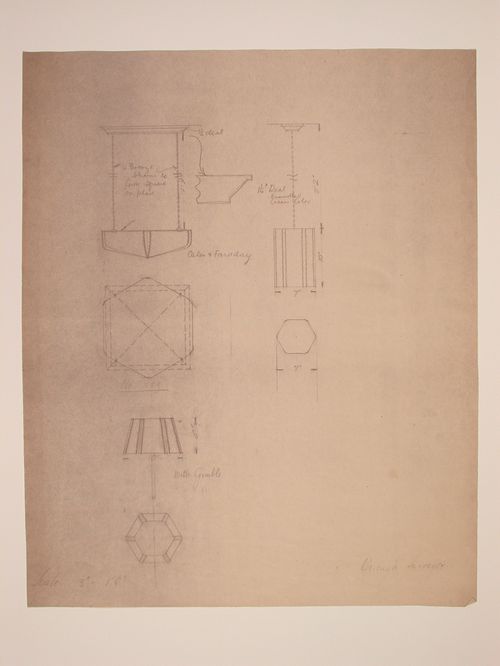
- This reprographic copy shows three lighting fixtures: one lamp and two pendant light fixtures suspended from the ceiling by bronze chains. The designs are probably for Electric House; the CCA collection contains similar designs for showroom light fixtures for Electric House, DR1988:0386 and DR1988:0396, which, like this print, are signed by the Borough Surveyor. - This work is part of an incomplete group of possibly working reprographic copies for Electric House, Battersea Borough, designed by the borough architect, Henry Hyams. The group also includes some reprographic copies which may have been used for publication purposes. - The style of many of these drawings and reprographic copies by Henry Hyams (DR1988:0332 - DR1988:0414) suggests that they were possibly for periodical illustrations. Hyams contributed articles to the periodicals 'The Builder' and 'The Architect'. Two objects in the CCA collections can be directly linked to an article published prior to 1926 in 'The Architect'; a reprographic copy (DR1988:0357) and a drawing (DR1988:0364) (Who's Who in Architecture, 161).
DR1988:0384
Description:
- This reprographic copy shows three lighting fixtures: one lamp and two pendant light fixtures suspended from the ceiling by bronze chains. The designs are probably for Electric House; the CCA collection contains similar designs for showroom light fixtures for Electric House, DR1988:0386 and DR1988:0396, which, like this print, are signed by the Borough Surveyor. - This work is part of an incomplete group of possibly working reprographic copies for Electric House, Battersea Borough, designed by the borough architect, Henry Hyams. The group also includes some reprographic copies which may have been used for publication purposes. - The style of many of these drawings and reprographic copies by Henry Hyams (DR1988:0332 - DR1988:0414) suggests that they were possibly for periodical illustrations. Hyams contributed articles to the periodicals 'The Builder' and 'The Architect'. Two objects in the CCA collections can be directly linked to an article published prior to 1926 in 'The Architect'; a reprographic copy (DR1988:0357) and a drawing (DR1988:0364) (Who's Who in Architecture, 161).
Personnes et institutions:
Sujet:
design d'intérieur
design d'intérieur
Date:
printed late 1926 or 1927
printed late 1926 or 1927
Titre:
Elevations, plans and a section for three lamps, probably for Electric House, Battersea Borough
Actions:
DR1988:0384
Description:
- This reprographic copy shows three lighting fixtures: one lamp and two pendant light fixtures suspended from the ceiling by bronze chains. The designs are probably for Electric House; the CCA collection contains similar designs for showroom light fixtures for Electric House, DR1988:0386 and DR1988:0396, which, like this print, are signed by the Borough Surveyor. - This work is part of an incomplete group of possibly working reprographic copies for Electric House, Battersea Borough, designed by the borough architect, Henry Hyams. The group also includes some reprographic copies which may have been used for publication purposes. - The style of many of these drawings and reprographic copies by Henry Hyams (DR1988:0332 - DR1988:0414) suggests that they were possibly for periodical illustrations. Hyams contributed articles to the periodicals 'The Builder' and 'The Architect'. Two objects in the CCA collections can be directly linked to an article published prior to 1926 in 'The Architect'; a reprographic copy (DR1988:0357) and a drawing (DR1988:0364) (Who's Who in Architecture, 161).
Elevations, plans and a section for three lamps, probably for Electric House, Battersea Borough
Actions:
DR1988:0384
Description:
- This reprographic copy shows three lighting fixtures: one lamp and two pendant light fixtures suspended from the ceiling by bronze chains. The designs are probably for Electric House; the CCA collection contains similar designs for showroom light fixtures for Electric House, DR1988:0386 and DR1988:0396, which, like this print, are signed by the Borough Surveyor. - This work is part of an incomplete group of possibly working reprographic copies for Electric House, Battersea Borough, designed by the borough architect, Henry Hyams. The group also includes some reprographic copies which may have been used for publication purposes. - The style of many of these drawings and reprographic copies by Henry Hyams (DR1988:0332 - DR1988:0414) suggests that they were possibly for periodical illustrations. Hyams contributed articles to the periodicals 'The Builder' and 'The Architect'. Two objects in the CCA collections can be directly linked to an article published prior to 1926 in 'The Architect'; a reprographic copy (DR1988:0357) and a drawing (DR1988:0364) (Who's Who in Architecture, 161).
Classification:
dessins
dessins
Date:
printed late 1926 or 1927
printed late 1926 or 1927
Personnes et institutions:
Sujet:
design d'intérieur
design d'intérieur


