


33490 Résultats
Classification:
documents textuels
documents textuels
Numéro de référence:
DR2012:0015:022:010
Description:
File containing documents in English (predominant), with French and Hebrew, including invitations, and press clippings related to the following projects and/or events: - Canadian tribute to human rights; - Corridart; - Parables and other allegories: the work of Melvin Charney, 1975-1990; - CCA garden; - Skyscraper, waterfall, brooks - a construction; - Conseil des arts & lettres du Québec; - Grand opening of the Canadian Centre for Architecture; - Montréal: plus ou moins?; - Melvin Charney: oeuvres 1970-1979; - Un dictionnaire; - Displacements: the work of artist-architect Melvin Charney.
DR2012:0015:022:010
Description:
File containing documents in English (predominant), with French and Hebrew, including invitations, and press clippings related to the following projects and/or events: - Canadian tribute to human rights; - Corridart; - Parables and other allegories: the work of Melvin Charney, 1975-1990; - CCA garden; - Skyscraper, waterfall, brooks - a construction; - Conseil des arts & lettres du Québec; - Grand opening of the Canadian Centre for Architecture; - Montréal: plus ou moins?; - Melvin Charney: oeuvres 1970-1979; - Un dictionnaire; - Displacements: the work of artist-architect Melvin Charney.
Personnes et institutions:
Date:
between 1972 and 2000
between 1972 and 2000
Titre:
Press clippings related to Melvin Charney's projects
Actions:
DR2012:0015:022:010
Description:
File containing documents in English (predominant), with French and Hebrew, including invitations, and press clippings related to the following projects and/or events: - Canadian tribute to human rights; - Corridart; - Parables and other allegories: the work of Melvin Charney, 1975-1990; - CCA garden; - Skyscraper, waterfall, brooks - a construction; - Conseil des arts & lettres du Québec; - Grand opening of the Canadian Centre for Architecture; - Montréal: plus ou moins?; - Melvin Charney: oeuvres 1970-1979; - Un dictionnaire; - Displacements: the work of artist-architect Melvin Charney.
Press clippings related to Melvin Charney's projects
Actions:
DR2012:0015:022:010
Description:
File containing documents in English (predominant), with French and Hebrew, including invitations, and press clippings related to the following projects and/or events: - Canadian tribute to human rights; - Corridart; - Parables and other allegories: the work of Melvin Charney, 1975-1990; - CCA garden; - Skyscraper, waterfall, brooks - a construction; - Conseil des arts & lettres du Québec; - Grand opening of the Canadian Centre for Architecture; - Montréal: plus ou moins?; - Melvin Charney: oeuvres 1970-1979; - Un dictionnaire; - Displacements: the work of artist-architect Melvin Charney.
Classification:
documents textuels
documents textuels
Date:
between 1972 and 2000
between 1972 and 2000
Personnes et institutions:
Actions:
Numéro de référence:
AP140.S2.SS7.D3.P10.6
Description:
Episode of television program "Building sites". James Stirling presents the architecture of the Katherine Stephen Room, a room for rare books at Newnham College, Cambridge, England, designed by architects Joanna van Heyningen and Birkin Haward. Presented by James Stirling. Camera, David Swan; sound, David Jewitt; stills photography, Hugh Palmer, Martin Charles; graphics, Rose James, Joel Greenberg; video editor, John Paroussi; production assistant, Mary McKernan; researcher, Ruth Rosenthal; producer, Clare Paterson; director, Geoff Dunlop.
AP140.S2.SS7.D3.P10.6
Description:
Episode of television program "Building sites". James Stirling presents the architecture of the Katherine Stephen Room, a room for rare books at Newnham College, Cambridge, England, designed by architects Joanna van Heyningen and Birkin Haward. Presented by James Stirling. Camera, David Swan; sound, David Jewitt; stills photography, Hugh Palmer, Martin Charles; graphics, Rose James, Joel Greenberg; video editor, John Paroussi; production assistant, Mary McKernan; researcher, Ruth Rosenthal; producer, Clare Paterson; director, Geoff Dunlop.
Personnes et institutions:
Date:
1989
1989
Titre:
Building sights (Television program)
Actions:
AP140.S2.SS7.D3.P10.6
Description:
Episode of television program "Building sites". James Stirling presents the architecture of the Katherine Stephen Room, a room for rare books at Newnham College, Cambridge, England, designed by architects Joanna van Heyningen and Birkin Haward. Presented by James Stirling. Camera, David Swan; sound, David Jewitt; stills photography, Hugh Palmer, Martin Charles; graphics, Rose James, Joel Greenberg; video editor, John Paroussi; production assistant, Mary McKernan; researcher, Ruth Rosenthal; producer, Clare Paterson; director, Geoff Dunlop.
Building sights (Television program)
Actions:
AP140.S2.SS7.D3.P10.6
Description:
Episode of television program "Building sites". James Stirling presents the architecture of the Katherine Stephen Room, a room for rare books at Newnham College, Cambridge, England, designed by architects Joanna van Heyningen and Birkin Haward. Presented by James Stirling. Camera, David Swan; sound, David Jewitt; stills photography, Hugh Palmer, Martin Charles; graphics, Rose James, Joel Greenberg; video editor, John Paroussi; production assistant, Mary McKernan; researcher, Ruth Rosenthal; producer, Clare Paterson; director, Geoff Dunlop.
Date:
1989
1989
Personnes et institutions:
Classification:
photographies
photographies
Numéro de référence:
ARCH280841
Description:
Group consists of various buildings, installations and sculptures in Chandigarh, India. There are photographs of the Museum and Art Gallery (including interior views) in sector 10, the Architects Office in sector 19, the Post Graduate Institute for Medical Research (Hospital P.G.I.) in sector 12, the Cinema in sector 22 and sculpture and memorial including the Tower of Shadows in sector 1. The group also includes photographs of buildings details and buildings in constructions.
ARCH280841
Description:
Group consists of various buildings, installations and sculptures in Chandigarh, India. There are photographs of the Museum and Art Gallery (including interior views) in sector 10, the Architects Office in sector 19, the Post Graduate Institute for Medical Research (Hospital P.G.I.) in sector 12, the Cinema in sector 22 and sculpture and memorial including the Tower of Shadows in sector 1. The group also includes photographs of buildings details and buildings in constructions.
Personnes et institutions:
Date:
s.d.
s.d.
Titre:
Photographs of various buildings and installations in Chandigarh, India
Actions:
ARCH280841
Description:
Group consists of various buildings, installations and sculptures in Chandigarh, India. There are photographs of the Museum and Art Gallery (including interior views) in sector 10, the Architects Office in sector 19, the Post Graduate Institute for Medical Research (Hospital P.G.I.) in sector 12, the Cinema in sector 22 and sculpture and memorial including the Tower of Shadows in sector 1. The group also includes photographs of buildings details and buildings in constructions.
Photographs of various buildings and installations in Chandigarh, India
Actions:
ARCH280841
Description:
Group consists of various buildings, installations and sculptures in Chandigarh, India. There are photographs of the Museum and Art Gallery (including interior views) in sector 10, the Architects Office in sector 19, the Post Graduate Institute for Medical Research (Hospital P.G.I.) in sector 12, the Cinema in sector 22 and sculpture and memorial including the Tower of Shadows in sector 1. The group also includes photographs of buildings details and buildings in constructions.
Classification:
photographies
photographies
Date:
s.d.
s.d.
Personnes et institutions:
Classification:
dessins
Quantité:
15 drawing(s)
dessins
Quantité:
15 drawing(s)
Numéro de référence:
ARCH269625
Description:
- This group consists of drawings on title block of Shoei Yoh + Architects. The project is identified on these drawings as "Harada G.S." or similarly. Drawing A1, entitled "Specification" is a general information sheet. Drawings 2-3 are respectively a roof plan and ceiling plan with elevation. Drawings A2-A9 include plans, elevations a section and details. Drawing A10 shows the canopy grid with nodes. Drawings A11-A13 are a table of XYZ coordinates for the canopy.
ARCH269625
Description:
- This group consists of drawings on title block of Shoei Yoh + Architects. The project is identified on these drawings as "Harada G.S." or similarly. Drawing A1, entitled "Specification" is a general information sheet. Drawings 2-3 are respectively a roof plan and ceiling plan with elevation. Drawings A2-A9 include plans, elevations a section and details. Drawing A10 shows the canopy grid with nodes. Drawings A11-A13 are a table of XYZ coordinates for the canopy.
Personnes et institutions:
Titre:
Glass Stn. Final 1993 (drawings A1, 2-3, A2-A13)
Actions:
ARCH269625
Description:
- This group consists of drawings on title block of Shoei Yoh + Architects. The project is identified on these drawings as "Harada G.S." or similarly. Drawing A1, entitled "Specification" is a general information sheet. Drawings 2-3 are respectively a roof plan and ceiling plan with elevation. Drawings A2-A9 include plans, elevations a section and details. Drawing A10 shows the canopy grid with nodes. Drawings A11-A13 are a table of XYZ coordinates for the canopy.
Glass Stn. Final 1993 (drawings A1, 2-3, A2-A13)
Actions:
ARCH269625
Description:
- This group consists of drawings on title block of Shoei Yoh + Architects. The project is identified on these drawings as "Harada G.S." or similarly. Drawing A1, entitled "Specification" is a general information sheet. Drawings 2-3 are respectively a roof plan and ceiling plan with elevation. Drawings A2-A9 include plans, elevations a section and details. Drawing A10 shows the canopy grid with nodes. Drawings A11-A13 are a table of XYZ coordinates for the canopy.
Classification:
dessins
Quantité:
15 drawing(s)
dessins
Quantité:
15 drawing(s)
Personnes et institutions:
Classification:
dessins
dessins
Actions:
Numéro de référence:
DR1996:0001
Description:
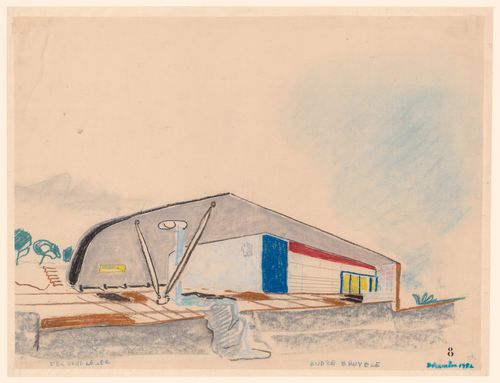
- Two groups of four pastel drawings were originally produced in connection with the Village Polychrome project. The architect André Bruyère had retained one group, while the other was given to the patron and client, Francisco de Assis Chateaubriand Bandeira de Melo, who then donated it to the Sao Paolo Museum of Modern Art. Bruyère subsequently gave one of the four drawings in his group to a friend. The three remaining drawings from Bruyère's group are in the CCA Prints and Drawings collection (DR1996:0001 - DR1996:0003) ("Projet de Village Polychrome, Biot, France").
DR1996:0001
Description:
- Two groups of four pastel drawings were originally produced in connection with the Village Polychrome project. The architect André Bruyère had retained one group, while the other was given to the patron and client, Francisco de Assis Chateaubriand Bandeira de Melo, who then donated it to the Sao Paolo Museum of Modern Art. Bruyère subsequently gave one of the four drawings in his group to a friend. The three remaining drawings from Bruyère's group are in the CCA Prints and Drawings collection (DR1996:0001 - DR1996:0003) ("Projet de Village Polychrome, Biot, France").
Personnes et institutions:
Sujet:
architecture
architecture
Date:
December 1952
December 1952
Titre:
Perspective for a guest villa showing the terrace and the principal and lateral façades, Village Polychrome, near Biot, France
Actions:
DR1996:0001
Description:
- Two groups of four pastel drawings were originally produced in connection with the Village Polychrome project. The architect André Bruyère had retained one group, while the other was given to the patron and client, Francisco de Assis Chateaubriand Bandeira de Melo, who then donated it to the Sao Paolo Museum of Modern Art. Bruyère subsequently gave one of the four drawings in his group to a friend. The three remaining drawings from Bruyère's group are in the CCA Prints and Drawings collection (DR1996:0001 - DR1996:0003) ("Projet de Village Polychrome, Biot, France").
Perspective for a guest villa showing the terrace and the principal and lateral façades, Village Polychrome, near Biot, France
Actions:
DR1996:0001
Description:
- Two groups of four pastel drawings were originally produced in connection with the Village Polychrome project. The architect André Bruyère had retained one group, while the other was given to the patron and client, Francisco de Assis Chateaubriand Bandeira de Melo, who then donated it to the Sao Paolo Museum of Modern Art. Bruyère subsequently gave one of the four drawings in his group to a friend. The three remaining drawings from Bruyère's group are in the CCA Prints and Drawings collection (DR1996:0001 - DR1996:0003) ("Projet de Village Polychrome, Biot, France").
Classification:
dessins
dessins
Date:
December 1952
December 1952
Personnes et institutions:
Sujet:
architecture
architecture
Classification:
dessins
dessins
Actions:
Numéro de référence:
DR1996:0003
Description:
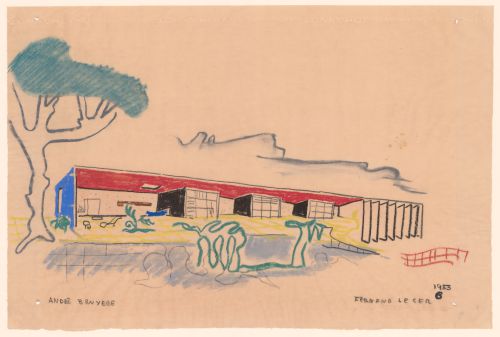
- Two groups of four pastel drawings were originally produced in connection with the Village Polychrome project. The architect André Bruyère had retained one group, while the other was given to the patron and client, Francisco de Assis Chateaubriand Bandeira de Melo, who then donated it to the Sao Paolo Museum of Modern Art. Bruyère subsequently gave one of the four drawings in his group to a friend. The three remaining drawings from Bruyère's group are in the CCA Prints and Drawings collection (DR1996:0001 - DR1996:0003) ("Projet de Village Polychrome, Biot, France").
DR1996:0003
Description:
- Two groups of four pastel drawings were originally produced in connection with the Village Polychrome project. The architect André Bruyère had retained one group, while the other was given to the patron and client, Francisco de Assis Chateaubriand Bandeira de Melo, who then donated it to the Sao Paolo Museum of Modern Art. Bruyère subsequently gave one of the four drawings in his group to a friend. The three remaining drawings from Bruyère's group are in the CCA Prints and Drawings collection (DR1996:0001 - DR1996:0003) ("Projet de Village Polychrome, Biot, France").
Personnes et institutions:
Sujet:
architecture, urbanisme
architecture, urbanisme
Date:
1953
1953
Titre:
Perspective for a villa with three workshops, Village Polychrome, near Biot, France
Actions:
DR1996:0003
Description:
- Two groups of four pastel drawings were originally produced in connection with the Village Polychrome project. The architect André Bruyère had retained one group, while the other was given to the patron and client, Francisco de Assis Chateaubriand Bandeira de Melo, who then donated it to the Sao Paolo Museum of Modern Art. Bruyère subsequently gave one of the four drawings in his group to a friend. The three remaining drawings from Bruyère's group are in the CCA Prints and Drawings collection (DR1996:0001 - DR1996:0003) ("Projet de Village Polychrome, Biot, France").
Perspective for a villa with three workshops, Village Polychrome, near Biot, France
Actions:
DR1996:0003
Description:
- Two groups of four pastel drawings were originally produced in connection with the Village Polychrome project. The architect André Bruyère had retained one group, while the other was given to the patron and client, Francisco de Assis Chateaubriand Bandeira de Melo, who then donated it to the Sao Paolo Museum of Modern Art. Bruyère subsequently gave one of the four drawings in his group to a friend. The three remaining drawings from Bruyère's group are in the CCA Prints and Drawings collection (DR1996:0001 - DR1996:0003) ("Projet de Village Polychrome, Biot, France").
Classification:
dessins
dessins
Date:
1953
1953
Personnes et institutions:
Sujet:
architecture, urbanisme
architecture, urbanisme
Classification:
dessins
dessins
Actions:
Numéro de référence:
DR1996:0004
Description:
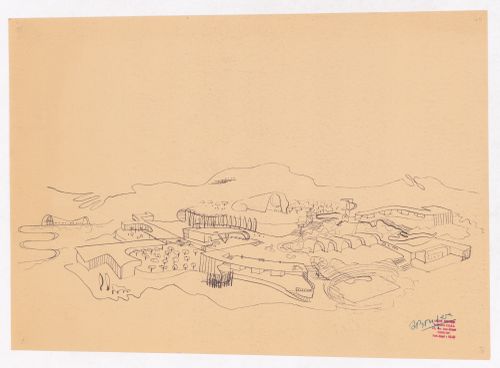
- Two groups of four pastel drawings were originally produced in connection with the Village Polychrome project. The architect André Bruyère had retained one group, while the other was given to the patron and client, Francisco de Assis Chateaubriand Bandeira de Melo, who then donated it to the Sao Paolo Museum of Modern Art. Bruyère subsequently gave one of the four drawings in his group to a friend. The three remaining drawings from Bruyère's group are in the CCA Prints and Drawings collection (DR1996:0001 - DR1996:0003) ("Projet de Village Polychrome, Biot, France").
DR1996:0004
Description:
- Two groups of four pastel drawings were originally produced in connection with the Village Polychrome project. The architect André Bruyère had retained one group, while the other was given to the patron and client, Francisco de Assis Chateaubriand Bandeira de Melo, who then donated it to the Sao Paolo Museum of Modern Art. Bruyère subsequently gave one of the four drawings in his group to a friend. The three remaining drawings from Bruyère's group are in the CCA Prints and Drawings collection (DR1996:0001 - DR1996:0003) ("Projet de Village Polychrome, Biot, France").
Personnes et institutions:
Sujet:
architecture, urbanisme
architecture, urbanisme
Date:
1952-1953
1952-1953
Titre:
Bird's-eye perspective for Village Polychrome, near Biot, France
Actions:
DR1996:0004
Description:
- Two groups of four pastel drawings were originally produced in connection with the Village Polychrome project. The architect André Bruyère had retained one group, while the other was given to the patron and client, Francisco de Assis Chateaubriand Bandeira de Melo, who then donated it to the Sao Paolo Museum of Modern Art. Bruyère subsequently gave one of the four drawings in his group to a friend. The three remaining drawings from Bruyère's group are in the CCA Prints and Drawings collection (DR1996:0001 - DR1996:0003) ("Projet de Village Polychrome, Biot, France").
Bird's-eye perspective for Village Polychrome, near Biot, France
Actions:
DR1996:0004
Description:
- Two groups of four pastel drawings were originally produced in connection with the Village Polychrome project. The architect André Bruyère had retained one group, while the other was given to the patron and client, Francisco de Assis Chateaubriand Bandeira de Melo, who then donated it to the Sao Paolo Museum of Modern Art. Bruyère subsequently gave one of the four drawings in his group to a friend. The three remaining drawings from Bruyère's group are in the CCA Prints and Drawings collection (DR1996:0001 - DR1996:0003) ("Projet de Village Polychrome, Biot, France").
Classification:
dessins
dessins
Date:
1952-1953
1952-1953
Personnes et institutions:
Sujet:
architecture, urbanisme
architecture, urbanisme
Classification:
dessins
dessins
Actions:
Numéro de référence:
DR1996:0005
Description:
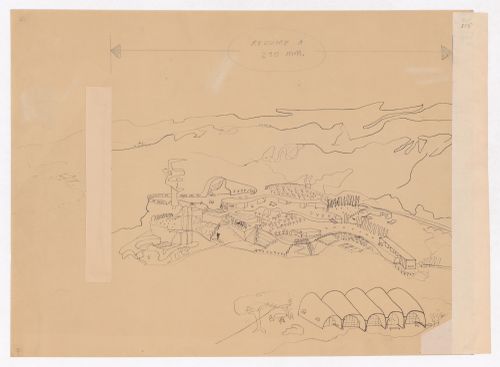
- Two groups of four pastel drawings were originally produced in connection with the Village Polychrome project. The architect André Bruyère had retained one group, while the other was given to the patron and client, Francisco de Assis Chateaubriand Bandeira de Melo, who then donated it to the Sao Paolo Museum of Modern Art. Bruyère subsequently gave one of the four drawings in his group to a friend. The three remaining drawings from Bruyère's group are in the CCA Prints and Drawings collection (DR1996:0001 - DR1996:0003) ("Projet de Village Polychrome, Biot, France").
DR1996:0005
Description:
- Two groups of four pastel drawings were originally produced in connection with the Village Polychrome project. The architect André Bruyère had retained one group, while the other was given to the patron and client, Francisco de Assis Chateaubriand Bandeira de Melo, who then donated it to the Sao Paolo Museum of Modern Art. Bruyère subsequently gave one of the four drawings in his group to a friend. The three remaining drawings from Bruyère's group are in the CCA Prints and Drawings collection (DR1996:0001 - DR1996:0003) ("Projet de Village Polychrome, Biot, France").
Personnes et institutions:
Sujet:
architecture, urbanisme
architecture, urbanisme
Date:
1952-1953
1952-1953
Titre:
Bird's-eye perspective for Village Polychrome, near Biot, France
Actions:
DR1996:0005
Description:
- Two groups of four pastel drawings were originally produced in connection with the Village Polychrome project. The architect André Bruyère had retained one group, while the other was given to the patron and client, Francisco de Assis Chateaubriand Bandeira de Melo, who then donated it to the Sao Paolo Museum of Modern Art. Bruyère subsequently gave one of the four drawings in his group to a friend. The three remaining drawings from Bruyère's group are in the CCA Prints and Drawings collection (DR1996:0001 - DR1996:0003) ("Projet de Village Polychrome, Biot, France").
Bird's-eye perspective for Village Polychrome, near Biot, France
Actions:
DR1996:0005
Description:
- Two groups of four pastel drawings were originally produced in connection with the Village Polychrome project. The architect André Bruyère had retained one group, while the other was given to the patron and client, Francisco de Assis Chateaubriand Bandeira de Melo, who then donated it to the Sao Paolo Museum of Modern Art. Bruyère subsequently gave one of the four drawings in his group to a friend. The three remaining drawings from Bruyère's group are in the CCA Prints and Drawings collection (DR1996:0001 - DR1996:0003) ("Projet de Village Polychrome, Biot, France").
Classification:
dessins
dessins
Date:
1952-1953
1952-1953
Personnes et institutions:
Sujet:
architecture, urbanisme
architecture, urbanisme
Classification:
dessins
dessins
Numéro de référence:
DR1996:0006
Description:
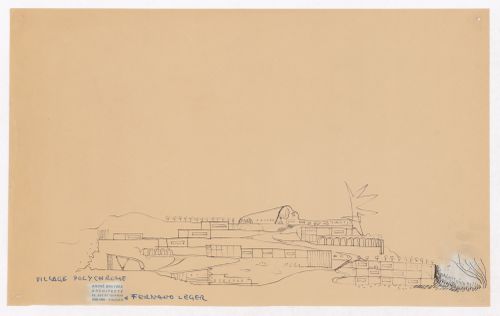
- Two groups of four pastel drawings were originally produced in connection with the Village Polychrome project. The architect André Bruyère had retained one group, while the other was given to the patron and client, Francisco de Assis Chateaubriand Bandeira de Melo, who then donated it to the Sao Paolo Museum of Modern Art. Bruyère subsequently gave one of the four drawings in his group to a friend. The three remaining drawings from Bruyère's group are in the CCA Prints and Drawings collection (DR1996:0001 - DR1996:0003) ("Projet de Village Polychrome, Biot, France").
DR1996:0006
Description:
- Two groups of four pastel drawings were originally produced in connection with the Village Polychrome project. The architect André Bruyère had retained one group, while the other was given to the patron and client, Francisco de Assis Chateaubriand Bandeira de Melo, who then donated it to the Sao Paolo Museum of Modern Art. Bruyère subsequently gave one of the four drawings in his group to a friend. The three remaining drawings from Bruyère's group are in the CCA Prints and Drawings collection (DR1996:0001 - DR1996:0003) ("Projet de Village Polychrome, Biot, France").
Personnes et institutions:
Sujet:
architecture, urbanisme
architecture, urbanisme
Date:
1952-1953
1952-1953
Titre:
Site elevation for Village Polychrome, near Biot, France
Actions:
DR1996:0006
Description:
- Two groups of four pastel drawings were originally produced in connection with the Village Polychrome project. The architect André Bruyère had retained one group, while the other was given to the patron and client, Francisco de Assis Chateaubriand Bandeira de Melo, who then donated it to the Sao Paolo Museum of Modern Art. Bruyère subsequently gave one of the four drawings in his group to a friend. The three remaining drawings from Bruyère's group are in the CCA Prints and Drawings collection (DR1996:0001 - DR1996:0003) ("Projet de Village Polychrome, Biot, France").
Site elevation for Village Polychrome, near Biot, France
Actions:
DR1996:0006
Description:
- Two groups of four pastel drawings were originally produced in connection with the Village Polychrome project. The architect André Bruyère had retained one group, while the other was given to the patron and client, Francisco de Assis Chateaubriand Bandeira de Melo, who then donated it to the Sao Paolo Museum of Modern Art. Bruyère subsequently gave one of the four drawings in his group to a friend. The three remaining drawings from Bruyère's group are in the CCA Prints and Drawings collection (DR1996:0001 - DR1996:0003) ("Projet de Village Polychrome, Biot, France").
Classification:
dessins
dessins
Date:
1952-1953
1952-1953
Personnes et institutions:
Sujet:
architecture, urbanisme
architecture, urbanisme
Classification:
dessins
dessins
Numéro de référence:
DR1996:0007
Description:
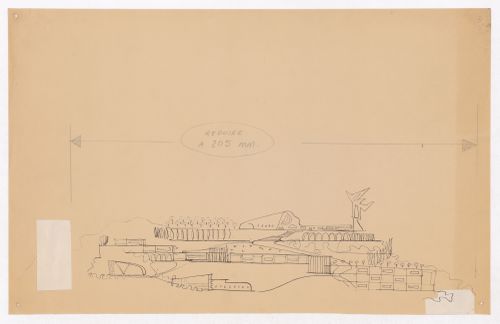
- Two groups of four pastel drawings were originally produced in connection with the Village Polychrome project. The architect André Bruyère had retained one group, while the other was given to the patron and client, Francisco de Assis Chateaubriand Bandeira de Melo, who then donated it to the Sao Paolo Museum of Modern Art. Bruyère subsequently gave one of the four drawings in his group to a friend. The three remaining drawings from Bruyère's group are in the CCA Prints and Drawings collection (DR1996:0001 - DR1996:0003) ("Projet de Village Polychrome, Biot, France").
DR1996:0007
Description:
- Two groups of four pastel drawings were originally produced in connection with the Village Polychrome project. The architect André Bruyère had retained one group, while the other was given to the patron and client, Francisco de Assis Chateaubriand Bandeira de Melo, who then donated it to the Sao Paolo Museum of Modern Art. Bruyère subsequently gave one of the four drawings in his group to a friend. The three remaining drawings from Bruyère's group are in the CCA Prints and Drawings collection (DR1996:0001 - DR1996:0003) ("Projet de Village Polychrome, Biot, France").
Personnes et institutions:
Sujet:
architecture, urbanisme
architecture, urbanisme
Date:
1952-1953
1952-1953
Titre:
Site elevation for Village Polychrome, near Biot, France
Actions:
DR1996:0007
Description:
- Two groups of four pastel drawings were originally produced in connection with the Village Polychrome project. The architect André Bruyère had retained one group, while the other was given to the patron and client, Francisco de Assis Chateaubriand Bandeira de Melo, who then donated it to the Sao Paolo Museum of Modern Art. Bruyère subsequently gave one of the four drawings in his group to a friend. The three remaining drawings from Bruyère's group are in the CCA Prints and Drawings collection (DR1996:0001 - DR1996:0003) ("Projet de Village Polychrome, Biot, France").
Site elevation for Village Polychrome, near Biot, France
Actions:
DR1996:0007
Description:
- Two groups of four pastel drawings were originally produced in connection with the Village Polychrome project. The architect André Bruyère had retained one group, while the other was given to the patron and client, Francisco de Assis Chateaubriand Bandeira de Melo, who then donated it to the Sao Paolo Museum of Modern Art. Bruyère subsequently gave one of the four drawings in his group to a friend. The three remaining drawings from Bruyère's group are in the CCA Prints and Drawings collection (DR1996:0001 - DR1996:0003) ("Projet de Village Polychrome, Biot, France").
Classification:
dessins
dessins
Date:
1952-1953
1952-1953
Personnes et institutions:
Sujet:
architecture, urbanisme
architecture, urbanisme


