


6057 Résultats
Niveau de description archivistique:
Série(s)
Série(s)
Numéro de référence:
AP119.S1
Description:
The series contains drawings for Peter Yeadon's architectural narrative for the Prix de Rome entitled "Karl: An Architerctural Narrative." In total eleven sets of digital prints were made, each set contains eighteen sheets. Canadian Centre for Architecture received the third of these eleven sets, which is included in this series. The narrative depicts the experience of a Canadian emigrant becoming a Roman citizen. The drawings represent the following titles: City; Fabric House; Columbarium; Horizon House; House City; Depth House; Colosseum for Vanishing Curiosities; City Gate; Teatro de Tevere; Neptune House; Bath; and Bricolage House. Each drawing is signed by the architect. Also included, are four sketchbooks for 'Karl: An Architerctural Narrative', two print proofs for Bricolage House, and project documentation. The documentation explains each of the titles in the narrative, Yeadon's curriculum vitae, and leaflets for the exhibition "Karl: an architectural narrative" held at the Art Gallery of Windsor, Ontario from August 2001 to January 2002.
AP119.S1
Description:
The series contains drawings for Peter Yeadon's architectural narrative for the Prix de Rome entitled "Karl: An Architerctural Narrative." In total eleven sets of digital prints were made, each set contains eighteen sheets. Canadian Centre for Architecture received the third of these eleven sets, which is included in this series. The narrative depicts the experience of a Canadian emigrant becoming a Roman citizen. The drawings represent the following titles: City; Fabric House; Columbarium; Horizon House; House City; Depth House; Colosseum for Vanishing Curiosities; City Gate; Teatro de Tevere; Neptune House; Bath; and Bricolage House. Each drawing is signed by the architect. Also included, are four sketchbooks for 'Karl: An Architerctural Narrative', two print proofs for Bricolage House, and project documentation. The documentation explains each of the titles in the narrative, Yeadon's curriculum vitae, and leaflets for the exhibition "Karl: an architectural narrative" held at the Art Gallery of Windsor, Ontario from August 2001 to January 2002.
Personnes et institutions:
Date:
1998-2002
1998-2002
Titre:
Karl: An Architectural Narrative (2000-2002)
Actions:
AP119.S1
Description:
The series contains drawings for Peter Yeadon's architectural narrative for the Prix de Rome entitled "Karl: An Architerctural Narrative." In total eleven sets of digital prints were made, each set contains eighteen sheets. Canadian Centre for Architecture received the third of these eleven sets, which is included in this series. The narrative depicts the experience of a Canadian emigrant becoming a Roman citizen. The drawings represent the following titles: City; Fabric House; Columbarium; Horizon House; House City; Depth House; Colosseum for Vanishing Curiosities; City Gate; Teatro de Tevere; Neptune House; Bath; and Bricolage House. Each drawing is signed by the architect. Also included, are four sketchbooks for 'Karl: An Architerctural Narrative', two print proofs for Bricolage House, and project documentation. The documentation explains each of the titles in the narrative, Yeadon's curriculum vitae, and leaflets for the exhibition "Karl: an architectural narrative" held at the Art Gallery of Windsor, Ontario from August 2001 to January 2002.
Karl: An Architectural Narrative (2000-2002)
Actions:
AP119.S1
Description:
The series contains drawings for Peter Yeadon's architectural narrative for the Prix de Rome entitled "Karl: An Architerctural Narrative." In total eleven sets of digital prints were made, each set contains eighteen sheets. Canadian Centre for Architecture received the third of these eleven sets, which is included in this series. The narrative depicts the experience of a Canadian emigrant becoming a Roman citizen. The drawings represent the following titles: City; Fabric House; Columbarium; Horizon House; House City; Depth House; Colosseum for Vanishing Curiosities; City Gate; Teatro de Tevere; Neptune House; Bath; and Bricolage House. Each drawing is signed by the architect. Also included, are four sketchbooks for 'Karl: An Architerctural Narrative', two print proofs for Bricolage House, and project documentation. The documentation explains each of the titles in the narrative, Yeadon's curriculum vitae, and leaflets for the exhibition "Karl: an architectural narrative" held at the Art Gallery of Windsor, Ontario from August 2001 to January 2002.
Niveau de description archivistique:
Series
Series
Date:
1998-2002
1998-2002
Personnes et institutions:
Niveau de description archivistique:
Projet
Projet
Numéro de référence:
AP207.S1.1967.PR01
Description:
This project series documents the "Rumble" Sofa, a couch designed by Pettena in 1967 and produced in 1968 by Gufram, an Italian seat and furniture manufacturer based in Barolo. The "Rumble" Sofa was part of the furniture at Pettena's studio-home." […] The design of this couch […] derives from the experience of living in a spacious place, originally a 19th century studio for artists, in which the furnishings had to suit the scale of the place and not that of the being." [1] The project series contains sketches, plans and details of the couch, as well as videos and photographs of the couch showing its various possible shapes and usages. It also includes a small wooden model with movable blocks, each block represents one of the cushions of the couch. Source: [1] Gianni Pettena website, https://www.giannipettena.it/italiano/opere-1/design-rumble-couch-1967/ (last accessed 16 October 2019)
AP207.S1.1967.PR01
Description:
This project series documents the "Rumble" Sofa, a couch designed by Pettena in 1967 and produced in 1968 by Gufram, an Italian seat and furniture manufacturer based in Barolo. The "Rumble" Sofa was part of the furniture at Pettena's studio-home." […] The design of this couch […] derives from the experience of living in a spacious place, originally a 19th century studio for artists, in which the furnishings had to suit the scale of the place and not that of the being." [1] The project series contains sketches, plans and details of the couch, as well as videos and photographs of the couch showing its various possible shapes and usages. It also includes a small wooden model with movable blocks, each block represents one of the cushions of the couch. Source: [1] Gianni Pettena website, https://www.giannipettena.it/italiano/opere-1/design-rumble-couch-1967/ (last accessed 16 October 2019)
Personnes et institutions:
Date:
circa 1967
circa 1967
Titre:
“Rumble” Sofa [“Rumble” Couch] (1967)
Actions:
AP207.S1.1967.PR01
Description:
This project series documents the "Rumble" Sofa, a couch designed by Pettena in 1967 and produced in 1968 by Gufram, an Italian seat and furniture manufacturer based in Barolo. The "Rumble" Sofa was part of the furniture at Pettena's studio-home." […] The design of this couch […] derives from the experience of living in a spacious place, originally a 19th century studio for artists, in which the furnishings had to suit the scale of the place and not that of the being." [1] The project series contains sketches, plans and details of the couch, as well as videos and photographs of the couch showing its various possible shapes and usages. It also includes a small wooden model with movable blocks, each block represents one of the cushions of the couch. Source: [1] Gianni Pettena website, https://www.giannipettena.it/italiano/opere-1/design-rumble-couch-1967/ (last accessed 16 October 2019)
“Rumble” Sofa [“Rumble” Couch] (1967)
Actions:
AP207.S1.1967.PR01
Description:
This project series documents the "Rumble" Sofa, a couch designed by Pettena in 1967 and produced in 1968 by Gufram, an Italian seat and furniture manufacturer based in Barolo. The "Rumble" Sofa was part of the furniture at Pettena's studio-home." […] The design of this couch […] derives from the experience of living in a spacious place, originally a 19th century studio for artists, in which the furnishings had to suit the scale of the place and not that of the being." [1] The project series contains sketches, plans and details of the couch, as well as videos and photographs of the couch showing its various possible shapes and usages. It also includes a small wooden model with movable blocks, each block represents one of the cushions of the couch. Source: [1] Gianni Pettena website, https://www.giannipettena.it/italiano/opere-1/design-rumble-couch-1967/ (last accessed 16 October 2019)
Niveau de description archivistique:
Project
Project
Date:
circa 1967
circa 1967
Personnes et institutions:
Classification:
dessins
dessins

Numéro de référence:
ARCH286690
Description:
This item contains harmful materials including violent imagery. The drawing illustrates the discrete elements of an exhibition involving several large-scale installations. One of these installations shows a crane on which a net filled with mannequins is suspended; the mannequins are soaked in oil, in the words of the designers, to represent the impacts of oil spills on the global population. This image, however, suggests violence beyond environmental disasters.
ARCH286690
Description:
This item contains harmful materials including violent imagery. The drawing illustrates the discrete elements of an exhibition involving several large-scale installations. One of these installations shows a crane on which a net filled with mannequins is suspended; the mannequins are soaked in oil, in the words of the designers, to represent the impacts of oil spills on the global population. This image, however, suggests violence beyond environmental disasters.
Personnes et institutions:
Date:
circa 1999-2000
circa 1999-2000
Titre:
Drawings for two installations for the exhibition on James Wines at the Venice Biennale
Actions:
ARCH286690
Description:
This item contains harmful materials including violent imagery. The drawing illustrates the discrete elements of an exhibition involving several large-scale installations. One of these installations shows a crane on which a net filled with mannequins is suspended; the mannequins are soaked in oil, in the words of the designers, to represent the impacts of oil spills on the global population. This image, however, suggests violence beyond environmental disasters.
Drawings for two installations for the exhibition on James Wines at the Venice Biennale
Actions:
ARCH286690
Description:
This item contains harmful materials including violent imagery. The drawing illustrates the discrete elements of an exhibition involving several large-scale installations. One of these installations shows a crane on which a net filled with mannequins is suspended; the mannequins are soaked in oil, in the words of the designers, to represent the impacts of oil spills on the global population. This image, however, suggests violence beyond environmental disasters.
Classification:
dessins
dessins
Date:
circa 1999-2000
circa 1999-2000
Personnes et institutions:
Classification:
oeuvres d'art
oeuvres d'art
Numéro de référence:
DR1988:0437:041
Description:
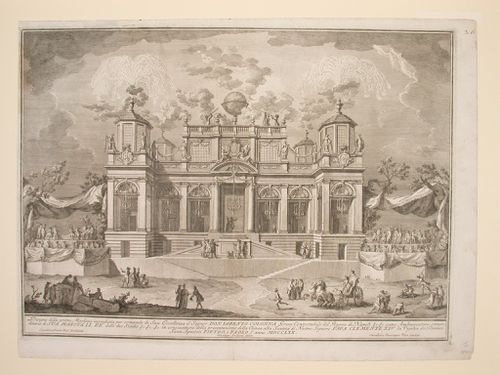
- This etching for a fireworks construction or macchina is in the form of a pavilion, with stands for musicians on either side. The lower level of the macchina represents a series of fish stalls and the architecture is deliberately rusticated, with cracks in the masonry and vines growing on the arches. The upper level consists of one large and four small canopies held up with columns wrapped with wreaths.
DR1988:0437:041
Description:
- This etching for a fireworks construction or macchina is in the form of a pavilion, with stands for musicians on either side. The lower level of the macchina represents a series of fish stalls and the architecture is deliberately rusticated, with cracks in the masonry and vines growing on the arches. The upper level consists of one large and four small canopies held up with columns wrapped with wreaths.
Personnes et institutions:
Sujet:
architecture temporaire
architecture temporaire
Date:
printed 1770
printed 1770
Titre:
Etching of Posi's design for the "seconda macchina" of 1770
Actions:
DR1988:0437:041
Description:
- This etching for a fireworks construction or macchina is in the form of a pavilion, with stands for musicians on either side. The lower level of the macchina represents a series of fish stalls and the architecture is deliberately rusticated, with cracks in the masonry and vines growing on the arches. The upper level consists of one large and four small canopies held up with columns wrapped with wreaths.
Etching of Posi's design for the "seconda macchina" of 1770
Actions:
DR1988:0437:041
Description:
- This etching for a fireworks construction or macchina is in the form of a pavilion, with stands for musicians on either side. The lower level of the macchina represents a series of fish stalls and the architecture is deliberately rusticated, with cracks in the masonry and vines growing on the arches. The upper level consists of one large and four small canopies held up with columns wrapped with wreaths.
Classification:
oeuvres d'art
oeuvres d'art
Date:
printed 1770
printed 1770
Personnes et institutions:
Sujet:
architecture temporaire
architecture temporaire
Classification:
dessins
dessins
Numéro de référence:
DR1987:0529 R/V
Description:
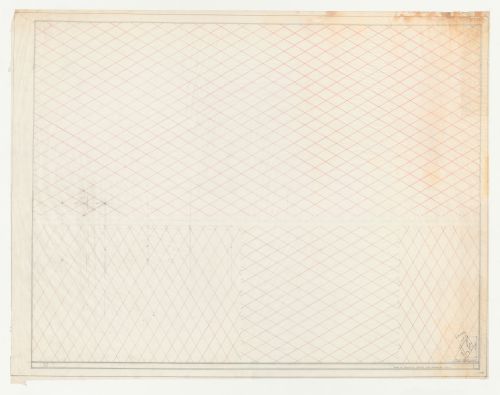
- This unused sheet was probably prepared for a drawing for Wayfarers' Chapel, Palos Verdes, California. The verso of the sheet includes four discrete grids whose units each represent an equilateral parallelgram measuring 4'8" along the side and 8'0 31/32" in length. These measurements are described by Lloyd Wright in the architect's statement as the grid unit for Wayfarers' Chapel (DR1987:0869:011:009).
DR1987:0529 R/V
Description:
- This unused sheet was probably prepared for a drawing for Wayfarers' Chapel, Palos Verdes, California. The verso of the sheet includes four discrete grids whose units each represent an equilateral parallelgram measuring 4'8" along the side and 8'0 31/32" in length. These measurements are described by Lloyd Wright in the architect's statement as the grid unit for Wayfarers' Chapel (DR1987:0869:011:009).
Personnes et institutions:
Sujet:
architecture
architecture
Date:
between 1946 and 1950
between 1946 and 1950
Titre:
Wayfarers' Chapel, Palos Verdes, California: Unused sheet ruled with guide line for orthographic drawings and measurements for a typical grid unit
Actions:
DR1987:0529 R/V
Description:
- This unused sheet was probably prepared for a drawing for Wayfarers' Chapel, Palos Verdes, California. The verso of the sheet includes four discrete grids whose units each represent an equilateral parallelgram measuring 4'8" along the side and 8'0 31/32" in length. These measurements are described by Lloyd Wright in the architect's statement as the grid unit for Wayfarers' Chapel (DR1987:0869:011:009).
Wayfarers' Chapel, Palos Verdes, California: Unused sheet ruled with guide line for orthographic drawings and measurements for a typical grid unit
Actions:
DR1987:0529 R/V
Description:
- This unused sheet was probably prepared for a drawing for Wayfarers' Chapel, Palos Verdes, California. The verso of the sheet includes four discrete grids whose units each represent an equilateral parallelgram measuring 4'8" along the side and 8'0 31/32" in length. These measurements are described by Lloyd Wright in the architect's statement as the grid unit for Wayfarers' Chapel (DR1987:0869:011:009).
Classification:
dessins
dessins
Date:
between 1946 and 1950
between 1946 and 1950
Personnes et institutions:
Sujet:
architecture
architecture
Classification:
archives
Niveau de description archivistique:
Fonds
archives
Niveau de description archivistique:
Fonds
Titre:
Fonds Ross & Macdonald
Fonds Ross & Macdonald
Numéro de référence:
AP013
Résumé:
The Ross & Macdonald fonds is comprised of documents concerning the work of six successive architectural firms: Ross & MacFarlane (1905-1912), Ross & Macdonald (1913-1944), Ross & Ross (1944-1946), Ross, Patterson, Townsend & Heughan (1946-1950), Ross, Patterson, Townsend & Fish (1950-1958), and Ross, Fish, Duschenes & Barrett (1958-1976). The greatest concentration of work was produced in Montreal where each of the firms maintained their head office, but there were also a large number of works executed in New Brunswick and Nova Scotia. The fonds contains 27 884 drawings (24 294 originals plus 3 590 reproductions), 236 photographs, and 18.6 metres of textual documents.
AP013
Résumé:
The Ross & Macdonald fonds is comprised of documents concerning the work of six successive architectural firms: Ross & MacFarlane (1905-1912), Ross & Macdonald (1913-1944), Ross & Ross (1944-1946), Ross, Patterson, Townsend & Heughan (1946-1950), Ross, Patterson, Townsend & Fish (1950-1958), and Ross, Fish, Duschenes & Barrett (1958-1976). The greatest concentration of work was produced in Montreal where each of the firms maintained their head office, but there were also a large number of works executed in New Brunswick and Nova Scotia. The fonds contains 27 884 drawings (24 294 originals plus 3 590 reproductions), 236 photographs, and 18.6 metres of textual documents.
Personnes et institutions:
Date:
1902-1982
1902-1982
Titre:
Fonds Ross & Macdonald
Actions:
AP013
Résumé:
The Ross & Macdonald fonds is comprised of documents concerning the work of six successive architectural firms: Ross & MacFarlane (1905-1912), Ross & Macdonald (1913-1944), Ross & Ross (1944-1946), Ross, Patterson, Townsend & Heughan (1946-1950), Ross, Patterson, Townsend & Fish (1950-1958), and Ross, Fish, Duschenes & Barrett (1958-1976). The greatest concentration of work was produced in Montreal where each of the firms maintained their head office, but there were also a large number of works executed in New Brunswick and Nova Scotia. The fonds contains 27 884 drawings (24 294 originals plus 3 590 reproductions), 236 photographs, and 18.6 metres of textual documents.
Fonds Ross & Macdonald
Actions:
AP013
Résumé:
The Ross & Macdonald fonds is comprised of documents concerning the work of six successive architectural firms: Ross & MacFarlane (1905-1912), Ross & Macdonald (1913-1944), Ross & Ross (1944-1946), Ross, Patterson, Townsend & Heughan (1946-1950), Ross, Patterson, Townsend & Fish (1950-1958), and Ross, Fish, Duschenes & Barrett (1958-1976). The greatest concentration of work was produced in Montreal where each of the firms maintained their head office, but there were also a large number of works executed in New Brunswick and Nova Scotia. The fonds contains 27 884 drawings (24 294 originals plus 3 590 reproductions), 236 photographs, and 18.6 metres of textual documents.
Classification:
archives
Niveau de description archivistique:
Fonds
archives
Niveau de description archivistique:
Fonds
Date:
1902-1982
1902-1982
Personnes et institutions:
Niveau de description archivistique:
Série(s)
Série(s)
Numéro de référence:
AP177.S2
Description:
This series contains additional CAD and 3D modeling work made by David Ruy for RUR Architecture in order to achieve the design of architectural elements of the Kansai-kan National Diet Library competition. Files are identified as parts or elements of the building such as “upper slab”, “pig” (term used for the theater), “topo[graphical] lines”, “spiral” (a part of the store), “diagram”, “catwalks”, “ramps”, etc. File names are similar to the ones found in AP177.S1, which could indicate that the files represent different versions of the digital drawings. Under the directory FINAL PLANS, file names suggest digital drawings presenting more substantial parts of the building such as “conference level”, “plan”, and “hanging volume”. Files were created using form*Z and Alias and were saved in FMZ, DXF and OBJ formats. Series also includes, in the “scans” directory, digitized images, in JPEG format, of manual drawings of the upper and lower slab with topographical lines, the spiral and the placing of support points.
AP177.S2
Description:
This series contains additional CAD and 3D modeling work made by David Ruy for RUR Architecture in order to achieve the design of architectural elements of the Kansai-kan National Diet Library competition. Files are identified as parts or elements of the building such as “upper slab”, “pig” (term used for the theater), “topo[graphical] lines”, “spiral” (a part of the store), “diagram”, “catwalks”, “ramps”, etc. File names are similar to the ones found in AP177.S1, which could indicate that the files represent different versions of the digital drawings. Under the directory FINAL PLANS, file names suggest digital drawings presenting more substantial parts of the building such as “conference level”, “plan”, and “hanging volume”. Files were created using form*Z and Alias and were saved in FMZ, DXF and OBJ formats. Series also includes, in the “scans” directory, digitized images, in JPEG format, of manual drawings of the upper and lower slab with topographical lines, the spiral and the placing of support points.
Personnes et institutions:
Date:
1996-2015
1996-2015
Titre:
David Ruy digital working files
Actions:
AP177.S2
Description:
This series contains additional CAD and 3D modeling work made by David Ruy for RUR Architecture in order to achieve the design of architectural elements of the Kansai-kan National Diet Library competition. Files are identified as parts or elements of the building such as “upper slab”, “pig” (term used for the theater), “topo[graphical] lines”, “spiral” (a part of the store), “diagram”, “catwalks”, “ramps”, etc. File names are similar to the ones found in AP177.S1, which could indicate that the files represent different versions of the digital drawings. Under the directory FINAL PLANS, file names suggest digital drawings presenting more substantial parts of the building such as “conference level”, “plan”, and “hanging volume”. Files were created using form*Z and Alias and were saved in FMZ, DXF and OBJ formats. Series also includes, in the “scans” directory, digitized images, in JPEG format, of manual drawings of the upper and lower slab with topographical lines, the spiral and the placing of support points.
David Ruy digital working files
Actions:
AP177.S2
Description:
This series contains additional CAD and 3D modeling work made by David Ruy for RUR Architecture in order to achieve the design of architectural elements of the Kansai-kan National Diet Library competition. Files are identified as parts or elements of the building such as “upper slab”, “pig” (term used for the theater), “topo[graphical] lines”, “spiral” (a part of the store), “diagram”, “catwalks”, “ramps”, etc. File names are similar to the ones found in AP177.S1, which could indicate that the files represent different versions of the digital drawings. Under the directory FINAL PLANS, file names suggest digital drawings presenting more substantial parts of the building such as “conference level”, “plan”, and “hanging volume”. Files were created using form*Z and Alias and were saved in FMZ, DXF and OBJ formats. Series also includes, in the “scans” directory, digitized images, in JPEG format, of manual drawings of the upper and lower slab with topographical lines, the spiral and the placing of support points.
Niveau de description archivistique:
Series
Series
Date:
1996-2015
1996-2015
Personnes et institutions:
Niveau de description archivistique:
Projet
Projet
Numéro de référence:
AP178.S1.1983.PR01
Description:
This project series documents the Reconstrução da Igreja Madre de Salemi, the Piazza Alicia and the Recuperação do Plano Cascio in Salemi, Italy. While the records were held in the office’s archives this project was assigned the number [7]/80. The office assigned the dates 1983-1999 for this project. The reconstruction of the mother Church of Salemi, the construction of the Piazza Alicia, and the rehabilitation of Plano Cascio was part of an urban renewal for Salemi. In 1968, an earthquake destroyed the Igreja Madre de Salemi and damaged the area. The church was never rebuilt. In 1982, Roberto Collovà and Siza we're chosen by the Curia of Mazara del Vallo for the reconstruction of the church. Instead of rebuilding it, the architects decided to use the ruins to create something new that would represent the spirit of the church and the memory of the earthquake. Documenting this project are plans, project documentation, and correspondence. Photographic materials document construction work and the model.
AP178.S1.1983.PR01
Description:
This project series documents the Reconstrução da Igreja Madre de Salemi, the Piazza Alicia and the Recuperação do Plano Cascio in Salemi, Italy. While the records were held in the office’s archives this project was assigned the number [7]/80. The office assigned the dates 1983-1999 for this project. The reconstruction of the mother Church of Salemi, the construction of the Piazza Alicia, and the rehabilitation of Plano Cascio was part of an urban renewal for Salemi. In 1968, an earthquake destroyed the Igreja Madre de Salemi and damaged the area. The church was never rebuilt. In 1982, Roberto Collovà and Siza we're chosen by the Curia of Mazara del Vallo for the reconstruction of the church. Instead of rebuilding it, the architects decided to use the ruins to create something new that would represent the spirit of the church and the memory of the earthquake. Documenting this project are plans, project documentation, and correspondence. Photographic materials document construction work and the model.
Personnes et institutions:
Date:
1984-1992
1984-1992
Titre:
Reconstrução da Igreja Madre de Salemi [Reconstruction of the Mother Church of Salemi], Salemi, Italy (1983-1999)
Actions:
AP178.S1.1983.PR01
Description:
This project series documents the Reconstrução da Igreja Madre de Salemi, the Piazza Alicia and the Recuperação do Plano Cascio in Salemi, Italy. While the records were held in the office’s archives this project was assigned the number [7]/80. The office assigned the dates 1983-1999 for this project. The reconstruction of the mother Church of Salemi, the construction of the Piazza Alicia, and the rehabilitation of Plano Cascio was part of an urban renewal for Salemi. In 1968, an earthquake destroyed the Igreja Madre de Salemi and damaged the area. The church was never rebuilt. In 1982, Roberto Collovà and Siza we're chosen by the Curia of Mazara del Vallo for the reconstruction of the church. Instead of rebuilding it, the architects decided to use the ruins to create something new that would represent the spirit of the church and the memory of the earthquake. Documenting this project are plans, project documentation, and correspondence. Photographic materials document construction work and the model.
Reconstrução da Igreja Madre de Salemi [Reconstruction of the Mother Church of Salemi], Salemi, Italy (1983-1999)
Actions:
AP178.S1.1983.PR01
Description:
This project series documents the Reconstrução da Igreja Madre de Salemi, the Piazza Alicia and the Recuperação do Plano Cascio in Salemi, Italy. While the records were held in the office’s archives this project was assigned the number [7]/80. The office assigned the dates 1983-1999 for this project. The reconstruction of the mother Church of Salemi, the construction of the Piazza Alicia, and the rehabilitation of Plano Cascio was part of an urban renewal for Salemi. In 1968, an earthquake destroyed the Igreja Madre de Salemi and damaged the area. The church was never rebuilt. In 1982, Roberto Collovà and Siza we're chosen by the Curia of Mazara del Vallo for the reconstruction of the church. Instead of rebuilding it, the architects decided to use the ruins to create something new that would represent the spirit of the church and the memory of the earthquake. Documenting this project are plans, project documentation, and correspondence. Photographic materials document construction work and the model.
Niveau de description archivistique:
Project
Project
Date:
1984-1992
1984-1992
Personnes et institutions:
Classification:
documents textuels
documents textuels
Numéro de référence:
DR1988:0017:001-003
Description:
Part of a miscellaneous group of visual and textual documents collected by Oswald Mathais Ungers, apparently to represent the work of artists/architects in Die gläserne Kette. In this letter Hansen describes a theoretical project, "Der Bauhof", which is typical of the utopian concerns of the members (transl. in Whyte, 67-69). Text signed "Antischmitz", pseudonym of Hansen for Die gläserne Kette correspondence.
DR1988:0017:001-003
Description:
Part of a miscellaneous group of visual and textual documents collected by Oswald Mathais Ungers, apparently to represent the work of artists/architects in Die gläserne Kette. In this letter Hansen describes a theoretical project, "Der Bauhof", which is typical of the utopian concerns of the members (transl. in Whyte, 67-69). Text signed "Antischmitz", pseudonym of Hansen for Die gläserne Kette correspondence.
Personnes et institutions:
Date:
1920
1920
Titre:
The Building Centre: Reprographic copy of a letter for Die gläserne Kette
Actions:
DR1988:0017:001-003
Description:
Part of a miscellaneous group of visual and textual documents collected by Oswald Mathais Ungers, apparently to represent the work of artists/architects in Die gläserne Kette. In this letter Hansen describes a theoretical project, "Der Bauhof", which is typical of the utopian concerns of the members (transl. in Whyte, 67-69). Text signed "Antischmitz", pseudonym of Hansen for Die gläserne Kette correspondence.
The Building Centre: Reprographic copy of a letter for Die gläserne Kette
Actions:
DR1988:0017:001-003
Description:
Part of a miscellaneous group of visual and textual documents collected by Oswald Mathais Ungers, apparently to represent the work of artists/architects in Die gläserne Kette. In this letter Hansen describes a theoretical project, "Der Bauhof", which is typical of the utopian concerns of the members (transl. in Whyte, 67-69). Text signed "Antischmitz", pseudonym of Hansen for Die gläserne Kette correspondence.
Classification:
documents textuels
documents textuels
Date:
1920
1920
Personnes et institutions:
Classification:
dessins
dessins
Numéro de référence:
ARCH286669
Description:
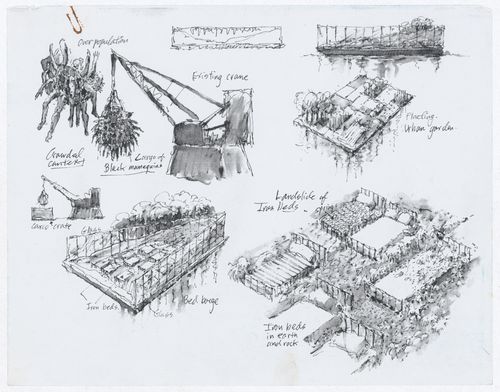
This item contains harmful materials including violent and racist imagery. The drawing illustrates the discrete elements of an exhibition involving several large-scale installations. One of these installations shows a crane on which a net filled with mannequins is suspended; the mannequins are painted black, in the words of the designers, to represent the impacts of oil spills on the global population. This image, however, suggests violence beyond environmental disasters.
ARCH286669
Description:
This item contains harmful materials including violent and racist imagery. The drawing illustrates the discrete elements of an exhibition involving several large-scale installations. One of these installations shows a crane on which a net filled with mannequins is suspended; the mannequins are painted black, in the words of the designers, to represent the impacts of oil spills on the global population. This image, however, suggests violence beyond environmental disasters.
Personnes et institutions:
Date:
circa 1999-2000
circa 1999-2000
Titre:
Drawing for the exhibition on James Wines at the Venice Biennale
Actions:
ARCH286669
Description:
This item contains harmful materials including violent and racist imagery. The drawing illustrates the discrete elements of an exhibition involving several large-scale installations. One of these installations shows a crane on which a net filled with mannequins is suspended; the mannequins are painted black, in the words of the designers, to represent the impacts of oil spills on the global population. This image, however, suggests violence beyond environmental disasters.
Drawing for the exhibition on James Wines at the Venice Biennale
Actions:
ARCH286669
Description:
This item contains harmful materials including violent and racist imagery. The drawing illustrates the discrete elements of an exhibition involving several large-scale installations. One of these installations shows a crane on which a net filled with mannequins is suspended; the mannequins are painted black, in the words of the designers, to represent the impacts of oil spills on the global population. This image, however, suggests violence beyond environmental disasters.
Classification:
dessins
dessins
Date:
circa 1999-2000
circa 1999-2000
Personnes et institutions:


