


33582 Résultats
Niveau de description archivistique:
Projet
Projet
Numéro de référence:
AP075.S1.1989.PR01
Description:
Project series documents Cornelia Hahn Oberlander's landscape project for the Environmental Science Building and Walter Ward Garden on West Bank Drive at Trent University, in Peterborough, Ontario. Oberlander worked on this project in 1989 with Richard Henriquez Architect and Laszlo Nemeth Associates who won the design competition for the new campus building. The project consists in an environmental garden with native plants and grasses and a landscaped roof linked to the ground level by a ramp covered in earth. The ramp and the green roof were design not for human but to give a refuge to ground hogs displaced by the construction of the building. The Environmental Science Building opened in 1991 while the garden was officially opened in 1992. The project series contains site plans, sketches, design developement drawings, including planting plans, landscape sections and details, working drawings, presentation drawings, including perspective drawings, and presentation panels. The project series also comprises working drawings of the building used as reference by Oberlander. The project is also documents through photographs of the construction of the building and the site work, concept notes by Oberlander, correspondence with clients, architects and consultants, specifications, including landscape specifications, plants selection documents, financial documents, reseach materials, and clippings of articles on the project.
AP075.S1.1989.PR01
Description:
Project series documents Cornelia Hahn Oberlander's landscape project for the Environmental Science Building and Walter Ward Garden on West Bank Drive at Trent University, in Peterborough, Ontario. Oberlander worked on this project in 1989 with Richard Henriquez Architect and Laszlo Nemeth Associates who won the design competition for the new campus building. The project consists in an environmental garden with native plants and grasses and a landscaped roof linked to the ground level by a ramp covered in earth. The ramp and the green roof were design not for human but to give a refuge to ground hogs displaced by the construction of the building. The Environmental Science Building opened in 1991 while the garden was officially opened in 1992. The project series contains site plans, sketches, design developement drawings, including planting plans, landscape sections and details, working drawings, presentation drawings, including perspective drawings, and presentation panels. The project series also comprises working drawings of the building used as reference by Oberlander. The project is also documents through photographs of the construction of the building and the site work, concept notes by Oberlander, correspondence with clients, architects and consultants, specifications, including landscape specifications, plants selection documents, financial documents, reseach materials, and clippings of articles on the project.
Personnes et institutions:
Date:
1989-1993
1989-1993
Titre:
Environmental Science Building and Walter Ward Garden, Trent University, Peterborough, Ontario (1989)
Actions:
AP075.S1.1989.PR01
Description:
Project series documents Cornelia Hahn Oberlander's landscape project for the Environmental Science Building and Walter Ward Garden on West Bank Drive at Trent University, in Peterborough, Ontario. Oberlander worked on this project in 1989 with Richard Henriquez Architect and Laszlo Nemeth Associates who won the design competition for the new campus building. The project consists in an environmental garden with native plants and grasses and a landscaped roof linked to the ground level by a ramp covered in earth. The ramp and the green roof were design not for human but to give a refuge to ground hogs displaced by the construction of the building. The Environmental Science Building opened in 1991 while the garden was officially opened in 1992. The project series contains site plans, sketches, design developement drawings, including planting plans, landscape sections and details, working drawings, presentation drawings, including perspective drawings, and presentation panels. The project series also comprises working drawings of the building used as reference by Oberlander. The project is also documents through photographs of the construction of the building and the site work, concept notes by Oberlander, correspondence with clients, architects and consultants, specifications, including landscape specifications, plants selection documents, financial documents, reseach materials, and clippings of articles on the project.
Environmental Science Building and Walter Ward Garden, Trent University, Peterborough, Ontario (1989)
Actions:
AP075.S1.1989.PR01
Description:
Project series documents Cornelia Hahn Oberlander's landscape project for the Environmental Science Building and Walter Ward Garden on West Bank Drive at Trent University, in Peterborough, Ontario. Oberlander worked on this project in 1989 with Richard Henriquez Architect and Laszlo Nemeth Associates who won the design competition for the new campus building. The project consists in an environmental garden with native plants and grasses and a landscaped roof linked to the ground level by a ramp covered in earth. The ramp and the green roof were design not for human but to give a refuge to ground hogs displaced by the construction of the building. The Environmental Science Building opened in 1991 while the garden was officially opened in 1992. The project series contains site plans, sketches, design developement drawings, including planting plans, landscape sections and details, working drawings, presentation drawings, including perspective drawings, and presentation panels. The project series also comprises working drawings of the building used as reference by Oberlander. The project is also documents through photographs of the construction of the building and the site work, concept notes by Oberlander, correspondence with clients, architects and consultants, specifications, including landscape specifications, plants selection documents, financial documents, reseach materials, and clippings of articles on the project.
Niveau de description archivistique:
Project
Project
Date:
1989-1993
1989-1993
Personnes et institutions:
Niveau de description archivistique:
Projet
Projet
Numéro de référence:
AP075.S1.1992.PR05
Description:
Project series documents Cornelia Hahn Oberlander's landscape project for the Liu Centre for Global Studies at University of British Columbia, Vancouver. Oberlander worked on this project in 1994 with architect Arthur Erickson and architectural firm Aitken Wreglesworth Associates. The overwall concept for the project was to design an environmentally responsible building and landscape. Situated at the north edge of a mature costal forest, the main concern of the landscape design was to avoid effecting the existing woodland. Oberlander preserved all existing mature trees on the site and used only native plants and grasses. The design of the building was also though to minimize any impact on the surrounding forest, by avoiding machineries on site or pruning of existing trees. The project also included a green roof, also design by Oberlander. The project was completed in 2000. The project series includes sketches, design development drawings, including landscape plans, landscape details and planting plans, working drawings, such as planting plans and details for the green roof, and working drawings for the building used as reference. The project series also comprises a proposal, concept notes by Oberlander, correspondence with clients, architects and consultants, meetings notes, financial documents, specifications and some promotional material and press clippings on the building. The project is also documented through photographs of landscaping work.
AP075.S1.1992.PR05
Description:
Project series documents Cornelia Hahn Oberlander's landscape project for the Liu Centre for Global Studies at University of British Columbia, Vancouver. Oberlander worked on this project in 1994 with architect Arthur Erickson and architectural firm Aitken Wreglesworth Associates. The overwall concept for the project was to design an environmentally responsible building and landscape. Situated at the north edge of a mature costal forest, the main concern of the landscape design was to avoid effecting the existing woodland. Oberlander preserved all existing mature trees on the site and used only native plants and grasses. The design of the building was also though to minimize any impact on the surrounding forest, by avoiding machineries on site or pruning of existing trees. The project also included a green roof, also design by Oberlander. The project was completed in 2000. The project series includes sketches, design development drawings, including landscape plans, landscape details and planting plans, working drawings, such as planting plans and details for the green roof, and working drawings for the building used as reference. The project series also comprises a proposal, concept notes by Oberlander, correspondence with clients, architects and consultants, meetings notes, financial documents, specifications and some promotional material and press clippings on the building. The project is also documented through photographs of landscaping work.
Personnes et institutions:
Date:
1992-2009
1992-2009
Titre:
Liu Centre for Global Studies, University of British Columbia, Vancouver, British Columbia (1992)
Actions:
AP075.S1.1992.PR05
Description:
Project series documents Cornelia Hahn Oberlander's landscape project for the Liu Centre for Global Studies at University of British Columbia, Vancouver. Oberlander worked on this project in 1994 with architect Arthur Erickson and architectural firm Aitken Wreglesworth Associates. The overwall concept for the project was to design an environmentally responsible building and landscape. Situated at the north edge of a mature costal forest, the main concern of the landscape design was to avoid effecting the existing woodland. Oberlander preserved all existing mature trees on the site and used only native plants and grasses. The design of the building was also though to minimize any impact on the surrounding forest, by avoiding machineries on site or pruning of existing trees. The project also included a green roof, also design by Oberlander. The project was completed in 2000. The project series includes sketches, design development drawings, including landscape plans, landscape details and planting plans, working drawings, such as planting plans and details for the green roof, and working drawings for the building used as reference. The project series also comprises a proposal, concept notes by Oberlander, correspondence with clients, architects and consultants, meetings notes, financial documents, specifications and some promotional material and press clippings on the building. The project is also documented through photographs of landscaping work.
Liu Centre for Global Studies, University of British Columbia, Vancouver, British Columbia (1992)
Actions:
AP075.S1.1992.PR05
Description:
Project series documents Cornelia Hahn Oberlander's landscape project for the Liu Centre for Global Studies at University of British Columbia, Vancouver. Oberlander worked on this project in 1994 with architect Arthur Erickson and architectural firm Aitken Wreglesworth Associates. The overwall concept for the project was to design an environmentally responsible building and landscape. Situated at the north edge of a mature costal forest, the main concern of the landscape design was to avoid effecting the existing woodland. Oberlander preserved all existing mature trees on the site and used only native plants and grasses. The design of the building was also though to minimize any impact on the surrounding forest, by avoiding machineries on site or pruning of existing trees. The project also included a green roof, also design by Oberlander. The project was completed in 2000. The project series includes sketches, design development drawings, including landscape plans, landscape details and planting plans, working drawings, such as planting plans and details for the green roof, and working drawings for the building used as reference. The project series also comprises a proposal, concept notes by Oberlander, correspondence with clients, architects and consultants, meetings notes, financial documents, specifications and some promotional material and press clippings on the building. The project is also documented through photographs of landscaping work.
Niveau de description archivistique:
Project
Project
Date:
1992-2009
1992-2009
Personnes et institutions:
Niveau de description archivistique:
Projet
Projet
Numéro de référence:
AP178.S1.1992.PR04
Description:
This project series documents the Helsinki Museum of Contemporary Art. While the records were held in the office’s archives this project was assigned the number 28/90. The office assigned the dates 1992-1993 to this project. For the 75th anniversary of the independence of the country, the Finnish government held a competition for the design of the Museum of Contemporary Art of Helsinki. The competition was exclusive to Scandinavian architects, with the exception of four invited architects, including Àlvaro Siza. Eduardo Souto de Moura collaborated with Siza on the design. The project site was located in the center of Helsinki, near the main post office and the Parliament. Siza decided to name the building Cometa. The proposal included exhibition spaces, teaching and public facilities, an auditorium, workrooms, workshops, storerooms, film studio, and spaces for the administration and archives. The showrooms were located on the first floor and most of the lighting was intended to come from natural light. The design proposed by Siza included the use of granite for the exterior of the building. Steven Holl was selected by the jury to built the museum. Documenting this project are floor plans, sections, elevations, and site plans. Textual material includes project documentation, competition documentation, and correspondence. Photographs and negatives document the project site.
AP178.S1.1992.PR04
Description:
This project series documents the Helsinki Museum of Contemporary Art. While the records were held in the office’s archives this project was assigned the number 28/90. The office assigned the dates 1992-1993 to this project. For the 75th anniversary of the independence of the country, the Finnish government held a competition for the design of the Museum of Contemporary Art of Helsinki. The competition was exclusive to Scandinavian architects, with the exception of four invited architects, including Àlvaro Siza. Eduardo Souto de Moura collaborated with Siza on the design. The project site was located in the center of Helsinki, near the main post office and the Parliament. Siza decided to name the building Cometa. The proposal included exhibition spaces, teaching and public facilities, an auditorium, workrooms, workshops, storerooms, film studio, and spaces for the administration and archives. The showrooms were located on the first floor and most of the lighting was intended to come from natural light. The design proposed by Siza included the use of granite for the exterior of the building. Steven Holl was selected by the jury to built the museum. Documenting this project are floor plans, sections, elevations, and site plans. Textual material includes project documentation, competition documentation, and correspondence. Photographs and negatives document the project site.
Personnes et institutions:
Date:
1992-1993
1992-1993
Titre:
Museu de Arte Contemporânea para Helsínquia [Helsinki Museum of Contemporary Art], Helsinki, Finland (1992-1993)
Actions:
AP178.S1.1992.PR04
Description:
This project series documents the Helsinki Museum of Contemporary Art. While the records were held in the office’s archives this project was assigned the number 28/90. The office assigned the dates 1992-1993 to this project. For the 75th anniversary of the independence of the country, the Finnish government held a competition for the design of the Museum of Contemporary Art of Helsinki. The competition was exclusive to Scandinavian architects, with the exception of four invited architects, including Àlvaro Siza. Eduardo Souto de Moura collaborated with Siza on the design. The project site was located in the center of Helsinki, near the main post office and the Parliament. Siza decided to name the building Cometa. The proposal included exhibition spaces, teaching and public facilities, an auditorium, workrooms, workshops, storerooms, film studio, and spaces for the administration and archives. The showrooms were located on the first floor and most of the lighting was intended to come from natural light. The design proposed by Siza included the use of granite for the exterior of the building. Steven Holl was selected by the jury to built the museum. Documenting this project are floor plans, sections, elevations, and site plans. Textual material includes project documentation, competition documentation, and correspondence. Photographs and negatives document the project site.
Museu de Arte Contemporânea para Helsínquia [Helsinki Museum of Contemporary Art], Helsinki, Finland (1992-1993)
Actions:
AP178.S1.1992.PR04
Description:
This project series documents the Helsinki Museum of Contemporary Art. While the records were held in the office’s archives this project was assigned the number 28/90. The office assigned the dates 1992-1993 to this project. For the 75th anniversary of the independence of the country, the Finnish government held a competition for the design of the Museum of Contemporary Art of Helsinki. The competition was exclusive to Scandinavian architects, with the exception of four invited architects, including Àlvaro Siza. Eduardo Souto de Moura collaborated with Siza on the design. The project site was located in the center of Helsinki, near the main post office and the Parliament. Siza decided to name the building Cometa. The proposal included exhibition spaces, teaching and public facilities, an auditorium, workrooms, workshops, storerooms, film studio, and spaces for the administration and archives. The showrooms were located on the first floor and most of the lighting was intended to come from natural light. The design proposed by Siza included the use of granite for the exterior of the building. Steven Holl was selected by the jury to built the museum. Documenting this project are floor plans, sections, elevations, and site plans. Textual material includes project documentation, competition documentation, and correspondence. Photographs and negatives document the project site.
Niveau de description archivistique:
Project
Project
Date:
1992-1993
1992-1993
Personnes et institutions:
Niveau de description archivistique:
Série(s)
Série(s)
Titre:
Personal Papers
Personal Papers
Numéro de référence:
AP032.S1
Description:
This series contains chronologically-arranged papers, photographs and drawings concerning Goldsmith's life from about the time of his enrollment at the Armour Institute in Chicago, to the mid-1950s when he returned from Europe to America to join Skidmore, Owings & Merrill. These documents are records of Goldsmith's early influences, and his education and training as an architect at the Armour Institute (later the Illinois Institute of Technology) and at the University of Rome. The papers also concern his service as an structural engineer in the U.S. armed forces, work in the office of Mies van der Rohe, and travels in Europe in the early 1950's all of which could be also considered as part of his education. The documents in this series are interesting for the quantity of Goldsmith's student sketches and research notes, including lectures by and observations on Mies van der Rohe and Pier Luigi Nervi. Moreover, correspondence, notes and photographs reveal a variety of other important influences on the young Goldsmith, such as a pilgrimage to visit Frank Lloyd Wright at Taliesan East, and letters to Buckminister Fuller. Of particular interest are the papers concerning Mies van der Rohe as teacher, mentor and friend to Goldsmith. The fonds contains various documents from office files, including Goldsmith's notations on projects like the Farnsworth House, and collections of period photographs and blueprints of Mies' buildings and furniture designs. Related documentation on Mies exists in various files throughout the fonds, especially in the Mies van der Rohe Centennial Project located in Series 3: Professional Activities - Teaching. The last section in this series, Papers and Correspondence, which consists of personal and business papers dating from the late 1950's to the mid-1990's. This material includes the Goldsmith-Ferris Portfolio, a collection of 150 mounted photographs (possibly for an exhibition) that presents mostly Goldsmith's collaborative work with architect James Ferris, from the experimental projects in reinforced concrete in Rome to the Kitt Peak Solar Telescope of 1962. Also included are documents concerning Mies van der Rohe's Mansion House Square scheme as revived by architect Peter Carter (1982-84).
AP032.S1
Description:
This series contains chronologically-arranged papers, photographs and drawings concerning Goldsmith's life from about the time of his enrollment at the Armour Institute in Chicago, to the mid-1950s when he returned from Europe to America to join Skidmore, Owings & Merrill. These documents are records of Goldsmith's early influences, and his education and training as an architect at the Armour Institute (later the Illinois Institute of Technology) and at the University of Rome. The papers also concern his service as an structural engineer in the U.S. armed forces, work in the office of Mies van der Rohe, and travels in Europe in the early 1950's all of which could be also considered as part of his education. The documents in this series are interesting for the quantity of Goldsmith's student sketches and research notes, including lectures by and observations on Mies van der Rohe and Pier Luigi Nervi. Moreover, correspondence, notes and photographs reveal a variety of other important influences on the young Goldsmith, such as a pilgrimage to visit Frank Lloyd Wright at Taliesan East, and letters to Buckminister Fuller. Of particular interest are the papers concerning Mies van der Rohe as teacher, mentor and friend to Goldsmith. The fonds contains various documents from office files, including Goldsmith's notations on projects like the Farnsworth House, and collections of period photographs and blueprints of Mies' buildings and furniture designs. Related documentation on Mies exists in various files throughout the fonds, especially in the Mies van der Rohe Centennial Project located in Series 3: Professional Activities - Teaching. The last section in this series, Papers and Correspondence, which consists of personal and business papers dating from the late 1950's to the mid-1990's. This material includes the Goldsmith-Ferris Portfolio, a collection of 150 mounted photographs (possibly for an exhibition) that presents mostly Goldsmith's collaborative work with architect James Ferris, from the experimental projects in reinforced concrete in Rome to the Kitt Peak Solar Telescope of 1962. Also included are documents concerning Mies van der Rohe's Mansion House Square scheme as revived by architect Peter Carter (1982-84).
Personnes et institutions:
Date:
1931-1995
1931-1995
Titre:
Personal Papers
Actions:
AP032.S1
Description:
This series contains chronologically-arranged papers, photographs and drawings concerning Goldsmith's life from about the time of his enrollment at the Armour Institute in Chicago, to the mid-1950s when he returned from Europe to America to join Skidmore, Owings & Merrill. These documents are records of Goldsmith's early influences, and his education and training as an architect at the Armour Institute (later the Illinois Institute of Technology) and at the University of Rome. The papers also concern his service as an structural engineer in the U.S. armed forces, work in the office of Mies van der Rohe, and travels in Europe in the early 1950's all of which could be also considered as part of his education. The documents in this series are interesting for the quantity of Goldsmith's student sketches and research notes, including lectures by and observations on Mies van der Rohe and Pier Luigi Nervi. Moreover, correspondence, notes and photographs reveal a variety of other important influences on the young Goldsmith, such as a pilgrimage to visit Frank Lloyd Wright at Taliesan East, and letters to Buckminister Fuller. Of particular interest are the papers concerning Mies van der Rohe as teacher, mentor and friend to Goldsmith. The fonds contains various documents from office files, including Goldsmith's notations on projects like the Farnsworth House, and collections of period photographs and blueprints of Mies' buildings and furniture designs. Related documentation on Mies exists in various files throughout the fonds, especially in the Mies van der Rohe Centennial Project located in Series 3: Professional Activities - Teaching. The last section in this series, Papers and Correspondence, which consists of personal and business papers dating from the late 1950's to the mid-1990's. This material includes the Goldsmith-Ferris Portfolio, a collection of 150 mounted photographs (possibly for an exhibition) that presents mostly Goldsmith's collaborative work with architect James Ferris, from the experimental projects in reinforced concrete in Rome to the Kitt Peak Solar Telescope of 1962. Also included are documents concerning Mies van der Rohe's Mansion House Square scheme as revived by architect Peter Carter (1982-84).
Personal Papers
Actions:
AP032.S1
Description:
This series contains chronologically-arranged papers, photographs and drawings concerning Goldsmith's life from about the time of his enrollment at the Armour Institute in Chicago, to the mid-1950s when he returned from Europe to America to join Skidmore, Owings & Merrill. These documents are records of Goldsmith's early influences, and his education and training as an architect at the Armour Institute (later the Illinois Institute of Technology) and at the University of Rome. The papers also concern his service as an structural engineer in the U.S. armed forces, work in the office of Mies van der Rohe, and travels in Europe in the early 1950's all of which could be also considered as part of his education. The documents in this series are interesting for the quantity of Goldsmith's student sketches and research notes, including lectures by and observations on Mies van der Rohe and Pier Luigi Nervi. Moreover, correspondence, notes and photographs reveal a variety of other important influences on the young Goldsmith, such as a pilgrimage to visit Frank Lloyd Wright at Taliesan East, and letters to Buckminister Fuller. Of particular interest are the papers concerning Mies van der Rohe as teacher, mentor and friend to Goldsmith. The fonds contains various documents from office files, including Goldsmith's notations on projects like the Farnsworth House, and collections of period photographs and blueprints of Mies' buildings and furniture designs. Related documentation on Mies exists in various files throughout the fonds, especially in the Mies van der Rohe Centennial Project located in Series 3: Professional Activities - Teaching. The last section in this series, Papers and Correspondence, which consists of personal and business papers dating from the late 1950's to the mid-1990's. This material includes the Goldsmith-Ferris Portfolio, a collection of 150 mounted photographs (possibly for an exhibition) that presents mostly Goldsmith's collaborative work with architect James Ferris, from the experimental projects in reinforced concrete in Rome to the Kitt Peak Solar Telescope of 1962. Also included are documents concerning Mies van der Rohe's Mansion House Square scheme as revived by architect Peter Carter (1982-84).
Niveau de description archivistique:
Series 1
Series 1
Date:
1931-1995
1931-1995
Personnes et institutions:
Niveau de description archivistique:
Projet
Projet
Numéro de référence:
AP018.S1.1974.PR07
Description:
This project series documents long-term planning for airports near Kabul, Afghanistan from 1974-1990. The office identified the project number as 7408. This project consisted of the planning of airports near Kabul for the years 1974-1990. This work was undertaken in joint venture with other Canadian firms who worked together on airport planning projects around the world. The firms, which consisted of Parkin Architects Planners as the architects, the Montreal Engineering Company Limited, and Peat, Marwick and Partners, joined with the local Afghan Bureau of Consulting Architects and Engineers for this project. It was to be funded by the Islamic Bank, with the Canadian government paying the design fees. The proposed airport, referred to as Logar Airport, consisted of a rectangular passenger terminal with each level set back to create the look of a staircase roofline. A 225 car parking lot, an administration building and a tower in the parking lot area were also included. The long-term plan showed a symmetrical addition built onto the passenger building and symmetrical 225 car parking lot to compliment it in the years following the original construction. An airport hotel was also proposed for future additions. A feasibility study for this project investigated Logar as a site for the airport, based on the ability to expand the terminal size for passenger processing and traffic, and the flexibility of the local topography. Planing, deplaning, processing and passenger flows were all investigated in this project, along with phasing and development plans. It is not clear from the project documentation if this project was ever built. The project is recorded through drawings, a photograph, and textual records dating from 1974-1976. The drawings include a large number of base plans with overlays to study planing and deplaning flows, natural lighting, and passenger movements. Plans, sections and presentation drawings are also included. The textual records consist of reports on the project program and costs, interoffice memos, correspondence, and financial records.
AP018.S1.1974.PR07
Description:
This project series documents long-term planning for airports near Kabul, Afghanistan from 1974-1990. The office identified the project number as 7408. This project consisted of the planning of airports near Kabul for the years 1974-1990. This work was undertaken in joint venture with other Canadian firms who worked together on airport planning projects around the world. The firms, which consisted of Parkin Architects Planners as the architects, the Montreal Engineering Company Limited, and Peat, Marwick and Partners, joined with the local Afghan Bureau of Consulting Architects and Engineers for this project. It was to be funded by the Islamic Bank, with the Canadian government paying the design fees. The proposed airport, referred to as Logar Airport, consisted of a rectangular passenger terminal with each level set back to create the look of a staircase roofline. A 225 car parking lot, an administration building and a tower in the parking lot area were also included. The long-term plan showed a symmetrical addition built onto the passenger building and symmetrical 225 car parking lot to compliment it in the years following the original construction. An airport hotel was also proposed for future additions. A feasibility study for this project investigated Logar as a site for the airport, based on the ability to expand the terminal size for passenger processing and traffic, and the flexibility of the local topography. Planing, deplaning, processing and passenger flows were all investigated in this project, along with phasing and development plans. It is not clear from the project documentation if this project was ever built. The project is recorded through drawings, a photograph, and textual records dating from 1974-1976. The drawings include a large number of base plans with overlays to study planing and deplaning flows, natural lighting, and passenger movements. Plans, sections and presentation drawings are also included. The textual records consist of reports on the project program and costs, interoffice memos, correspondence, and financial records.
Personnes et institutions:
Date:
1974-1976
1974-1976
Titre:
Kabul Area Airport Developments, Afghanistan (1974-1990)
Actions:
AP018.S1.1974.PR07
Description:
This project series documents long-term planning for airports near Kabul, Afghanistan from 1974-1990. The office identified the project number as 7408. This project consisted of the planning of airports near Kabul for the years 1974-1990. This work was undertaken in joint venture with other Canadian firms who worked together on airport planning projects around the world. The firms, which consisted of Parkin Architects Planners as the architects, the Montreal Engineering Company Limited, and Peat, Marwick and Partners, joined with the local Afghan Bureau of Consulting Architects and Engineers for this project. It was to be funded by the Islamic Bank, with the Canadian government paying the design fees. The proposed airport, referred to as Logar Airport, consisted of a rectangular passenger terminal with each level set back to create the look of a staircase roofline. A 225 car parking lot, an administration building and a tower in the parking lot area were also included. The long-term plan showed a symmetrical addition built onto the passenger building and symmetrical 225 car parking lot to compliment it in the years following the original construction. An airport hotel was also proposed for future additions. A feasibility study for this project investigated Logar as a site for the airport, based on the ability to expand the terminal size for passenger processing and traffic, and the flexibility of the local topography. Planing, deplaning, processing and passenger flows were all investigated in this project, along with phasing and development plans. It is not clear from the project documentation if this project was ever built. The project is recorded through drawings, a photograph, and textual records dating from 1974-1976. The drawings include a large number of base plans with overlays to study planing and deplaning flows, natural lighting, and passenger movements. Plans, sections and presentation drawings are also included. The textual records consist of reports on the project program and costs, interoffice memos, correspondence, and financial records.
Kabul Area Airport Developments, Afghanistan (1974-1990)
Actions:
AP018.S1.1974.PR07
Description:
This project series documents long-term planning for airports near Kabul, Afghanistan from 1974-1990. The office identified the project number as 7408. This project consisted of the planning of airports near Kabul for the years 1974-1990. This work was undertaken in joint venture with other Canadian firms who worked together on airport planning projects around the world. The firms, which consisted of Parkin Architects Planners as the architects, the Montreal Engineering Company Limited, and Peat, Marwick and Partners, joined with the local Afghan Bureau of Consulting Architects and Engineers for this project. It was to be funded by the Islamic Bank, with the Canadian government paying the design fees. The proposed airport, referred to as Logar Airport, consisted of a rectangular passenger terminal with each level set back to create the look of a staircase roofline. A 225 car parking lot, an administration building and a tower in the parking lot area were also included. The long-term plan showed a symmetrical addition built onto the passenger building and symmetrical 225 car parking lot to compliment it in the years following the original construction. An airport hotel was also proposed for future additions. A feasibility study for this project investigated Logar as a site for the airport, based on the ability to expand the terminal size for passenger processing and traffic, and the flexibility of the local topography. Planing, deplaning, processing and passenger flows were all investigated in this project, along with phasing and development plans. It is not clear from the project documentation if this project was ever built. The project is recorded through drawings, a photograph, and textual records dating from 1974-1976. The drawings include a large number of base plans with overlays to study planing and deplaning flows, natural lighting, and passenger movements. Plans, sections and presentation drawings are also included. The textual records consist of reports on the project program and costs, interoffice memos, correspondence, and financial records.
Niveau de description archivistique:
Project
Project
Date:
1974-1976
1974-1976
Personnes et institutions:
Niveau de description archivistique:
Projet
Projet
Numéro de référence:
AP056.S1.1999.PR01
Description:
This project series documents the Canadian Embassy in Berlin, Germany from 1999-2005. The office identified the project number as 9903. This project consisted of a new embassy building for Canada in the reunified German capital located at the junction of Leipziger Platz and Potsdamer Platz. The embassy was built in joint venture with Gagnon Letellier Cyr Architects and Smith Carter Architects and Engineers. The firms were selected for the project by the Canadian Department of Foreign Affairs and International Trade after a national competition was held. The competition jury had chosen a different design, by architecture firm Saucier + Perrotte.[1] The embassy, built to follow the original octagonal wall of Leipziger Platz, had a stone exterior punched with windows, as dictated by the District Office of Central Berlin's guidelines.[2] It occupied the first four floors of the Leipziger Platz block and all floors of the Ebertstrasse block. Inside, the Focus Canada Centre off the Ebertstrasse entrance served as the central government information centre and included interactive kiosks. The Embassy Reception Hall, complete was an Inuksuk at its entrance, was a space that greeted guests and provided consular services. The Canada Lounge defined the ground floor and provided a space where visitors could engage with Canadian news through newspapers, radios and televisions. The cylindrical Great Timber Hall pierced through the embassy. This wood-lined space had a sky-light ceiling to allow natural light to flow inside and served as an executive meeting room and a space for special guests, entertainment, events and exhibits. Retail spaces were also provided along Vossstrasse and a residential component made up the upper floors of Leipziger Platz. The project is recorded through a model and drawings dating from 1998-2000. The large part of these drawings are sketches, but plans, elevations, sections, perspectives and details are also included. [1] Adele Weder, "A Berlin Chronicle," The Canadian Architect, June 20, 1999, 20-21. [2] "Canadian Embassy Berlin." KPMB. Accessed April 18, 2019. http://www.kpmb.com/project/canadian-embassy-berlin/
AP056.S1.1999.PR01
Description:
This project series documents the Canadian Embassy in Berlin, Germany from 1999-2005. The office identified the project number as 9903. This project consisted of a new embassy building for Canada in the reunified German capital located at the junction of Leipziger Platz and Potsdamer Platz. The embassy was built in joint venture with Gagnon Letellier Cyr Architects and Smith Carter Architects and Engineers. The firms were selected for the project by the Canadian Department of Foreign Affairs and International Trade after a national competition was held. The competition jury had chosen a different design, by architecture firm Saucier + Perrotte.[1] The embassy, built to follow the original octagonal wall of Leipziger Platz, had a stone exterior punched with windows, as dictated by the District Office of Central Berlin's guidelines.[2] It occupied the first four floors of the Leipziger Platz block and all floors of the Ebertstrasse block. Inside, the Focus Canada Centre off the Ebertstrasse entrance served as the central government information centre and included interactive kiosks. The Embassy Reception Hall, complete was an Inuksuk at its entrance, was a space that greeted guests and provided consular services. The Canada Lounge defined the ground floor and provided a space where visitors could engage with Canadian news through newspapers, radios and televisions. The cylindrical Great Timber Hall pierced through the embassy. This wood-lined space had a sky-light ceiling to allow natural light to flow inside and served as an executive meeting room and a space for special guests, entertainment, events and exhibits. Retail spaces were also provided along Vossstrasse and a residential component made up the upper floors of Leipziger Platz. The project is recorded through a model and drawings dating from 1998-2000. The large part of these drawings are sketches, but plans, elevations, sections, perspectives and details are also included. [1] Adele Weder, "A Berlin Chronicle," The Canadian Architect, June 20, 1999, 20-21. [2] "Canadian Embassy Berlin." KPMB. Accessed April 18, 2019. http://www.kpmb.com/project/canadian-embassy-berlin/
Personnes et institutions:
Date:
1998-2000
1998-2000
Titre:
Canadian Embassy, Berlin, Germany (1999-2005)
Actions:
AP056.S1.1999.PR01
Description:
This project series documents the Canadian Embassy in Berlin, Germany from 1999-2005. The office identified the project number as 9903. This project consisted of a new embassy building for Canada in the reunified German capital located at the junction of Leipziger Platz and Potsdamer Platz. The embassy was built in joint venture with Gagnon Letellier Cyr Architects and Smith Carter Architects and Engineers. The firms were selected for the project by the Canadian Department of Foreign Affairs and International Trade after a national competition was held. The competition jury had chosen a different design, by architecture firm Saucier + Perrotte.[1] The embassy, built to follow the original octagonal wall of Leipziger Platz, had a stone exterior punched with windows, as dictated by the District Office of Central Berlin's guidelines.[2] It occupied the first four floors of the Leipziger Platz block and all floors of the Ebertstrasse block. Inside, the Focus Canada Centre off the Ebertstrasse entrance served as the central government information centre and included interactive kiosks. The Embassy Reception Hall, complete was an Inuksuk at its entrance, was a space that greeted guests and provided consular services. The Canada Lounge defined the ground floor and provided a space where visitors could engage with Canadian news through newspapers, radios and televisions. The cylindrical Great Timber Hall pierced through the embassy. This wood-lined space had a sky-light ceiling to allow natural light to flow inside and served as an executive meeting room and a space for special guests, entertainment, events and exhibits. Retail spaces were also provided along Vossstrasse and a residential component made up the upper floors of Leipziger Platz. The project is recorded through a model and drawings dating from 1998-2000. The large part of these drawings are sketches, but plans, elevations, sections, perspectives and details are also included. [1] Adele Weder, "A Berlin Chronicle," The Canadian Architect, June 20, 1999, 20-21. [2] "Canadian Embassy Berlin." KPMB. Accessed April 18, 2019. http://www.kpmb.com/project/canadian-embassy-berlin/
Canadian Embassy, Berlin, Germany (1999-2005)
Actions:
AP056.S1.1999.PR01
Description:
This project series documents the Canadian Embassy in Berlin, Germany from 1999-2005. The office identified the project number as 9903. This project consisted of a new embassy building for Canada in the reunified German capital located at the junction of Leipziger Platz and Potsdamer Platz. The embassy was built in joint venture with Gagnon Letellier Cyr Architects and Smith Carter Architects and Engineers. The firms were selected for the project by the Canadian Department of Foreign Affairs and International Trade after a national competition was held. The competition jury had chosen a different design, by architecture firm Saucier + Perrotte.[1] The embassy, built to follow the original octagonal wall of Leipziger Platz, had a stone exterior punched with windows, as dictated by the District Office of Central Berlin's guidelines.[2] It occupied the first four floors of the Leipziger Platz block and all floors of the Ebertstrasse block. Inside, the Focus Canada Centre off the Ebertstrasse entrance served as the central government information centre and included interactive kiosks. The Embassy Reception Hall, complete was an Inuksuk at its entrance, was a space that greeted guests and provided consular services. The Canada Lounge defined the ground floor and provided a space where visitors could engage with Canadian news through newspapers, radios and televisions. The cylindrical Great Timber Hall pierced through the embassy. This wood-lined space had a sky-light ceiling to allow natural light to flow inside and served as an executive meeting room and a space for special guests, entertainment, events and exhibits. Retail spaces were also provided along Vossstrasse and a residential component made up the upper floors of Leipziger Platz. The project is recorded through a model and drawings dating from 1998-2000. The large part of these drawings are sketches, but plans, elevations, sections, perspectives and details are also included. [1] Adele Weder, "A Berlin Chronicle," The Canadian Architect, June 20, 1999, 20-21. [2] "Canadian Embassy Berlin." KPMB. Accessed April 18, 2019. http://www.kpmb.com/project/canadian-embassy-berlin/
Niveau de description archivistique:
Project
Project
Date:
1998-2000
1998-2000
Personnes et institutions:
Niveau de description archivistique:
Projet
Projet
Numéro de référence:
AP018.S1.1976.PR23
Description:
This project series documents the design of the new National Gallery of Canada for a limited architectural competition in Ottawa, Ontario in 1976. The office identified the project number as 7630. This project consisted of designing a new gallery to house Canada's most prized artworks and artefacts in a competition run by Public Works Canada on behalf of National Museums of Canada. The building site was down the street from Canada's parliament buildings, with views of the Ottawa River and across to Quebec. The design submitted by Parkin Architects Planners was highly modular, with cubes turned on an angle making up the majority of the building. The six-storey building design had three floors of galleries, while other levels were to be used for staff, services, and storage. A panel of international architects and representatives anonymously chose Parkin's design as the winner of the competition in early 1977. However, after cited lack of funds, and controversies over the chosen site and the way in which the competition was run, the newly formed Canada Museums Construction Company sought another design and architect for the new National Gallery. The dispute over this decision is recorded in materials from this project series and related project series. Eventually, Parkin did participate in the construction of the National Gallery's final design, but as the minor partner in a joint venture with Moshe Safdie (see materials in project series AP018.S1.1983.PR02 in this fonds for more information). The project is recorded through drawings, including presentation boards, photographs, and textual records dating from 1974-1985. The drawings are a mix of original design drawings and site drawings. The site drawings were prepared for the competitors by Public Works Canada and the National Capital Commission. The drawings prepared by these government agencies are bilingual. The textual records primarily consist of guidelines, specifications, and other information from Public Works Canada to the competitors. The textual documentation also includes financial records and correspondence on the controversy surrounding the competition.
AP018.S1.1976.PR23
Description:
This project series documents the design of the new National Gallery of Canada for a limited architectural competition in Ottawa, Ontario in 1976. The office identified the project number as 7630. This project consisted of designing a new gallery to house Canada's most prized artworks and artefacts in a competition run by Public Works Canada on behalf of National Museums of Canada. The building site was down the street from Canada's parliament buildings, with views of the Ottawa River and across to Quebec. The design submitted by Parkin Architects Planners was highly modular, with cubes turned on an angle making up the majority of the building. The six-storey building design had three floors of galleries, while other levels were to be used for staff, services, and storage. A panel of international architects and representatives anonymously chose Parkin's design as the winner of the competition in early 1977. However, after cited lack of funds, and controversies over the chosen site and the way in which the competition was run, the newly formed Canada Museums Construction Company sought another design and architect for the new National Gallery. The dispute over this decision is recorded in materials from this project series and related project series. Eventually, Parkin did participate in the construction of the National Gallery's final design, but as the minor partner in a joint venture with Moshe Safdie (see materials in project series AP018.S1.1983.PR02 in this fonds for more information). The project is recorded through drawings, including presentation boards, photographs, and textual records dating from 1974-1985. The drawings are a mix of original design drawings and site drawings. The site drawings were prepared for the competitors by Public Works Canada and the National Capital Commission. The drawings prepared by these government agencies are bilingual. The textual records primarily consist of guidelines, specifications, and other information from Public Works Canada to the competitors. The textual documentation also includes financial records and correspondence on the controversy surrounding the competition.
Personnes et institutions:
Date:
1974-1985
1974-1985
Titre:
National Gallery of Canada, Limited Architectural Competition, Ottawa, Ontario (1976)
Actions:
AP018.S1.1976.PR23
Description:
This project series documents the design of the new National Gallery of Canada for a limited architectural competition in Ottawa, Ontario in 1976. The office identified the project number as 7630. This project consisted of designing a new gallery to house Canada's most prized artworks and artefacts in a competition run by Public Works Canada on behalf of National Museums of Canada. The building site was down the street from Canada's parliament buildings, with views of the Ottawa River and across to Quebec. The design submitted by Parkin Architects Planners was highly modular, with cubes turned on an angle making up the majority of the building. The six-storey building design had three floors of galleries, while other levels were to be used for staff, services, and storage. A panel of international architects and representatives anonymously chose Parkin's design as the winner of the competition in early 1977. However, after cited lack of funds, and controversies over the chosen site and the way in which the competition was run, the newly formed Canada Museums Construction Company sought another design and architect for the new National Gallery. The dispute over this decision is recorded in materials from this project series and related project series. Eventually, Parkin did participate in the construction of the National Gallery's final design, but as the minor partner in a joint venture with Moshe Safdie (see materials in project series AP018.S1.1983.PR02 in this fonds for more information). The project is recorded through drawings, including presentation boards, photographs, and textual records dating from 1974-1985. The drawings are a mix of original design drawings and site drawings. The site drawings were prepared for the competitors by Public Works Canada and the National Capital Commission. The drawings prepared by these government agencies are bilingual. The textual records primarily consist of guidelines, specifications, and other information from Public Works Canada to the competitors. The textual documentation also includes financial records and correspondence on the controversy surrounding the competition.
National Gallery of Canada, Limited Architectural Competition, Ottawa, Ontario (1976)
Actions:
AP018.S1.1976.PR23
Description:
This project series documents the design of the new National Gallery of Canada for a limited architectural competition in Ottawa, Ontario in 1976. The office identified the project number as 7630. This project consisted of designing a new gallery to house Canada's most prized artworks and artefacts in a competition run by Public Works Canada on behalf of National Museums of Canada. The building site was down the street from Canada's parliament buildings, with views of the Ottawa River and across to Quebec. The design submitted by Parkin Architects Planners was highly modular, with cubes turned on an angle making up the majority of the building. The six-storey building design had three floors of galleries, while other levels were to be used for staff, services, and storage. A panel of international architects and representatives anonymously chose Parkin's design as the winner of the competition in early 1977. However, after cited lack of funds, and controversies over the chosen site and the way in which the competition was run, the newly formed Canada Museums Construction Company sought another design and architect for the new National Gallery. The dispute over this decision is recorded in materials from this project series and related project series. Eventually, Parkin did participate in the construction of the National Gallery's final design, but as the minor partner in a joint venture with Moshe Safdie (see materials in project series AP018.S1.1983.PR02 in this fonds for more information). The project is recorded through drawings, including presentation boards, photographs, and textual records dating from 1974-1985. The drawings are a mix of original design drawings and site drawings. The site drawings were prepared for the competitors by Public Works Canada and the National Capital Commission. The drawings prepared by these government agencies are bilingual. The textual records primarily consist of guidelines, specifications, and other information from Public Works Canada to the competitors. The textual documentation also includes financial records and correspondence on the controversy surrounding the competition.
Niveau de description archivistique:
Project
Project
Date:
1974-1985
1974-1985
Personnes et institutions:
Niveau de description archivistique:
Projet
Projet
Numéro de référence:
AP075.S1.1974.PR01
Description:
Project series documents Cornelia Hahn Oberlander's project for the landscape of Robson Square Provincial Government Complex in Vancouver, British Columbia. Oberlander worked on this project in 1974-1982 with architect Arthur Erickson and architect Bing Thom. The project consisted in designing a new provincial civic complex that included a courthouse and provincial government offices. The initial plan consisted in a 55-storey highrise. Arthur Erickson suggested to lay the building on its side and spread it accross three city blocks (known as Block 51, Block 61 and Block 71) and add a green roof to create linear park. Oberlander's ideas for the landscape concept was to create a space accessible for everyone that will be attractive and interesting in all seasons. Her design consisted in a series of pathways, stairs and terraces, mainly situated on Block 61, and rising gradually up to 30 feets above the Robson street level. The design was intented to "encourage pedestrians to cut accross the urban grid". [1] Planters where included to buildings facades to create a hanging garden using hanging plants. The project series contains design development drawings and working drawings for the landscape design, such as landscape plans, landscape sections, elevations and details, grading and irrigation plans, and planting plans. The drawings includes in this project series also comprises plans of the complex buildings used as reference. The majority of the drawings are reprographic copies. The series also comprises five original sketches by Oberlander. The project is also documented through interior and exterior photographs of the building, photographs of the landscape and various views of the completed complex. The project series also includes textual records, including documents related to the plants selection, specifications, financial documents, concept development notes of Oberlander, correspondence with architects, clients and consultants, documentation and research material, and clippings and articles on Robson Square project. Source: [1] Herrington, Susan. Cornelia Hahn Oberlander: Making the Modern Landscape, University of Virginia Press, 2014, 304 pages. p. 123.
AP075.S1.1974.PR01
Description:
Project series documents Cornelia Hahn Oberlander's project for the landscape of Robson Square Provincial Government Complex in Vancouver, British Columbia. Oberlander worked on this project in 1974-1982 with architect Arthur Erickson and architect Bing Thom. The project consisted in designing a new provincial civic complex that included a courthouse and provincial government offices. The initial plan consisted in a 55-storey highrise. Arthur Erickson suggested to lay the building on its side and spread it accross three city blocks (known as Block 51, Block 61 and Block 71) and add a green roof to create linear park. Oberlander's ideas for the landscape concept was to create a space accessible for everyone that will be attractive and interesting in all seasons. Her design consisted in a series of pathways, stairs and terraces, mainly situated on Block 61, and rising gradually up to 30 feets above the Robson street level. The design was intented to "encourage pedestrians to cut accross the urban grid". [1] Planters where included to buildings facades to create a hanging garden using hanging plants. The project series contains design development drawings and working drawings for the landscape design, such as landscape plans, landscape sections, elevations and details, grading and irrigation plans, and planting plans. The drawings includes in this project series also comprises plans of the complex buildings used as reference. The majority of the drawings are reprographic copies. The series also comprises five original sketches by Oberlander. The project is also documented through interior and exterior photographs of the building, photographs of the landscape and various views of the completed complex. The project series also includes textual records, including documents related to the plants selection, specifications, financial documents, concept development notes of Oberlander, correspondence with architects, clients and consultants, documentation and research material, and clippings and articles on Robson Square project. Source: [1] Herrington, Susan. Cornelia Hahn Oberlander: Making the Modern Landscape, University of Virginia Press, 2014, 304 pages. p. 123.
Personnes et institutions:
Date:
1970-1995
1970-1995
Titre:
Robson Square Provincial Government Complex, Vancouver, British Columbia (1974-1982)
Actions:
AP075.S1.1974.PR01
Description:
Project series documents Cornelia Hahn Oberlander's project for the landscape of Robson Square Provincial Government Complex in Vancouver, British Columbia. Oberlander worked on this project in 1974-1982 with architect Arthur Erickson and architect Bing Thom. The project consisted in designing a new provincial civic complex that included a courthouse and provincial government offices. The initial plan consisted in a 55-storey highrise. Arthur Erickson suggested to lay the building on its side and spread it accross three city blocks (known as Block 51, Block 61 and Block 71) and add a green roof to create linear park. Oberlander's ideas for the landscape concept was to create a space accessible for everyone that will be attractive and interesting in all seasons. Her design consisted in a series of pathways, stairs and terraces, mainly situated on Block 61, and rising gradually up to 30 feets above the Robson street level. The design was intented to "encourage pedestrians to cut accross the urban grid". [1] Planters where included to buildings facades to create a hanging garden using hanging plants. The project series contains design development drawings and working drawings for the landscape design, such as landscape plans, landscape sections, elevations and details, grading and irrigation plans, and planting plans. The drawings includes in this project series also comprises plans of the complex buildings used as reference. The majority of the drawings are reprographic copies. The series also comprises five original sketches by Oberlander. The project is also documented through interior and exterior photographs of the building, photographs of the landscape and various views of the completed complex. The project series also includes textual records, including documents related to the plants selection, specifications, financial documents, concept development notes of Oberlander, correspondence with architects, clients and consultants, documentation and research material, and clippings and articles on Robson Square project. Source: [1] Herrington, Susan. Cornelia Hahn Oberlander: Making the Modern Landscape, University of Virginia Press, 2014, 304 pages. p. 123.
Robson Square Provincial Government Complex, Vancouver, British Columbia (1974-1982)
Actions:
AP075.S1.1974.PR01
Description:
Project series documents Cornelia Hahn Oberlander's project for the landscape of Robson Square Provincial Government Complex in Vancouver, British Columbia. Oberlander worked on this project in 1974-1982 with architect Arthur Erickson and architect Bing Thom. The project consisted in designing a new provincial civic complex that included a courthouse and provincial government offices. The initial plan consisted in a 55-storey highrise. Arthur Erickson suggested to lay the building on its side and spread it accross three city blocks (known as Block 51, Block 61 and Block 71) and add a green roof to create linear park. Oberlander's ideas for the landscape concept was to create a space accessible for everyone that will be attractive and interesting in all seasons. Her design consisted in a series of pathways, stairs and terraces, mainly situated on Block 61, and rising gradually up to 30 feets above the Robson street level. The design was intented to "encourage pedestrians to cut accross the urban grid". [1] Planters where included to buildings facades to create a hanging garden using hanging plants. The project series contains design development drawings and working drawings for the landscape design, such as landscape plans, landscape sections, elevations and details, grading and irrigation plans, and planting plans. The drawings includes in this project series also comprises plans of the complex buildings used as reference. The majority of the drawings are reprographic copies. The series also comprises five original sketches by Oberlander. The project is also documented through interior and exterior photographs of the building, photographs of the landscape and various views of the completed complex. The project series also includes textual records, including documents related to the plants selection, specifications, financial documents, concept development notes of Oberlander, correspondence with architects, clients and consultants, documentation and research material, and clippings and articles on Robson Square project. Source: [1] Herrington, Susan. Cornelia Hahn Oberlander: Making the Modern Landscape, University of Virginia Press, 2014, 304 pages. p. 123.
Niveau de description archivistique:
Project
Project
Date:
1970-1995
1970-1995
Personnes et institutions:
Classification:
archives
Niveau de description archivistique:
Fonds
archives
Niveau de description archivistique:
Fonds
Titre:
Fonds Melvin Charney
Fonds Melvin Charney
Numéro de référence:
AP041
Résumé:
The Melvin Charney fonds documents Charney's career from the 1950s to the 2012 over 70 architectural and artistics projects, records related to exhibitions he designed, exhibition in which his projects were presented, his teaching activities, and his writings. The fonds contains a considerable amount of textual records, architectural drawings, photographic materials, some models, and a small number of artefacts related to his projects.
AP041
Résumé:
The Melvin Charney fonds documents Charney's career from the 1950s to the 2012 over 70 architectural and artistics projects, records related to exhibitions he designed, exhibition in which his projects were presented, his teaching activities, and his writings. The fonds contains a considerable amount of textual records, architectural drawings, photographic materials, some models, and a small number of artefacts related to his projects.
Personnes et institutions:
Date:
1947-2012
1947-2012
Titre:
Fonds Melvin Charney
Actions:
AP041
Résumé:
The Melvin Charney fonds documents Charney's career from the 1950s to the 2012 over 70 architectural and artistics projects, records related to exhibitions he designed, exhibition in which his projects were presented, his teaching activities, and his writings. The fonds contains a considerable amount of textual records, architectural drawings, photographic materials, some models, and a small number of artefacts related to his projects.
Fonds Melvin Charney
Actions:
AP041
Résumé:
The Melvin Charney fonds documents Charney's career from the 1950s to the 2012 over 70 architectural and artistics projects, records related to exhibitions he designed, exhibition in which his projects were presented, his teaching activities, and his writings. The fonds contains a considerable amount of textual records, architectural drawings, photographic materials, some models, and a small number of artefacts related to his projects.
Classification:
archives
Niveau de description archivistique:
Fonds
archives
Niveau de description archivistique:
Fonds
Date:
1947-2012
1947-2012
Personnes et institutions:
Classification:
expositions
expositions
Actions:
Description:
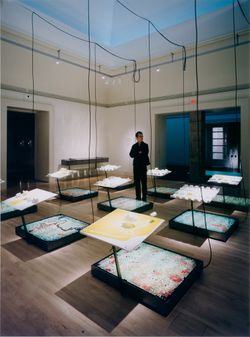
Surface du quotidien : La pelouse en Amérique montre la pelouse comme symbole de la vie domestique, espace public de représentation, agent économique et icône de l’Amérique. Les pavillons des lotissements de banlieue, les sièges d’entreprise établis en milieu suburbain et la Maison Blanche ont une chose en commun : tous ces bâtiments sont entourés d’une pelouse – une(...)
Surface du quotidien : La pelouse en Amérique montre la pelouse comme symbole de la vie domestique, espace public de représentation, agent économique et icône de l’Amérique. Les pavillons des lotissements de banlieue, les sièges d’entreprise établis en milieu suburbain et la Maison Blanche ont une chose en commun : tous ces bâtiments sont entourés d’une pelouse – une(...)
Localisation:
Salles principales, salle octogonale et vitrines
Salles principales, salle octogonale et vitrines
Date:
16 juin 1998 au 8 novembre 1998
16 juin 1998 au 8 novembre 1998
Titre:
Surface du quotidien : la pelouse en Amérique
Actions:
Description:
Surface du quotidien : La pelouse en Amérique montre la pelouse comme symbole de la vie domestique, espace public de représentation, agent économique et icône de l’Amérique. Les pavillons des lotissements de banlieue, les sièges d’entreprise établis en milieu suburbain et la Maison Blanche ont une chose en commun : tous ces bâtiments sont entourés d’une pelouse – une(...)
Surface du quotidien : la pelouse en Amérique
Actions:
Description:
Surface du quotidien : La pelouse en Amérique montre la pelouse comme symbole de la vie domestique, espace public de représentation, agent économique et icône de l’Amérique. Les pavillons des lotissements de banlieue, les sièges d’entreprise établis en milieu suburbain et la Maison Blanche ont une chose en commun : tous ces bâtiments sont entourés d’une pelouse – une(...)
Classification:
expositions
expositions
Date:
16 juin 1998 au
8 novembre 1998
16 juin 1998 au
8 novembre 1998
Localisation:
Salles principales, salle octogonale et vitrines
Salles principales, salle octogonale et vitrines


