


26977 Résultats
Classification:
dessins
dessins
Actions:
Numéro de référence:
DR1974:0002:016:001-070
Description:
- This album contains mostly highly finished drawings - plans, elevations, and sections - for three gendarmerie barracks in Paris by Hubert Rohault de Fleury: rue du Faubourg-Saint-Martin (1829-1830 ?), rue des Minimes (1823-1825 ?), and rue Mouffetard (1821-1824). Rohault de Fleury's alterations to the Faubourg-Saint-Martin barracks were probably limited to the "2e" and "3e étages" and the sewer system (DR1974:0002:016:001 - DR1974:0002:016:006). It has not been determined whether these alterations were for the initial conversion of the Hôtel des arts into barracks, or for subsequent alterations to the barracks. The drawings for the Minimes barracks are more comprehensive and relate to work on the disposition of the interiors, the enclosing wall, and the entrance gateway (DR1974:0002:016:007 - DR1974:0002:016:022 and DR1974:0002:016:024 - DR1974:0002:016:027). The Mouffetard barracks is the largest and best known of the projects in the album (DR1974:0002:016:023, DR1974:0002:016:028 - DR1974:0002:016:070). It is comprehensively documented and includes: a bidding document for the barracks, plans of the existing Couvent des Augustines de Notre-Dame-de-la-Miséricorde situated on the site, early projects for the barracks of 1821, and the 1824 project which apparently conforms to the barracks as executed. The façades of the Caserne de la Gendarmerie royale, rue Mouffetard, are in the pared-down classical style typical of Hubert's utilitarian structures.
DR1974:0002:016:001-070
Description:
- This album contains mostly highly finished drawings - plans, elevations, and sections - for three gendarmerie barracks in Paris by Hubert Rohault de Fleury: rue du Faubourg-Saint-Martin (1829-1830 ?), rue des Minimes (1823-1825 ?), and rue Mouffetard (1821-1824). Rohault de Fleury's alterations to the Faubourg-Saint-Martin barracks were probably limited to the "2e" and "3e étages" and the sewer system (DR1974:0002:016:001 - DR1974:0002:016:006). It has not been determined whether these alterations were for the initial conversion of the Hôtel des arts into barracks, or for subsequent alterations to the barracks. The drawings for the Minimes barracks are more comprehensive and relate to work on the disposition of the interiors, the enclosing wall, and the entrance gateway (DR1974:0002:016:007 - DR1974:0002:016:022 and DR1974:0002:016:024 - DR1974:0002:016:027). The Mouffetard barracks is the largest and best known of the projects in the album (DR1974:0002:016:023, DR1974:0002:016:028 - DR1974:0002:016:070). It is comprehensively documented and includes: a bidding document for the barracks, plans of the existing Couvent des Augustines de Notre-Dame-de-la-Miséricorde situated on the site, early projects for the barracks of 1821, and the 1824 project which apparently conforms to the barracks as executed. The façades of the Caserne de la Gendarmerie royale, rue Mouffetard, are in the pared-down classical style typical of Hubert's utilitarian structures.
Personnes et institutions:
Sujet:
architecture
architecture
Date:
drawings executed 1817-1830, manuscript written 1817-1821
drawings executed 1817-1830, manuscript written 1817-1821
Titre:
Album of drawings for three gendarmerie barracks: rue du Faubourg-Saint-Martin, rue des Minimes, and rue Mouffetard, Paris
Actions:
DR1974:0002:016:001-070
Description:
- This album contains mostly highly finished drawings - plans, elevations, and sections - for three gendarmerie barracks in Paris by Hubert Rohault de Fleury: rue du Faubourg-Saint-Martin (1829-1830 ?), rue des Minimes (1823-1825 ?), and rue Mouffetard (1821-1824). Rohault de Fleury's alterations to the Faubourg-Saint-Martin barracks were probably limited to the "2e" and "3e étages" and the sewer system (DR1974:0002:016:001 - DR1974:0002:016:006). It has not been determined whether these alterations were for the initial conversion of the Hôtel des arts into barracks, or for subsequent alterations to the barracks. The drawings for the Minimes barracks are more comprehensive and relate to work on the disposition of the interiors, the enclosing wall, and the entrance gateway (DR1974:0002:016:007 - DR1974:0002:016:022 and DR1974:0002:016:024 - DR1974:0002:016:027). The Mouffetard barracks is the largest and best known of the projects in the album (DR1974:0002:016:023, DR1974:0002:016:028 - DR1974:0002:016:070). It is comprehensively documented and includes: a bidding document for the barracks, plans of the existing Couvent des Augustines de Notre-Dame-de-la-Miséricorde situated on the site, early projects for the barracks of 1821, and the 1824 project which apparently conforms to the barracks as executed. The façades of the Caserne de la Gendarmerie royale, rue Mouffetard, are in the pared-down classical style typical of Hubert's utilitarian structures.
Album of drawings for three gendarmerie barracks: rue du Faubourg-Saint-Martin, rue des Minimes, and rue Mouffetard, Paris
Actions:
DR1974:0002:016:001-070
Description:
- This album contains mostly highly finished drawings - plans, elevations, and sections - for three gendarmerie barracks in Paris by Hubert Rohault de Fleury: rue du Faubourg-Saint-Martin (1829-1830 ?), rue des Minimes (1823-1825 ?), and rue Mouffetard (1821-1824). Rohault de Fleury's alterations to the Faubourg-Saint-Martin barracks were probably limited to the "2e" and "3e étages" and the sewer system (DR1974:0002:016:001 - DR1974:0002:016:006). It has not been determined whether these alterations were for the initial conversion of the Hôtel des arts into barracks, or for subsequent alterations to the barracks. The drawings for the Minimes barracks are more comprehensive and relate to work on the disposition of the interiors, the enclosing wall, and the entrance gateway (DR1974:0002:016:007 - DR1974:0002:016:022 and DR1974:0002:016:024 - DR1974:0002:016:027). The Mouffetard barracks is the largest and best known of the projects in the album (DR1974:0002:016:023, DR1974:0002:016:028 - DR1974:0002:016:070). It is comprehensively documented and includes: a bidding document for the barracks, plans of the existing Couvent des Augustines de Notre-Dame-de-la-Miséricorde situated on the site, early projects for the barracks of 1821, and the 1824 project which apparently conforms to the barracks as executed. The façades of the Caserne de la Gendarmerie royale, rue Mouffetard, are in the pared-down classical style typical of Hubert's utilitarian structures.
Classification:
dessins
dessins
Date:
drawings executed 1817-1830, manuscript written 1817-1821
drawings executed 1817-1830, manuscript written 1817-1821
Personnes et institutions:
Sujet:
architecture
architecture
Classification:
dessins, documents textuels, né numérique
dessins, documents textuels, né numérique
Numéro de référence:
AP181.S1.005
Description:
Original directory name: "04_Planung". File shows plans, drawings, renderings, project specifications, lists of plans and their circulation among consultants for design planning. These include PRO-Elektroplan GmbH, Bollinger+Grohmann, Dr. Pfeiler GmbH, Kersken + Kirchner GmbH., KBP Beratende Ingenieure GmbH, pbb planungsbüro balke, Ingenieurgemeinschaft BDP, a.g Licht, bfm, Realgruen Landschaftsarchitekten, Lang + Burkhardt Verkehrsplanung und Städtebau, Emmer Pfenninger Partner AG, IB Rüdiger Schönenberg, Thomas A. Weisse + Partner. Consultant Schmitt Stumpf Frühauf und partner (SSF) also facilitated some of the documentation’s organization and exchange. Bulk dates run from 2003-2006. Over a third of the records are under the “CAD” directory. They are DWG data models, layouts, templates, fonts, line types and plot styles, and act as reference materials for the project. More elaborate files show drawings and plans of the roof, the double cone, the restaurants, the hall, etc. A handbook is included to guide the usage of CAD tools for the BMW Welt project, and can be found in “b_CAD\06_Handbuecher”. It provides an understanding of the firm’s methodology for the development of the project into a building. Furthermore, the “Archiv” directory contains an earlier version of the "b_CAD/01_Datenmodell" directory. Its “Transfer” sub-directory has records showing how COOP HIMMELB(L)AU sent plans to the project's stakeholders. An additional third of the records are part of the “3D-Modell” directory which reflects the use of a diversity of software and formats (Rhino, Maya, DWG, JPG, TIFF, IGES, MAX, etc.) for plans of the various parts of the building, such as the facade, hall, roof, and double cone. The “Raumbuch” directory includes files showing the detailed planning for all parts of a given room: plumbing, heat and ventilation, refrigeration systems, building automation, etc. Related Access and FileMaker databases can be found in file AP181.S1.006 under "b_KBP_Haustechnik\D_Berichte\Raumbuch" and "c_PRO_Elektro_Foerdertechnik\I_Raumbuch_Elektro". Under “Valid plans” (gueltige plaene) are specific sets of plans organized under directories dated between June 2005 and April 2007. Those subdirectories also indicate the building area they concern. Most plans were saved here in PDF, although there are some AutoCAD and Rhino files too. "Dokumentation" records are divided under three directories: design (entwurf), approval planning (genehmigungsplanung), and specifications (baubeschreibung). The first two contain plans, organized by date and building area or stakeholder. The third one contains textual records of various early scenarios of specifications for the project. Specific and smaller sets of records in other directories include: scheduling and circulation of plans to stakeholders in “Lieferscheine_Planlisten”; early documentation on program planning in “Flaechenlisten”; reference documentation and concept presentations for the choice of materials, such as lights and facade materials, in “Materialen”; drawings and plans for the steel structure in “ZBV”; engineering data for parts of the building (basement, facade, double cone, etc.) in “Bauteilkatalog”; and stock material from the client in “3D-Modelle-BMWs”. Most common file formats: JPEG File Interchange Format, AutoCAD Drawing, 3DM, Exchangeable Image File Format (Compressed), Acrobat PDF 1.4 - Portable Document Format
AP181.S1.005
Description:
Original directory name: "04_Planung". File shows plans, drawings, renderings, project specifications, lists of plans and their circulation among consultants for design planning. These include PRO-Elektroplan GmbH, Bollinger+Grohmann, Dr. Pfeiler GmbH, Kersken + Kirchner GmbH., KBP Beratende Ingenieure GmbH, pbb planungsbüro balke, Ingenieurgemeinschaft BDP, a.g Licht, bfm, Realgruen Landschaftsarchitekten, Lang + Burkhardt Verkehrsplanung und Städtebau, Emmer Pfenninger Partner AG, IB Rüdiger Schönenberg, Thomas A. Weisse + Partner. Consultant Schmitt Stumpf Frühauf und partner (SSF) also facilitated some of the documentation’s organization and exchange. Bulk dates run from 2003-2006. Over a third of the records are under the “CAD” directory. They are DWG data models, layouts, templates, fonts, line types and plot styles, and act as reference materials for the project. More elaborate files show drawings and plans of the roof, the double cone, the restaurants, the hall, etc. A handbook is included to guide the usage of CAD tools for the BMW Welt project, and can be found in “b_CAD\06_Handbuecher”. It provides an understanding of the firm’s methodology for the development of the project into a building. Furthermore, the “Archiv” directory contains an earlier version of the "b_CAD/01_Datenmodell" directory. Its “Transfer” sub-directory has records showing how COOP HIMMELB(L)AU sent plans to the project's stakeholders. An additional third of the records are part of the “3D-Modell” directory which reflects the use of a diversity of software and formats (Rhino, Maya, DWG, JPG, TIFF, IGES, MAX, etc.) for plans of the various parts of the building, such as the facade, hall, roof, and double cone. The “Raumbuch” directory includes files showing the detailed planning for all parts of a given room: plumbing, heat and ventilation, refrigeration systems, building automation, etc. Related Access and FileMaker databases can be found in file AP181.S1.006 under "b_KBP_Haustechnik\D_Berichte\Raumbuch" and "c_PRO_Elektro_Foerdertechnik\I_Raumbuch_Elektro". Under “Valid plans” (gueltige plaene) are specific sets of plans organized under directories dated between June 2005 and April 2007. Those subdirectories also indicate the building area they concern. Most plans were saved here in PDF, although there are some AutoCAD and Rhino files too. "Dokumentation" records are divided under three directories: design (entwurf), approval planning (genehmigungsplanung), and specifications (baubeschreibung). The first two contain plans, organized by date and building area or stakeholder. The third one contains textual records of various early scenarios of specifications for the project. Specific and smaller sets of records in other directories include: scheduling and circulation of plans to stakeholders in “Lieferscheine_Planlisten”; early documentation on program planning in “Flaechenlisten”; reference documentation and concept presentations for the choice of materials, such as lights and facade materials, in “Materialen”; drawings and plans for the steel structure in “ZBV”; engineering data for parts of the building (basement, facade, double cone, etc.) in “Bauteilkatalog”; and stock material from the client in “3D-Modelle-BMWs”. Most common file formats: JPEG File Interchange Format, AutoCAD Drawing, 3DM, Exchangeable Image File Format (Compressed), Acrobat PDF 1.4 - Portable Document Format
Personnes et institutions:
Date:
1994-2013
1994-2013
Titre:
Design planning, BMW Welt, Munich
Actions:
AP181.S1.005
Description:
Original directory name: "04_Planung". File shows plans, drawings, renderings, project specifications, lists of plans and their circulation among consultants for design planning. These include PRO-Elektroplan GmbH, Bollinger+Grohmann, Dr. Pfeiler GmbH, Kersken + Kirchner GmbH., KBP Beratende Ingenieure GmbH, pbb planungsbüro balke, Ingenieurgemeinschaft BDP, a.g Licht, bfm, Realgruen Landschaftsarchitekten, Lang + Burkhardt Verkehrsplanung und Städtebau, Emmer Pfenninger Partner AG, IB Rüdiger Schönenberg, Thomas A. Weisse + Partner. Consultant Schmitt Stumpf Frühauf und partner (SSF) also facilitated some of the documentation’s organization and exchange. Bulk dates run from 2003-2006. Over a third of the records are under the “CAD” directory. They are DWG data models, layouts, templates, fonts, line types and plot styles, and act as reference materials for the project. More elaborate files show drawings and plans of the roof, the double cone, the restaurants, the hall, etc. A handbook is included to guide the usage of CAD tools for the BMW Welt project, and can be found in “b_CAD\06_Handbuecher”. It provides an understanding of the firm’s methodology for the development of the project into a building. Furthermore, the “Archiv” directory contains an earlier version of the "b_CAD/01_Datenmodell" directory. Its “Transfer” sub-directory has records showing how COOP HIMMELB(L)AU sent plans to the project's stakeholders. An additional third of the records are part of the “3D-Modell” directory which reflects the use of a diversity of software and formats (Rhino, Maya, DWG, JPG, TIFF, IGES, MAX, etc.) for plans of the various parts of the building, such as the facade, hall, roof, and double cone. The “Raumbuch” directory includes files showing the detailed planning for all parts of a given room: plumbing, heat and ventilation, refrigeration systems, building automation, etc. Related Access and FileMaker databases can be found in file AP181.S1.006 under "b_KBP_Haustechnik\D_Berichte\Raumbuch" and "c_PRO_Elektro_Foerdertechnik\I_Raumbuch_Elektro". Under “Valid plans” (gueltige plaene) are specific sets of plans organized under directories dated between June 2005 and April 2007. Those subdirectories also indicate the building area they concern. Most plans were saved here in PDF, although there are some AutoCAD and Rhino files too. "Dokumentation" records are divided under three directories: design (entwurf), approval planning (genehmigungsplanung), and specifications (baubeschreibung). The first two contain plans, organized by date and building area or stakeholder. The third one contains textual records of various early scenarios of specifications for the project. Specific and smaller sets of records in other directories include: scheduling and circulation of plans to stakeholders in “Lieferscheine_Planlisten”; early documentation on program planning in “Flaechenlisten”; reference documentation and concept presentations for the choice of materials, such as lights and facade materials, in “Materialen”; drawings and plans for the steel structure in “ZBV”; engineering data for parts of the building (basement, facade, double cone, etc.) in “Bauteilkatalog”; and stock material from the client in “3D-Modelle-BMWs”. Most common file formats: JPEG File Interchange Format, AutoCAD Drawing, 3DM, Exchangeable Image File Format (Compressed), Acrobat PDF 1.4 - Portable Document Format
Design planning, BMW Welt, Munich
Actions:
AP181.S1.005
Description:
Original directory name: "04_Planung". File shows plans, drawings, renderings, project specifications, lists of plans and their circulation among consultants for design planning. These include PRO-Elektroplan GmbH, Bollinger+Grohmann, Dr. Pfeiler GmbH, Kersken + Kirchner GmbH., KBP Beratende Ingenieure GmbH, pbb planungsbüro balke, Ingenieurgemeinschaft BDP, a.g Licht, bfm, Realgruen Landschaftsarchitekten, Lang + Burkhardt Verkehrsplanung und Städtebau, Emmer Pfenninger Partner AG, IB Rüdiger Schönenberg, Thomas A. Weisse + Partner. Consultant Schmitt Stumpf Frühauf und partner (SSF) also facilitated some of the documentation’s organization and exchange. Bulk dates run from 2003-2006. Over a third of the records are under the “CAD” directory. They are DWG data models, layouts, templates, fonts, line types and plot styles, and act as reference materials for the project. More elaborate files show drawings and plans of the roof, the double cone, the restaurants, the hall, etc. A handbook is included to guide the usage of CAD tools for the BMW Welt project, and can be found in “b_CAD\06_Handbuecher”. It provides an understanding of the firm’s methodology for the development of the project into a building. Furthermore, the “Archiv” directory contains an earlier version of the "b_CAD/01_Datenmodell" directory. Its “Transfer” sub-directory has records showing how COOP HIMMELB(L)AU sent plans to the project's stakeholders. An additional third of the records are part of the “3D-Modell” directory which reflects the use of a diversity of software and formats (Rhino, Maya, DWG, JPG, TIFF, IGES, MAX, etc.) for plans of the various parts of the building, such as the facade, hall, roof, and double cone. The “Raumbuch” directory includes files showing the detailed planning for all parts of a given room: plumbing, heat and ventilation, refrigeration systems, building automation, etc. Related Access and FileMaker databases can be found in file AP181.S1.006 under "b_KBP_Haustechnik\D_Berichte\Raumbuch" and "c_PRO_Elektro_Foerdertechnik\I_Raumbuch_Elektro". Under “Valid plans” (gueltige plaene) are specific sets of plans organized under directories dated between June 2005 and April 2007. Those subdirectories also indicate the building area they concern. Most plans were saved here in PDF, although there are some AutoCAD and Rhino files too. "Dokumentation" records are divided under three directories: design (entwurf), approval planning (genehmigungsplanung), and specifications (baubeschreibung). The first two contain plans, organized by date and building area or stakeholder. The third one contains textual records of various early scenarios of specifications for the project. Specific and smaller sets of records in other directories include: scheduling and circulation of plans to stakeholders in “Lieferscheine_Planlisten”; early documentation on program planning in “Flaechenlisten”; reference documentation and concept presentations for the choice of materials, such as lights and facade materials, in “Materialen”; drawings and plans for the steel structure in “ZBV”; engineering data for parts of the building (basement, facade, double cone, etc.) in “Bauteilkatalog”; and stock material from the client in “3D-Modelle-BMWs”. Most common file formats: JPEG File Interchange Format, AutoCAD Drawing, 3DM, Exchangeable Image File Format (Compressed), Acrobat PDF 1.4 - Portable Document Format
Classification:
dessins, documents textuels, né numérique
dessins, documents textuels, né numérique
Date:
1994-2013
1994-2013
Personnes et institutions:
Classification:
dessins
dessins
Actions:
Numéro de référence:
DR1981:0017:001 R/V
Description:
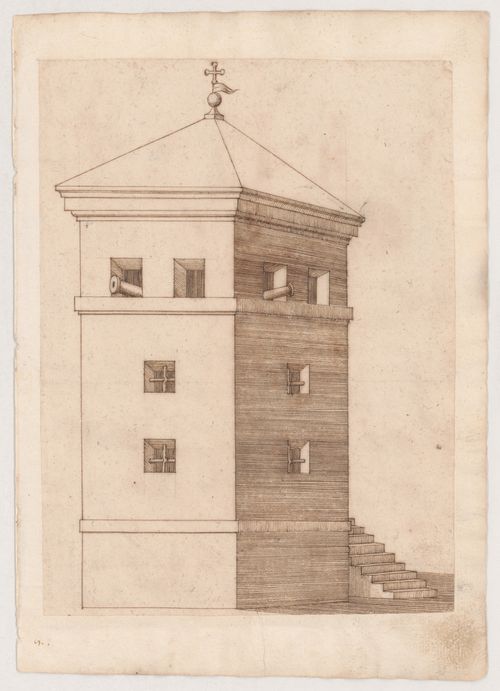
- Most of the drawings in the group DR1981:0017:001 R/V - DR1981:0017:079 R/V are by Luca Danese, with the exception of those by Giovanni Antonio Zani (DR1981:0017:034, DR1981:0017:066 R/V, DR1981:0017:67 R/V and DR1981:0017:069 R/V), and the possible exception of the lower drawing on DR1981:0017:063 R, which bears the inscription, "Giovanni Danese". The Danese drawings include sketches of buildings, fortifications, facades, temporary architecture, locks and bridges as well as maps and designs for escutcheons, facades, temporary architecture, locks and one bridge. Most of these drawings show structures in the area around Comacchio and Ferrara in northeastern Italy, but there are also a number of record drawings made as far south as Rome, and as far north as Venice. In addition, there are plans which were probably not made "in situ" for fortifications at Innsbruck, Austria (DR1981:0017:064 R) and Altenburg (Mosonmagyarovar), Hungary (DR1981:0017:018 R). The drawings range in date between 1629 (DR1981:0017:018 R) and 1641 (DR1981:0017:0017:010 V), with a number of the record drawings made in Rome inscribed "1635". The Zani drawings are undated designs for military storage facilities, including a design for a magazine at Ferrara (DR1981:0017:067 R). Many of the sheets and secondary supports have been inscribed by an unknown contemporary Italian hand, including the drawing DR1981:0017:039 which gives Danese's death date as "1672". The date at which the drawings were bound into an album has not been determined.
DR1981:0017:001 R/V
Description:
- Most of the drawings in the group DR1981:0017:001 R/V - DR1981:0017:079 R/V are by Luca Danese, with the exception of those by Giovanni Antonio Zani (DR1981:0017:034, DR1981:0017:066 R/V, DR1981:0017:67 R/V and DR1981:0017:069 R/V), and the possible exception of the lower drawing on DR1981:0017:063 R, which bears the inscription, "Giovanni Danese". The Danese drawings include sketches of buildings, fortifications, facades, temporary architecture, locks and bridges as well as maps and designs for escutcheons, facades, temporary architecture, locks and one bridge. Most of these drawings show structures in the area around Comacchio and Ferrara in northeastern Italy, but there are also a number of record drawings made as far south as Rome, and as far north as Venice. In addition, there are plans which were probably not made "in situ" for fortifications at Innsbruck, Austria (DR1981:0017:064 R) and Altenburg (Mosonmagyarovar), Hungary (DR1981:0017:018 R). The drawings range in date between 1629 (DR1981:0017:018 R) and 1641 (DR1981:0017:0017:010 V), with a number of the record drawings made in Rome inscribed "1635". The Zani drawings are undated designs for military storage facilities, including a design for a magazine at Ferrara (DR1981:0017:067 R). Many of the sheets and secondary supports have been inscribed by an unknown contemporary Italian hand, including the drawing DR1981:0017:039 which gives Danese's death date as "1672". The date at which the drawings were bound into an album has not been determined.
Personnes et institutions:
Sujet:
architecture, militaire
architecture, militaire
Date:
ca. 1630-1640
ca. 1630-1640
Titre:
Elevation of a fortified tower with cannons; verso: View of the Ponte Felice, Borghetto; Offset images of a bridge and an architectural detail
Actions:
DR1981:0017:001 R/V
Description:
- Most of the drawings in the group DR1981:0017:001 R/V - DR1981:0017:079 R/V are by Luca Danese, with the exception of those by Giovanni Antonio Zani (DR1981:0017:034, DR1981:0017:066 R/V, DR1981:0017:67 R/V and DR1981:0017:069 R/V), and the possible exception of the lower drawing on DR1981:0017:063 R, which bears the inscription, "Giovanni Danese". The Danese drawings include sketches of buildings, fortifications, facades, temporary architecture, locks and bridges as well as maps and designs for escutcheons, facades, temporary architecture, locks and one bridge. Most of these drawings show structures in the area around Comacchio and Ferrara in northeastern Italy, but there are also a number of record drawings made as far south as Rome, and as far north as Venice. In addition, there are plans which were probably not made "in situ" for fortifications at Innsbruck, Austria (DR1981:0017:064 R) and Altenburg (Mosonmagyarovar), Hungary (DR1981:0017:018 R). The drawings range in date between 1629 (DR1981:0017:018 R) and 1641 (DR1981:0017:0017:010 V), with a number of the record drawings made in Rome inscribed "1635". The Zani drawings are undated designs for military storage facilities, including a design for a magazine at Ferrara (DR1981:0017:067 R). Many of the sheets and secondary supports have been inscribed by an unknown contemporary Italian hand, including the drawing DR1981:0017:039 which gives Danese's death date as "1672". The date at which the drawings were bound into an album has not been determined.
Elevation of a fortified tower with cannons; verso: View of the Ponte Felice, Borghetto; Offset images of a bridge and an architectural detail
Actions:
DR1981:0017:001 R/V
Description:
- Most of the drawings in the group DR1981:0017:001 R/V - DR1981:0017:079 R/V are by Luca Danese, with the exception of those by Giovanni Antonio Zani (DR1981:0017:034, DR1981:0017:066 R/V, DR1981:0017:67 R/V and DR1981:0017:069 R/V), and the possible exception of the lower drawing on DR1981:0017:063 R, which bears the inscription, "Giovanni Danese". The Danese drawings include sketches of buildings, fortifications, facades, temporary architecture, locks and bridges as well as maps and designs for escutcheons, facades, temporary architecture, locks and one bridge. Most of these drawings show structures in the area around Comacchio and Ferrara in northeastern Italy, but there are also a number of record drawings made as far south as Rome, and as far north as Venice. In addition, there are plans which were probably not made "in situ" for fortifications at Innsbruck, Austria (DR1981:0017:064 R) and Altenburg (Mosonmagyarovar), Hungary (DR1981:0017:018 R). The drawings range in date between 1629 (DR1981:0017:018 R) and 1641 (DR1981:0017:0017:010 V), with a number of the record drawings made in Rome inscribed "1635". The Zani drawings are undated designs for military storage facilities, including a design for a magazine at Ferrara (DR1981:0017:067 R). Many of the sheets and secondary supports have been inscribed by an unknown contemporary Italian hand, including the drawing DR1981:0017:039 which gives Danese's death date as "1672". The date at which the drawings were bound into an album has not been determined.
Classification:
dessins
dessins
Date:
ca. 1630-1640
ca. 1630-1640
Personnes et institutions:
Sujet:
architecture, militaire
architecture, militaire
Classification:
dessins, oeuvres d'art
dessins, oeuvres d'art
Titre:
Album of drawings and prints for a Hôtel de préfecture and a Hôtel de ville, Poitiers, France
Album of drawings and prints for a Hôtel de préfecture and a Hôtel de ville, Poitiers, France
Actions:
Numéro de référence:
DR1974:0002:020:001-050
Description:
- This album contains drawings by Charles Rohault de Fleury which range from preliminary sketches to finished drawings - mostly plans, elevations and sections - for unexecuted projects for a Hôtel de préfecture and a Hôtel de ville for the city of Poitiers (Département de Vienne). Highly finished conceptual drawings dated September 1859 depict the general appearance and layout of the Hôtel de préfecture, however, the plans pertain primarily to the Hôtel du Préfet (DR1974:0002:020:003 - DR1974:0002:020:011). Transfer lithographs of working drawings for the Hôtel de préfecture dated November 1859 have detailed measurements showing the layout and construction of all the major building components (DR1974:0002:020:014 - DR1974:0002:020:018 and DR1974:0002:020:020). Also included are a plan and elevation dated February 1860 (DR1974:0002:020:013 and DR1974:0002:020:019). A site plan and perspective view for this Louis XIIIth style hôtel de préfecture have detailed keys (DR1974:0002:020:001 and DR1974:0002:020:002). The utilitarian structures for the Hôtel de préfecture, such as the portico pavilions and the Archives building, are constructed in a sparser style than the Hôtel du Préfet. The project for the Hôtel de ville is much less developed than that for the Hôtel de préfecture. Most of the drawings are unbound at the end of the album (DR1974:0002:020:035 - DR1974:0002:020:050). The two designs for this project, dated October 1859 and December 1859, are similar and depict an Italianate (Francis I ?) two-storey arcuated façade with pedimented windows, and coupled Corinthian columns. The construction materials are brick and stone. The two designs differ in the disposition of their flanking pavilions: the earlier project is housed under one roof (DR1974:0002:020:037), while the later project shows separate roofs for the pavilions (DR1974:0002:020:040 and DR1974:0002:020:042). Site plan DR1974:0002:020:012 indicates the proposed locations of the Hôtel de préfecture and Hôtel de ville: the former is situated near the train station between rue des Carmelites and boulevard Solferino, and the latter on a newly created square just west of the Hôtel de préfecture between rue des Grandes Écoles and rue de la Mairie.
DR1974:0002:020:001-050
Description:
- This album contains drawings by Charles Rohault de Fleury which range from preliminary sketches to finished drawings - mostly plans, elevations and sections - for unexecuted projects for a Hôtel de préfecture and a Hôtel de ville for the city of Poitiers (Département de Vienne). Highly finished conceptual drawings dated September 1859 depict the general appearance and layout of the Hôtel de préfecture, however, the plans pertain primarily to the Hôtel du Préfet (DR1974:0002:020:003 - DR1974:0002:020:011). Transfer lithographs of working drawings for the Hôtel de préfecture dated November 1859 have detailed measurements showing the layout and construction of all the major building components (DR1974:0002:020:014 - DR1974:0002:020:018 and DR1974:0002:020:020). Also included are a plan and elevation dated February 1860 (DR1974:0002:020:013 and DR1974:0002:020:019). A site plan and perspective view for this Louis XIIIth style hôtel de préfecture have detailed keys (DR1974:0002:020:001 and DR1974:0002:020:002). The utilitarian structures for the Hôtel de préfecture, such as the portico pavilions and the Archives building, are constructed in a sparser style than the Hôtel du Préfet. The project for the Hôtel de ville is much less developed than that for the Hôtel de préfecture. Most of the drawings are unbound at the end of the album (DR1974:0002:020:035 - DR1974:0002:020:050). The two designs for this project, dated October 1859 and December 1859, are similar and depict an Italianate (Francis I ?) two-storey arcuated façade with pedimented windows, and coupled Corinthian columns. The construction materials are brick and stone. The two designs differ in the disposition of their flanking pavilions: the earlier project is housed under one roof (DR1974:0002:020:037), while the later project shows separate roofs for the pavilions (DR1974:0002:020:040 and DR1974:0002:020:042). Site plan DR1974:0002:020:012 indicates the proposed locations of the Hôtel de préfecture and Hôtel de ville: the former is situated near the train station between rue des Carmelites and boulevard Solferino, and the latter on a newly created square just west of the Hôtel de préfecture between rue des Grandes Écoles and rue de la Mairie.
Personnes et institutions:
Sujet:
architecture, design d'intérieur
architecture, design d'intérieur
Date:
1859-1860, printed 1859-1860
1859-1860, printed 1859-1860
Titre:
Album of drawings and prints for a Hôtel de préfecture and a Hôtel de ville, Poitiers, France
Actions:
DR1974:0002:020:001-050
Description:
- This album contains drawings by Charles Rohault de Fleury which range from preliminary sketches to finished drawings - mostly plans, elevations and sections - for unexecuted projects for a Hôtel de préfecture and a Hôtel de ville for the city of Poitiers (Département de Vienne). Highly finished conceptual drawings dated September 1859 depict the general appearance and layout of the Hôtel de préfecture, however, the plans pertain primarily to the Hôtel du Préfet (DR1974:0002:020:003 - DR1974:0002:020:011). Transfer lithographs of working drawings for the Hôtel de préfecture dated November 1859 have detailed measurements showing the layout and construction of all the major building components (DR1974:0002:020:014 - DR1974:0002:020:018 and DR1974:0002:020:020). Also included are a plan and elevation dated February 1860 (DR1974:0002:020:013 and DR1974:0002:020:019). A site plan and perspective view for this Louis XIIIth style hôtel de préfecture have detailed keys (DR1974:0002:020:001 and DR1974:0002:020:002). The utilitarian structures for the Hôtel de préfecture, such as the portico pavilions and the Archives building, are constructed in a sparser style than the Hôtel du Préfet. The project for the Hôtel de ville is much less developed than that for the Hôtel de préfecture. Most of the drawings are unbound at the end of the album (DR1974:0002:020:035 - DR1974:0002:020:050). The two designs for this project, dated October 1859 and December 1859, are similar and depict an Italianate (Francis I ?) two-storey arcuated façade with pedimented windows, and coupled Corinthian columns. The construction materials are brick and stone. The two designs differ in the disposition of their flanking pavilions: the earlier project is housed under one roof (DR1974:0002:020:037), while the later project shows separate roofs for the pavilions (DR1974:0002:020:040 and DR1974:0002:020:042). Site plan DR1974:0002:020:012 indicates the proposed locations of the Hôtel de préfecture and Hôtel de ville: the former is situated near the train station between rue des Carmelites and boulevard Solferino, and the latter on a newly created square just west of the Hôtel de préfecture between rue des Grandes Écoles and rue de la Mairie.
Album of drawings and prints for a Hôtel de préfecture and a Hôtel de ville, Poitiers, France
Actions:
DR1974:0002:020:001-050
Description:
- This album contains drawings by Charles Rohault de Fleury which range from preliminary sketches to finished drawings - mostly plans, elevations and sections - for unexecuted projects for a Hôtel de préfecture and a Hôtel de ville for the city of Poitiers (Département de Vienne). Highly finished conceptual drawings dated September 1859 depict the general appearance and layout of the Hôtel de préfecture, however, the plans pertain primarily to the Hôtel du Préfet (DR1974:0002:020:003 - DR1974:0002:020:011). Transfer lithographs of working drawings for the Hôtel de préfecture dated November 1859 have detailed measurements showing the layout and construction of all the major building components (DR1974:0002:020:014 - DR1974:0002:020:018 and DR1974:0002:020:020). Also included are a plan and elevation dated February 1860 (DR1974:0002:020:013 and DR1974:0002:020:019). A site plan and perspective view for this Louis XIIIth style hôtel de préfecture have detailed keys (DR1974:0002:020:001 and DR1974:0002:020:002). The utilitarian structures for the Hôtel de préfecture, such as the portico pavilions and the Archives building, are constructed in a sparser style than the Hôtel du Préfet. The project for the Hôtel de ville is much less developed than that for the Hôtel de préfecture. Most of the drawings are unbound at the end of the album (DR1974:0002:020:035 - DR1974:0002:020:050). The two designs for this project, dated October 1859 and December 1859, are similar and depict an Italianate (Francis I ?) two-storey arcuated façade with pedimented windows, and coupled Corinthian columns. The construction materials are brick and stone. The two designs differ in the disposition of their flanking pavilions: the earlier project is housed under one roof (DR1974:0002:020:037), while the later project shows separate roofs for the pavilions (DR1974:0002:020:040 and DR1974:0002:020:042). Site plan DR1974:0002:020:012 indicates the proposed locations of the Hôtel de préfecture and Hôtel de ville: the former is situated near the train station between rue des Carmelites and boulevard Solferino, and the latter on a newly created square just west of the Hôtel de préfecture between rue des Grandes Écoles and rue de la Mairie.
Classification:
dessins, oeuvres d'art
dessins, oeuvres d'art
Date:
1859-1860, printed 1859-1860
1859-1860, printed 1859-1860
Personnes et institutions:
Sujet:
architecture, design d'intérieur
architecture, design d'intérieur
Classification:
dessins, oeuvres d'art
Quantité:
4 portfolio(s)
dessins, oeuvres d'art
Quantité:
4 portfolio(s)
Actions:
Numéro de référence:
DR1974:0002:030:001-065
Description:
The four portfolios of drawings and prints in this group are entitled: Croquis à placer en papier; Croquis divers; Vues d'Italie; and Croquis arrangement de boutiques, de meubles, et de decorations (DR1974:0002:030:001 - DR1974:0002:030:008; DR1974:0002:030:009 - DR1974:0002:030:030; DR1974:0002:030:031 - DR1974:0002:030:050; DR1974:0002:030:051 - DR1974:0002:030:065. -- Porfolio Croquis à placer en papier, comprises three unidentified topographical views in graphite, a drawing of furnishings from the Palais Matteï, Italy [?], a still life of fruit, and a drawing of an elephant. -- Portfolio Croquis divers, comprises both record and design drawings - ranging from sketches to renderings - of varied subject matter. The record drawings include a rendering of the Hôtel de ville, Brussels, and line drawings of a baldachin and an urban square. The design drawings for buildings and interiors in Classical, Gothic and Exotic Revival styles are probably by Hubert Rohault de Fleury and include: line and finished drawings for a dairy after Jean François Joseph LeCointre; an imaginary church, perhaps inspired by Pugin; and a hôtel on rue de Varennes, Paris. Several drawings and prints depict military subject matter: fortifications after Louis de Cormontaigne, a battery, a cannon, and revolutionary battle scenes, some in Paris. Also included are several drawings of non-architectural subject matter - a coat of arms, perhaps of the Bougainville family, cossack soldiers, a boar hunt, a rock formation and lithographic maps of Istria and Rhodes. -- Portfolio Vues d'Italie, consists of mostly freehand drawings of Italian views and buildings in Paestum, Arezzo, Naples, Rome, Caprarola, Florence, Fidenza, Genoa, and Tivoli. The buildings and urban spaces include: Villa Belvedere, Naples; the Cathedral of Borgo S. Donino; the Temple of Vesta, Tivoli; the Campidoglio, Piazza del Popolo, Palais Maccarani, Arc de Septimus Severus, Ste. Pudenziana, and Baslica of Constantine, all in Rome. The presence of preparatory drawings for some of these views suggests they were intended to be published, either as individual prints or in a book. -- Portfolio Croquis arrangement de boutiques, de meuble et de decorations, comprises mostly finished watercolour drawings for Empire style interiors and furniture, probably designed by Hubert Rohault de Fleury. Also included are an elevation for a storefront for Batton Magasin de Fleurs Fines, drawings for two garden structures, and elevations for classical interiors and mouldings.
DR1974:0002:030:001-065
Description:
The four portfolios of drawings and prints in this group are entitled: Croquis à placer en papier; Croquis divers; Vues d'Italie; and Croquis arrangement de boutiques, de meubles, et de decorations (DR1974:0002:030:001 - DR1974:0002:030:008; DR1974:0002:030:009 - DR1974:0002:030:030; DR1974:0002:030:031 - DR1974:0002:030:050; DR1974:0002:030:051 - DR1974:0002:030:065. -- Porfolio Croquis à placer en papier, comprises three unidentified topographical views in graphite, a drawing of furnishings from the Palais Matteï, Italy [?], a still life of fruit, and a drawing of an elephant. -- Portfolio Croquis divers, comprises both record and design drawings - ranging from sketches to renderings - of varied subject matter. The record drawings include a rendering of the Hôtel de ville, Brussels, and line drawings of a baldachin and an urban square. The design drawings for buildings and interiors in Classical, Gothic and Exotic Revival styles are probably by Hubert Rohault de Fleury and include: line and finished drawings for a dairy after Jean François Joseph LeCointre; an imaginary church, perhaps inspired by Pugin; and a hôtel on rue de Varennes, Paris. Several drawings and prints depict military subject matter: fortifications after Louis de Cormontaigne, a battery, a cannon, and revolutionary battle scenes, some in Paris. Also included are several drawings of non-architectural subject matter - a coat of arms, perhaps of the Bougainville family, cossack soldiers, a boar hunt, a rock formation and lithographic maps of Istria and Rhodes. -- Portfolio Vues d'Italie, consists of mostly freehand drawings of Italian views and buildings in Paestum, Arezzo, Naples, Rome, Caprarola, Florence, Fidenza, Genoa, and Tivoli. The buildings and urban spaces include: Villa Belvedere, Naples; the Cathedral of Borgo S. Donino; the Temple of Vesta, Tivoli; the Campidoglio, Piazza del Popolo, Palais Maccarani, Arc de Septimus Severus, Ste. Pudenziana, and Baslica of Constantine, all in Rome. The presence of preparatory drawings for some of these views suggests they were intended to be published, either as individual prints or in a book. -- Portfolio Croquis arrangement de boutiques, de meuble et de decorations, comprises mostly finished watercolour drawings for Empire style interiors and furniture, probably designed by Hubert Rohault de Fleury. Also included are an elevation for a storefront for Batton Magasin de Fleurs Fines, drawings for two garden structures, and elevations for classical interiors and mouldings.
Personnes et institutions:
Sujet:
architecture, design d'intérieur, ingénierie, militaire, sculpture, topographique, urbanisme
architecture, design d'intérieur, ingénierie, militaire, sculpture, topographique, urbanisme
Date:
printed first half of the 19th century
printed first half of the 19th century
Titre:
Four portfolios of drawings of Italian views, interior designs, Empire style furniture, military subjects, and other diverse subject matter
Actions:
DR1974:0002:030:001-065
Description:
The four portfolios of drawings and prints in this group are entitled: Croquis à placer en papier; Croquis divers; Vues d'Italie; and Croquis arrangement de boutiques, de meubles, et de decorations (DR1974:0002:030:001 - DR1974:0002:030:008; DR1974:0002:030:009 - DR1974:0002:030:030; DR1974:0002:030:031 - DR1974:0002:030:050; DR1974:0002:030:051 - DR1974:0002:030:065. -- Porfolio Croquis à placer en papier, comprises three unidentified topographical views in graphite, a drawing of furnishings from the Palais Matteï, Italy [?], a still life of fruit, and a drawing of an elephant. -- Portfolio Croquis divers, comprises both record and design drawings - ranging from sketches to renderings - of varied subject matter. The record drawings include a rendering of the Hôtel de ville, Brussels, and line drawings of a baldachin and an urban square. The design drawings for buildings and interiors in Classical, Gothic and Exotic Revival styles are probably by Hubert Rohault de Fleury and include: line and finished drawings for a dairy after Jean François Joseph LeCointre; an imaginary church, perhaps inspired by Pugin; and a hôtel on rue de Varennes, Paris. Several drawings and prints depict military subject matter: fortifications after Louis de Cormontaigne, a battery, a cannon, and revolutionary battle scenes, some in Paris. Also included are several drawings of non-architectural subject matter - a coat of arms, perhaps of the Bougainville family, cossack soldiers, a boar hunt, a rock formation and lithographic maps of Istria and Rhodes. -- Portfolio Vues d'Italie, consists of mostly freehand drawings of Italian views and buildings in Paestum, Arezzo, Naples, Rome, Caprarola, Florence, Fidenza, Genoa, and Tivoli. The buildings and urban spaces include: Villa Belvedere, Naples; the Cathedral of Borgo S. Donino; the Temple of Vesta, Tivoli; the Campidoglio, Piazza del Popolo, Palais Maccarani, Arc de Septimus Severus, Ste. Pudenziana, and Baslica of Constantine, all in Rome. The presence of preparatory drawings for some of these views suggests they were intended to be published, either as individual prints or in a book. -- Portfolio Croquis arrangement de boutiques, de meuble et de decorations, comprises mostly finished watercolour drawings for Empire style interiors and furniture, probably designed by Hubert Rohault de Fleury. Also included are an elevation for a storefront for Batton Magasin de Fleurs Fines, drawings for two garden structures, and elevations for classical interiors and mouldings.
Four portfolios of drawings of Italian views, interior designs, Empire style furniture, military subjects, and other diverse subject matter
Actions:
DR1974:0002:030:001-065
Description:
The four portfolios of drawings and prints in this group are entitled: Croquis à placer en papier; Croquis divers; Vues d'Italie; and Croquis arrangement de boutiques, de meubles, et de decorations (DR1974:0002:030:001 - DR1974:0002:030:008; DR1974:0002:030:009 - DR1974:0002:030:030; DR1974:0002:030:031 - DR1974:0002:030:050; DR1974:0002:030:051 - DR1974:0002:030:065. -- Porfolio Croquis à placer en papier, comprises three unidentified topographical views in graphite, a drawing of furnishings from the Palais Matteï, Italy [?], a still life of fruit, and a drawing of an elephant. -- Portfolio Croquis divers, comprises both record and design drawings - ranging from sketches to renderings - of varied subject matter. The record drawings include a rendering of the Hôtel de ville, Brussels, and line drawings of a baldachin and an urban square. The design drawings for buildings and interiors in Classical, Gothic and Exotic Revival styles are probably by Hubert Rohault de Fleury and include: line and finished drawings for a dairy after Jean François Joseph LeCointre; an imaginary church, perhaps inspired by Pugin; and a hôtel on rue de Varennes, Paris. Several drawings and prints depict military subject matter: fortifications after Louis de Cormontaigne, a battery, a cannon, and revolutionary battle scenes, some in Paris. Also included are several drawings of non-architectural subject matter - a coat of arms, perhaps of the Bougainville family, cossack soldiers, a boar hunt, a rock formation and lithographic maps of Istria and Rhodes. -- Portfolio Vues d'Italie, consists of mostly freehand drawings of Italian views and buildings in Paestum, Arezzo, Naples, Rome, Caprarola, Florence, Fidenza, Genoa, and Tivoli. The buildings and urban spaces include: Villa Belvedere, Naples; the Cathedral of Borgo S. Donino; the Temple of Vesta, Tivoli; the Campidoglio, Piazza del Popolo, Palais Maccarani, Arc de Septimus Severus, Ste. Pudenziana, and Baslica of Constantine, all in Rome. The presence of preparatory drawings for some of these views suggests they were intended to be published, either as individual prints or in a book. -- Portfolio Croquis arrangement de boutiques, de meuble et de decorations, comprises mostly finished watercolour drawings for Empire style interiors and furniture, probably designed by Hubert Rohault de Fleury. Also included are an elevation for a storefront for Batton Magasin de Fleurs Fines, drawings for two garden structures, and elevations for classical interiors and mouldings.
Classification:
dessins, oeuvres d'art
Quantité:
4 portfolio(s)
dessins, oeuvres d'art
Quantité:
4 portfolio(s)
Date:
printed first half of the 19th century
printed first half of the 19th century
Personnes et institutions:
Sujet:
architecture, design d'intérieur, ingénierie, militaire, sculpture, topographique, urbanisme
architecture, design d'intérieur, ingénierie, militaire, sculpture, topographique, urbanisme
Classification:
dessins, oeuvres d'art
dessins, oeuvres d'art
Actions:
Numéro de référence:
DR1974:0002:014:001-104
Description:
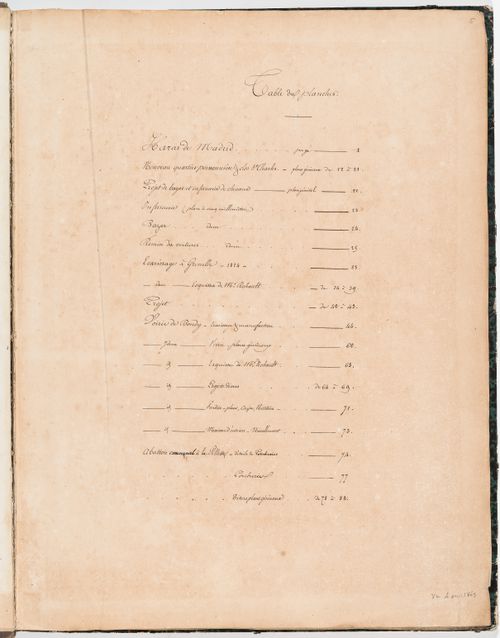
- This album contains drawings by Hubert and Charles Rohault de Fleury for six projects related to horses, with some pertaining to larger issues of urban development. The drawings range from design development drawings to highly finished renderings - mostly plans, elevations and sections. The proposed projects are in a pared-down classical style typical of the Rohault de Fleury's utilitarian structures. The projects include a stud-farm, Haras de Madrid, Bois de Boulogne (1819); a horse auction house (bazaar) and infirmary, Clos St. Charles, nouveau quartier Poissonnière, including studies for the development of the quartier (1823-1825); Clos d'équarrissage, fôret de Bondy (probably 1825-1827); and three projects for horse slaughterhouses: Plaine de Grenelle (1824), an unnamed project (probably between 1825 and 1827), and La Villette (1835-1836). Hubert's project for a stud-farm on the site of the old Château de Madrid consists mostly of highly finished plans, elevations, and sections for the stables (DR1974:0002:014:001 - DR1974:0002:014:013). Hubert's project for a horse auction house (bazaar) and infirmary for the Clos St. Charles area is apparently part of a larger project to develop the nouveau quartier Poissonnière (DR1974:0002:014:014 - DR1974:0002:014:029). The numerous site plans show the horse auction house (bazaar) and infirmary, proposed roads, and properties to be purchased and sold. Included is a property lots plan for the quartier (DR1974:0002:014:014). Hubert's Clos d'équarrissage is the most extensive project in the album. Forty-three finished drawings - including construction drawings and plans showing variant configurations for the disposition of buildings - depict a slaughterhouse, a factory for the preservation of muscles, buildings for the preservation and processing of offal, and workers' housing (DR1974:0002:014:051 - DR1974:0002:014:088, DR1974:0002:014:091 - DR1974:0002:014:093, DR1974:0002:014:095 and DR1974:002:014:096). Hubert's drawings for a horse slaughterhouse, Plaine de Grenelle, range from detailed design development drawings to highly finished site plans (DR1974:0002:014:030 - DR1974:0002:014:048) and a bird's-eye view of the slaughterhouse (DR1974:0002:014:033). The drawings for an unidentified slaughterhouse are possibly for this project (DR1974:0002:014:049 - DR1974:0002:014:051). Charles's project for a slaughterhouse at La Villette consists of variant site plans (DR1974:0002:014:089 - DR1974:00002:014:090, DR1974:0002:014:095, DR1974:0002:014:104).
DR1974:0002:014:001-104
Description:
- This album contains drawings by Hubert and Charles Rohault de Fleury for six projects related to horses, with some pertaining to larger issues of urban development. The drawings range from design development drawings to highly finished renderings - mostly plans, elevations and sections. The proposed projects are in a pared-down classical style typical of the Rohault de Fleury's utilitarian structures. The projects include a stud-farm, Haras de Madrid, Bois de Boulogne (1819); a horse auction house (bazaar) and infirmary, Clos St. Charles, nouveau quartier Poissonnière, including studies for the development of the quartier (1823-1825); Clos d'équarrissage, fôret de Bondy (probably 1825-1827); and three projects for horse slaughterhouses: Plaine de Grenelle (1824), an unnamed project (probably between 1825 and 1827), and La Villette (1835-1836). Hubert's project for a stud-farm on the site of the old Château de Madrid consists mostly of highly finished plans, elevations, and sections for the stables (DR1974:0002:014:001 - DR1974:0002:014:013). Hubert's project for a horse auction house (bazaar) and infirmary for the Clos St. Charles area is apparently part of a larger project to develop the nouveau quartier Poissonnière (DR1974:0002:014:014 - DR1974:0002:014:029). The numerous site plans show the horse auction house (bazaar) and infirmary, proposed roads, and properties to be purchased and sold. Included is a property lots plan for the quartier (DR1974:0002:014:014). Hubert's Clos d'équarrissage is the most extensive project in the album. Forty-three finished drawings - including construction drawings and plans showing variant configurations for the disposition of buildings - depict a slaughterhouse, a factory for the preservation of muscles, buildings for the preservation and processing of offal, and workers' housing (DR1974:0002:014:051 - DR1974:0002:014:088, DR1974:0002:014:091 - DR1974:0002:014:093, DR1974:0002:014:095 and DR1974:002:014:096). Hubert's drawings for a horse slaughterhouse, Plaine de Grenelle, range from detailed design development drawings to highly finished site plans (DR1974:0002:014:030 - DR1974:0002:014:048) and a bird's-eye view of the slaughterhouse (DR1974:0002:014:033). The drawings for an unidentified slaughterhouse are possibly for this project (DR1974:0002:014:049 - DR1974:0002:014:051). Charles's project for a slaughterhouse at La Villette consists of variant site plans (DR1974:0002:014:089 - DR1974:00002:014:090, DR1974:0002:014:095, DR1974:0002:014:104).
Personnes et institutions:
Sujet:
architecture, urbanisme
architecture, urbanisme
Date:
1835-1836, printed 1819-1827 ?
1835-1836, printed 1819-1827 ?
Titre:
Album of drawings for six projects related to horses: a stud-farm, an auction house and infirmary, and slaughterhouses, France
Actions:
DR1974:0002:014:001-104
Description:
- This album contains drawings by Hubert and Charles Rohault de Fleury for six projects related to horses, with some pertaining to larger issues of urban development. The drawings range from design development drawings to highly finished renderings - mostly plans, elevations and sections. The proposed projects are in a pared-down classical style typical of the Rohault de Fleury's utilitarian structures. The projects include a stud-farm, Haras de Madrid, Bois de Boulogne (1819); a horse auction house (bazaar) and infirmary, Clos St. Charles, nouveau quartier Poissonnière, including studies for the development of the quartier (1823-1825); Clos d'équarrissage, fôret de Bondy (probably 1825-1827); and three projects for horse slaughterhouses: Plaine de Grenelle (1824), an unnamed project (probably between 1825 and 1827), and La Villette (1835-1836). Hubert's project for a stud-farm on the site of the old Château de Madrid consists mostly of highly finished plans, elevations, and sections for the stables (DR1974:0002:014:001 - DR1974:0002:014:013). Hubert's project for a horse auction house (bazaar) and infirmary for the Clos St. Charles area is apparently part of a larger project to develop the nouveau quartier Poissonnière (DR1974:0002:014:014 - DR1974:0002:014:029). The numerous site plans show the horse auction house (bazaar) and infirmary, proposed roads, and properties to be purchased and sold. Included is a property lots plan for the quartier (DR1974:0002:014:014). Hubert's Clos d'équarrissage is the most extensive project in the album. Forty-three finished drawings - including construction drawings and plans showing variant configurations for the disposition of buildings - depict a slaughterhouse, a factory for the preservation of muscles, buildings for the preservation and processing of offal, and workers' housing (DR1974:0002:014:051 - DR1974:0002:014:088, DR1974:0002:014:091 - DR1974:0002:014:093, DR1974:0002:014:095 and DR1974:002:014:096). Hubert's drawings for a horse slaughterhouse, Plaine de Grenelle, range from detailed design development drawings to highly finished site plans (DR1974:0002:014:030 - DR1974:0002:014:048) and a bird's-eye view of the slaughterhouse (DR1974:0002:014:033). The drawings for an unidentified slaughterhouse are possibly for this project (DR1974:0002:014:049 - DR1974:0002:014:051). Charles's project for a slaughterhouse at La Villette consists of variant site plans (DR1974:0002:014:089 - DR1974:00002:014:090, DR1974:0002:014:095, DR1974:0002:014:104).
Album of drawings for six projects related to horses: a stud-farm, an auction house and infirmary, and slaughterhouses, France
Actions:
DR1974:0002:014:001-104
Description:
- This album contains drawings by Hubert and Charles Rohault de Fleury for six projects related to horses, with some pertaining to larger issues of urban development. The drawings range from design development drawings to highly finished renderings - mostly plans, elevations and sections. The proposed projects are in a pared-down classical style typical of the Rohault de Fleury's utilitarian structures. The projects include a stud-farm, Haras de Madrid, Bois de Boulogne (1819); a horse auction house (bazaar) and infirmary, Clos St. Charles, nouveau quartier Poissonnière, including studies for the development of the quartier (1823-1825); Clos d'équarrissage, fôret de Bondy (probably 1825-1827); and three projects for horse slaughterhouses: Plaine de Grenelle (1824), an unnamed project (probably between 1825 and 1827), and La Villette (1835-1836). Hubert's project for a stud-farm on the site of the old Château de Madrid consists mostly of highly finished plans, elevations, and sections for the stables (DR1974:0002:014:001 - DR1974:0002:014:013). Hubert's project for a horse auction house (bazaar) and infirmary for the Clos St. Charles area is apparently part of a larger project to develop the nouveau quartier Poissonnière (DR1974:0002:014:014 - DR1974:0002:014:029). The numerous site plans show the horse auction house (bazaar) and infirmary, proposed roads, and properties to be purchased and sold. Included is a property lots plan for the quartier (DR1974:0002:014:014). Hubert's Clos d'équarrissage is the most extensive project in the album. Forty-three finished drawings - including construction drawings and plans showing variant configurations for the disposition of buildings - depict a slaughterhouse, a factory for the preservation of muscles, buildings for the preservation and processing of offal, and workers' housing (DR1974:0002:014:051 - DR1974:0002:014:088, DR1974:0002:014:091 - DR1974:0002:014:093, DR1974:0002:014:095 and DR1974:002:014:096). Hubert's drawings for a horse slaughterhouse, Plaine de Grenelle, range from detailed design development drawings to highly finished site plans (DR1974:0002:014:030 - DR1974:0002:014:048) and a bird's-eye view of the slaughterhouse (DR1974:0002:014:033). The drawings for an unidentified slaughterhouse are possibly for this project (DR1974:0002:014:049 - DR1974:0002:014:051). Charles's project for a slaughterhouse at La Villette consists of variant site plans (DR1974:0002:014:089 - DR1974:00002:014:090, DR1974:0002:014:095, DR1974:0002:014:104).
Classification:
dessins, oeuvres d'art
dessins, oeuvres d'art
Date:
1835-1836, printed 1819-1827 ?
1835-1836, printed 1819-1827 ?
Personnes et institutions:
Sujet:
architecture, urbanisme
architecture, urbanisme
Actions:
Numéro de référence:
PH1979:0508
Description:
This album depicts photographs, plans, sketches of Stonehenge and texts. Preface is signed by Sir Henry James, 29th May 1867, Southhampton. Album has appendix and List of Books inserted at the end. "Col. Sir Henry James, Director-General of the Ordnance Survey, was a strong believer that photography had to be utilized as a major tool for mapping and survey work and he employed the Royal Engineers for that purpose. Colonel James appears in several of the Stonehenge photographs published by the Ordnance Survey. [...] Stonehenge is the world's most famous, large megalithic stone circle and is usually designated as a site used for religious worship in Neolithic Britain. However, the first use of this locality for documented ritual activity goes back to the Mesolithic and the erection of several large totem poles perhaps as early as 8,000 BC (Stonehenge O). Lunar observations preceded the construction of a causeway c.3200 BC, followed by an earth circle and Heel Stones c.3100 BC (Stonehenge 1a) and the Aubrey Holes (Stonehenge 1b). The Stonehenge site was then abandoned for about 1,000 years when large bluestones quarried in Wales were brought to the site and made into the Double Bluestone Circle with Avenue. 2150 BC (Stonehenge II). Soon thereafter sarsen stones were brought in from Avebury to build the great Sarsen Circle and Trilithon Horseshoe, 2100 BC (Stonehenge IIIz). Bluestones were brought back and added as the Bluestone Circle and Bluestone Horseshoe to the sarsen monument, 1800 BC (Stonehenge IIId). The sacred avenue was extended to the River Avon, 1100 BC (Stonehenge IV), the last phase of megalithic construction at this site. Note that the great stone circle and all construction at the Stonehenge site was completed several hundred years before we can postulate Celtic druids in the vicinity. We can only mention in passing that Stonehenge was embedded within a large ritual complex, where several of the ten megalithic constructions were also monumental in scale. Integration between these structures may not have been well planned in advance, but assuredly was articulated as each was built." Neolithic Britian Online.
PH1979:0508
Description:
This album depicts photographs, plans, sketches of Stonehenge and texts. Preface is signed by Sir Henry James, 29th May 1867, Southhampton. Album has appendix and List of Books inserted at the end. "Col. Sir Henry James, Director-General of the Ordnance Survey, was a strong believer that photography had to be utilized as a major tool for mapping and survey work and he employed the Royal Engineers for that purpose. Colonel James appears in several of the Stonehenge photographs published by the Ordnance Survey. [...] Stonehenge is the world's most famous, large megalithic stone circle and is usually designated as a site used for religious worship in Neolithic Britain. However, the first use of this locality for documented ritual activity goes back to the Mesolithic and the erection of several large totem poles perhaps as early as 8,000 BC (Stonehenge O). Lunar observations preceded the construction of a causeway c.3200 BC, followed by an earth circle and Heel Stones c.3100 BC (Stonehenge 1a) and the Aubrey Holes (Stonehenge 1b). The Stonehenge site was then abandoned for about 1,000 years when large bluestones quarried in Wales were brought to the site and made into the Double Bluestone Circle with Avenue. 2150 BC (Stonehenge II). Soon thereafter sarsen stones were brought in from Avebury to build the great Sarsen Circle and Trilithon Horseshoe, 2100 BC (Stonehenge IIIz). Bluestones were brought back and added as the Bluestone Circle and Bluestone Horseshoe to the sarsen monument, 1800 BC (Stonehenge IIId). The sacred avenue was extended to the River Avon, 1100 BC (Stonehenge IV), the last phase of megalithic construction at this site. Note that the great stone circle and all construction at the Stonehenge site was completed several hundred years before we can postulate Celtic druids in the vicinity. We can only mention in passing that Stonehenge was embedded within a large ritual complex, where several of the ten megalithic constructions were also monumental in scale. Integration between these structures may not have been well planned in advance, but assuredly was articulated as each was built." Neolithic Britian Online.
Personnes et institutions:
Sujet:
sculpture, topographique
sculpture, topographique
Date:
1867
1867
Titre:
Plans and Photographs of Stonehenge, and of Turusachan in the Island of Lewis; with Notes Relating to the Druids and Sketches of Cromlechs in Ireland
Actions:
PH1979:0508
Description:
This album depicts photographs, plans, sketches of Stonehenge and texts. Preface is signed by Sir Henry James, 29th May 1867, Southhampton. Album has appendix and List of Books inserted at the end. "Col. Sir Henry James, Director-General of the Ordnance Survey, was a strong believer that photography had to be utilized as a major tool for mapping and survey work and he employed the Royal Engineers for that purpose. Colonel James appears in several of the Stonehenge photographs published by the Ordnance Survey. [...] Stonehenge is the world's most famous, large megalithic stone circle and is usually designated as a site used for religious worship in Neolithic Britain. However, the first use of this locality for documented ritual activity goes back to the Mesolithic and the erection of several large totem poles perhaps as early as 8,000 BC (Stonehenge O). Lunar observations preceded the construction of a causeway c.3200 BC, followed by an earth circle and Heel Stones c.3100 BC (Stonehenge 1a) and the Aubrey Holes (Stonehenge 1b). The Stonehenge site was then abandoned for about 1,000 years when large bluestones quarried in Wales were brought to the site and made into the Double Bluestone Circle with Avenue. 2150 BC (Stonehenge II). Soon thereafter sarsen stones were brought in from Avebury to build the great Sarsen Circle and Trilithon Horseshoe, 2100 BC (Stonehenge IIIz). Bluestones were brought back and added as the Bluestone Circle and Bluestone Horseshoe to the sarsen monument, 1800 BC (Stonehenge IIId). The sacred avenue was extended to the River Avon, 1100 BC (Stonehenge IV), the last phase of megalithic construction at this site. Note that the great stone circle and all construction at the Stonehenge site was completed several hundred years before we can postulate Celtic druids in the vicinity. We can only mention in passing that Stonehenge was embedded within a large ritual complex, where several of the ten megalithic constructions were also monumental in scale. Integration between these structures may not have been well planned in advance, but assuredly was articulated as each was built." Neolithic Britian Online.
Plans and Photographs of Stonehenge, and of Turusachan in the Island of Lewis; with Notes Relating to the Druids and Sketches of Cromlechs in Ireland
Actions:
PH1979:0508
Description:
This album depicts photographs, plans, sketches of Stonehenge and texts. Preface is signed by Sir Henry James, 29th May 1867, Southhampton. Album has appendix and List of Books inserted at the end. "Col. Sir Henry James, Director-General of the Ordnance Survey, was a strong believer that photography had to be utilized as a major tool for mapping and survey work and he employed the Royal Engineers for that purpose. Colonel James appears in several of the Stonehenge photographs published by the Ordnance Survey. [...] Stonehenge is the world's most famous, large megalithic stone circle and is usually designated as a site used for religious worship in Neolithic Britain. However, the first use of this locality for documented ritual activity goes back to the Mesolithic and the erection of several large totem poles perhaps as early as 8,000 BC (Stonehenge O). Lunar observations preceded the construction of a causeway c.3200 BC, followed by an earth circle and Heel Stones c.3100 BC (Stonehenge 1a) and the Aubrey Holes (Stonehenge 1b). The Stonehenge site was then abandoned for about 1,000 years when large bluestones quarried in Wales were brought to the site and made into the Double Bluestone Circle with Avenue. 2150 BC (Stonehenge II). Soon thereafter sarsen stones were brought in from Avebury to build the great Sarsen Circle and Trilithon Horseshoe, 2100 BC (Stonehenge IIIz). Bluestones were brought back and added as the Bluestone Circle and Bluestone Horseshoe to the sarsen monument, 1800 BC (Stonehenge IIId). The sacred avenue was extended to the River Avon, 1100 BC (Stonehenge IV), the last phase of megalithic construction at this site. Note that the great stone circle and all construction at the Stonehenge site was completed several hundred years before we can postulate Celtic druids in the vicinity. We can only mention in passing that Stonehenge was embedded within a large ritual complex, where several of the ten megalithic constructions were also monumental in scale. Integration between these structures may not have been well planned in advance, but assuredly was articulated as each was built." Neolithic Britian Online.
Date:
1867
1867
Personnes et institutions:
Sujet:
sculpture, topographique
sculpture, topographique
Classification:
dessins, documents textuels, oeuvres d'art
dessins, documents textuels, oeuvres d'art
Actions:
Numéro de référence:
DR1974:0002:011:001-089
Description:
- This album contains mostly design development and presentation drawings for the conversion or renovation of several Parisan hôtel particuliers by Hubert Rohault de Fleury, and for the Rohault de Fleury family house, 12-14 rue d'Aguesseau, Paris. Also included are four prints of British country seats. The drawings - mostly plans - for hôtel particuliers include: alterations to the Hôtel du ministère de la Guerre, perhaps the initial conversion of the Hôtel du Maine into government offices (DR1974:0002:011:003 - DR1974:0002:011:005); alterations to Hôtel de Rothelin-Charolais (Hôtel de Conti) as offices for the Ministère de l'intérieur (DR1974:0002:011:006 - DR1974:0002:011:009); the conversion of Hôtel de Soyécourt into gendarmerie barracks (DR1974:0002:011:017 - DR1974:0002:011:027 and DR1974:0002:011:089); and the alterations to Hôtel de la Colonnade (Grand and Petit Hôtels de Wagram) as offices for the Ministère des affaires étrangères (DR1974:0002:011:028 - DR1974:0002:011:042). Letter DR1974:0002:011:037 R/V apparently concerns the alterations to Hôtel de la Colonnade. The album contains drawings for several other hôtels - Hôtel de Lorge, Petit hôtel de Nivernais, Hôtel de Bouillon, and an hôtel on rue des Quatre-Fils. The purpose of these drawings has not been determined. Drawings for the Rohault de Fleury family house include: 22 graphite design development drawings with dimensions, calculations and notes - mostly plans and elevations; seven finished watercolour presentation drawings - plans, sections and elevations; two interior perspectives; and one drawing for the roof structures (DR1974:0002:011:050 - DR1974:0002:011:083). The coloured sections and the interior perspective drawings show the Empire style interior decoration, including furnishings (DR1974:0002:011:080 - DR1974:0002:011:082 R and DR1974:0002:011:083 R). The four prints are part of a series of views of English country seats by William Henry Toms after Thomas Badeslade and William Winstanley printed during the mid 18th century: Hawarden Castle and the adjacent Broadlane Hall, Wales, seat of Sir John Glynne; Erddig (house), Wales, seat of Simon Yorke; Hather Thorpe (house), Lincolnshire, England, seat of Sir Michael Newton; and Rushton Hall, Northamptonshire, England, seat of Viscount Cullen (DR1974:0002:011:085 - DR1974:0002:011:088). The album also includes: three drawings for a château for M. le marquis de la Sainte-Aulaire, designed by Perrot, the first of which is possibly for proposed additions by Hubert Rohault de Fleury (DR1974:0002:011:013); an elevation for a temporary altar; a cost estimate for a country cottage; six drawings for an unidentified country house; and a site plan of the village [?] and vicinity of Chailly, France for Mr. Pierre Jacques Le Roy.
DR1974:0002:011:001-089
Description:
- This album contains mostly design development and presentation drawings for the conversion or renovation of several Parisan hôtel particuliers by Hubert Rohault de Fleury, and for the Rohault de Fleury family house, 12-14 rue d'Aguesseau, Paris. Also included are four prints of British country seats. The drawings - mostly plans - for hôtel particuliers include: alterations to the Hôtel du ministère de la Guerre, perhaps the initial conversion of the Hôtel du Maine into government offices (DR1974:0002:011:003 - DR1974:0002:011:005); alterations to Hôtel de Rothelin-Charolais (Hôtel de Conti) as offices for the Ministère de l'intérieur (DR1974:0002:011:006 - DR1974:0002:011:009); the conversion of Hôtel de Soyécourt into gendarmerie barracks (DR1974:0002:011:017 - DR1974:0002:011:027 and DR1974:0002:011:089); and the alterations to Hôtel de la Colonnade (Grand and Petit Hôtels de Wagram) as offices for the Ministère des affaires étrangères (DR1974:0002:011:028 - DR1974:0002:011:042). Letter DR1974:0002:011:037 R/V apparently concerns the alterations to Hôtel de la Colonnade. The album contains drawings for several other hôtels - Hôtel de Lorge, Petit hôtel de Nivernais, Hôtel de Bouillon, and an hôtel on rue des Quatre-Fils. The purpose of these drawings has not been determined. Drawings for the Rohault de Fleury family house include: 22 graphite design development drawings with dimensions, calculations and notes - mostly plans and elevations; seven finished watercolour presentation drawings - plans, sections and elevations; two interior perspectives; and one drawing for the roof structures (DR1974:0002:011:050 - DR1974:0002:011:083). The coloured sections and the interior perspective drawings show the Empire style interior decoration, including furnishings (DR1974:0002:011:080 - DR1974:0002:011:082 R and DR1974:0002:011:083 R). The four prints are part of a series of views of English country seats by William Henry Toms after Thomas Badeslade and William Winstanley printed during the mid 18th century: Hawarden Castle and the adjacent Broadlane Hall, Wales, seat of Sir John Glynne; Erddig (house), Wales, seat of Simon Yorke; Hather Thorpe (house), Lincolnshire, England, seat of Sir Michael Newton; and Rushton Hall, Northamptonshire, England, seat of Viscount Cullen (DR1974:0002:011:085 - DR1974:0002:011:088). The album also includes: three drawings for a château for M. le marquis de la Sainte-Aulaire, designed by Perrot, the first of which is possibly for proposed additions by Hubert Rohault de Fleury (DR1974:0002:011:013); an elevation for a temporary altar; a cost estimate for a country cottage; six drawings for an unidentified country house; and a site plan of the village [?] and vicinity of Chailly, France for Mr. Pierre Jacques Le Roy.
Personnes et institutions:
Sujet:
architecture, architecture de paysage, architecture temporaire, design d'intérieur, militaire, topographique
architecture, architecture de paysage, architecture temporaire, design d'intérieur, militaire, topographique
Date:
1755-1849, manuscripts written between 1792-1849, printed between ca. 1740-1849
1755-1849, manuscripts written between 1792-1849, printed between ca. 1740-1849
Titre:
Album of drawings for alterations to several Parisian hôtel particuliers and the Rohault de Fleury family house, rue d'Aguesseau, Paris, and of prints of English country seats
Actions:
DR1974:0002:011:001-089
Description:
- This album contains mostly design development and presentation drawings for the conversion or renovation of several Parisan hôtel particuliers by Hubert Rohault de Fleury, and for the Rohault de Fleury family house, 12-14 rue d'Aguesseau, Paris. Also included are four prints of British country seats. The drawings - mostly plans - for hôtel particuliers include: alterations to the Hôtel du ministère de la Guerre, perhaps the initial conversion of the Hôtel du Maine into government offices (DR1974:0002:011:003 - DR1974:0002:011:005); alterations to Hôtel de Rothelin-Charolais (Hôtel de Conti) as offices for the Ministère de l'intérieur (DR1974:0002:011:006 - DR1974:0002:011:009); the conversion of Hôtel de Soyécourt into gendarmerie barracks (DR1974:0002:011:017 - DR1974:0002:011:027 and DR1974:0002:011:089); and the alterations to Hôtel de la Colonnade (Grand and Petit Hôtels de Wagram) as offices for the Ministère des affaires étrangères (DR1974:0002:011:028 - DR1974:0002:011:042). Letter DR1974:0002:011:037 R/V apparently concerns the alterations to Hôtel de la Colonnade. The album contains drawings for several other hôtels - Hôtel de Lorge, Petit hôtel de Nivernais, Hôtel de Bouillon, and an hôtel on rue des Quatre-Fils. The purpose of these drawings has not been determined. Drawings for the Rohault de Fleury family house include: 22 graphite design development drawings with dimensions, calculations and notes - mostly plans and elevations; seven finished watercolour presentation drawings - plans, sections and elevations; two interior perspectives; and one drawing for the roof structures (DR1974:0002:011:050 - DR1974:0002:011:083). The coloured sections and the interior perspective drawings show the Empire style interior decoration, including furnishings (DR1974:0002:011:080 - DR1974:0002:011:082 R and DR1974:0002:011:083 R). The four prints are part of a series of views of English country seats by William Henry Toms after Thomas Badeslade and William Winstanley printed during the mid 18th century: Hawarden Castle and the adjacent Broadlane Hall, Wales, seat of Sir John Glynne; Erddig (house), Wales, seat of Simon Yorke; Hather Thorpe (house), Lincolnshire, England, seat of Sir Michael Newton; and Rushton Hall, Northamptonshire, England, seat of Viscount Cullen (DR1974:0002:011:085 - DR1974:0002:011:088). The album also includes: three drawings for a château for M. le marquis de la Sainte-Aulaire, designed by Perrot, the first of which is possibly for proposed additions by Hubert Rohault de Fleury (DR1974:0002:011:013); an elevation for a temporary altar; a cost estimate for a country cottage; six drawings for an unidentified country house; and a site plan of the village [?] and vicinity of Chailly, France for Mr. Pierre Jacques Le Roy.
Album of drawings for alterations to several Parisian hôtel particuliers and the Rohault de Fleury family house, rue d'Aguesseau, Paris, and of prints of English country seats
Actions:
DR1974:0002:011:001-089
Description:
- This album contains mostly design development and presentation drawings for the conversion or renovation of several Parisan hôtel particuliers by Hubert Rohault de Fleury, and for the Rohault de Fleury family house, 12-14 rue d'Aguesseau, Paris. Also included are four prints of British country seats. The drawings - mostly plans - for hôtel particuliers include: alterations to the Hôtel du ministère de la Guerre, perhaps the initial conversion of the Hôtel du Maine into government offices (DR1974:0002:011:003 - DR1974:0002:011:005); alterations to Hôtel de Rothelin-Charolais (Hôtel de Conti) as offices for the Ministère de l'intérieur (DR1974:0002:011:006 - DR1974:0002:011:009); the conversion of Hôtel de Soyécourt into gendarmerie barracks (DR1974:0002:011:017 - DR1974:0002:011:027 and DR1974:0002:011:089); and the alterations to Hôtel de la Colonnade (Grand and Petit Hôtels de Wagram) as offices for the Ministère des affaires étrangères (DR1974:0002:011:028 - DR1974:0002:011:042). Letter DR1974:0002:011:037 R/V apparently concerns the alterations to Hôtel de la Colonnade. The album contains drawings for several other hôtels - Hôtel de Lorge, Petit hôtel de Nivernais, Hôtel de Bouillon, and an hôtel on rue des Quatre-Fils. The purpose of these drawings has not been determined. Drawings for the Rohault de Fleury family house include: 22 graphite design development drawings with dimensions, calculations and notes - mostly plans and elevations; seven finished watercolour presentation drawings - plans, sections and elevations; two interior perspectives; and one drawing for the roof structures (DR1974:0002:011:050 - DR1974:0002:011:083). The coloured sections and the interior perspective drawings show the Empire style interior decoration, including furnishings (DR1974:0002:011:080 - DR1974:0002:011:082 R and DR1974:0002:011:083 R). The four prints are part of a series of views of English country seats by William Henry Toms after Thomas Badeslade and William Winstanley printed during the mid 18th century: Hawarden Castle and the adjacent Broadlane Hall, Wales, seat of Sir John Glynne; Erddig (house), Wales, seat of Simon Yorke; Hather Thorpe (house), Lincolnshire, England, seat of Sir Michael Newton; and Rushton Hall, Northamptonshire, England, seat of Viscount Cullen (DR1974:0002:011:085 - DR1974:0002:011:088). The album also includes: three drawings for a château for M. le marquis de la Sainte-Aulaire, designed by Perrot, the first of which is possibly for proposed additions by Hubert Rohault de Fleury (DR1974:0002:011:013); an elevation for a temporary altar; a cost estimate for a country cottage; six drawings for an unidentified country house; and a site plan of the village [?] and vicinity of Chailly, France for Mr. Pierre Jacques Le Roy.
Classification:
dessins, documents textuels, oeuvres d'art
dessins, documents textuels, oeuvres d'art
Date:
1755-1849, manuscripts written between 1792-1849, printed between ca. 1740-1849
1755-1849, manuscripts written between 1792-1849, printed between ca. 1740-1849
Personnes et institutions:
Sujet:
architecture, architecture de paysage, architecture temporaire, design d'intérieur, militaire, topographique
architecture, architecture de paysage, architecture temporaire, design d'intérieur, militaire, topographique
Classification:
dessins
dessins
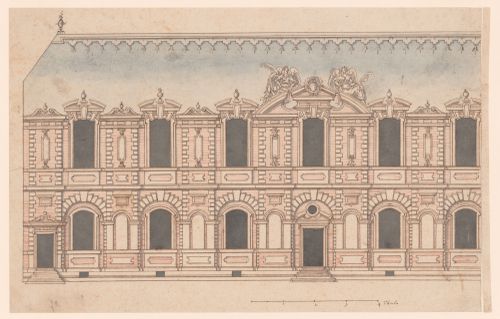
Titre:
Elevation of a palace façade
Elevation of a palace façade
Actions:
Numéro de référence:
DR1970:0003
Description:
This drawing shows an exterior of a residential building. The artist uses color to suggest the materials used in construction; blue-grey for the pitched slate roof, brown for masonry details and architectural sculpture, and red striations for brickwork. This combination of materials was common in early modern France, where a play on color and materiality enlivened the façades of well-known royal edifices including the chateaux of Fontainebleau and Saint-Germain-en-Laye. As with the construction technique that interwove stone with brick, the architectural style depicted in the drawing combines traditional French ideas about building with classicizing elements imported to France via Italian artists and architects as well as through printed translations of Vitruvius’s 'De architectura' and Sebastiano Serlio’s architectural treatise. The inclusion of masonry rustication and the decorative urns that punctuate the roofline suggest a knowledge of classicizing trends in architectural ornament and a familiarity with the œuvre of artists working in the circle of the first and second Écoles de Fontainebleau. The structure’s elongated form suggests a gallery and the organization of the façade borrows the combination of slightly protruding vertical bays and long horizontal registers that characterizes Pierre Lescot’s wing of the Louvre, a project that would have been well-known in court circles in the latter half of the sixteenth century. Similarly, the two winged allegorical figures flanking the central pediment are reminiscent of Jean Goujon’s sculptural additions to the Lescot wing. In the Canadian Centre for Architecture’s drawing both figures hold palms, but the artist omitted any further identifying attributes, perhaps – along with the empty niches – as an invitation for the patron to imagine his or her own thematic program for the project.
DR1970:0003
Description:
This drawing shows an exterior of a residential building. The artist uses color to suggest the materials used in construction; blue-grey for the pitched slate roof, brown for masonry details and architectural sculpture, and red striations for brickwork. This combination of materials was common in early modern France, where a play on color and materiality enlivened the façades of well-known royal edifices including the chateaux of Fontainebleau and Saint-Germain-en-Laye. As with the construction technique that interwove stone with brick, the architectural style depicted in the drawing combines traditional French ideas about building with classicizing elements imported to France via Italian artists and architects as well as through printed translations of Vitruvius’s 'De architectura' and Sebastiano Serlio’s architectural treatise. The inclusion of masonry rustication and the decorative urns that punctuate the roofline suggest a knowledge of classicizing trends in architectural ornament and a familiarity with the œuvre of artists working in the circle of the first and second Écoles de Fontainebleau. The structure’s elongated form suggests a gallery and the organization of the façade borrows the combination of slightly protruding vertical bays and long horizontal registers that characterizes Pierre Lescot’s wing of the Louvre, a project that would have been well-known in court circles in the latter half of the sixteenth century. Similarly, the two winged allegorical figures flanking the central pediment are reminiscent of Jean Goujon’s sculptural additions to the Lescot wing. In the Canadian Centre for Architecture’s drawing both figures hold palms, but the artist omitted any further identifying attributes, perhaps – along with the empty niches – as an invitation for the patron to imagine his or her own thematic program for the project.
Personnes et institutions:
Date:
first quarter of the 16th century
first quarter of the 16th century
Titre:
Elevation of a palace façade
Actions:
DR1970:0003
Description:
This drawing shows an exterior of a residential building. The artist uses color to suggest the materials used in construction; blue-grey for the pitched slate roof, brown for masonry details and architectural sculpture, and red striations for brickwork. This combination of materials was common in early modern France, where a play on color and materiality enlivened the façades of well-known royal edifices including the chateaux of Fontainebleau and Saint-Germain-en-Laye. As with the construction technique that interwove stone with brick, the architectural style depicted in the drawing combines traditional French ideas about building with classicizing elements imported to France via Italian artists and architects as well as through printed translations of Vitruvius’s 'De architectura' and Sebastiano Serlio’s architectural treatise. The inclusion of masonry rustication and the decorative urns that punctuate the roofline suggest a knowledge of classicizing trends in architectural ornament and a familiarity with the œuvre of artists working in the circle of the first and second Écoles de Fontainebleau. The structure’s elongated form suggests a gallery and the organization of the façade borrows the combination of slightly protruding vertical bays and long horizontal registers that characterizes Pierre Lescot’s wing of the Louvre, a project that would have been well-known in court circles in the latter half of the sixteenth century. Similarly, the two winged allegorical figures flanking the central pediment are reminiscent of Jean Goujon’s sculptural additions to the Lescot wing. In the Canadian Centre for Architecture’s drawing both figures hold palms, but the artist omitted any further identifying attributes, perhaps – along with the empty niches – as an invitation for the patron to imagine his or her own thematic program for the project.
Elevation of a palace façade
Actions:
DR1970:0003
Description:
This drawing shows an exterior of a residential building. The artist uses color to suggest the materials used in construction; blue-grey for the pitched slate roof, brown for masonry details and architectural sculpture, and red striations for brickwork. This combination of materials was common in early modern France, where a play on color and materiality enlivened the façades of well-known royal edifices including the chateaux of Fontainebleau and Saint-Germain-en-Laye. As with the construction technique that interwove stone with brick, the architectural style depicted in the drawing combines traditional French ideas about building with classicizing elements imported to France via Italian artists and architects as well as through printed translations of Vitruvius’s 'De architectura' and Sebastiano Serlio’s architectural treatise. The inclusion of masonry rustication and the decorative urns that punctuate the roofline suggest a knowledge of classicizing trends in architectural ornament and a familiarity with the œuvre of artists working in the circle of the first and second Écoles de Fontainebleau. The structure’s elongated form suggests a gallery and the organization of the façade borrows the combination of slightly protruding vertical bays and long horizontal registers that characterizes Pierre Lescot’s wing of the Louvre, a project that would have been well-known in court circles in the latter half of the sixteenth century. Similarly, the two winged allegorical figures flanking the central pediment are reminiscent of Jean Goujon’s sculptural additions to the Lescot wing. In the Canadian Centre for Architecture’s drawing both figures hold palms, but the artist omitted any further identifying attributes, perhaps – along with the empty niches – as an invitation for the patron to imagine his or her own thematic program for the project.
Classification:
dessins
dessins
Date:
first quarter of the 16th century
first quarter of the 16th century
Personnes et institutions:
Classification:
artéfacts
artéfacts
Titre:
[Structure]
[Structure]
Actions:
Exemplaires:
Description:
1 model : mixed metal ; 4 x 7 x 4 cm
Description:
1 model : mixed metal ; 4 x 7 x 4 cm
Sujet:
Publication:
[approximately 1920] ([United States? : publisher not identified])
[approximately 1920] ([United States? : publisher not identified])
Classification:
artéfacts
artéfacts
Publication:
[approximately 1920] ([United States? : publisher not identified])
[approximately 1920] ([United States? : publisher not identified])
Sujet:


