


44148 Résultats
Niveau de description archivistique:
Sous-série
Sous-série
Numéro de référence:
AP178.S1.2002.PR05.SS1
Description:
This project subseries documents the Parque de Vidago Complexo Termal e Hotel Palace in Vidago, Portugal. While the records were held in the office’s archives this project was assigned the number 49/00. The office assigned the date 2002 to this project. The project consisted of major renovations to update and modernize the Vidago Palace Hotel, originally opened in 1910, and the addition of a new thermal spa. Architects José Pedro Lopes Vieira and Diogo Rosa Lã were responsible for the interior decoration of the Palace Hotel, while Siza designed the Spa. The full or partial demolition of some parts of the hotel and nearby buildings was necessary to maintain the original character of the resort. In contrast to the historic hotel, the new spa was contemporary and minimalist with marble interiors. It included pools, Turkish baths, treatment and relaxation rooms, a gym, bars and meditation area. This project subseries is documented through drawings, photographic materials, study models and textual records dating from 2002-2012. These materials primarily document the spa but documentation for the surrounding site, Palace Hotel, Fonte Salus (spring), gatehouse and Serralves exhibition space is also included. The drawings are largely reprographic copies of printed CAD drawings and include sketches, studies, plans, details, sections, elevations, demolition drawings and mechanical, electrical and structural drawings. The textual records include correspondence, meeting minutes, studies, building programs, furniture and spa equipment documentation, budgets and contracts. A large amount of documentation on various electrical, structural and mechanical systems is also included. The photographic materials are mostly printed digital photos showing buildings across the site, pre and post construction work and reference images. There are also a number of photos, postcards and brochures showing historical images of the hotel.
AP178.S1.2002.PR05.SS1
Description:
This project subseries documents the Parque de Vidago Complexo Termal e Hotel Palace in Vidago, Portugal. While the records were held in the office’s archives this project was assigned the number 49/00. The office assigned the date 2002 to this project. The project consisted of major renovations to update and modernize the Vidago Palace Hotel, originally opened in 1910, and the addition of a new thermal spa. Architects José Pedro Lopes Vieira and Diogo Rosa Lã were responsible for the interior decoration of the Palace Hotel, while Siza designed the Spa. The full or partial demolition of some parts of the hotel and nearby buildings was necessary to maintain the original character of the resort. In contrast to the historic hotel, the new spa was contemporary and minimalist with marble interiors. It included pools, Turkish baths, treatment and relaxation rooms, a gym, bars and meditation area. This project subseries is documented through drawings, photographic materials, study models and textual records dating from 2002-2012. These materials primarily document the spa but documentation for the surrounding site, Palace Hotel, Fonte Salus (spring), gatehouse and Serralves exhibition space is also included. The drawings are largely reprographic copies of printed CAD drawings and include sketches, studies, plans, details, sections, elevations, demolition drawings and mechanical, electrical and structural drawings. The textual records include correspondence, meeting minutes, studies, building programs, furniture and spa equipment documentation, budgets and contracts. A large amount of documentation on various electrical, structural and mechanical systems is also included. The photographic materials are mostly printed digital photos showing buildings across the site, pre and post construction work and reference images. There are also a number of photos, postcards and brochures showing historical images of the hotel.
Personnes et institutions:
Date:
2002-2012
2002-2012
Titre:
Parque de Vidago, Complexo Termal e Hotel Palace [Vidago Palace Hotel and Spa], Vidago, Portugal (2002)
Actions:
AP178.S1.2002.PR05.SS1
Description:
This project subseries documents the Parque de Vidago Complexo Termal e Hotel Palace in Vidago, Portugal. While the records were held in the office’s archives this project was assigned the number 49/00. The office assigned the date 2002 to this project. The project consisted of major renovations to update and modernize the Vidago Palace Hotel, originally opened in 1910, and the addition of a new thermal spa. Architects José Pedro Lopes Vieira and Diogo Rosa Lã were responsible for the interior decoration of the Palace Hotel, while Siza designed the Spa. The full or partial demolition of some parts of the hotel and nearby buildings was necessary to maintain the original character of the resort. In contrast to the historic hotel, the new spa was contemporary and minimalist with marble interiors. It included pools, Turkish baths, treatment and relaxation rooms, a gym, bars and meditation area. This project subseries is documented through drawings, photographic materials, study models and textual records dating from 2002-2012. These materials primarily document the spa but documentation for the surrounding site, Palace Hotel, Fonte Salus (spring), gatehouse and Serralves exhibition space is also included. The drawings are largely reprographic copies of printed CAD drawings and include sketches, studies, plans, details, sections, elevations, demolition drawings and mechanical, electrical and structural drawings. The textual records include correspondence, meeting minutes, studies, building programs, furniture and spa equipment documentation, budgets and contracts. A large amount of documentation on various electrical, structural and mechanical systems is also included. The photographic materials are mostly printed digital photos showing buildings across the site, pre and post construction work and reference images. There are also a number of photos, postcards and brochures showing historical images of the hotel.
Parque de Vidago, Complexo Termal e Hotel Palace [Vidago Palace Hotel and Spa], Vidago, Portugal (2002)
Actions:
AP178.S1.2002.PR05.SS1
Description:
This project subseries documents the Parque de Vidago Complexo Termal e Hotel Palace in Vidago, Portugal. While the records were held in the office’s archives this project was assigned the number 49/00. The office assigned the date 2002 to this project. The project consisted of major renovations to update and modernize the Vidago Palace Hotel, originally opened in 1910, and the addition of a new thermal spa. Architects José Pedro Lopes Vieira and Diogo Rosa Lã were responsible for the interior decoration of the Palace Hotel, while Siza designed the Spa. The full or partial demolition of some parts of the hotel and nearby buildings was necessary to maintain the original character of the resort. In contrast to the historic hotel, the new spa was contemporary and minimalist with marble interiors. It included pools, Turkish baths, treatment and relaxation rooms, a gym, bars and meditation area. This project subseries is documented through drawings, photographic materials, study models and textual records dating from 2002-2012. These materials primarily document the spa but documentation for the surrounding site, Palace Hotel, Fonte Salus (spring), gatehouse and Serralves exhibition space is also included. The drawings are largely reprographic copies of printed CAD drawings and include sketches, studies, plans, details, sections, elevations, demolition drawings and mechanical, electrical and structural drawings. The textual records include correspondence, meeting minutes, studies, building programs, furniture and spa equipment documentation, budgets and contracts. A large amount of documentation on various electrical, structural and mechanical systems is also included. The photographic materials are mostly printed digital photos showing buildings across the site, pre and post construction work and reference images. There are also a number of photos, postcards and brochures showing historical images of the hotel.
Niveau de description archivistique:
Project
Project
Date:
2002-2012
2002-2012
Personnes et institutions:
Classification:
événements
événements
Titre:
La connaissance du bâti
La connaissance du bâti
Actions:
Description:
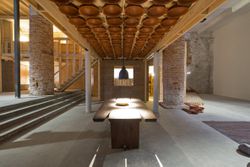
Au cours de cette conférence, Madame Kundoo parlera d’un éventail de projets tirés de sa pratique, de sa recherche et de son enseignement. Dans ces sphères de travail distinctes mais complémentaires, elle tente de bâtir un savoir collectif, en collaboration avec des ingénieurs, des maçons, des dessinateurs, des producteurs d’infrastructure, des résidents, des fournisseurs(...)
Au cours de cette conférence, Madame Kundoo parlera d’un éventail de projets tirés de sa pratique, de sa recherche et de son enseignement. Dans ces sphères de travail distinctes mais complémentaires, elle tente de bâtir un savoir collectif, en collaboration avec des ingénieurs, des maçons, des dessinateurs, des producteurs d’infrastructure, des résidents, des fournisseurs(...)
Localisation:
Théâtre Paul-Desmarais
Théâtre Paul-Desmarais
Date:
16 avril 2015 , 18h
16 avril 2015 , 18h
Titre:
La connaissance du bâti
Actions:
Description:
Au cours de cette conférence, Madame Kundoo parlera d’un éventail de projets tirés de sa pratique, de sa recherche et de son enseignement. Dans ces sphères de travail distinctes mais complémentaires, elle tente de bâtir un savoir collectif, en collaboration avec des ingénieurs, des maçons, des dessinateurs, des producteurs d’infrastructure, des résidents, des fournisseurs(...)
La connaissance du bâti
Actions:
Description:
Au cours de cette conférence, Madame Kundoo parlera d’un éventail de projets tirés de sa pratique, de sa recherche et de son enseignement. Dans ces sphères de travail distinctes mais complémentaires, elle tente de bâtir un savoir collectif, en collaboration avec des ingénieurs, des maçons, des dessinateurs, des producteurs d’infrastructure, des résidents, des fournisseurs(...)
Classification:
événements
événements
Date:
16 avril 2015
18h
16 avril 2015
18h
Localisation:
Théâtre Paul-Desmarais
Théâtre Paul-Desmarais
Classification:
dessins
dessins
Actions:
Numéro de référence:
DR1988:0394
Description:
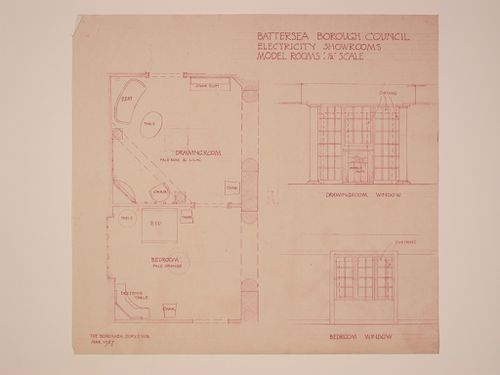
- This plan shows a bedroom and drawing room suite, part of the Electric House showrooms. The placement of the furniture is indicated on the plan, as is the pale rose and lilac colour scheme of the drawing room and the pale orange colour scheme for the bedroom. Elevations of the drawing room and bedroom windows appear to the right of the plan. - This work is part of an incomplete group of possibly working reprographic copies for Electric House, Battersea Borough, designed by the borough architect, Henry Hyams. The group also includes some reprographic copies which may have been used for publication purposes. - The style of many of these drawings and reprographic copies by Henry Hyams (DR1988:0332 - DR1988:0414) suggests that they were possibly for periodical illustrations. Hyams contributed articles to the periodicals 'The Builder' and 'The Architect'. Two objects in the CCA collections can be directly linked to an article published prior to 1926 in 'The Architect'; a reprographic copy (DR1988:0357) and a drawing (DR1988:0364) (Who's Who in Architecture, 161).
DR1988:0394
Description:
- This plan shows a bedroom and drawing room suite, part of the Electric House showrooms. The placement of the furniture is indicated on the plan, as is the pale rose and lilac colour scheme of the drawing room and the pale orange colour scheme for the bedroom. Elevations of the drawing room and bedroom windows appear to the right of the plan. - This work is part of an incomplete group of possibly working reprographic copies for Electric House, Battersea Borough, designed by the borough architect, Henry Hyams. The group also includes some reprographic copies which may have been used for publication purposes. - The style of many of these drawings and reprographic copies by Henry Hyams (DR1988:0332 - DR1988:0414) suggests that they were possibly for periodical illustrations. Hyams contributed articles to the periodicals 'The Builder' and 'The Architect'. Two objects in the CCA collections can be directly linked to an article published prior to 1926 in 'The Architect'; a reprographic copy (DR1988:0357) and a drawing (DR1988:0364) (Who's Who in Architecture, 161).
Personnes et institutions:
Sujet:
architecture, design d'intérieur
architecture, design d'intérieur
Date:
printed March 1927
printed March 1927
Titre:
Plan and details for the model drawing room and bedroom, Electric House, Battersea Borough
Actions:
DR1988:0394
Description:
- This plan shows a bedroom and drawing room suite, part of the Electric House showrooms. The placement of the furniture is indicated on the plan, as is the pale rose and lilac colour scheme of the drawing room and the pale orange colour scheme for the bedroom. Elevations of the drawing room and bedroom windows appear to the right of the plan. - This work is part of an incomplete group of possibly working reprographic copies for Electric House, Battersea Borough, designed by the borough architect, Henry Hyams. The group also includes some reprographic copies which may have been used for publication purposes. - The style of many of these drawings and reprographic copies by Henry Hyams (DR1988:0332 - DR1988:0414) suggests that they were possibly for periodical illustrations. Hyams contributed articles to the periodicals 'The Builder' and 'The Architect'. Two objects in the CCA collections can be directly linked to an article published prior to 1926 in 'The Architect'; a reprographic copy (DR1988:0357) and a drawing (DR1988:0364) (Who's Who in Architecture, 161).
Plan and details for the model drawing room and bedroom, Electric House, Battersea Borough
Actions:
DR1988:0394
Description:
- This plan shows a bedroom and drawing room suite, part of the Electric House showrooms. The placement of the furniture is indicated on the plan, as is the pale rose and lilac colour scheme of the drawing room and the pale orange colour scheme for the bedroom. Elevations of the drawing room and bedroom windows appear to the right of the plan. - This work is part of an incomplete group of possibly working reprographic copies for Electric House, Battersea Borough, designed by the borough architect, Henry Hyams. The group also includes some reprographic copies which may have been used for publication purposes. - The style of many of these drawings and reprographic copies by Henry Hyams (DR1988:0332 - DR1988:0414) suggests that they were possibly for periodical illustrations. Hyams contributed articles to the periodicals 'The Builder' and 'The Architect'. Two objects in the CCA collections can be directly linked to an article published prior to 1926 in 'The Architect'; a reprographic copy (DR1988:0357) and a drawing (DR1988:0364) (Who's Who in Architecture, 161).
Classification:
dessins
dessins
Date:
printed March 1927
printed March 1927
Personnes et institutions:
Sujet:
architecture, design d'intérieur
architecture, design d'intérieur
Classification:
articles
articles
Titre:
Les dimensions d’une idée
Les dimensions d’une idée
Actions:
Carla Juaçaba et Marina Oba en conversation
Dossier:
Forces de friction
Forces de friction
Publié:
16 juin 2025
16 juin 2025
Dossier:
Forces de friction
Forces de friction
Classification:
photographies
photographies
Numéro de référence:
AP207.S4.018
Description:
Includes reference slides on Alessandro Mendini's works, on seaside clubs and colonies, Andrea Palladio's works, and landscape architecture.
AP207.S4.018
Description:
Includes reference slides on Alessandro Mendini's works, on seaside clubs and colonies, Andrea Palladio's works, and landscape architecture.
Personnes et institutions:
Date:
1970s-1990s
1970s-1990s
Titre:
References slides used as teaching material
Actions:
AP207.S4.018
Description:
Includes reference slides on Alessandro Mendini's works, on seaside clubs and colonies, Andrea Palladio's works, and landscape architecture.
References slides used as teaching material
Actions:
AP207.S4.018
Description:
Includes reference slides on Alessandro Mendini's works, on seaside clubs and colonies, Andrea Palladio's works, and landscape architecture.
Classification:
photographies
photographies
Date:
1970s-1990s
1970s-1990s
Personnes et institutions:
Niveau de description archivistique:
Projet
Projet
Titre:
IBA
IBA
Numéro de référence:
AP143.S4.D32
Description:
File documents the partially executed project for the Restricted International Competition "South Friedrichstadt as a Place to Live and Work," West Berlin (now Berlin), West Germany (now in Germany). Material in this file was produced between 1980 and 1988. File documents the design for one of four urban blocks in the area of the Kochstrasse and Friedrichstrasse, Berlin. The competition required the preservation of three existing structures and the construction of mixed-used buildings on vacant lots. The architect develops an overall strategy to occupy the urban block by extending the geometry of the three existing buildings onto the site (DR1991:0018:002; DR1991:0018:004-006), on which he overlays what he calls the "Mercator grid", an orthogonal grid oriented according to the compass (DR1991:0018:016). The "el structures" used by Eisenman in House X, House 11a, and the Cannaregio project reappear in plan, and later as forms emerging from the square compartments delimited by the "Mercator grid", this time developed three-dimensionally (House X, 1975-1977, DR1994:0138:001-1546; House 11a, 1978, DR1994:0139:001-303; Cannaregio project, 1978, DR1991:0017:001-094). After finalizing the urban concept, Eisenman concentrates his efforts on the planning of individual buildings, developing the massing of the building facing Kochstrasse in a series of axonometrics (DR1991:0018:088-092), sections (DR1991:0018:088) and facade studies (DR1991:0018:204-210). A series of scrolled drawings study the L-shaped elements and thin slabs with characteristically gridded surfaces found in House X (DR1991:0018:204 and DR1991:0018:209-210). File contains record drawings, conceptual drawings, design development drawings, schematic drawings, competition drawings, presentation drawings, photographic material, and textual records.
AP143.S4.D32
Description:
File documents the partially executed project for the Restricted International Competition "South Friedrichstadt as a Place to Live and Work," West Berlin (now Berlin), West Germany (now in Germany). Material in this file was produced between 1980 and 1988. File documents the design for one of four urban blocks in the area of the Kochstrasse and Friedrichstrasse, Berlin. The competition required the preservation of three existing structures and the construction of mixed-used buildings on vacant lots. The architect develops an overall strategy to occupy the urban block by extending the geometry of the three existing buildings onto the site (DR1991:0018:002; DR1991:0018:004-006), on which he overlays what he calls the "Mercator grid", an orthogonal grid oriented according to the compass (DR1991:0018:016). The "el structures" used by Eisenman in House X, House 11a, and the Cannaregio project reappear in plan, and later as forms emerging from the square compartments delimited by the "Mercator grid", this time developed three-dimensionally (House X, 1975-1977, DR1994:0138:001-1546; House 11a, 1978, DR1994:0139:001-303; Cannaregio project, 1978, DR1991:0017:001-094). After finalizing the urban concept, Eisenman concentrates his efforts on the planning of individual buildings, developing the massing of the building facing Kochstrasse in a series of axonometrics (DR1991:0018:088-092), sections (DR1991:0018:088) and facade studies (DR1991:0018:204-210). A series of scrolled drawings study the L-shaped elements and thin slabs with characteristically gridded surfaces found in House X (DR1991:0018:204 and DR1991:0018:209-210). File contains record drawings, conceptual drawings, design development drawings, schematic drawings, competition drawings, presentation drawings, photographic material, and textual records.
Personnes et institutions:
Date:
1980-1988
1980-1988
Titre:
IBA
Actions:
AP143.S4.D32
Description:
File documents the partially executed project for the Restricted International Competition "South Friedrichstadt as a Place to Live and Work," West Berlin (now Berlin), West Germany (now in Germany). Material in this file was produced between 1980 and 1988. File documents the design for one of four urban blocks in the area of the Kochstrasse and Friedrichstrasse, Berlin. The competition required the preservation of three existing structures and the construction of mixed-used buildings on vacant lots. The architect develops an overall strategy to occupy the urban block by extending the geometry of the three existing buildings onto the site (DR1991:0018:002; DR1991:0018:004-006), on which he overlays what he calls the "Mercator grid", an orthogonal grid oriented according to the compass (DR1991:0018:016). The "el structures" used by Eisenman in House X, House 11a, and the Cannaregio project reappear in plan, and later as forms emerging from the square compartments delimited by the "Mercator grid", this time developed three-dimensionally (House X, 1975-1977, DR1994:0138:001-1546; House 11a, 1978, DR1994:0139:001-303; Cannaregio project, 1978, DR1991:0017:001-094). After finalizing the urban concept, Eisenman concentrates his efforts on the planning of individual buildings, developing the massing of the building facing Kochstrasse in a series of axonometrics (DR1991:0018:088-092), sections (DR1991:0018:088) and facade studies (DR1991:0018:204-210). A series of scrolled drawings study the L-shaped elements and thin slabs with characteristically gridded surfaces found in House X (DR1991:0018:204 and DR1991:0018:209-210). File contains record drawings, conceptual drawings, design development drawings, schematic drawings, competition drawings, presentation drawings, photographic material, and textual records.
IBA
Actions:
AP143.S4.D32
Description:
File documents the partially executed project for the Restricted International Competition "South Friedrichstadt as a Place to Live and Work," West Berlin (now Berlin), West Germany (now in Germany). Material in this file was produced between 1980 and 1988. File documents the design for one of four urban blocks in the area of the Kochstrasse and Friedrichstrasse, Berlin. The competition required the preservation of three existing structures and the construction of mixed-used buildings on vacant lots. The architect develops an overall strategy to occupy the urban block by extending the geometry of the three existing buildings onto the site (DR1991:0018:002; DR1991:0018:004-006), on which he overlays what he calls the "Mercator grid", an orthogonal grid oriented according to the compass (DR1991:0018:016). The "el structures" used by Eisenman in House X, House 11a, and the Cannaregio project reappear in plan, and later as forms emerging from the square compartments delimited by the "Mercator grid", this time developed three-dimensionally (House X, 1975-1977, DR1994:0138:001-1546; House 11a, 1978, DR1994:0139:001-303; Cannaregio project, 1978, DR1991:0017:001-094). After finalizing the urban concept, Eisenman concentrates his efforts on the planning of individual buildings, developing the massing of the building facing Kochstrasse in a series of axonometrics (DR1991:0018:088-092), sections (DR1991:0018:088) and facade studies (DR1991:0018:204-210). A series of scrolled drawings study the L-shaped elements and thin slabs with characteristically gridded surfaces found in House X (DR1991:0018:204 and DR1991:0018:209-210). File contains record drawings, conceptual drawings, design development drawings, schematic drawings, competition drawings, presentation drawings, photographic material, and textual records.
Niveau de description archivistique:
File 32
File 32
Date:
1980-1988
1980-1988
Personnes et institutions:
Niveau de description archivistique:
Sous-série
Sous-série
Titre:
Virtools files
Virtools files
Numéro de référence:
AP167.S1.SS3
Description:
Sub-series 3, Virtools files, 1995—2013, contains files generated and coordinated by Virtools, a 3D visualization software used to make the Muscle move, respond to users, and play sound. It includes Virtools files, HTML files, audiovisual files (MP3s, WAVs and MPEGs), JPEGs, and applications. There are also a small number of CAD files, including 3DS, Maya, and AutoCad formats. The Virtools proprietary formats include composition files (.cmo), player files (.vmo), object files (.nmo) and scripts files (.nms). Virtools object files and scripts files may be combined and saved as composition files using Virtools Dev, CAD-like software that also coordinates sound and movement. (Virtools Dev is located in file AP167.S1.SS3.002, Virtools software and NSA Muscle composition and player files.) From Virtools Dev, a composition file can be exported to HTML or a player file. The HTML exports no longer work due to a missing JavaScript plugin. Player files and composition files can be played back in the Virtools player; the player also allows the user to interact with player files and behaves much like a video game interface. See file AP167.S1.SS3.008, NSA Muscle interface. Of note, the Virtools player file containing the NSA Muscle interface used at the Architecture non standard exhibition at the Centre George Pompidou is located in this sub-series. See item muscle.bat in file AP167.S1.SS3.008, NSA Muscle interface. There are also a number of other Virtools player files that allow the user to alter and interact with a virtual representation of a structure, which demonstrate ONL’s experimentation with the intersection of architecture and video game design. See file AP 167.S1.SS3.001, Early Virtools experimentation and architecture games.
AP167.S1.SS3
Description:
Sub-series 3, Virtools files, 1995—2013, contains files generated and coordinated by Virtools, a 3D visualization software used to make the Muscle move, respond to users, and play sound. It includes Virtools files, HTML files, audiovisual files (MP3s, WAVs and MPEGs), JPEGs, and applications. There are also a small number of CAD files, including 3DS, Maya, and AutoCad formats. The Virtools proprietary formats include composition files (.cmo), player files (.vmo), object files (.nmo) and scripts files (.nms). Virtools object files and scripts files may be combined and saved as composition files using Virtools Dev, CAD-like software that also coordinates sound and movement. (Virtools Dev is located in file AP167.S1.SS3.002, Virtools software and NSA Muscle composition and player files.) From Virtools Dev, a composition file can be exported to HTML or a player file. The HTML exports no longer work due to a missing JavaScript plugin. Player files and composition files can be played back in the Virtools player; the player also allows the user to interact with player files and behaves much like a video game interface. See file AP167.S1.SS3.008, NSA Muscle interface. Of note, the Virtools player file containing the NSA Muscle interface used at the Architecture non standard exhibition at the Centre George Pompidou is located in this sub-series. See item muscle.bat in file AP167.S1.SS3.008, NSA Muscle interface. There are also a number of other Virtools player files that allow the user to alter and interact with a virtual representation of a structure, which demonstrate ONL’s experimentation with the intersection of architecture and video game design. See file AP 167.S1.SS3.001, Early Virtools experimentation and architecture games.
Personnes et institutions:
Date:
1995-2013
1995-2013
Titre:
Virtools files
Actions:
AP167.S1.SS3
Description:
Sub-series 3, Virtools files, 1995—2013, contains files generated and coordinated by Virtools, a 3D visualization software used to make the Muscle move, respond to users, and play sound. It includes Virtools files, HTML files, audiovisual files (MP3s, WAVs and MPEGs), JPEGs, and applications. There are also a small number of CAD files, including 3DS, Maya, and AutoCad formats. The Virtools proprietary formats include composition files (.cmo), player files (.vmo), object files (.nmo) and scripts files (.nms). Virtools object files and scripts files may be combined and saved as composition files using Virtools Dev, CAD-like software that also coordinates sound and movement. (Virtools Dev is located in file AP167.S1.SS3.002, Virtools software and NSA Muscle composition and player files.) From Virtools Dev, a composition file can be exported to HTML or a player file. The HTML exports no longer work due to a missing JavaScript plugin. Player files and composition files can be played back in the Virtools player; the player also allows the user to interact with player files and behaves much like a video game interface. See file AP167.S1.SS3.008, NSA Muscle interface. Of note, the Virtools player file containing the NSA Muscle interface used at the Architecture non standard exhibition at the Centre George Pompidou is located in this sub-series. See item muscle.bat in file AP167.S1.SS3.008, NSA Muscle interface. There are also a number of other Virtools player files that allow the user to alter and interact with a virtual representation of a structure, which demonstrate ONL’s experimentation with the intersection of architecture and video game design. See file AP 167.S1.SS3.001, Early Virtools experimentation and architecture games.
Virtools files
Actions:
AP167.S1.SS3
Description:
Sub-series 3, Virtools files, 1995—2013, contains files generated and coordinated by Virtools, a 3D visualization software used to make the Muscle move, respond to users, and play sound. It includes Virtools files, HTML files, audiovisual files (MP3s, WAVs and MPEGs), JPEGs, and applications. There are also a small number of CAD files, including 3DS, Maya, and AutoCad formats. The Virtools proprietary formats include composition files (.cmo), player files (.vmo), object files (.nmo) and scripts files (.nms). Virtools object files and scripts files may be combined and saved as composition files using Virtools Dev, CAD-like software that also coordinates sound and movement. (Virtools Dev is located in file AP167.S1.SS3.002, Virtools software and NSA Muscle composition and player files.) From Virtools Dev, a composition file can be exported to HTML or a player file. The HTML exports no longer work due to a missing JavaScript plugin. Player files and composition files can be played back in the Virtools player; the player also allows the user to interact with player files and behaves much like a video game interface. See file AP167.S1.SS3.008, NSA Muscle interface. Of note, the Virtools player file containing the NSA Muscle interface used at the Architecture non standard exhibition at the Centre George Pompidou is located in this sub-series. See item muscle.bat in file AP167.S1.SS3.008, NSA Muscle interface. There are also a number of other Virtools player files that allow the user to alter and interact with a virtual representation of a structure, which demonstrate ONL’s experimentation with the intersection of architecture and video game design. See file AP 167.S1.SS3.001, Early Virtools experimentation and architecture games.
Niveau de description archivistique:
Subseries
Subseries
Date:
1995-2013
1995-2013
Personnes et institutions:
Classification:
oeuvres d'art
oeuvres d'art
Actions:
Numéro de référence:
DR1987:0027
Description:
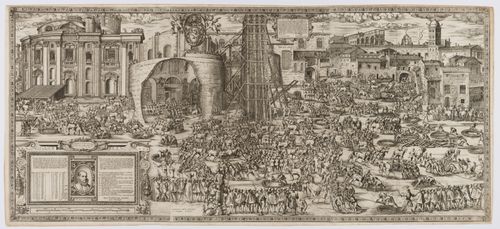
- During the moving of the obelisk, Fontana issued two prints, DR1987:0026 and DR1987:0027. The first (DR1987:0026), was published in March 1586 just prior to the lowering, and distributed with a companion tract by Filippo Pigafetta. It shows both the original and final positions of the obelisk as well as the device proposed by Fontana for its transportation. This involved the use of a twin timber tower (the castello, as it was called, is seen in the central portion of the print) that was erected on either side of the obelisk and was used for lowering and raising the monolith. The second (this print) appeared in August, during the raising, and showed the lowering of the obelisk, as it had occured in late April, with a detailed inventory of all the men and horses involved in the operation. The transportation was begun on 30 April and was completed on 10 September, according to Fontana's description of the process in his book, 'Della trasportione dell'obelisco vaticano' of 1590, a work illustrated by Bonifazio and Guerra, the two artists responsible for the execution of these prints.
DR1987:0027
Description:
- During the moving of the obelisk, Fontana issued two prints, DR1987:0026 and DR1987:0027. The first (DR1987:0026), was published in March 1586 just prior to the lowering, and distributed with a companion tract by Filippo Pigafetta. It shows both the original and final positions of the obelisk as well as the device proposed by Fontana for its transportation. This involved the use of a twin timber tower (the castello, as it was called, is seen in the central portion of the print) that was erected on either side of the obelisk and was used for lowering and raising the monolith. The second (this print) appeared in August, during the raising, and showed the lowering of the obelisk, as it had occured in late April, with a detailed inventory of all the men and horses involved in the operation. The transportation was begun on 30 April and was completed on 10 September, according to Fontana's description of the process in his book, 'Della trasportione dell'obelisco vaticano' of 1590, a work illustrated by Bonifazio and Guerra, the two artists responsible for the execution of these prints.
Personnes et institutions:
Sujet:
architecture, ingénierie
architecture, ingénierie
Date:
published August 1586
published August 1586
Titre:
The lowering of the Vatican obelisk
Actions:
DR1987:0027
Description:
- During the moving of the obelisk, Fontana issued two prints, DR1987:0026 and DR1987:0027. The first (DR1987:0026), was published in March 1586 just prior to the lowering, and distributed with a companion tract by Filippo Pigafetta. It shows both the original and final positions of the obelisk as well as the device proposed by Fontana for its transportation. This involved the use of a twin timber tower (the castello, as it was called, is seen in the central portion of the print) that was erected on either side of the obelisk and was used for lowering and raising the monolith. The second (this print) appeared in August, during the raising, and showed the lowering of the obelisk, as it had occured in late April, with a detailed inventory of all the men and horses involved in the operation. The transportation was begun on 30 April and was completed on 10 September, according to Fontana's description of the process in his book, 'Della trasportione dell'obelisco vaticano' of 1590, a work illustrated by Bonifazio and Guerra, the two artists responsible for the execution of these prints.
The lowering of the Vatican obelisk
Actions:
DR1987:0027
Description:
- During the moving of the obelisk, Fontana issued two prints, DR1987:0026 and DR1987:0027. The first (DR1987:0026), was published in March 1586 just prior to the lowering, and distributed with a companion tract by Filippo Pigafetta. It shows both the original and final positions of the obelisk as well as the device proposed by Fontana for its transportation. This involved the use of a twin timber tower (the castello, as it was called, is seen in the central portion of the print) that was erected on either side of the obelisk and was used for lowering and raising the monolith. The second (this print) appeared in August, during the raising, and showed the lowering of the obelisk, as it had occured in late April, with a detailed inventory of all the men and horses involved in the operation. The transportation was begun on 30 April and was completed on 10 September, according to Fontana's description of the process in his book, 'Della trasportione dell'obelisco vaticano' of 1590, a work illustrated by Bonifazio and Guerra, the two artists responsible for the execution of these prints.
Classification:
oeuvres d'art
oeuvres d'art
Date:
published August 1586
published August 1586
Personnes et institutions:
Sujet:
architecture, ingénierie
architecture, ingénierie
Classification:
événements
événements
Actions:
Description:
None
None
Date:
14 décembre 2017
14 décembre 2017
Titre:
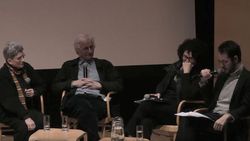
Eve Blau, Richard Pare et Phyllis Lambert sur la preuve photographique
Actions:
Description:
None
Eve Blau, Richard Pare et Phyllis Lambert sur la preuve photographique
Actions:
Description:
None
Classification:
événements
événements
Date:
14 décembre 2017
14 décembre 2017
Niveau de description archivistique:
Projet
Projet
Numéro de référence:
AP164.S1.2000.D6
Description:
The project series documents the competion entry for the design, construction and exploitation of a biomethanisation, recycling and composting plant, and an ecomuseum, in Pinto, Spain. In 2000, Abalos & Herreros, in collaboration with Urbaser, won the competition organised by Consejaría de Gestíon y Desarollo del Medio Ambiente (GEDESMA), Comunidad Autónoma de Madrid. The plant was built between 2001 and 2003. The firm also worked with Renata Sentkiewicz and Wouter Van Daele. The firm identified this project as number 130. The complex was built in harmony with the landscape using the natural hill. The roof is a series of terraces creating an artificial landscape complements its surrounding. Documenting the project are conceptual, design development, presentation and working drawings, textual records, and photographic materials.
AP164.S1.2000.D6
Description:
The project series documents the competion entry for the design, construction and exploitation of a biomethanisation, recycling and composting plant, and an ecomuseum, in Pinto, Spain. In 2000, Abalos & Herreros, in collaboration with Urbaser, won the competition organised by Consejaría de Gestíon y Desarollo del Medio Ambiente (GEDESMA), Comunidad Autónoma de Madrid. The plant was built between 2001 and 2003. The firm also worked with Renata Sentkiewicz and Wouter Van Daele. The firm identified this project as number 130. The complex was built in harmony with the landscape using the natural hill. The roof is a series of terraces creating an artificial landscape complements its surrounding. Documenting the project are conceptual, design development, presentation and working drawings, textual records, and photographic materials.
Personnes et institutions:
Date:
1999-2003
1999-2003
Titre:
Planta de biometanización y compostaje de residuos urbanos, Pinto, Spain (2000-2003)
Actions:
AP164.S1.2000.D6
Description:
The project series documents the competion entry for the design, construction and exploitation of a biomethanisation, recycling and composting plant, and an ecomuseum, in Pinto, Spain. In 2000, Abalos & Herreros, in collaboration with Urbaser, won the competition organised by Consejaría de Gestíon y Desarollo del Medio Ambiente (GEDESMA), Comunidad Autónoma de Madrid. The plant was built between 2001 and 2003. The firm also worked with Renata Sentkiewicz and Wouter Van Daele. The firm identified this project as number 130. The complex was built in harmony with the landscape using the natural hill. The roof is a series of terraces creating an artificial landscape complements its surrounding. Documenting the project are conceptual, design development, presentation and working drawings, textual records, and photographic materials.
Planta de biometanización y compostaje de residuos urbanos, Pinto, Spain (2000-2003)
Actions:
AP164.S1.2000.D6
Description:
The project series documents the competion entry for the design, construction and exploitation of a biomethanisation, recycling and composting plant, and an ecomuseum, in Pinto, Spain. In 2000, Abalos & Herreros, in collaboration with Urbaser, won the competition organised by Consejaría de Gestíon y Desarollo del Medio Ambiente (GEDESMA), Comunidad Autónoma de Madrid. The plant was built between 2001 and 2003. The firm also worked with Renata Sentkiewicz and Wouter Van Daele. The firm identified this project as number 130. The complex was built in harmony with the landscape using the natural hill. The roof is a series of terraces creating an artificial landscape complements its surrounding. Documenting the project are conceptual, design development, presentation and working drawings, textual records, and photographic materials.
Niveau de description archivistique:
Project
Project
Date:
1999-2003
1999-2003
Personnes et institutions:


