


44160 Résultats
Classification:
dessins
dessins
Numéro de référence:
DR1989:0015:049
Description:
- This work is part of a group of drawings and reprographic copies of drawings for St. Peter's Home, Woking, and St. Peter's Convent, Woking, from the offices of John Loughborough Pearson and Frank Loughborough Pearson (DR1989:0015:011 - DR1989:0015:085 R/V). Composed of contract and working drawings including plans, site plans, sections, and elevations dated between 1881 and 1936, these drawings were sold at auction by the convent along with those for the older institution of St. Peter's Home, Kilburn (DR1989:0015:001 - DR1989:0015:010). Both St. Peter's Home, Kilburn, and St. Peter's Home, Woking were commissioned from John Loughborough Pearson by Benjamin Lancaster. The alterations to the Home at Kilburn were commissioned on behalf of Lancaster's wife, who founded the home and a lay nursing order which ran it. The institution at Woking was founded by Lancaster as a home for incurables in 1882 and dedicated to the memory of his deceased wife (Quiney 67-68, 254-255, and 284). It was probably first known as St. Peter's Home, Woking, not becoming a convent until ca. 1934.
DR1989:0015:049
Description:
- This work is part of a group of drawings and reprographic copies of drawings for St. Peter's Home, Woking, and St. Peter's Convent, Woking, from the offices of John Loughborough Pearson and Frank Loughborough Pearson (DR1989:0015:011 - DR1989:0015:085 R/V). Composed of contract and working drawings including plans, site plans, sections, and elevations dated between 1881 and 1936, these drawings were sold at auction by the convent along with those for the older institution of St. Peter's Home, Kilburn (DR1989:0015:001 - DR1989:0015:010). Both St. Peter's Home, Kilburn, and St. Peter's Home, Woking were commissioned from John Loughborough Pearson by Benjamin Lancaster. The alterations to the Home at Kilburn were commissioned on behalf of Lancaster's wife, who founded the home and a lay nursing order which ran it. The institution at Woking was founded by Lancaster as a home for incurables in 1882 and dedicated to the memory of his deceased wife (Quiney 67-68, 254-255, and 284). It was probably first known as St. Peter's Home, Woking, not becoming a convent until ca. 1934.
Personnes et institutions:
Sujet:
architecture
architecture
Date:
1925-1926
1925-1926
Titre:
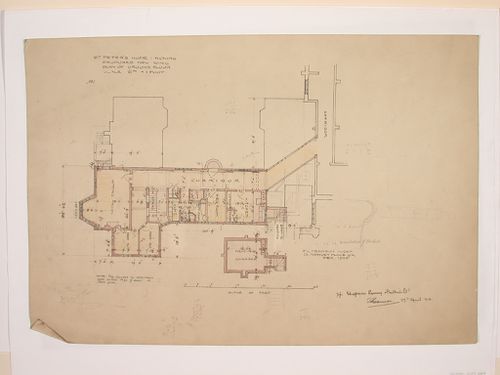
St. Peter's Home, Woking: Ground floor plan for the new wing
Actions:
DR1989:0015:049
Description:
- This work is part of a group of drawings and reprographic copies of drawings for St. Peter's Home, Woking, and St. Peter's Convent, Woking, from the offices of John Loughborough Pearson and Frank Loughborough Pearson (DR1989:0015:011 - DR1989:0015:085 R/V). Composed of contract and working drawings including plans, site plans, sections, and elevations dated between 1881 and 1936, these drawings were sold at auction by the convent along with those for the older institution of St. Peter's Home, Kilburn (DR1989:0015:001 - DR1989:0015:010). Both St. Peter's Home, Kilburn, and St. Peter's Home, Woking were commissioned from John Loughborough Pearson by Benjamin Lancaster. The alterations to the Home at Kilburn were commissioned on behalf of Lancaster's wife, who founded the home and a lay nursing order which ran it. The institution at Woking was founded by Lancaster as a home for incurables in 1882 and dedicated to the memory of his deceased wife (Quiney 67-68, 254-255, and 284). It was probably first known as St. Peter's Home, Woking, not becoming a convent until ca. 1934.
St. Peter's Home, Woking: Ground floor plan for the new wing
Actions:
DR1989:0015:049
Description:
- This work is part of a group of drawings and reprographic copies of drawings for St. Peter's Home, Woking, and St. Peter's Convent, Woking, from the offices of John Loughborough Pearson and Frank Loughborough Pearson (DR1989:0015:011 - DR1989:0015:085 R/V). Composed of contract and working drawings including plans, site plans, sections, and elevations dated between 1881 and 1936, these drawings were sold at auction by the convent along with those for the older institution of St. Peter's Home, Kilburn (DR1989:0015:001 - DR1989:0015:010). Both St. Peter's Home, Kilburn, and St. Peter's Home, Woking were commissioned from John Loughborough Pearson by Benjamin Lancaster. The alterations to the Home at Kilburn were commissioned on behalf of Lancaster's wife, who founded the home and a lay nursing order which ran it. The institution at Woking was founded by Lancaster as a home for incurables in 1882 and dedicated to the memory of his deceased wife (Quiney 67-68, 254-255, and 284). It was probably first known as St. Peter's Home, Woking, not becoming a convent until ca. 1934.
Classification:
dessins
dessins
Date:
1925-1926
1925-1926
Personnes et institutions:
Sujet:
architecture
architecture
Classification:
dessins
dessins
Numéro de référence:
DR1989:0015:050
Description:
- This work is part of a group of drawings and reprographic copies of drawings for St. Peter's Home, Woking, and St. Peter's Convent, Woking, from the offices of John Loughborough Pearson and Frank Loughborough Pearson (DR1989:0015:011 - DR1989:0015:085 R/V). Composed of contract and working drawings including plans, site plans, sections, and elevations dated between 1881 and 1936, these drawings were sold at auction by the convent along with those for the older institution of St. Peter's Home, Kilburn (DR1989:0015:001 - DR1989:0015:010). Both St. Peter's Home, Kilburn, and St. Peter's Home, Woking were commissioned from John Loughborough Pearson by Benjamin Lancaster. The alterations to the Home at Kilburn were commissioned on behalf of Lancaster's wife, who founded the home and a lay nursing order which ran it. The institution at Woking was founded by Lancaster as a home for incurables in 1882 and dedicated to the memory of his deceased wife (Quiney 67-68, 254-255, and 284). It was probably first known as St. Peter's Home, Woking, not becoming a convent until ca. 1934.
DR1989:0015:050
Description:
- This work is part of a group of drawings and reprographic copies of drawings for St. Peter's Home, Woking, and St. Peter's Convent, Woking, from the offices of John Loughborough Pearson and Frank Loughborough Pearson (DR1989:0015:011 - DR1989:0015:085 R/V). Composed of contract and working drawings including plans, site plans, sections, and elevations dated between 1881 and 1936, these drawings were sold at auction by the convent along with those for the older institution of St. Peter's Home, Kilburn (DR1989:0015:001 - DR1989:0015:010). Both St. Peter's Home, Kilburn, and St. Peter's Home, Woking were commissioned from John Loughborough Pearson by Benjamin Lancaster. The alterations to the Home at Kilburn were commissioned on behalf of Lancaster's wife, who founded the home and a lay nursing order which ran it. The institution at Woking was founded by Lancaster as a home for incurables in 1882 and dedicated to the memory of his deceased wife (Quiney 67-68, 254-255, and 284). It was probably first known as St. Peter's Home, Woking, not becoming a convent until ca. 1934.
Personnes et institutions:
Sujet:
architecture
architecture
Date:
1925-1926
1925-1926
Titre:
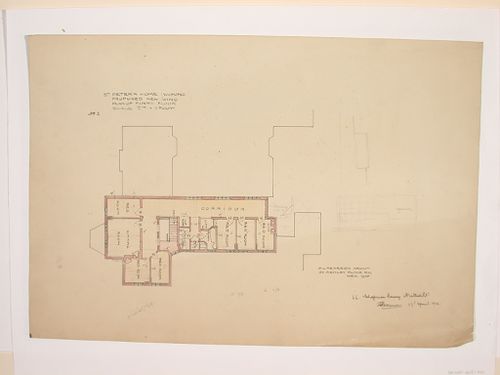
St. Peter's Home, Woking: First floor plan for the new wing
Actions:
DR1989:0015:050
Description:
- This work is part of a group of drawings and reprographic copies of drawings for St. Peter's Home, Woking, and St. Peter's Convent, Woking, from the offices of John Loughborough Pearson and Frank Loughborough Pearson (DR1989:0015:011 - DR1989:0015:085 R/V). Composed of contract and working drawings including plans, site plans, sections, and elevations dated between 1881 and 1936, these drawings were sold at auction by the convent along with those for the older institution of St. Peter's Home, Kilburn (DR1989:0015:001 - DR1989:0015:010). Both St. Peter's Home, Kilburn, and St. Peter's Home, Woking were commissioned from John Loughborough Pearson by Benjamin Lancaster. The alterations to the Home at Kilburn were commissioned on behalf of Lancaster's wife, who founded the home and a lay nursing order which ran it. The institution at Woking was founded by Lancaster as a home for incurables in 1882 and dedicated to the memory of his deceased wife (Quiney 67-68, 254-255, and 284). It was probably first known as St. Peter's Home, Woking, not becoming a convent until ca. 1934.
St. Peter's Home, Woking: First floor plan for the new wing
Actions:
DR1989:0015:050
Description:
- This work is part of a group of drawings and reprographic copies of drawings for St. Peter's Home, Woking, and St. Peter's Convent, Woking, from the offices of John Loughborough Pearson and Frank Loughborough Pearson (DR1989:0015:011 - DR1989:0015:085 R/V). Composed of contract and working drawings including plans, site plans, sections, and elevations dated between 1881 and 1936, these drawings were sold at auction by the convent along with those for the older institution of St. Peter's Home, Kilburn (DR1989:0015:001 - DR1989:0015:010). Both St. Peter's Home, Kilburn, and St. Peter's Home, Woking were commissioned from John Loughborough Pearson by Benjamin Lancaster. The alterations to the Home at Kilburn were commissioned on behalf of Lancaster's wife, who founded the home and a lay nursing order which ran it. The institution at Woking was founded by Lancaster as a home for incurables in 1882 and dedicated to the memory of his deceased wife (Quiney 67-68, 254-255, and 284). It was probably first known as St. Peter's Home, Woking, not becoming a convent until ca. 1934.
Classification:
dessins
dessins
Date:
1925-1926
1925-1926
Personnes et institutions:
Sujet:
architecture
architecture
Classification:
dessins
dessins
Numéro de référence:
DR1989:0015:051
Description:
- This work is part of a group of drawings and reprographic copies of drawings for St. Peter's Home, Woking, and St. Peter's Convent, Woking, from the offices of John Loughborough Pearson and Frank Loughborough Pearson (DR1989:0015:011 - DR1989:0015:085 R/V). Composed of contract and working drawings including plans, site plans, sections, and elevations dated between 1881 and 1936, these drawings were sold at auction by the convent along with those for the older institution of St. Peter's Home, Kilburn (DR1989:0015:001 - DR1989:0015:010). Both St. Peter's Home, Kilburn, and St. Peter's Home, Woking were commissioned from John Loughborough Pearson by Benjamin Lancaster. The alterations to the Home at Kilburn were commissioned on behalf of Lancaster's wife, who founded the home and a lay nursing order which ran it. The institution at Woking was founded by Lancaster as a home for incurables in 1882 and dedicated to the memory of his deceased wife (Quiney 67-68, 254-255, and 284). It was probably first known as St. Peter's Home, Woking, not becoming a convent until ca. 1934.
DR1989:0015:051
Description:
- This work is part of a group of drawings and reprographic copies of drawings for St. Peter's Home, Woking, and St. Peter's Convent, Woking, from the offices of John Loughborough Pearson and Frank Loughborough Pearson (DR1989:0015:011 - DR1989:0015:085 R/V). Composed of contract and working drawings including plans, site plans, sections, and elevations dated between 1881 and 1936, these drawings were sold at auction by the convent along with those for the older institution of St. Peter's Home, Kilburn (DR1989:0015:001 - DR1989:0015:010). Both St. Peter's Home, Kilburn, and St. Peter's Home, Woking were commissioned from John Loughborough Pearson by Benjamin Lancaster. The alterations to the Home at Kilburn were commissioned on behalf of Lancaster's wife, who founded the home and a lay nursing order which ran it. The institution at Woking was founded by Lancaster as a home for incurables in 1882 and dedicated to the memory of his deceased wife (Quiney 67-68, 254-255, and 284). It was probably first known as St. Peter's Home, Woking, not becoming a convent until ca. 1934.
Personnes et institutions:
Sujet:
architecture
architecture
Date:
1925-1926
1925-1926
Titre:
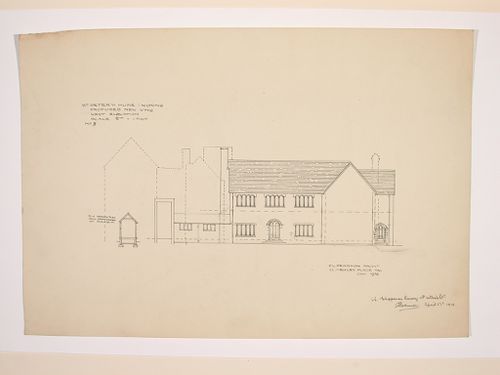
St. Peter's Home, Woking: West elevation for the new wing
Actions:
DR1989:0015:051
Description:
- This work is part of a group of drawings and reprographic copies of drawings for St. Peter's Home, Woking, and St. Peter's Convent, Woking, from the offices of John Loughborough Pearson and Frank Loughborough Pearson (DR1989:0015:011 - DR1989:0015:085 R/V). Composed of contract and working drawings including plans, site plans, sections, and elevations dated between 1881 and 1936, these drawings were sold at auction by the convent along with those for the older institution of St. Peter's Home, Kilburn (DR1989:0015:001 - DR1989:0015:010). Both St. Peter's Home, Kilburn, and St. Peter's Home, Woking were commissioned from John Loughborough Pearson by Benjamin Lancaster. The alterations to the Home at Kilburn were commissioned on behalf of Lancaster's wife, who founded the home and a lay nursing order which ran it. The institution at Woking was founded by Lancaster as a home for incurables in 1882 and dedicated to the memory of his deceased wife (Quiney 67-68, 254-255, and 284). It was probably first known as St. Peter's Home, Woking, not becoming a convent until ca. 1934.
St. Peter's Home, Woking: West elevation for the new wing
Actions:
DR1989:0015:051
Description:
- This work is part of a group of drawings and reprographic copies of drawings for St. Peter's Home, Woking, and St. Peter's Convent, Woking, from the offices of John Loughborough Pearson and Frank Loughborough Pearson (DR1989:0015:011 - DR1989:0015:085 R/V). Composed of contract and working drawings including plans, site plans, sections, and elevations dated between 1881 and 1936, these drawings were sold at auction by the convent along with those for the older institution of St. Peter's Home, Kilburn (DR1989:0015:001 - DR1989:0015:010). Both St. Peter's Home, Kilburn, and St. Peter's Home, Woking were commissioned from John Loughborough Pearson by Benjamin Lancaster. The alterations to the Home at Kilburn were commissioned on behalf of Lancaster's wife, who founded the home and a lay nursing order which ran it. The institution at Woking was founded by Lancaster as a home for incurables in 1882 and dedicated to the memory of his deceased wife (Quiney 67-68, 254-255, and 284). It was probably first known as St. Peter's Home, Woking, not becoming a convent until ca. 1934.
Classification:
dessins
dessins
Date:
1925-1926
1925-1926
Personnes et institutions:
Sujet:
architecture
architecture
Classification:
dessins
dessins
Numéro de référence:
DR1989:0015:052
Description:
- This work is part of a group of drawings and reprographic copies of drawings for St. Peter's Home, Woking, and St. Peter's Convent, Woking, from the offices of John Loughborough Pearson and Frank Loughborough Pearson (DR1989:0015:011 - DR1989:0015:085 R/V). Composed of contract and working drawings including plans, site plans, sections, and elevations dated between 1881 and 1936, these drawings were sold at auction by the convent along with those for the older institution of St. Peter's Home, Kilburn (DR1989:0015:001 - DR1989:0015:010). Both St. Peter's Home, Kilburn, and St. Peter's Home, Woking were commissioned from John Loughborough Pearson by Benjamin Lancaster. The alterations to the Home at Kilburn were commissioned on behalf of Lancaster's wife, who founded the home and a lay nursing order which ran it. The institution at Woking was founded by Lancaster as a home for incurables in 1882 and dedicated to the memory of his deceased wife (Quiney 67-68, 254-255, and 284). It was probably first known as St. Peter's Home, Woking, not becoming a convent until ca. 1934.
DR1989:0015:052
Description:
- This work is part of a group of drawings and reprographic copies of drawings for St. Peter's Home, Woking, and St. Peter's Convent, Woking, from the offices of John Loughborough Pearson and Frank Loughborough Pearson (DR1989:0015:011 - DR1989:0015:085 R/V). Composed of contract and working drawings including plans, site plans, sections, and elevations dated between 1881 and 1936, these drawings were sold at auction by the convent along with those for the older institution of St. Peter's Home, Kilburn (DR1989:0015:001 - DR1989:0015:010). Both St. Peter's Home, Kilburn, and St. Peter's Home, Woking were commissioned from John Loughborough Pearson by Benjamin Lancaster. The alterations to the Home at Kilburn were commissioned on behalf of Lancaster's wife, who founded the home and a lay nursing order which ran it. The institution at Woking was founded by Lancaster as a home for incurables in 1882 and dedicated to the memory of his deceased wife (Quiney 67-68, 254-255, and 284). It was probably first known as St. Peter's Home, Woking, not becoming a convent until ca. 1934.
Personnes et institutions:
Sujet:
architecture
architecture
Date:
1925-1926
1925-1926
Titre:
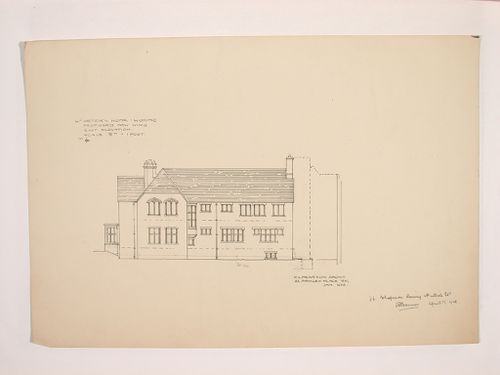
St. Peter's Home, Woking: East elevation for the new wing
Actions:
DR1989:0015:052
Description:
- This work is part of a group of drawings and reprographic copies of drawings for St. Peter's Home, Woking, and St. Peter's Convent, Woking, from the offices of John Loughborough Pearson and Frank Loughborough Pearson (DR1989:0015:011 - DR1989:0015:085 R/V). Composed of contract and working drawings including plans, site plans, sections, and elevations dated between 1881 and 1936, these drawings were sold at auction by the convent along with those for the older institution of St. Peter's Home, Kilburn (DR1989:0015:001 - DR1989:0015:010). Both St. Peter's Home, Kilburn, and St. Peter's Home, Woking were commissioned from John Loughborough Pearson by Benjamin Lancaster. The alterations to the Home at Kilburn were commissioned on behalf of Lancaster's wife, who founded the home and a lay nursing order which ran it. The institution at Woking was founded by Lancaster as a home for incurables in 1882 and dedicated to the memory of his deceased wife (Quiney 67-68, 254-255, and 284). It was probably first known as St. Peter's Home, Woking, not becoming a convent until ca. 1934.
St. Peter's Home, Woking: East elevation for the new wing
Actions:
DR1989:0015:052
Description:
- This work is part of a group of drawings and reprographic copies of drawings for St. Peter's Home, Woking, and St. Peter's Convent, Woking, from the offices of John Loughborough Pearson and Frank Loughborough Pearson (DR1989:0015:011 - DR1989:0015:085 R/V). Composed of contract and working drawings including plans, site plans, sections, and elevations dated between 1881 and 1936, these drawings were sold at auction by the convent along with those for the older institution of St. Peter's Home, Kilburn (DR1989:0015:001 - DR1989:0015:010). Both St. Peter's Home, Kilburn, and St. Peter's Home, Woking were commissioned from John Loughborough Pearson by Benjamin Lancaster. The alterations to the Home at Kilburn were commissioned on behalf of Lancaster's wife, who founded the home and a lay nursing order which ran it. The institution at Woking was founded by Lancaster as a home for incurables in 1882 and dedicated to the memory of his deceased wife (Quiney 67-68, 254-255, and 284). It was probably first known as St. Peter's Home, Woking, not becoming a convent until ca. 1934.
Classification:
dessins
dessins
Date:
1925-1926
1925-1926
Personnes et institutions:
Sujet:
architecture
architecture
Classification:
dessins
dessins
Actions:
Numéro de référence:
DR1989:0015:053
Description:
- This work is part of a group of drawings and reprographic copies of drawings for St. Peter's Home, Woking, and St. Peter's Convent, Woking, from the offices of John Loughborough Pearson and Frank Loughborough Pearson (DR1989:0015:011 - DR1989:0015:085 R/V). Composed of contract and working drawings including plans, site plans, sections, and elevations dated between 1881 and 1936, these drawings were sold at auction by the convent along with those for the older institution of St. Peter's Home, Kilburn (DR1989:0015:001 - DR1989:0015:010). Both St. Peter's Home, Kilburn, and St. Peter's Home, Woking were commissioned from John Loughborough Pearson by Benjamin Lancaster. The alterations to the Home at Kilburn were commissioned on behalf of Lancaster's wife, who founded the home and a lay nursing order which ran it. The institution at Woking was founded by Lancaster as a home for incurables in 1882 and dedicated to the memory of his deceased wife (Quiney 67-68, 254-255, and 284). It was probably first known as St. Peter's Home, Woking, not becoming a convent until ca. 1934.
DR1989:0015:053
Description:
- This work is part of a group of drawings and reprographic copies of drawings for St. Peter's Home, Woking, and St. Peter's Convent, Woking, from the offices of John Loughborough Pearson and Frank Loughborough Pearson (DR1989:0015:011 - DR1989:0015:085 R/V). Composed of contract and working drawings including plans, site plans, sections, and elevations dated between 1881 and 1936, these drawings were sold at auction by the convent along with those for the older institution of St. Peter's Home, Kilburn (DR1989:0015:001 - DR1989:0015:010). Both St. Peter's Home, Kilburn, and St. Peter's Home, Woking were commissioned from John Loughborough Pearson by Benjamin Lancaster. The alterations to the Home at Kilburn were commissioned on behalf of Lancaster's wife, who founded the home and a lay nursing order which ran it. The institution at Woking was founded by Lancaster as a home for incurables in 1882 and dedicated to the memory of his deceased wife (Quiney 67-68, 254-255, and 284). It was probably first known as St. Peter's Home, Woking, not becoming a convent until ca. 1934.
Personnes et institutions:
Sujet:
architecture
architecture
Date:
1925-1926
1925-1926
Titre:
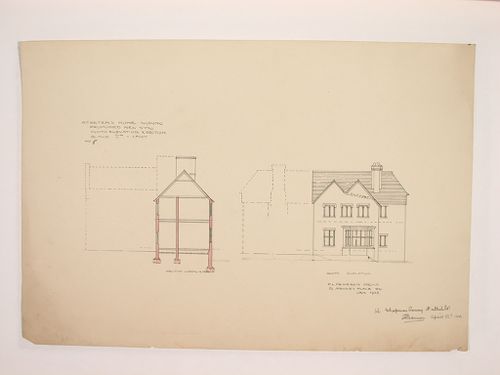
St. Peter's Home, Woking: South elevation and section for the new wing
Actions:
DR1989:0015:053
Description:
- This work is part of a group of drawings and reprographic copies of drawings for St. Peter's Home, Woking, and St. Peter's Convent, Woking, from the offices of John Loughborough Pearson and Frank Loughborough Pearson (DR1989:0015:011 - DR1989:0015:085 R/V). Composed of contract and working drawings including plans, site plans, sections, and elevations dated between 1881 and 1936, these drawings were sold at auction by the convent along with those for the older institution of St. Peter's Home, Kilburn (DR1989:0015:001 - DR1989:0015:010). Both St. Peter's Home, Kilburn, and St. Peter's Home, Woking were commissioned from John Loughborough Pearson by Benjamin Lancaster. The alterations to the Home at Kilburn were commissioned on behalf of Lancaster's wife, who founded the home and a lay nursing order which ran it. The institution at Woking was founded by Lancaster as a home for incurables in 1882 and dedicated to the memory of his deceased wife (Quiney 67-68, 254-255, and 284). It was probably first known as St. Peter's Home, Woking, not becoming a convent until ca. 1934.
St. Peter's Home, Woking: South elevation and section for the new wing
Actions:
DR1989:0015:053
Description:
- This work is part of a group of drawings and reprographic copies of drawings for St. Peter's Home, Woking, and St. Peter's Convent, Woking, from the offices of John Loughborough Pearson and Frank Loughborough Pearson (DR1989:0015:011 - DR1989:0015:085 R/V). Composed of contract and working drawings including plans, site plans, sections, and elevations dated between 1881 and 1936, these drawings were sold at auction by the convent along with those for the older institution of St. Peter's Home, Kilburn (DR1989:0015:001 - DR1989:0015:010). Both St. Peter's Home, Kilburn, and St. Peter's Home, Woking were commissioned from John Loughborough Pearson by Benjamin Lancaster. The alterations to the Home at Kilburn were commissioned on behalf of Lancaster's wife, who founded the home and a lay nursing order which ran it. The institution at Woking was founded by Lancaster as a home for incurables in 1882 and dedicated to the memory of his deceased wife (Quiney 67-68, 254-255, and 284). It was probably first known as St. Peter's Home, Woking, not becoming a convent until ca. 1934.
Classification:
dessins
dessins
Date:
1925-1926
1925-1926
Personnes et institutions:
Sujet:
architecture
architecture
Classification:
dessins
dessins
Actions:
Numéro de référence:
DR1989:0015:054
Description:
- This work is part of a group of drawings and reprographic copies of drawings for St. Peter's Home, Woking, and St. Peter's Convent, Woking, from the offices of John Loughborough Pearson and Frank Loughborough Pearson (DR1989:0015:011 - DR1989:0015:085 R/V). Composed of contract and working drawings including plans, site plans, sections, and elevations dated between 1881 and 1936, these drawings were sold at auction by the convent along with those for the older institution of St. Peter's Home, Kilburn (DR1989:0015:001 - DR1989:0015:010). Both St. Peter's Home, Kilburn, and St. Peter's Home, Woking were commissioned from John Loughborough Pearson by Benjamin Lancaster. The alterations to the Home at Kilburn were commissioned on behalf of Lancaster's wife, who founded the home and a lay nursing order which ran it. The institution at Woking was founded by Lancaster as a home for incurables in 1882 and dedicated to the memory of his deceased wife (Quiney 67-68, 254-255, and 284). It was probably first known as St. Peter's Home, Woking, not becoming a convent until ca. 1934.
DR1989:0015:054
Description:
- This work is part of a group of drawings and reprographic copies of drawings for St. Peter's Home, Woking, and St. Peter's Convent, Woking, from the offices of John Loughborough Pearson and Frank Loughborough Pearson (DR1989:0015:011 - DR1989:0015:085 R/V). Composed of contract and working drawings including plans, site plans, sections, and elevations dated between 1881 and 1936, these drawings were sold at auction by the convent along with those for the older institution of St. Peter's Home, Kilburn (DR1989:0015:001 - DR1989:0015:010). Both St. Peter's Home, Kilburn, and St. Peter's Home, Woking were commissioned from John Loughborough Pearson by Benjamin Lancaster. The alterations to the Home at Kilburn were commissioned on behalf of Lancaster's wife, who founded the home and a lay nursing order which ran it. The institution at Woking was founded by Lancaster as a home for incurables in 1882 and dedicated to the memory of his deceased wife (Quiney 67-68, 254-255, and 284). It was probably first known as St. Peter's Home, Woking, not becoming a convent until ca. 1934.
Personnes et institutions:
Sujet:
architecture
architecture
Date:
1925-1926
1925-1926
Titre:
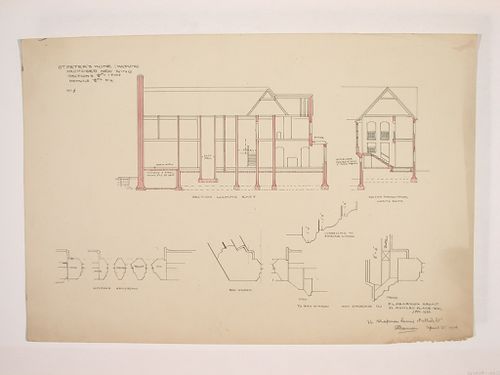
St. Peter's Home, Woking: Sections for the new wing with window details
Actions:
DR1989:0015:054
Description:
- This work is part of a group of drawings and reprographic copies of drawings for St. Peter's Home, Woking, and St. Peter's Convent, Woking, from the offices of John Loughborough Pearson and Frank Loughborough Pearson (DR1989:0015:011 - DR1989:0015:085 R/V). Composed of contract and working drawings including plans, site plans, sections, and elevations dated between 1881 and 1936, these drawings were sold at auction by the convent along with those for the older institution of St. Peter's Home, Kilburn (DR1989:0015:001 - DR1989:0015:010). Both St. Peter's Home, Kilburn, and St. Peter's Home, Woking were commissioned from John Loughborough Pearson by Benjamin Lancaster. The alterations to the Home at Kilburn were commissioned on behalf of Lancaster's wife, who founded the home and a lay nursing order which ran it. The institution at Woking was founded by Lancaster as a home for incurables in 1882 and dedicated to the memory of his deceased wife (Quiney 67-68, 254-255, and 284). It was probably first known as St. Peter's Home, Woking, not becoming a convent until ca. 1934.
St. Peter's Home, Woking: Sections for the new wing with window details
Actions:
DR1989:0015:054
Description:
- This work is part of a group of drawings and reprographic copies of drawings for St. Peter's Home, Woking, and St. Peter's Convent, Woking, from the offices of John Loughborough Pearson and Frank Loughborough Pearson (DR1989:0015:011 - DR1989:0015:085 R/V). Composed of contract and working drawings including plans, site plans, sections, and elevations dated between 1881 and 1936, these drawings were sold at auction by the convent along with those for the older institution of St. Peter's Home, Kilburn (DR1989:0015:001 - DR1989:0015:010). Both St. Peter's Home, Kilburn, and St. Peter's Home, Woking were commissioned from John Loughborough Pearson by Benjamin Lancaster. The alterations to the Home at Kilburn were commissioned on behalf of Lancaster's wife, who founded the home and a lay nursing order which ran it. The institution at Woking was founded by Lancaster as a home for incurables in 1882 and dedicated to the memory of his deceased wife (Quiney 67-68, 254-255, and 284). It was probably first known as St. Peter's Home, Woking, not becoming a convent until ca. 1934.
Classification:
dessins
dessins
Date:
1925-1926
1925-1926
Personnes et institutions:
Sujet:
architecture
architecture
Niveau de description archivistique:
Projet
Projet
Titre:
Blackpool Project
Blackpool Project
Numéro de référence:
AP144.S2.D81
Description:
File documents the completed project for a restaurant at the Blackpool Zoo Park in Blackpool, England, for client J. Lyons & Co. Ltd. Initially the brief also called for the erection of five pre-fabricated Wimpy kiosks, of which at least one and possibly two kiosks were erected. The restaurant building is a square, clear-span, steel-frame building with its own kitchen and store rooms, and includes a cafeteria, a full service restaurant and bar, and offices. The restaurant dining room can be converted from one large space into two by means of a curtain on a track, removable barrier rails, and mobile cash and cutlery units. The exterior is timber-clad with tinted glazing. Existing conditions drawings show the existing site layout, landscaping plans and plans showing water supply and electrical services. Design development drawings and working drawings include preliminary interior perspectives, site plans, floor plans, reflected ceiling plans, utility plans, sections, elevations, axonometric views of interior, roof trusses, and structural system, construction details, and progress charts. Two sets of drawings that include plans, sections, and elevations, were possibly used for presentation purposes. Construction details are drawn on letter-size paper and show details for curtain tracks, exterior walls, and windows. A project schedule listing the remaining work is dated October 29, 1973. Consultant's drawings for catering, structural, mechanical, and electrical services are also included in the file. Over 300 detail drawings on letter-size paper are included in the textual records. Cedric Price visited the restaurant in 1988. Some material in this file was published in 'Cedric Price-Works II' (London: Architectural Press, 1984), 81. Some reference drawings are attributed to H. Carpenter, Engineer, County Borough of Blackpool, and to Building Design Partnership. Versa-Serve Ltd Catering Consultants, Briggs Amasco, Crittall-Hope, Archbell Greenwood Ltd Structural Engineers, Hall & Kay Limited, Campbell & Isherwood Ltd Electrical Engineers appear as consultants in this project. Bovis: Fee Construction Limited appears as the general contractor for this project. File contains design development drawings, presentation drawings, reference drawings, technical drawings, working drawings, photographic materials, and textual records.
AP144.S2.D81
Description:
File documents the completed project for a restaurant at the Blackpool Zoo Park in Blackpool, England, for client J. Lyons & Co. Ltd. Initially the brief also called for the erection of five pre-fabricated Wimpy kiosks, of which at least one and possibly two kiosks were erected. The restaurant building is a square, clear-span, steel-frame building with its own kitchen and store rooms, and includes a cafeteria, a full service restaurant and bar, and offices. The restaurant dining room can be converted from one large space into two by means of a curtain on a track, removable barrier rails, and mobile cash and cutlery units. The exterior is timber-clad with tinted glazing. Existing conditions drawings show the existing site layout, landscaping plans and plans showing water supply and electrical services. Design development drawings and working drawings include preliminary interior perspectives, site plans, floor plans, reflected ceiling plans, utility plans, sections, elevations, axonometric views of interior, roof trusses, and structural system, construction details, and progress charts. Two sets of drawings that include plans, sections, and elevations, were possibly used for presentation purposes. Construction details are drawn on letter-size paper and show details for curtain tracks, exterior walls, and windows. A project schedule listing the remaining work is dated October 29, 1973. Consultant's drawings for catering, structural, mechanical, and electrical services are also included in the file. Over 300 detail drawings on letter-size paper are included in the textual records. Cedric Price visited the restaurant in 1988. Some material in this file was published in 'Cedric Price-Works II' (London: Architectural Press, 1984), 81. Some reference drawings are attributed to H. Carpenter, Engineer, County Borough of Blackpool, and to Building Design Partnership. Versa-Serve Ltd Catering Consultants, Briggs Amasco, Crittall-Hope, Archbell Greenwood Ltd Structural Engineers, Hall & Kay Limited, Campbell & Isherwood Ltd Electrical Engineers appear as consultants in this project. Bovis: Fee Construction Limited appears as the general contractor for this project. File contains design development drawings, presentation drawings, reference drawings, technical drawings, working drawings, photographic materials, and textual records.
Personnes et institutions:
Date:
1963-1988, predominant 1971-1975
1963-1988, predominant 1971-1975
Titre:
Blackpool Project
Actions:
AP144.S2.D81
Description:
File documents the completed project for a restaurant at the Blackpool Zoo Park in Blackpool, England, for client J. Lyons & Co. Ltd. Initially the brief also called for the erection of five pre-fabricated Wimpy kiosks, of which at least one and possibly two kiosks were erected. The restaurant building is a square, clear-span, steel-frame building with its own kitchen and store rooms, and includes a cafeteria, a full service restaurant and bar, and offices. The restaurant dining room can be converted from one large space into two by means of a curtain on a track, removable barrier rails, and mobile cash and cutlery units. The exterior is timber-clad with tinted glazing. Existing conditions drawings show the existing site layout, landscaping plans and plans showing water supply and electrical services. Design development drawings and working drawings include preliminary interior perspectives, site plans, floor plans, reflected ceiling plans, utility plans, sections, elevations, axonometric views of interior, roof trusses, and structural system, construction details, and progress charts. Two sets of drawings that include plans, sections, and elevations, were possibly used for presentation purposes. Construction details are drawn on letter-size paper and show details for curtain tracks, exterior walls, and windows. A project schedule listing the remaining work is dated October 29, 1973. Consultant's drawings for catering, structural, mechanical, and electrical services are also included in the file. Over 300 detail drawings on letter-size paper are included in the textual records. Cedric Price visited the restaurant in 1988. Some material in this file was published in 'Cedric Price-Works II' (London: Architectural Press, 1984), 81. Some reference drawings are attributed to H. Carpenter, Engineer, County Borough of Blackpool, and to Building Design Partnership. Versa-Serve Ltd Catering Consultants, Briggs Amasco, Crittall-Hope, Archbell Greenwood Ltd Structural Engineers, Hall & Kay Limited, Campbell & Isherwood Ltd Electrical Engineers appear as consultants in this project. Bovis: Fee Construction Limited appears as the general contractor for this project. File contains design development drawings, presentation drawings, reference drawings, technical drawings, working drawings, photographic materials, and textual records.
Blackpool Project
Actions:
AP144.S2.D81
Description:
File documents the completed project for a restaurant at the Blackpool Zoo Park in Blackpool, England, for client J. Lyons & Co. Ltd. Initially the brief also called for the erection of five pre-fabricated Wimpy kiosks, of which at least one and possibly two kiosks were erected. The restaurant building is a square, clear-span, steel-frame building with its own kitchen and store rooms, and includes a cafeteria, a full service restaurant and bar, and offices. The restaurant dining room can be converted from one large space into two by means of a curtain on a track, removable barrier rails, and mobile cash and cutlery units. The exterior is timber-clad with tinted glazing. Existing conditions drawings show the existing site layout, landscaping plans and plans showing water supply and electrical services. Design development drawings and working drawings include preliminary interior perspectives, site plans, floor plans, reflected ceiling plans, utility plans, sections, elevations, axonometric views of interior, roof trusses, and structural system, construction details, and progress charts. Two sets of drawings that include plans, sections, and elevations, were possibly used for presentation purposes. Construction details are drawn on letter-size paper and show details for curtain tracks, exterior walls, and windows. A project schedule listing the remaining work is dated October 29, 1973. Consultant's drawings for catering, structural, mechanical, and electrical services are also included in the file. Over 300 detail drawings on letter-size paper are included in the textual records. Cedric Price visited the restaurant in 1988. Some material in this file was published in 'Cedric Price-Works II' (London: Architectural Press, 1984), 81. Some reference drawings are attributed to H. Carpenter, Engineer, County Borough of Blackpool, and to Building Design Partnership. Versa-Serve Ltd Catering Consultants, Briggs Amasco, Crittall-Hope, Archbell Greenwood Ltd Structural Engineers, Hall & Kay Limited, Campbell & Isherwood Ltd Electrical Engineers appear as consultants in this project. Bovis: Fee Construction Limited appears as the general contractor for this project. File contains design development drawings, presentation drawings, reference drawings, technical drawings, working drawings, photographic materials, and textual records.
Niveau de description archivistique:
File 81
File 81
Date:
1963-1988, predominant 1971-1975
1963-1988, predominant 1971-1975
Personnes et institutions:
Niveau de description archivistique:
Projet
Projet
Numéro de référence:
AP194.S1.1995.PR01
Description:
Project records consist of records documenting the three phases of the Synthetic Landscape project (1995-2000) as worked on by Johan Bettum and OCEAN North. The project was initially developed and submitted in 1995 for the Membrane Design International Competition held in Japan by the Taiyo Kogyo Corporation. The entry showcases a children’s playscape in the setting of Oslo’s Tøyen Park, joining both its urban surroundings and its natural landscape into a synthetic space. Afterwards, the project was exhibited at the Architecture Association (AA) in London, where Johan Bettum and Kivi Sotamaa met. This eventually led to Bettum and Sotamaa collaborating on projects, along with their respective OCEAN teams in Oslo and Helsinki. The Synthetic Landscape project continued as a research project, with a second phase in 1996 and a third phase which ran from 1997 through 2000 and integrated design methods (particle streaming, Channelling Systems) from the work made on the Töölö and Jyväskylä projects. In the third phase, a pavilion was also added to the setting. Aside from one drawing, all records for this project are in a digital format. Drawings and models from phase 1 show parts or the whole of a shell-like structure. A color scheme seems to be associated to the different components of the structure. A report on phases 1 and 2 discusses the use of synthetic and composite materials for the structure, explaining the concept for the site. Phase 2 textual records include a working plan, site charts and program. Additional drawings and models show an evolution in the shape of the landscape. Most records are related to the third phase of Synthetic Landscape. They are largely drawings and models showing textures and coloured grafts used in the design process, section and surfaces studies, as well as site plans. Other files of the third phase consist of animated renderings of Channelling Systems studies within the Synthetic Landscape topology, saved as Quicktime MOV files. Additionally, the third phase of Synthetic Landscape has files related to the FEM (finite element method) analysis process utilized in the project’s engineering. This particular section includes raster images showing vectorial drawings and data appearing to be surface studies. These were likely created with the software Mathematica. The bulk of textual documentation on the project’s scope and outcomes may be found in AP194.S1.1995.PR01.001 for phases 1 and 2, and in AP194.S1.1995.PR01.005 for phase 3. The latter file also contains documentation related to a grant application to The Research Council of Norway; a proposal for a conference and exhibition at the AA; and administrative records such as budgets, correspondence, invoices, progress reports, meeting agendas and minutes. For all project phases, records related to the design process consist of CAD models saved in a variety of modelling formats (iges, fmz, dgn, 3dm, dxf) as well as raster or vector images (tiff, jpeg, png, eps, pict, etc.). In some cases, only these raster or vector images of the original CAD drawings are present in the archive.
AP194.S1.1995.PR01
Description:
Project records consist of records documenting the three phases of the Synthetic Landscape project (1995-2000) as worked on by Johan Bettum and OCEAN North. The project was initially developed and submitted in 1995 for the Membrane Design International Competition held in Japan by the Taiyo Kogyo Corporation. The entry showcases a children’s playscape in the setting of Oslo’s Tøyen Park, joining both its urban surroundings and its natural landscape into a synthetic space. Afterwards, the project was exhibited at the Architecture Association (AA) in London, where Johan Bettum and Kivi Sotamaa met. This eventually led to Bettum and Sotamaa collaborating on projects, along with their respective OCEAN teams in Oslo and Helsinki. The Synthetic Landscape project continued as a research project, with a second phase in 1996 and a third phase which ran from 1997 through 2000 and integrated design methods (particle streaming, Channelling Systems) from the work made on the Töölö and Jyväskylä projects. In the third phase, a pavilion was also added to the setting. Aside from one drawing, all records for this project are in a digital format. Drawings and models from phase 1 show parts or the whole of a shell-like structure. A color scheme seems to be associated to the different components of the structure. A report on phases 1 and 2 discusses the use of synthetic and composite materials for the structure, explaining the concept for the site. Phase 2 textual records include a working plan, site charts and program. Additional drawings and models show an evolution in the shape of the landscape. Most records are related to the third phase of Synthetic Landscape. They are largely drawings and models showing textures and coloured grafts used in the design process, section and surfaces studies, as well as site plans. Other files of the third phase consist of animated renderings of Channelling Systems studies within the Synthetic Landscape topology, saved as Quicktime MOV files. Additionally, the third phase of Synthetic Landscape has files related to the FEM (finite element method) analysis process utilized in the project’s engineering. This particular section includes raster images showing vectorial drawings and data appearing to be surface studies. These were likely created with the software Mathematica. The bulk of textual documentation on the project’s scope and outcomes may be found in AP194.S1.1995.PR01.001 for phases 1 and 2, and in AP194.S1.1995.PR01.005 for phase 3. The latter file also contains documentation related to a grant application to The Research Council of Norway; a proposal for a conference and exhibition at the AA; and administrative records such as budgets, correspondence, invoices, progress reports, meeting agendas and minutes. For all project phases, records related to the design process consist of CAD models saved in a variety of modelling formats (iges, fmz, dgn, 3dm, dxf) as well as raster or vector images (tiff, jpeg, png, eps, pict, etc.). In some cases, only these raster or vector images of the original CAD drawings are present in the archive.
Personnes et institutions:
Date:
1995-2000
1995-2000
Titre:
Synthetic Landscape research project, Oslo, Norway (1995-2000)
Actions:
AP194.S1.1995.PR01
Description:
Project records consist of records documenting the three phases of the Synthetic Landscape project (1995-2000) as worked on by Johan Bettum and OCEAN North. The project was initially developed and submitted in 1995 for the Membrane Design International Competition held in Japan by the Taiyo Kogyo Corporation. The entry showcases a children’s playscape in the setting of Oslo’s Tøyen Park, joining both its urban surroundings and its natural landscape into a synthetic space. Afterwards, the project was exhibited at the Architecture Association (AA) in London, where Johan Bettum and Kivi Sotamaa met. This eventually led to Bettum and Sotamaa collaborating on projects, along with their respective OCEAN teams in Oslo and Helsinki. The Synthetic Landscape project continued as a research project, with a second phase in 1996 and a third phase which ran from 1997 through 2000 and integrated design methods (particle streaming, Channelling Systems) from the work made on the Töölö and Jyväskylä projects. In the third phase, a pavilion was also added to the setting. Aside from one drawing, all records for this project are in a digital format. Drawings and models from phase 1 show parts or the whole of a shell-like structure. A color scheme seems to be associated to the different components of the structure. A report on phases 1 and 2 discusses the use of synthetic and composite materials for the structure, explaining the concept for the site. Phase 2 textual records include a working plan, site charts and program. Additional drawings and models show an evolution in the shape of the landscape. Most records are related to the third phase of Synthetic Landscape. They are largely drawings and models showing textures and coloured grafts used in the design process, section and surfaces studies, as well as site plans. Other files of the third phase consist of animated renderings of Channelling Systems studies within the Synthetic Landscape topology, saved as Quicktime MOV files. Additionally, the third phase of Synthetic Landscape has files related to the FEM (finite element method) analysis process utilized in the project’s engineering. This particular section includes raster images showing vectorial drawings and data appearing to be surface studies. These were likely created with the software Mathematica. The bulk of textual documentation on the project’s scope and outcomes may be found in AP194.S1.1995.PR01.001 for phases 1 and 2, and in AP194.S1.1995.PR01.005 for phase 3. The latter file also contains documentation related to a grant application to The Research Council of Norway; a proposal for a conference and exhibition at the AA; and administrative records such as budgets, correspondence, invoices, progress reports, meeting agendas and minutes. For all project phases, records related to the design process consist of CAD models saved in a variety of modelling formats (iges, fmz, dgn, 3dm, dxf) as well as raster or vector images (tiff, jpeg, png, eps, pict, etc.). In some cases, only these raster or vector images of the original CAD drawings are present in the archive.
Synthetic Landscape research project, Oslo, Norway (1995-2000)
Actions:
AP194.S1.1995.PR01
Description:
Project records consist of records documenting the three phases of the Synthetic Landscape project (1995-2000) as worked on by Johan Bettum and OCEAN North. The project was initially developed and submitted in 1995 for the Membrane Design International Competition held in Japan by the Taiyo Kogyo Corporation. The entry showcases a children’s playscape in the setting of Oslo’s Tøyen Park, joining both its urban surroundings and its natural landscape into a synthetic space. Afterwards, the project was exhibited at the Architecture Association (AA) in London, where Johan Bettum and Kivi Sotamaa met. This eventually led to Bettum and Sotamaa collaborating on projects, along with their respective OCEAN teams in Oslo and Helsinki. The Synthetic Landscape project continued as a research project, with a second phase in 1996 and a third phase which ran from 1997 through 2000 and integrated design methods (particle streaming, Channelling Systems) from the work made on the Töölö and Jyväskylä projects. In the third phase, a pavilion was also added to the setting. Aside from one drawing, all records for this project are in a digital format. Drawings and models from phase 1 show parts or the whole of a shell-like structure. A color scheme seems to be associated to the different components of the structure. A report on phases 1 and 2 discusses the use of synthetic and composite materials for the structure, explaining the concept for the site. Phase 2 textual records include a working plan, site charts and program. Additional drawings and models show an evolution in the shape of the landscape. Most records are related to the third phase of Synthetic Landscape. They are largely drawings and models showing textures and coloured grafts used in the design process, section and surfaces studies, as well as site plans. Other files of the third phase consist of animated renderings of Channelling Systems studies within the Synthetic Landscape topology, saved as Quicktime MOV files. Additionally, the third phase of Synthetic Landscape has files related to the FEM (finite element method) analysis process utilized in the project’s engineering. This particular section includes raster images showing vectorial drawings and data appearing to be surface studies. These were likely created with the software Mathematica. The bulk of textual documentation on the project’s scope and outcomes may be found in AP194.S1.1995.PR01.001 for phases 1 and 2, and in AP194.S1.1995.PR01.005 for phase 3. The latter file also contains documentation related to a grant application to The Research Council of Norway; a proposal for a conference and exhibition at the AA; and administrative records such as budgets, correspondence, invoices, progress reports, meeting agendas and minutes. For all project phases, records related to the design process consist of CAD models saved in a variety of modelling formats (iges, fmz, dgn, 3dm, dxf) as well as raster or vector images (tiff, jpeg, png, eps, pict, etc.). In some cases, only these raster or vector images of the original CAD drawings are present in the archive.
Niveau de description archivistique:
Project
Project
Date:
1995-2000
1995-2000
Personnes et institutions:
Classification:
documents textuels, graphique
Quantité:
26 textual record(s)
documents textuels, graphique
Quantité:
26 textual record(s)
Actions:
Numéro de référence:
DR1987:0865:001-023
Description:
- This group of correspondence, clippings and other documents was compiled by the architect, Lloyd Wright, for his own record while he was pursuing the commission for Boeing Airport, Burbank, Los Angeles County, California. He was not successful in obtaining the commission. The correspondence includes letters to and from Lloyd Wright, drafts for and carbon copies of these same letters, and telegrams to Lloyd Wright. Other documents include three newspaper clippings, an estimate and notes. Of the clippings, one reports on the beginning of work on Boeing Airport, the second announces a new meteorological station for pilots in the San Fernando Valley, and includes details of other aviation industry investments in the area, and the third is another account of the initiation of Boeing Airport. The latter clipping is folded up with a sheet noting the address of Lloyd St. John. Although the estimate is not identified by project name, it was probably prepared for Lloyd Wright's Boeing Airport proposal, which included an airport, manufacturing plant and other amenities, all mentioned in the estimate.
DR1987:0865:001-023
Description:
- This group of correspondence, clippings and other documents was compiled by the architect, Lloyd Wright, for his own record while he was pursuing the commission for Boeing Airport, Burbank, Los Angeles County, California. He was not successful in obtaining the commission. The correspondence includes letters to and from Lloyd Wright, drafts for and carbon copies of these same letters, and telegrams to Lloyd Wright. Other documents include three newspaper clippings, an estimate and notes. Of the clippings, one reports on the beginning of work on Boeing Airport, the second announces a new meteorological station for pilots in the San Fernando Valley, and includes details of other aviation industry investments in the area, and the third is another account of the initiation of Boeing Airport. The latter clipping is folded up with a sheet noting the address of Lloyd St. John. Although the estimate is not identified by project name, it was probably prepared for Lloyd Wright's Boeing Airport proposal, which included an airport, manufacturing plant and other amenities, all mentioned in the estimate.
Personnes et institutions:
Sujet:
architecture
architecture
Date:
printed 1929 ?
printed 1929 ?
Titre:
Boeing Airport, Burbank, California: Correspondence and other documents relating to Lloyd Wright's design
Actions:
DR1987:0865:001-023
Description:
- This group of correspondence, clippings and other documents was compiled by the architect, Lloyd Wright, for his own record while he was pursuing the commission for Boeing Airport, Burbank, Los Angeles County, California. He was not successful in obtaining the commission. The correspondence includes letters to and from Lloyd Wright, drafts for and carbon copies of these same letters, and telegrams to Lloyd Wright. Other documents include three newspaper clippings, an estimate and notes. Of the clippings, one reports on the beginning of work on Boeing Airport, the second announces a new meteorological station for pilots in the San Fernando Valley, and includes details of other aviation industry investments in the area, and the third is another account of the initiation of Boeing Airport. The latter clipping is folded up with a sheet noting the address of Lloyd St. John. Although the estimate is not identified by project name, it was probably prepared for Lloyd Wright's Boeing Airport proposal, which included an airport, manufacturing plant and other amenities, all mentioned in the estimate.
Boeing Airport, Burbank, California: Correspondence and other documents relating to Lloyd Wright's design
Actions:
DR1987:0865:001-023
Description:
- This group of correspondence, clippings and other documents was compiled by the architect, Lloyd Wright, for his own record while he was pursuing the commission for Boeing Airport, Burbank, Los Angeles County, California. He was not successful in obtaining the commission. The correspondence includes letters to and from Lloyd Wright, drafts for and carbon copies of these same letters, and telegrams to Lloyd Wright. Other documents include three newspaper clippings, an estimate and notes. Of the clippings, one reports on the beginning of work on Boeing Airport, the second announces a new meteorological station for pilots in the San Fernando Valley, and includes details of other aviation industry investments in the area, and the third is another account of the initiation of Boeing Airport. The latter clipping is folded up with a sheet noting the address of Lloyd St. John. Although the estimate is not identified by project name, it was probably prepared for Lloyd Wright's Boeing Airport proposal, which included an airport, manufacturing plant and other amenities, all mentioned in the estimate.
Classification:
documents textuels, graphique
Quantité:
26 textual record(s)
documents textuels, graphique
Quantité:
26 textual record(s)
Date:
printed 1929 ?
printed 1929 ?
Personnes et institutions:
Sujet:
architecture
architecture
Classification:
expositions
expositions
Titre:
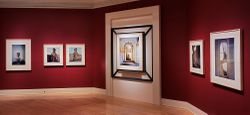
Vues et points de vue : l'architecture de Borromini dans les photographies d'Edward Burtynsky
Vues et points de vue : l'architecture de Borromini dans les photographies d'Edward Burtynsky
Actions:
Description:
Vues et points de vue conjugue la photographie contemporaine avec des gravures datant des XVIIe et XVIIIe siècles, et établit un dialogue entre deux démarches différentes qui représentent les œuvres construites de Borromini. Les photographies, commandées au photographe torontois Edward Burtynsky, ont été prises à Rome en 1999; elles font partie d’une collection plus vaste(...)
Vues et points de vue conjugue la photographie contemporaine avec des gravures datant des XVIIe et XVIIIe siècles, et établit un dialogue entre deux démarches différentes qui représentent les œuvres construites de Borromini. Les photographies, commandées au photographe torontois Edward Burtynsky, ont été prises à Rome en 1999; elles font partie d’une collection plus vaste(...)
Localisation:
Salle octogonale
Salle octogonale
Date:
15 mars 2000 au 7 mai 2000
15 mars 2000 au 7 mai 2000
Titre:
Vues et points de vue : l'architecture de Borromini dans les photographies d'Edward Burtynsky
Actions:
Description:
Vues et points de vue conjugue la photographie contemporaine avec des gravures datant des XVIIe et XVIIIe siècles, et établit un dialogue entre deux démarches différentes qui représentent les œuvres construites de Borromini. Les photographies, commandées au photographe torontois Edward Burtynsky, ont été prises à Rome en 1999; elles font partie d’une collection plus vaste(...)
Vues et points de vue : l'architecture de Borromini dans les photographies d'Edward Burtynsky
Actions:
Description:
Vues et points de vue conjugue la photographie contemporaine avec des gravures datant des XVIIe et XVIIIe siècles, et établit un dialogue entre deux démarches différentes qui représentent les œuvres construites de Borromini. Les photographies, commandées au photographe torontois Edward Burtynsky, ont été prises à Rome en 1999; elles font partie d’une collection plus vaste(...)
Classification:
expositions
expositions
Date:
15 mars 2000 au
7 mai 2000
15 mars 2000 au
7 mai 2000
Localisation:
Salle octogonale
Salle octogonale


