


33582 Résultats
Niveau de description archivistique:
Projet
Projet
Numéro de référence:
AP075.S1.1961.PR01
Description:
This project series documents Cornelia Hahn Oberlander's landscape project for the Skeena Terrace Low Rent Housing Project, a housing development located on the eastern edge of Vancouver. Oberlander worked on this project between 1961 and 1965. The architectural firm in charge of the project was Underwood, McKinley, Cameron, Wilson & Smith Architects. The project was comprised of an eight-storey apartment tower and twenty-seven three-storey maisonettes. Oberlander was in charge of the landscape design for the twelve-acre site. The project initially included the construction of a roadway cutting the site in two, but was never built due to protests from the community. Oberlander's landscape plan included a design for an outdoor terrace and garden areas for the maisonnettes, a community garden and numerous recreational and social spaces. She also designed play scultpures for small children. The project series contains design development drawings, including landscape plans and planting plans, working drawings, including a site plan and planting plans, a specifications addendum, an invitation to the official inauguration of the project, and photographs, which are mostly of the construction site. Source: Herrington, Susan. Cornelia Hahn Oberlander: Making the Modern Landscape, University of Virginia Press, 2014, 304 pages.
AP075.S1.1961.PR01
Description:
This project series documents Cornelia Hahn Oberlander's landscape project for the Skeena Terrace Low Rent Housing Project, a housing development located on the eastern edge of Vancouver. Oberlander worked on this project between 1961 and 1965. The architectural firm in charge of the project was Underwood, McKinley, Cameron, Wilson & Smith Architects. The project was comprised of an eight-storey apartment tower and twenty-seven three-storey maisonettes. Oberlander was in charge of the landscape design for the twelve-acre site. The project initially included the construction of a roadway cutting the site in two, but was never built due to protests from the community. Oberlander's landscape plan included a design for an outdoor terrace and garden areas for the maisonnettes, a community garden and numerous recreational and social spaces. She also designed play scultpures for small children. The project series contains design development drawings, including landscape plans and planting plans, working drawings, including a site plan and planting plans, a specifications addendum, an invitation to the official inauguration of the project, and photographs, which are mostly of the construction site. Source: Herrington, Susan. Cornelia Hahn Oberlander: Making the Modern Landscape, University of Virginia Press, 2014, 304 pages.
Personnes et institutions:
Date:
1961-1965
1961-1965
Titre:
Skeena Terrace Low Rent Housing, Vancouver, British Columbia (1961-1965)
Actions:
AP075.S1.1961.PR01
Description:
This project series documents Cornelia Hahn Oberlander's landscape project for the Skeena Terrace Low Rent Housing Project, a housing development located on the eastern edge of Vancouver. Oberlander worked on this project between 1961 and 1965. The architectural firm in charge of the project was Underwood, McKinley, Cameron, Wilson & Smith Architects. The project was comprised of an eight-storey apartment tower and twenty-seven three-storey maisonettes. Oberlander was in charge of the landscape design for the twelve-acre site. The project initially included the construction of a roadway cutting the site in two, but was never built due to protests from the community. Oberlander's landscape plan included a design for an outdoor terrace and garden areas for the maisonnettes, a community garden and numerous recreational and social spaces. She also designed play scultpures for small children. The project series contains design development drawings, including landscape plans and planting plans, working drawings, including a site plan and planting plans, a specifications addendum, an invitation to the official inauguration of the project, and photographs, which are mostly of the construction site. Source: Herrington, Susan. Cornelia Hahn Oberlander: Making the Modern Landscape, University of Virginia Press, 2014, 304 pages.
Skeena Terrace Low Rent Housing, Vancouver, British Columbia (1961-1965)
Actions:
AP075.S1.1961.PR01
Description:
This project series documents Cornelia Hahn Oberlander's landscape project for the Skeena Terrace Low Rent Housing Project, a housing development located on the eastern edge of Vancouver. Oberlander worked on this project between 1961 and 1965. The architectural firm in charge of the project was Underwood, McKinley, Cameron, Wilson & Smith Architects. The project was comprised of an eight-storey apartment tower and twenty-seven three-storey maisonettes. Oberlander was in charge of the landscape design for the twelve-acre site. The project initially included the construction of a roadway cutting the site in two, but was never built due to protests from the community. Oberlander's landscape plan included a design for an outdoor terrace and garden areas for the maisonnettes, a community garden and numerous recreational and social spaces. She also designed play scultpures for small children. The project series contains design development drawings, including landscape plans and planting plans, working drawings, including a site plan and planting plans, a specifications addendum, an invitation to the official inauguration of the project, and photographs, which are mostly of the construction site. Source: Herrington, Susan. Cornelia Hahn Oberlander: Making the Modern Landscape, University of Virginia Press, 2014, 304 pages.
Niveau de description archivistique:
Project
Project
Date:
1961-1965
1961-1965
Personnes et institutions:
Niveau de description archivistique:
Projet
Projet
Numéro de référence:
AP075.S1.1995.PR02
Description:
Project series documents Cornelia Hahn Oberlander's project for landscape master plan of Smith College campus, Northampton, Massachusetts. Oberlander worked on this project from 1995-1997 in collaboration with Shavaun Towers from landscape architectural firm Rolland/Towers. The project required to preserve the historic landscaping, initially design by Frederick Law Olsmsted, while also taking into account future growth of the campus. In this idea Oberlander and Towers bases their landscape master plan on six key concepts: to preserve the sacred spaces of the campus, to restore Olmsted vision, to develope open spaces in an hierarchical fashion, to limite vehicular traffic and separate it from pedestrian circulation, to provide stronger pedestrian connexions and commun spaces for social interactions, and to expande and enhance the Botanic Garden on the campus. The project series contains concept notes by Oberlander, research and reference material, proposal, meetings notes, contract, correspondence, mostly with landscape architects, clients and consultants, and financial documents. The project is also documented through landscape master plans for Oberlander and Towers proposal and campus landscape plans and previous landscape working drawings used as reference.The project series also contains photographic materials, such as slides and photographs, of the college landscaping, and postcards of Smith College.
AP075.S1.1995.PR02
Description:
Project series documents Cornelia Hahn Oberlander's project for landscape master plan of Smith College campus, Northampton, Massachusetts. Oberlander worked on this project from 1995-1997 in collaboration with Shavaun Towers from landscape architectural firm Rolland/Towers. The project required to preserve the historic landscaping, initially design by Frederick Law Olsmsted, while also taking into account future growth of the campus. In this idea Oberlander and Towers bases their landscape master plan on six key concepts: to preserve the sacred spaces of the campus, to restore Olmsted vision, to develope open spaces in an hierarchical fashion, to limite vehicular traffic and separate it from pedestrian circulation, to provide stronger pedestrian connexions and commun spaces for social interactions, and to expande and enhance the Botanic Garden on the campus. The project series contains concept notes by Oberlander, research and reference material, proposal, meetings notes, contract, correspondence, mostly with landscape architects, clients and consultants, and financial documents. The project is also documented through landscape master plans for Oberlander and Towers proposal and campus landscape plans and previous landscape working drawings used as reference.The project series also contains photographic materials, such as slides and photographs, of the college landscaping, and postcards of Smith College.
Personnes et institutions:
Date:
1974-2012
1974-2012
Titre:
Smith College, Northampton, Massachusetts (1995-1997)
Actions:
AP075.S1.1995.PR02
Description:
Project series documents Cornelia Hahn Oberlander's project for landscape master plan of Smith College campus, Northampton, Massachusetts. Oberlander worked on this project from 1995-1997 in collaboration with Shavaun Towers from landscape architectural firm Rolland/Towers. The project required to preserve the historic landscaping, initially design by Frederick Law Olsmsted, while also taking into account future growth of the campus. In this idea Oberlander and Towers bases their landscape master plan on six key concepts: to preserve the sacred spaces of the campus, to restore Olmsted vision, to develope open spaces in an hierarchical fashion, to limite vehicular traffic and separate it from pedestrian circulation, to provide stronger pedestrian connexions and commun spaces for social interactions, and to expande and enhance the Botanic Garden on the campus. The project series contains concept notes by Oberlander, research and reference material, proposal, meetings notes, contract, correspondence, mostly with landscape architects, clients and consultants, and financial documents. The project is also documented through landscape master plans for Oberlander and Towers proposal and campus landscape plans and previous landscape working drawings used as reference.The project series also contains photographic materials, such as slides and photographs, of the college landscaping, and postcards of Smith College.
Smith College, Northampton, Massachusetts (1995-1997)
Actions:
AP075.S1.1995.PR02
Description:
Project series documents Cornelia Hahn Oberlander's project for landscape master plan of Smith College campus, Northampton, Massachusetts. Oberlander worked on this project from 1995-1997 in collaboration with Shavaun Towers from landscape architectural firm Rolland/Towers. The project required to preserve the historic landscaping, initially design by Frederick Law Olsmsted, while also taking into account future growth of the campus. In this idea Oberlander and Towers bases their landscape master plan on six key concepts: to preserve the sacred spaces of the campus, to restore Olmsted vision, to develope open spaces in an hierarchical fashion, to limite vehicular traffic and separate it from pedestrian circulation, to provide stronger pedestrian connexions and commun spaces for social interactions, and to expande and enhance the Botanic Garden on the campus. The project series contains concept notes by Oberlander, research and reference material, proposal, meetings notes, contract, correspondence, mostly with landscape architects, clients and consultants, and financial documents. The project is also documented through landscape master plans for Oberlander and Towers proposal and campus landscape plans and previous landscape working drawings used as reference.The project series also contains photographic materials, such as slides and photographs, of the college landscaping, and postcards of Smith College.
Niveau de description archivistique:
Project
Project
Date:
1974-2012
1974-2012
Personnes et institutions:
Niveau de description archivistique:
Projet
Projet
Numéro de référence:
AP075.S1.2000.PR04
Description:
Project series documents Cornelia Hahn Oberlander's landscape project for the redesign of low-income housing development New Holly Park III in South Beacon Hill, outside Seattle, Washington. Oberlander was hired by Daniel Solomon ETC Artchitects to work on the landscape. She worked on this project in the early 2000s. The housing development was original called Holly Park. The project in the redesign of the existing housing development built in the 1940s and adding 219 rentals and 121 owned properties. For the landscaping, Oberlander "planned not only central market park but also numerous pocket parks and a greenhouse" [1]. The project series contains design development drawings, presentation drawings and working drawings, such as site plans, landscape plans, planting plans, and irrigations plans. The drawings also includes housing construction plans used as reference. The project is also documented through correspondence with client, architect, consultant and contractors, specifications, contract, financial documents, plant selection and documentation. The project series also includes photographs of the project and digital photographs of a site visit by Oberlander. Sources: [1] Herrington, Susan. Cornelia Hahn Oberlander: Making the Modern Landscape, University of Virginia Press, 2014, 304 pages, p. 69.
AP075.S1.2000.PR04
Description:
Project series documents Cornelia Hahn Oberlander's landscape project for the redesign of low-income housing development New Holly Park III in South Beacon Hill, outside Seattle, Washington. Oberlander was hired by Daniel Solomon ETC Artchitects to work on the landscape. She worked on this project in the early 2000s. The housing development was original called Holly Park. The project in the redesign of the existing housing development built in the 1940s and adding 219 rentals and 121 owned properties. For the landscaping, Oberlander "planned not only central market park but also numerous pocket parks and a greenhouse" [1]. The project series contains design development drawings, presentation drawings and working drawings, such as site plans, landscape plans, planting plans, and irrigations plans. The drawings also includes housing construction plans used as reference. The project is also documented through correspondence with client, architect, consultant and contractors, specifications, contract, financial documents, plant selection and documentation. The project series also includes photographs of the project and digital photographs of a site visit by Oberlander. Sources: [1] Herrington, Susan. Cornelia Hahn Oberlander: Making the Modern Landscape, University of Virginia Press, 2014, 304 pages, p. 69.
Personnes et institutions:
Date:
2000-2005
2000-2005
Titre:
New Holly Park III, Seattle, Washington (2000)
Actions:
AP075.S1.2000.PR04
Description:
Project series documents Cornelia Hahn Oberlander's landscape project for the redesign of low-income housing development New Holly Park III in South Beacon Hill, outside Seattle, Washington. Oberlander was hired by Daniel Solomon ETC Artchitects to work on the landscape. She worked on this project in the early 2000s. The housing development was original called Holly Park. The project in the redesign of the existing housing development built in the 1940s and adding 219 rentals and 121 owned properties. For the landscaping, Oberlander "planned not only central market park but also numerous pocket parks and a greenhouse" [1]. The project series contains design development drawings, presentation drawings and working drawings, such as site plans, landscape plans, planting plans, and irrigations plans. The drawings also includes housing construction plans used as reference. The project is also documented through correspondence with client, architect, consultant and contractors, specifications, contract, financial documents, plant selection and documentation. The project series also includes photographs of the project and digital photographs of a site visit by Oberlander. Sources: [1] Herrington, Susan. Cornelia Hahn Oberlander: Making the Modern Landscape, University of Virginia Press, 2014, 304 pages, p. 69.
New Holly Park III, Seattle, Washington (2000)
Actions:
AP075.S1.2000.PR04
Description:
Project series documents Cornelia Hahn Oberlander's landscape project for the redesign of low-income housing development New Holly Park III in South Beacon Hill, outside Seattle, Washington. Oberlander was hired by Daniel Solomon ETC Artchitects to work on the landscape. She worked on this project in the early 2000s. The housing development was original called Holly Park. The project in the redesign of the existing housing development built in the 1940s and adding 219 rentals and 121 owned properties. For the landscaping, Oberlander "planned not only central market park but also numerous pocket parks and a greenhouse" [1]. The project series contains design development drawings, presentation drawings and working drawings, such as site plans, landscape plans, planting plans, and irrigations plans. The drawings also includes housing construction plans used as reference. The project is also documented through correspondence with client, architect, consultant and contractors, specifications, contract, financial documents, plant selection and documentation. The project series also includes photographs of the project and digital photographs of a site visit by Oberlander. Sources: [1] Herrington, Susan. Cornelia Hahn Oberlander: Making the Modern Landscape, University of Virginia Press, 2014, 304 pages, p. 69.
Niveau de description archivistique:
Project
Project
Date:
2000-2005
2000-2005
Personnes et institutions:
Classification:
documents textuels
documents textuels
Actions:
Numéro de référence:
DR2001:0029
Description:
documents include correspondence to colleagues and universities for 1991-1992: Coop Himmelblau, UMRISS - Coop Himmelblauk Stephanie Dudek, Kurt Forster, Frank O. Gehry & Assoc., Fabio Ghersi (architect), David Goldblatt - Journal of Aesthetics and Art Criticism, Zaha Hadid, Philip Johnson, Philip Johnson 85th Birthday Invoices, Libeskind, Daniel and Nina, Macklowe - CMRI (drawings for exhibition), Rick Mandell, Edith Miller, David Neuman, Peter Noever - Architecture in Transition, John Rajchman, Renato Rizzi, Zoran Sladoljev, Antoine Predock, Antonia Soulez, Mark Taylor, Massimo Vignelli and Faruk Yorgancioglu. University Publications: University of California - Riverside, The Cooper Union, Cornell University, The Chicago Institute (for Architecture and Urbanism), Columbia High School, Columbia University, Universitat Hanover, Harvard Graduate school of Design, The University of Illinois at Chicago, Oberlin (College), Ohio State University, Pratt Institute, Princeton University, Rice School of Architecture, College of William and Mary and Richard Bland College.
DR2001:0029
Description:
documents include correspondence to colleagues and universities for 1991-1992: Coop Himmelblau, UMRISS - Coop Himmelblauk Stephanie Dudek, Kurt Forster, Frank O. Gehry & Assoc., Fabio Ghersi (architect), David Goldblatt - Journal of Aesthetics and Art Criticism, Zaha Hadid, Philip Johnson, Philip Johnson 85th Birthday Invoices, Libeskind, Daniel and Nina, Macklowe - CMRI (drawings for exhibition), Rick Mandell, Edith Miller, David Neuman, Peter Noever - Architecture in Transition, John Rajchman, Renato Rizzi, Zoran Sladoljev, Antoine Predock, Antonia Soulez, Mark Taylor, Massimo Vignelli and Faruk Yorgancioglu. University Publications: University of California - Riverside, The Cooper Union, Cornell University, The Chicago Institute (for Architecture and Urbanism), Columbia High School, Columbia University, Universitat Hanover, Harvard Graduate school of Design, The University of Illinois at Chicago, Oberlin (College), Ohio State University, Pratt Institute, Princeton University, Rice School of Architecture, College of William and Mary and Richard Bland College.
Personnes et institutions:
Titre:
Correspondence to colleagues and universities
Actions:
DR2001:0029
Description:
documents include correspondence to colleagues and universities for 1991-1992: Coop Himmelblau, UMRISS - Coop Himmelblauk Stephanie Dudek, Kurt Forster, Frank O. Gehry & Assoc., Fabio Ghersi (architect), David Goldblatt - Journal of Aesthetics and Art Criticism, Zaha Hadid, Philip Johnson, Philip Johnson 85th Birthday Invoices, Libeskind, Daniel and Nina, Macklowe - CMRI (drawings for exhibition), Rick Mandell, Edith Miller, David Neuman, Peter Noever - Architecture in Transition, John Rajchman, Renato Rizzi, Zoran Sladoljev, Antoine Predock, Antonia Soulez, Mark Taylor, Massimo Vignelli and Faruk Yorgancioglu. University Publications: University of California - Riverside, The Cooper Union, Cornell University, The Chicago Institute (for Architecture and Urbanism), Columbia High School, Columbia University, Universitat Hanover, Harvard Graduate school of Design, The University of Illinois at Chicago, Oberlin (College), Ohio State University, Pratt Institute, Princeton University, Rice School of Architecture, College of William and Mary and Richard Bland College.
Correspondence to colleagues and universities
Actions:
DR2001:0029
Description:
documents include correspondence to colleagues and universities for 1991-1992: Coop Himmelblau, UMRISS - Coop Himmelblauk Stephanie Dudek, Kurt Forster, Frank O. Gehry & Assoc., Fabio Ghersi (architect), David Goldblatt - Journal of Aesthetics and Art Criticism, Zaha Hadid, Philip Johnson, Philip Johnson 85th Birthday Invoices, Libeskind, Daniel and Nina, Macklowe - CMRI (drawings for exhibition), Rick Mandell, Edith Miller, David Neuman, Peter Noever - Architecture in Transition, John Rajchman, Renato Rizzi, Zoran Sladoljev, Antoine Predock, Antonia Soulez, Mark Taylor, Massimo Vignelli and Faruk Yorgancioglu. University Publications: University of California - Riverside, The Cooper Union, Cornell University, The Chicago Institute (for Architecture and Urbanism), Columbia High School, Columbia University, Universitat Hanover, Harvard Graduate school of Design, The University of Illinois at Chicago, Oberlin (College), Ohio State University, Pratt Institute, Princeton University, Rice School of Architecture, College of William and Mary and Richard Bland College.
Classification:
documents textuels
documents textuels
Personnes et institutions:
Classification:
graphique
graphique
Numéro de référence:
ARCH153788
Description:
Various posters advertising IAUS exhibitions: Clorindo Testa: Architecture and Personal Mythology; November 9 to 25, 1981 (2) Office for Metropolitan Architecture: Toward a modern (re)construction of the European City - Four Housing Projects; March 12 to May 28, 1982 (2) Princeton's Beaux-Arts and its New Academicism from Labatut to the Program of Geddes - An Exhibition of Original Drawings over Fifty Years; January 27 to February 18 [?] (2) Gwathmey Siegel Architects : Twenty-four Residences; December 15, 1977 to January 15, 1978 (2) O.M. Ungers : An Exhibition of Architecture, May 6 to May 31, 1977 (2) Philip Johnson: Processes, September 12 to October 31, 1978 (2) Wallace Harrison: Fifty Years of Architecture, December 13, 1979 to January 13, 1980 (1) On Style - Two Evenings at the IAUS, December 6 and 8, 1982; [The Portland Building by Michael Graves] (2)
ARCH153788
Description:
Various posters advertising IAUS exhibitions: Clorindo Testa: Architecture and Personal Mythology; November 9 to 25, 1981 (2) Office for Metropolitan Architecture: Toward a modern (re)construction of the European City - Four Housing Projects; March 12 to May 28, 1982 (2) Princeton's Beaux-Arts and its New Academicism from Labatut to the Program of Geddes - An Exhibition of Original Drawings over Fifty Years; January 27 to February 18 [?] (2) Gwathmey Siegel Architects : Twenty-four Residences; December 15, 1977 to January 15, 1978 (2) O.M. Ungers : An Exhibition of Architecture, May 6 to May 31, 1977 (2) Philip Johnson: Processes, September 12 to October 31, 1978 (2) Wallace Harrison: Fifty Years of Architecture, December 13, 1979 to January 13, 1980 (1) On Style - Two Evenings at the IAUS, December 6 and 8, 1982; [The Portland Building by Michael Graves] (2)
Personnes et institutions:
Date:
1977-1982
1977-1982
Titre:
Various posters advertising IAUS exhibitions
Actions:
ARCH153788
Description:
Various posters advertising IAUS exhibitions: Clorindo Testa: Architecture and Personal Mythology; November 9 to 25, 1981 (2) Office for Metropolitan Architecture: Toward a modern (re)construction of the European City - Four Housing Projects; March 12 to May 28, 1982 (2) Princeton's Beaux-Arts and its New Academicism from Labatut to the Program of Geddes - An Exhibition of Original Drawings over Fifty Years; January 27 to February 18 [?] (2) Gwathmey Siegel Architects : Twenty-four Residences; December 15, 1977 to January 15, 1978 (2) O.M. Ungers : An Exhibition of Architecture, May 6 to May 31, 1977 (2) Philip Johnson: Processes, September 12 to October 31, 1978 (2) Wallace Harrison: Fifty Years of Architecture, December 13, 1979 to January 13, 1980 (1) On Style - Two Evenings at the IAUS, December 6 and 8, 1982; [The Portland Building by Michael Graves] (2)
Various posters advertising IAUS exhibitions
Actions:
ARCH153788
Description:
Various posters advertising IAUS exhibitions: Clorindo Testa: Architecture and Personal Mythology; November 9 to 25, 1981 (2) Office for Metropolitan Architecture: Toward a modern (re)construction of the European City - Four Housing Projects; March 12 to May 28, 1982 (2) Princeton's Beaux-Arts and its New Academicism from Labatut to the Program of Geddes - An Exhibition of Original Drawings over Fifty Years; January 27 to February 18 [?] (2) Gwathmey Siegel Architects : Twenty-four Residences; December 15, 1977 to January 15, 1978 (2) O.M. Ungers : An Exhibition of Architecture, May 6 to May 31, 1977 (2) Philip Johnson: Processes, September 12 to October 31, 1978 (2) Wallace Harrison: Fifty Years of Architecture, December 13, 1979 to January 13, 1980 (1) On Style - Two Evenings at the IAUS, December 6 and 8, 1982; [The Portland Building by Michael Graves] (2)
Classification:
graphique
graphique
Date:
1977-1982
1977-1982
Personnes et institutions:
Classification:
recherche
recherche
Titre:
Chercheurs en résidence 2004
Chercheurs en résidence 2004
Actions:
Description:
Jean-Pierre Chupin, École darchitecture, Université de Montréal, Canada Sujet : Théories du projet et paradoxes de la pensée analogique au tournant des années 70 Samuel D. Abert, Département d’histoire de l’art, Université hébraïque de Jérusalem, Israël Sujet : And was Jerusalem builded here… Maarten Delbeke, Universiteit Gent, Gand, Belgique Sujet : The Sacred History(...)
Jean-Pierre Chupin, École darchitecture, Université de Montréal, Canada Sujet : Théories du projet et paradoxes de la pensée analogique au tournant des années 70 Samuel D. Abert, Département d’histoire de l’art, Université hébraïque de Jérusalem, Israël Sujet : And was Jerusalem builded here… Maarten Delbeke, Universiteit Gent, Gand, Belgique Sujet : The Sacred History(...)
Date:
janvier 2004 au août 2004
janvier 2004 au août 2004
Titre:
Chercheurs en résidence 2004
Actions:
Description:
Jean-Pierre Chupin, École darchitecture, Université de Montréal, Canada Sujet : Théories du projet et paradoxes de la pensée analogique au tournant des années 70 Samuel D. Abert, Département d’histoire de l’art, Université hébraïque de Jérusalem, Israël Sujet : And was Jerusalem builded here… Maarten Delbeke, Universiteit Gent, Gand, Belgique Sujet : The Sacred History(...)
Chercheurs en résidence 2004
Actions:
Description:
Jean-Pierre Chupin, École darchitecture, Université de Montréal, Canada Sujet : Théories du projet et paradoxes de la pensée analogique au tournant des années 70 Samuel D. Abert, Département d’histoire de l’art, Université hébraïque de Jérusalem, Israël Sujet : And was Jerusalem builded here… Maarten Delbeke, Universiteit Gent, Gand, Belgique Sujet : The Sacred History(...)
Classification:
recherche
recherche
Date:
janvier 2004 au
août 2004
janvier 2004 au
août 2004
Classification:
événements
événements
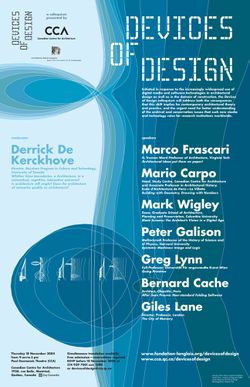
Titre:
Devices of Design
Devices of Design
Actions:
Description:
Le colloque Devices of Design est une collaboration entre le CCA et la Fondation Daniel Langlois pour l’art, la science et la technologie. Il a été organisé en réponse à l’utilisation de plus en plus massive des outils numériques et des nouvelles technologies dans la conception architecturale et dans le domaine de la construction. Diverses communications ainsi qu’une(...)
Le colloque Devices of Design est une collaboration entre le CCA et la Fondation Daniel Langlois pour l’art, la science et la technologie. Il a été organisé en réponse à l’utilisation de plus en plus massive des outils numériques et des nouvelles technologies dans la conception architecturale et dans le domaine de la construction. Diverses communications ainsi qu’une(...)
Localisation:
Théâtre Paul-Desmarais
Théâtre Paul-Desmarais
Date:
18 novembre 2004 au 19 novembre 2004
18 novembre 2004 au 19 novembre 2004
Titre:
Devices of Design
Actions:
Description:
Le colloque Devices of Design est une collaboration entre le CCA et la Fondation Daniel Langlois pour l’art, la science et la technologie. Il a été organisé en réponse à l’utilisation de plus en plus massive des outils numériques et des nouvelles technologies dans la conception architecturale et dans le domaine de la construction. Diverses communications ainsi qu’une(...)
Devices of Design
Actions:
Description:
Le colloque Devices of Design est une collaboration entre le CCA et la Fondation Daniel Langlois pour l’art, la science et la technologie. Il a été organisé en réponse à l’utilisation de plus en plus massive des outils numériques et des nouvelles technologies dans la conception architecturale et dans le domaine de la construction. Diverses communications ainsi qu’une(...)
Classification:
événements
événements
Date:
18 novembre 2004 au
19 novembre 2004
18 novembre 2004 au
19 novembre 2004
Localisation:
Théâtre Paul-Desmarais
Théâtre Paul-Desmarais
Niveau de description archivistique:
Sous-série
Sous-série
Titre:
Opera Houses
Opera Houses
Numéro de référence:
CI001.S2.D3
Description:
Charles Rohault de Fleury's sustained involvement with the design of opera houses began with his appointment in 1846 as official architect of the existing Salle Le Pelletier, home to the *Paris Opera, and continued until an open competition was called in 1860 (Charles Garnier won this competition). During this period Rohault de Fleury submitted numerous proposals to replace theprovisional Salle Le Pelletier with a structure more appropriate to the grandeur and importance of France's national opera company. The CCA collection contains four projects related to his work for the Paris opera: two early projects (1846 and 1847) and one later one (1859) for a newopera house, and a portfolio of lithographs and drawings related to alterations and repairs to Salle Le Pelletier (1850-1854). The collection also includes Charles' earliest theatre project, a comprehensive plan for an opera house and surrounding infrastructure for the Theatre Royal Italien opera company (1838-1840), and an album containing drawings and prints of antique and contemporary theatres (1839-1854?). Charles' first project was for the Theatre Royal Italien opera company whose previous home, the Salle Favart, had burned down on the night of January 14 1838. The CCA collection contains an album of presentation drawings for a new theatre located on rue de la Paix with boutiques in the adjacent 'passages' (DR1974:0002:019:001-023). A second album consists of site plans including proposed 'maisons à loyers' (apartment buildings) and documents relating to the cost estimates and rental income for the entire project (DR1974:0002:036:001-016). The architectural style and interior arrangement of the theatre is heavily indebted to Francois Debret's Salle Le Pelletier. Charles' originality lies more in his conception of the social and economic role of the theatre in relation and integration, to its surrounding urban fabric. An explanation of the entire Theatre Royal Italien project, and Charles' role as architect in it, is found in two proposal letters (located in the Avery Library, Columbia University, NY) written by the entrepreneur Eugene Lecomte to the Minister of the Interior, Comte Duchatel, on May 15 and October 31 1839 (1). Charles' album of drawings at the CCA for the theatre and some of the cost and rental estimates are probably presentation copies directly related to the first letter, and most likely submitted to the Minister of the Interior. Charles' project was never executed, and the Italian opera company eventualy found a permanent home in the existing Salle Ventadour (1841). However, the inclusive nature of the Théâtre Royal Italien proposal, with its stress on urban development and contextuality, continued to play a seminal role in his later Paris Opera projects. Upon replacing Francois Debret as architect of Salle Le Pelletier in 1846, Charles proposed nine possible locations (site plans) for a new opera house for the Paris Opera (*Academie Royale de Musique) and, in the following year (1847) prepared a portfolio of drawings for the actual structure with an accompanying seven-page manuscript describing the project. Although executed in successive years, the site plans and 1847 drawings are conceptually related. Both components were undertaken in response to offical interest in a public competition that was never implemented (2)(3). The CCA has two sets of the nine site plans proposed in 1846 (DR1974:0002:036:001-016), one containing transfer lithographed site plans with a written analysis and cost estimate for each of the proposed locations, and the other with only the site plans (similar sets are located in the 'Archives Nationales' in France). They indicate that Charles, (heavily influenced by his Théâtre Royal Italien project) preferred the Rue de la Paix location (siteplan #3) for the new opera house. Although site plan number six, Boulevard des Capucines, was not favoured at this date, it is highly prophetic as it was the location officially chosen in 1860 for the new opera house. Apparently unique to the CCA collection is the 1847 manuscript and portfolio of drawings for the proposed opera house (DR1974:0002:036:001-016). The manuscript is both an indepth review of the requirements for a national opera house and a guide to his portfolio of drawings. Charles' conception and design continued to be strongly influenced by Debret's Salle Lepelletier, as well as his own Théâtre Italien project, and various antique and contemporary opera houses and theatres. Many of the French and Italian sources mentioned in the manuscript are collected in an album (DR1974:0002:010:001-048) as references for his own designs (4). As official architect of Salle Le pelletier, Charles was also responsible for repairs, restorations, and alterations to the existing structure. The drawings and transfer lithographs in the CCA collection (DR1974:0002:036:001-016) are primarily dated 1854, and relate to documented repair and restoration projects undertaken during this period (5)(6). The CCA collection has the presentation drawings and lithographs for the later 1859 project (DR1974:0002:027:001-027) for the Paris opera (*Theatre Imperiale de l'opera) that were sent to Achille Fould, the Minister of State. This project is probably a counterpart to a similiar one that he submitted to the Prefect of the Seine, Baron Haussmann, in the same year (7). Site plans show the opera house on an irregular polygonal site facing Boulevard des Capucines. The placement of the 'maisons à loyers' on the rear of the site reflects Charles' continued emphasis on integrating his opera projects into the surrounding urban context. In 1859, it appeared that Charles was favoured to build the new opera house. But late in the following year, a public competition was called in which Charles Garnier emerged as the victor. Although Charles did not build the final structure, his numerous projects, as exemplified in the CCA collection, were of prime importance in determining the location, configuration, and plan of the Place de l'Opera (8). * The 'Paris Opera' was France's national opera, and thus its name changed numerous times throughout its history according to altering perceptions of its role in French culture and/or changes in political regimes. For reasons of clarity, the national opera will be referred to as the Paris Opera. The names indicated in brackets with a star refer to the proper name of the opera company at the date of the project. (1) Eugene Le Comte, "Projet de Salle rue de la Paix, pour le Théâtre Royal Italien: Lettres à Monsieur le Ministre de l'Intérieur, en date des 15 mai et 31octobre 1839" (Paris: P. Dupont, 1839). (2) Christopher Curtis Mead, "Charles Garnier's Paris Opera and the Renaissance of Classicism in Nineteenth century French Architecture", 3 vols. (PhD thesis; Philadelphia: University of Pennsylvania, 1986), p. 234 and p. 956, fn. 30. (3) Monika Steinhauser, "Die Architektur des Pariser Oper" (Munich: Prestel Verlag, 1969), p. 45, fns. 143 and 144. (4) Barry Bergdoll, "Charles Rohault de Fleury: Part Three: Theatres and the Opera house", 'CCA Research Report', n.d., p. 3. (5) Larousse XIXth Century, s.v. "Rohault de Fleury, Charles". (6) Mead, p. 238. (7) Oeuvres de C. Rohault de Fleury, architecte" (Paris: Librarie centrale d'architecture, 1884).. (8) Macmillan, s.v. "Rohault de Fleury Familly".
CI001.S2.D3
Description:
Charles Rohault de Fleury's sustained involvement with the design of opera houses began with his appointment in 1846 as official architect of the existing Salle Le Pelletier, home to the *Paris Opera, and continued until an open competition was called in 1860 (Charles Garnier won this competition). During this period Rohault de Fleury submitted numerous proposals to replace theprovisional Salle Le Pelletier with a structure more appropriate to the grandeur and importance of France's national opera company. The CCA collection contains four projects related to his work for the Paris opera: two early projects (1846 and 1847) and one later one (1859) for a newopera house, and a portfolio of lithographs and drawings related to alterations and repairs to Salle Le Pelletier (1850-1854). The collection also includes Charles' earliest theatre project, a comprehensive plan for an opera house and surrounding infrastructure for the Theatre Royal Italien opera company (1838-1840), and an album containing drawings and prints of antique and contemporary theatres (1839-1854?). Charles' first project was for the Theatre Royal Italien opera company whose previous home, the Salle Favart, had burned down on the night of January 14 1838. The CCA collection contains an album of presentation drawings for a new theatre located on rue de la Paix with boutiques in the adjacent 'passages' (DR1974:0002:019:001-023). A second album consists of site plans including proposed 'maisons à loyers' (apartment buildings) and documents relating to the cost estimates and rental income for the entire project (DR1974:0002:036:001-016). The architectural style and interior arrangement of the theatre is heavily indebted to Francois Debret's Salle Le Pelletier. Charles' originality lies more in his conception of the social and economic role of the theatre in relation and integration, to its surrounding urban fabric. An explanation of the entire Theatre Royal Italien project, and Charles' role as architect in it, is found in two proposal letters (located in the Avery Library, Columbia University, NY) written by the entrepreneur Eugene Lecomte to the Minister of the Interior, Comte Duchatel, on May 15 and October 31 1839 (1). Charles' album of drawings at the CCA for the theatre and some of the cost and rental estimates are probably presentation copies directly related to the first letter, and most likely submitted to the Minister of the Interior. Charles' project was never executed, and the Italian opera company eventualy found a permanent home in the existing Salle Ventadour (1841). However, the inclusive nature of the Théâtre Royal Italien proposal, with its stress on urban development and contextuality, continued to play a seminal role in his later Paris Opera projects. Upon replacing Francois Debret as architect of Salle Le Pelletier in 1846, Charles proposed nine possible locations (site plans) for a new opera house for the Paris Opera (*Academie Royale de Musique) and, in the following year (1847) prepared a portfolio of drawings for the actual structure with an accompanying seven-page manuscript describing the project. Although executed in successive years, the site plans and 1847 drawings are conceptually related. Both components were undertaken in response to offical interest in a public competition that was never implemented (2)(3). The CCA has two sets of the nine site plans proposed in 1846 (DR1974:0002:036:001-016), one containing transfer lithographed site plans with a written analysis and cost estimate for each of the proposed locations, and the other with only the site plans (similar sets are located in the 'Archives Nationales' in France). They indicate that Charles, (heavily influenced by his Théâtre Royal Italien project) preferred the Rue de la Paix location (siteplan #3) for the new opera house. Although site plan number six, Boulevard des Capucines, was not favoured at this date, it is highly prophetic as it was the location officially chosen in 1860 for the new opera house. Apparently unique to the CCA collection is the 1847 manuscript and portfolio of drawings for the proposed opera house (DR1974:0002:036:001-016). The manuscript is both an indepth review of the requirements for a national opera house and a guide to his portfolio of drawings. Charles' conception and design continued to be strongly influenced by Debret's Salle Lepelletier, as well as his own Théâtre Italien project, and various antique and contemporary opera houses and theatres. Many of the French and Italian sources mentioned in the manuscript are collected in an album (DR1974:0002:010:001-048) as references for his own designs (4). As official architect of Salle Le pelletier, Charles was also responsible for repairs, restorations, and alterations to the existing structure. The drawings and transfer lithographs in the CCA collection (DR1974:0002:036:001-016) are primarily dated 1854, and relate to documented repair and restoration projects undertaken during this period (5)(6). The CCA collection has the presentation drawings and lithographs for the later 1859 project (DR1974:0002:027:001-027) for the Paris opera (*Theatre Imperiale de l'opera) that were sent to Achille Fould, the Minister of State. This project is probably a counterpart to a similiar one that he submitted to the Prefect of the Seine, Baron Haussmann, in the same year (7). Site plans show the opera house on an irregular polygonal site facing Boulevard des Capucines. The placement of the 'maisons à loyers' on the rear of the site reflects Charles' continued emphasis on integrating his opera projects into the surrounding urban context. In 1859, it appeared that Charles was favoured to build the new opera house. But late in the following year, a public competition was called in which Charles Garnier emerged as the victor. Although Charles did not build the final structure, his numerous projects, as exemplified in the CCA collection, were of prime importance in determining the location, configuration, and plan of the Place de l'Opera (8). * The 'Paris Opera' was France's national opera, and thus its name changed numerous times throughout its history according to altering perceptions of its role in French culture and/or changes in political regimes. For reasons of clarity, the national opera will be referred to as the Paris Opera. The names indicated in brackets with a star refer to the proper name of the opera company at the date of the project. (1) Eugene Le Comte, "Projet de Salle rue de la Paix, pour le Théâtre Royal Italien: Lettres à Monsieur le Ministre de l'Intérieur, en date des 15 mai et 31octobre 1839" (Paris: P. Dupont, 1839). (2) Christopher Curtis Mead, "Charles Garnier's Paris Opera and the Renaissance of Classicism in Nineteenth century French Architecture", 3 vols. (PhD thesis; Philadelphia: University of Pennsylvania, 1986), p. 234 and p. 956, fn. 30. (3) Monika Steinhauser, "Die Architektur des Pariser Oper" (Munich: Prestel Verlag, 1969), p. 45, fns. 143 and 144. (4) Barry Bergdoll, "Charles Rohault de Fleury: Part Three: Theatres and the Opera house", 'CCA Research Report', n.d., p. 3. (5) Larousse XIXth Century, s.v. "Rohault de Fleury, Charles". (6) Mead, p. 238. (7) Oeuvres de C. Rohault de Fleury, architecte" (Paris: Librarie centrale d'architecture, 1884).. (8) Macmillan, s.v. "Rohault de Fleury Familly".
Personnes et institutions:
Date:
1717-1868
1717-1868
Titre:
Opera Houses
CI001.S2.D3
Description:
Charles Rohault de Fleury's sustained involvement with the design of opera houses began with his appointment in 1846 as official architect of the existing Salle Le Pelletier, home to the *Paris Opera, and continued until an open competition was called in 1860 (Charles Garnier won this competition). During this period Rohault de Fleury submitted numerous proposals to replace theprovisional Salle Le Pelletier with a structure more appropriate to the grandeur and importance of France's national opera company. The CCA collection contains four projects related to his work for the Paris opera: two early projects (1846 and 1847) and one later one (1859) for a newopera house, and a portfolio of lithographs and drawings related to alterations and repairs to Salle Le Pelletier (1850-1854). The collection also includes Charles' earliest theatre project, a comprehensive plan for an opera house and surrounding infrastructure for the Theatre Royal Italien opera company (1838-1840), and an album containing drawings and prints of antique and contemporary theatres (1839-1854?). Charles' first project was for the Theatre Royal Italien opera company whose previous home, the Salle Favart, had burned down on the night of January 14 1838. The CCA collection contains an album of presentation drawings for a new theatre located on rue de la Paix with boutiques in the adjacent 'passages' (DR1974:0002:019:001-023). A second album consists of site plans including proposed 'maisons à loyers' (apartment buildings) and documents relating to the cost estimates and rental income for the entire project (DR1974:0002:036:001-016). The architectural style and interior arrangement of the theatre is heavily indebted to Francois Debret's Salle Le Pelletier. Charles' originality lies more in his conception of the social and economic role of the theatre in relation and integration, to its surrounding urban fabric. An explanation of the entire Theatre Royal Italien project, and Charles' role as architect in it, is found in two proposal letters (located in the Avery Library, Columbia University, NY) written by the entrepreneur Eugene Lecomte to the Minister of the Interior, Comte Duchatel, on May 15 and October 31 1839 (1). Charles' album of drawings at the CCA for the theatre and some of the cost and rental estimates are probably presentation copies directly related to the first letter, and most likely submitted to the Minister of the Interior. Charles' project was never executed, and the Italian opera company eventualy found a permanent home in the existing Salle Ventadour (1841). However, the inclusive nature of the Théâtre Royal Italien proposal, with its stress on urban development and contextuality, continued to play a seminal role in his later Paris Opera projects. Upon replacing Francois Debret as architect of Salle Le Pelletier in 1846, Charles proposed nine possible locations (site plans) for a new opera house for the Paris Opera (*Academie Royale de Musique) and, in the following year (1847) prepared a portfolio of drawings for the actual structure with an accompanying seven-page manuscript describing the project. Although executed in successive years, the site plans and 1847 drawings are conceptually related. Both components were undertaken in response to offical interest in a public competition that was never implemented (2)(3). The CCA has two sets of the nine site plans proposed in 1846 (DR1974:0002:036:001-016), one containing transfer lithographed site plans with a written analysis and cost estimate for each of the proposed locations, and the other with only the site plans (similar sets are located in the 'Archives Nationales' in France). They indicate that Charles, (heavily influenced by his Théâtre Royal Italien project) preferred the Rue de la Paix location (siteplan #3) for the new opera house. Although site plan number six, Boulevard des Capucines, was not favoured at this date, it is highly prophetic as it was the location officially chosen in 1860 for the new opera house. Apparently unique to the CCA collection is the 1847 manuscript and portfolio of drawings for the proposed opera house (DR1974:0002:036:001-016). The manuscript is both an indepth review of the requirements for a national opera house and a guide to his portfolio of drawings. Charles' conception and design continued to be strongly influenced by Debret's Salle Lepelletier, as well as his own Théâtre Italien project, and various antique and contemporary opera houses and theatres. Many of the French and Italian sources mentioned in the manuscript are collected in an album (DR1974:0002:010:001-048) as references for his own designs (4). As official architect of Salle Le pelletier, Charles was also responsible for repairs, restorations, and alterations to the existing structure. The drawings and transfer lithographs in the CCA collection (DR1974:0002:036:001-016) are primarily dated 1854, and relate to documented repair and restoration projects undertaken during this period (5)(6). The CCA collection has the presentation drawings and lithographs for the later 1859 project (DR1974:0002:027:001-027) for the Paris opera (*Theatre Imperiale de l'opera) that were sent to Achille Fould, the Minister of State. This project is probably a counterpart to a similiar one that he submitted to the Prefect of the Seine, Baron Haussmann, in the same year (7). Site plans show the opera house on an irregular polygonal site facing Boulevard des Capucines. The placement of the 'maisons à loyers' on the rear of the site reflects Charles' continued emphasis on integrating his opera projects into the surrounding urban context. In 1859, it appeared that Charles was favoured to build the new opera house. But late in the following year, a public competition was called in which Charles Garnier emerged as the victor. Although Charles did not build the final structure, his numerous projects, as exemplified in the CCA collection, were of prime importance in determining the location, configuration, and plan of the Place de l'Opera (8). * The 'Paris Opera' was France's national opera, and thus its name changed numerous times throughout its history according to altering perceptions of its role in French culture and/or changes in political regimes. For reasons of clarity, the national opera will be referred to as the Paris Opera. The names indicated in brackets with a star refer to the proper name of the opera company at the date of the project. (1) Eugene Le Comte, "Projet de Salle rue de la Paix, pour le Théâtre Royal Italien: Lettres à Monsieur le Ministre de l'Intérieur, en date des 15 mai et 31octobre 1839" (Paris: P. Dupont, 1839). (2) Christopher Curtis Mead, "Charles Garnier's Paris Opera and the Renaissance of Classicism in Nineteenth century French Architecture", 3 vols. (PhD thesis; Philadelphia: University of Pennsylvania, 1986), p. 234 and p. 956, fn. 30. (3) Monika Steinhauser, "Die Architektur des Pariser Oper" (Munich: Prestel Verlag, 1969), p. 45, fns. 143 and 144. (4) Barry Bergdoll, "Charles Rohault de Fleury: Part Three: Theatres and the Opera house", 'CCA Research Report', n.d., p. 3. (5) Larousse XIXth Century, s.v. "Rohault de Fleury, Charles". (6) Mead, p. 238. (7) Oeuvres de C. Rohault de Fleury, architecte" (Paris: Librarie centrale d'architecture, 1884).. (8) Macmillan, s.v. "Rohault de Fleury Familly".
Opera Houses
CI001.S2.D3
Description:
Charles Rohault de Fleury's sustained involvement with the design of opera houses began with his appointment in 1846 as official architect of the existing Salle Le Pelletier, home to the *Paris Opera, and continued until an open competition was called in 1860 (Charles Garnier won this competition). During this period Rohault de Fleury submitted numerous proposals to replace theprovisional Salle Le Pelletier with a structure more appropriate to the grandeur and importance of France's national opera company. The CCA collection contains four projects related to his work for the Paris opera: two early projects (1846 and 1847) and one later one (1859) for a newopera house, and a portfolio of lithographs and drawings related to alterations and repairs to Salle Le Pelletier (1850-1854). The collection also includes Charles' earliest theatre project, a comprehensive plan for an opera house and surrounding infrastructure for the Theatre Royal Italien opera company (1838-1840), and an album containing drawings and prints of antique and contemporary theatres (1839-1854?). Charles' first project was for the Theatre Royal Italien opera company whose previous home, the Salle Favart, had burned down on the night of January 14 1838. The CCA collection contains an album of presentation drawings for a new theatre located on rue de la Paix with boutiques in the adjacent 'passages' (DR1974:0002:019:001-023). A second album consists of site plans including proposed 'maisons à loyers' (apartment buildings) and documents relating to the cost estimates and rental income for the entire project (DR1974:0002:036:001-016). The architectural style and interior arrangement of the theatre is heavily indebted to Francois Debret's Salle Le Pelletier. Charles' originality lies more in his conception of the social and economic role of the theatre in relation and integration, to its surrounding urban fabric. An explanation of the entire Theatre Royal Italien project, and Charles' role as architect in it, is found in two proposal letters (located in the Avery Library, Columbia University, NY) written by the entrepreneur Eugene Lecomte to the Minister of the Interior, Comte Duchatel, on May 15 and October 31 1839 (1). Charles' album of drawings at the CCA for the theatre and some of the cost and rental estimates are probably presentation copies directly related to the first letter, and most likely submitted to the Minister of the Interior. Charles' project was never executed, and the Italian opera company eventualy found a permanent home in the existing Salle Ventadour (1841). However, the inclusive nature of the Théâtre Royal Italien proposal, with its stress on urban development and contextuality, continued to play a seminal role in his later Paris Opera projects. Upon replacing Francois Debret as architect of Salle Le Pelletier in 1846, Charles proposed nine possible locations (site plans) for a new opera house for the Paris Opera (*Academie Royale de Musique) and, in the following year (1847) prepared a portfolio of drawings for the actual structure with an accompanying seven-page manuscript describing the project. Although executed in successive years, the site plans and 1847 drawings are conceptually related. Both components were undertaken in response to offical interest in a public competition that was never implemented (2)(3). The CCA has two sets of the nine site plans proposed in 1846 (DR1974:0002:036:001-016), one containing transfer lithographed site plans with a written analysis and cost estimate for each of the proposed locations, and the other with only the site plans (similar sets are located in the 'Archives Nationales' in France). They indicate that Charles, (heavily influenced by his Théâtre Royal Italien project) preferred the Rue de la Paix location (siteplan #3) for the new opera house. Although site plan number six, Boulevard des Capucines, was not favoured at this date, it is highly prophetic as it was the location officially chosen in 1860 for the new opera house. Apparently unique to the CCA collection is the 1847 manuscript and portfolio of drawings for the proposed opera house (DR1974:0002:036:001-016). The manuscript is both an indepth review of the requirements for a national opera house and a guide to his portfolio of drawings. Charles' conception and design continued to be strongly influenced by Debret's Salle Lepelletier, as well as his own Théâtre Italien project, and various antique and contemporary opera houses and theatres. Many of the French and Italian sources mentioned in the manuscript are collected in an album (DR1974:0002:010:001-048) as references for his own designs (4). As official architect of Salle Le pelletier, Charles was also responsible for repairs, restorations, and alterations to the existing structure. The drawings and transfer lithographs in the CCA collection (DR1974:0002:036:001-016) are primarily dated 1854, and relate to documented repair and restoration projects undertaken during this period (5)(6). The CCA collection has the presentation drawings and lithographs for the later 1859 project (DR1974:0002:027:001-027) for the Paris opera (*Theatre Imperiale de l'opera) that were sent to Achille Fould, the Minister of State. This project is probably a counterpart to a similiar one that he submitted to the Prefect of the Seine, Baron Haussmann, in the same year (7). Site plans show the opera house on an irregular polygonal site facing Boulevard des Capucines. The placement of the 'maisons à loyers' on the rear of the site reflects Charles' continued emphasis on integrating his opera projects into the surrounding urban context. In 1859, it appeared that Charles was favoured to build the new opera house. But late in the following year, a public competition was called in which Charles Garnier emerged as the victor. Although Charles did not build the final structure, his numerous projects, as exemplified in the CCA collection, were of prime importance in determining the location, configuration, and plan of the Place de l'Opera (8). * The 'Paris Opera' was France's national opera, and thus its name changed numerous times throughout its history according to altering perceptions of its role in French culture and/or changes in political regimes. For reasons of clarity, the national opera will be referred to as the Paris Opera. The names indicated in brackets with a star refer to the proper name of the opera company at the date of the project. (1) Eugene Le Comte, "Projet de Salle rue de la Paix, pour le Théâtre Royal Italien: Lettres à Monsieur le Ministre de l'Intérieur, en date des 15 mai et 31octobre 1839" (Paris: P. Dupont, 1839). (2) Christopher Curtis Mead, "Charles Garnier's Paris Opera and the Renaissance of Classicism in Nineteenth century French Architecture", 3 vols. (PhD thesis; Philadelphia: University of Pennsylvania, 1986), p. 234 and p. 956, fn. 30. (3) Monika Steinhauser, "Die Architektur des Pariser Oper" (Munich: Prestel Verlag, 1969), p. 45, fns. 143 and 144. (4) Barry Bergdoll, "Charles Rohault de Fleury: Part Three: Theatres and the Opera house", 'CCA Research Report', n.d., p. 3. (5) Larousse XIXth Century, s.v. "Rohault de Fleury, Charles". (6) Mead, p. 238. (7) Oeuvres de C. Rohault de Fleury, architecte" (Paris: Librarie centrale d'architecture, 1884).. (8) Macmillan, s.v. "Rohault de Fleury Familly".
Niveau de description archivistique:
File 3
File 3
Date:
1717-1868
1717-1868
Personnes et institutions:
Niveau de description archivistique:
Projet
Projet
Titre:
University Art Museum
University Art Museum
Numéro de référence:
AP143.S4.D65
Description:
File documents the unexecuted project for the University Art Museum, Long Beach, California. Material in this file was produced between 1986 and 1988. California State University, Long Beach (CSULB), commissioned Eisenman/Robertson Architects to design an art museum adjacent to the main campus entrance. The 67,500-square-foot building was to comprise four galleries, a black-box theater, an auditorium, a cafe, conference rooms, a library, offices, preparation spaces, and storage vaults. The project, sited on a 23-acre arboretum, included landscaping; terraced sculpture courtyards, botanical gardens, and a two-acre pond. Eisenman linked the northern and southern parts of the arboretum by an elevated public walkway through the museum. Sets of drawings were presented on 8 and 30 April, 2 June, and 5 Aug. In the first design phase Eisenman explores the cartographic figures which form the basis of his artificial excavation when superposed: a series of sketches establishes the analogical relationships which fix the relative scales of the plans and produce the superpositions; another series contextualizes the superposed figures by placing them within the museum site (DR1987:0859:087-090). The second phase concerns the building; the working model shows the building carved out of a square pit, from which spring an oil derrick and a reconstruction of a recreational pier (Rainbow Pier, 1920s) used here as circulatory bridge (DR1987:0859:160). In the third phase the architect systematizes his archeological procedure by using five significant cartographic dates - 1849, 1889, 1949, 1989, 2049 - each corresponding to a specific superposition (see DR1987:0859:274-277). In the fourth phase, Eisenman simplifies the superposition of 2049 to a few iconic colour-coded forms: ranch (green), ranch house (blue), campus site (red), and water forms (river and pond) (gold). Material for the fourth phase includes three relief models, four presentation drawings, and a model (property of the CSULB) (relief models: DR1987:0859:001-003; drawings: DR1987:0859:004-008). Eisenman "inhabits" his artifical archeology by detailed planning of interior spaces, and gives substance to the cartographic traces in a series of sketch sections, perspectives, and working models. Working models reveal how the central "canal" area gradually became the museum's access point (DR1987:0859:484-490); the museum, galleries, offices, and preparation areas are on one side of this deep cut, while the cafeteria and black-box theater are on the other. The upper level was to house offices, meeting rooms, and the library. File contains audiovisual material, conceptual drawings, design development drawings, presentation drawings, reference drawings, working drawings, photographic materials, and textual records.
AP143.S4.D65
Description:
File documents the unexecuted project for the University Art Museum, Long Beach, California. Material in this file was produced between 1986 and 1988. California State University, Long Beach (CSULB), commissioned Eisenman/Robertson Architects to design an art museum adjacent to the main campus entrance. The 67,500-square-foot building was to comprise four galleries, a black-box theater, an auditorium, a cafe, conference rooms, a library, offices, preparation spaces, and storage vaults. The project, sited on a 23-acre arboretum, included landscaping; terraced sculpture courtyards, botanical gardens, and a two-acre pond. Eisenman linked the northern and southern parts of the arboretum by an elevated public walkway through the museum. Sets of drawings were presented on 8 and 30 April, 2 June, and 5 Aug. In the first design phase Eisenman explores the cartographic figures which form the basis of his artificial excavation when superposed: a series of sketches establishes the analogical relationships which fix the relative scales of the plans and produce the superpositions; another series contextualizes the superposed figures by placing them within the museum site (DR1987:0859:087-090). The second phase concerns the building; the working model shows the building carved out of a square pit, from which spring an oil derrick and a reconstruction of a recreational pier (Rainbow Pier, 1920s) used here as circulatory bridge (DR1987:0859:160). In the third phase the architect systematizes his archeological procedure by using five significant cartographic dates - 1849, 1889, 1949, 1989, 2049 - each corresponding to a specific superposition (see DR1987:0859:274-277). In the fourth phase, Eisenman simplifies the superposition of 2049 to a few iconic colour-coded forms: ranch (green), ranch house (blue), campus site (red), and water forms (river and pond) (gold). Material for the fourth phase includes three relief models, four presentation drawings, and a model (property of the CSULB) (relief models: DR1987:0859:001-003; drawings: DR1987:0859:004-008). Eisenman "inhabits" his artifical archeology by detailed planning of interior spaces, and gives substance to the cartographic traces in a series of sketch sections, perspectives, and working models. Working models reveal how the central "canal" area gradually became the museum's access point (DR1987:0859:484-490); the museum, galleries, offices, and preparation areas are on one side of this deep cut, while the cafeteria and black-box theater are on the other. The upper level was to house offices, meeting rooms, and the library. File contains audiovisual material, conceptual drawings, design development drawings, presentation drawings, reference drawings, working drawings, photographic materials, and textual records.
Personnes et institutions:
Date:
1986-1988
1986-1988
Titre:
University Art Museum
Actions:
AP143.S4.D65
Description:
File documents the unexecuted project for the University Art Museum, Long Beach, California. Material in this file was produced between 1986 and 1988. California State University, Long Beach (CSULB), commissioned Eisenman/Robertson Architects to design an art museum adjacent to the main campus entrance. The 67,500-square-foot building was to comprise four galleries, a black-box theater, an auditorium, a cafe, conference rooms, a library, offices, preparation spaces, and storage vaults. The project, sited on a 23-acre arboretum, included landscaping; terraced sculpture courtyards, botanical gardens, and a two-acre pond. Eisenman linked the northern and southern parts of the arboretum by an elevated public walkway through the museum. Sets of drawings were presented on 8 and 30 April, 2 June, and 5 Aug. In the first design phase Eisenman explores the cartographic figures which form the basis of his artificial excavation when superposed: a series of sketches establishes the analogical relationships which fix the relative scales of the plans and produce the superpositions; another series contextualizes the superposed figures by placing them within the museum site (DR1987:0859:087-090). The second phase concerns the building; the working model shows the building carved out of a square pit, from which spring an oil derrick and a reconstruction of a recreational pier (Rainbow Pier, 1920s) used here as circulatory bridge (DR1987:0859:160). In the third phase the architect systematizes his archeological procedure by using five significant cartographic dates - 1849, 1889, 1949, 1989, 2049 - each corresponding to a specific superposition (see DR1987:0859:274-277). In the fourth phase, Eisenman simplifies the superposition of 2049 to a few iconic colour-coded forms: ranch (green), ranch house (blue), campus site (red), and water forms (river and pond) (gold). Material for the fourth phase includes three relief models, four presentation drawings, and a model (property of the CSULB) (relief models: DR1987:0859:001-003; drawings: DR1987:0859:004-008). Eisenman "inhabits" his artifical archeology by detailed planning of interior spaces, and gives substance to the cartographic traces in a series of sketch sections, perspectives, and working models. Working models reveal how the central "canal" area gradually became the museum's access point (DR1987:0859:484-490); the museum, galleries, offices, and preparation areas are on one side of this deep cut, while the cafeteria and black-box theater are on the other. The upper level was to house offices, meeting rooms, and the library. File contains audiovisual material, conceptual drawings, design development drawings, presentation drawings, reference drawings, working drawings, photographic materials, and textual records.
University Art Museum
Actions:
AP143.S4.D65
Description:
File documents the unexecuted project for the University Art Museum, Long Beach, California. Material in this file was produced between 1986 and 1988. California State University, Long Beach (CSULB), commissioned Eisenman/Robertson Architects to design an art museum adjacent to the main campus entrance. The 67,500-square-foot building was to comprise four galleries, a black-box theater, an auditorium, a cafe, conference rooms, a library, offices, preparation spaces, and storage vaults. The project, sited on a 23-acre arboretum, included landscaping; terraced sculpture courtyards, botanical gardens, and a two-acre pond. Eisenman linked the northern and southern parts of the arboretum by an elevated public walkway through the museum. Sets of drawings were presented on 8 and 30 April, 2 June, and 5 Aug. In the first design phase Eisenman explores the cartographic figures which form the basis of his artificial excavation when superposed: a series of sketches establishes the analogical relationships which fix the relative scales of the plans and produce the superpositions; another series contextualizes the superposed figures by placing them within the museum site (DR1987:0859:087-090). The second phase concerns the building; the working model shows the building carved out of a square pit, from which spring an oil derrick and a reconstruction of a recreational pier (Rainbow Pier, 1920s) used here as circulatory bridge (DR1987:0859:160). In the third phase the architect systematizes his archeological procedure by using five significant cartographic dates - 1849, 1889, 1949, 1989, 2049 - each corresponding to a specific superposition (see DR1987:0859:274-277). In the fourth phase, Eisenman simplifies the superposition of 2049 to a few iconic colour-coded forms: ranch (green), ranch house (blue), campus site (red), and water forms (river and pond) (gold). Material for the fourth phase includes three relief models, four presentation drawings, and a model (property of the CSULB) (relief models: DR1987:0859:001-003; drawings: DR1987:0859:004-008). Eisenman "inhabits" his artifical archeology by detailed planning of interior spaces, and gives substance to the cartographic traces in a series of sketch sections, perspectives, and working models. Working models reveal how the central "canal" area gradually became the museum's access point (DR1987:0859:484-490); the museum, galleries, offices, and preparation areas are on one side of this deep cut, while the cafeteria and black-box theater are on the other. The upper level was to house offices, meeting rooms, and the library. File contains audiovisual material, conceptual drawings, design development drawings, presentation drawings, reference drawings, working drawings, photographic materials, and textual records.
Niveau de description archivistique:
File 65
File 65
Date:
1986-1988
1986-1988
Personnes et institutions:
Niveau de description archivistique:
Projet
Projet
Numéro de référence:
AP143.S4.D108
Description:
The project series documents the executed project for Cites of Artificial Excavation, Madrid, Spain. Material in was produced between 1994 and 1995. In 1993, the CCA invited Peter Eisenman to design an installation for the exhibition 'Cities of Artificial Excavation: The Work of Peter Eisenman, 1978-1988'. The exhibition was presented at the CCA from 2 March to 29 May 1994. The drawings and models in this project series document the development of Eisenman's installation design from late 1993 through March 1994, as well as the various processes used by the architect in his investigation of the 'Cities of Artificial Excavation'. Eisenman uses a computer to superimpose, distort and multiply a Greek cross, while simultaneously modifying its plan and section. The computer enables the architect to generate geometric figures that are extremely difficult to produce by traditional means. It also constitutes a new phase in Eisenman's research into the depersonalization of the creative process, a central concern of his 'Cities of Artificial Excavation' (1978-1988). The Greek cross was one of the elements of the grid developed for the 'Museum of Artifical Excavation', and part of the project he submitted for the Internationale Bauausstellung in Berlin (1980-1986). The project series contains material by Eisenman's office including material for schemes A and B, the first and second proposals for the installation, as well as material for the exhibition installation. Material for scheme A includes conceptual drawings (DR1994:0030:001-005), hardline design development drawings (DR1994:0030:006-011), design development computer-aided drawings (DR1994:0030:012-027), and fully developed drawings (DR1994:0030:028-034). Material for scheme B, a design which is closer to the final project, includes hardline drawings (DR1994:0030:035-044) and computer-aided drawings (DR1994:0030:045-069). Material for the exhibition installation includes: computer-aided drawings (DR1994:0030:070-196) which were generated to construct models for the installation, notably a preliminary model (DR1994:0035) and the final model (DR1994:0036) which was used for planning the exhibition layout; hardline drawings which are the final drawings for the installation (DR1994:0030:262-265); a preliminary exhibition layout (DR1994:0030:280); and Iris colour prints of computer-aided conceptual axonometrics (DR1994:0030:281-282). Three working models show different stages of the design development (DR1994:0031 - DR1994:0034). Also included are photographs of the completed installation by Richard Pare (DR1994:0037:001-028), fragments of the installation preserved after its demolition (DR1994:0038:001-0028), and paint samples (DR1994:0038:035-037). The project series contains design development drawings, working drawings, photographic materials, publication drawings, reference drawings, textual records, and models.
AP143.S4.D108
Description:
The project series documents the executed project for Cites of Artificial Excavation, Madrid, Spain. Material in was produced between 1994 and 1995. In 1993, the CCA invited Peter Eisenman to design an installation for the exhibition 'Cities of Artificial Excavation: The Work of Peter Eisenman, 1978-1988'. The exhibition was presented at the CCA from 2 March to 29 May 1994. The drawings and models in this project series document the development of Eisenman's installation design from late 1993 through March 1994, as well as the various processes used by the architect in his investigation of the 'Cities of Artificial Excavation'. Eisenman uses a computer to superimpose, distort and multiply a Greek cross, while simultaneously modifying its plan and section. The computer enables the architect to generate geometric figures that are extremely difficult to produce by traditional means. It also constitutes a new phase in Eisenman's research into the depersonalization of the creative process, a central concern of his 'Cities of Artificial Excavation' (1978-1988). The Greek cross was one of the elements of the grid developed for the 'Museum of Artifical Excavation', and part of the project he submitted for the Internationale Bauausstellung in Berlin (1980-1986). The project series contains material by Eisenman's office including material for schemes A and B, the first and second proposals for the installation, as well as material for the exhibition installation. Material for scheme A includes conceptual drawings (DR1994:0030:001-005), hardline design development drawings (DR1994:0030:006-011), design development computer-aided drawings (DR1994:0030:012-027), and fully developed drawings (DR1994:0030:028-034). Material for scheme B, a design which is closer to the final project, includes hardline drawings (DR1994:0030:035-044) and computer-aided drawings (DR1994:0030:045-069). Material for the exhibition installation includes: computer-aided drawings (DR1994:0030:070-196) which were generated to construct models for the installation, notably a preliminary model (DR1994:0035) and the final model (DR1994:0036) which was used for planning the exhibition layout; hardline drawings which are the final drawings for the installation (DR1994:0030:262-265); a preliminary exhibition layout (DR1994:0030:280); and Iris colour prints of computer-aided conceptual axonometrics (DR1994:0030:281-282). Three working models show different stages of the design development (DR1994:0031 - DR1994:0034). Also included are photographs of the completed installation by Richard Pare (DR1994:0037:001-028), fragments of the installation preserved after its demolition (DR1994:0038:001-0028), and paint samples (DR1994:0038:035-037). The project series contains design development drawings, working drawings, photographic materials, publication drawings, reference drawings, textual records, and models.
Personnes et institutions:
Date:
1994-1995
1994-1995
Titre:
Cities of Artificial Excavation, Madrid
Actions:
AP143.S4.D108
Description:
The project series documents the executed project for Cites of Artificial Excavation, Madrid, Spain. Material in was produced between 1994 and 1995. In 1993, the CCA invited Peter Eisenman to design an installation for the exhibition 'Cities of Artificial Excavation: The Work of Peter Eisenman, 1978-1988'. The exhibition was presented at the CCA from 2 March to 29 May 1994. The drawings and models in this project series document the development of Eisenman's installation design from late 1993 through March 1994, as well as the various processes used by the architect in his investigation of the 'Cities of Artificial Excavation'. Eisenman uses a computer to superimpose, distort and multiply a Greek cross, while simultaneously modifying its plan and section. The computer enables the architect to generate geometric figures that are extremely difficult to produce by traditional means. It also constitutes a new phase in Eisenman's research into the depersonalization of the creative process, a central concern of his 'Cities of Artificial Excavation' (1978-1988). The Greek cross was one of the elements of the grid developed for the 'Museum of Artifical Excavation', and part of the project he submitted for the Internationale Bauausstellung in Berlin (1980-1986). The project series contains material by Eisenman's office including material for schemes A and B, the first and second proposals for the installation, as well as material for the exhibition installation. Material for scheme A includes conceptual drawings (DR1994:0030:001-005), hardline design development drawings (DR1994:0030:006-011), design development computer-aided drawings (DR1994:0030:012-027), and fully developed drawings (DR1994:0030:028-034). Material for scheme B, a design which is closer to the final project, includes hardline drawings (DR1994:0030:035-044) and computer-aided drawings (DR1994:0030:045-069). Material for the exhibition installation includes: computer-aided drawings (DR1994:0030:070-196) which were generated to construct models for the installation, notably a preliminary model (DR1994:0035) and the final model (DR1994:0036) which was used for planning the exhibition layout; hardline drawings which are the final drawings for the installation (DR1994:0030:262-265); a preliminary exhibition layout (DR1994:0030:280); and Iris colour prints of computer-aided conceptual axonometrics (DR1994:0030:281-282). Three working models show different stages of the design development (DR1994:0031 - DR1994:0034). Also included are photographs of the completed installation by Richard Pare (DR1994:0037:001-028), fragments of the installation preserved after its demolition (DR1994:0038:001-0028), and paint samples (DR1994:0038:035-037). The project series contains design development drawings, working drawings, photographic materials, publication drawings, reference drawings, textual records, and models.
Cities of Artificial Excavation, Madrid
Actions:
AP143.S4.D108
Description:
The project series documents the executed project for Cites of Artificial Excavation, Madrid, Spain. Material in was produced between 1994 and 1995. In 1993, the CCA invited Peter Eisenman to design an installation for the exhibition 'Cities of Artificial Excavation: The Work of Peter Eisenman, 1978-1988'. The exhibition was presented at the CCA from 2 March to 29 May 1994. The drawings and models in this project series document the development of Eisenman's installation design from late 1993 through March 1994, as well as the various processes used by the architect in his investigation of the 'Cities of Artificial Excavation'. Eisenman uses a computer to superimpose, distort and multiply a Greek cross, while simultaneously modifying its plan and section. The computer enables the architect to generate geometric figures that are extremely difficult to produce by traditional means. It also constitutes a new phase in Eisenman's research into the depersonalization of the creative process, a central concern of his 'Cities of Artificial Excavation' (1978-1988). The Greek cross was one of the elements of the grid developed for the 'Museum of Artifical Excavation', and part of the project he submitted for the Internationale Bauausstellung in Berlin (1980-1986). The project series contains material by Eisenman's office including material for schemes A and B, the first and second proposals for the installation, as well as material for the exhibition installation. Material for scheme A includes conceptual drawings (DR1994:0030:001-005), hardline design development drawings (DR1994:0030:006-011), design development computer-aided drawings (DR1994:0030:012-027), and fully developed drawings (DR1994:0030:028-034). Material for scheme B, a design which is closer to the final project, includes hardline drawings (DR1994:0030:035-044) and computer-aided drawings (DR1994:0030:045-069). Material for the exhibition installation includes: computer-aided drawings (DR1994:0030:070-196) which were generated to construct models for the installation, notably a preliminary model (DR1994:0035) and the final model (DR1994:0036) which was used for planning the exhibition layout; hardline drawings which are the final drawings for the installation (DR1994:0030:262-265); a preliminary exhibition layout (DR1994:0030:280); and Iris colour prints of computer-aided conceptual axonometrics (DR1994:0030:281-282). Three working models show different stages of the design development (DR1994:0031 - DR1994:0034). Also included are photographs of the completed installation by Richard Pare (DR1994:0037:001-028), fragments of the installation preserved after its demolition (DR1994:0038:001-0028), and paint samples (DR1994:0038:035-037). The project series contains design development drawings, working drawings, photographic materials, publication drawings, reference drawings, textual records, and models.
Niveau de description archivistique:
File 108
File 108
Date:
1994-1995
1994-1995
Personnes et institutions:


