


1974 Résultats
Classification:
livres
livres
Actions:
Prix:
$55.00
(disponible sur commande)
Résumé:
In this collection of idiosyncratic lessons, architect and teacher Pier Paolo Tamburelli engages with the very foundations of architecture, proposing a series of new and open-ended perspectives on how we build the world. Developed for the ''Grundkurs'', or ''basic course'', at Vienna Technical University, Tamburelli’s lessons are presented through the annotated sketches(...)
$55.00
(disponible sur commande)
Résumé:
In this collection of idiosyncratic lessons, architect and teacher Pier Paolo Tamburelli engages with the very foundations of architecture, proposing a series of new and open-ended perspectives on how we build the world. Developed for the ''Grundkurs'', or ''basic course'', at Vienna Technical University, Tamburelli’s lessons are presented through the annotated sketches(...)
Titre:
Grundkurs: What is architecture about?
Actions:
Prix:
$55.00
(disponible sur commande)
Résumé:
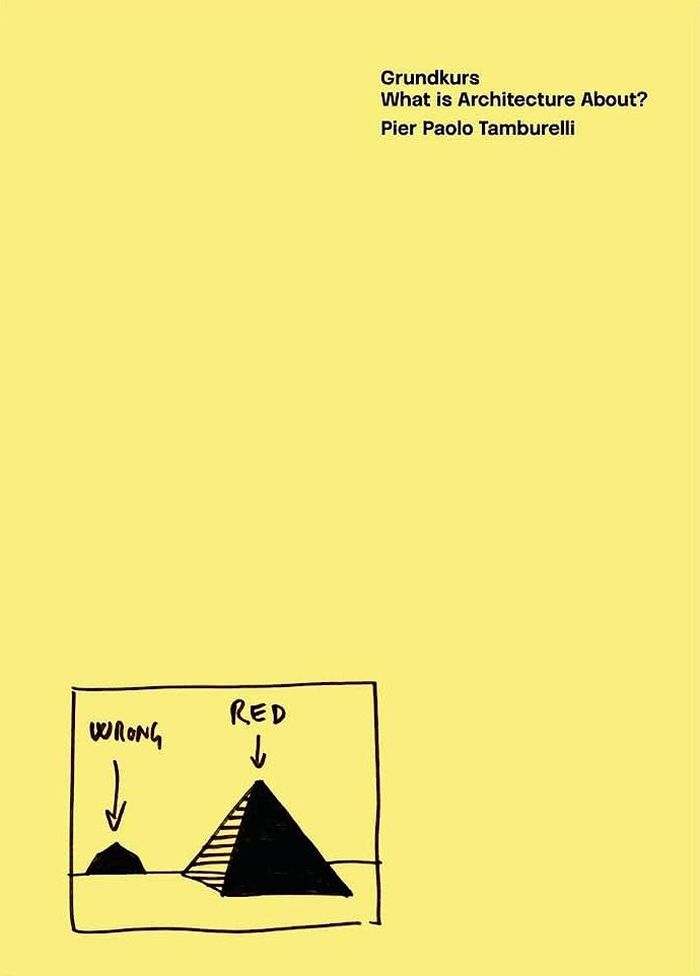
In this collection of idiosyncratic lessons, architect and teacher Pier Paolo Tamburelli engages with the very foundations of architecture, proposing a series of new and open-ended perspectives on how we build the world. Developed for the ''Grundkurs'', or ''basic course'', at Vienna Technical University, Tamburelli’s lessons are presented through the annotated sketches that form the basis of his lectures – variously rough and precise, sarcastic and sincere, and always uniquely expressive. This volume is a rich visual sourcebook of architectural ideas that form an accessible and discursive introduction to the discipline – one which pauses on the road to grand theories to learn from the intuitive processes of notetaking, drawing, and association. Tamburelli’s lessons are based around a series of dialectic couples, including Roof/Wall, Shelter/Memory, and Language/Action. The pairs are experimental and often provocative, offering a framework to be used to climb in the direction of architecture. Tamburelli trusts in the capacity of images to suspend the restraints of more rigorous theoretical approaches, embraces the flexible wisdom of the note, and relishes the intrigue of the cryptic messages we leave for ourselves. Reproduced here in their entirety, these eight lessons offer countless routes towards, through, and around architecture, providing newcomers and experts alike with an intimate and refreshing encounter with a millennia-old discipline.
Grundkurs: What is architecture about?
Actions:
Prix:
$55.00
(disponible sur commande)
Résumé:
In this collection of idiosyncratic lessons, architect and teacher Pier Paolo Tamburelli engages with the very foundations of architecture, proposing a series of new and open-ended perspectives on how we build the world. Developed for the ''Grundkurs'', or ''basic course'', at Vienna Technical University, Tamburelli’s lessons are presented through the annotated sketches that form the basis of his lectures – variously rough and precise, sarcastic and sincere, and always uniquely expressive. This volume is a rich visual sourcebook of architectural ideas that form an accessible and discursive introduction to the discipline – one which pauses on the road to grand theories to learn from the intuitive processes of notetaking, drawing, and association. Tamburelli’s lessons are based around a series of dialectic couples, including Roof/Wall, Shelter/Memory, and Language/Action. The pairs are experimental and often provocative, offering a framework to be used to climb in the direction of architecture. Tamburelli trusts in the capacity of images to suspend the restraints of more rigorous theoretical approaches, embraces the flexible wisdom of the note, and relishes the intrigue of the cryptic messages we leave for ourselves. Reproduced here in their entirety, these eight lessons offer countless routes towards, through, and around architecture, providing newcomers and experts alike with an intimate and refreshing encounter with a millennia-old discipline.
Classification:
livres
livres
Publication:
mars 2023
mars 2023
Sujet:
Théorie de l’architecture
Théorie de l’architecture
Classification:
livres
livres
Prix:
$52.00
(disponible sur commande)
Résumé:
An expanded and updated edition of a classic study of the history of modern design. One of the most widely read books on modern design, Nikolaus Pevsner’s landmark work today remains as stimulating as it was when first published in 1936. This expanded edition of Pioneers of Modern Design provides Pevsner’s original text along with significant new and updated(...)
$52.00
(disponible sur commande)
Résumé:
An expanded and updated edition of a classic study of the history of modern design. One of the most widely read books on modern design, Nikolaus Pevsner’s landmark work today remains as stimulating as it was when first published in 1936. This expanded edition of Pioneers of Modern Design provides Pevsner’s original text along with significant new and updated(...)
Titre:
Pioneers of modern design from William Morris to Walter Gropius
Actions:
Prix:
$52.00
(disponible sur commande)
Résumé:
An expanded and updated edition of a classic study of the history of modern design. One of the most widely read books on modern design, Nikolaus Pevsner’s landmark work today remains as stimulating as it was when first published in 1936. This expanded edition of Pioneers of Modern Design provides Pevsner’s original text along with significant new and updated information, enhancing Pevsner’s illuminating account of the roots of Modernism. The book now offers many beautiful colour illustrations; biographies and bibliographies of all major figures; illustrated short essays on key themes, movements, and individuals; a critique of Pevsner’s analysis from today’s perspective; examples of works after 1914 (where the original study ended); a biography detailing Pevsner’s life and achievements; and much more. Pevsner saw Modernism as a synthesis of three main sources: William Morris and his followers, the work of nineteenth-century engineers, and Art Nouveau. The author considers the role of these sources in the work of early Modernists and looks at such masters of the movement as C.F.A. Voysey and Charles Rennie Mackintosh in Britain, Louis Sullivan and Frank Lloyd Wright in America, and Adolf Loos and Otto Wagner in Vienna. The account concludes with a discussion of the radical break with the past represented by the design work of Walter Gropius and his future Bauhaus colleagues.
Pioneers of modern design from William Morris to Walter Gropius
Actions:
Prix:
$52.00
(disponible sur commande)
Résumé:
An expanded and updated edition of a classic study of the history of modern design. One of the most widely read books on modern design, Nikolaus Pevsner’s landmark work today remains as stimulating as it was when first published in 1936. This expanded edition of Pioneers of Modern Design provides Pevsner’s original text along with significant new and updated information, enhancing Pevsner’s illuminating account of the roots of Modernism. The book now offers many beautiful colour illustrations; biographies and bibliographies of all major figures; illustrated short essays on key themes, movements, and individuals; a critique of Pevsner’s analysis from today’s perspective; examples of works after 1914 (where the original study ended); a biography detailing Pevsner’s life and achievements; and much more. Pevsner saw Modernism as a synthesis of three main sources: William Morris and his followers, the work of nineteenth-century engineers, and Art Nouveau. The author considers the role of these sources in the work of early Modernists and looks at such masters of the movement as C.F.A. Voysey and Charles Rennie Mackintosh in Britain, Louis Sullivan and Frank Lloyd Wright in America, and Adolf Loos and Otto Wagner in Vienna. The account concludes with a discussion of the radical break with the past represented by the design work of Walter Gropius and his future Bauhaus colleagues.
Classification:
livres
livres
Publication:
mars 2005, New Haven
mars 2005, New Haven
Sujet:
Design d’intérieur
Design d’intérieur
Classification:
livres
livres
Actions:
Prix:
$36.95
(disponible sur commande)
Résumé:
By United Nations estimates, 60 percent of the world's population will be urban by 2030. With the increasing speed of urbanization, especially in the developing world, scholars are now rethinking standard concepts and histories of modern cities. "The Spaces of the Modern City" historicizes the contemporary discussion of urbanism, highlighting the local and global breadth(...)
$36.95
(disponible sur commande)
Résumé:
By United Nations estimates, 60 percent of the world's population will be urban by 2030. With the increasing speed of urbanization, especially in the developing world, scholars are now rethinking standard concepts and histories of modern cities. "The Spaces of the Modern City" historicizes the contemporary discussion of urbanism, highlighting the local and global breadth(...)
Sujet:
Théorie de l’urbanisme
Théorie de l’urbanisme
Publication:
février 2008, Princeton, Oxford
février 2008, Princeton, Oxford
Titre:
The Spaces of the Modern city : imaginaries, politics, and everyday life
Actions:
Prix:
$36.95
(disponible sur commande)
Résumé:
By United Nations estimates, 60 percent of the world's population will be urban by 2030. With the increasing speed of urbanization, especially in the developing world, scholars are now rethinking standard concepts and histories of modern cities. "The Spaces of the Modern City" historicizes the contemporary discussion of urbanism, highlighting the local and global breadth of the city landscape. This interdisciplinary collection examines how the city develops in the interactions of space and imagination. The essays focus on issues such as street design in Vienna, the motion picture industry in Los Angeles, architecture in Marseilles and Algiers, and the kaleidoscopic paradox of post-apartheid Johannesburg. They explore the nature of spatial politics, examining the disparate worlds of eighteenth-century Baghdad, nineteenth-century Morelia, Cold War-era West Berlin, and postwar Los Angeles. They also show the meaning of everyday spaces to urban life, illuminating issues such as crime in metropolitan London, youth culture in Dakar, "memory projects" in Tokyo, and Bombay cinema. Informed by a range of theoretical writings, this collection offers a fresh and truly global perspective on the nature of the modern city. The contributors are Sheila Crane, Belinda Davis, Mamadou Diouf, Philip J. Ethington, David Frisby, Christina M. Jiménez, Dina Rizk Khoury, Ranjani Mazumdar, Frank Mort, Martin Murray, Jordan Sand, and Sarah Schrank.
The Spaces of the Modern city : imaginaries, politics, and everyday life
Actions:
Prix:
$36.95
(disponible sur commande)
Résumé:
By United Nations estimates, 60 percent of the world's population will be urban by 2030. With the increasing speed of urbanization, especially in the developing world, scholars are now rethinking standard concepts and histories of modern cities. "The Spaces of the Modern City" historicizes the contemporary discussion of urbanism, highlighting the local and global breadth of the city landscape. This interdisciplinary collection examines how the city develops in the interactions of space and imagination. The essays focus on issues such as street design in Vienna, the motion picture industry in Los Angeles, architecture in Marseilles and Algiers, and the kaleidoscopic paradox of post-apartheid Johannesburg. They explore the nature of spatial politics, examining the disparate worlds of eighteenth-century Baghdad, nineteenth-century Morelia, Cold War-era West Berlin, and postwar Los Angeles. They also show the meaning of everyday spaces to urban life, illuminating issues such as crime in metropolitan London, youth culture in Dakar, "memory projects" in Tokyo, and Bombay cinema. Informed by a range of theoretical writings, this collection offers a fresh and truly global perspective on the nature of the modern city. The contributors are Sheila Crane, Belinda Davis, Mamadou Diouf, Philip J. Ethington, David Frisby, Christina M. Jiménez, Dina Rizk Khoury, Ranjani Mazumdar, Frank Mort, Martin Murray, Jordan Sand, and Sarah Schrank.
Classification:
livres
livres
Publication:
février 2008, Princeton, Oxford
février 2008, Princeton, Oxford
Sujet:
Théorie de l’urbanisme
Théorie de l’urbanisme
Classification:
livres
livres
Actions:
Prix:
$85.00
(disponible sur commande)
Résumé:
Known as the “King of the Air,” the Swiss balloonist Eduard Spelterini (1852–1931) enchanted the imaginations of European royalty, military generals, wealthy patrons, and the public alike with his mastery of the most whimsical mode of travel ever invented—the gas balloon. During the course of his storied aviation career, Spelterini flew his balloons over the Swiss Alps,(...)
$85.00
(disponible sur commande)
Résumé:
Known as the “King of the Air,” the Swiss balloonist Eduard Spelterini (1852–1931) enchanted the imaginations of European royalty, military generals, wealthy patrons, and the public alike with his mastery of the most whimsical mode of travel ever invented—the gas balloon. During the course of his storied aviation career, Spelterini flew his balloons over the Swiss Alps,(...)
Titre:
Spelterini photographs of a pioneer balloonist/Fotografien des ballonpioniers
Actions:
Prix:
$85.00
(disponible sur commande)
Résumé:
Known as the “King of the Air,” the Swiss balloonist Eduard Spelterini (1852–1931) enchanted the imaginations of European royalty, military generals, wealthy patrons, and the public alike with his mastery of the most whimsical mode of travel ever invented—the gas balloon. During the course of his storied aviation career, Spelterini flew his balloons over the Swiss Alps, across the Egyptian pyramids, and past the ziggurats of the Middle East, taking breathtaking photographs of landscapes and cities from the sky. On Spelterini’s first ballooning ventures, he ferried aristocrats between Vienna, Bucharest, Athens, and other European capitals, on flights that became so famous that they were soon jam-packed with an international press corps looking for the next sensational story. Later in his life, Spelterini was the first aeronaut to succeed in the hazardous passage over the Swiss Alps, a trip then thought impossible. Eventually, he decided to bring his camera on every voyage in order to document the full panorama of international vistas he encountered. Eduard Spelterini—Photographs of A Pioneer Balloonist is the first book after 80 years to present these images of his journeys, reproduced directly from the artist’s original glass negatives. Contextualized by essays that explore both Spelterini’s life and his photographic work, the photographs featured in this volume capture the heady mix of danger and discovery that defined the early years of international air travel when balloons ruled the skies.
Spelterini photographs of a pioneer balloonist/Fotografien des ballonpioniers
Actions:
Prix:
$85.00
(disponible sur commande)
Résumé:
Known as the “King of the Air,” the Swiss balloonist Eduard Spelterini (1852–1931) enchanted the imaginations of European royalty, military generals, wealthy patrons, and the public alike with his mastery of the most whimsical mode of travel ever invented—the gas balloon. During the course of his storied aviation career, Spelterini flew his balloons over the Swiss Alps, across the Egyptian pyramids, and past the ziggurats of the Middle East, taking breathtaking photographs of landscapes and cities from the sky. On Spelterini’s first ballooning ventures, he ferried aristocrats between Vienna, Bucharest, Athens, and other European capitals, on flights that became so famous that they were soon jam-packed with an international press corps looking for the next sensational story. Later in his life, Spelterini was the first aeronaut to succeed in the hazardous passage over the Swiss Alps, a trip then thought impossible. Eventually, he decided to bring his camera on every voyage in order to document the full panorama of international vistas he encountered. Eduard Spelterini—Photographs of A Pioneer Balloonist is the first book after 80 years to present these images of his journeys, reproduced directly from the artist’s original glass negatives. Contextualized by essays that explore both Spelterini’s life and his photographic work, the photographs featured in this volume capture the heady mix of danger and discovery that defined the early years of international air travel when balloons ruled the skies.
Classification:
livres
livres
Publication:
septembre 2007, Zurich
septembre 2007, Zurich
Sujet:
Monographies photo
Monographies photo
Classification:
livres
livres
Titre:
The stairway to the sun & dance of the comets: four fairy tales of home and one of astral pantomime
The stairway to the sun & dance of the comets: four fairy tales of home and one of astral pantomime
Actions:
Prix:
$17.95
(disponible sur commande)
Résumé:
"The Stairway to the Sun & Dance of the Comets" brings together two short books, originally published in 1903, by the anti-erotic godfather of German science fiction, Paul Scheerbart. "The Stairway to the Sun" consists of four fairy tales of sun, sea, animals, and storm, each set in a different, fantastical locale: from the giant fever-dream palace of an astral star to a(...)
$17.95
(disponible sur commande)
Résumé:
"The Stairway to the Sun & Dance of the Comets" brings together two short books, originally published in 1903, by the anti-erotic godfather of German science fiction, Paul Scheerbart. "The Stairway to the Sun" consists of four fairy tales of sun, sea, animals, and storm, each set in a different, fantastical locale: from the giant fever-dream palace of an astral star to a(...)
Titre:
The stairway to the sun & dance of the comets: four fairy tales of home and one of astral pantomime
Actions:
Prix:
$17.95
(disponible sur commande)
Résumé:
"The Stairway to the Sun & Dance of the Comets" brings together two short books, originally published in 1903, by the anti-erotic godfather of German science fiction, Paul Scheerbart. "The Stairway to the Sun" consists of four fairy tales of sun, sea, animals, and storm, each set in a different, fantastical locale: from the giant fever-dream palace of an astral star to a dwarf’s glass underwater lair in the jellyfish kingdom. Scheerbart’s sad, whimsical tales provide gentle, simple, though unexpected morals that outline his work as a whole: treat animals as one would treat oneself, mutual admiration will never lead to harm, and if one is able to remember that the world is grand, one will never be sad in one’s own life. "Dance of the Comets", though published as an “Astral Pantomime,” was originally conceived as a scenario for a ballet, and one that Richard Strauss had planned to score in 1900 (and which Gustav Mahler even accepted for the Vienna Opera). Though the project was never realized, Scheerbart’s written choreography of dance, gesture, costume, feather dusters, violet moon hair, and a variety of stars and planets outlines a symbolic sequence of events in which everyone—enthusiastic maid, temperamental king, indifferent executioner, foolish poet—seeks, joins, and in some cases, becomes a celestial body: a “dance” toward higher aspirations and a staging of Scheerbart’s lifelong yearning for a home in the universe.
The stairway to the sun & dance of the comets: four fairy tales of home and one of astral pantomime
Actions:
Prix:
$17.95
(disponible sur commande)
Résumé:
"The Stairway to the Sun & Dance of the Comets" brings together two short books, originally published in 1903, by the anti-erotic godfather of German science fiction, Paul Scheerbart. "The Stairway to the Sun" consists of four fairy tales of sun, sea, animals, and storm, each set in a different, fantastical locale: from the giant fever-dream palace of an astral star to a dwarf’s glass underwater lair in the jellyfish kingdom. Scheerbart’s sad, whimsical tales provide gentle, simple, though unexpected morals that outline his work as a whole: treat animals as one would treat oneself, mutual admiration will never lead to harm, and if one is able to remember that the world is grand, one will never be sad in one’s own life. "Dance of the Comets", though published as an “Astral Pantomime,” was originally conceived as a scenario for a ballet, and one that Richard Strauss had planned to score in 1900 (and which Gustav Mahler even accepted for the Vienna Opera). Though the project was never realized, Scheerbart’s written choreography of dance, gesture, costume, feather dusters, violet moon hair, and a variety of stars and planets outlines a symbolic sequence of events in which everyone—enthusiastic maid, temperamental king, indifferent executioner, foolish poet—seeks, joins, and in some cases, becomes a celestial body: a “dance” toward higher aspirations and a staging of Scheerbart’s lifelong yearning for a home in the universe.
Classification:
livres
livres
Publication:
octobre 2016
octobre 2016
Sujet:
Théorie/ philosophie
Théorie/ philosophie
Classification:
livres
livres

Actions:
Prix:
$60.00
(disponible sur commande)
Résumé:
In the late 1960s, Polaroid Corporation founder Edwin Land initiated a project to invite more than 800 artists around the world to shoot on Polaroid film, supplying them with the company's latest products. Over the ensuing decades, more than 4,500 works, by photographers ranging from Ansel Adams to Andy Warhol, were presented to the company and found their way into(...)
$60.00
(disponible sur commande)
Résumé:
In the late 1960s, Polaroid Corporation founder Edwin Land initiated a project to invite more than 800 artists around the world to shoot on Polaroid film, supplying them with the company's latest products. Over the ensuing decades, more than 4,500 works, by photographers ranging from Ansel Adams to Andy Warhol, were presented to the company and found their way into(...)
Titre:
From polaroid to impossible: masterpieces of instant photography, the Westlicht collection
Actions:
Prix:
$60.00
(disponible sur commande)
Résumé:
In the late 1960s, Polaroid Corporation founder Edwin Land initiated a project to invite more than 800 artists around the world to shoot on Polaroid film, supplying them with the company's latest products. Over the ensuing decades, more than 4,500 works, by photographers ranging from Ansel Adams to Andy Warhol, were presented to the company and found their way into Polaroid's International Collection at their European headquarters near Frankfurt am Main. In 2008 Polaroid went bankrupt. The company was bought by the Impossible Project (who promptly invented a new kind of instant film at the Polaroid factory in Enschede) and its legendary collection was acquired by the Westlicht Schauplatz museum in Vienna. From Polaroid to Impossible celebrates both this acquisition and the launch of a new Polaroid collection spearheaded by Westlicht and the Impossible Project. It offers the first overview of the European Polaroid Collection, and includes selected Polaroid masterpieces by figures such as Ansel Adams, Barbara Crane, Giselle Freund, Gottfried Helnwein, Sally Mann, Robert Mapplethorpe, Helmut Newton, Stephen Shore, Aaron Siskind, Andy Warhol, William Wegman and Minor White; artists like Miyako Ishiuchi, Andreas Mahl and Catherine Wagner, who made specialties of the medium; plus newly commissioned Impossible instant photography by contemporary artists such as Nobuyoshi Araki, David Leventhal, Mary Ellen Mark and Stefanie Schneider. Numerous images are reproduced in full color at 1:1 scale, making this volume a luscious and giftworthy celebration of the charm of the Polaroid photograph.
From polaroid to impossible: masterpieces of instant photography, the Westlicht collection
Actions:
Prix:
$60.00
(disponible sur commande)
Résumé:
In the late 1960s, Polaroid Corporation founder Edwin Land initiated a project to invite more than 800 artists around the world to shoot on Polaroid film, supplying them with the company's latest products. Over the ensuing decades, more than 4,500 works, by photographers ranging from Ansel Adams to Andy Warhol, were presented to the company and found their way into Polaroid's International Collection at their European headquarters near Frankfurt am Main. In 2008 Polaroid went bankrupt. The company was bought by the Impossible Project (who promptly invented a new kind of instant film at the Polaroid factory in Enschede) and its legendary collection was acquired by the Westlicht Schauplatz museum in Vienna. From Polaroid to Impossible celebrates both this acquisition and the launch of a new Polaroid collection spearheaded by Westlicht and the Impossible Project. It offers the first overview of the European Polaroid Collection, and includes selected Polaroid masterpieces by figures such as Ansel Adams, Barbara Crane, Giselle Freund, Gottfried Helnwein, Sally Mann, Robert Mapplethorpe, Helmut Newton, Stephen Shore, Aaron Siskind, Andy Warhol, William Wegman and Minor White; artists like Miyako Ishiuchi, Andreas Mahl and Catherine Wagner, who made specialties of the medium; plus newly commissioned Impossible instant photography by contemporary artists such as Nobuyoshi Araki, David Leventhal, Mary Ellen Mark and Stefanie Schneider. Numerous images are reproduced in full color at 1:1 scale, making this volume a luscious and giftworthy celebration of the charm of the Polaroid photograph.
Classification:
livres
livres
Publication:
juillet 2011
juillet 2011
Sujet:
Théorie de la photographie
Théorie de la photographie
Classification:
livres
livres
Actions:
Prix:
$31.00
(disponible sur commande)
Résumé:
Today on almost every desk in every office sits a computer. Eighty years ago, desktops were equipped with a nonelectronic data processing machine: a card file. In this publication, Markus Krajewski traces the evolution of this proto-computer of rearrangeable parts (file cards) that became ubiquitous in offices between the world wars. The story begins with Konrad(...)
$31.00
(disponible sur commande)
Résumé:
Today on almost every desk in every office sits a computer. Eighty years ago, desktops were equipped with a nonelectronic data processing machine: a card file. In this publication, Markus Krajewski traces the evolution of this proto-computer of rearrangeable parts (file cards) that became ubiquitous in offices between the world wars. The story begins with Konrad(...)
Titre:
Paper machines : about cards & catalogs, 1548-1929
Actions:
Prix:
$31.00
(disponible sur commande)
Résumé:
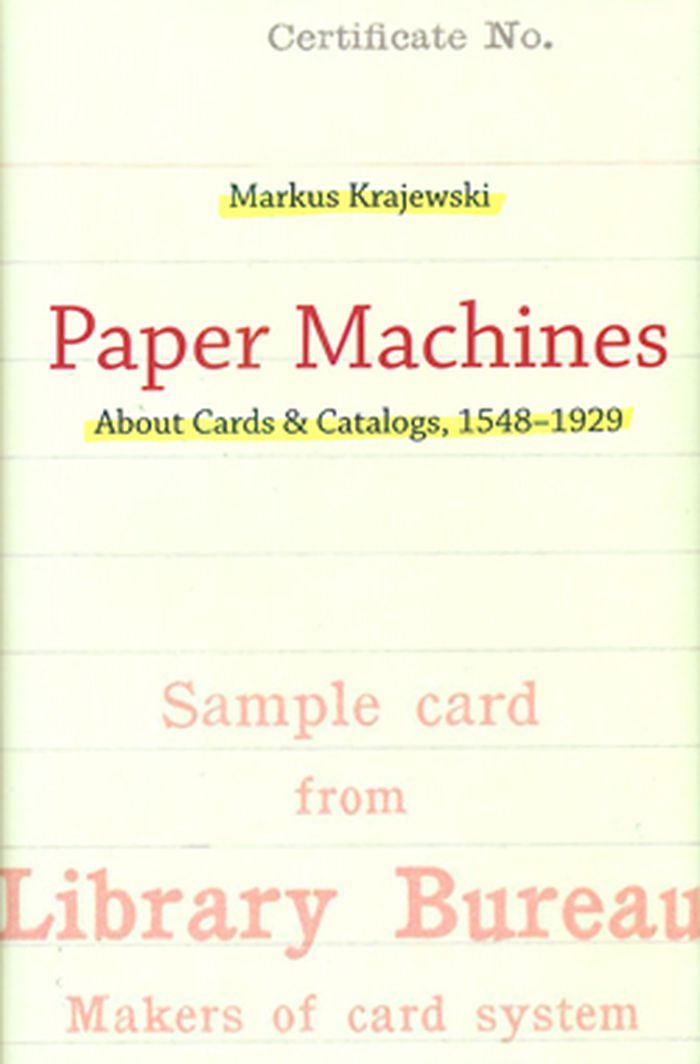
Today on almost every desk in every office sits a computer. Eighty years ago, desktops were equipped with a nonelectronic data processing machine: a card file. In this publication, Markus Krajewski traces the evolution of this proto-computer of rearrangeable parts (file cards) that became ubiquitous in offices between the world wars. The story begins with Konrad Gessner, a sixteenth-century Swiss polymath who described a new method of processing data: to cut up a sheet of handwritten notes into slips of paper, with one fact or topic per slip, and arrange as desired. In the late eighteenth century, the card catalog became the librarian's answer to the threat of information overload. Then, at the turn of the twentieth century, business adopted the technology of the card catalog as a bookkeeping tool. Krajewski explores this conceptual development and casts the card file as a "universal paper machine" that accomplishes the basic operations of Turing's universal discrete machine: storing, processing, and transferring data. In telling his story, Krajewski takes the reader on a number of illuminating detours, telling us, for example, that the card catalog and the numbered street address emerged at the same time in the same city (Vienna), and that Harvard University's home-grown cataloging system grew out of a librarian's laziness; and that Melvil Dewey (originator of the Dewey Decimal System) helped bring about the technology transfer of card files to business.
Paper machines : about cards & catalogs, 1548-1929
Actions:
Prix:
$31.00
(disponible sur commande)
Résumé:
Today on almost every desk in every office sits a computer. Eighty years ago, desktops were equipped with a nonelectronic data processing machine: a card file. In this publication, Markus Krajewski traces the evolution of this proto-computer of rearrangeable parts (file cards) that became ubiquitous in offices between the world wars. The story begins with Konrad Gessner, a sixteenth-century Swiss polymath who described a new method of processing data: to cut up a sheet of handwritten notes into slips of paper, with one fact or topic per slip, and arrange as desired. In the late eighteenth century, the card catalog became the librarian's answer to the threat of information overload. Then, at the turn of the twentieth century, business adopted the technology of the card catalog as a bookkeeping tool. Krajewski explores this conceptual development and casts the card file as a "universal paper machine" that accomplishes the basic operations of Turing's universal discrete machine: storing, processing, and transferring data. In telling his story, Krajewski takes the reader on a number of illuminating detours, telling us, for example, that the card catalog and the numbered street address emerged at the same time in the same city (Vienna), and that Harvard University's home-grown cataloging system grew out of a librarian's laziness; and that Melvil Dewey (originator of the Dewey Decimal System) helped bring about the technology transfer of card files to business.
Classification:
livres
livres
Publication:
octobre 2011
octobre 2011
Classification:
livres
livres
Actions:
Prix:
$39.00
(disponible sur commande)
Résumé:
Sylvia Lavin's “Form Follows Libido” argues that by the 1950s, some architects felt an urge to steer the cool abstraction of high modernism away from a neutral formalism toward the production of more erotic, affective environments. Lavin turns to the architecture of Richard Neutra (1892-1970) to explore the genesis of these new mood-inducing environments. In a series of(...)
$39.00
(disponible sur commande)
Résumé:
Sylvia Lavin's “Form Follows Libido” argues that by the 1950s, some architects felt an urge to steer the cool abstraction of high modernism away from a neutral formalism toward the production of more erotic, affective environments. Lavin turns to the architecture of Richard Neutra (1892-1970) to explore the genesis of these new mood-inducing environments. In a series of(...)
Titre:
Form follows libido : architecture and Richard Neutra in a psychoanalytic culture
Actions:
Prix:
$39.00
(disponible sur commande)
Résumé:
Sylvia Lavin's “Form Follows Libido” argues that by the 1950s, some architects felt an urge to steer the cool abstraction of high modernism away from a neutral formalism toward the production of more erotic, affective environments. Lavin turns to the architecture of Richard Neutra (1892-1970) to explore the genesis of these new mood-inducing environments. In a series of engaging essays weaving through the designs and writings of this Vienna-born, California-based architect, Lavin discovers in Neutra a sustained and poignant psychoanalytic reflection set in the context of a burgeoning psychoanalytic culture in America. Lavin shows that Neutra's redirection of modernism constituted not a lyrical regression to sentimentality but a deliberate advance of architectural theory and technique to engage the unconscious mind, fuelled by the ideas of psychoanalysis that were being rapidly disseminated at the time. In Neutra's responses to a vivid range of issues, from psychoanalysis proper to the popular psychology of tele-evangelical prayer, Lavin uncovers a radical reconstitution of the architectural discipline. Arguing persuasively that the received historical views of both psychoanalysis and architecture have led to a suppression of their compelling coincidences and unorthodoxies, Lavin sets out to unleash mid-century architecture's hidden libido. Neither Neutra nor psychoanalysis emerges unscathed from her investigation of how architecture came to be saturated by the intrigues of affect, often against its will. If Reyner Banham sought to put architecture "on the couch," then Lavin, through Neutra, leaps beyond Banham's ameliorative aim to lure contemporary architecture into the lush and dangerous liaisons of environmental design.
Form follows libido : architecture and Richard Neutra in a psychoanalytic culture
Actions:
Prix:
$39.00
(disponible sur commande)
Résumé:
Sylvia Lavin's “Form Follows Libido” argues that by the 1950s, some architects felt an urge to steer the cool abstraction of high modernism away from a neutral formalism toward the production of more erotic, affective environments. Lavin turns to the architecture of Richard Neutra (1892-1970) to explore the genesis of these new mood-inducing environments. In a series of engaging essays weaving through the designs and writings of this Vienna-born, California-based architect, Lavin discovers in Neutra a sustained and poignant psychoanalytic reflection set in the context of a burgeoning psychoanalytic culture in America. Lavin shows that Neutra's redirection of modernism constituted not a lyrical regression to sentimentality but a deliberate advance of architectural theory and technique to engage the unconscious mind, fuelled by the ideas of psychoanalysis that were being rapidly disseminated at the time. In Neutra's responses to a vivid range of issues, from psychoanalysis proper to the popular psychology of tele-evangelical prayer, Lavin uncovers a radical reconstitution of the architectural discipline. Arguing persuasively that the received historical views of both psychoanalysis and architecture have led to a suppression of their compelling coincidences and unorthodoxies, Lavin sets out to unleash mid-century architecture's hidden libido. Neither Neutra nor psychoanalysis emerges unscathed from her investigation of how architecture came to be saturated by the intrigues of affect, often against its will. If Reyner Banham sought to put architecture "on the couch," then Lavin, through Neutra, leaps beyond Banham's ameliorative aim to lure contemporary architecture into the lush and dangerous liaisons of environmental design.
Classification:
livres
livres
Publication:
janvier 2005, Cambridge, Mass.
janvier 2005, Cambridge, Mass.
Sujet:
Architecture, monographies
Architecture, monographies
Classification:
livres
livres
Actions:
Prix:
$77.95
(disponible sur commande)
Résumé:
In 1911, Le Corbusier (1887–1965), then twenty-four and still going by the name of Charles-Edouard Jeanneret, embarked on a grand tour of Eastern Europe, Turkey, and the Balkans with his friend, August Klipstein (1885–1951), an art history scholar. Together, the two visited Prague, Vienna, Budapest, Bulgaria and Serbia, Constantinople, Mount Athos, and Athens, as well as(...)
$77.95
(disponible sur commande)
Résumé:
In 1911, Le Corbusier (1887–1965), then twenty-four and still going by the name of Charles-Edouard Jeanneret, embarked on a grand tour of Eastern Europe, Turkey, and the Balkans with his friend, August Klipstein (1885–1951), an art history scholar. Together, the two visited Prague, Vienna, Budapest, Bulgaria and Serbia, Constantinople, Mount Athos, and Athens, as well as(...)
Titre:
Klip and Corb on the road: the dual diaries of August Klipstein and Le Corbusier, 1911
Actions:
Prix:
$77.95
(disponible sur commande)
Résumé:
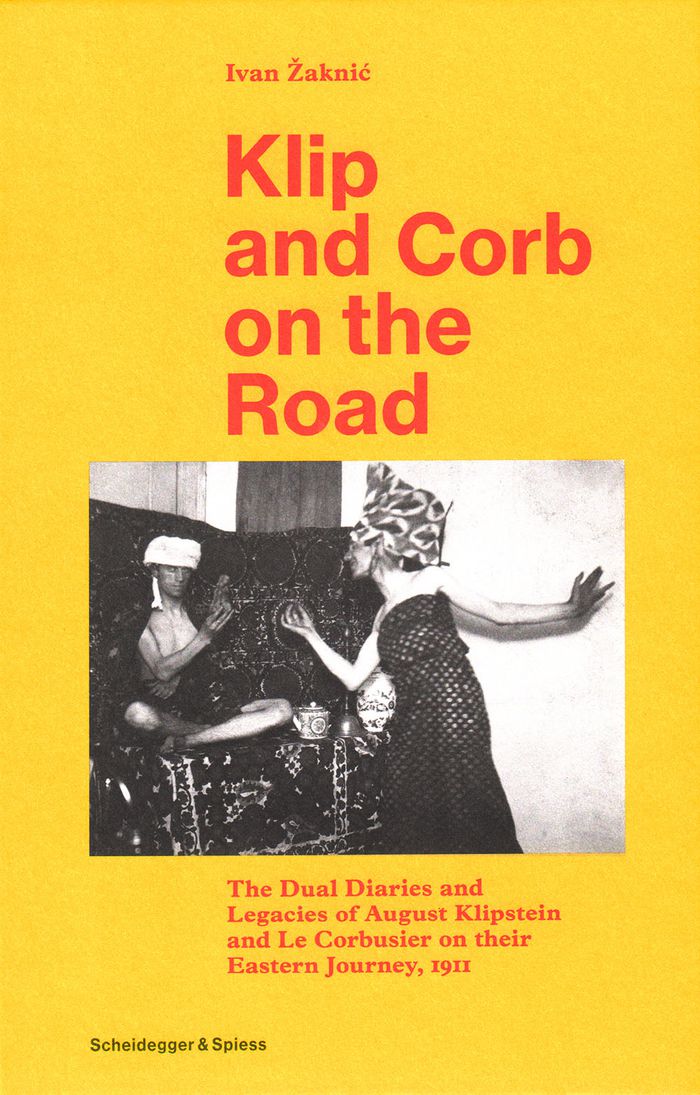
In 1911, Le Corbusier (1887–1965), then twenty-four and still going by the name of Charles-Edouard Jeanneret, embarked on a grand tour of Eastern Europe, Turkey, and the Balkans with his friend, August Klipstein (1885–1951), an art history scholar. Together, the two visited Prague, Vienna, Budapest, Bulgaria and Serbia, Constantinople, Mount Athos, and Athens, as well as Rome and Pompeii. Both young men kept detailed notebooks throughout their journey with drawings, sketches, and photographs created en route. While Le Corbusier’s notebooks were published in 1966 as “Journey to the East” and went on to attain wide renown, Klipstein’s records of their travels have remained relatively unknown. In “Klip and Corb on the Road”, Ivan Žaknic´ brings the notebooks together for the first time to explore the fruitful creative symbiosis of this friendship and offer a new perspective on this seemingly well-known undertaking. The two men sometimes address the same events or subjects—a seasick passage, the bustle of a Turkish bazaar—and even copy one another’s work. But while Klipstein’s reflections tend to focus on research for his thesis, Jeanneret’s impressions evince a more romantic mindset inspired by his immediate surroundings. The book includes copious previously unpublished material, including the complete text of Klipstein’s diary, as well as that of the correspondence between Jeanneret and Klipstein. Reintroducing readers to Klipstein, who went on to a career as a prominent art dealer, it also offers insight into a key influence in the artistic development of Le Corbusier in his formative years. The book also includes an essay by British architectural historian Tim Benton.
Klip and Corb on the road: the dual diaries of August Klipstein and Le Corbusier, 1911
Actions:
Prix:
$77.95
(disponible sur commande)
Résumé:
In 1911, Le Corbusier (1887–1965), then twenty-four and still going by the name of Charles-Edouard Jeanneret, embarked on a grand tour of Eastern Europe, Turkey, and the Balkans with his friend, August Klipstein (1885–1951), an art history scholar. Together, the two visited Prague, Vienna, Budapest, Bulgaria and Serbia, Constantinople, Mount Athos, and Athens, as well as Rome and Pompeii. Both young men kept detailed notebooks throughout their journey with drawings, sketches, and photographs created en route. While Le Corbusier’s notebooks were published in 1966 as “Journey to the East” and went on to attain wide renown, Klipstein’s records of their travels have remained relatively unknown. In “Klip and Corb on the Road”, Ivan Žaknic´ brings the notebooks together for the first time to explore the fruitful creative symbiosis of this friendship and offer a new perspective on this seemingly well-known undertaking. The two men sometimes address the same events or subjects—a seasick passage, the bustle of a Turkish bazaar—and even copy one another’s work. But while Klipstein’s reflections tend to focus on research for his thesis, Jeanneret’s impressions evince a more romantic mindset inspired by his immediate surroundings. The book includes copious previously unpublished material, including the complete text of Klipstein’s diary, as well as that of the correspondence between Jeanneret and Klipstein. Reintroducing readers to Klipstein, who went on to a career as a prominent art dealer, it also offers insight into a key influence in the artistic development of Le Corbusier in his formative years. The book also includes an essay by British architectural historian Tim Benton.
Classification:
livres
livres
Publication:
janvier 2020
janvier 2020
Sujet:
Architecture, monographies
Architecture, monographies
Classification:
livres
livres
Prix:
$60.00
(disponible sur commande)
Résumé:
Wittgenstein's House reads Wittgenstein's his two main philosophical texts, Tractatus Logico-Philosophicus and Philosophical Investigations, in relation to an experience that intervened between them: his design and construction of the Stonborough-Wittgenstein house in Vienna. Arguing that the practice of architecture occupies not just a historical position between(...)
$60.00
(disponible sur commande)
Résumé:
Wittgenstein's House reads Wittgenstein's his two main philosophical texts, Tractatus Logico-Philosophicus and Philosophical Investigations, in relation to an experience that intervened between them: his design and construction of the Stonborough-Wittgenstein house in Vienna. Arguing that the practice of architecture occupies not just a historical position between(...)
Titre:
Wittgenstein's house: language, space, & architecture
Actions:
Prix:
$60.00
(disponible sur commande)
Résumé:
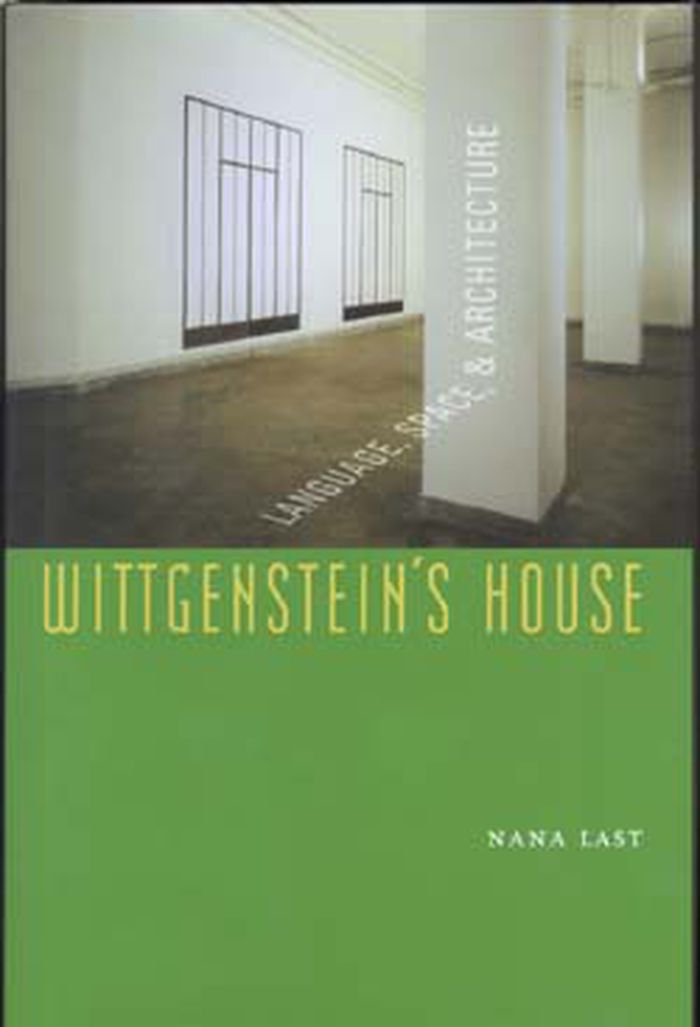
Wittgenstein's House reads Wittgenstein's his two main philosophical texts, Tractatus Logico-Philosophicus and Philosophical Investigations, in relation to an experience that intervened between them: his design and construction of the Stonborough-Wittgenstein house in Vienna. Arguing that the practice of architecture occupies not just a historical position between Wittgenstein's early and late philosophy, but a conceptual position as well, the book demonstrates that Wittgenstein's practice of architecture constitutes a fundamental component in the development of his philosophy of language from its early to late phases. The book advances the radical proposition that the field in which architecture and philosophy operate includes linguistic and spatial practices. It develops innovative forms of interdisciplinary analyses to demonstrate that the philosophical positions put forth by Wittgenstein's two main works are literally unthinkable outside of their respective conceptions of space: the view from above in the early work and the view from within constructed by the late work. To examine the manner in which Wittgenstein's practice of architecture insinuated itself into his philosophy, the author interweaves in-depth analyses of the spatial constructs underpinning the early and late philosophies with conceptual, formal and operative discussions of the design of the Stonborough-Wittgenstein house. Together these discussions reveal how Wittgenstein's practice of architecture engaged philosophical concepts, through which it influenced Wittgenstein's philosophy of language. At the heart of this approach is the finding that the philosophical concepts at the core of Wittgenstein's philosophy areindeed spatial ones, including his concerns with the limits of language, the boundary between showing and saying, the intricate textual numbering systems he devises, the relationship between the interiority of the subject and the publicness of language, and the formative principle of family resemblance.
Wittgenstein's house: language, space, & architecture
Actions:
Prix:
$60.00
(disponible sur commande)
Résumé:
Wittgenstein's House reads Wittgenstein's his two main philosophical texts, Tractatus Logico-Philosophicus and Philosophical Investigations, in relation to an experience that intervened between them: his design and construction of the Stonborough-Wittgenstein house in Vienna. Arguing that the practice of architecture occupies not just a historical position between Wittgenstein's early and late philosophy, but a conceptual position as well, the book demonstrates that Wittgenstein's practice of architecture constitutes a fundamental component in the development of his philosophy of language from its early to late phases. The book advances the radical proposition that the field in which architecture and philosophy operate includes linguistic and spatial practices. It develops innovative forms of interdisciplinary analyses to demonstrate that the philosophical positions put forth by Wittgenstein's two main works are literally unthinkable outside of their respective conceptions of space: the view from above in the early work and the view from within constructed by the late work. To examine the manner in which Wittgenstein's practice of architecture insinuated itself into his philosophy, the author interweaves in-depth analyses of the spatial constructs underpinning the early and late philosophies with conceptual, formal and operative discussions of the design of the Stonborough-Wittgenstein house. Together these discussions reveal how Wittgenstein's practice of architecture engaged philosophical concepts, through which it influenced Wittgenstein's philosophy of language. At the heart of this approach is the finding that the philosophical concepts at the core of Wittgenstein's philosophy areindeed spatial ones, including his concerns with the limits of language, the boundary between showing and saying, the intricate textual numbering systems he devises, the relationship between the interiority of the subject and the publicness of language, and the formative principle of family resemblance.
Classification:
livres
livres
Publication:
mai 2008, New York
mai 2008, New York
Sujet:
Théorie de l’architecture
Théorie de l’architecture


