


287 Résultats
Classification:
documents textuels, photographies
documents textuels, photographies
Numéro de référence:
DR2012:0015:024:011
Description:
File containing documents in English and French (predominant), including photographs, and press clippings. Also includes one copy of a 10th anniversary booklet for Sauve construction limitée, based in Saint-Thérèse, Quebec. Materials possibly gathered for inclusion in Louis Martin's 2013 book, "On architecture: Melvin Charney: a critical anthology". Original folder inscribed in graphite: MC ANTHO - IMAGES QUEBEC 1960's/70's
DR2012:0015:024:011
Description:
File containing documents in English and French (predominant), including photographs, and press clippings. Also includes one copy of a 10th anniversary booklet for Sauve construction limitée, based in Saint-Thérèse, Quebec. Materials possibly gathered for inclusion in Louis Martin's 2013 book, "On architecture: Melvin Charney: a critical anthology". Original folder inscribed in graphite: MC ANTHO - IMAGES QUEBEC 1960's/70's
Personnes et institutions:
Date:
1972-1974
1972-1974
Titre:
Reference materials possibly used to article "On architecture: Melvin Charney: a critical anthology"
Actions:
DR2012:0015:024:011
Description:
File containing documents in English and French (predominant), including photographs, and press clippings. Also includes one copy of a 10th anniversary booklet for Sauve construction limitée, based in Saint-Thérèse, Quebec. Materials possibly gathered for inclusion in Louis Martin's 2013 book, "On architecture: Melvin Charney: a critical anthology". Original folder inscribed in graphite: MC ANTHO - IMAGES QUEBEC 1960's/70's
Reference materials possibly used to article "On architecture: Melvin Charney: a critical anthology"
Actions:
DR2012:0015:024:011
Description:
File containing documents in English and French (predominant), including photographs, and press clippings. Also includes one copy of a 10th anniversary booklet for Sauve construction limitée, based in Saint-Thérèse, Quebec. Materials possibly gathered for inclusion in Louis Martin's 2013 book, "On architecture: Melvin Charney: a critical anthology". Original folder inscribed in graphite: MC ANTHO - IMAGES QUEBEC 1960's/70's
Classification:
documents textuels, photographies
documents textuels, photographies
Date:
1972-1974
1972-1974
Personnes et institutions:
Classification:
né numérique
Quantité:
357 digital file(s)
né numérique
Quantité:
357 digital file(s)
Numéro de référence:
AP174.S1.2001.D1.003
Description:
Contains press reviews and pictures documenting Carbon Tower's inclusion in the Extreme Textiles exhibit at the Cooper-Hewitt Smithsonian Design Museum (New York, 2005) in the form of captured HTML pages and associated folders containing media and code. Original directory name: "_ref_PRESS". Most common file formats: Graphics Interchange Format, JavaScript file, JPEG File Interchange Format, Cascading Style Sheet, Hypertext Markup Language
AP174.S1.2001.D1.003
Description:
Contains press reviews and pictures documenting Carbon Tower's inclusion in the Extreme Textiles exhibit at the Cooper-Hewitt Smithsonian Design Museum (New York, 2005) in the form of captured HTML pages and associated folders containing media and code. Original directory name: "_ref_PRESS". Most common file formats: Graphics Interchange Format, JavaScript file, JPEG File Interchange Format, Cascading Style Sheet, Hypertext Markup Language
Personnes et institutions:
Date:
2004-2007
2004-2007
Titre:
Extreme Textiles exhibit press
Actions:
AP174.S1.2001.D1.003
Description:
Contains press reviews and pictures documenting Carbon Tower's inclusion in the Extreme Textiles exhibit at the Cooper-Hewitt Smithsonian Design Museum (New York, 2005) in the form of captured HTML pages and associated folders containing media and code. Original directory name: "_ref_PRESS". Most common file formats: Graphics Interchange Format, JavaScript file, JPEG File Interchange Format, Cascading Style Sheet, Hypertext Markup Language
Extreme Textiles exhibit press
Actions:
AP174.S1.2001.D1.003
Description:
Contains press reviews and pictures documenting Carbon Tower's inclusion in the Extreme Textiles exhibit at the Cooper-Hewitt Smithsonian Design Museum (New York, 2005) in the form of captured HTML pages and associated folders containing media and code. Original directory name: "_ref_PRESS". Most common file formats: Graphics Interchange Format, JavaScript file, JPEG File Interchange Format, Cascading Style Sheet, Hypertext Markup Language
Classification:
né numérique
Quantité:
357 digital file(s)
né numérique
Quantité:
357 digital file(s)
Date:
2004-2007
2004-2007
Personnes et institutions:
Classification:
photographies
photographies
Numéro de référence:
DR2012:0015:024:005
Description:
File containing a colour printout of a map of Montreal in 1761 on coated paper, and the following photographic materials: - the CCA garden (1 chromogenic colour print, 1 gelatin silver print); - Monument 30: monument to the dormitory barracks (1 gelatin silver print); - Complexe Desjardins (1 black-and-white printout on coated paper). Materials possibly gathered for inclusion in Louis Martin's 2013 book, On architecture: Melvin Charney: a critical anthology. Original folder inscribed in graphite: CURRENT MC ANTHO – BOOK PHOTOS TO CHECK
DR2012:0015:024:005
Description:
File containing a colour printout of a map of Montreal in 1761 on coated paper, and the following photographic materials: - the CCA garden (1 chromogenic colour print, 1 gelatin silver print); - Monument 30: monument to the dormitory barracks (1 gelatin silver print); - Complexe Desjardins (1 black-and-white printout on coated paper). Materials possibly gathered for inclusion in Louis Martin's 2013 book, On architecture: Melvin Charney: a critical anthology. Original folder inscribed in graphite: CURRENT MC ANTHO – BOOK PHOTOS TO CHECK
Personnes et institutions:
Date:
1987
1987
Titre:
Reference photographic materials possibly used for book by Louis Martin on Melvin Charney
Actions:
DR2012:0015:024:005
Description:
File containing a colour printout of a map of Montreal in 1761 on coated paper, and the following photographic materials: - the CCA garden (1 chromogenic colour print, 1 gelatin silver print); - Monument 30: monument to the dormitory barracks (1 gelatin silver print); - Complexe Desjardins (1 black-and-white printout on coated paper). Materials possibly gathered for inclusion in Louis Martin's 2013 book, On architecture: Melvin Charney: a critical anthology. Original folder inscribed in graphite: CURRENT MC ANTHO – BOOK PHOTOS TO CHECK
Reference photographic materials possibly used for book by Louis Martin on Melvin Charney
Actions:
DR2012:0015:024:005
Description:
File containing a colour printout of a map of Montreal in 1761 on coated paper, and the following photographic materials: - the CCA garden (1 chromogenic colour print, 1 gelatin silver print); - Monument 30: monument to the dormitory barracks (1 gelatin silver print); - Complexe Desjardins (1 black-and-white printout on coated paper). Materials possibly gathered for inclusion in Louis Martin's 2013 book, On architecture: Melvin Charney: a critical anthology. Original folder inscribed in graphite: CURRENT MC ANTHO – BOOK PHOTOS TO CHECK
Classification:
photographies
photographies
Date:
1987
1987
Personnes et institutions:
Classification:
photographies
photographies
Numéro de référence:
DR2012:0015:024:003
Description:
File containing photographic materials held in plastic sleeves and glassine, related to the following events, locations, and/or projects: - Melvin Charney’s travels through Italy (118 black-and-white negative frames, 91 contact sheet frames, 1 colour slide); - Corridart project (1 gelatin silver print); - CCA garden (5 colour slides); - Montréal, plus ou moins? (19 black-and-white slides). Materials possibly gathered for inclusion in Louis Martin's 2013 book, On architecture: Melvin Charney: a critical anthology. Original folder inscribed in graphite: AIGEUS MORT OSTIA ANTICA 1961
DR2012:0015:024:003
Description:
File containing photographic materials held in plastic sleeves and glassine, related to the following events, locations, and/or projects: - Melvin Charney’s travels through Italy (118 black-and-white negative frames, 91 contact sheet frames, 1 colour slide); - Corridart project (1 gelatin silver print); - CCA garden (5 colour slides); - Montréal, plus ou moins? (19 black-and-white slides). Materials possibly gathered for inclusion in Louis Martin's 2013 book, On architecture: Melvin Charney: a critical anthology. Original folder inscribed in graphite: AIGEUS MORT OSTIA ANTICA 1961
Personnes et institutions:
Date:
1960-1961, 1986, 2000
1960-1961, 1986, 2000
Titre:
Photographs of various artworks from Melvin Charney's projects and events
Actions:
DR2012:0015:024:003
Description:
File containing photographic materials held in plastic sleeves and glassine, related to the following events, locations, and/or projects: - Melvin Charney’s travels through Italy (118 black-and-white negative frames, 91 contact sheet frames, 1 colour slide); - Corridart project (1 gelatin silver print); - CCA garden (5 colour slides); - Montréal, plus ou moins? (19 black-and-white slides). Materials possibly gathered for inclusion in Louis Martin's 2013 book, On architecture: Melvin Charney: a critical anthology. Original folder inscribed in graphite: AIGEUS MORT OSTIA ANTICA 1961
Photographs of various artworks from Melvin Charney's projects and events
Actions:
DR2012:0015:024:003
Description:
File containing photographic materials held in plastic sleeves and glassine, related to the following events, locations, and/or projects: - Melvin Charney’s travels through Italy (118 black-and-white negative frames, 91 contact sheet frames, 1 colour slide); - Corridart project (1 gelatin silver print); - CCA garden (5 colour slides); - Montréal, plus ou moins? (19 black-and-white slides). Materials possibly gathered for inclusion in Louis Martin's 2013 book, On architecture: Melvin Charney: a critical anthology. Original folder inscribed in graphite: AIGEUS MORT OSTIA ANTICA 1961
Classification:
photographies
photographies
Date:
1960-1961, 1986, 2000
1960-1961, 1986, 2000
Personnes et institutions:
Classification:
expositions
expositions
Titre:
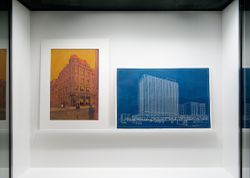
Sur les traces des... gens
Sur les traces des... gens
Actions:
Description:
L’un des indicateurs de la modernité à partir du XVIIIe siècle est l’apparition des « gens » comme nouvelle entité politique respectée. En réponse à ce phénomène, les architectes se sont engagés dans la transformation des villes, ont exploré de nouvelles technologies, testé de nouveaux discours en architecture et ont pris part dans des conflits culturels enflammés – le(...)
L’un des indicateurs de la modernité à partir du XVIIIe siècle est l’apparition des « gens » comme nouvelle entité politique respectée. En réponse à ce phénomène, les architectes se sont engagés dans la transformation des villes, ont exploré de nouvelles technologies, testé de nouveaux discours en architecture et ont pris part dans des conflits culturels enflammés – le(...)
Localisation:
Vitrines
Vitrines
Date:
5 octobre 2011 au 22 janvier 2012
5 octobre 2011 au 22 janvier 2012
Titre:
Sur les traces des... gens
Actions:
Description:
L’un des indicateurs de la modernité à partir du XVIIIe siècle est l’apparition des « gens » comme nouvelle entité politique respectée. En réponse à ce phénomène, les architectes se sont engagés dans la transformation des villes, ont exploré de nouvelles technologies, testé de nouveaux discours en architecture et ont pris part dans des conflits culturels enflammés – le(...)
Sur les traces des... gens
Actions:
Description:
L’un des indicateurs de la modernité à partir du XVIIIe siècle est l’apparition des « gens » comme nouvelle entité politique respectée. En réponse à ce phénomène, les architectes se sont engagés dans la transformation des villes, ont exploré de nouvelles technologies, testé de nouveaux discours en architecture et ont pris part dans des conflits culturels enflammés – le(...)
Classification:
expositions
expositions
Date:
5 octobre 2011 au
22 janvier 2012
5 octobre 2011 au
22 janvier 2012
Localisation:
Vitrines
Vitrines
Classification:
archives
Niveau de description archivistique:
Fonds
archives
Niveau de description archivistique:
Fonds
Numéro de référence:
AP218
Résumé:
The Gillian Hopwood and John Godwin fonds documents Hopwood and Godwin’s architectural projects from the early 1950s to the late 1980s, as well as their training to become architects, the administration of their architecture practice, and their career as architectural consultants, and their writing from the 1940s to 2023. The fonds mostly contains material related to their architectural projects, over 450 of them, mostly in Nigeria and some from their practice in the United Kingdom.
AP218
Résumé:
The Gillian Hopwood and John Godwin fonds documents Hopwood and Godwin’s architectural projects from the early 1950s to the late 1980s, as well as their training to become architects, the administration of their architecture practice, and their career as architectural consultants, and their writing from the 1940s to 2023. The fonds mostly contains material related to their architectural projects, over 450 of them, mostly in Nigeria and some from their practice in the United Kingdom.
Personnes et institutions:
Date:
1940-2025
1940-2025
Titre:
Gillian Hopwood and John Godwin fonds
Actions:
AP218
Résumé:
The Gillian Hopwood and John Godwin fonds documents Hopwood and Godwin’s architectural projects from the early 1950s to the late 1980s, as well as their training to become architects, the administration of their architecture practice, and their career as architectural consultants, and their writing from the 1940s to 2023. The fonds mostly contains material related to their architectural projects, over 450 of them, mostly in Nigeria and some from their practice in the United Kingdom.
Gillian Hopwood and John Godwin fonds
Actions:
AP218
Résumé:
The Gillian Hopwood and John Godwin fonds documents Hopwood and Godwin’s architectural projects from the early 1950s to the late 1980s, as well as their training to become architects, the administration of their architecture practice, and their career as architectural consultants, and their writing from the 1940s to 2023. The fonds mostly contains material related to their architectural projects, over 450 of them, mostly in Nigeria and some from their practice in the United Kingdom.
Classification:
archives
Niveau de description archivistique:
Fonds
archives
Niveau de description archivistique:
Fonds
Date:
1940-2025
1940-2025
Personnes et institutions:
Classification:
dessins, documents textuels, né numérique
dessins, documents textuels, né numérique
Numéro de référence:
AP181.S1.003
Description:
Original directory name:"02_1_Berater BMW". Records relate to construction and planning issues where BMW, as the client, was either in charge or more involved in the decision making. There is at least one report mentioning a BMW Design Planning Office. Bulk dates run from 2002 to 2007. There are sixteen consultants’ files, identified primarily with the firm or consultant name and expertise. These include Interbrand Zintzmeyer & Lux on corporate identity, ECE Projektmanagement GmbH on logistics, Stangl AG on facility management, Ingenieurbüro Georg Ziegler IGVB for surveying, GHTM AG on lightning protection, Schottenhamel & Kiening on restaurants cuisine and atmosphere planning, and bp solar on the inclusion of solar panels on the roof. Records consist of plans and drawings in CAD and PDF formats, renderings saved as JPEG, photographs, and textual records, such as correspondence, engineering reports, and presentations by the consultants. Most common file formats: AutoCAD Drawing, JPEG File Interchange Format, Acrobat PDF 1.4 - Portable Document Format, Acrobat PDF 1.2 - Portable Document Format, Acrobat PDF 1.3 - Portable Document Format
AP181.S1.003
Description:
Original directory name:"02_1_Berater BMW". Records relate to construction and planning issues where BMW, as the client, was either in charge or more involved in the decision making. There is at least one report mentioning a BMW Design Planning Office. Bulk dates run from 2002 to 2007. There are sixteen consultants’ files, identified primarily with the firm or consultant name and expertise. These include Interbrand Zintzmeyer & Lux on corporate identity, ECE Projektmanagement GmbH on logistics, Stangl AG on facility management, Ingenieurbüro Georg Ziegler IGVB for surveying, GHTM AG on lightning protection, Schottenhamel & Kiening on restaurants cuisine and atmosphere planning, and bp solar on the inclusion of solar panels on the roof. Records consist of plans and drawings in CAD and PDF formats, renderings saved as JPEG, photographs, and textual records, such as correspondence, engineering reports, and presentations by the consultants. Most common file formats: AutoCAD Drawing, JPEG File Interchange Format, Acrobat PDF 1.4 - Portable Document Format, Acrobat PDF 1.2 - Portable Document Format, Acrobat PDF 1.3 - Portable Document Format
Personnes et institutions:
Date:
1999-2012
1999-2012
Titre:
BMW consultants files, BMW Welt, Munich
Actions:
AP181.S1.003
Description:
Original directory name:"02_1_Berater BMW". Records relate to construction and planning issues where BMW, as the client, was either in charge or more involved in the decision making. There is at least one report mentioning a BMW Design Planning Office. Bulk dates run from 2002 to 2007. There are sixteen consultants’ files, identified primarily with the firm or consultant name and expertise. These include Interbrand Zintzmeyer & Lux on corporate identity, ECE Projektmanagement GmbH on logistics, Stangl AG on facility management, Ingenieurbüro Georg Ziegler IGVB for surveying, GHTM AG on lightning protection, Schottenhamel & Kiening on restaurants cuisine and atmosphere planning, and bp solar on the inclusion of solar panels on the roof. Records consist of plans and drawings in CAD and PDF formats, renderings saved as JPEG, photographs, and textual records, such as correspondence, engineering reports, and presentations by the consultants. Most common file formats: AutoCAD Drawing, JPEG File Interchange Format, Acrobat PDF 1.4 - Portable Document Format, Acrobat PDF 1.2 - Portable Document Format, Acrobat PDF 1.3 - Portable Document Format
BMW consultants files, BMW Welt, Munich
Actions:
AP181.S1.003
Description:
Original directory name:"02_1_Berater BMW". Records relate to construction and planning issues where BMW, as the client, was either in charge or more involved in the decision making. There is at least one report mentioning a BMW Design Planning Office. Bulk dates run from 2002 to 2007. There are sixteen consultants’ files, identified primarily with the firm or consultant name and expertise. These include Interbrand Zintzmeyer & Lux on corporate identity, ECE Projektmanagement GmbH on logistics, Stangl AG on facility management, Ingenieurbüro Georg Ziegler IGVB for surveying, GHTM AG on lightning protection, Schottenhamel & Kiening on restaurants cuisine and atmosphere planning, and bp solar on the inclusion of solar panels on the roof. Records consist of plans and drawings in CAD and PDF formats, renderings saved as JPEG, photographs, and textual records, such as correspondence, engineering reports, and presentations by the consultants. Most common file formats: AutoCAD Drawing, JPEG File Interchange Format, Acrobat PDF 1.4 - Portable Document Format, Acrobat PDF 1.2 - Portable Document Format, Acrobat PDF 1.3 - Portable Document Format
Classification:
dessins, documents textuels, né numérique
dessins, documents textuels, né numérique
Date:
1999-2012
1999-2012
Personnes et institutions:
Classification:
documents textuels
Quantité:
248 manuscript(s)
documents textuels
Quantité:
248 manuscript(s)
Actions:
Numéro de référence:
DR1984:1633:001
Description:
- This is a group of correspondences between Edward Leonard and Belgian architects whose work was proposed for inclusion in a book (never published) on domestic Belgian architecture of the 1920s (see object file DR1984:1633:01-02). The architects whose buildings have been included in the album DR1984:1633:002 are: Richard Acke, Fern Bodson, Paul Bonduelle, Victor Bourgeois, A. van Braekel, Frans Cools, J.A. De Bondt, J. De Ridder, Auguste De Smet, Henri Derée, Paul Detaeye, J.B. Dewin, J. Diongre, René Doom, Eeckeren, J.J. Eggericx, Alfons Francken, Lucien Francois, Jean E.P. Hendrickx, E.P. Jean, Huib Hoste, Houben, Huygh, E. Janssens, Ferdinand van Mierlo, J Minmaar, R. Nyst, Jacques Obozinski, Antoine Pompe, Portielje & De Braey Architectes, A Puissant, Paul Rubbers, Shobert, Cornelis Sol, Edward van Steenbergen, P.T.T. Verbruggen, R. Verwilghen, Jozef Viérin, Vincent Cols & Jules De Roeck Architectes, Oscar van de Voorde, and H.A. Wittocx. - The architects with whom Edward Leonard corresponded, but whose work is not included in the album DR1984:1633:002 are: J. van Asperen, E. van Averbeke, Frank Blockx, Georges Brosens, van Cauwelaert, Edward Craye, A.Defever, Julien De Ridder, Albert van Huffel, Jan Jacobs, S. Jasinski, W. van Kuyek, J. de Lange, F.J. Langeraert, Jan Lauwers, C. Leurs, Jean de Ligne, Alfred Minner, E.H.Nagels, E. van Not, E. van der Paal, F. Petit, Florent van Reeth, Jos. Ritzen, Paul Smekens, Jos. Smolderen, Léon Stynen, Lovis van der Swaelmen, Valentin Vaerwyck, and Henry van de Velde.
DR1984:1633:001
Description:
- This is a group of correspondences between Edward Leonard and Belgian architects whose work was proposed for inclusion in a book (never published) on domestic Belgian architecture of the 1920s (see object file DR1984:1633:01-02). The architects whose buildings have been included in the album DR1984:1633:002 are: Richard Acke, Fern Bodson, Paul Bonduelle, Victor Bourgeois, A. van Braekel, Frans Cools, J.A. De Bondt, J. De Ridder, Auguste De Smet, Henri Derée, Paul Detaeye, J.B. Dewin, J. Diongre, René Doom, Eeckeren, J.J. Eggericx, Alfons Francken, Lucien Francois, Jean E.P. Hendrickx, E.P. Jean, Huib Hoste, Houben, Huygh, E. Janssens, Ferdinand van Mierlo, J Minmaar, R. Nyst, Jacques Obozinski, Antoine Pompe, Portielje & De Braey Architectes, A Puissant, Paul Rubbers, Shobert, Cornelis Sol, Edward van Steenbergen, P.T.T. Verbruggen, R. Verwilghen, Jozef Viérin, Vincent Cols & Jules De Roeck Architectes, Oscar van de Voorde, and H.A. Wittocx. - The architects with whom Edward Leonard corresponded, but whose work is not included in the album DR1984:1633:002 are: J. van Asperen, E. van Averbeke, Frank Blockx, Georges Brosens, van Cauwelaert, Edward Craye, A.Defever, Julien De Ridder, Albert van Huffel, Jan Jacobs, S. Jasinski, W. van Kuyek, J. de Lange, F.J. Langeraert, Jan Lauwers, C. Leurs, Jean de Ligne, Alfred Minner, E.H.Nagels, E. van Not, E. van der Paal, F. Petit, Florent van Reeth, Jos. Ritzen, Paul Smekens, Jos. Smolderen, Léon Stynen, Lovis van der Swaelmen, Valentin Vaerwyck, and Henry van de Velde.
Personnes et institutions:
Sujet:
architecture
architecture
Date:
1922-1929
1922-1929
Titre:
Folder of letters and documents concerning the publication of a book on domestic architecture in Belgium after World War I
Actions:
DR1984:1633:001
Description:
- This is a group of correspondences between Edward Leonard and Belgian architects whose work was proposed for inclusion in a book (never published) on domestic Belgian architecture of the 1920s (see object file DR1984:1633:01-02). The architects whose buildings have been included in the album DR1984:1633:002 are: Richard Acke, Fern Bodson, Paul Bonduelle, Victor Bourgeois, A. van Braekel, Frans Cools, J.A. De Bondt, J. De Ridder, Auguste De Smet, Henri Derée, Paul Detaeye, J.B. Dewin, J. Diongre, René Doom, Eeckeren, J.J. Eggericx, Alfons Francken, Lucien Francois, Jean E.P. Hendrickx, E.P. Jean, Huib Hoste, Houben, Huygh, E. Janssens, Ferdinand van Mierlo, J Minmaar, R. Nyst, Jacques Obozinski, Antoine Pompe, Portielje & De Braey Architectes, A Puissant, Paul Rubbers, Shobert, Cornelis Sol, Edward van Steenbergen, P.T.T. Verbruggen, R. Verwilghen, Jozef Viérin, Vincent Cols & Jules De Roeck Architectes, Oscar van de Voorde, and H.A. Wittocx. - The architects with whom Edward Leonard corresponded, but whose work is not included in the album DR1984:1633:002 are: J. van Asperen, E. van Averbeke, Frank Blockx, Georges Brosens, van Cauwelaert, Edward Craye, A.Defever, Julien De Ridder, Albert van Huffel, Jan Jacobs, S. Jasinski, W. van Kuyek, J. de Lange, F.J. Langeraert, Jan Lauwers, C. Leurs, Jean de Ligne, Alfred Minner, E.H.Nagels, E. van Not, E. van der Paal, F. Petit, Florent van Reeth, Jos. Ritzen, Paul Smekens, Jos. Smolderen, Léon Stynen, Lovis van der Swaelmen, Valentin Vaerwyck, and Henry van de Velde.
Folder of letters and documents concerning the publication of a book on domestic architecture in Belgium after World War I
Actions:
DR1984:1633:001
Description:
- This is a group of correspondences between Edward Leonard and Belgian architects whose work was proposed for inclusion in a book (never published) on domestic Belgian architecture of the 1920s (see object file DR1984:1633:01-02). The architects whose buildings have been included in the album DR1984:1633:002 are: Richard Acke, Fern Bodson, Paul Bonduelle, Victor Bourgeois, A. van Braekel, Frans Cools, J.A. De Bondt, J. De Ridder, Auguste De Smet, Henri Derée, Paul Detaeye, J.B. Dewin, J. Diongre, René Doom, Eeckeren, J.J. Eggericx, Alfons Francken, Lucien Francois, Jean E.P. Hendrickx, E.P. Jean, Huib Hoste, Houben, Huygh, E. Janssens, Ferdinand van Mierlo, J Minmaar, R. Nyst, Jacques Obozinski, Antoine Pompe, Portielje & De Braey Architectes, A Puissant, Paul Rubbers, Shobert, Cornelis Sol, Edward van Steenbergen, P.T.T. Verbruggen, R. Verwilghen, Jozef Viérin, Vincent Cols & Jules De Roeck Architectes, Oscar van de Voorde, and H.A. Wittocx. - The architects with whom Edward Leonard corresponded, but whose work is not included in the album DR1984:1633:002 are: J. van Asperen, E. van Averbeke, Frank Blockx, Georges Brosens, van Cauwelaert, Edward Craye, A.Defever, Julien De Ridder, Albert van Huffel, Jan Jacobs, S. Jasinski, W. van Kuyek, J. de Lange, F.J. Langeraert, Jan Lauwers, C. Leurs, Jean de Ligne, Alfred Minner, E.H.Nagels, E. van Not, E. van der Paal, F. Petit, Florent van Reeth, Jos. Ritzen, Paul Smekens, Jos. Smolderen, Léon Stynen, Lovis van der Swaelmen, Valentin Vaerwyck, and Henry van de Velde.
Classification:
documents textuels
Quantité:
248 manuscript(s)
documents textuels
Quantité:
248 manuscript(s)
Date:
1922-1929
1922-1929
Personnes et institutions:
Sujet:
architecture
architecture
Classification:
photographies
photographies
Actions:
Numéro de référence:
DR1984:1633:002
Description:
- This is a group of photographs and drawings by Belgian architects selected by Edward Leonard for inclusion in a book (never published) on Belgian architecture of the 1920s (see object file DR1984:1633:01-02). Some of the photographs have been taken by Duquenne. The architects whose buildings have been included in the album DR1984:1633:002 are: Richard Acke, Fern Bodson, Paul Bonduelle, Victor Bourgeois, A. van Braekel, Frans Cools, J.A. De Bondt, J. De Ridder, Auguste De Smet, Henri Derée, Paul Detaeye, J.B. Dewin, J. Diongre, René Doom, Eeckeren, J.J. Eggericx, Alfons Francken, Lucien Francois, Jean E.P. Hendrickx, E.P. Jean, Huib Hoste, Houben, Huygh, E. Janssens, Ferdinand van Mierlo, J Minmaar, R. Nyst, Jacques Obozinski, Antoine Pompe, Portielje & De Braey Architectes, A Puissant, Paul Rubbers, Shobert, Cornelis Sol, Edward van Steenbergen, P.T.T. Verbruggen, R. Verwilghen, Jozef Viérin, Vincent Cols & Jules De Roeck Architectes, Oscar van de Voorde, and H.A. Wittocx. - The architects with whom Edward Leonard corresponded, but whose work is not included in the album DR1984:1633:002 are: J. van Asperen, E. van Averbeke, Frank Blockx, Georges Brosens, van Cauwelaert, Edward Craye, A.Defever, Julien De Ridder, Albert van Huffel, Jan Jacobs, S. Jasinski, W. van Kuyek, J. de Lange, F.J. Langeraert, Jan Lauwers, C. Leurs, Jean de Ligne, Alfred Minner, E.H.Nagels, E. van Not, E. van der Paal, F. Petit, Florent van Reeth, Jos. Ritzen, Paul Smekens, Jos. Smolderen, Léon Stynen, Lovis van der Swaelmen, Valentin Vaerwyck, and Henry van de Velde.
DR1984:1633:002
Description:
- This is a group of photographs and drawings by Belgian architects selected by Edward Leonard for inclusion in a book (never published) on Belgian architecture of the 1920s (see object file DR1984:1633:01-02). Some of the photographs have been taken by Duquenne. The architects whose buildings have been included in the album DR1984:1633:002 are: Richard Acke, Fern Bodson, Paul Bonduelle, Victor Bourgeois, A. van Braekel, Frans Cools, J.A. De Bondt, J. De Ridder, Auguste De Smet, Henri Derée, Paul Detaeye, J.B. Dewin, J. Diongre, René Doom, Eeckeren, J.J. Eggericx, Alfons Francken, Lucien Francois, Jean E.P. Hendrickx, E.P. Jean, Huib Hoste, Houben, Huygh, E. Janssens, Ferdinand van Mierlo, J Minmaar, R. Nyst, Jacques Obozinski, Antoine Pompe, Portielje & De Braey Architectes, A Puissant, Paul Rubbers, Shobert, Cornelis Sol, Edward van Steenbergen, P.T.T. Verbruggen, R. Verwilghen, Jozef Viérin, Vincent Cols & Jules De Roeck Architectes, Oscar van de Voorde, and H.A. Wittocx. - The architects with whom Edward Leonard corresponded, but whose work is not included in the album DR1984:1633:002 are: J. van Asperen, E. van Averbeke, Frank Blockx, Georges Brosens, van Cauwelaert, Edward Craye, A.Defever, Julien De Ridder, Albert van Huffel, Jan Jacobs, S. Jasinski, W. van Kuyek, J. de Lange, F.J. Langeraert, Jan Lauwers, C. Leurs, Jean de Ligne, Alfred Minner, E.H.Nagels, E. van Not, E. van der Paal, F. Petit, Florent van Reeth, Jos. Ritzen, Paul Smekens, Jos. Smolderen, Léon Stynen, Lovis van der Swaelmen, Valentin Vaerwyck, and Henry van de Velde.
Personnes et institutions:
Sujet:
architecture
architecture
Date:
1922-1929
1922-1929
Titre:
Album of photographs, drawings, reprographic copies, few correspondences, and ephemera for a book on domestic architecture in Belgium after World War I
Actions:
DR1984:1633:002
Description:
- This is a group of photographs and drawings by Belgian architects selected by Edward Leonard for inclusion in a book (never published) on Belgian architecture of the 1920s (see object file DR1984:1633:01-02). Some of the photographs have been taken by Duquenne. The architects whose buildings have been included in the album DR1984:1633:002 are: Richard Acke, Fern Bodson, Paul Bonduelle, Victor Bourgeois, A. van Braekel, Frans Cools, J.A. De Bondt, J. De Ridder, Auguste De Smet, Henri Derée, Paul Detaeye, J.B. Dewin, J. Diongre, René Doom, Eeckeren, J.J. Eggericx, Alfons Francken, Lucien Francois, Jean E.P. Hendrickx, E.P. Jean, Huib Hoste, Houben, Huygh, E. Janssens, Ferdinand van Mierlo, J Minmaar, R. Nyst, Jacques Obozinski, Antoine Pompe, Portielje & De Braey Architectes, A Puissant, Paul Rubbers, Shobert, Cornelis Sol, Edward van Steenbergen, P.T.T. Verbruggen, R. Verwilghen, Jozef Viérin, Vincent Cols & Jules De Roeck Architectes, Oscar van de Voorde, and H.A. Wittocx. - The architects with whom Edward Leonard corresponded, but whose work is not included in the album DR1984:1633:002 are: J. van Asperen, E. van Averbeke, Frank Blockx, Georges Brosens, van Cauwelaert, Edward Craye, A.Defever, Julien De Ridder, Albert van Huffel, Jan Jacobs, S. Jasinski, W. van Kuyek, J. de Lange, F.J. Langeraert, Jan Lauwers, C. Leurs, Jean de Ligne, Alfred Minner, E.H.Nagels, E. van Not, E. van der Paal, F. Petit, Florent van Reeth, Jos. Ritzen, Paul Smekens, Jos. Smolderen, Léon Stynen, Lovis van der Swaelmen, Valentin Vaerwyck, and Henry van de Velde.
Album of photographs, drawings, reprographic copies, few correspondences, and ephemera for a book on domestic architecture in Belgium after World War I
Actions:
DR1984:1633:002
Description:
- This is a group of photographs and drawings by Belgian architects selected by Edward Leonard for inclusion in a book (never published) on Belgian architecture of the 1920s (see object file DR1984:1633:01-02). Some of the photographs have been taken by Duquenne. The architects whose buildings have been included in the album DR1984:1633:002 are: Richard Acke, Fern Bodson, Paul Bonduelle, Victor Bourgeois, A. van Braekel, Frans Cools, J.A. De Bondt, J. De Ridder, Auguste De Smet, Henri Derée, Paul Detaeye, J.B. Dewin, J. Diongre, René Doom, Eeckeren, J.J. Eggericx, Alfons Francken, Lucien Francois, Jean E.P. Hendrickx, E.P. Jean, Huib Hoste, Houben, Huygh, E. Janssens, Ferdinand van Mierlo, J Minmaar, R. Nyst, Jacques Obozinski, Antoine Pompe, Portielje & De Braey Architectes, A Puissant, Paul Rubbers, Shobert, Cornelis Sol, Edward van Steenbergen, P.T.T. Verbruggen, R. Verwilghen, Jozef Viérin, Vincent Cols & Jules De Roeck Architectes, Oscar van de Voorde, and H.A. Wittocx. - The architects with whom Edward Leonard corresponded, but whose work is not included in the album DR1984:1633:002 are: J. van Asperen, E. van Averbeke, Frank Blockx, Georges Brosens, van Cauwelaert, Edward Craye, A.Defever, Julien De Ridder, Albert van Huffel, Jan Jacobs, S. Jasinski, W. van Kuyek, J. de Lange, F.J. Langeraert, Jan Lauwers, C. Leurs, Jean de Ligne, Alfred Minner, E.H.Nagels, E. van Not, E. van der Paal, F. Petit, Florent van Reeth, Jos. Ritzen, Paul Smekens, Jos. Smolderen, Léon Stynen, Lovis van der Swaelmen, Valentin Vaerwyck, and Henry van de Velde.
Classification:
photographies
photographies
Date:
1922-1929
1922-1929
Personnes et institutions:
Sujet:
architecture
architecture
Classification:
dessins
dessins
Titre:
Elevation of a palace façade
Elevation of a palace façade
Actions:
Numéro de référence:
DR1970:0003
Description:
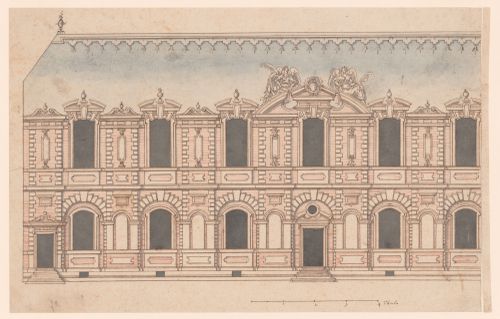
This drawing shows an exterior of a residential building. The artist uses color to suggest the materials used in construction; blue-grey for the pitched slate roof, brown for masonry details and architectural sculpture, and red striations for brickwork. This combination of materials was common in early modern France, where a play on color and materiality enlivened the façades of well-known royal edifices including the chateaux of Fontainebleau and Saint-Germain-en-Laye. As with the construction technique that interwove stone with brick, the architectural style depicted in the drawing combines traditional French ideas about building with classicizing elements imported to France via Italian artists and architects as well as through printed translations of Vitruvius’s 'De architectura' and Sebastiano Serlio’s architectural treatise. The inclusion of masonry rustication and the decorative urns that punctuate the roofline suggest a knowledge of classicizing trends in architectural ornament and a familiarity with the œuvre of artists working in the circle of the first and second Écoles de Fontainebleau. The structure’s elongated form suggests a gallery and the organization of the façade borrows the combination of slightly protruding vertical bays and long horizontal registers that characterizes Pierre Lescot’s wing of the Louvre, a project that would have been well-known in court circles in the latter half of the sixteenth century. Similarly, the two winged allegorical figures flanking the central pediment are reminiscent of Jean Goujon’s sculptural additions to the Lescot wing. In the Canadian Centre for Architecture’s drawing both figures hold palms, but the artist omitted any further identifying attributes, perhaps – along with the empty niches – as an invitation for the patron to imagine his or her own thematic program for the project.
DR1970:0003
Description:
This drawing shows an exterior of a residential building. The artist uses color to suggest the materials used in construction; blue-grey for the pitched slate roof, brown for masonry details and architectural sculpture, and red striations for brickwork. This combination of materials was common in early modern France, where a play on color and materiality enlivened the façades of well-known royal edifices including the chateaux of Fontainebleau and Saint-Germain-en-Laye. As with the construction technique that interwove stone with brick, the architectural style depicted in the drawing combines traditional French ideas about building with classicizing elements imported to France via Italian artists and architects as well as through printed translations of Vitruvius’s 'De architectura' and Sebastiano Serlio’s architectural treatise. The inclusion of masonry rustication and the decorative urns that punctuate the roofline suggest a knowledge of classicizing trends in architectural ornament and a familiarity with the œuvre of artists working in the circle of the first and second Écoles de Fontainebleau. The structure’s elongated form suggests a gallery and the organization of the façade borrows the combination of slightly protruding vertical bays and long horizontal registers that characterizes Pierre Lescot’s wing of the Louvre, a project that would have been well-known in court circles in the latter half of the sixteenth century. Similarly, the two winged allegorical figures flanking the central pediment are reminiscent of Jean Goujon’s sculptural additions to the Lescot wing. In the Canadian Centre for Architecture’s drawing both figures hold palms, but the artist omitted any further identifying attributes, perhaps – along with the empty niches – as an invitation for the patron to imagine his or her own thematic program for the project.
Personnes et institutions:
Date:
first quarter of the 16th century
first quarter of the 16th century
Titre:
Elevation of a palace façade
Actions:
DR1970:0003
Description:
This drawing shows an exterior of a residential building. The artist uses color to suggest the materials used in construction; blue-grey for the pitched slate roof, brown for masonry details and architectural sculpture, and red striations for brickwork. This combination of materials was common in early modern France, where a play on color and materiality enlivened the façades of well-known royal edifices including the chateaux of Fontainebleau and Saint-Germain-en-Laye. As with the construction technique that interwove stone with brick, the architectural style depicted in the drawing combines traditional French ideas about building with classicizing elements imported to France via Italian artists and architects as well as through printed translations of Vitruvius’s 'De architectura' and Sebastiano Serlio’s architectural treatise. The inclusion of masonry rustication and the decorative urns that punctuate the roofline suggest a knowledge of classicizing trends in architectural ornament and a familiarity with the œuvre of artists working in the circle of the first and second Écoles de Fontainebleau. The structure’s elongated form suggests a gallery and the organization of the façade borrows the combination of slightly protruding vertical bays and long horizontal registers that characterizes Pierre Lescot’s wing of the Louvre, a project that would have been well-known in court circles in the latter half of the sixteenth century. Similarly, the two winged allegorical figures flanking the central pediment are reminiscent of Jean Goujon’s sculptural additions to the Lescot wing. In the Canadian Centre for Architecture’s drawing both figures hold palms, but the artist omitted any further identifying attributes, perhaps – along with the empty niches – as an invitation for the patron to imagine his or her own thematic program for the project.
Elevation of a palace façade
Actions:
DR1970:0003
Description:
This drawing shows an exterior of a residential building. The artist uses color to suggest the materials used in construction; blue-grey for the pitched slate roof, brown for masonry details and architectural sculpture, and red striations for brickwork. This combination of materials was common in early modern France, where a play on color and materiality enlivened the façades of well-known royal edifices including the chateaux of Fontainebleau and Saint-Germain-en-Laye. As with the construction technique that interwove stone with brick, the architectural style depicted in the drawing combines traditional French ideas about building with classicizing elements imported to France via Italian artists and architects as well as through printed translations of Vitruvius’s 'De architectura' and Sebastiano Serlio’s architectural treatise. The inclusion of masonry rustication and the decorative urns that punctuate the roofline suggest a knowledge of classicizing trends in architectural ornament and a familiarity with the œuvre of artists working in the circle of the first and second Écoles de Fontainebleau. The structure’s elongated form suggests a gallery and the organization of the façade borrows the combination of slightly protruding vertical bays and long horizontal registers that characterizes Pierre Lescot’s wing of the Louvre, a project that would have been well-known in court circles in the latter half of the sixteenth century. Similarly, the two winged allegorical figures flanking the central pediment are reminiscent of Jean Goujon’s sculptural additions to the Lescot wing. In the Canadian Centre for Architecture’s drawing both figures hold palms, but the artist omitted any further identifying attributes, perhaps – along with the empty niches – as an invitation for the patron to imagine his or her own thematic program for the project.
Classification:
dessins
dessins
Date:
first quarter of the 16th century
first quarter of the 16th century
Personnes et institutions:


