


2092 Résultats
Classification:
livres
livres
Prix:
$51.95
(disponible sur commande)
Résumé:
Trees capture our imagination because they are rooted solidly in the earth but point ethereally toward the sky. They occupy a dimension that has as much to do with time and patience as with place and landscape. They are vertical beings to whom we attribute qualities both divine and human. Since 1991, photographer Barbara Bosworth has been on a quest to photograph(...)
$51.95
(disponible sur commande)
Résumé:
Trees capture our imagination because they are rooted solidly in the earth but point ethereally toward the sky. They occupy a dimension that has as much to do with time and patience as with place and landscape. They are vertical beings to whom we attribute qualities both divine and human. Since 1991, photographer Barbara Bosworth has been on a quest to photograph(...)
Sujet:
Monographies photo
Monographies photo
Publication:
septembre 2005, Cambridge
septembre 2005, Cambridge
Titre:
Trees : national champions / photographs by Barbara Bosworth
Actions:
Prix:
$51.95
(disponible sur commande)
Résumé:
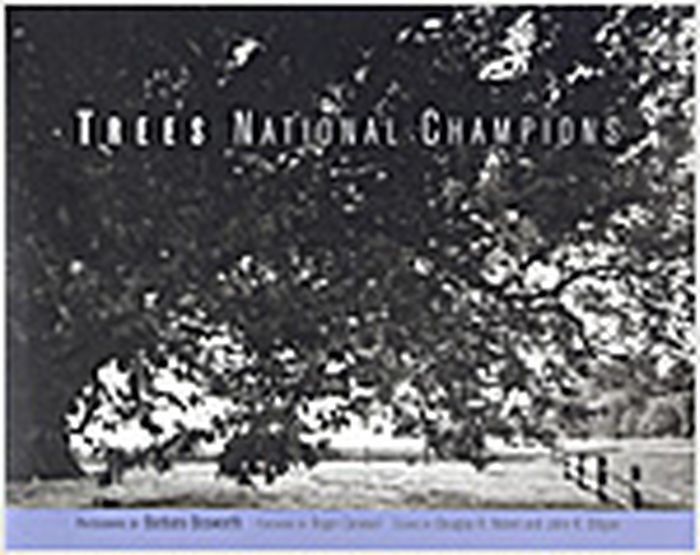
Trees capture our imagination because they are rooted solidly in the earth but point ethereally toward the sky. They occupy a dimension that has as much to do with time and patience as with place and landscape. They are vertical beings to whom we attribute qualities both divine and human. Since 1991, photographer Barbara Bosworth has been on a quest to photograph America's "champion" trees - trees that are the biggest of their species, as recorded in the National Register of Big Trees, a list established and maintained by the nonprofit conservation organization American Forests. She has traveled down highways and up back roads, walked through forests and across clear-cut land, sometimes led by local tree enthusiasts, sometimes alone, to photograph trees that are remarkable not only for their size but for their endurance. Bosworth finds champion trees in backyards, fields, and forests, near roadways, power lines, and sidewalks. Her photographs document the trees' magnificence but also show how they are markers of a changing landscape. The yellow poplar, for example, stands on the fringes of a suburban housing development, in the center of a park for the enjoyment and relaxation of residents. The western red cedar stands alone in the middle of a clear-cut, saved from logging only because it is recorded in the Register as the biggest of its kind. The trees and their surroundings tell us about our relationship with nature and the land. Bosworth captures the ineffable grace and dignity of trees with clarity and directness: the green ash that shades a midwestern crossroads, the common pear that blooms in a Washington field, and the Florida strangler fig with its mass of entwining aerial roots. Her photographs, panoramic views taken with an 8 x 10 camera, show the immensity of the largest species and the hidden triumphs of the smallest. Some trees are dethroned each year because of sickness or destruction, but more often simpy because a new and bigger specimen is discovered; only three trees from the original Register in 1940 are still living today. Bosworth's 70 photographs of champion trees are not only a collection of tree portraits but the story of an American adventure as well. With a foreword by Roger Conover and essays by Douglas R. Nickel and John R. Stilgoe.
Trees : national champions / photographs by Barbara Bosworth
Actions:
Prix:
$51.95
(disponible sur commande)
Résumé:
Trees capture our imagination because they are rooted solidly in the earth but point ethereally toward the sky. They occupy a dimension that has as much to do with time and patience as with place and landscape. They are vertical beings to whom we attribute qualities both divine and human. Since 1991, photographer Barbara Bosworth has been on a quest to photograph America's "champion" trees - trees that are the biggest of their species, as recorded in the National Register of Big Trees, a list established and maintained by the nonprofit conservation organization American Forests. She has traveled down highways and up back roads, walked through forests and across clear-cut land, sometimes led by local tree enthusiasts, sometimes alone, to photograph trees that are remarkable not only for their size but for their endurance. Bosworth finds champion trees in backyards, fields, and forests, near roadways, power lines, and sidewalks. Her photographs document the trees' magnificence but also show how they are markers of a changing landscape. The yellow poplar, for example, stands on the fringes of a suburban housing development, in the center of a park for the enjoyment and relaxation of residents. The western red cedar stands alone in the middle of a clear-cut, saved from logging only because it is recorded in the Register as the biggest of its kind. The trees and their surroundings tell us about our relationship with nature and the land. Bosworth captures the ineffable grace and dignity of trees with clarity and directness: the green ash that shades a midwestern crossroads, the common pear that blooms in a Washington field, and the Florida strangler fig with its mass of entwining aerial roots. Her photographs, panoramic views taken with an 8 x 10 camera, show the immensity of the largest species and the hidden triumphs of the smallest. Some trees are dethroned each year because of sickness or destruction, but more often simpy because a new and bigger specimen is discovered; only three trees from the original Register in 1940 are still living today. Bosworth's 70 photographs of champion trees are not only a collection of tree portraits but the story of an American adventure as well. With a foreword by Roger Conover and essays by Douglas R. Nickel and John R. Stilgoe.
Classification:
livres
livres
Publication:
septembre 2005, Cambridge
septembre 2005, Cambridge
Sujet:
Monographies photo
Monographies photo
Classification:
livres
livres

Actions:
Prix:
$20.00
(disponible en magasin)
Résumé:
Almost ten years ago, Canary architectural practice AmP with its founders Felipe Artengo Rufino and José Pastrana (and their former partner Fernando Menis / Today: Menis Arquitectos) received acclaim far beyond their own country of Spain with their government building for the Canary Islands. A decisive factor for the international success of the team, which can be(...)
$20.00
(disponible en magasin)
Résumé:
Almost ten years ago, Canary architectural practice AmP with its founders Felipe Artengo Rufino and José Pastrana (and their former partner Fernando Menis / Today: Menis Arquitectos) received acclaim far beyond their own country of Spain with their government building for the Canary Islands. A decisive factor for the international success of the team, which can be(...)
Titre:
Amp - the mark of the volcano : artengo + pastrana
Actions:
Prix:
$20.00
(disponible en magasin)
Résumé:
Almost ten years ago, Canary architectural practice AmP with its founders Felipe Artengo Rufino and José Pastrana (and their former partner Fernando Menis / Today: Menis Arquitectos) received acclaim far beyond their own country of Spain with their government building for the Canary Islands. A decisive factor for the international success of the team, which can be considered neither minimalist nor traditionalist, was the congenial mixture of four elements: their expressionist creative impulse, their deep roots in their home environment, the Canary Islands, their sculptural approach to architecture and the creative use of concrete as design element in combination with local materials. These vital aspects of their architecture also characterize the latest works of AmP, which are always the result of exact observations of space and locality. The Aedes exhibition’s focus is on the athletics stadium in Tenerife which was completed this year. Fitted like a giant earth and stone embankment into the suburban context, it represents at the same time a master piece of modern high-tech architecture. The two residential towers in Añaza, 2007, which have already gained landmark character and are an example of an offbeat approach to council housing in Spain, appear like giant concrete sculptures with their slightly bent shape and their odd-sized windows irregularly dispersed throughout the façade. Other projects are the court house in Santa Cruz, 2007 (competition entry), the extension building Cabildo, 2007 and a school in Orotawa, 2005. The competition entry for the harbour area in Los Cristianos, 2007, illustrates the sensitive approach of Felipe Artengo Rufino und José Pastrana within the urban context, achieving a user- friendly transformation of this area where the city meets the sea, for residents as well as for tourist. A fundamental principle of AmP would be to understand a place as a sediment of geological and climatic forces, of industrial, agrarian and urban residue, permeated by sociological and cultural components. Closeness to their environment and the means at their disposal enable Felipe Artengo Rufino and José Pastrana to do research in situ and thus create a clearly defined architecture. The scenic variety of the islands, in which light plays an essential role, has a strong influence on their design process. The effects of time on their work are vital to AmP. The aging process of their favourite materials concrete, stone and timber fosters a continuous natural change which accentuates the power of architecture and makes the formal and structural aspects become even more evident in the course of time.
Amp - the mark of the volcano : artengo + pastrana
Actions:
Prix:
$20.00
(disponible en magasin)
Résumé:
Almost ten years ago, Canary architectural practice AmP with its founders Felipe Artengo Rufino and José Pastrana (and their former partner Fernando Menis / Today: Menis Arquitectos) received acclaim far beyond their own country of Spain with their government building for the Canary Islands. A decisive factor for the international success of the team, which can be considered neither minimalist nor traditionalist, was the congenial mixture of four elements: their expressionist creative impulse, their deep roots in their home environment, the Canary Islands, their sculptural approach to architecture and the creative use of concrete as design element in combination with local materials. These vital aspects of their architecture also characterize the latest works of AmP, which are always the result of exact observations of space and locality. The Aedes exhibition’s focus is on the athletics stadium in Tenerife which was completed this year. Fitted like a giant earth and stone embankment into the suburban context, it represents at the same time a master piece of modern high-tech architecture. The two residential towers in Añaza, 2007, which have already gained landmark character and are an example of an offbeat approach to council housing in Spain, appear like giant concrete sculptures with their slightly bent shape and their odd-sized windows irregularly dispersed throughout the façade. Other projects are the court house in Santa Cruz, 2007 (competition entry), the extension building Cabildo, 2007 and a school in Orotawa, 2005. The competition entry for the harbour area in Los Cristianos, 2007, illustrates the sensitive approach of Felipe Artengo Rufino und José Pastrana within the urban context, achieving a user- friendly transformation of this area where the city meets the sea, for residents as well as for tourist. A fundamental principle of AmP would be to understand a place as a sediment of geological and climatic forces, of industrial, agrarian and urban residue, permeated by sociological and cultural components. Closeness to their environment and the means at their disposal enable Felipe Artengo Rufino and José Pastrana to do research in situ and thus create a clearly defined architecture. The scenic variety of the islands, in which light plays an essential role, has a strong influence on their design process. The effects of time on their work are vital to AmP. The aging process of their favourite materials concrete, stone and timber fosters a continuous natural change which accentuates the power of architecture and makes the formal and structural aspects become even more evident in the course of time.
Classification:
livres
livres
Publication:
juillet 2007, Berlin
juillet 2007, Berlin
Sujet:
petits formats
petits formats


