


2162 Résultats
Classification:
livres
livres
Actions:
Prix:
$39.99
(disponible sur commande)
Résumé:
We are living through a global catastrophe. Buildings affect how we feel, moment by moment, day by day. They have the power to lift us up and make us feel awestruck, playful, safe, and inspired, just as they can make us feel alienated and sad. But many of the places where we live, work, learn, and heal have become monotonous and disposable. We’re surrounded by cheap,(...)
$39.99
(disponible sur commande)
Résumé:
We are living through a global catastrophe. Buildings affect how we feel, moment by moment, day by day. They have the power to lift us up and make us feel awestruck, playful, safe, and inspired, just as they can make us feel alienated and sad. But many of the places where we live, work, learn, and heal have become monotonous and disposable. We’re surrounded by cheap,(...)
Titre:
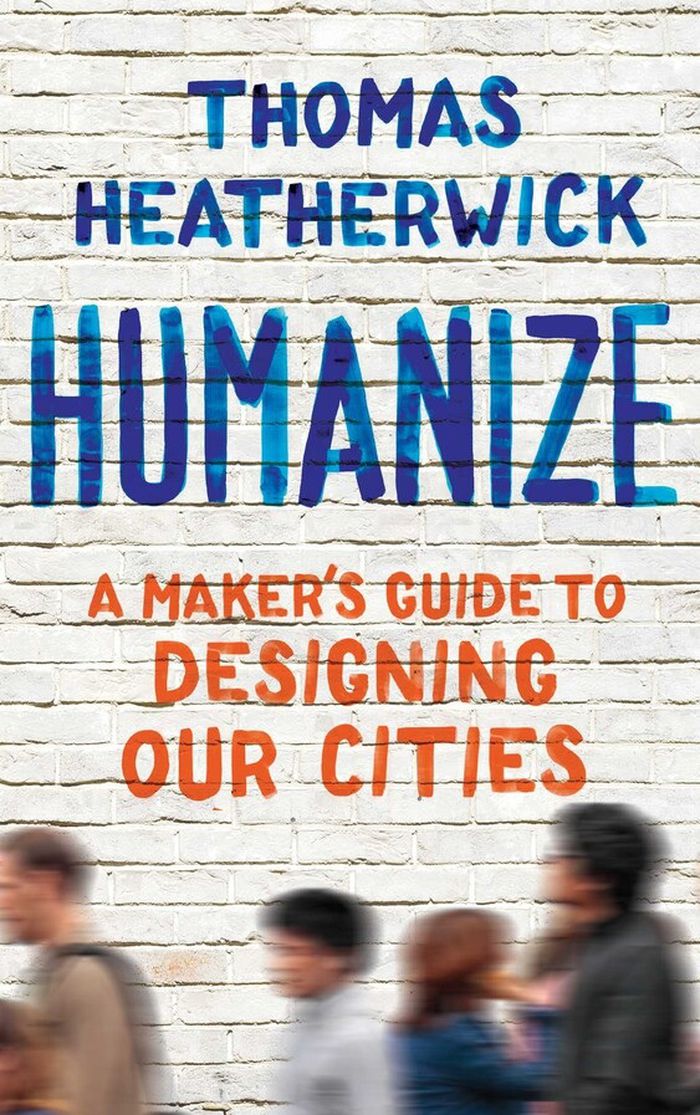
Humanize: A maker's guide to designing our cities
Actions:
Prix:
$39.99
(disponible sur commande)
Résumé:
We are living through a global catastrophe. Buildings affect how we feel, moment by moment, day by day. They have the power to lift us up and make us feel awestruck, playful, safe, and inspired, just as they can make us feel alienated and sad. But many of the places where we live, work, learn, and heal have become monotonous and disposable. We’re surrounded by cheap, boring buildings that make people stressed, sick, and unhappy. In short, much of our world has been crafted in a way that is hostile to human experience. Now, drawing on his experience of the last thirty years in making bold, beautiful objects and buildings, Thomas Heatherwick offers both an informed critique of the inhumanity in most of today’s contemporary building design, and a rousing call for action. Looking through Heatherwick’s eyes, we see familiar landmarks and cityscapes around the world, from London, Paris, Barcelona, Singapore, New York, Vancouver, and beyond, both old and new, famous and obscure, to learn how places can either sap the life out of us—or nourish our senses and our psyche. The time has come, he says, to put emotion back at the heart of the design process, and the reasons to do so could not be more urgent. Design is not superficial: it has an impact upon economics, climate change, our mental and physical wellbeing—even the peace and cohesion of our societies.
Humanize: A maker's guide to designing our cities
Actions:
Prix:
$39.99
(disponible sur commande)
Résumé:
We are living through a global catastrophe. Buildings affect how we feel, moment by moment, day by day. They have the power to lift us up and make us feel awestruck, playful, safe, and inspired, just as they can make us feel alienated and sad. But many of the places where we live, work, learn, and heal have become monotonous and disposable. We’re surrounded by cheap, boring buildings that make people stressed, sick, and unhappy. In short, much of our world has been crafted in a way that is hostile to human experience. Now, drawing on his experience of the last thirty years in making bold, beautiful objects and buildings, Thomas Heatherwick offers both an informed critique of the inhumanity in most of today’s contemporary building design, and a rousing call for action. Looking through Heatherwick’s eyes, we see familiar landmarks and cityscapes around the world, from London, Paris, Barcelona, Singapore, New York, Vancouver, and beyond, both old and new, famous and obscure, to learn how places can either sap the life out of us—or nourish our senses and our psyche. The time has come, he says, to put emotion back at the heart of the design process, and the reasons to do so could not be more urgent. Design is not superficial: it has an impact upon economics, climate change, our mental and physical wellbeing—even the peace and cohesion of our societies.
Classification:
livres
livres
Publication:
novembre 2023
novembre 2023
Sujet:
Théorie de l’urbanisme
Théorie de l’urbanisme
Classification:
livres
livres
Titre:
Rachel Harrison If I did it
Rachel Harrison If I did it
Actions:
Prix:
$56.00
(disponible sur commande)
Résumé:
Gracing the cover jacket of Rachel Harrison's highly anticipated second monograph is an informal monument to the man who holds the Americas' namesake. The only hint to this memorial for the 15th century Italian explorer, Amerigo Vespucci, is an apple resting on an outcropping of neon-green cement; of course the fact that the apple is not only artificial but has a bite(...)
$56.00
(disponible sur commande)
Résumé:
Gracing the cover jacket of Rachel Harrison's highly anticipated second monograph is an informal monument to the man who holds the Americas' namesake. The only hint to this memorial for the 15th century Italian explorer, Amerigo Vespucci, is an apple resting on an outcropping of neon-green cement; of course the fact that the apple is not only artificial but has a bite(...)
Publication:
mars 2008, Zurich
mars 2008, Zurich
Titre:
Rachel Harrison If I did it
Actions:
Prix:
$56.00
(disponible sur commande)
Résumé:
Gracing the cover jacket of Rachel Harrison's highly anticipated second monograph is an informal monument to the man who holds the Americas' namesake. The only hint to this memorial for the 15th century Italian explorer, Amerigo Vespucci, is an apple resting on an outcropping of neon-green cement; of course the fact that the apple is not only artificial but has a bite taken out of it suggests otherwise to the discovery of these "Edenic" continents. This slight yet important fact raises the basic concept of if i did it: the active disavowal of art's political function as a museological testament to the "progress" of social history. By tossing off this monumental propensity, Harrison builds "antimonuments;" not so much sculptures but lumpen aggregates of pop psychology. In addition to Vespucci, throughout the book, one finds that celebrities Johnny Depp and Tiger Woods are included in a pantheon with John Locke and 18th century Corsican revolutionary Pasquale Paoli, meanwhile Al Gore checks the temperature, Claude Levi-Strauss checks the door with a taxidermied hen and rooster and a bi-curious Alexander the Great is the master of ceremonies. The title, taken from O.J. Simpson's infamous "hypothetical" account of his murder of Nicole Brown Simpson and Donald Goldman, groups this role call of high- and low- brow idols into a nonhierarchical tableau where cultural and political value are allotted only where one sees fit.
Rachel Harrison If I did it
Actions:
Prix:
$56.00
(disponible sur commande)
Résumé:
Gracing the cover jacket of Rachel Harrison's highly anticipated second monograph is an informal monument to the man who holds the Americas' namesake. The only hint to this memorial for the 15th century Italian explorer, Amerigo Vespucci, is an apple resting on an outcropping of neon-green cement; of course the fact that the apple is not only artificial but has a bite taken out of it suggests otherwise to the discovery of these "Edenic" continents. This slight yet important fact raises the basic concept of if i did it: the active disavowal of art's political function as a museological testament to the "progress" of social history. By tossing off this monumental propensity, Harrison builds "antimonuments;" not so much sculptures but lumpen aggregates of pop psychology. In addition to Vespucci, throughout the book, one finds that celebrities Johnny Depp and Tiger Woods are included in a pantheon with John Locke and 18th century Corsican revolutionary Pasquale Paoli, meanwhile Al Gore checks the temperature, Claude Levi-Strauss checks the door with a taxidermied hen and rooster and a bi-curious Alexander the Great is the master of ceremonies. The title, taken from O.J. Simpson's infamous "hypothetical" account of his murder of Nicole Brown Simpson and Donald Goldman, groups this role call of high- and low- brow idols into a nonhierarchical tableau where cultural and political value are allotted only where one sees fit.
Classification:
livres
livres
Publication:
mars 2008, Zurich
mars 2008, Zurich
Classification:
livres
livres
Titre:
The Remembered film
The Remembered film
Actions:
Prix:
$24.95
(disponible sur commande)
Résumé:
Most books about cinema, whether popular or academic, concentrate on what we might call the ‘inside’ of the film: from star performances to narrative structures. The relatively few books about the ‘outside’ of films speak mainly of such aspects of production and reception as the organization of the film industry and the sociology of audiences: the Hollywood studio system,(...)
$24.95
(disponible sur commande)
Résumé:
Most books about cinema, whether popular or academic, concentrate on what we might call the ‘inside’ of the film: from star performances to narrative structures. The relatively few books about the ‘outside’ of films speak mainly of such aspects of production and reception as the organization of the film industry and the sociology of audiences: the Hollywood studio system,(...)
Titre:
The Remembered film
Actions:
Prix:
$24.95
(disponible sur commande)
Résumé:
Most books about cinema, whether popular or academic, concentrate on what we might call the ‘inside’ of the film: from star performances to narrative structures. The relatively few books about the ‘outside’ of films speak mainly of such aspects of production and reception as the organization of the film industry and the sociology of audiences: the Hollywood studio system, for example, or fan clubs. The Remembered Film is unique in addressing a previously overlooked aspect of cinema: the isolated fragments of films, iconic images or scenes, that fleetingly cross our perceptions and thoughts in the course of everyday life. Victor Burgin examines a kaleidescope of film fragments drawn from a variety of media, the internet, memory and fantasy. Among these are sequences of such brevity they might almost be stills. Such ‘sequence-images’, as Burgin calls them, are neither strictly ‘image’ nor ‘image sequence’ and have not been considered before by either film or photography theory. He also considers some typical individual experiences ‘sampled’ from mainstream cinema. He reflects on such disparate occurrences as the association in memory of fragments from otherwise unrelated films, of the relation of a recollected film image to an architectural setting, or of a feeling ‘marked’ by an image remembered from a film. The Remembered Film provides a radical new way of thinking about film outside conventional cinema, and in relation to our everyday lives. It will appeal to a wide audience interested in film and media.
The Remembered film
Actions:
Prix:
$24.95
(disponible sur commande)
Résumé:
Most books about cinema, whether popular or academic, concentrate on what we might call the ‘inside’ of the film: from star performances to narrative structures. The relatively few books about the ‘outside’ of films speak mainly of such aspects of production and reception as the organization of the film industry and the sociology of audiences: the Hollywood studio system, for example, or fan clubs. The Remembered Film is unique in addressing a previously overlooked aspect of cinema: the isolated fragments of films, iconic images or scenes, that fleetingly cross our perceptions and thoughts in the course of everyday life. Victor Burgin examines a kaleidescope of film fragments drawn from a variety of media, the internet, memory and fantasy. Among these are sequences of such brevity they might almost be stills. Such ‘sequence-images’, as Burgin calls them, are neither strictly ‘image’ nor ‘image sequence’ and have not been considered before by either film or photography theory. He also considers some typical individual experiences ‘sampled’ from mainstream cinema. He reflects on such disparate occurrences as the association in memory of fragments from otherwise unrelated films, of the relation of a recollected film image to an architectural setting, or of a feeling ‘marked’ by an image remembered from a film. The Remembered Film provides a radical new way of thinking about film outside conventional cinema, and in relation to our everyday lives. It will appeal to a wide audience interested in film and media.
Classification:
livres
livres
Publication:
octobre 2004, London
octobre 2004, London
Sujet:
Monographies photo
Monographies photo
Classification:
livres
livres
Actions:
Prix:
$89.99
(disponible sur commande)
Résumé:
Written by the chair of the LEED-Neighborhood Development (LEED-ND) initiative, Sustainable Urbanism: Urban Design with Nature is both an urgent call to action and a comprehensive introduction to "sustainable urbanism"--the emerging and growing design reform movement that combines the creation and enhancement of walkable and diverse places with the need to build(...)
$89.99
(disponible sur commande)
Résumé:
Written by the chair of the LEED-Neighborhood Development (LEED-ND) initiative, Sustainable Urbanism: Urban Design with Nature is both an urgent call to action and a comprehensive introduction to "sustainable urbanism"--the emerging and growing design reform movement that combines the creation and enhancement of walkable and diverse places with the need to build(...)
Titre:
Sustainable urbanism: urban design with nature
Actions:
Prix:
$89.99
(disponible sur commande)
Résumé:
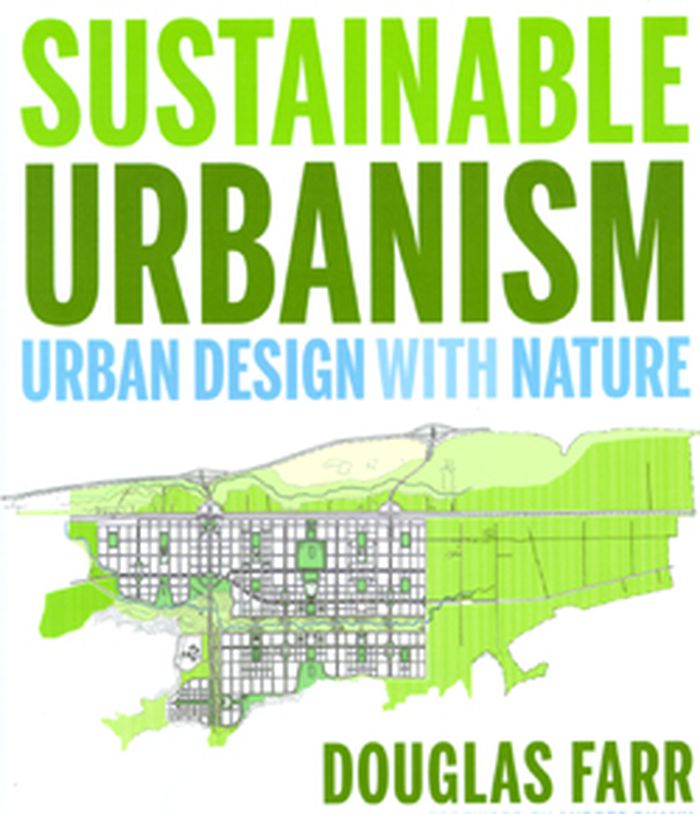
Written by the chair of the LEED-Neighborhood Development (LEED-ND) initiative, Sustainable Urbanism: Urban Design with Nature is both an urgent call to action and a comprehensive introduction to "sustainable urbanism"--the emerging and growing design reform movement that combines the creation and enhancement of walkable and diverse places with the need to build high-performance infrastructure and buildings. Providing a historic perspective on the standards and regulations that got us to where we are today in terms of urban lifestyle and attempts at reform, Douglas Farr makes a powerful case for sustainable urbanism, showing where we went wrong, and where we need to go. He then explains how to implement sustainable urbanism through leadership and communication in cities, communities, and neighborhoods. Essays written by Farr and others delve into such issues as: Increasing sustainability through density. Integrating transportation and land use. Creating sustainable neighborhoods, including housing, car-free areas, locally-owned stores, walkable neighborhoods, and universal accessibility. The health and environmental benefits of linking humans to nature, including walk-to open spaces, neighborhood stormwater systems and waste treatment, and food production. High performance buildings and district energy systems. Enriching the argument are in-depth case studies in sustainable urbanism, from BedZED in London, England and Newington in Sydney, Australia, to New Railroad Square in Santa Rosa, California and Dongtan, Shanghai, China. An epilogue looks to the future of sustainable urbanism over the next 200 years.
Sustainable urbanism: urban design with nature
Actions:
Prix:
$89.99
(disponible sur commande)
Résumé:
Written by the chair of the LEED-Neighborhood Development (LEED-ND) initiative, Sustainable Urbanism: Urban Design with Nature is both an urgent call to action and a comprehensive introduction to "sustainable urbanism"--the emerging and growing design reform movement that combines the creation and enhancement of walkable and diverse places with the need to build high-performance infrastructure and buildings. Providing a historic perspective on the standards and regulations that got us to where we are today in terms of urban lifestyle and attempts at reform, Douglas Farr makes a powerful case for sustainable urbanism, showing where we went wrong, and where we need to go. He then explains how to implement sustainable urbanism through leadership and communication in cities, communities, and neighborhoods. Essays written by Farr and others delve into such issues as: Increasing sustainability through density. Integrating transportation and land use. Creating sustainable neighborhoods, including housing, car-free areas, locally-owned stores, walkable neighborhoods, and universal accessibility. The health and environmental benefits of linking humans to nature, including walk-to open spaces, neighborhood stormwater systems and waste treatment, and food production. High performance buildings and district energy systems. Enriching the argument are in-depth case studies in sustainable urbanism, from BedZED in London, England and Newington in Sydney, Australia, to New Railroad Square in Santa Rosa, California and Dongtan, Shanghai, China. An epilogue looks to the future of sustainable urbanism over the next 200 years.
Classification:
livres
livres
Publication:
novembre 2007, Hoboken, New Jersey
novembre 2007, Hoboken, New Jersey
Sujet:
Théorie de l’urbanisme
Théorie de l’urbanisme
Classification:
livres
livres

Titre:
The Neutral
The Neutral
Actions:
Prix:
$50.00
(disponible sur commande)
Résumé:
"I define the Neutral as that which outplays the paradigm, or rather I call Neutral everything that baffles paradigm." With these words, Roland Barthes describes a concept that profoundly shaped his work and was the subject of a landmark series of lectures delivered in 1978 at the College de France, just two years before his death. Not published in France until 2002, and(...)
$50.00
(disponible sur commande)
Résumé:
"I define the Neutral as that which outplays the paradigm, or rather I call Neutral everything that baffles paradigm." With these words, Roland Barthes describes a concept that profoundly shaped his work and was the subject of a landmark series of lectures delivered in 1978 at the College de France, just two years before his death. Not published in France until 2002, and(...)
Titre:
The Neutral
Actions:
Prix:
$50.00
(disponible sur commande)
Résumé:
"I define the Neutral as that which outplays the paradigm, or rather I call Neutral everything that baffles paradigm." With these words, Roland Barthes describes a concept that profoundly shaped his work and was the subject of a landmark series of lectures delivered in 1978 at the College de France, just two years before his death. Not published in France until 2002, and appearing in English for the first time, these creative and engaging lectures deepen our understanding of Roland Barthes' intellectual itinerary and reveal his distinctive style as thinker and teacher. "The Neutral" ( le neutre), as Barthes describes it, escapes or undoes the paradigmatic binary oppositions that structure and produce meaning in Western thought and discourse. These binaries are found in all aspects of human society ranging from language to sexuality to politics. For Barthes, the attempt to deconstruct or escape from these binaries has profound ethical, philosophical, and linguistic implications. "The Neutral" is comprised of the prewritten texts from which Barthes lectured and centers around 23 "figures," also referred to as "traits" or "twinklings," that are possible embodiments of the Neutral (sleep, silence, tact, etc.) or of the anti-Neutral (anger, arrogance, conflict, etc.). His lectures draw on a diverse set of authors and intellectual traditions, including Lao-tzu, Tolstoy, German mysticism, classical philosophy, Rousseau, Baudelaire, Walter Benjamin, and John Cage. Barthes' idiosyncratic approach to his subjects gives the lectures a playful, personal, and even joyous quality that enhances his rich insights. In addition to his reflections on a variety of literary and scholarly works, Barthes' personal convictions and the events of his life shaped the course and content of the lectures. Most prominently, as Barthes admits, the recent death of his mother and the idea of mourning shape several of his lectures.
The Neutral
Actions:
Prix:
$50.00
(disponible sur commande)
Résumé:
"I define the Neutral as that which outplays the paradigm, or rather I call Neutral everything that baffles paradigm." With these words, Roland Barthes describes a concept that profoundly shaped his work and was the subject of a landmark series of lectures delivered in 1978 at the College de France, just two years before his death. Not published in France until 2002, and appearing in English for the first time, these creative and engaging lectures deepen our understanding of Roland Barthes' intellectual itinerary and reveal his distinctive style as thinker and teacher. "The Neutral" ( le neutre), as Barthes describes it, escapes or undoes the paradigmatic binary oppositions that structure and produce meaning in Western thought and discourse. These binaries are found in all aspects of human society ranging from language to sexuality to politics. For Barthes, the attempt to deconstruct or escape from these binaries has profound ethical, philosophical, and linguistic implications. "The Neutral" is comprised of the prewritten texts from which Barthes lectured and centers around 23 "figures," also referred to as "traits" or "twinklings," that are possible embodiments of the Neutral (sleep, silence, tact, etc.) or of the anti-Neutral (anger, arrogance, conflict, etc.). His lectures draw on a diverse set of authors and intellectual traditions, including Lao-tzu, Tolstoy, German mysticism, classical philosophy, Rousseau, Baudelaire, Walter Benjamin, and John Cage. Barthes' idiosyncratic approach to his subjects gives the lectures a playful, personal, and even joyous quality that enhances his rich insights. In addition to his reflections on a variety of literary and scholarly works, Barthes' personal convictions and the events of his life shaped the course and content of the lectures. Most prominently, as Barthes admits, the recent death of his mother and the idea of mourning shape several of his lectures.
Classification:
livres
livres
Publication:
septembre 2007, New York
septembre 2007, New York
Sujet:
Théorie/ philosophie
Théorie/ philosophie
Classification:
livres
livres
Titre:
Notes on the Underground
Notes on the Underground
Actions:
Prix:
$24.95
(disponible sur commande)
Résumé:
The underground has always played a prominent role in human imaginings, both as a place of refuge and as a source of fear. The late nineteenth century saw a new fascination with the underground as Western societies tried to cope with the pervasive changes of a new social and technological order. In Notes on the Underground, Rosalind Williams takes us inside that critical(...)
$24.95
(disponible sur commande)
Résumé:
The underground has always played a prominent role in human imaginings, both as a place of refuge and as a source of fear. The late nineteenth century saw a new fascination with the underground as Western societies tried to cope with the pervasive changes of a new social and technological order. In Notes on the Underground, Rosalind Williams takes us inside that critical(...)
Titre:
Notes on the Underground
Actions:
Prix:
$24.95
(disponible sur commande)
Résumé:
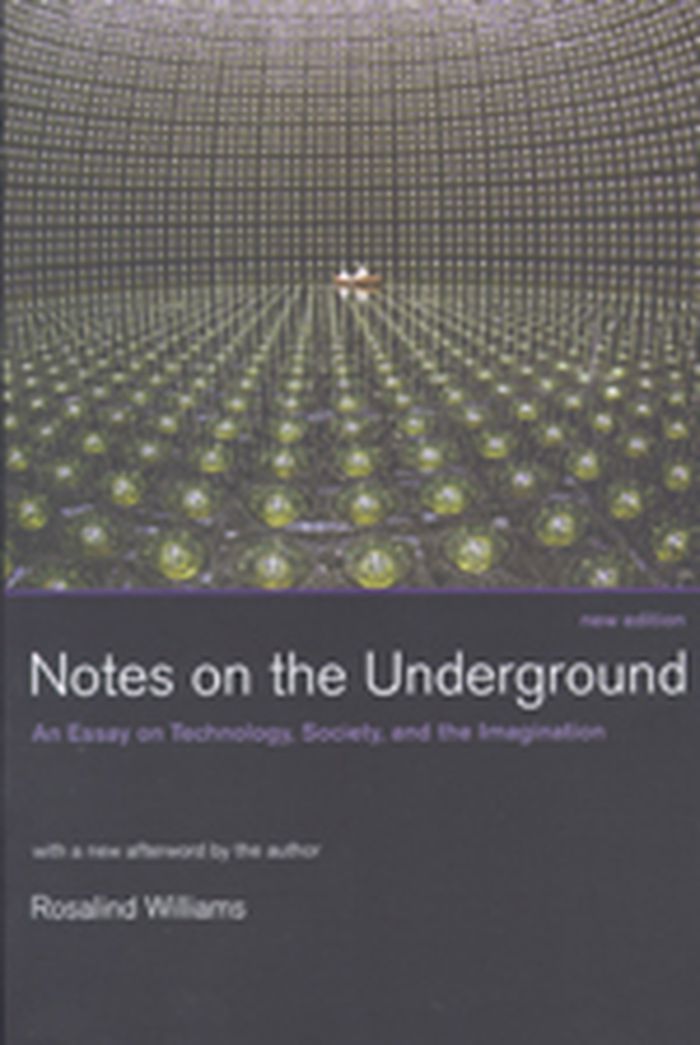
The underground has always played a prominent role in human imaginings, both as a place of refuge and as a source of fear. The late nineteenth century saw a new fascination with the underground as Western societies tried to cope with the pervasive changes of a new social and technological order. In Notes on the Underground, Rosalind Williams takes us inside that critical historical moment, giving equal coverage to actual and imaginary undergrounds. She looks at the real-life invasions of the underground that occurred as modern urban infrastructures of sewers and subways were laid, and at the simultaneous archaeological excavations that were unearthing both human history and the planet’s deep past. She also examines the subterranean stories of Verne, Wells, Forster, Hugo, Bulwer-Lytton, and other writers who proposed alternative visions of the coming technological civilization. Williams argues that these imagined and real underground environments provide models of human life in a world dominated by human presence and offer a prophetic look at today’s technology-dominated society. In a new afterword written for this edition, Williams points out that her book traces the emergence in the nineteenth century of what we would now call an environmental consciousness--an awareness that there will be consequences when humans live in a sealed, finite environment. Today we are more aware than ever of our limited biosphere and how vulnerable it is. Notes on the Underground, now even more than when it first appeared, offers a guide to the human, cultural, and technical consequences of what Williams calls "the human empire on earth."
Notes on the Underground
Actions:
Prix:
$24.95
(disponible sur commande)
Résumé:
The underground has always played a prominent role in human imaginings, both as a place of refuge and as a source of fear. The late nineteenth century saw a new fascination with the underground as Western societies tried to cope with the pervasive changes of a new social and technological order. In Notes on the Underground, Rosalind Williams takes us inside that critical historical moment, giving equal coverage to actual and imaginary undergrounds. She looks at the real-life invasions of the underground that occurred as modern urban infrastructures of sewers and subways were laid, and at the simultaneous archaeological excavations that were unearthing both human history and the planet’s deep past. She also examines the subterranean stories of Verne, Wells, Forster, Hugo, Bulwer-Lytton, and other writers who proposed alternative visions of the coming technological civilization. Williams argues that these imagined and real underground environments provide models of human life in a world dominated by human presence and offer a prophetic look at today’s technology-dominated society. In a new afterword written for this edition, Williams points out that her book traces the emergence in the nineteenth century of what we would now call an environmental consciousness--an awareness that there will be consequences when humans live in a sealed, finite environment. Today we are more aware than ever of our limited biosphere and how vulnerable it is. Notes on the Underground, now even more than when it first appeared, offers a guide to the human, cultural, and technical consequences of what Williams calls "the human empire on earth."
Classification:
livres
livres
Publication:
mars 2008, Cambridge
mars 2008, Cambridge
Sujet:
Théorie de l’architecture
Théorie de l’architecture
Classification:
livres
livres
Actions:
Prix:
$57.00
(disponible en magasin)
Résumé:
In 1983, Ursula Schulz-Dornburg accompanied two ethnologists and an architect on a research trip to Tana Toraja on the central Indonesian island of Sulawesi. Initiated by the Royal Tropical Institute of Amsterdam, the trip was intended to “explore the changing patterns in architecture and symbolism among the Sa‘dan Toraja”. On the way back from Rantepao to Ujung Pandang(...)
$57.00
(disponible en magasin)
Résumé:
In 1983, Ursula Schulz-Dornburg accompanied two ethnologists and an architect on a research trip to Tana Toraja on the central Indonesian island of Sulawesi. Initiated by the Royal Tropical Institute of Amsterdam, the trip was intended to “explore the changing patterns in architecture and symbolism among the Sa‘dan Toraja”. On the way back from Rantepao to Ujung Pandang(...)
Titre:
Ursula Schulz-Dornburg: Bugis Houses, Celebes
Actions:
Prix:
$57.00
(disponible en magasin)
Résumé:
In 1983, Ursula Schulz-Dornburg accompanied two ethnologists and an architect on a research trip to Tana Toraja on the central Indonesian island of Sulawesi. Initiated by the Royal Tropical Institute of Amsterdam, the trip was intended to “explore the changing patterns in architecture and symbolism among the Sa‘dan Toraja”. On the way back from Rantepao to Ujung Pandang airport, Schulz-Dornburg passed the distinctive houses of the Bugis or To-Ugiq people, perched on the yellow paddy fields. Fascinated by their complex, expressive architectures, she began to photograph the houses in the short time she had before leaving, realising that the structures would likely not exist in their traditional form for much longer. The result is a body of work that not only surveys the houses’ physical forms but also considers wide-ranging ideas of physical and emotional homebuilding and the precarious place of tradition in the present day. Poised between heaven and earth and standing above the water when the rice fields are flooded, the Bugis houses reflect the creation myth of their people, in which the gods of the upper and lower worlds came together to create man to populate the uninhabited middle world. The farmers depicted by Schulz-Dornburg are likewise suspended between historic tradition and the impending pressures of the contemporary world. As they go about their work or greet her camera, they and their homes are held in the balance between past and future, mythology and everyday reality. With these shrewd and sensitive images, Schulz-Dornburg captures life as it is built and lived within a particular culture and landscape, offering a searching reflection on the places we call home.
Ursula Schulz-Dornburg: Bugis Houses, Celebes
Actions:
Prix:
$57.00
(disponible en magasin)
Résumé:
In 1983, Ursula Schulz-Dornburg accompanied two ethnologists and an architect on a research trip to Tana Toraja on the central Indonesian island of Sulawesi. Initiated by the Royal Tropical Institute of Amsterdam, the trip was intended to “explore the changing patterns in architecture and symbolism among the Sa‘dan Toraja”. On the way back from Rantepao to Ujung Pandang airport, Schulz-Dornburg passed the distinctive houses of the Bugis or To-Ugiq people, perched on the yellow paddy fields. Fascinated by their complex, expressive architectures, she began to photograph the houses in the short time she had before leaving, realising that the structures would likely not exist in their traditional form for much longer. The result is a body of work that not only surveys the houses’ physical forms but also considers wide-ranging ideas of physical and emotional homebuilding and the precarious place of tradition in the present day. Poised between heaven and earth and standing above the water when the rice fields are flooded, the Bugis houses reflect the creation myth of their people, in which the gods of the upper and lower worlds came together to create man to populate the uninhabited middle world. The farmers depicted by Schulz-Dornburg are likewise suspended between historic tradition and the impending pressures of the contemporary world. As they go about their work or greet her camera, they and their homes are held in the balance between past and future, mythology and everyday reality. With these shrewd and sensitive images, Schulz-Dornburg captures life as it is built and lived within a particular culture and landscape, offering a searching reflection on the places we call home.
Classification:
livres
livres
Publication:
juillet 2021
juillet 2021
Sujet:
Monographies photo
Monographies photo
Classification:
livres
livres
Prix:
$29.95
(disponible sur commande)
Résumé:
Van Alen Institute mounted the exhibition "Renewing, Rebuilding, Remembering" to demonstrate how cities, after incomparable loss of people and places, find ways to plan, design, and reconstruct the life of the city. The book is both a catalogue and a special edition of our series of "Van Alen Reports," the publication both documents the exhibit and expands on it with(...)
$29.95
(disponible sur commande)
Résumé:
Van Alen Institute mounted the exhibition "Renewing, Rebuilding, Remembering" to demonstrate how cities, after incomparable loss of people and places, find ways to plan, design, and reconstruct the life of the city. The book is both a catalogue and a special edition of our series of "Van Alen Reports," the publication both documents the exhibit and expands on it with(...)
Titre:
Information exchange : how cities renew, rebuild, and remember
Actions:
Prix:
$29.95
(disponible sur commande)
Résumé:
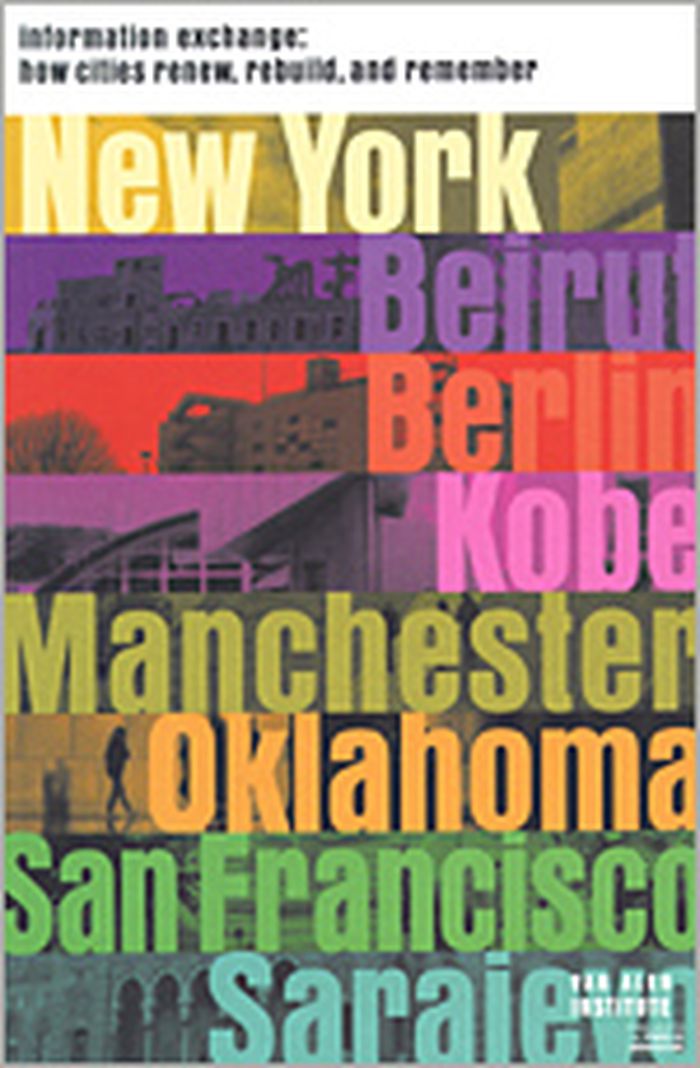
Van Alen Institute mounted the exhibition "Renewing, Rebuilding, Remembering" to demonstrate how cities, after incomparable loss of people and places, find ways to plan, design, and reconstruct the life of the city. The book is both a catalogue and a special edition of our series of "Van Alen Reports," the publication both documents the exhibit and expands on it with personal essays, articles and interviews. The point of the exhibition was not to compare catastrophes, but to compare, contrast, and try to explicate and understand initiatives, projects, plans, and actions that took place after the bomb, the earthquake, the war. After that, what worked, what would they do differently, what mattered right away, what mattered for the long-term? In October, the Institute put out a call for ideas for the exhibit. Students, designers, planners, artists, professors, photographers, public officials and a wide range of respondents from around the world were generous in suggesting places, projects, issues, and designs that were telling for the future of New York. From this response and ongoing research, the Institute chose to focus on specific processes and projects in seven cities. In Beirut, a public art installation that progressed through the city was a first step in reclaiming its war-torn districts, and the Lebanese capital has continued not only with master plans and major new developments, but also with works such as the Garden of Forgiveness, grappling with a hard history to contemplate. In Berlin, a center for information about the city and its reconstruction rose above the ruins of the Berlin Wall, half a century after the city had been devastated and divided. In San Francisco, an earthquake left the elevated highway downtown in such precarious decision that the city decided to tear it down-and implement a long-held dream of reopening the city to the waterfront. In Kobe, where an earthquake resulted not only in billions of dollars of damage to infrastructure, but also in a terrible loss of life, architects responded with an outpouring of energy to survey the damage and construct innovative emergency housing, proving the old adage that necessity is the mother of invention. In addition, they strove to understand the disaster, building a museum about, and at, the geological fault that brought down so much of their city. Manchester had a terrorist attack in the mid-1990s, and rebuilt its center city better than before, as well as setting up an institute for the study of cities around the world, to better understand that the life of the city and its public realm can not be taken for granted. So, too, did Oklahoma City, where a public process led to an international design competition for a memorial, and the city has rebuilt itself around it. Sarajevo, after years of civil war, pulled together its citizens through restoring the landmarks of their public life.
Information exchange : how cities renew, rebuild, and remember
Actions:
Prix:
$29.95
(disponible sur commande)
Résumé:
Van Alen Institute mounted the exhibition "Renewing, Rebuilding, Remembering" to demonstrate how cities, after incomparable loss of people and places, find ways to plan, design, and reconstruct the life of the city. The book is both a catalogue and a special edition of our series of "Van Alen Reports," the publication both documents the exhibit and expands on it with personal essays, articles and interviews. The point of the exhibition was not to compare catastrophes, but to compare, contrast, and try to explicate and understand initiatives, projects, plans, and actions that took place after the bomb, the earthquake, the war. After that, what worked, what would they do differently, what mattered right away, what mattered for the long-term? In October, the Institute put out a call for ideas for the exhibit. Students, designers, planners, artists, professors, photographers, public officials and a wide range of respondents from around the world were generous in suggesting places, projects, issues, and designs that were telling for the future of New York. From this response and ongoing research, the Institute chose to focus on specific processes and projects in seven cities. In Beirut, a public art installation that progressed through the city was a first step in reclaiming its war-torn districts, and the Lebanese capital has continued not only with master plans and major new developments, but also with works such as the Garden of Forgiveness, grappling with a hard history to contemplate. In Berlin, a center for information about the city and its reconstruction rose above the ruins of the Berlin Wall, half a century after the city had been devastated and divided. In San Francisco, an earthquake left the elevated highway downtown in such precarious decision that the city decided to tear it down-and implement a long-held dream of reopening the city to the waterfront. In Kobe, where an earthquake resulted not only in billions of dollars of damage to infrastructure, but also in a terrible loss of life, architects responded with an outpouring of energy to survey the damage and construct innovative emergency housing, proving the old adage that necessity is the mother of invention. In addition, they strove to understand the disaster, building a museum about, and at, the geological fault that brought down so much of their city. Manchester had a terrorist attack in the mid-1990s, and rebuilt its center city better than before, as well as setting up an institute for the study of cities around the world, to better understand that the life of the city and its public realm can not be taken for granted. So, too, did Oklahoma City, where a public process led to an international design competition for a memorial, and the city has rebuilt itself around it. Sarajevo, after years of civil war, pulled together its citizens through restoring the landmarks of their public life.
Classification:
livres
livres
Publication:
mars 2003, New York
mars 2003, New York
Sujet:
Théorie de l’urbanisme
Théorie de l’urbanisme
Classification:
livres
livres
Prix:
$59.95
(disponible sur commande)
Résumé:
"The Artist as Producer" reshapes our understanding of the fundamental contribution of the Russian avant-garde to the development of modernism. Focusing on the single most important hotbed of Constructivist activity in the early 1920s - the Institute of Artistic Culture (INKhUK) in Moscow - Maria Gough offers a powerful reinterpretation of the work of the first group of(...)
$59.95
(disponible sur commande)
Résumé:
"The Artist as Producer" reshapes our understanding of the fundamental contribution of the Russian avant-garde to the development of modernism. Focusing on the single most important hotbed of Constructivist activity in the early 1920s - the Institute of Artistic Culture (INKhUK) in Moscow - Maria Gough offers a powerful reinterpretation of the work of the first group of(...)
Titre:
The artist as producer : Russian Constructivism in revolution
Actions:
Prix:
$59.95
(disponible sur commande)
Résumé:
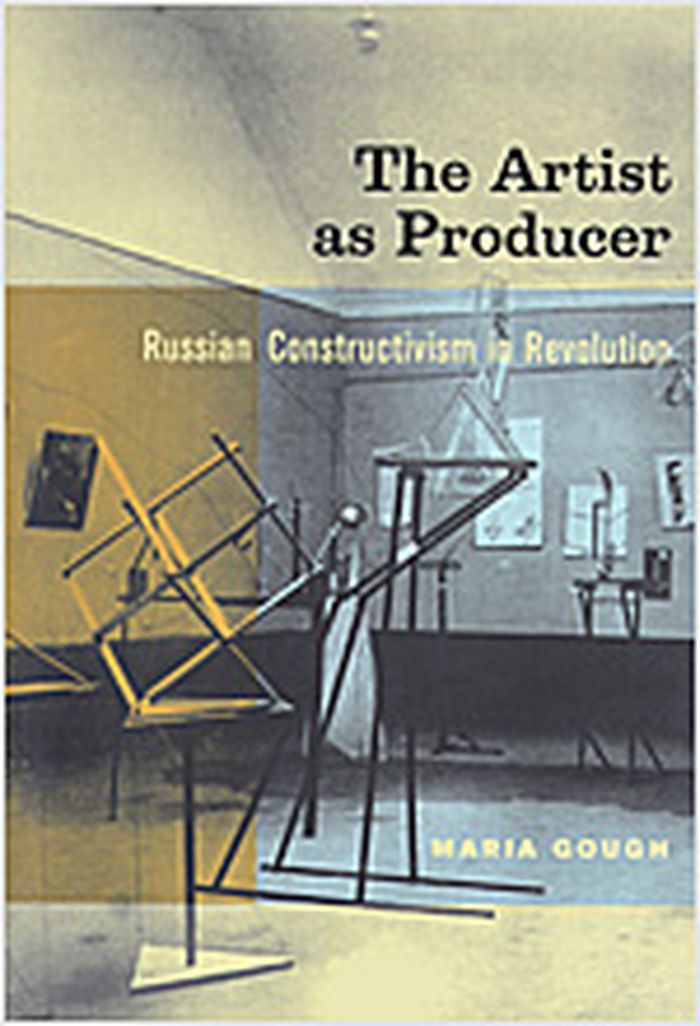
"The Artist as Producer" reshapes our understanding of the fundamental contribution of the Russian avant-garde to the development of modernism. Focusing on the single most important hotbed of Constructivist activity in the early 1920s - the Institute of Artistic Culture (INKhUK) in Moscow - Maria Gough offers a powerful reinterpretation of the work of the first group of artists to call themselves Constructivists. Her lively narrative ranges from famous figures such as Aleksandr Rodchenko to others who are much less well known, such as Karl Ioganson, a key member of the state-funded INKhUK whose work paved the way for an eventual dematerialization of the integral art object. Through the mining of untapped archives and collections in Russia and Latvia and a close reading of key Constructivist works, Gough highlights fundamental differences among the Moscow group in their handling of the experimental new sculptural form - the spatial construction - and of their subsequent shift to industrial production. "The Artist as Producer" upends the standard view that the Moscow group's formalism and abstraction were incompatible with the sociopolitical imperatives of the new Communist state. It challenges the common equation of Constructivism with functionalism and utilitarianism by delineating a contrary tendency toward non-determinism and an alternate orientation to process rather than product. Finally, the book counters the popular perception that Constructivism failed in its ambition to enter production by presenting the first-ever case study of how a Constructivist could, and in fact did, operate within an industrial environment. "The Artist as Producer" offers provocative new perspectives on three critical issues - formalism, functionalism, and failure - that are of central importance to our understanding not only of the Soviet phenomenon but also of the European vanguards more generally.
The artist as producer : Russian Constructivism in revolution
Actions:
Prix:
$59.95
(disponible sur commande)
Résumé:
"The Artist as Producer" reshapes our understanding of the fundamental contribution of the Russian avant-garde to the development of modernism. Focusing on the single most important hotbed of Constructivist activity in the early 1920s - the Institute of Artistic Culture (INKhUK) in Moscow - Maria Gough offers a powerful reinterpretation of the work of the first group of artists to call themselves Constructivists. Her lively narrative ranges from famous figures such as Aleksandr Rodchenko to others who are much less well known, such as Karl Ioganson, a key member of the state-funded INKhUK whose work paved the way for an eventual dematerialization of the integral art object. Through the mining of untapped archives and collections in Russia and Latvia and a close reading of key Constructivist works, Gough highlights fundamental differences among the Moscow group in their handling of the experimental new sculptural form - the spatial construction - and of their subsequent shift to industrial production. "The Artist as Producer" upends the standard view that the Moscow group's formalism and abstraction were incompatible with the sociopolitical imperatives of the new Communist state. It challenges the common equation of Constructivism with functionalism and utilitarianism by delineating a contrary tendency toward non-determinism and an alternate orientation to process rather than product. Finally, the book counters the popular perception that Constructivism failed in its ambition to enter production by presenting the first-ever case study of how a Constructivist could, and in fact did, operate within an industrial environment. "The Artist as Producer" offers provocative new perspectives on three critical issues - formalism, functionalism, and failure - that are of central importance to our understanding not only of the Soviet phenomenon but also of the European vanguards more generally.
Classification:
livres
livres
Publication:
janvier 1900, Berkeley
janvier 1900, Berkeley
Classification:
livres
livres
Actions:
Prix:
$39.95
(disponible sur commande)
Résumé:
This publication is based on a thesis that studies global mobility and territories in dispersion. Based in Rotterdam, Diego Barajas concentrates his research on the urban dispersals shaped by migration, looking first at the Cape Verdean Diaspora and its territorial structure, and then focused on the case of the 'belhuis' - 'call-house'. By 'territories in dispersion',(...)
$39.95
(disponible sur commande)
Résumé:
This publication is based on a thesis that studies global mobility and territories in dispersion. Based in Rotterdam, Diego Barajas concentrates his research on the urban dispersals shaped by migration, looking first at the Cape Verdean Diaspora and its territorial structure, and then focused on the case of the 'belhuis' - 'call-house'. By 'territories in dispersion',(...)
Titre:
Dispersion : a study of global mobility and the dynamics of a fictional urbanism
Actions:
Prix:
$39.95
(disponible sur commande)
Résumé:
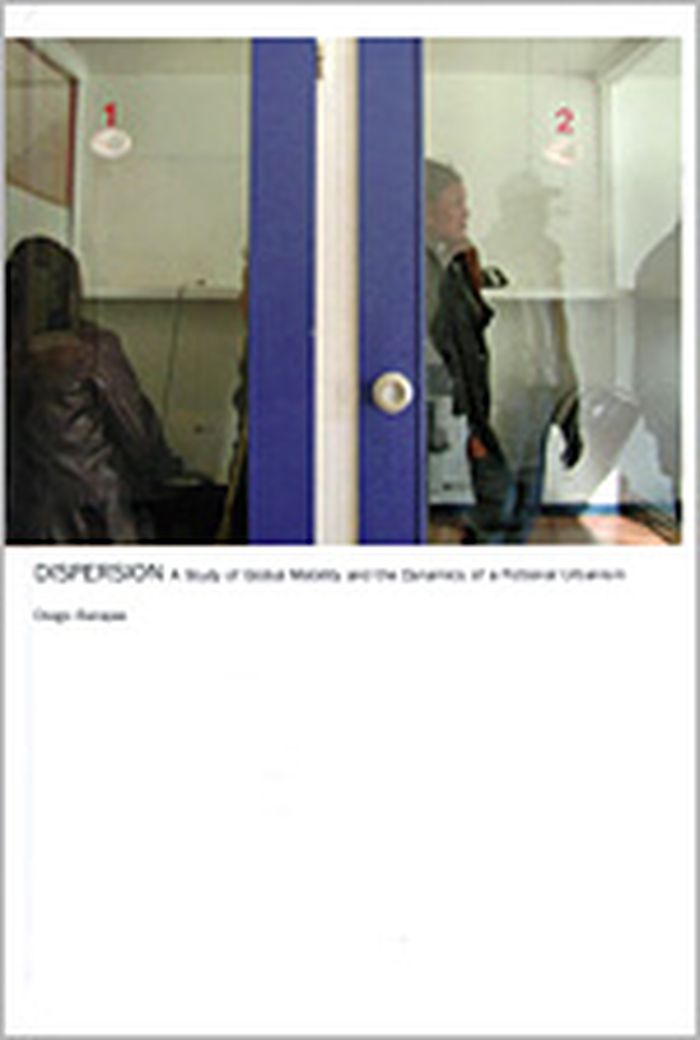
This publication is based on a thesis that studies global mobility and territories in dispersion. Based in Rotterdam, Diego Barajas concentrates his research on the urban dispersals shaped by migration, looking first at the Cape Verdean Diaspora and its territorial structure, and then focused on the case of the 'belhuis' - 'call-house'. By 'territories in dispersion', Barajas refers to social habitats that are no longer physically contained in geographically continuous areas, but have been spread out and re-articulated by artificial means. The de-territorialized condition created by increased mobility - particularly by migration - had led to an urbanism of artificial re-territorializaton. This is a functional urbanism - as based on mental constructions but tangible - that is manifested in the city as fragments, micro environments of global circuits, each of which establishes its own identity, time, rules and aesthetics - its own atmospheres. These fragments are globally connected and articulated by abstract infrastructures like telecommunication systems, as much as by physical places - ethnic shops, religious centers, et cetera - and by the imaginary and idealized realms through which dispersed societies operate. This is an urbanism ruled by traditional values, by intuitive and emotional forces, as much by efficiency and functionality. This research argues that as patterns of dispersion intensify, they generate not just fragmented societies, but a new territorial cohesion - a realm in which 'the collective' has gained a new dimension. Cultural identity is no longer necessarily linked to geographical place, or to traditional territorial structures like the nation-state, but has become a particular concept attached to individual imaginations though subjected to and conditioned by the contradictory pressures of self-determination and commoditization. This research is an attempt to trace the patterns of urban dispersals shaped by migration to the city of Rotterdam. A city whose harbour has made it one of the most concentrated points of settlement for Cape Verdean emigrants.
Dispersion : a study of global mobility and the dynamics of a fictional urbanism
Actions:
Prix:
$39.95
(disponible sur commande)
Résumé:
This publication is based on a thesis that studies global mobility and territories in dispersion. Based in Rotterdam, Diego Barajas concentrates his research on the urban dispersals shaped by migration, looking first at the Cape Verdean Diaspora and its territorial structure, and then focused on the case of the 'belhuis' - 'call-house'. By 'territories in dispersion', Barajas refers to social habitats that are no longer physically contained in geographically continuous areas, but have been spread out and re-articulated by artificial means. The de-territorialized condition created by increased mobility - particularly by migration - had led to an urbanism of artificial re-territorializaton. This is a functional urbanism - as based on mental constructions but tangible - that is manifested in the city as fragments, micro environments of global circuits, each of which establishes its own identity, time, rules and aesthetics - its own atmospheres. These fragments are globally connected and articulated by abstract infrastructures like telecommunication systems, as much as by physical places - ethnic shops, religious centers, et cetera - and by the imaginary and idealized realms through which dispersed societies operate. This is an urbanism ruled by traditional values, by intuitive and emotional forces, as much by efficiency and functionality. This research argues that as patterns of dispersion intensify, they generate not just fragmented societies, but a new territorial cohesion - a realm in which 'the collective' has gained a new dimension. Cultural identity is no longer necessarily linked to geographical place, or to traditional territorial structures like the nation-state, but has become a particular concept attached to individual imaginations though subjected to and conditioned by the contradictory pressures of self-determination and commoditization. This research is an attempt to trace the patterns of urban dispersals shaped by migration to the city of Rotterdam. A city whose harbour has made it one of the most concentrated points of settlement for Cape Verdean emigrants.
Classification:
livres
livres
Publication:
mai 2003, Rotterdam
mai 2003, Rotterdam
Sujet:
Théorie de l’urbanisme
Théorie de l’urbanisme


