


44178 Résultats
Classification:
expositions
expositions
Description:
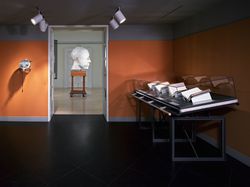
Piero en tête présente des sculptures contemporaines de l’artiste canado-britannique Geoffrey Smedley, ainsi que 30 livres rares datant du XVe au XVIIIe siècle. Les sculptures de Smedley s’inspirent d’une série de dessins de tête humaine, réalisés par le maître de la Renaissance Piero della Francesca. L’exposition relie ces dessins et les sculptures de Smedley à la(...)
Piero en tête présente des sculptures contemporaines de l’artiste canado-britannique Geoffrey Smedley, ainsi que 30 livres rares datant du XVe au XVIIIe siècle. Les sculptures de Smedley s’inspirent d’une série de dessins de tête humaine, réalisés par le maître de la Renaissance Piero della Francesca. L’exposition relie ces dessins et les sculptures de Smedley à la(...)
Localisation:
Salle octogonale
Salle octogonale
Date:
2 mai 2001 au 16 septembre 2001
2 mai 2001 au 16 septembre 2001
Titre:
Piero en tête
Actions:
Description:
Piero en tête présente des sculptures contemporaines de l’artiste canado-britannique Geoffrey Smedley, ainsi que 30 livres rares datant du XVe au XVIIIe siècle. Les sculptures de Smedley s’inspirent d’une série de dessins de tête humaine, réalisés par le maître de la Renaissance Piero della Francesca. L’exposition relie ces dessins et les sculptures de Smedley à la(...)
Piero en tête
Actions:
Description:
Piero en tête présente des sculptures contemporaines de l’artiste canado-britannique Geoffrey Smedley, ainsi que 30 livres rares datant du XVe au XVIIIe siècle. Les sculptures de Smedley s’inspirent d’une série de dessins de tête humaine, réalisés par le maître de la Renaissance Piero della Francesca. L’exposition relie ces dessins et les sculptures de Smedley à la(...)
Classification:
expositions
expositions
Date:
2 mai 2001 au
16 septembre 2001
2 mai 2001 au
16 septembre 2001
Localisation:
Salle octogonale
Salle octogonale
Classification:
photographies
photographies
Actions:
Numéro de référence:
PH1989:0262.03:022
Description:
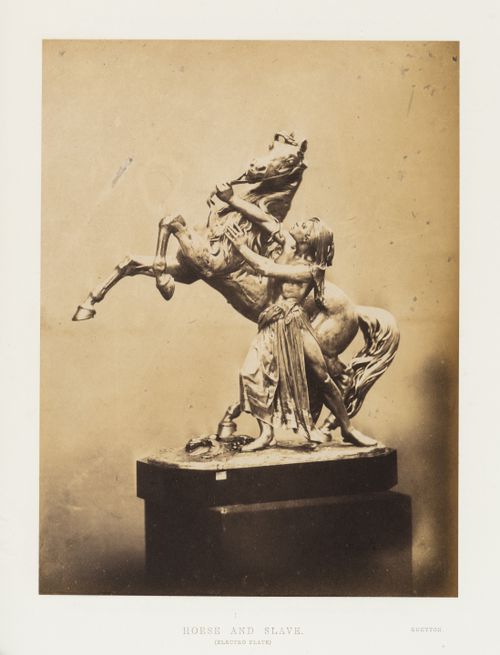
The photograph was taken while the sculpture was exhibited at the Great Exhibition of the Works of Industry of All Nations, Crystal Palace, Hyde Park, London, England.
PH1989:0262.03:022
Description:
The photograph was taken while the sculpture was exhibited at the Great Exhibition of the Works of Industry of All Nations, Crystal Palace, Hyde Park, London, England.
Personnes et institutions:
Sujet:
sculpture
sculpture
Date:
1851
1851
Titre:
View of electroplated sculpture titled "Horse and Slave", by Gueyton, London, England
Actions:
PH1989:0262.03:022
Description:
The photograph was taken while the sculpture was exhibited at the Great Exhibition of the Works of Industry of All Nations, Crystal Palace, Hyde Park, London, England.
View of electroplated sculpture titled "Horse and Slave", by Gueyton, London, England
Actions:
PH1989:0262.03:022
Description:
The photograph was taken while the sculpture was exhibited at the Great Exhibition of the Works of Industry of All Nations, Crystal Palace, Hyde Park, London, England.
Classification:
photographies
photographies
Date:
1851
1851
Personnes et institutions:
Sujet:
sculpture
sculpture
Classification:
photographies
photographies
Actions:
Numéro de référence:
PH1989:0262.04:056
Description:
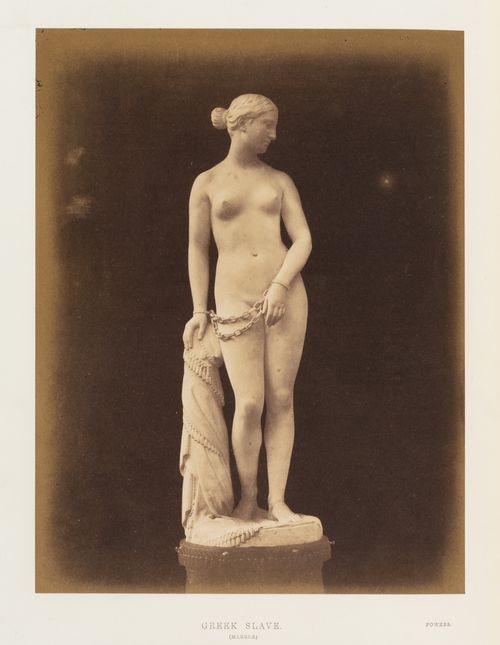
The photograph was taken while the sculpture was exhibited at the Great Exhibition of the Works of Industry of All Nations, Crystal Palace, Hyde Park, London, England.
PH1989:0262.04:056
Description:
The photograph was taken while the sculpture was exhibited at the Great Exhibition of the Works of Industry of All Nations, Crystal Palace, Hyde Park, London, England.
Personnes et institutions:
Sujet:
sculpture
sculpture
Date:
1851
1851
Titre:
View of marble sculpture titled "The Greek Slave", by Hiram Powers, London, England
Actions:
PH1989:0262.04:056
Description:
The photograph was taken while the sculpture was exhibited at the Great Exhibition of the Works of Industry of All Nations, Crystal Palace, Hyde Park, London, England.
View of marble sculpture titled "The Greek Slave", by Hiram Powers, London, England
Actions:
PH1989:0262.04:056
Description:
The photograph was taken while the sculpture was exhibited at the Great Exhibition of the Works of Industry of All Nations, Crystal Palace, Hyde Park, London, England.
Classification:
photographies
photographies
Date:
1851
1851
Personnes et institutions:
Sujet:
sculpture
sculpture
Classification:
documents textuels
documents textuels
Numéro de référence:
DR1995:0263:032:013:001
Description:
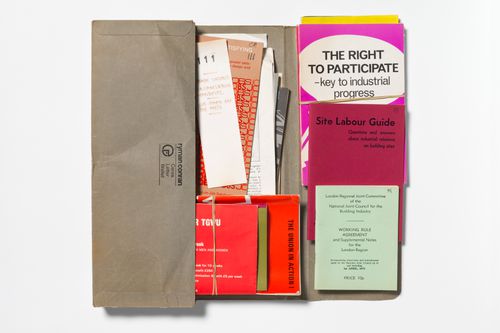
This group includes published pamphlets, several issued by the Transport & General Workers Union, 2 monographs issued by the U.S. Department of Labor, and photocopies of articles.
DR1995:0263:032:013:001
Description:
This group includes published pamphlets, several issued by the Transport & General Workers Union, 2 monographs issued by the U.S. Department of Labor, and photocopies of articles.
Personnes et institutions:
Date:
1963-1975
1963-1975
Titre:
Trade unions organisation handouts
Actions:
DR1995:0263:032:013:001
Description:
This group includes published pamphlets, several issued by the Transport & General Workers Union, 2 monographs issued by the U.S. Department of Labor, and photocopies of articles.
Trade unions organisation handouts
Actions:
DR1995:0263:032:013:001
Description:
This group includes published pamphlets, several issued by the Transport & General Workers Union, 2 monographs issued by the U.S. Department of Labor, and photocopies of articles.
Classification:
documents textuels
documents textuels
Date:
1963-1975
1963-1975
Personnes et institutions:
Classification:
dessins
dessins
Actions:
Numéro de référence:
DR1989:0015:030
Description:
- The three drawings on the recto of this sheet relate to the design for the porch on the corridor between the mortuary and chapel of Saint Peter's Home, Woking. The drawings on the two pieces of tracing paper glued to the wove paper have been traced from the earlier porch design, DR1989:0015:035. The drawing on wove paper appears to be an elaboration of the traced drawings. On the verso there is a drawing of an arch, perhaps for the same project. - This work is part of a group of drawings and reprographic prints of drawings for St. Peter's Home, Woking, and St. Peter's Convent, Woking, from the offices of John Loughborough Pearson and Frank Loughborough Pearson (DR1989:0015:011 - DR1989:0015:085 R/V). Composed of contract and working drawings including plans, site plans, sections, and elevations dated between 1881 and 1936, these drawings were sold at auction by the convent along with those for the older institution of St. Peter's Home, Kilburn (DR1989:0015:001 - DR1989:0015:010). Both St. Peter's Home, Kilburn, and St. Peter's Home, Woking were commissioned from John Loughborough Pearson by Benjamin Lancaster. The alterations to the Home at Kilburn were commissioned on behalf of Lancaster's wife, who founded the home and a lay nursing order which ran it. The institution at Woking was founded by Lancaster as a home for incurables in 1882 and dedicated to the memory of his deceased wife (Quiney 67-68, 254-255, and 284). It was probably first known as St. Peter's Home, Woking, not becoming a convent until ca. 1934.
DR1989:0015:030
Description:
- The three drawings on the recto of this sheet relate to the design for the porch on the corridor between the mortuary and chapel of Saint Peter's Home, Woking. The drawings on the two pieces of tracing paper glued to the wove paper have been traced from the earlier porch design, DR1989:0015:035. The drawing on wove paper appears to be an elaboration of the traced drawings. On the verso there is a drawing of an arch, perhaps for the same project. - This work is part of a group of drawings and reprographic prints of drawings for St. Peter's Home, Woking, and St. Peter's Convent, Woking, from the offices of John Loughborough Pearson and Frank Loughborough Pearson (DR1989:0015:011 - DR1989:0015:085 R/V). Composed of contract and working drawings including plans, site plans, sections, and elevations dated between 1881 and 1936, these drawings were sold at auction by the convent along with those for the older institution of St. Peter's Home, Kilburn (DR1989:0015:001 - DR1989:0015:010). Both St. Peter's Home, Kilburn, and St. Peter's Home, Woking were commissioned from John Loughborough Pearson by Benjamin Lancaster. The alterations to the Home at Kilburn were commissioned on behalf of Lancaster's wife, who founded the home and a lay nursing order which ran it. The institution at Woking was founded by Lancaster as a home for incurables in 1882 and dedicated to the memory of his deceased wife (Quiney 67-68, 254-255, and 284). It was probably first known as St. Peter's Home, Woking, not becoming a convent until ca. 1934.
Personnes et institutions:
Sujet:
architecture
architecture
Date:
1899
1899
Titre:
St. Peter's Home, Woking: Alternative design for the porch on the corridor between the chapel and the mortuary
Actions:
DR1989:0015:030
Description:
- The three drawings on the recto of this sheet relate to the design for the porch on the corridor between the mortuary and chapel of Saint Peter's Home, Woking. The drawings on the two pieces of tracing paper glued to the wove paper have been traced from the earlier porch design, DR1989:0015:035. The drawing on wove paper appears to be an elaboration of the traced drawings. On the verso there is a drawing of an arch, perhaps for the same project. - This work is part of a group of drawings and reprographic prints of drawings for St. Peter's Home, Woking, and St. Peter's Convent, Woking, from the offices of John Loughborough Pearson and Frank Loughborough Pearson (DR1989:0015:011 - DR1989:0015:085 R/V). Composed of contract and working drawings including plans, site plans, sections, and elevations dated between 1881 and 1936, these drawings were sold at auction by the convent along with those for the older institution of St. Peter's Home, Kilburn (DR1989:0015:001 - DR1989:0015:010). Both St. Peter's Home, Kilburn, and St. Peter's Home, Woking were commissioned from John Loughborough Pearson by Benjamin Lancaster. The alterations to the Home at Kilburn were commissioned on behalf of Lancaster's wife, who founded the home and a lay nursing order which ran it. The institution at Woking was founded by Lancaster as a home for incurables in 1882 and dedicated to the memory of his deceased wife (Quiney 67-68, 254-255, and 284). It was probably first known as St. Peter's Home, Woking, not becoming a convent until ca. 1934.
St. Peter's Home, Woking: Alternative design for the porch on the corridor between the chapel and the mortuary
Actions:
DR1989:0015:030
Description:
- The three drawings on the recto of this sheet relate to the design for the porch on the corridor between the mortuary and chapel of Saint Peter's Home, Woking. The drawings on the two pieces of tracing paper glued to the wove paper have been traced from the earlier porch design, DR1989:0015:035. The drawing on wove paper appears to be an elaboration of the traced drawings. On the verso there is a drawing of an arch, perhaps for the same project. - This work is part of a group of drawings and reprographic prints of drawings for St. Peter's Home, Woking, and St. Peter's Convent, Woking, from the offices of John Loughborough Pearson and Frank Loughborough Pearson (DR1989:0015:011 - DR1989:0015:085 R/V). Composed of contract and working drawings including plans, site plans, sections, and elevations dated between 1881 and 1936, these drawings were sold at auction by the convent along with those for the older institution of St. Peter's Home, Kilburn (DR1989:0015:001 - DR1989:0015:010). Both St. Peter's Home, Kilburn, and St. Peter's Home, Woking were commissioned from John Loughborough Pearson by Benjamin Lancaster. The alterations to the Home at Kilburn were commissioned on behalf of Lancaster's wife, who founded the home and a lay nursing order which ran it. The institution at Woking was founded by Lancaster as a home for incurables in 1882 and dedicated to the memory of his deceased wife (Quiney 67-68, 254-255, and 284). It was probably first known as St. Peter's Home, Woking, not becoming a convent until ca. 1934.
Classification:
dessins
dessins
Date:
1899
1899
Personnes et institutions:
Sujet:
architecture
architecture
Classification:
photographies
photographies
Numéro de référence:
DR2007:0086:003
Description:
Includes 13 photographs of the installation of works that were included in the publication "Paraboles et autre allégories, l'oeuvre de Melvin Charney, 1975-1990", CCA,1991.
DR2007:0086:003
Description:
Includes 13 photographs of the installation of works that were included in the publication "Paraboles et autre allégories, l'oeuvre de Melvin Charney, 1975-1990", CCA,1991.
Personnes et institutions:
Date:
1976-1989
1976-1989
Titre:
Photographs of the various installation of works
Actions:
DR2007:0086:003
Description:
Includes 13 photographs of the installation of works that were included in the publication "Paraboles et autre allégories, l'oeuvre de Melvin Charney, 1975-1990", CCA,1991.
Photographs of the various installation of works
Actions:
DR2007:0086:003
Description:
Includes 13 photographs of the installation of works that were included in the publication "Paraboles et autre allégories, l'oeuvre de Melvin Charney, 1975-1990", CCA,1991.
Classification:
photographies
photographies
Date:
1976-1989
1976-1989
Personnes et institutions:
Classification:
documents textuels
documents textuels
Titre:
Artiste
Artiste
Numéro de référence:
ARCH268030
Description:
This group consists of clippings, folders, correspondence and related documents about artists, arts exhibitions and works of art, the majority in Québec and Canada.
ARCH268030
Description:
This group consists of clippings, folders, correspondence and related documents about artists, arts exhibitions and works of art, the majority in Québec and Canada.
Personnes et institutions:
Date:
1967-1993
1967-1993
Titre:
Artiste
Actions:
ARCH268030
Description:
This group consists of clippings, folders, correspondence and related documents about artists, arts exhibitions and works of art, the majority in Québec and Canada.
Artiste
Actions:
ARCH268030
Description:
This group consists of clippings, folders, correspondence and related documents about artists, arts exhibitions and works of art, the majority in Québec and Canada.
Classification:
documents textuels
documents textuels
Date:
1967-1993
1967-1993
Personnes et institutions:
Classification:
documents textuels
documents textuels
Numéro de référence:
ARCH268031
Description:
This group consists of clippings, folders, correspondence and related documents about artists, arts exhibitions and works of art, the majority in Québec and Canada.
ARCH268031
Description:
This group consists of clippings, folders, correspondence and related documents about artists, arts exhibitions and works of art, the majority in Québec and Canada.
Personnes et institutions:
Titre:
Artiste 1979-1980
Actions:
ARCH268031
Description:
This group consists of clippings, folders, correspondence and related documents about artists, arts exhibitions and works of art, the majority in Québec and Canada.
Artiste 1979-1980
Actions:
ARCH268031
Description:
This group consists of clippings, folders, correspondence and related documents about artists, arts exhibitions and works of art, the majority in Québec and Canada.
Classification:
documents textuels
documents textuels
Personnes et institutions:
Classification:
photographies
photographies
Actions:
Numéro de référence:
PH1981:1267:020
Description:
- This photograph shows workers installing a one-quarter aluminum section using a sheet of aluminium as a guide for centering and squaring each section.
PH1981:1267:020
Description:
- This photograph shows workers installing a one-quarter aluminum section using a sheet of aluminium as a guide for centering and squaring each section.
Personnes et institutions:
Sujet:
architecture, sculpture
architecture, sculpture
Date:
August 1970
August 1970
Titre:
View of workers installing a trial one-quarter aluminum section during the restoration of the Corinthian capitals of the principal façade of the Head Office of the Bank of Montréal, 119 rue Saint-Jacques, Montréal, Québec
Actions:
PH1981:1267:020
Description:
- This photograph shows workers installing a one-quarter aluminum section using a sheet of aluminium as a guide for centering and squaring each section.
View of workers installing a trial one-quarter aluminum section during the restoration of the Corinthian capitals of the principal façade of the Head Office of the Bank of Montréal, 119 rue Saint-Jacques, Montréal, Québec
Actions:
PH1981:1267:020
Description:
- This photograph shows workers installing a one-quarter aluminum section using a sheet of aluminium as a guide for centering and squaring each section.
Classification:
photographies
photographies
Date:
August 1970
August 1970
Personnes et institutions:
Sujet:
architecture, sculpture
architecture, sculpture
Classification:
photographies
Quantité:
2 photograph(s)
photographies
Quantité:
2 photograph(s)
Titre:
Panorama of workers' housing on Wohler and Davy streets looking northeast, north Arvida, Quebec
Panorama of workers' housing on Wohler and Davy streets looking northeast, north Arvida, Quebec
Actions:
Numéro de référence:
PH1995:0080:001-002
Description:
Group consists of 2 colour photographic prints that form a panorama view of workers' housing on Wohler and Davy streets looking northeast, north Arvida, Quebec.
PH1995:0080:001-002
Description:
Group consists of 2 colour photographic prints that form a panorama view of workers' housing on Wohler and Davy streets looking northeast, north Arvida, Quebec.
Personnes et institutions:
Date:
1995
1995
Titre:
Panorama of workers' housing on Wohler and Davy streets looking northeast, north Arvida, Quebec
Actions:
PH1995:0080:001-002
Description:
Group consists of 2 colour photographic prints that form a panorama view of workers' housing on Wohler and Davy streets looking northeast, north Arvida, Quebec.
Panorama of workers' housing on Wohler and Davy streets looking northeast, north Arvida, Quebec
Actions:
PH1995:0080:001-002
Description:
Group consists of 2 colour photographic prints that form a panorama view of workers' housing on Wohler and Davy streets looking northeast, north Arvida, Quebec.
Classification:
photographies
Quantité:
2 photograph(s)
photographies
Quantité:
2 photograph(s)
Date:
1995
1995
Personnes et institutions:


