


2285 Résultats
Classification:
livres
livres

Titre:
Phyllis Ma: Special nothing
Phyllis Ma: Special nothing
Actions:
Prix:
$65.00
(disponible sur commande)
Résumé:
In a supermarket in Berlin, wandering through aisle after aisle of processed meats, the artist Phyllis Ma conceived of Special Nothing, a collection of travel photos that take the form of still lifes. To Ma, ''special nothings'' are those everyday objects that, on the right day, or in the right moment, are sources of pure delight: a very hairy flower; a block of head(...)
$65.00
(disponible sur commande)
Résumé:
In a supermarket in Berlin, wandering through aisle after aisle of processed meats, the artist Phyllis Ma conceived of Special Nothing, a collection of travel photos that take the form of still lifes. To Ma, ''special nothings'' are those everyday objects that, on the right day, or in the right moment, are sources of pure delight: a very hairy flower; a block of head(...)
Titre:
Phyllis Ma: Special nothing
Actions:
Prix:
$65.00
(disponible sur commande)
Résumé:
In a supermarket in Berlin, wandering through aisle after aisle of processed meats, the artist Phyllis Ma conceived of Special Nothing, a collection of travel photos that take the form of still lifes. To Ma, ''special nothings'' are those everyday objects that, on the right day, or in the right moment, are sources of pure delight: a very hairy flower; a block of head cheese the size and shape of an iPhone; a gherkin that looks especially perverse. If you pay attention, you can find these special nothings in your home or on your block, but we tend to be more attuned to them when we’re in an unfamiliar place. In a new country, the most mundane sights and tasks are often fascinating, difficult, and strange: doing laundry, boarding a bus, buying groceries. But it’s in supermarkets, with their promise of familiarity — the same bright overhead lighting, neat aisles, and row of checkout counters can be found the world over — where things become most uncanny. In today’s global economy, you can visit a supermarket in any major city and find many of the same goods and brands that you would in your hometown. And yet everything isn’t the same. Refrigeration practices differ, labels confuse. You are seduced by a product’s packaging, want to buy it badly, but then realize you’re not even sure what type of food it is. This feeling of wonderment is at the heart of Ma’s fantastical aesthetic. Created in Berlin, London, Tokyo, Mexico City and New York, ''Special nothing'' is a unique travel diary, a distillation of those moments when the commonplace and the strange coalesce, turn into something magical, surreal.
Phyllis Ma: Special nothing
Actions:
Prix:
$65.00
(disponible sur commande)
Résumé:
In a supermarket in Berlin, wandering through aisle after aisle of processed meats, the artist Phyllis Ma conceived of Special Nothing, a collection of travel photos that take the form of still lifes. To Ma, ''special nothings'' are those everyday objects that, on the right day, or in the right moment, are sources of pure delight: a very hairy flower; a block of head cheese the size and shape of an iPhone; a gherkin that looks especially perverse. If you pay attention, you can find these special nothings in your home or on your block, but we tend to be more attuned to them when we’re in an unfamiliar place. In a new country, the most mundane sights and tasks are often fascinating, difficult, and strange: doing laundry, boarding a bus, buying groceries. But it’s in supermarkets, with their promise of familiarity — the same bright overhead lighting, neat aisles, and row of checkout counters can be found the world over — where things become most uncanny. In today’s global economy, you can visit a supermarket in any major city and find many of the same goods and brands that you would in your hometown. And yet everything isn’t the same. Refrigeration practices differ, labels confuse. You are seduced by a product’s packaging, want to buy it badly, but then realize you’re not even sure what type of food it is. This feeling of wonderment is at the heart of Ma’s fantastical aesthetic. Created in Berlin, London, Tokyo, Mexico City and New York, ''Special nothing'' is a unique travel diary, a distillation of those moments when the commonplace and the strange coalesce, turn into something magical, surreal.
Classification:
livres
livres
Publication:
octobre 2020
octobre 2020
Sujet:
Monographies photo
Monographies photo
Classification:
livres
livres
Titre:
Sprawl : a compact history
Sprawl : a compact history
Actions:
Prix:
$34.50
(disponible sur commande)
Résumé:
As anyone who has flown into Los Angeles at dusk or Houston at midday knows, urban areas today defy traditional notions of what a city is. Our old definitions of urban, suburban, and rural fail to capture the complexity of these vast regions with their superhighways, subdivisions, industrial areas, office parks, and resort areas pushing far out into the countryside.(...)
$34.50
(disponible sur commande)
Résumé:
As anyone who has flown into Los Angeles at dusk or Houston at midday knows, urban areas today defy traditional notions of what a city is. Our old definitions of urban, suburban, and rural fail to capture the complexity of these vast regions with their superhighways, subdivisions, industrial areas, office parks, and resort areas pushing far out into the countryside.(...)
Titre:
Sprawl : a compact history
Actions:
Prix:
$34.50
(disponible sur commande)
Résumé:
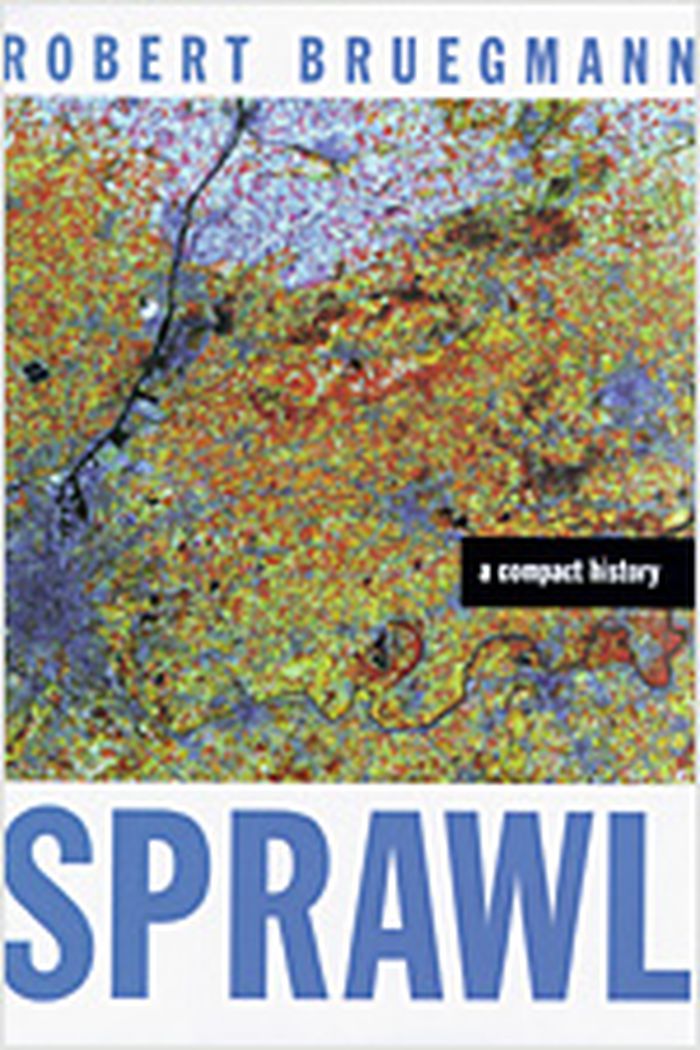
As anyone who has flown into Los Angeles at dusk or Houston at midday knows, urban areas today defy traditional notions of what a city is. Our old definitions of urban, suburban, and rural fail to capture the complexity of these vast regions with their superhighways, subdivisions, industrial areas, office parks, and resort areas pushing far out into the countryside. Detractors call it sprawl and assert that it is economically inefficient, socially inequitable, environmentally irresponsible, and aesthetically ugly. Robert Bruegmann calls it a logical consequence of economic growth and the democratization of society, with benefits that urban planners have failed to recognize. In his history of the expanded city, Bruegmann overturns every assumption we have about sprawl. Taking a long view of urban development, he demonstrates that sprawl is neither recent nor particularly American but as old as cities themselves, just as characteristic of ancient Rome and eighteenth-century Paris as it is of Atlanta or Los Angeles. Nor is sprawl the disaster claimed by many contemporary observers. Although sprawl, like any settlement pattern, has undoubtedly produced problems that must be addressed, it has also provided millions of people with the kinds of mobility, privacy, and choice that were once the exclusive prerogatives of the rich and powerful. The first major book to strip urban sprawl of its pejorative connotations, Sprawl offers a completely new vision of the city and its growth. Bruegmann leads readers to the powerful conclusion that ''in its immense complexity and constant change, the city-whether dense and concentrated at its core, looser and more sprawling in suburbia, or in the vast tracts of exurban penumbra that extend dozens, even hundreds, of miles-is the grandest and most marvelous work of mankind.''
Sprawl : a compact history
Actions:
Prix:
$34.50
(disponible sur commande)
Résumé:
As anyone who has flown into Los Angeles at dusk or Houston at midday knows, urban areas today defy traditional notions of what a city is. Our old definitions of urban, suburban, and rural fail to capture the complexity of these vast regions with their superhighways, subdivisions, industrial areas, office parks, and resort areas pushing far out into the countryside. Detractors call it sprawl and assert that it is economically inefficient, socially inequitable, environmentally irresponsible, and aesthetically ugly. Robert Bruegmann calls it a logical consequence of economic growth and the democratization of society, with benefits that urban planners have failed to recognize. In his history of the expanded city, Bruegmann overturns every assumption we have about sprawl. Taking a long view of urban development, he demonstrates that sprawl is neither recent nor particularly American but as old as cities themselves, just as characteristic of ancient Rome and eighteenth-century Paris as it is of Atlanta or Los Angeles. Nor is sprawl the disaster claimed by many contemporary observers. Although sprawl, like any settlement pattern, has undoubtedly produced problems that must be addressed, it has also provided millions of people with the kinds of mobility, privacy, and choice that were once the exclusive prerogatives of the rich and powerful. The first major book to strip urban sprawl of its pejorative connotations, Sprawl offers a completely new vision of the city and its growth. Bruegmann leads readers to the powerful conclusion that ''in its immense complexity and constant change, the city-whether dense and concentrated at its core, looser and more sprawling in suburbia, or in the vast tracts of exurban penumbra that extend dozens, even hundreds, of miles-is the grandest and most marvelous work of mankind.''
Classification:
livres
livres
Publication:
octobre 2005, Chicago, London
octobre 2005, Chicago, London
Sujet:
Théorie de l’urbanisme
Théorie de l’urbanisme
Classification:
livres
livres
Actions:
Prix:
$24.95
(disponible sur commande)
Résumé:
The old dream of social belonging and political sovereignty--the dream of nation--was fraught with anxiety and contradiction for many artists and intellectuals in the 1950s. On the one hand, memories of the Second World War remained vivid and the chauvinism that had enabled it threatened to return with the growing tensions of the Cold War. On the other hand, the need to(...)
$24.95
(disponible sur commande)
Résumé:
The old dream of social belonging and political sovereignty--the dream of nation--was fraught with anxiety and contradiction for many artists and intellectuals in the 1950s. On the one hand, memories of the Second World War remained vivid and the chauvinism that had enabled it threatened to return with the growing tensions of the Cold War. On the other hand, the need to(...)
Titre:
The pivot of the world : photography and its nation
Actions:
Prix:
$24.95
(disponible sur commande)
Résumé:
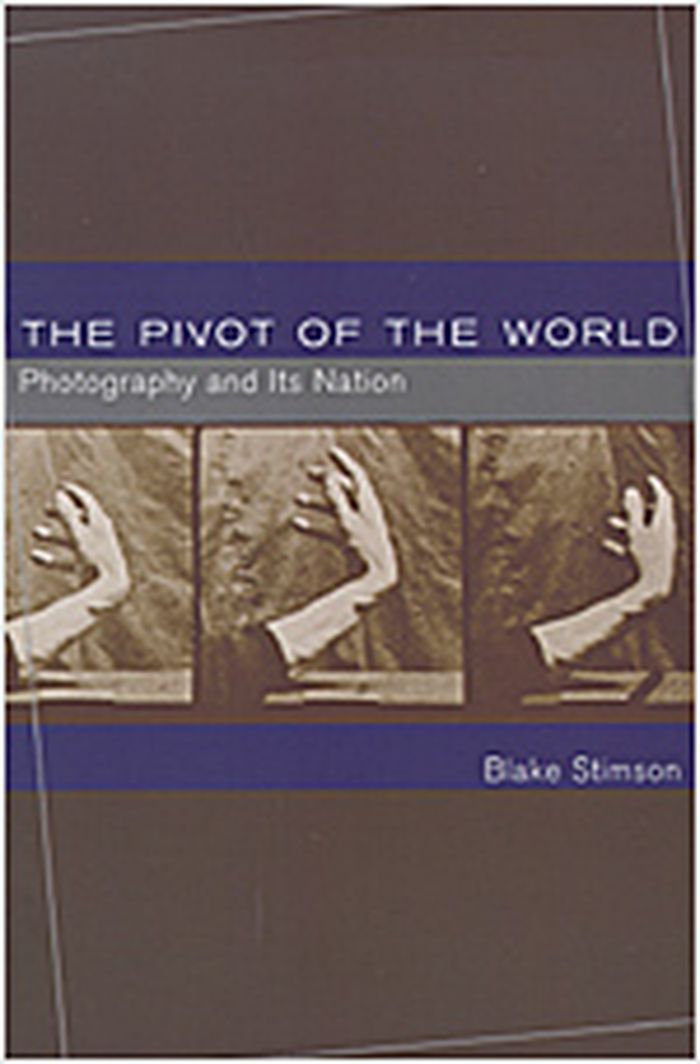
The old dream of social belonging and political sovereignty--the dream of nation--was fraught with anxiety and contradiction for many artists and intellectuals in the 1950s. On the one hand, memories of the Second World War remained vivid and the chauvinism that had enabled it threatened to return with the growing tensions of the Cold War. On the other hand, the need to bind together into a new global identity--into a world nation or "family of man"--seemed ever more pressing as a bulwark against the rapidly expanding threat of a nuclear World War III. The Pivot of the World looks at an exceptional effort to work out that geopolitical tension by cultural means as developed in three hugely ambitious photographic projects: The Family of Man exhibition that opened in 1955 and traveled the world for the next decade; Robert Frank's influential book The Americans, photographed in 1955-1956 and first published in 1958; and Bernd and Hilla Becher's typological record of industrial architecture, begun in 1957 and continuing today. Each of these projects worked to release the dream of nation--of belonging and sovereignty--from its old civic trappings through the medium of photography's serial form, in the experience of one photograph followed by another and another and another, so that all seem at once intimately connected and at the same time autonomous and distinct. Innovations in the serial composition of photographic form could open new possibilities for social form while the modern desire for political belonging could be made cosmopolitan, could be globalized--but in the most human of ways. This epic sense of purpose lasted only for a moment--it had already passed by the beginning of the 1960s--but it bears particular interest for any historical understanding of the contest over globalization that continues to hold such great consequence for us now.
The pivot of the world : photography and its nation
Actions:
Prix:
$24.95
(disponible sur commande)
Résumé:
The old dream of social belonging and political sovereignty--the dream of nation--was fraught with anxiety and contradiction for many artists and intellectuals in the 1950s. On the one hand, memories of the Second World War remained vivid and the chauvinism that had enabled it threatened to return with the growing tensions of the Cold War. On the other hand, the need to bind together into a new global identity--into a world nation or "family of man"--seemed ever more pressing as a bulwark against the rapidly expanding threat of a nuclear World War III. The Pivot of the World looks at an exceptional effort to work out that geopolitical tension by cultural means as developed in three hugely ambitious photographic projects: The Family of Man exhibition that opened in 1955 and traveled the world for the next decade; Robert Frank's influential book The Americans, photographed in 1955-1956 and first published in 1958; and Bernd and Hilla Becher's typological record of industrial architecture, begun in 1957 and continuing today. Each of these projects worked to release the dream of nation--of belonging and sovereignty--from its old civic trappings through the medium of photography's serial form, in the experience of one photograph followed by another and another and another, so that all seem at once intimately connected and at the same time autonomous and distinct. Innovations in the serial composition of photographic form could open new possibilities for social form while the modern desire for political belonging could be made cosmopolitan, could be globalized--but in the most human of ways. This epic sense of purpose lasted only for a moment--it had already passed by the beginning of the 1960s--but it bears particular interest for any historical understanding of the contest over globalization that continues to hold such great consequence for us now.
Classification:
livres
livres
Publication:
janvier 2006, Cambridge, Mass.
janvier 2006, Cambridge, Mass.
Sujet:
Théorie de la photographie
Théorie de la photographie
Classification:
périodiques
périodiques
Titre:
Detail 7/8 2017
Detail 7/8 2017
Actions:
Prix:
$32.95
(disponible sur commande)
Résumé:
The laws of the series. In the 1920s, a group of architects in Milan came together to form a movement that would later be known as Razionalismo. Architecture, they were convinced, must adhere to the rules of reason. They propagated the notion of “pure rhythm”, which was reflected in the repetition of individual elements as a fundamental design principle. Today, the(...)
$32.95
(disponible sur commande)
Résumé:
The laws of the series. In the 1920s, a group of architects in Milan came together to form a movement that would later be known as Razionalismo. Architecture, they were convinced, must adhere to the rules of reason. They propagated the notion of “pure rhythm”, which was reflected in the repetition of individual elements as a fundamental design principle. Today, the(...)
Titre:
Detail 7/8 2017
Actions:
Prix:
$32.95
(disponible sur commande)
Résumé:
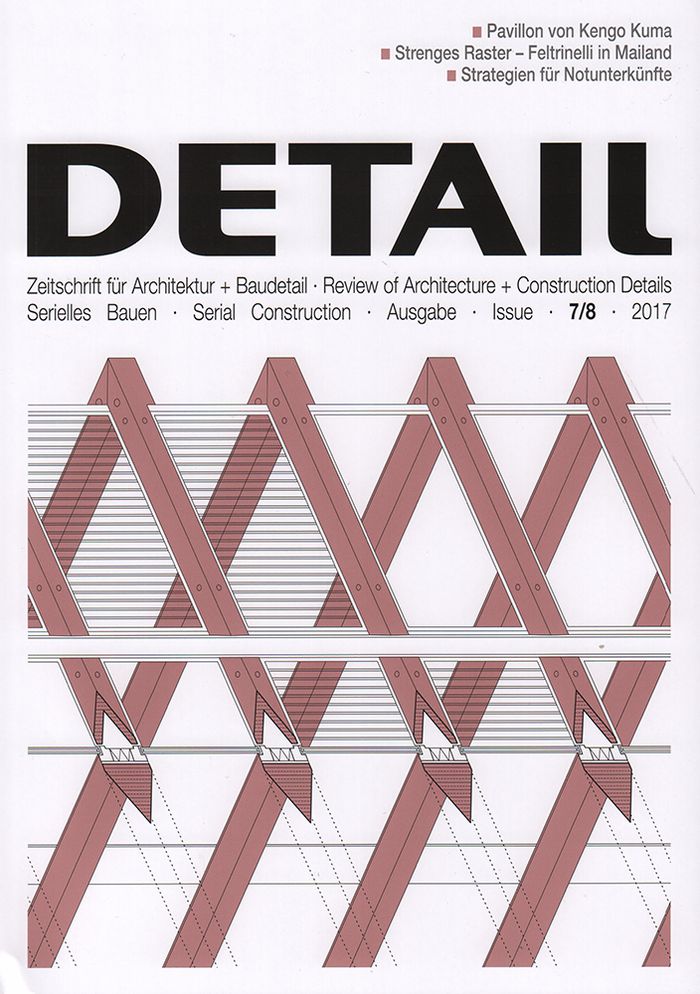
The laws of the series. In the 1920s, a group of architects in Milan came together to form a movement that would later be known as Razionalismo. Architecture, they were convinced, must adhere to the rules of reason. They propagated the notion of “pure rhythm”, which was reflected in the repetition of individual elements as a fundamental design principle. Today, the relevance of serial production methods in architecture reach far beyond their significance at the time of Razionalismo. Repetitive structures can not only be found characterising the aesthetic appearance of buildings, they often play a decisive role in complex planning and construction processes, such as in the combination of individual modules or other industrially prefabricated elements. In our July/August issue, we present contemporary buildings that embrace the notion of the series in a variety of ways. For our Documentation section, Burkhard Franke explores examples in which aspects of repetition is used both as a design element and with respect to construction methodologies. A new social housing project by Florian Nagler in Munich, for instance, is a hybrid construction made with prefabricated wood elements. Meanwhile, a student housing complex in Berlin that Holzer Kobler Architekturen built using shipping containers resist any sense of monotony despite their stacked arrangement. For the exemplary French social housing buildings by Poggi & More near Bordeaux and by PPA architectures in Toulouse, modular components likewise contributed to the reduction of construction costs. Are buildings produced according to serial fabrication methods invariably cost effective? In our Technology feature, Frank Kaltenbach has compiled an overview of recent solutions in refugee housing. The majority of them needed to be built within a short time period and under high budgetary constraints. The ways in which serial production methods seem to be predestined for such demanding projects can be discovered in this issue.
Detail 7/8 2017
Actions:
Prix:
$32.95
(disponible sur commande)
Résumé:
The laws of the series. In the 1920s, a group of architects in Milan came together to form a movement that would later be known as Razionalismo. Architecture, they were convinced, must adhere to the rules of reason. They propagated the notion of “pure rhythm”, which was reflected in the repetition of individual elements as a fundamental design principle. Today, the relevance of serial production methods in architecture reach far beyond their significance at the time of Razionalismo. Repetitive structures can not only be found characterising the aesthetic appearance of buildings, they often play a decisive role in complex planning and construction processes, such as in the combination of individual modules or other industrially prefabricated elements. In our July/August issue, we present contemporary buildings that embrace the notion of the series in a variety of ways. For our Documentation section, Burkhard Franke explores examples in which aspects of repetition is used both as a design element and with respect to construction methodologies. A new social housing project by Florian Nagler in Munich, for instance, is a hybrid construction made with prefabricated wood elements. Meanwhile, a student housing complex in Berlin that Holzer Kobler Architekturen built using shipping containers resist any sense of monotony despite their stacked arrangement. For the exemplary French social housing buildings by Poggi & More near Bordeaux and by PPA architectures in Toulouse, modular components likewise contributed to the reduction of construction costs. Are buildings produced according to serial fabrication methods invariably cost effective? In our Technology feature, Frank Kaltenbach has compiled an overview of recent solutions in refugee housing. The majority of them needed to be built within a short time period and under high budgetary constraints. The ways in which serial production methods seem to be predestined for such demanding projects can be discovered in this issue.
Classification:
périodiques
périodiques
Publication:
juillet 2017
juillet 2017
Sujet:
Revues
Revues
Classification:
périodiques
périodiques
Titre:
Security dialogue.
Security dialogue.
Actions:
Auteur:
Sujet:
Publication:
[Thousand Oaks, Calif.] : Sage Publications
[Thousand Oaks, Calif.] : Sage Publications
Classification:
périodiques
périodiques
Publication:
[Thousand Oaks, Calif.] : Sage Publications
[Thousand Oaks, Calif.] : Sage Publications
Auteur:
Sujet:
Classification:
périodiques
périodiques
Actions:
Description:
1 online resource (volumes) : illustrations
Auteur:
Sujet:
Publication:
Sheffield, UK : Greenleaf Pub.
Sheffield, UK : Greenleaf Pub.
Titre:
The journal of corporate citizenship.
Actions:
Description:
1 online resource (volumes) : illustrations
The journal of corporate citizenship.
Actions:
Description:
1 online resource (volumes) : illustrations
Classification:
périodiques
périodiques
Publication:
Sheffield, UK : Greenleaf Pub.
Sheffield, UK : Greenleaf Pub.
Auteur:
Sujet:
Classification:
livres
livres
Titre:
Frank Lloyd Wright
Frank Lloyd Wright
Actions:
Prix:
$21.50
(disponible sur commande)
Résumé:
The life and architecture of Frank Lloyd Wright (1867-1959) have been much-studied, yet there is a consistent division between analyses of his architecture, which exclude any discussion of his daily life, and books that tell the often sensational tale of his life, with barely a passing reference to the buildings themselves. The result is that, despite the large number of(...)
$21.50
(disponible sur commande)
Résumé:
The life and architecture of Frank Lloyd Wright (1867-1959) have been much-studied, yet there is a consistent division between analyses of his architecture, which exclude any discussion of his daily life, and books that tell the often sensational tale of his life, with barely a passing reference to the buildings themselves. The result is that, despite the large number of(...)
Titre:
Frank Lloyd Wright
Actions:
Prix:
$21.50
(disponible sur commande)
Résumé:
The life and architecture of Frank Lloyd Wright (1867-1959) have been much-studied, yet there is a consistent division between analyses of his architecture, which exclude any discussion of his daily life, and books that tell the often sensational tale of his life, with barely a passing reference to the buildings themselves. The result is that, despite the large number of volumes on Wright, the most essential part of his life – his life as an architect, working, as he said, ‘in the cause of architecture’ – remains virtually unexplored. "Frank Lloyd Wright" offers an account of Wright’s life as an architect, the ideas, beliefs and relationships that shaped his life and work, and the manner in which these affected, and are reflected in, his architecture. During a tumultuous life and extensive career which includes such hugely defining buildings as the Guggenheim Museum, Fallingwater, Taliesin, Unity Temple, and the prolific Prairie Houses, Wright endeavoured to shape the emerging and evolving American democracy, its mode of dwelling, and its relation to the traditional conception of the city. Fusing ancient construction geometries with contemporary ideals of Transcendental philosophy, Wright sought to develop an appropriate architecture for the new world of the twentieth century. In doing so, he served as the primary inspiration for the emergence of Modern architecture around the world. Robert McCarter examines how Wright’s architecture crystallized key conceptions of both private dwelling and public citizenship for American society, and relates how, through his work and writings, Wright developed relationships with key leaders of the arts, industry and society. He analyses how and why Wright maintained that architecture was the ‘background or framework’ for daily life, never the literal ‘object’ of our attention, as well as Wright’s belief that architects have the most significant ethical responsibilities to improve the larger society and culture to which they belong. In exploring Wright’s life, times and culture, Robert McCarter shows how Wright was an architect of astonishing ability, whose works continue to shape the world around us, fifty years after his death.
Frank Lloyd Wright
Actions:
Prix:
$21.50
(disponible sur commande)
Résumé:
The life and architecture of Frank Lloyd Wright (1867-1959) have been much-studied, yet there is a consistent division between analyses of his architecture, which exclude any discussion of his daily life, and books that tell the often sensational tale of his life, with barely a passing reference to the buildings themselves. The result is that, despite the large number of volumes on Wright, the most essential part of his life – his life as an architect, working, as he said, ‘in the cause of architecture’ – remains virtually unexplored. "Frank Lloyd Wright" offers an account of Wright’s life as an architect, the ideas, beliefs and relationships that shaped his life and work, and the manner in which these affected, and are reflected in, his architecture. During a tumultuous life and extensive career which includes such hugely defining buildings as the Guggenheim Museum, Fallingwater, Taliesin, Unity Temple, and the prolific Prairie Houses, Wright endeavoured to shape the emerging and evolving American democracy, its mode of dwelling, and its relation to the traditional conception of the city. Fusing ancient construction geometries with contemporary ideals of Transcendental philosophy, Wright sought to develop an appropriate architecture for the new world of the twentieth century. In doing so, he served as the primary inspiration for the emergence of Modern architecture around the world. Robert McCarter examines how Wright’s architecture crystallized key conceptions of both private dwelling and public citizenship for American society, and relates how, through his work and writings, Wright developed relationships with key leaders of the arts, industry and society. He analyses how and why Wright maintained that architecture was the ‘background or framework’ for daily life, never the literal ‘object’ of our attention, as well as Wright’s belief that architects have the most significant ethical responsibilities to improve the larger society and culture to which they belong. In exploring Wright’s life, times and culture, Robert McCarter shows how Wright was an architect of astonishing ability, whose works continue to shape the world around us, fifty years after his death.
Classification:
livres
livres
Publication:
mars 2006, London
mars 2006, London
Sujet:
Architecture, monographies
Architecture, monographies
Classification:
livres
livres

Titre:
Maya Lin : boundaries
Maya Lin : boundaries
Actions:
Prix:
$34.50
(disponible sur commande)
Résumé:
Walking through this parklike area, the memorial appears as a rift in the earth - a long, polished black stone wall, emerging from and receding into the earth. Approaching the memorial, the ground slopes gently downward, and the low walls emerging on either side, growing out of the earth, extend and converge at a point below and ahead. Walking into the grassy site(...)
$34.50
(disponible sur commande)
Résumé:
Walking through this parklike area, the memorial appears as a rift in the earth - a long, polished black stone wall, emerging from and receding into the earth. Approaching the memorial, the ground slopes gently downward, and the low walls emerging on either side, growing out of the earth, extend and converge at a point below and ahead. Walking into the grassy site(...)
Titre:
Maya Lin : boundaries
Actions:
Prix:
$34.50
(disponible sur commande)
Résumé:
Walking through this parklike area, the memorial appears as a rift in the earth - a long, polished black stone wall, emerging from and receding into the earth. Approaching the memorial, the ground slopes gently downward, and the low walls emerging on either side, growing out of the earth, extend and converge at a point below and ahead. Walking into the grassy site contained by the walls of this memorial, we can barely make out the carved names upon the memorial's walls. These names, seemingly infinite in number, convey the sense of overwhelming numbers, while unifying these individuals into a whole.... So begins the competition entry submitted in 1981 by a Yale undergraduate for the design of the Vietnam Veterans Memorial in Washington, D.C. - subsequently called "as moving and awesome and popular a piece of memorial architecture as exists anywhere in the world." Its creator, Maya Lin, has been nothing less than world famous ever since. From the explicitly political to the un-ashamedly literary to the completely abstract, her simple and powerful sculpture - the Rockefeller Foundation sculpture, the Southern Poverty Law Center Civil Rights Memorial, the Yale Women's Table, Wave Field - her architecture, including The Museum for African Art and the Norton residence, and her protean design talents have defined her as one of the most gifted creative geniuses of the age. Boundaries is her first book : an eloquent visual/verbal sketchbook produced with the same inspiration and attention to detail as any of her other artworks. Like her environmental sculptures, it is a site, but one which exists at a remove so that it may comment on the personal and artistic elements that make up those works. In it, sketches, photographs, workbook entries, and original designs are held together by a deeply personal text. "Boundaries" is a powerful literary and visual statement by "a leading public artist" (Holland Carter). It is itself a unique work of art.
Maya Lin : boundaries
Actions:
Prix:
$34.50
(disponible sur commande)
Résumé:
Walking through this parklike area, the memorial appears as a rift in the earth - a long, polished black stone wall, emerging from and receding into the earth. Approaching the memorial, the ground slopes gently downward, and the low walls emerging on either side, growing out of the earth, extend and converge at a point below and ahead. Walking into the grassy site contained by the walls of this memorial, we can barely make out the carved names upon the memorial's walls. These names, seemingly infinite in number, convey the sense of overwhelming numbers, while unifying these individuals into a whole.... So begins the competition entry submitted in 1981 by a Yale undergraduate for the design of the Vietnam Veterans Memorial in Washington, D.C. - subsequently called "as moving and awesome and popular a piece of memorial architecture as exists anywhere in the world." Its creator, Maya Lin, has been nothing less than world famous ever since. From the explicitly political to the un-ashamedly literary to the completely abstract, her simple and powerful sculpture - the Rockefeller Foundation sculpture, the Southern Poverty Law Center Civil Rights Memorial, the Yale Women's Table, Wave Field - her architecture, including The Museum for African Art and the Norton residence, and her protean design talents have defined her as one of the most gifted creative geniuses of the age. Boundaries is her first book : an eloquent visual/verbal sketchbook produced with the same inspiration and attention to detail as any of her other artworks. Like her environmental sculptures, it is a site, but one which exists at a remove so that it may comment on the personal and artistic elements that make up those works. In it, sketches, photographs, workbook entries, and original designs are held together by a deeply personal text. "Boundaries" is a powerful literary and visual statement by "a leading public artist" (Holland Carter). It is itself a unique work of art.
Classification:
livres
livres
Publication:
septembre 2006, New York
septembre 2006, New York
Classification:
périodiques
périodiques
Titre:
Biometrika.
Biometrika.
Actions:
Description:
1 online resource
Auteur:
Sujet:
Publication:
Cambridge [England] : University Press ; New York : Macmillan Co., 1901-
Cambridge [England] : University Press ; New York : Macmillan Co., 1901-
Classification:
périodiques
périodiques
Publication:
Cambridge [England] : University Press ; New York : Macmillan Co., 1901-
Cambridge [England] : University Press ; New York : Macmillan Co., 1901-
Auteur:
Sujet:
Classification:
livres
livres

Titre:
Heidegger's hut
Heidegger's hut
Actions:
Prix:
$32.95
(disponible sur commande)
Résumé:
"This is the most thorough architectural 'crit' of a hut ever set down, the justification for which is that the hut was the setting in which Martin Heidegger wrote phenomenological texts that became touchstones for late-twentieth-century architectural theory." --from the foreword by Simon Sadler Beginning in the summer of 1922, philosopher Martin Heidegger(...)
$32.95
(disponible sur commande)
Résumé:
"This is the most thorough architectural 'crit' of a hut ever set down, the justification for which is that the hut was the setting in which Martin Heidegger wrote phenomenological texts that became touchstones for late-twentieth-century architectural theory." --from the foreword by Simon Sadler Beginning in the summer of 1922, philosopher Martin Heidegger(...)
Sujet:
Théorie de l’architecture
Théorie de l’architecture
Publication:
octobre 2006, Cambridge / London
octobre 2006, Cambridge / London
Titre:
Heidegger's hut
Actions:
Prix:
$32.95
(disponible sur commande)
Résumé:
"This is the most thorough architectural 'crit' of a hut ever set down, the justification for which is that the hut was the setting in which Martin Heidegger wrote phenomenological texts that became touchstones for late-twentieth-century architectural theory." --from the foreword by Simon Sadler Beginning in the summer of 1922, philosopher Martin Heidegger (1889-1976) occupied a small, three-room cabin in the Black Forest Mountains of southern Germany. He called it "die Hütte" ("the hut"). Over the years, Heidegger worked on many of his most famous writings in this cabin, from his early lectures to his last enigmatic texts. He claimed an intellectual and emotional intimacy with the building and its surroundings, and even suggested that the landscape expressed itself through him, almost without agency. In Heidegger's Hut, Adam Sharr explores this intense relationship of thought, place, and person. Heidegger's mountain hut has been an object of fascination for many, including architects interested in his writings about "dwelling" and "place." Sharr's account--the first substantive investigation of the building and Heidegger's life there--reminds us that, in approaching Heidegger's writings, it is important to consider the circumstances in which the philosopher, as he himself said, felt "transported" into the work's "own rhythm." Indeed, Heidegger's apparent abdication of agency and tendency toward romanticism seem especially significant in light of his troubling involvement with the Nazi regime in the early 1930s. Sharr draws on original research, including interviews with Heidegger's relatives, as well as on written accounts of the hut by Heidegger and his visitors. The book's evocative photographs include scenic and architectural views taken by the author and many remarkable images of a septuagenarian Heidegger in the hut taken by the photojournalist Digne Meller-Markovicz. There are many ways to interpret Heidegger's hut--as the site of heroic confrontation between philosopher and existence; as the petit bourgeois escape of a misguided romantic; as a place overshadowed by fascism; or as an entirely unremarkable little building. Heidegger's Hut does not argue for any one reading, but guides readers toward their own possible interpretations of the importance of "die Hütte."
Heidegger's hut
Actions:
Prix:
$32.95
(disponible sur commande)
Résumé:
"This is the most thorough architectural 'crit' of a hut ever set down, the justification for which is that the hut was the setting in which Martin Heidegger wrote phenomenological texts that became touchstones for late-twentieth-century architectural theory." --from the foreword by Simon Sadler Beginning in the summer of 1922, philosopher Martin Heidegger (1889-1976) occupied a small, three-room cabin in the Black Forest Mountains of southern Germany. He called it "die Hütte" ("the hut"). Over the years, Heidegger worked on many of his most famous writings in this cabin, from his early lectures to his last enigmatic texts. He claimed an intellectual and emotional intimacy with the building and its surroundings, and even suggested that the landscape expressed itself through him, almost without agency. In Heidegger's Hut, Adam Sharr explores this intense relationship of thought, place, and person. Heidegger's mountain hut has been an object of fascination for many, including architects interested in his writings about "dwelling" and "place." Sharr's account--the first substantive investigation of the building and Heidegger's life there--reminds us that, in approaching Heidegger's writings, it is important to consider the circumstances in which the philosopher, as he himself said, felt "transported" into the work's "own rhythm." Indeed, Heidegger's apparent abdication of agency and tendency toward romanticism seem especially significant in light of his troubling involvement with the Nazi regime in the early 1930s. Sharr draws on original research, including interviews with Heidegger's relatives, as well as on written accounts of the hut by Heidegger and his visitors. The book's evocative photographs include scenic and architectural views taken by the author and many remarkable images of a septuagenarian Heidegger in the hut taken by the photojournalist Digne Meller-Markovicz. There are many ways to interpret Heidegger's hut--as the site of heroic confrontation between philosopher and existence; as the petit bourgeois escape of a misguided romantic; as a place overshadowed by fascism; or as an entirely unremarkable little building. Heidegger's Hut does not argue for any one reading, but guides readers toward their own possible interpretations of the importance of "die Hütte."
Classification:
livres
livres
Publication:
octobre 2006, Cambridge / London
octobre 2006, Cambridge / London
Sujet:
Théorie de l’architecture
Théorie de l’architecture


