


57161 Résultats
Classification:
dessins, photographies
dessins, photographies
Numéro de référence:
DR2012:0012:069:002
Description:
Portfolio containing documents in English (predominant) and French, including conceptual drawings, photographic prints, reference materials, reprographic copies of artworks and architectural drawings (including elevations, sections, site plans), and a map related to the following projects: - Mont-Royal Metro Station (6 reprographic copies); - Canadian Government pavillion, World Expo, Osaka Japan (4 reprographic copies); - Unknown project(s); - Curé Grenier School, Notre-Dame des Laurentides, Quebec; - Clowes Memorial Hall, Butler University, Indianapolis, Indiana (2 reprographic copies); - The Museum of Art, Science and Industry, Bridgeport, Connecticut (5 reprographic copies); - U.C.C. building, Montreal (12 reprographic copies); As well as: - Schwarzenbach residence (J. M. Johansen, architect) (20 reprographic copies).
DR2012:0012:069:002
Description:
Portfolio containing documents in English (predominant) and French, including conceptual drawings, photographic prints, reference materials, reprographic copies of artworks and architectural drawings (including elevations, sections, site plans), and a map related to the following projects: - Mont-Royal Metro Station (6 reprographic copies); - Canadian Government pavillion, World Expo, Osaka Japan (4 reprographic copies); - Unknown project(s); - Curé Grenier School, Notre-Dame des Laurentides, Quebec; - Clowes Memorial Hall, Butler University, Indianapolis, Indiana (2 reprographic copies); - The Museum of Art, Science and Industry, Bridgeport, Connecticut (5 reprographic copies); - U.C.C. building, Montreal (12 reprographic copies); As well as: - Schwarzenbach residence (J. M. Johansen, architect) (20 reprographic copies).
Personnes et institutions:
Date:
1959-1967
1959-1967
Titre:
Portfolio of Melvin Charney's early professional work
Actions:
DR2012:0012:069:002
Description:
Portfolio containing documents in English (predominant) and French, including conceptual drawings, photographic prints, reference materials, reprographic copies of artworks and architectural drawings (including elevations, sections, site plans), and a map related to the following projects: - Mont-Royal Metro Station (6 reprographic copies); - Canadian Government pavillion, World Expo, Osaka Japan (4 reprographic copies); - Unknown project(s); - Curé Grenier School, Notre-Dame des Laurentides, Quebec; - Clowes Memorial Hall, Butler University, Indianapolis, Indiana (2 reprographic copies); - The Museum of Art, Science and Industry, Bridgeport, Connecticut (5 reprographic copies); - U.C.C. building, Montreal (12 reprographic copies); As well as: - Schwarzenbach residence (J. M. Johansen, architect) (20 reprographic copies).
Portfolio of Melvin Charney's early professional work
Actions:
DR2012:0012:069:002
Description:
Portfolio containing documents in English (predominant) and French, including conceptual drawings, photographic prints, reference materials, reprographic copies of artworks and architectural drawings (including elevations, sections, site plans), and a map related to the following projects: - Mont-Royal Metro Station (6 reprographic copies); - Canadian Government pavillion, World Expo, Osaka Japan (4 reprographic copies); - Unknown project(s); - Curé Grenier School, Notre-Dame des Laurentides, Quebec; - Clowes Memorial Hall, Butler University, Indianapolis, Indiana (2 reprographic copies); - The Museum of Art, Science and Industry, Bridgeport, Connecticut (5 reprographic copies); - U.C.C. building, Montreal (12 reprographic copies); As well as: - Schwarzenbach residence (J. M. Johansen, architect) (20 reprographic copies).
Classification:
dessins, photographies
dessins, photographies
Date:
1959-1967
1959-1967
Personnes et institutions:
Classification:
photographies
photographies
Actions:
Numéro de référence:
PH1984:0038:023
Description:
- Photograph PH1984:0038:023 is apparently taken from the intersection of State and Adams Streets based on the imprinted title. Further research is required to determine if this photograph is in fact taken from the intersection and from which direction the photograph was taken, as well as to identify the domed building at the center left of the photograph. If photographer was looking east along Adams Street, the Chicago Art Institute would be located at the center left of the photograph, however, the Institute never had a dome. Research has revealed no building which would "block" Adams Street looking west and/or State Street looking north or south (Schulze and Harrington).
PH1984:0038:023
Description:
- Photograph PH1984:0038:023 is apparently taken from the intersection of State and Adams Streets based on the imprinted title. Further research is required to determine if this photograph is in fact taken from the intersection and from which direction the photograph was taken, as well as to identify the domed building at the center left of the photograph. If photographer was looking east along Adams Street, the Chicago Art Institute would be located at the center left of the photograph, however, the Institute never had a dome. Research has revealed no building which would "block" Adams Street looking west and/or State Street looking north or south (Schulze and Harrington).
Personnes et institutions:
Sujet:
architecture
architecture
Date:
1863 - ca. 1887
1863 - ca. 1887
Titre:
View of State and Adams Streets [?] showing commericial buildings with the W.W. Kimball musical instrument store on the right, Chicago, Illinois
Actions:
PH1984:0038:023
Description:
- Photograph PH1984:0038:023 is apparently taken from the intersection of State and Adams Streets based on the imprinted title. Further research is required to determine if this photograph is in fact taken from the intersection and from which direction the photograph was taken, as well as to identify the domed building at the center left of the photograph. If photographer was looking east along Adams Street, the Chicago Art Institute would be located at the center left of the photograph, however, the Institute never had a dome. Research has revealed no building which would "block" Adams Street looking west and/or State Street looking north or south (Schulze and Harrington).
View of State and Adams Streets [?] showing commericial buildings with the W.W. Kimball musical instrument store on the right, Chicago, Illinois
Actions:
PH1984:0038:023
Description:
- Photograph PH1984:0038:023 is apparently taken from the intersection of State and Adams Streets based on the imprinted title. Further research is required to determine if this photograph is in fact taken from the intersection and from which direction the photograph was taken, as well as to identify the domed building at the center left of the photograph. If photographer was looking east along Adams Street, the Chicago Art Institute would be located at the center left of the photograph, however, the Institute never had a dome. Research has revealed no building which would "block" Adams Street looking west and/or State Street looking north or south (Schulze and Harrington).
Classification:
photographies
photographies
Date:
1863 - ca. 1887
1863 - ca. 1887
Personnes et institutions:
Sujet:
architecture
architecture
Classification:
archives
Niveau de description archivistique:
Fonds
archives
Niveau de description archivistique:
Fonds
Titre:
Fonds Ernest Isbell Barott
Fonds Ernest Isbell Barott
Numéro de référence:
AP003
Résumé:
The Ernest Isbell Barott fonds, 1912-1983, documents architect Ernest Isbell Barott’s design and construction of over 380 built projects in Canada. The fonds comprises of materials relating to projects executed by Ernest Isbell Barott during his active years at the firm, 1912-1962, as well as projects exclusively completed by the firm after Barott’s retirement, 1962-1983. Materials in this fonds consist of approximately 11 764 drawings (including reprographic copies), approximately 1795 photographic materials, 8.75 l.m. of textual records, 4 medals, and 1 key.
AP003
Résumé:
The Ernest Isbell Barott fonds, 1912-1983, documents architect Ernest Isbell Barott’s design and construction of over 380 built projects in Canada. The fonds comprises of materials relating to projects executed by Ernest Isbell Barott during his active years at the firm, 1912-1962, as well as projects exclusively completed by the firm after Barott’s retirement, 1962-1983. Materials in this fonds consist of approximately 11 764 drawings (including reprographic copies), approximately 1795 photographic materials, 8.75 l.m. of textual records, 4 medals, and 1 key.
Personnes et institutions:
Date:
1912-1983
1912-1983
Titre:
Fonds Ernest Isbell Barott
Actions:
AP003
Résumé:
The Ernest Isbell Barott fonds, 1912-1983, documents architect Ernest Isbell Barott’s design and construction of over 380 built projects in Canada. The fonds comprises of materials relating to projects executed by Ernest Isbell Barott during his active years at the firm, 1912-1962, as well as projects exclusively completed by the firm after Barott’s retirement, 1962-1983. Materials in this fonds consist of approximately 11 764 drawings (including reprographic copies), approximately 1795 photographic materials, 8.75 l.m. of textual records, 4 medals, and 1 key.
Fonds Ernest Isbell Barott
Actions:
AP003
Résumé:
The Ernest Isbell Barott fonds, 1912-1983, documents architect Ernest Isbell Barott’s design and construction of over 380 built projects in Canada. The fonds comprises of materials relating to projects executed by Ernest Isbell Barott during his active years at the firm, 1912-1962, as well as projects exclusively completed by the firm after Barott’s retirement, 1962-1983. Materials in this fonds consist of approximately 11 764 drawings (including reprographic copies), approximately 1795 photographic materials, 8.75 l.m. of textual records, 4 medals, and 1 key.
Classification:
archives
Niveau de description archivistique:
Fonds
archives
Niveau de description archivistique:
Fonds
Date:
1912-1983
1912-1983
Personnes et institutions:
Classification:
dessins, documents textuels, photographies
dessins, documents textuels, photographies
Numéro de référence:
ARCH163985
Description:
Coupure de presse Article de Jean-Claude Marsan: "De la transnationale au bar de quartier : deux réussites d'aménagement urbain qui se méritent déjà la qualité sans nom", Le Devoir, 5 janvier 1984 35,5 x 31,5 cm 2 feuillets: photocopie de l'article 21,5 x 35,5 cm 2 négatifs et 2 photographies noir et blanc 12,5 x 9 cm 1 dépliant: "Offre de service, pour tout besoin en art visuel" 21,5 x 35,5 cm 14 feuillets: Notes et photocopies 21,5 x 35,5 cm 3 dessins: Dessins préparatoires aux plans d'éxécution de la façade du bar mine de plomb sur papier calque jusqu'à 59 x 30,5 cm
ARCH163985
Description:
Coupure de presse Article de Jean-Claude Marsan: "De la transnationale au bar de quartier : deux réussites d'aménagement urbain qui se méritent déjà la qualité sans nom", Le Devoir, 5 janvier 1984 35,5 x 31,5 cm 2 feuillets: photocopie de l'article 21,5 x 35,5 cm 2 négatifs et 2 photographies noir et blanc 12,5 x 9 cm 1 dépliant: "Offre de service, pour tout besoin en art visuel" 21,5 x 35,5 cm 14 feuillets: Notes et photocopies 21,5 x 35,5 cm 3 dessins: Dessins préparatoires aux plans d'éxécution de la façade du bar mine de plomb sur papier calque jusqu'à 59 x 30,5 cm
Personnes et institutions:
Titre:
De la transnationale au bar de quartier
Actions:
ARCH163985
Description:
Coupure de presse Article de Jean-Claude Marsan: "De la transnationale au bar de quartier : deux réussites d'aménagement urbain qui se méritent déjà la qualité sans nom", Le Devoir, 5 janvier 1984 35,5 x 31,5 cm 2 feuillets: photocopie de l'article 21,5 x 35,5 cm 2 négatifs et 2 photographies noir et blanc 12,5 x 9 cm 1 dépliant: "Offre de service, pour tout besoin en art visuel" 21,5 x 35,5 cm 14 feuillets: Notes et photocopies 21,5 x 35,5 cm 3 dessins: Dessins préparatoires aux plans d'éxécution de la façade du bar mine de plomb sur papier calque jusqu'à 59 x 30,5 cm
De la transnationale au bar de quartier
Actions:
ARCH163985
Description:
Coupure de presse Article de Jean-Claude Marsan: "De la transnationale au bar de quartier : deux réussites d'aménagement urbain qui se méritent déjà la qualité sans nom", Le Devoir, 5 janvier 1984 35,5 x 31,5 cm 2 feuillets: photocopie de l'article 21,5 x 35,5 cm 2 négatifs et 2 photographies noir et blanc 12,5 x 9 cm 1 dépliant: "Offre de service, pour tout besoin en art visuel" 21,5 x 35,5 cm 14 feuillets: Notes et photocopies 21,5 x 35,5 cm 3 dessins: Dessins préparatoires aux plans d'éxécution de la façade du bar mine de plomb sur papier calque jusqu'à 59 x 30,5 cm
Classification:
dessins, documents textuels, photographies
dessins, documents textuels, photographies
Personnes et institutions:
Classification:
archives
Niveau de description archivistique:
Fonds
archives
Niveau de description archivistique:
Fonds
Titre:
Fonds Brian Boigon
Fonds Brian Boigon
Numéro de référence:
AP188
Résumé:
The Brian Boigon fonds, 1981–2015, documents various creative and professional projects by artist and data-architect, Brian Boigon. The majority of the fonds documents the multidisciplinary symposium series Culture Lab. Material in the fonds also documents Boigon’s research into cartoon movement in cyberspace in the form of both the Cartoon Regulators and Spillville. The fonds also contains records pertaining to Boigon’s web design company, Roller Coaster Studios. The records in the fonds largely consist of research and planning material, photographs and AV recordings documenting the projects, and sketches by Boigon and others.
AP188
Résumé:
The Brian Boigon fonds, 1981–2015, documents various creative and professional projects by artist and data-architect, Brian Boigon. The majority of the fonds documents the multidisciplinary symposium series Culture Lab. Material in the fonds also documents Boigon’s research into cartoon movement in cyberspace in the form of both the Cartoon Regulators and Spillville. The fonds also contains records pertaining to Boigon’s web design company, Roller Coaster Studios. The records in the fonds largely consist of research and planning material, photographs and AV recordings documenting the projects, and sketches by Boigon and others.
Personnes et institutions:
Date:
1981 - 2015
1981 - 2015
Titre:
Fonds Brian Boigon
Actions:
AP188
Résumé:
The Brian Boigon fonds, 1981–2015, documents various creative and professional projects by artist and data-architect, Brian Boigon. The majority of the fonds documents the multidisciplinary symposium series Culture Lab. Material in the fonds also documents Boigon’s research into cartoon movement in cyberspace in the form of both the Cartoon Regulators and Spillville. The fonds also contains records pertaining to Boigon’s web design company, Roller Coaster Studios. The records in the fonds largely consist of research and planning material, photographs and AV recordings documenting the projects, and sketches by Boigon and others.
Fonds Brian Boigon
Actions:
AP188
Résumé:
The Brian Boigon fonds, 1981–2015, documents various creative and professional projects by artist and data-architect, Brian Boigon. The majority of the fonds documents the multidisciplinary symposium series Culture Lab. Material in the fonds also documents Boigon’s research into cartoon movement in cyberspace in the form of both the Cartoon Regulators and Spillville. The fonds also contains records pertaining to Boigon’s web design company, Roller Coaster Studios. The records in the fonds largely consist of research and planning material, photographs and AV recordings documenting the projects, and sketches by Boigon and others.
Classification:
archives
Niveau de description archivistique:
Fonds
archives
Niveau de description archivistique:
Fonds
Date:
1981 - 2015
1981 - 2015
Personnes et institutions:
Niveau de description archivistique:
Projet
Projet
Numéro de référence:
AP056.S1.2000.PR08
Description:
This project series documents buildings for Concordia University's downtown campus in Montréal from 2000-2009. The office identified the project number as 0004. This project eventually became known as Le Quartier Concordia. This project was the winning submission of an architectural competition by Kuwabara Payne McKenna Blumberg Architects, in joint-venture with Fichten Soiferman et Associés Architectes, to design an integrated, vertical campus to revitalize and reinvent the University. This project consisted of three interconnected high-rise buildings on either side of Montreal's Guy Street, below De Maisonneuve Boulevard, to rehouse three important faculties: Visual Arts, Engineering and Computer Science, and the John Molson School of Business. These three buildings had glazed curtain wall exteriors with copper-coloured metal lines that created visual consistency inside and outside of all three buildings. Large art installations were also included on the façades. Triple-height atriums on the ground floors of the Engineering Building and the John Molson building added welcoming, public areas to the campus, and connected pedestrians to the Guy-Concordia metro station below. The tops of these two buildings featured massive north-south canopies that pointed from Montreal's Mont Royal down to the St. Lawrence River. The shorter Visual Arts building was directly connected to the Engineering building and today they are known together as the EV Building. The building interiors, comprised largely of stone tiles and concrete, featured large, multi-storey spiral staircases in a nod to the famous exterior spiral stairs of Montreal homes.[1] The Engineering and Visual Arts buildings were completed in 2005 and the John Molson building in 2009. Recladding of the exterior of another campus building to match these was completed in 2011.[2] It should be noted that these project materials were donated to the CCA part way through the project's realization. The project is recorded through drawings and textual records dating from 2000-2003. The drawings are mostly originals but reprographic copies and printouts of CAD drawings are also included. The drawings consist of sketches, digital renderings, plans, elevations, sections, perspectives, details and construction drawings. The textual records are arranged within the drawings and consist of research. [1]Contributions from Phyllis Lambert et al., The Architecture of Kuwabara, Payne, McKenna, Blumberg (Boston, MA: Birkhäuser-Publishers for Architecture, 2004), 180. [2]"Le Quartier Concordia." KPMB. Accessed July 11, 2019. http://www.kpmb.com/project/concordia-university-john-molson-school-of-business/
AP056.S1.2000.PR08
Description:
This project series documents buildings for Concordia University's downtown campus in Montréal from 2000-2009. The office identified the project number as 0004. This project eventually became known as Le Quartier Concordia. This project was the winning submission of an architectural competition by Kuwabara Payne McKenna Blumberg Architects, in joint-venture with Fichten Soiferman et Associés Architectes, to design an integrated, vertical campus to revitalize and reinvent the University. This project consisted of three interconnected high-rise buildings on either side of Montreal's Guy Street, below De Maisonneuve Boulevard, to rehouse three important faculties: Visual Arts, Engineering and Computer Science, and the John Molson School of Business. These three buildings had glazed curtain wall exteriors with copper-coloured metal lines that created visual consistency inside and outside of all three buildings. Large art installations were also included on the façades. Triple-height atriums on the ground floors of the Engineering Building and the John Molson building added welcoming, public areas to the campus, and connected pedestrians to the Guy-Concordia metro station below. The tops of these two buildings featured massive north-south canopies that pointed from Montreal's Mont Royal down to the St. Lawrence River. The shorter Visual Arts building was directly connected to the Engineering building and today they are known together as the EV Building. The building interiors, comprised largely of stone tiles and concrete, featured large, multi-storey spiral staircases in a nod to the famous exterior spiral stairs of Montreal homes.[1] The Engineering and Visual Arts buildings were completed in 2005 and the John Molson building in 2009. Recladding of the exterior of another campus building to match these was completed in 2011.[2] It should be noted that these project materials were donated to the CCA part way through the project's realization. The project is recorded through drawings and textual records dating from 2000-2003. The drawings are mostly originals but reprographic copies and printouts of CAD drawings are also included. The drawings consist of sketches, digital renderings, plans, elevations, sections, perspectives, details and construction drawings. The textual records are arranged within the drawings and consist of research. [1]Contributions from Phyllis Lambert et al., The Architecture of Kuwabara, Payne, McKenna, Blumberg (Boston, MA: Birkhäuser-Publishers for Architecture, 2004), 180. [2]"Le Quartier Concordia." KPMB. Accessed July 11, 2019. http://www.kpmb.com/project/concordia-university-john-molson-school-of-business/
Personnes et institutions:
Date:
2000-2003
2000-2003
Titre:
Concordia University, Montréal (2000-2009)
Actions:
AP056.S1.2000.PR08
Description:
This project series documents buildings for Concordia University's downtown campus in Montréal from 2000-2009. The office identified the project number as 0004. This project eventually became known as Le Quartier Concordia. This project was the winning submission of an architectural competition by Kuwabara Payne McKenna Blumberg Architects, in joint-venture with Fichten Soiferman et Associés Architectes, to design an integrated, vertical campus to revitalize and reinvent the University. This project consisted of three interconnected high-rise buildings on either side of Montreal's Guy Street, below De Maisonneuve Boulevard, to rehouse three important faculties: Visual Arts, Engineering and Computer Science, and the John Molson School of Business. These three buildings had glazed curtain wall exteriors with copper-coloured metal lines that created visual consistency inside and outside of all three buildings. Large art installations were also included on the façades. Triple-height atriums on the ground floors of the Engineering Building and the John Molson building added welcoming, public areas to the campus, and connected pedestrians to the Guy-Concordia metro station below. The tops of these two buildings featured massive north-south canopies that pointed from Montreal's Mont Royal down to the St. Lawrence River. The shorter Visual Arts building was directly connected to the Engineering building and today they are known together as the EV Building. The building interiors, comprised largely of stone tiles and concrete, featured large, multi-storey spiral staircases in a nod to the famous exterior spiral stairs of Montreal homes.[1] The Engineering and Visual Arts buildings were completed in 2005 and the John Molson building in 2009. Recladding of the exterior of another campus building to match these was completed in 2011.[2] It should be noted that these project materials were donated to the CCA part way through the project's realization. The project is recorded through drawings and textual records dating from 2000-2003. The drawings are mostly originals but reprographic copies and printouts of CAD drawings are also included. The drawings consist of sketches, digital renderings, plans, elevations, sections, perspectives, details and construction drawings. The textual records are arranged within the drawings and consist of research. [1]Contributions from Phyllis Lambert et al., The Architecture of Kuwabara, Payne, McKenna, Blumberg (Boston, MA: Birkhäuser-Publishers for Architecture, 2004), 180. [2]"Le Quartier Concordia." KPMB. Accessed July 11, 2019. http://www.kpmb.com/project/concordia-university-john-molson-school-of-business/
Concordia University, Montréal (2000-2009)
Actions:
AP056.S1.2000.PR08
Description:
This project series documents buildings for Concordia University's downtown campus in Montréal from 2000-2009. The office identified the project number as 0004. This project eventually became known as Le Quartier Concordia. This project was the winning submission of an architectural competition by Kuwabara Payne McKenna Blumberg Architects, in joint-venture with Fichten Soiferman et Associés Architectes, to design an integrated, vertical campus to revitalize and reinvent the University. This project consisted of three interconnected high-rise buildings on either side of Montreal's Guy Street, below De Maisonneuve Boulevard, to rehouse three important faculties: Visual Arts, Engineering and Computer Science, and the John Molson School of Business. These three buildings had glazed curtain wall exteriors with copper-coloured metal lines that created visual consistency inside and outside of all three buildings. Large art installations were also included on the façades. Triple-height atriums on the ground floors of the Engineering Building and the John Molson building added welcoming, public areas to the campus, and connected pedestrians to the Guy-Concordia metro station below. The tops of these two buildings featured massive north-south canopies that pointed from Montreal's Mont Royal down to the St. Lawrence River. The shorter Visual Arts building was directly connected to the Engineering building and today they are known together as the EV Building. The building interiors, comprised largely of stone tiles and concrete, featured large, multi-storey spiral staircases in a nod to the famous exterior spiral stairs of Montreal homes.[1] The Engineering and Visual Arts buildings were completed in 2005 and the John Molson building in 2009. Recladding of the exterior of another campus building to match these was completed in 2011.[2] It should be noted that these project materials were donated to the CCA part way through the project's realization. The project is recorded through drawings and textual records dating from 2000-2003. The drawings are mostly originals but reprographic copies and printouts of CAD drawings are also included. The drawings consist of sketches, digital renderings, plans, elevations, sections, perspectives, details and construction drawings. The textual records are arranged within the drawings and consist of research. [1]Contributions from Phyllis Lambert et al., The Architecture of Kuwabara, Payne, McKenna, Blumberg (Boston, MA: Birkhäuser-Publishers for Architecture, 2004), 180. [2]"Le Quartier Concordia." KPMB. Accessed July 11, 2019. http://www.kpmb.com/project/concordia-university-john-molson-school-of-business/
Niveau de description archivistique:
Project
Project
Date:
2000-2003
2000-2003
Personnes et institutions:
Classification:
archives
Niveau de description archivistique:
Fonds
archives
Niveau de description archivistique:
Fonds
Titre:
Fonds Amancio Williams
Fonds Amancio Williams
Numéro de référence:
AP205
Résumé:
The Amancio Williams fonds documents Williams' career as an architect and designer from the 1940s to the late 1980s. The fonds documents his work for over 80 architectural, urban planning and furniture design projects, as well as the administration of his architecture practice, and his professional activities through correspondence, photographic material, and promotional materials.
AP205
Résumé:
The Amancio Williams fonds documents Williams' career as an architect and designer from the 1940s to the late 1980s. The fonds documents his work for over 80 architectural, urban planning and furniture design projects, as well as the administration of his architecture practice, and his professional activities through correspondence, photographic material, and promotional materials.
Personnes et institutions:
Date:
1848-2010s
1848-2010s
Titre:
Fonds Amancio Williams
Actions:
AP205
Résumé:
The Amancio Williams fonds documents Williams' career as an architect and designer from the 1940s to the late 1980s. The fonds documents his work for over 80 architectural, urban planning and furniture design projects, as well as the administration of his architecture practice, and his professional activities through correspondence, photographic material, and promotional materials.
Fonds Amancio Williams
Actions:
AP205
Résumé:
The Amancio Williams fonds documents Williams' career as an architect and designer from the 1940s to the late 1980s. The fonds documents his work for over 80 architectural, urban planning and furniture design projects, as well as the administration of his architecture practice, and his professional activities through correspondence, photographic material, and promotional materials.
Classification:
archives
Niveau de description archivistique:
Fonds
archives
Niveau de description archivistique:
Fonds
Date:
1848-2010s
1848-2010s
Personnes et institutions:
Classification:
né numérique
Quantité:
2304 digital file(s)
né numérique
Quantité:
2304 digital file(s)
Titre:
Maya and ZBrush renderings
Maya and ZBrush renderings
Numéro de référence:
AP174.S1.2006.D2.006
Description:
Contains the results of rendering tests in Maya, 2006 and 2009; renderings of Strand Tower used in the Skin and Bones exhibit at the Museum of Contemporary Art, Los Angeles, 2006; renderings of Strand Tower and exhibition photos from the Wild Child exhibit at Bridge Gallery, New York, 2009; ZBrush renders from 2009; and final renderings created in ZBrush in 2013. Includes a README file from 2014 indicating that final ZBrush renderings can also be found in the directory containing InDesign material (AP174.S1.2006.D2.004). Original directory name: "RENDERS". Most common file formats: Tagged Image File Format, JPEG File Interchange Format, Portable Network Graphics, Maya Binary File Format, Unidentified
AP174.S1.2006.D2.006
Description:
Contains the results of rendering tests in Maya, 2006 and 2009; renderings of Strand Tower used in the Skin and Bones exhibit at the Museum of Contemporary Art, Los Angeles, 2006; renderings of Strand Tower and exhibition photos from the Wild Child exhibit at Bridge Gallery, New York, 2009; ZBrush renders from 2009; and final renderings created in ZBrush in 2013. Includes a README file from 2014 indicating that final ZBrush renderings can also be found in the directory containing InDesign material (AP174.S1.2006.D2.004). Original directory name: "RENDERS". Most common file formats: Tagged Image File Format, JPEG File Interchange Format, Portable Network Graphics, Maya Binary File Format, Unidentified
Personnes et institutions:
Date:
2006-2014
2006-2014
Titre:
Maya and ZBrush renderings
Actions:
AP174.S1.2006.D2.006
Description:
Contains the results of rendering tests in Maya, 2006 and 2009; renderings of Strand Tower used in the Skin and Bones exhibit at the Museum of Contemporary Art, Los Angeles, 2006; renderings of Strand Tower and exhibition photos from the Wild Child exhibit at Bridge Gallery, New York, 2009; ZBrush renders from 2009; and final renderings created in ZBrush in 2013. Includes a README file from 2014 indicating that final ZBrush renderings can also be found in the directory containing InDesign material (AP174.S1.2006.D2.004). Original directory name: "RENDERS". Most common file formats: Tagged Image File Format, JPEG File Interchange Format, Portable Network Graphics, Maya Binary File Format, Unidentified
Maya and ZBrush renderings
Actions:
AP174.S1.2006.D2.006
Description:
Contains the results of rendering tests in Maya, 2006 and 2009; renderings of Strand Tower used in the Skin and Bones exhibit at the Museum of Contemporary Art, Los Angeles, 2006; renderings of Strand Tower and exhibition photos from the Wild Child exhibit at Bridge Gallery, New York, 2009; ZBrush renders from 2009; and final renderings created in ZBrush in 2013. Includes a README file from 2014 indicating that final ZBrush renderings can also be found in the directory containing InDesign material (AP174.S1.2006.D2.004). Original directory name: "RENDERS". Most common file formats: Tagged Image File Format, JPEG File Interchange Format, Portable Network Graphics, Maya Binary File Format, Unidentified
Classification:
né numérique
Quantité:
2304 digital file(s)
né numérique
Quantité:
2304 digital file(s)
Date:
2006-2014
2006-2014
Personnes et institutions:
Niveau de description archivistique:
Projet
Projet
Titre:
Carbon Tower (2001)
Carbon Tower (2001)
Numéro de référence:
AP174.S1.2001.D1
Description:
This project file documents an unbuilt design by Testa & Weiser for Carbon Tower (2001), a forty-storey building made almost entirely of carbon fibre. The project was developed in parallel with scripting software designed while Peter Testa and Devyn Weiser co-directed the Emergent Design Group at MIT. "The tower consists of an interdependent set of parts: floor plates hang from a diagrid structure of bundled fibres reinforced by two double-helix covered ramps, which are run in and out of the structure and are themselves made of strands woven at a finer scale. A thin composite skin—glass would be too heavy—wraps the tower’s parts together. A collaboration with Arup in 2002 allowed Testa & Weiser to simplify the scheme even further, by moving all core elements, from elevators to structural supports, to the tower’s perimeter. To take full advantage of the flexibility and energy efficiency of composite materials, Testa & Weiser also imagined that the carbon fibre structures would be formed on site through a process called pultrusion."[1] The file contains a large number of digital files documenting the conceptual and design development of the project; consultation with Arup Consulting Engineers, New York; research on composite materials; fabrication of 3D printed physical models by 3D Systems and Windform; and exhibition of the project at several museums and galleries, including the Museum of Contemporary Art, Los Angeles and the Cooper-Hewitt Smithsonian Design Museum, New York. Also contained in the file are 56 paper drawings (including some sketches done on top of printed computer-aided designs) and two 3D printed physical models produced by 3D Systems. Sources: [1] Canadian Centre for Architecture. Archaeology of the Digital 12: Testa & Weiser, Carbon Tower, ed. Greg Lynn (2015), ISBN 978-1-927071-25-0.
AP174.S1.2001.D1
Description:
This project file documents an unbuilt design by Testa & Weiser for Carbon Tower (2001), a forty-storey building made almost entirely of carbon fibre. The project was developed in parallel with scripting software designed while Peter Testa and Devyn Weiser co-directed the Emergent Design Group at MIT. "The tower consists of an interdependent set of parts: floor plates hang from a diagrid structure of bundled fibres reinforced by two double-helix covered ramps, which are run in and out of the structure and are themselves made of strands woven at a finer scale. A thin composite skin—glass would be too heavy—wraps the tower’s parts together. A collaboration with Arup in 2002 allowed Testa & Weiser to simplify the scheme even further, by moving all core elements, from elevators to structural supports, to the tower’s perimeter. To take full advantage of the flexibility and energy efficiency of composite materials, Testa & Weiser also imagined that the carbon fibre structures would be formed on site through a process called pultrusion."[1] The file contains a large number of digital files documenting the conceptual and design development of the project; consultation with Arup Consulting Engineers, New York; research on composite materials; fabrication of 3D printed physical models by 3D Systems and Windform; and exhibition of the project at several museums and galleries, including the Museum of Contemporary Art, Los Angeles and the Cooper-Hewitt Smithsonian Design Museum, New York. Also contained in the file are 56 paper drawings (including some sketches done on top of printed computer-aided designs) and two 3D printed physical models produced by 3D Systems. Sources: [1] Canadian Centre for Architecture. Archaeology of the Digital 12: Testa & Weiser, Carbon Tower, ed. Greg Lynn (2015), ISBN 978-1-927071-25-0.
Personnes et institutions:
Date:
2002-2014
2002-2014
Titre:
Carbon Tower (2001)
Actions:
AP174.S1.2001.D1
Description:
This project file documents an unbuilt design by Testa & Weiser for Carbon Tower (2001), a forty-storey building made almost entirely of carbon fibre. The project was developed in parallel with scripting software designed while Peter Testa and Devyn Weiser co-directed the Emergent Design Group at MIT. "The tower consists of an interdependent set of parts: floor plates hang from a diagrid structure of bundled fibres reinforced by two double-helix covered ramps, which are run in and out of the structure and are themselves made of strands woven at a finer scale. A thin composite skin—glass would be too heavy—wraps the tower’s parts together. A collaboration with Arup in 2002 allowed Testa & Weiser to simplify the scheme even further, by moving all core elements, from elevators to structural supports, to the tower’s perimeter. To take full advantage of the flexibility and energy efficiency of composite materials, Testa & Weiser also imagined that the carbon fibre structures would be formed on site through a process called pultrusion."[1] The file contains a large number of digital files documenting the conceptual and design development of the project; consultation with Arup Consulting Engineers, New York; research on composite materials; fabrication of 3D printed physical models by 3D Systems and Windform; and exhibition of the project at several museums and galleries, including the Museum of Contemporary Art, Los Angeles and the Cooper-Hewitt Smithsonian Design Museum, New York. Also contained in the file are 56 paper drawings (including some sketches done on top of printed computer-aided designs) and two 3D printed physical models produced by 3D Systems. Sources: [1] Canadian Centre for Architecture. Archaeology of the Digital 12: Testa & Weiser, Carbon Tower, ed. Greg Lynn (2015), ISBN 978-1-927071-25-0.
Carbon Tower (2001)
Actions:
AP174.S1.2001.D1
Description:
This project file documents an unbuilt design by Testa & Weiser for Carbon Tower (2001), a forty-storey building made almost entirely of carbon fibre. The project was developed in parallel with scripting software designed while Peter Testa and Devyn Weiser co-directed the Emergent Design Group at MIT. "The tower consists of an interdependent set of parts: floor plates hang from a diagrid structure of bundled fibres reinforced by two double-helix covered ramps, which are run in and out of the structure and are themselves made of strands woven at a finer scale. A thin composite skin—glass would be too heavy—wraps the tower’s parts together. A collaboration with Arup in 2002 allowed Testa & Weiser to simplify the scheme even further, by moving all core elements, from elevators to structural supports, to the tower’s perimeter. To take full advantage of the flexibility and energy efficiency of composite materials, Testa & Weiser also imagined that the carbon fibre structures would be formed on site through a process called pultrusion."[1] The file contains a large number of digital files documenting the conceptual and design development of the project; consultation with Arup Consulting Engineers, New York; research on composite materials; fabrication of 3D printed physical models by 3D Systems and Windform; and exhibition of the project at several museums and galleries, including the Museum of Contemporary Art, Los Angeles and the Cooper-Hewitt Smithsonian Design Museum, New York. Also contained in the file are 56 paper drawings (including some sketches done on top of printed computer-aided designs) and two 3D printed physical models produced by 3D Systems. Sources: [1] Canadian Centre for Architecture. Archaeology of the Digital 12: Testa & Weiser, Carbon Tower, ed. Greg Lynn (2015), ISBN 978-1-927071-25-0.
Niveau de description archivistique:
Project
Project
Date:
2002-2014
2002-2014
Personnes et institutions:
Classification:
événements
événements
Actions:
Description:
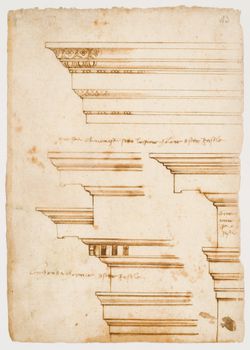
Cara Rachele, chercheure en résidence 2016, présente ses recherches: Cette conférence se penche sur l’explosion de dessins détaillés produits pendant la Renaissance. Elle établit le lien entre l’émergence, au XVIe siècle, du détail devenu un canon du dessin et l’évocation de l’antique matériel. L’évolution organique de la façon de dessiner les détails transparaît dans(...)
Cara Rachele, chercheure en résidence 2016, présente ses recherches: Cette conférence se penche sur l’explosion de dessins détaillés produits pendant la Renaissance. Elle établit le lien entre l’émergence, au XVIe siècle, du détail devenu un canon du dessin et l’évocation de l’antique matériel. L’évolution organique de la façon de dessiner les détails transparaît dans(...)
Date:
11 août 2016, 18h
11 août 2016, 18h
Titre:
Séminaire de chercheur en résidence : Cara Rachele
Actions:
Description:
Cara Rachele, chercheure en résidence 2016, présente ses recherches: Cette conférence se penche sur l’explosion de dessins détaillés produits pendant la Renaissance. Elle établit le lien entre l’émergence, au XVIe siècle, du détail devenu un canon du dessin et l’évocation de l’antique matériel. L’évolution organique de la façon de dessiner les détails transparaît dans(...)
Séminaire de chercheur en résidence : Cara Rachele
Actions:
Description:
Cara Rachele, chercheure en résidence 2016, présente ses recherches: Cette conférence se penche sur l’explosion de dessins détaillés produits pendant la Renaissance. Elle établit le lien entre l’émergence, au XVIe siècle, du détail devenu un canon du dessin et l’évocation de l’antique matériel. L’évolution organique de la façon de dessiner les détails transparaît dans(...)
Classification:
événements
événements
Date:
11 août 2016
18h
11 août 2016
18h


