


18396 Résultats
Classification:
photographies
photographies
Actions:
Numéro de référence:
PH1987:1050
Description:
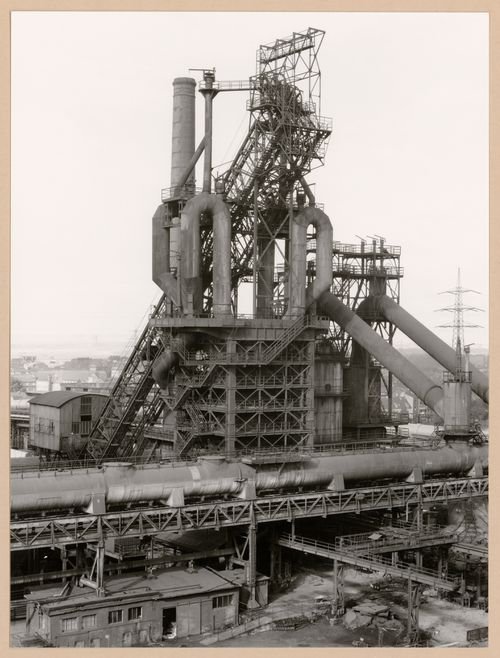
- The group of 86 photographs PH1987:0996 - PH1987:1081 by Bernd and Hilla Becher show 75 views of steel mill blast furnaces and 11 views of mines. There are 45 views of steel mill blast furnaces in Germany, 15 in the United States, and five in each of France, Luxembourg and Belgium. There are five views of mines in Germany, two in Belgium, two in the United States, and one in each of France and Wales. - The group of 86 photographs PH1987:0996 - PH1987:1081 by Bernd and Hilla Becher show 45 views of steel mill blast furnaces in Germany including: 36 views of three blast furnaces of the Metallhüttenwerk in Lübeck-Herrenwyk (PH1987:0996 - PH1987:1031); three views of the Thyssen Hütte steel mill in Ruhrort, Duisburg (PH1987:1033, PH1987:1043 and PH1987:1050); two views of the Gute-Hoffnungs-Hütte steel mill in Oberhausen, Ruhr (PH1987:1044 and PH1987:1070); and one view each of the Klöckner Werke steel mill in Haspe (PH1987:1032), the Schalker Verein steel mill in Gelsenkirchen, Ruhr (PH1987:1042), the Ilseder Hütte steel mill in Ilsede (PH1987:1034) and the Hainer Hütte steel mill in Siegen (PH1987:1045). - The photographers indicate that the group of six photographs PH1987:1048 - PH1987:1053 of views of blast furnaces should be exhibited in two rows arranged from left to right and top to bottom in numerical order according to the photographers' inscriptions "M 1" through "M 6",. Photograph PH1987:1048 would therefore be at the far left of the upper row, while photograph PH1987:1053 would be at the far right of the bottom row (Kicken Pauseback, 1987).
PH1987:1050
Description:
- The group of 86 photographs PH1987:0996 - PH1987:1081 by Bernd and Hilla Becher show 75 views of steel mill blast furnaces and 11 views of mines. There are 45 views of steel mill blast furnaces in Germany, 15 in the United States, and five in each of France, Luxembourg and Belgium. There are five views of mines in Germany, two in Belgium, two in the United States, and one in each of France and Wales. - The group of 86 photographs PH1987:0996 - PH1987:1081 by Bernd and Hilla Becher show 45 views of steel mill blast furnaces in Germany including: 36 views of three blast furnaces of the Metallhüttenwerk in Lübeck-Herrenwyk (PH1987:0996 - PH1987:1031); three views of the Thyssen Hütte steel mill in Ruhrort, Duisburg (PH1987:1033, PH1987:1043 and PH1987:1050); two views of the Gute-Hoffnungs-Hütte steel mill in Oberhausen, Ruhr (PH1987:1044 and PH1987:1070); and one view each of the Klöckner Werke steel mill in Haspe (PH1987:1032), the Schalker Verein steel mill in Gelsenkirchen, Ruhr (PH1987:1042), the Ilseder Hütte steel mill in Ilsede (PH1987:1034) and the Hainer Hütte steel mill in Siegen (PH1987:1045). - The photographers indicate that the group of six photographs PH1987:1048 - PH1987:1053 of views of blast furnaces should be exhibited in two rows arranged from left to right and top to bottom in numerical order according to the photographers' inscriptions "M 1" through "M 6",. Photograph PH1987:1048 would therefore be at the far left of the upper row, while photograph PH1987:1053 would be at the far right of the bottom row (Kicken Pauseback, 1987).
Personnes et institutions:
Sujet:
architecture, ingénierie
architecture, ingénierie
Date:
1971
1971
Titre:
View of a blast furnace of Thyssen Hütte steel mill, Ruhrort, Duisburg, Germany
Actions:
PH1987:1050
Description:
- The group of 86 photographs PH1987:0996 - PH1987:1081 by Bernd and Hilla Becher show 75 views of steel mill blast furnaces and 11 views of mines. There are 45 views of steel mill blast furnaces in Germany, 15 in the United States, and five in each of France, Luxembourg and Belgium. There are five views of mines in Germany, two in Belgium, two in the United States, and one in each of France and Wales. - The group of 86 photographs PH1987:0996 - PH1987:1081 by Bernd and Hilla Becher show 45 views of steel mill blast furnaces in Germany including: 36 views of three blast furnaces of the Metallhüttenwerk in Lübeck-Herrenwyk (PH1987:0996 - PH1987:1031); three views of the Thyssen Hütte steel mill in Ruhrort, Duisburg (PH1987:1033, PH1987:1043 and PH1987:1050); two views of the Gute-Hoffnungs-Hütte steel mill in Oberhausen, Ruhr (PH1987:1044 and PH1987:1070); and one view each of the Klöckner Werke steel mill in Haspe (PH1987:1032), the Schalker Verein steel mill in Gelsenkirchen, Ruhr (PH1987:1042), the Ilseder Hütte steel mill in Ilsede (PH1987:1034) and the Hainer Hütte steel mill in Siegen (PH1987:1045). - The photographers indicate that the group of six photographs PH1987:1048 - PH1987:1053 of views of blast furnaces should be exhibited in two rows arranged from left to right and top to bottom in numerical order according to the photographers' inscriptions "M 1" through "M 6",. Photograph PH1987:1048 would therefore be at the far left of the upper row, while photograph PH1987:1053 would be at the far right of the bottom row (Kicken Pauseback, 1987).
View of a blast furnace of Thyssen Hütte steel mill, Ruhrort, Duisburg, Germany
Actions:
PH1987:1050
Description:
- The group of 86 photographs PH1987:0996 - PH1987:1081 by Bernd and Hilla Becher show 75 views of steel mill blast furnaces and 11 views of mines. There are 45 views of steel mill blast furnaces in Germany, 15 in the United States, and five in each of France, Luxembourg and Belgium. There are five views of mines in Germany, two in Belgium, two in the United States, and one in each of France and Wales. - The group of 86 photographs PH1987:0996 - PH1987:1081 by Bernd and Hilla Becher show 45 views of steel mill blast furnaces in Germany including: 36 views of three blast furnaces of the Metallhüttenwerk in Lübeck-Herrenwyk (PH1987:0996 - PH1987:1031); three views of the Thyssen Hütte steel mill in Ruhrort, Duisburg (PH1987:1033, PH1987:1043 and PH1987:1050); two views of the Gute-Hoffnungs-Hütte steel mill in Oberhausen, Ruhr (PH1987:1044 and PH1987:1070); and one view each of the Klöckner Werke steel mill in Haspe (PH1987:1032), the Schalker Verein steel mill in Gelsenkirchen, Ruhr (PH1987:1042), the Ilseder Hütte steel mill in Ilsede (PH1987:1034) and the Hainer Hütte steel mill in Siegen (PH1987:1045). - The photographers indicate that the group of six photographs PH1987:1048 - PH1987:1053 of views of blast furnaces should be exhibited in two rows arranged from left to right and top to bottom in numerical order according to the photographers' inscriptions "M 1" through "M 6",. Photograph PH1987:1048 would therefore be at the far left of the upper row, while photograph PH1987:1053 would be at the far right of the bottom row (Kicken Pauseback, 1987).
Classification:
photographies
photographies
Date:
1971
1971
Personnes et institutions:
Sujet:
architecture, ingénierie
architecture, ingénierie
Classification:
événements
événements

Actions:
Description:
Tamar Zinguer, chercheure au Programme d’accueil 2014 et professeure associée à la Cooper Union, analyse la propension dans la discipline architecturale pour un terme littéraire « degré zéro ». Cliquez ici pour lévénement Facebook.
Tamar Zinguer, chercheure au Programme d’accueil 2014 et professeure associée à la Cooper Union, analyse la propension dans la discipline architecturale pour un terme littéraire « degré zéro ». Cliquez ici pour lévénement Facebook.
Localisation:
Maison Shaughnessy
Maison Shaughnessy
Date:
10 juillet 2014, 18h
10 juillet 2014, 18h
Titre:
Séminaire de chercheur en résidence : Tamar Zinguer
Actions:
Description:
Tamar Zinguer, chercheure au Programme d’accueil 2014 et professeure associée à la Cooper Union, analyse la propension dans la discipline architecturale pour un terme littéraire « degré zéro ». Cliquez ici pour lévénement Facebook.
Séminaire de chercheur en résidence : Tamar Zinguer
Actions:
Description:
Tamar Zinguer, chercheure au Programme d’accueil 2014 et professeure associée à la Cooper Union, analyse la propension dans la discipline architecturale pour un terme littéraire « degré zéro ». Cliquez ici pour lévénement Facebook.
Classification:
événements
événements
Date:
10 juillet 2014
18h
10 juillet 2014
18h
Localisation:
Maison Shaughnessy
Maison Shaughnessy
Classification:
dessins
dessins
Numéro de référence:
AP075.S3.SS2.090
Description:
Includes flats from the following landscape projects: - Playground for Children's Creative Centre of the Canadian Federal Pavilion at Expo '67, Montréal, Québec, Canada (1965-1967) - Robson Square Provincial Government Complex, Vancouver, British Columbia, Canada (1974-1982) - Dr. Norman Keevil Residence, Vancouver, British Columbia, Canada (1977) - Russell Residence, Tacoma, Washington, United States (1986) - Dr. Norman Keevil Residence (or The Hollies), Vancouver, British Columbia, Canada (1986-1989) - British Columbia Institute of Technology Multi-Tenant Facility, Discovery Parks, Willingdon Site, Burnaby, British Columbia, Canada (1987-1984) - Friedman Residence, Vancouver, British Columbia, Canada (ca. 1988) - Jarvis Residence, 7075 Hudson Street, Vancouver, British Columbia, Canada (1988-1992) -Ottawa City Hall, Ottawa, Ontario, Canada (1989) - University of British Columbia Faculty Club, upgrade and maintenance, Vancouver, British Columbia, Canada (1991)
AP075.S3.SS2.090
Description:
Includes flats from the following landscape projects: - Playground for Children's Creative Centre of the Canadian Federal Pavilion at Expo '67, Montréal, Québec, Canada (1965-1967) - Robson Square Provincial Government Complex, Vancouver, British Columbia, Canada (1974-1982) - Dr. Norman Keevil Residence, Vancouver, British Columbia, Canada (1977) - Russell Residence, Tacoma, Washington, United States (1986) - Dr. Norman Keevil Residence (or The Hollies), Vancouver, British Columbia, Canada (1986-1989) - British Columbia Institute of Technology Multi-Tenant Facility, Discovery Parks, Willingdon Site, Burnaby, British Columbia, Canada (1987-1984) - Friedman Residence, Vancouver, British Columbia, Canada (ca. 1988) - Jarvis Residence, 7075 Hudson Street, Vancouver, British Columbia, Canada (1988-1992) -Ottawa City Hall, Ottawa, Ontario, Canada (1989) - University of British Columbia Faculty Club, upgrade and maintenance, Vancouver, British Columbia, Canada (1991)
Personnes et institutions:
Date:
1965-1991
1965-1991
Titre:
Negatives for presentation drawings for various landscape projects by Cornelia Hahn Oberlander
Actions:
AP075.S3.SS2.090
Description:
Includes flats from the following landscape projects: - Playground for Children's Creative Centre of the Canadian Federal Pavilion at Expo '67, Montréal, Québec, Canada (1965-1967) - Robson Square Provincial Government Complex, Vancouver, British Columbia, Canada (1974-1982) - Dr. Norman Keevil Residence, Vancouver, British Columbia, Canada (1977) - Russell Residence, Tacoma, Washington, United States (1986) - Dr. Norman Keevil Residence (or The Hollies), Vancouver, British Columbia, Canada (1986-1989) - British Columbia Institute of Technology Multi-Tenant Facility, Discovery Parks, Willingdon Site, Burnaby, British Columbia, Canada (1987-1984) - Friedman Residence, Vancouver, British Columbia, Canada (ca. 1988) - Jarvis Residence, 7075 Hudson Street, Vancouver, British Columbia, Canada (1988-1992) -Ottawa City Hall, Ottawa, Ontario, Canada (1989) - University of British Columbia Faculty Club, upgrade and maintenance, Vancouver, British Columbia, Canada (1991)
Negatives for presentation drawings for various landscape projects by Cornelia Hahn Oberlander
Actions:
AP075.S3.SS2.090
Description:
Includes flats from the following landscape projects: - Playground for Children's Creative Centre of the Canadian Federal Pavilion at Expo '67, Montréal, Québec, Canada (1965-1967) - Robson Square Provincial Government Complex, Vancouver, British Columbia, Canada (1974-1982) - Dr. Norman Keevil Residence, Vancouver, British Columbia, Canada (1977) - Russell Residence, Tacoma, Washington, United States (1986) - Dr. Norman Keevil Residence (or The Hollies), Vancouver, British Columbia, Canada (1986-1989) - British Columbia Institute of Technology Multi-Tenant Facility, Discovery Parks, Willingdon Site, Burnaby, British Columbia, Canada (1987-1984) - Friedman Residence, Vancouver, British Columbia, Canada (ca. 1988) - Jarvis Residence, 7075 Hudson Street, Vancouver, British Columbia, Canada (1988-1992) -Ottawa City Hall, Ottawa, Ontario, Canada (1989) - University of British Columbia Faculty Club, upgrade and maintenance, Vancouver, British Columbia, Canada (1991)
Classification:
dessins
dessins
Date:
1965-1991
1965-1991
Personnes et institutions:
Classification:
photographies
photographies
Numéro de référence:
AP140.S2.SS7.D2.P8
Description:
views of projects by the successive firms of James Stirling, James Stirling and Partner and James Stirling, Michael Wilford, and Associates, including the History Faculty Building, University of Cambridge, and Dorman Long Headquarters, and one view of the State Gallery Addition and New Chamber Theatre, and of the Biennale Bookshop, also views of Liverpool, probably photographed in the early 1960s, of the Maison de verre in Paris by architect Pierre Charreau, of the Villa Lante, in Bagnaia, Italy, of Villa Caprola, of churches by architect Balthasar Neumann, of buildings by architect Karl Friedrich Schinkel, also views of Gloucester, Oxford, Salisbury, Longleat, Blenheim, Bath and Stourhead, and of travels in the United States, probably photographed in the 1950s or early 1960s, in Berlin, in Italy, dated 1975, Spain, dated 1976, India, dated 1975 and 1986, Iran, dated 1976, Lambay Island, dated 1981, and Venice, dated 1984
AP140.S2.SS7.D2.P8
Description:
views of projects by the successive firms of James Stirling, James Stirling and Partner and James Stirling, Michael Wilford, and Associates, including the History Faculty Building, University of Cambridge, and Dorman Long Headquarters, and one view of the State Gallery Addition and New Chamber Theatre, and of the Biennale Bookshop, also views of Liverpool, probably photographed in the early 1960s, of the Maison de verre in Paris by architect Pierre Charreau, of the Villa Lante, in Bagnaia, Italy, of Villa Caprola, of churches by architect Balthasar Neumann, of buildings by architect Karl Friedrich Schinkel, also views of Gloucester, Oxford, Salisbury, Longleat, Blenheim, Bath and Stourhead, and of travels in the United States, probably photographed in the 1950s or early 1960s, in Berlin, in Italy, dated 1975, Spain, dated 1976, India, dated 1975 and 1986, Iran, dated 1976, Lambay Island, dated 1981, and Venice, dated 1984
Personnes et institutions:
Titre:
Views of projects by the successive firms of James Stirling
Actions:
AP140.S2.SS7.D2.P8
Description:
views of projects by the successive firms of James Stirling, James Stirling and Partner and James Stirling, Michael Wilford, and Associates, including the History Faculty Building, University of Cambridge, and Dorman Long Headquarters, and one view of the State Gallery Addition and New Chamber Theatre, and of the Biennale Bookshop, also views of Liverpool, probably photographed in the early 1960s, of the Maison de verre in Paris by architect Pierre Charreau, of the Villa Lante, in Bagnaia, Italy, of Villa Caprola, of churches by architect Balthasar Neumann, of buildings by architect Karl Friedrich Schinkel, also views of Gloucester, Oxford, Salisbury, Longleat, Blenheim, Bath and Stourhead, and of travels in the United States, probably photographed in the 1950s or early 1960s, in Berlin, in Italy, dated 1975, Spain, dated 1976, India, dated 1975 and 1986, Iran, dated 1976, Lambay Island, dated 1981, and Venice, dated 1984
Views of projects by the successive firms of James Stirling
Actions:
AP140.S2.SS7.D2.P8
Description:
views of projects by the successive firms of James Stirling, James Stirling and Partner and James Stirling, Michael Wilford, and Associates, including the History Faculty Building, University of Cambridge, and Dorman Long Headquarters, and one view of the State Gallery Addition and New Chamber Theatre, and of the Biennale Bookshop, also views of Liverpool, probably photographed in the early 1960s, of the Maison de verre in Paris by architect Pierre Charreau, of the Villa Lante, in Bagnaia, Italy, of Villa Caprola, of churches by architect Balthasar Neumann, of buildings by architect Karl Friedrich Schinkel, also views of Gloucester, Oxford, Salisbury, Longleat, Blenheim, Bath and Stourhead, and of travels in the United States, probably photographed in the 1950s or early 1960s, in Berlin, in Italy, dated 1975, Spain, dated 1976, India, dated 1975 and 1986, Iran, dated 1976, Lambay Island, dated 1981, and Venice, dated 1984
Classification:
photographies
photographies
Personnes et institutions:
Classification:
archives
Niveau de description archivistique:
Fonds
archives
Niveau de description archivistique:
Fonds
Numéro de référence:
AP058
Résumé:
The Blanche Lemco van Ginkel fonds consists of textual records documenting her participation in professional societies and committees, conferences and lectures, and her administrative and teaching activities at the Faculty of Architecture and Landscape Architecture, University of Toronto, including material relating to the programme and exhibitions. The fonds contains correspondence, reports, minutes, notes, information packages, papers, presentation panels, etc., dating from 1970 to 1992.
AP058
Résumé:
The Blanche Lemco van Ginkel fonds consists of textual records documenting her participation in professional societies and committees, conferences and lectures, and her administrative and teaching activities at the Faculty of Architecture and Landscape Architecture, University of Toronto, including material relating to the programme and exhibitions. The fonds contains correspondence, reports, minutes, notes, information packages, papers, presentation panels, etc., dating from 1970 to 1992.
Personnes et institutions:
Date:
1970-1992
1970-1992
Titre:
Fonds Blanche Lemco van Ginkel
Actions:
AP058
Résumé:
The Blanche Lemco van Ginkel fonds consists of textual records documenting her participation in professional societies and committees, conferences and lectures, and her administrative and teaching activities at the Faculty of Architecture and Landscape Architecture, University of Toronto, including material relating to the programme and exhibitions. The fonds contains correspondence, reports, minutes, notes, information packages, papers, presentation panels, etc., dating from 1970 to 1992.
Fonds Blanche Lemco van Ginkel
Actions:
AP058
Résumé:
The Blanche Lemco van Ginkel fonds consists of textual records documenting her participation in professional societies and committees, conferences and lectures, and her administrative and teaching activities at the Faculty of Architecture and Landscape Architecture, University of Toronto, including material relating to the programme and exhibitions. The fonds contains correspondence, reports, minutes, notes, information packages, papers, presentation panels, etc., dating from 1970 to 1992.
Classification:
archives
Niveau de description archivistique:
Fonds
archives
Niveau de description archivistique:
Fonds
Date:
1970-1992
1970-1992
Personnes et institutions:
Classification:
archives
Niveau de description archivistique:
Fonds
archives
Niveau de description archivistique:
Fonds
Titre:
Fonds Shoei Yoh
Fonds Shoei Yoh
Numéro de référence:
AP166
Résumé:
The Shoei Yoh fonds (1976-2014, predominant 1990-1996) documents a selection of works by the Japanese architect and designer Shoei Yoh and the firm Shoei Yoh + Architects. The selection is comprised of two projects that were featured in the CCA exhibition Archaeology of the Digital (May 7-October 27, 2013)—the Galaxy Toyama Gymnasium and the unbuilt Odawara Municipal Sports Complex --and five other projects.The fonds also includes some published material by and about Shoei Yoh.
AP166
Résumé:
The Shoei Yoh fonds (1976-2014, predominant 1990-1996) documents a selection of works by the Japanese architect and designer Shoei Yoh and the firm Shoei Yoh + Architects. The selection is comprised of two projects that were featured in the CCA exhibition Archaeology of the Digital (May 7-October 27, 2013)—the Galaxy Toyama Gymnasium and the unbuilt Odawara Municipal Sports Complex --and five other projects.The fonds also includes some published material by and about Shoei Yoh.
Personnes et institutions:
Date:
1976-2014, predominant 1990-1996
1976-2014, predominant 1990-1996
Titre:
Fonds Shoei Yoh
Actions:
AP166
Résumé:
The Shoei Yoh fonds (1976-2014, predominant 1990-1996) documents a selection of works by the Japanese architect and designer Shoei Yoh and the firm Shoei Yoh + Architects. The selection is comprised of two projects that were featured in the CCA exhibition Archaeology of the Digital (May 7-October 27, 2013)—the Galaxy Toyama Gymnasium and the unbuilt Odawara Municipal Sports Complex --and five other projects.The fonds also includes some published material by and about Shoei Yoh.
Fonds Shoei Yoh
Actions:
AP166
Résumé:
The Shoei Yoh fonds (1976-2014, predominant 1990-1996) documents a selection of works by the Japanese architect and designer Shoei Yoh and the firm Shoei Yoh + Architects. The selection is comprised of two projects that were featured in the CCA exhibition Archaeology of the Digital (May 7-October 27, 2013)—the Galaxy Toyama Gymnasium and the unbuilt Odawara Municipal Sports Complex --and five other projects.The fonds also includes some published material by and about Shoei Yoh.
Classification:
archives
Niveau de description archivistique:
Fonds
archives
Niveau de description archivistique:
Fonds
Date:
1976-2014, predominant 1990-1996
1976-2014, predominant 1990-1996
Personnes et institutions:
Classification:
photographies
photographies
Numéro de référence:
ARCH276588
Description:
Binder contains presentation slides for projects filed under, "Education." Includes : Stanford University Biological Sciences Expansion, University of California Biological Sciences Unit 2, North Carolina State University Textile School, Biological Science and Chemistry Building Western Washington University, University of California Clinical Sciences Building, Kwantlen College Surrey Campus, United Arab Emirates University, Washington State University Downtown Campus, University of Arizona Business School, West Mall Complex S.F.U., Central Library Phase 1 U.B.C., Contemporary Art Centre S.F.U.
ARCH276588
Description:
Binder contains presentation slides for projects filed under, "Education." Includes : Stanford University Biological Sciences Expansion, University of California Biological Sciences Unit 2, North Carolina State University Textile School, Biological Science and Chemistry Building Western Washington University, University of California Clinical Sciences Building, Kwantlen College Surrey Campus, United Arab Emirates University, Washington State University Downtown Campus, University of Arizona Business School, West Mall Complex S.F.U., Central Library Phase 1 U.B.C., Contemporary Art Centre S.F.U.
Personnes et institutions:
Date:
1985-1991
1985-1991
Titre:
Presentation slides for various educational buildings projects
Actions:
ARCH276588
Description:
Binder contains presentation slides for projects filed under, "Education." Includes : Stanford University Biological Sciences Expansion, University of California Biological Sciences Unit 2, North Carolina State University Textile School, Biological Science and Chemistry Building Western Washington University, University of California Clinical Sciences Building, Kwantlen College Surrey Campus, United Arab Emirates University, Washington State University Downtown Campus, University of Arizona Business School, West Mall Complex S.F.U., Central Library Phase 1 U.B.C., Contemporary Art Centre S.F.U.
Presentation slides for various educational buildings projects
Actions:
ARCH276588
Description:
Binder contains presentation slides for projects filed under, "Education." Includes : Stanford University Biological Sciences Expansion, University of California Biological Sciences Unit 2, North Carolina State University Textile School, Biological Science and Chemistry Building Western Washington University, University of California Clinical Sciences Building, Kwantlen College Surrey Campus, United Arab Emirates University, Washington State University Downtown Campus, University of Arizona Business School, West Mall Complex S.F.U., Central Library Phase 1 U.B.C., Contemporary Art Centre S.F.U.
Classification:
photographies
photographies
Date:
1985-1991
1985-1991
Personnes et institutions:
Classification:
archives
Niveau de description archivistique:
Fonds
archives
Niveau de description archivistique:
Fonds
Numéro de référence:
AP226
Résumé:
The Toyo Ito & Associates, Architects fonds, 1970 – 2011, documents the studio’s architectural work and involvement in selected exhibitions in the 1970s and 1980s. The records in this fonds represent 34 architectural projects, including built, unbuilt, and conceptual projects. The majority of the projects are located in Japan and are mostly documented through drawings as well as a limited number of videos, models, panels, textual records, and photographs. The fonds also contains records related to Toyo Ito & Associates, Architects’ participation in three exhibitions in the USA and the UK in 1978 and 1986.
AP226
Résumé:
The Toyo Ito & Associates, Architects fonds, 1970 – 2011, documents the studio’s architectural work and involvement in selected exhibitions in the 1970s and 1980s. The records in this fonds represent 34 architectural projects, including built, unbuilt, and conceptual projects. The majority of the projects are located in Japan and are mostly documented through drawings as well as a limited number of videos, models, panels, textual records, and photographs. The fonds also contains records related to Toyo Ito & Associates, Architects’ participation in three exhibitions in the USA and the UK in 1978 and 1986.
Personnes et institutions:
Date:
1970 - 2011
1970 - 2011
Titre:
Toyo Ito & Associates, Architects fonds
Actions:
AP226
Résumé:
The Toyo Ito & Associates, Architects fonds, 1970 – 2011, documents the studio’s architectural work and involvement in selected exhibitions in the 1970s and 1980s. The records in this fonds represent 34 architectural projects, including built, unbuilt, and conceptual projects. The majority of the projects are located in Japan and are mostly documented through drawings as well as a limited number of videos, models, panels, textual records, and photographs. The fonds also contains records related to Toyo Ito & Associates, Architects’ participation in three exhibitions in the USA and the UK in 1978 and 1986.
Toyo Ito & Associates, Architects fonds
Actions:
AP226
Résumé:
The Toyo Ito & Associates, Architects fonds, 1970 – 2011, documents the studio’s architectural work and involvement in selected exhibitions in the 1970s and 1980s. The records in this fonds represent 34 architectural projects, including built, unbuilt, and conceptual projects. The majority of the projects are located in Japan and are mostly documented through drawings as well as a limited number of videos, models, panels, textual records, and photographs. The fonds also contains records related to Toyo Ito & Associates, Architects’ participation in three exhibitions in the USA and the UK in 1978 and 1986.
Classification:
archives
Niveau de description archivistique:
Fonds
archives
Niveau de description archivistique:
Fonds
Date:
1970 - 2011
1970 - 2011
Personnes et institutions:
Niveau de description archivistique:
Projet
Projet
Titre:
Castelli House
Castelli House
Numéro de référence:
AP143.S4.D26
Description:
This project series documents an unexecuted project for Castelli House, also known as House El Even Odd, designed for the exhibition "Houses for Sale" displayed at the Leo Castelli Gallery in New York, and later at the James Corcoran Gallery in Los Angeles, United States. Material in this file was produced in 1980. There are few drawings by Eisenman for this house; he is most concerned with publication layouts in twelve of the drawings (DR1994:0140:001-012). An original transformation diagram documents the triple axonometric transformation of the "el" (DR1994:0140:051, published in Archer, 24-25). Two texts by Eisenman concerning House El Even Odd explain his intentions (published in Archer, 18-19). These texts, currently grouped with the material for Fin d'Ou T Hou S (DR1994:0141:250-252), are positive prints of the KC5 negative DR1994:0140:079. Fragments of models for House El Even Odd are also included in this project series; finished versions of the models are part of the CCA can be found in file DR1987:0857 and DR1987:0858. Note that model DR1994:0140:080 is in pieces and could not be measured. File contains conceptual drawings, design development drawings, presentation drawings, models, photographic material, and textual records. Conceptual drawings include plans and axonometrics - many graphite or black felt-tip pen on wove paper and some coloured felt-tip pen on tracing paper; and reprographic copies - one photocopy one wove paper. Design development drawings include plans, sections, and elevations - some graphite and/or black felt-tip pen on yellow trace. Presentation drawings include plans, sections, elevations, perspectives, and axonometrics - many pen and black ink and translucent adhesive coloured film on mylar and some pen and black ink on tracing vellum; reprographic copies - mostly blueline prints on wove paper; and one photomechanical print - on wove paper. Notes include notes and an invoice - one pen and black ink on wove paper and one graphite on ruled paper.
AP143.S4.D26
Description:
This project series documents an unexecuted project for Castelli House, also known as House El Even Odd, designed for the exhibition "Houses for Sale" displayed at the Leo Castelli Gallery in New York, and later at the James Corcoran Gallery in Los Angeles, United States. Material in this file was produced in 1980. There are few drawings by Eisenman for this house; he is most concerned with publication layouts in twelve of the drawings (DR1994:0140:001-012). An original transformation diagram documents the triple axonometric transformation of the "el" (DR1994:0140:051, published in Archer, 24-25). Two texts by Eisenman concerning House El Even Odd explain his intentions (published in Archer, 18-19). These texts, currently grouped with the material for Fin d'Ou T Hou S (DR1994:0141:250-252), are positive prints of the KC5 negative DR1994:0140:079. Fragments of models for House El Even Odd are also included in this project series; finished versions of the models are part of the CCA can be found in file DR1987:0857 and DR1987:0858. Note that model DR1994:0140:080 is in pieces and could not be measured. File contains conceptual drawings, design development drawings, presentation drawings, models, photographic material, and textual records. Conceptual drawings include plans and axonometrics - many graphite or black felt-tip pen on wove paper and some coloured felt-tip pen on tracing paper; and reprographic copies - one photocopy one wove paper. Design development drawings include plans, sections, and elevations - some graphite and/or black felt-tip pen on yellow trace. Presentation drawings include plans, sections, elevations, perspectives, and axonometrics - many pen and black ink and translucent adhesive coloured film on mylar and some pen and black ink on tracing vellum; reprographic copies - mostly blueline prints on wove paper; and one photomechanical print - on wove paper. Notes include notes and an invoice - one pen and black ink on wove paper and one graphite on ruled paper.
Personnes et institutions:
Date:
1980
1980
Titre:
Castelli House
Actions:
AP143.S4.D26
Description:
This project series documents an unexecuted project for Castelli House, also known as House El Even Odd, designed for the exhibition "Houses for Sale" displayed at the Leo Castelli Gallery in New York, and later at the James Corcoran Gallery in Los Angeles, United States. Material in this file was produced in 1980. There are few drawings by Eisenman for this house; he is most concerned with publication layouts in twelve of the drawings (DR1994:0140:001-012). An original transformation diagram documents the triple axonometric transformation of the "el" (DR1994:0140:051, published in Archer, 24-25). Two texts by Eisenman concerning House El Even Odd explain his intentions (published in Archer, 18-19). These texts, currently grouped with the material for Fin d'Ou T Hou S (DR1994:0141:250-252), are positive prints of the KC5 negative DR1994:0140:079. Fragments of models for House El Even Odd are also included in this project series; finished versions of the models are part of the CCA can be found in file DR1987:0857 and DR1987:0858. Note that model DR1994:0140:080 is in pieces and could not be measured. File contains conceptual drawings, design development drawings, presentation drawings, models, photographic material, and textual records. Conceptual drawings include plans and axonometrics - many graphite or black felt-tip pen on wove paper and some coloured felt-tip pen on tracing paper; and reprographic copies - one photocopy one wove paper. Design development drawings include plans, sections, and elevations - some graphite and/or black felt-tip pen on yellow trace. Presentation drawings include plans, sections, elevations, perspectives, and axonometrics - many pen and black ink and translucent adhesive coloured film on mylar and some pen and black ink on tracing vellum; reprographic copies - mostly blueline prints on wove paper; and one photomechanical print - on wove paper. Notes include notes and an invoice - one pen and black ink on wove paper and one graphite on ruled paper.
Castelli House
Actions:
AP143.S4.D26
Description:
This project series documents an unexecuted project for Castelli House, also known as House El Even Odd, designed for the exhibition "Houses for Sale" displayed at the Leo Castelli Gallery in New York, and later at the James Corcoran Gallery in Los Angeles, United States. Material in this file was produced in 1980. There are few drawings by Eisenman for this house; he is most concerned with publication layouts in twelve of the drawings (DR1994:0140:001-012). An original transformation diagram documents the triple axonometric transformation of the "el" (DR1994:0140:051, published in Archer, 24-25). Two texts by Eisenman concerning House El Even Odd explain his intentions (published in Archer, 18-19). These texts, currently grouped with the material for Fin d'Ou T Hou S (DR1994:0141:250-252), are positive prints of the KC5 negative DR1994:0140:079. Fragments of models for House El Even Odd are also included in this project series; finished versions of the models are part of the CCA can be found in file DR1987:0857 and DR1987:0858. Note that model DR1994:0140:080 is in pieces and could not be measured. File contains conceptual drawings, design development drawings, presentation drawings, models, photographic material, and textual records. Conceptual drawings include plans and axonometrics - many graphite or black felt-tip pen on wove paper and some coloured felt-tip pen on tracing paper; and reprographic copies - one photocopy one wove paper. Design development drawings include plans, sections, and elevations - some graphite and/or black felt-tip pen on yellow trace. Presentation drawings include plans, sections, elevations, perspectives, and axonometrics - many pen and black ink and translucent adhesive coloured film on mylar and some pen and black ink on tracing vellum; reprographic copies - mostly blueline prints on wove paper; and one photomechanical print - on wove paper. Notes include notes and an invoice - one pen and black ink on wove paper and one graphite on ruled paper.
Niveau de description archivistique:
File 26
File 26
Date:
1980
1980
Personnes et institutions:
Niveau de description archivistique:
Sous-série
Sous-série
Numéro de référence:
AP022.S3.SS3
Description:
Sub-series documents public relations, marketing activities and collaborations of the offices of Erickson / Massey and Arthur Erickson Architects in Vancouver, British columbia, and Toronto, Ontario. The material was intended for media and press releases, publications, photographs and information requests, presentations, publicity and marketing brochures, and includes project descriptions, photographs and slides, magazine articles and clippings, publication drawings, galley proofs for books and a Life Magazine article on the Graham House, correspondence, and printing plates for a publicity brochure. Sub-series also documents Erickson / Massey and Arthur Erickson Architects collaboration with Francisco Imported Furniture Ltd the company of Francisco Leopoldo Kripacz (b. 8 April, 1942 - d. 3 August, 2000). Kripacz was born in Caracas, Venezuela, educated in Europe, the United States, and studied design in Vancouver and New York. He also went to the University of British Columbia for a Bachelor of Commerce degree in 1964. He became a resident Canadian in 1961, and a Canadian citizen in 1973. In 1964 he founded an interior design and furniture import business in Vancouver with Arthur Erickson, and opened a showroom in Montreal (550 Sherbrooke St. West), in 1965. Kripacz designed the exhibition unit in Habitat 67 (by architect Moshe Safdie) for the 1967 World Exposition in Montreal, and created interiors for a private clientel as well as for many of Arthur Erickson's buildings. The latter included the Helmut Eppich House and Erickson's own residence in Vancouver, the Hilborn Residence in Ontario, the Prime Minister's office and resdence in Ottawa, the UBC Faculty Club, the Macmillan Blodel Bulding, Vancouver, the Bank of Canada Headquarters in Ottawa, the Student Union Building at Queen's University, Kingston, the Provincial Law Courts in Robson Square, Vancouver, Roy Thomson Hall and the Tech Mining offices in Toronto, the Canadian Chancery in Washington, D.C., amongst others. Material related to Francisco Imported Furniture Ltd Sub-series also contains professional correspondence with Arthur Erickson Architect, financial documents of Francisco Imported Furniture Ltd, furniture design proposals, photographs and personal correspondance files of Francisco Kripacz.
AP022.S3.SS3
Description:
Sub-series documents public relations, marketing activities and collaborations of the offices of Erickson / Massey and Arthur Erickson Architects in Vancouver, British columbia, and Toronto, Ontario. The material was intended for media and press releases, publications, photographs and information requests, presentations, publicity and marketing brochures, and includes project descriptions, photographs and slides, magazine articles and clippings, publication drawings, galley proofs for books and a Life Magazine article on the Graham House, correspondence, and printing plates for a publicity brochure. Sub-series also documents Erickson / Massey and Arthur Erickson Architects collaboration with Francisco Imported Furniture Ltd the company of Francisco Leopoldo Kripacz (b. 8 April, 1942 - d. 3 August, 2000). Kripacz was born in Caracas, Venezuela, educated in Europe, the United States, and studied design in Vancouver and New York. He also went to the University of British Columbia for a Bachelor of Commerce degree in 1964. He became a resident Canadian in 1961, and a Canadian citizen in 1973. In 1964 he founded an interior design and furniture import business in Vancouver with Arthur Erickson, and opened a showroom in Montreal (550 Sherbrooke St. West), in 1965. Kripacz designed the exhibition unit in Habitat 67 (by architect Moshe Safdie) for the 1967 World Exposition in Montreal, and created interiors for a private clientel as well as for many of Arthur Erickson's buildings. The latter included the Helmut Eppich House and Erickson's own residence in Vancouver, the Hilborn Residence in Ontario, the Prime Minister's office and resdence in Ottawa, the UBC Faculty Club, the Macmillan Blodel Bulding, Vancouver, the Bank of Canada Headquarters in Ottawa, the Student Union Building at Queen's University, Kingston, the Provincial Law Courts in Robson Square, Vancouver, Roy Thomson Hall and the Tech Mining offices in Toronto, the Canadian Chancery in Washington, D.C., amongst others. Material related to Francisco Imported Furniture Ltd Sub-series also contains professional correspondence with Arthur Erickson Architect, financial documents of Francisco Imported Furniture Ltd, furniture design proposals, photographs and personal correspondance files of Francisco Kripacz.
Personnes et institutions:
Date:
1967-1988
1967-1988
Titre:
Public relations, marketing and collaborations
Actions:
AP022.S3.SS3
Description:
Sub-series documents public relations, marketing activities and collaborations of the offices of Erickson / Massey and Arthur Erickson Architects in Vancouver, British columbia, and Toronto, Ontario. The material was intended for media and press releases, publications, photographs and information requests, presentations, publicity and marketing brochures, and includes project descriptions, photographs and slides, magazine articles and clippings, publication drawings, galley proofs for books and a Life Magazine article on the Graham House, correspondence, and printing plates for a publicity brochure. Sub-series also documents Erickson / Massey and Arthur Erickson Architects collaboration with Francisco Imported Furniture Ltd the company of Francisco Leopoldo Kripacz (b. 8 April, 1942 - d. 3 August, 2000). Kripacz was born in Caracas, Venezuela, educated in Europe, the United States, and studied design in Vancouver and New York. He also went to the University of British Columbia for a Bachelor of Commerce degree in 1964. He became a resident Canadian in 1961, and a Canadian citizen in 1973. In 1964 he founded an interior design and furniture import business in Vancouver with Arthur Erickson, and opened a showroom in Montreal (550 Sherbrooke St. West), in 1965. Kripacz designed the exhibition unit in Habitat 67 (by architect Moshe Safdie) for the 1967 World Exposition in Montreal, and created interiors for a private clientel as well as for many of Arthur Erickson's buildings. The latter included the Helmut Eppich House and Erickson's own residence in Vancouver, the Hilborn Residence in Ontario, the Prime Minister's office and resdence in Ottawa, the UBC Faculty Club, the Macmillan Blodel Bulding, Vancouver, the Bank of Canada Headquarters in Ottawa, the Student Union Building at Queen's University, Kingston, the Provincial Law Courts in Robson Square, Vancouver, Roy Thomson Hall and the Tech Mining offices in Toronto, the Canadian Chancery in Washington, D.C., amongst others. Material related to Francisco Imported Furniture Ltd Sub-series also contains professional correspondence with Arthur Erickson Architect, financial documents of Francisco Imported Furniture Ltd, furniture design proposals, photographs and personal correspondance files of Francisco Kripacz.
Public relations, marketing and collaborations
Actions:
AP022.S3.SS3
Description:
Sub-series documents public relations, marketing activities and collaborations of the offices of Erickson / Massey and Arthur Erickson Architects in Vancouver, British columbia, and Toronto, Ontario. The material was intended for media and press releases, publications, photographs and information requests, presentations, publicity and marketing brochures, and includes project descriptions, photographs and slides, magazine articles and clippings, publication drawings, galley proofs for books and a Life Magazine article on the Graham House, correspondence, and printing plates for a publicity brochure. Sub-series also documents Erickson / Massey and Arthur Erickson Architects collaboration with Francisco Imported Furniture Ltd the company of Francisco Leopoldo Kripacz (b. 8 April, 1942 - d. 3 August, 2000). Kripacz was born in Caracas, Venezuela, educated in Europe, the United States, and studied design in Vancouver and New York. He also went to the University of British Columbia for a Bachelor of Commerce degree in 1964. He became a resident Canadian in 1961, and a Canadian citizen in 1973. In 1964 he founded an interior design and furniture import business in Vancouver with Arthur Erickson, and opened a showroom in Montreal (550 Sherbrooke St. West), in 1965. Kripacz designed the exhibition unit in Habitat 67 (by architect Moshe Safdie) for the 1967 World Exposition in Montreal, and created interiors for a private clientel as well as for many of Arthur Erickson's buildings. The latter included the Helmut Eppich House and Erickson's own residence in Vancouver, the Hilborn Residence in Ontario, the Prime Minister's office and resdence in Ottawa, the UBC Faculty Club, the Macmillan Blodel Bulding, Vancouver, the Bank of Canada Headquarters in Ottawa, the Student Union Building at Queen's University, Kingston, the Provincial Law Courts in Robson Square, Vancouver, Roy Thomson Hall and the Tech Mining offices in Toronto, the Canadian Chancery in Washington, D.C., amongst others. Material related to Francisco Imported Furniture Ltd Sub-series also contains professional correspondence with Arthur Erickson Architect, financial documents of Francisco Imported Furniture Ltd, furniture design proposals, photographs and personal correspondance files of Francisco Kripacz.
Niveau de description archivistique:
sub-series
sub-series
Date:
1967-1988
1967-1988
Personnes et institutions:


