


36938 Résultats
Classification:
archives
Niveau de description archivistique:
Fonds
archives
Niveau de description archivistique:
Fonds
Numéro de référence:
AP183
Résumé:
The Ulrich Königs Chemnitz Stadium project records, 1995-1996, document the competition entry and design for an innovative stadium in Chemnitz, Germany. The project was a collaboration between Peter Kulka, Ulrich Königs, Cecil Balmond, and Arup Group, Ltd. The design was primarily driven by the theoretical and methodological processes made possible by computer-aided design, rather than aesthetics. The project records have both digital and physical components, which chiefly include renderings, wireframe drawings, digital 3D models, photographs, slides, video, and a booklet.
AP183
Résumé:
The Ulrich Königs Chemnitz Stadium project records, 1995-1996, document the competition entry and design for an innovative stadium in Chemnitz, Germany. The project was a collaboration between Peter Kulka, Ulrich Königs, Cecil Balmond, and Arup Group, Ltd. The design was primarily driven by the theoretical and methodological processes made possible by computer-aided design, rather than aesthetics. The project records have both digital and physical components, which chiefly include renderings, wireframe drawings, digital 3D models, photographs, slides, video, and a booklet.
Personnes et institutions:
Date:
1995-1996
1995-1996
Titre:
Documents d’archives d’Ulrich Königs pour le projet Chemnitz Stadium
Actions:
AP183
Résumé:
The Ulrich Königs Chemnitz Stadium project records, 1995-1996, document the competition entry and design for an innovative stadium in Chemnitz, Germany. The project was a collaboration between Peter Kulka, Ulrich Königs, Cecil Balmond, and Arup Group, Ltd. The design was primarily driven by the theoretical and methodological processes made possible by computer-aided design, rather than aesthetics. The project records have both digital and physical components, which chiefly include renderings, wireframe drawings, digital 3D models, photographs, slides, video, and a booklet.
Documents d’archives d’Ulrich Königs pour le projet Chemnitz Stadium
Actions:
AP183
Résumé:
The Ulrich Königs Chemnitz Stadium project records, 1995-1996, document the competition entry and design for an innovative stadium in Chemnitz, Germany. The project was a collaboration between Peter Kulka, Ulrich Königs, Cecil Balmond, and Arup Group, Ltd. The design was primarily driven by the theoretical and methodological processes made possible by computer-aided design, rather than aesthetics. The project records have both digital and physical components, which chiefly include renderings, wireframe drawings, digital 3D models, photographs, slides, video, and a booklet.
Classification:
archives
Niveau de description archivistique:
Fonds
archives
Niveau de description archivistique:
Fonds
Date:
1995-1996
1995-1996
Personnes et institutions:
Classification:
archives
Niveau de description archivistique:
Fonds
archives
Niveau de description archivistique:
Fonds
Titre:
Fonds Ray Affleck
Fonds Ray Affleck
Numéro de référence:
AP088
Résumé:
The Ray Affleck fonds, 1952-1989, documents Raymond Tait Affleck’s professional career as an associate at Affleck, Desbarats, Dimakopoulos, Lebensold, Michaud, Sise (1958-1970) and a principal at Arcop Associates (1970-1989). The fonds comprises of approximately 370 administrative files that were collected by Affleck’s personal secretaries from 1952 to 1989.
AP088
Résumé:
The Ray Affleck fonds, 1952-1989, documents Raymond Tait Affleck’s professional career as an associate at Affleck, Desbarats, Dimakopoulos, Lebensold, Michaud, Sise (1958-1970) and a principal at Arcop Associates (1970-1989). The fonds comprises of approximately 370 administrative files that were collected by Affleck’s personal secretaries from 1952 to 1989.
Personnes et institutions:
Date:
1952-1989
1952-1989
Titre:
Fonds Ray Affleck
Actions:
AP088
Résumé:
The Ray Affleck fonds, 1952-1989, documents Raymond Tait Affleck’s professional career as an associate at Affleck, Desbarats, Dimakopoulos, Lebensold, Michaud, Sise (1958-1970) and a principal at Arcop Associates (1970-1989). The fonds comprises of approximately 370 administrative files that were collected by Affleck’s personal secretaries from 1952 to 1989.
Fonds Ray Affleck
Actions:
AP088
Résumé:
The Ray Affleck fonds, 1952-1989, documents Raymond Tait Affleck’s professional career as an associate at Affleck, Desbarats, Dimakopoulos, Lebensold, Michaud, Sise (1958-1970) and a principal at Arcop Associates (1970-1989). The fonds comprises of approximately 370 administrative files that were collected by Affleck’s personal secretaries from 1952 to 1989.
Classification:
archives
Niveau de description archivistique:
Fonds
archives
Niveau de description archivistique:
Fonds
Date:
1952-1989
1952-1989
Personnes et institutions:
Niveau de description archivistique:
Projet
Projet
Numéro de référence:
AP164.S1.1995.D1
Description:
The project series documents the competition entry, design, and execution of the José Hierro public library in the Usera district, Madrid, Spain. Abalos & Herreros were invited to participate in the competition organised by Consejería de Educación y Cultura (Council for Education and Culture), of the Comunidad de Autónoma de Madrid, and their entry won. The firm worked in collaboration with architect Ángel S. Jaramillo and artist Peter Halley. The firm identified this project as number 94. In 2003, this project was a finalist at the 7th edition of the Bienal de Arquitectua Española and received a mention at the 17th edition of the Premios de Urbanismo, Arquitectura y Obra Publica 2003 from the Madrid City Council. Documenting the project are design development and working drawings, correspondence, notes, project descriptions, studies, specifications, photographic materials and a model.
AP164.S1.1995.D1
Description:
The project series documents the competition entry, design, and execution of the José Hierro public library in the Usera district, Madrid, Spain. Abalos & Herreros were invited to participate in the competition organised by Consejería de Educación y Cultura (Council for Education and Culture), of the Comunidad de Autónoma de Madrid, and their entry won. The firm worked in collaboration with architect Ángel S. Jaramillo and artist Peter Halley. The firm identified this project as number 94. In 2003, this project was a finalist at the 7th edition of the Bienal de Arquitectua Española and received a mention at the 17th edition of the Premios de Urbanismo, Arquitectura y Obra Publica 2003 from the Madrid City Council. Documenting the project are design development and working drawings, correspondence, notes, project descriptions, studies, specifications, photographic materials and a model.
Personnes et institutions:
Date:
1995-2003
1995-2003
Titre:
Biblioteca de Usera, Madrid, Spain (1995-2003)
Actions:
AP164.S1.1995.D1
Description:
The project series documents the competition entry, design, and execution of the José Hierro public library in the Usera district, Madrid, Spain. Abalos & Herreros were invited to participate in the competition organised by Consejería de Educación y Cultura (Council for Education and Culture), of the Comunidad de Autónoma de Madrid, and their entry won. The firm worked in collaboration with architect Ángel S. Jaramillo and artist Peter Halley. The firm identified this project as number 94. In 2003, this project was a finalist at the 7th edition of the Bienal de Arquitectua Española and received a mention at the 17th edition of the Premios de Urbanismo, Arquitectura y Obra Publica 2003 from the Madrid City Council. Documenting the project are design development and working drawings, correspondence, notes, project descriptions, studies, specifications, photographic materials and a model.
Biblioteca de Usera, Madrid, Spain (1995-2003)
Actions:
AP164.S1.1995.D1
Description:
The project series documents the competition entry, design, and execution of the José Hierro public library in the Usera district, Madrid, Spain. Abalos & Herreros were invited to participate in the competition organised by Consejería de Educación y Cultura (Council for Education and Culture), of the Comunidad de Autónoma de Madrid, and their entry won. The firm worked in collaboration with architect Ángel S. Jaramillo and artist Peter Halley. The firm identified this project as number 94. In 2003, this project was a finalist at the 7th edition of the Bienal de Arquitectua Española and received a mention at the 17th edition of the Premios de Urbanismo, Arquitectura y Obra Publica 2003 from the Madrid City Council. Documenting the project are design development and working drawings, correspondence, notes, project descriptions, studies, specifications, photographic materials and a model.
Niveau de description archivistique:
Project
Project
Date:
1995-2003
1995-2003
Personnes et institutions:
Niveau de description archivistique:
Projet
Projet
Numéro de référence:
AP164.S1.2000.D3
Description:
The project series documents the competition, design, and construction of a gymnastics pavillion in Retiro park for the Instituto Municipal de Deporte of Madrid, Spain. Abalos & Herreros were invited to enter this competition and won first prize in collaboration with Renata Sentkiewicz. The project includes changing rooms, offices and a gymnasium, and was integrated into the surrounding and growing vegetation of the park. The firm worked in collaboration with Fermina Garrido and Obiol y Moya. The firm identified this project as number 127. In 2004, the firm received the Public Initiative Award for this project at the 28th Premios de Urbanismo, Arquitectura y Obra Publica 2003 from the Madrid City Council. Documenting this project are presentation, design development and working drawings, correspondence, project descriptions, budgets, specifications, postcards, notes, and reference, graphic, photographic and digital materials.
AP164.S1.2000.D3
Description:
The project series documents the competition, design, and construction of a gymnastics pavillion in Retiro park for the Instituto Municipal de Deporte of Madrid, Spain. Abalos & Herreros were invited to enter this competition and won first prize in collaboration with Renata Sentkiewicz. The project includes changing rooms, offices and a gymnasium, and was integrated into the surrounding and growing vegetation of the park. The firm worked in collaboration with Fermina Garrido and Obiol y Moya. The firm identified this project as number 127. In 2004, the firm received the Public Initiative Award for this project at the 28th Premios de Urbanismo, Arquitectura y Obra Publica 2003 from the Madrid City Council. Documenting this project are presentation, design development and working drawings, correspondence, project descriptions, budgets, specifications, postcards, notes, and reference, graphic, photographic and digital materials.
Personnes et institutions:
Date:
1989-2003
1989-2003
Titre:
Pabellón de gimnasia en el parque del Retiro, Madrid, Spain (2000-2003)
Actions:
AP164.S1.2000.D3
Description:
The project series documents the competition, design, and construction of a gymnastics pavillion in Retiro park for the Instituto Municipal de Deporte of Madrid, Spain. Abalos & Herreros were invited to enter this competition and won first prize in collaboration with Renata Sentkiewicz. The project includes changing rooms, offices and a gymnasium, and was integrated into the surrounding and growing vegetation of the park. The firm worked in collaboration with Fermina Garrido and Obiol y Moya. The firm identified this project as number 127. In 2004, the firm received the Public Initiative Award for this project at the 28th Premios de Urbanismo, Arquitectura y Obra Publica 2003 from the Madrid City Council. Documenting this project are presentation, design development and working drawings, correspondence, project descriptions, budgets, specifications, postcards, notes, and reference, graphic, photographic and digital materials.
Pabellón de gimnasia en el parque del Retiro, Madrid, Spain (2000-2003)
Actions:
AP164.S1.2000.D3
Description:
The project series documents the competition, design, and construction of a gymnastics pavillion in Retiro park for the Instituto Municipal de Deporte of Madrid, Spain. Abalos & Herreros were invited to enter this competition and won first prize in collaboration with Renata Sentkiewicz. The project includes changing rooms, offices and a gymnasium, and was integrated into the surrounding and growing vegetation of the park. The firm worked in collaboration with Fermina Garrido and Obiol y Moya. The firm identified this project as number 127. In 2004, the firm received the Public Initiative Award for this project at the 28th Premios de Urbanismo, Arquitectura y Obra Publica 2003 from the Madrid City Council. Documenting this project are presentation, design development and working drawings, correspondence, project descriptions, budgets, specifications, postcards, notes, and reference, graphic, photographic and digital materials.
Niveau de description archivistique:
Project
Project
Date:
1989-2003
1989-2003
Personnes et institutions:
Niveau de description archivistique:
Projet
Projet
Numéro de référence:
AP206.S1.1986.PR01
Description:
This project series documents the Maharaja Aggarsain Public School in Kurukshetra, India from 1986-1987. The project consisted of a U-shaped building that surrounded a large playground courtyard and included a dormitory block on the west, a classroom block on the east and an auditorium block that joined the other two. In some schemes, a swimming pool block completes the square at the open end. The elevations facing the interior playground were lined with verandas that had large, repeated archway openings. The other elevations followed this style through the use of arched windows and doors. Additional courtyards placed evenly throughout the east and west blocks created communal spaces within the school. The project is recorded through drawings, most of which are originals, consisting of plans, elevations, sections and details dating from 1986-1987.
AP206.S1.1986.PR01
Description:
This project series documents the Maharaja Aggarsain Public School in Kurukshetra, India from 1986-1987. The project consisted of a U-shaped building that surrounded a large playground courtyard and included a dormitory block on the west, a classroom block on the east and an auditorium block that joined the other two. In some schemes, a swimming pool block completes the square at the open end. The elevations facing the interior playground were lined with verandas that had large, repeated archway openings. The other elevations followed this style through the use of arched windows and doors. Additional courtyards placed evenly throughout the east and west blocks created communal spaces within the school. The project is recorded through drawings, most of which are originals, consisting of plans, elevations, sections and details dating from 1986-1987.
Personnes et institutions:
Date:
1986-1987
1986-1987
Titre:
Maharaja Aggarsain Public School, Kurukshetra, India (1986-1987)
Actions:
AP206.S1.1986.PR01
Description:
This project series documents the Maharaja Aggarsain Public School in Kurukshetra, India from 1986-1987. The project consisted of a U-shaped building that surrounded a large playground courtyard and included a dormitory block on the west, a classroom block on the east and an auditorium block that joined the other two. In some schemes, a swimming pool block completes the square at the open end. The elevations facing the interior playground were lined with verandas that had large, repeated archway openings. The other elevations followed this style through the use of arched windows and doors. Additional courtyards placed evenly throughout the east and west blocks created communal spaces within the school. The project is recorded through drawings, most of which are originals, consisting of plans, elevations, sections and details dating from 1986-1987.
Maharaja Aggarsain Public School, Kurukshetra, India (1986-1987)
Actions:
AP206.S1.1986.PR01
Description:
This project series documents the Maharaja Aggarsain Public School in Kurukshetra, India from 1986-1987. The project consisted of a U-shaped building that surrounded a large playground courtyard and included a dormitory block on the west, a classroom block on the east and an auditorium block that joined the other two. In some schemes, a swimming pool block completes the square at the open end. The elevations facing the interior playground were lined with verandas that had large, repeated archway openings. The other elevations followed this style through the use of arched windows and doors. Additional courtyards placed evenly throughout the east and west blocks created communal spaces within the school. The project is recorded through drawings, most of which are originals, consisting of plans, elevations, sections and details dating from 1986-1987.
Niveau de description archivistique:
Project
Project
Date:
1986-1987
1986-1987
Personnes et institutions:
Classification:
dessins
Quantité:
8 reprographic copy(ies)
dessins
Quantité:
8 reprographic copy(ies)
Numéro de référence:
DR1995:0169:001-008
Description:
This project for a guest house, Gachsaran, Iran, was possibly intended for foreign employees of an Iranian oil, exploration, and producing company. The guest house is divided into three sections: a two-storey wing containing the guest rooms; the entrance area where public facilities such as the dining room, lounge, bar, and terraces are located; and a servant's wing with servants' rooms surrounding a service yard. The guest rooms are approximately 200 sq. ft. each and include a full walk-in closet and private bathroom.
DR1995:0169:001-008
Description:
This project for a guest house, Gachsaran, Iran, was possibly intended for foreign employees of an Iranian oil, exploration, and producing company. The guest house is divided into three sections: a two-storey wing containing the guest rooms; the entrance area where public facilities such as the dining room, lounge, bar, and terraces are located; and a servant's wing with servants' rooms surrounding a service yard. The guest rooms are approximately 200 sq. ft. each and include a full walk-in closet and private bathroom.
Personnes et institutions:
Date:
1957-1958
1957-1958
Titre:
Guest house Gachsaran, Iran: Construction prints and details
Actions:
DR1995:0169:001-008
Description:
This project for a guest house, Gachsaran, Iran, was possibly intended for foreign employees of an Iranian oil, exploration, and producing company. The guest house is divided into three sections: a two-storey wing containing the guest rooms; the entrance area where public facilities such as the dining room, lounge, bar, and terraces are located; and a servant's wing with servants' rooms surrounding a service yard. The guest rooms are approximately 200 sq. ft. each and include a full walk-in closet and private bathroom.
Guest house Gachsaran, Iran: Construction prints and details
Actions:
DR1995:0169:001-008
Description:
This project for a guest house, Gachsaran, Iran, was possibly intended for foreign employees of an Iranian oil, exploration, and producing company. The guest house is divided into three sections: a two-storey wing containing the guest rooms; the entrance area where public facilities such as the dining room, lounge, bar, and terraces are located; and a servant's wing with servants' rooms surrounding a service yard. The guest rooms are approximately 200 sq. ft. each and include a full walk-in closet and private bathroom.
Classification:
dessins
Quantité:
8 reprographic copy(ies)
dessins
Quantité:
8 reprographic copy(ies)
Date:
1957-1958
1957-1958
Personnes et institutions:
Niveau de description archivistique:
Série(s)
Série(s)
Numéro de référence:
AP179.S3
Description:
Series 3, Tongxian Art Center, Beijing, 2000 – 2007, documents the development of a multiphase project for a public arts complex thirty miles from Beijing. Phases are distinguished when possible. Phase I of the project is the gatehouse (realized), which consists of housing and studio space for artists-in-residence. It is conceived as a brick monolith that has been shrink-wrapped or vacuumed into its shape – a metaphor for the optimization of the building’s limited space. Regional materials are incorporated through the use of local brick and native chudumu wood on the exterior. The gatehouse was completed in 2003. Phase II of the project is the art center (unrealized), which consists of public spaces, sculpture courts, administrative spaces and infrastructural needs of the institution, connected through a series of alleyways. The layout is organized to maximize interaction between inhabitants while maintaining a level of privacy. In addition to phases I and II, records in the series document a design referred to as Tongxian Gatekeeper (unrealized). Drawings, circa 2006, illustrate a building to house animals and agriculture in the southwest corner of the Tongxian Art complex grounds. The series contains sketches, drawings and reprographic copies from pre-design to construction stages of the project, two models including a wood model of the art center and a cardboard model of the gatekeeper wall, and photographic materials. The series also contains textual documents including correspondence with on-site project coordinator Timothy Clark, as well as meeting agendas, project schedules, agreements and proposals, and other project documentation. Digital material includes photographs of construction, CAD drawings, renderings, e-mail, and a video featuring the project team. The majority of material in the series relates to phase I of the project, the gatehouse. Some files include documentation about the involvement of contemporary artist Ai Wei Wei in a supervisory role for the project.
AP179.S3
Description:
Series 3, Tongxian Art Center, Beijing, 2000 – 2007, documents the development of a multiphase project for a public arts complex thirty miles from Beijing. Phases are distinguished when possible. Phase I of the project is the gatehouse (realized), which consists of housing and studio space for artists-in-residence. It is conceived as a brick monolith that has been shrink-wrapped or vacuumed into its shape – a metaphor for the optimization of the building’s limited space. Regional materials are incorporated through the use of local brick and native chudumu wood on the exterior. The gatehouse was completed in 2003. Phase II of the project is the art center (unrealized), which consists of public spaces, sculpture courts, administrative spaces and infrastructural needs of the institution, connected through a series of alleyways. The layout is organized to maximize interaction between inhabitants while maintaining a level of privacy. In addition to phases I and II, records in the series document a design referred to as Tongxian Gatekeeper (unrealized). Drawings, circa 2006, illustrate a building to house animals and agriculture in the southwest corner of the Tongxian Art complex grounds. The series contains sketches, drawings and reprographic copies from pre-design to construction stages of the project, two models including a wood model of the art center and a cardboard model of the gatekeeper wall, and photographic materials. The series also contains textual documents including correspondence with on-site project coordinator Timothy Clark, as well as meeting agendas, project schedules, agreements and proposals, and other project documentation. Digital material includes photographs of construction, CAD drawings, renderings, e-mail, and a video featuring the project team. The majority of material in the series relates to phase I of the project, the gatehouse. Some files include documentation about the involvement of contemporary artist Ai Wei Wei in a supervisory role for the project.
Personnes et institutions:
Date:
2000 - 2007
2000 - 2007
Titre:
Tongxian Art Center, Beijing, China (2000 - 2007)
Actions:
AP179.S3
Description:
Series 3, Tongxian Art Center, Beijing, 2000 – 2007, documents the development of a multiphase project for a public arts complex thirty miles from Beijing. Phases are distinguished when possible. Phase I of the project is the gatehouse (realized), which consists of housing and studio space for artists-in-residence. It is conceived as a brick monolith that has been shrink-wrapped or vacuumed into its shape – a metaphor for the optimization of the building’s limited space. Regional materials are incorporated through the use of local brick and native chudumu wood on the exterior. The gatehouse was completed in 2003. Phase II of the project is the art center (unrealized), which consists of public spaces, sculpture courts, administrative spaces and infrastructural needs of the institution, connected through a series of alleyways. The layout is organized to maximize interaction between inhabitants while maintaining a level of privacy. In addition to phases I and II, records in the series document a design referred to as Tongxian Gatekeeper (unrealized). Drawings, circa 2006, illustrate a building to house animals and agriculture in the southwest corner of the Tongxian Art complex grounds. The series contains sketches, drawings and reprographic copies from pre-design to construction stages of the project, two models including a wood model of the art center and a cardboard model of the gatekeeper wall, and photographic materials. The series also contains textual documents including correspondence with on-site project coordinator Timothy Clark, as well as meeting agendas, project schedules, agreements and proposals, and other project documentation. Digital material includes photographs of construction, CAD drawings, renderings, e-mail, and a video featuring the project team. The majority of material in the series relates to phase I of the project, the gatehouse. Some files include documentation about the involvement of contemporary artist Ai Wei Wei in a supervisory role for the project.
Tongxian Art Center, Beijing, China (2000 - 2007)
Actions:
AP179.S3
Description:
Series 3, Tongxian Art Center, Beijing, 2000 – 2007, documents the development of a multiphase project for a public arts complex thirty miles from Beijing. Phases are distinguished when possible. Phase I of the project is the gatehouse (realized), which consists of housing and studio space for artists-in-residence. It is conceived as a brick monolith that has been shrink-wrapped or vacuumed into its shape – a metaphor for the optimization of the building’s limited space. Regional materials are incorporated through the use of local brick and native chudumu wood on the exterior. The gatehouse was completed in 2003. Phase II of the project is the art center (unrealized), which consists of public spaces, sculpture courts, administrative spaces and infrastructural needs of the institution, connected through a series of alleyways. The layout is organized to maximize interaction between inhabitants while maintaining a level of privacy. In addition to phases I and II, records in the series document a design referred to as Tongxian Gatekeeper (unrealized). Drawings, circa 2006, illustrate a building to house animals and agriculture in the southwest corner of the Tongxian Art complex grounds. The series contains sketches, drawings and reprographic copies from pre-design to construction stages of the project, two models including a wood model of the art center and a cardboard model of the gatekeeper wall, and photographic materials. The series also contains textual documents including correspondence with on-site project coordinator Timothy Clark, as well as meeting agendas, project schedules, agreements and proposals, and other project documentation. Digital material includes photographs of construction, CAD drawings, renderings, e-mail, and a video featuring the project team. The majority of material in the series relates to phase I of the project, the gatehouse. Some files include documentation about the involvement of contemporary artist Ai Wei Wei in a supervisory role for the project.
Niveau de description archivistique:
Series
Series
Date:
2000 - 2007
2000 - 2007
Personnes et institutions:
Niveau de description archivistique:
Projet
Projet
Numéro de référence:
AP056.S1.1991.PR07
Description:
This project series documents the master plan for the Royal Conservatory of Music in Toronto in 1991. The office identified the project number as 9107. This project consisted of long-range planning for renovations and additions to the music school, located in Victorian-era McMaster Hall on Bloor Street and originally built in 1881. This plan came in preparation of the Conservatory's separation from the University of Toronto in 1987. The program recognized the need for 73,450 square feet of space for the school to carry out its teaching, administrative, public, and performance duties. The building had a basement, six floors above grade and two levels of parking. The work was to focus around public spaces for socialization and to create grand spaces for the performance of music. Smaller teaching and practice rooms, along with administrative spaces, were also to be included. The plan proposed the restoration of McMaster Hall, the restoration of Memorial Hall to the east of the building as a 220-seat recital hall, the creation of a new enclosed courtyard surrounded by cloisters, and renovations to the South Pavilion as a cafe. A new West Wing was also proposed to accommodate teaching and practice areas, while a new East Wing would contain a 550-seat concert hall. These changes were to be carried out in phases, with 3 phases proposed as the most effecient and cost effective. The project is recorded through drawings, presentation paintings, a magazine, and textual records dating from 1991. The drawings include sketches, presentation drawings, plans, elevations and sections. The magazine is a special issue of the Canadian Architect Awards of Excellence, featuring this project, and the textual records present the complete project proposal.
AP056.S1.1991.PR07
Description:
This project series documents the master plan for the Royal Conservatory of Music in Toronto in 1991. The office identified the project number as 9107. This project consisted of long-range planning for renovations and additions to the music school, located in Victorian-era McMaster Hall on Bloor Street and originally built in 1881. This plan came in preparation of the Conservatory's separation from the University of Toronto in 1987. The program recognized the need for 73,450 square feet of space for the school to carry out its teaching, administrative, public, and performance duties. The building had a basement, six floors above grade and two levels of parking. The work was to focus around public spaces for socialization and to create grand spaces for the performance of music. Smaller teaching and practice rooms, along with administrative spaces, were also to be included. The plan proposed the restoration of McMaster Hall, the restoration of Memorial Hall to the east of the building as a 220-seat recital hall, the creation of a new enclosed courtyard surrounded by cloisters, and renovations to the South Pavilion as a cafe. A new West Wing was also proposed to accommodate teaching and practice areas, while a new East Wing would contain a 550-seat concert hall. These changes were to be carried out in phases, with 3 phases proposed as the most effecient and cost effective. The project is recorded through drawings, presentation paintings, a magazine, and textual records dating from 1991. The drawings include sketches, presentation drawings, plans, elevations and sections. The magazine is a special issue of the Canadian Architect Awards of Excellence, featuring this project, and the textual records present the complete project proposal.
Personnes et institutions:
Date:
1991-1997
1991-1997
Titre:
Royal Conservatory of Music, Master Plan, Toronto (1991)
Actions:
AP056.S1.1991.PR07
Description:
This project series documents the master plan for the Royal Conservatory of Music in Toronto in 1991. The office identified the project number as 9107. This project consisted of long-range planning for renovations and additions to the music school, located in Victorian-era McMaster Hall on Bloor Street and originally built in 1881. This plan came in preparation of the Conservatory's separation from the University of Toronto in 1987. The program recognized the need for 73,450 square feet of space for the school to carry out its teaching, administrative, public, and performance duties. The building had a basement, six floors above grade and two levels of parking. The work was to focus around public spaces for socialization and to create grand spaces for the performance of music. Smaller teaching and practice rooms, along with administrative spaces, were also to be included. The plan proposed the restoration of McMaster Hall, the restoration of Memorial Hall to the east of the building as a 220-seat recital hall, the creation of a new enclosed courtyard surrounded by cloisters, and renovations to the South Pavilion as a cafe. A new West Wing was also proposed to accommodate teaching and practice areas, while a new East Wing would contain a 550-seat concert hall. These changes were to be carried out in phases, with 3 phases proposed as the most effecient and cost effective. The project is recorded through drawings, presentation paintings, a magazine, and textual records dating from 1991. The drawings include sketches, presentation drawings, plans, elevations and sections. The magazine is a special issue of the Canadian Architect Awards of Excellence, featuring this project, and the textual records present the complete project proposal.
Royal Conservatory of Music, Master Plan, Toronto (1991)
Actions:
AP056.S1.1991.PR07
Description:
This project series documents the master plan for the Royal Conservatory of Music in Toronto in 1991. The office identified the project number as 9107. This project consisted of long-range planning for renovations and additions to the music school, located in Victorian-era McMaster Hall on Bloor Street and originally built in 1881. This plan came in preparation of the Conservatory's separation from the University of Toronto in 1987. The program recognized the need for 73,450 square feet of space for the school to carry out its teaching, administrative, public, and performance duties. The building had a basement, six floors above grade and two levels of parking. The work was to focus around public spaces for socialization and to create grand spaces for the performance of music. Smaller teaching and practice rooms, along with administrative spaces, were also to be included. The plan proposed the restoration of McMaster Hall, the restoration of Memorial Hall to the east of the building as a 220-seat recital hall, the creation of a new enclosed courtyard surrounded by cloisters, and renovations to the South Pavilion as a cafe. A new West Wing was also proposed to accommodate teaching and practice areas, while a new East Wing would contain a 550-seat concert hall. These changes were to be carried out in phases, with 3 phases proposed as the most effecient and cost effective. The project is recorded through drawings, presentation paintings, a magazine, and textual records dating from 1991. The drawings include sketches, presentation drawings, plans, elevations and sections. The magazine is a special issue of the Canadian Architect Awards of Excellence, featuring this project, and the textual records present the complete project proposal.
Niveau de description archivistique:
Project
Project
Date:
1991-1997
1991-1997
Personnes et institutions:
Classification:
photographies
photographies
Actions:
Numéro de référence:
PH1979:0162.01:001-015
Description:
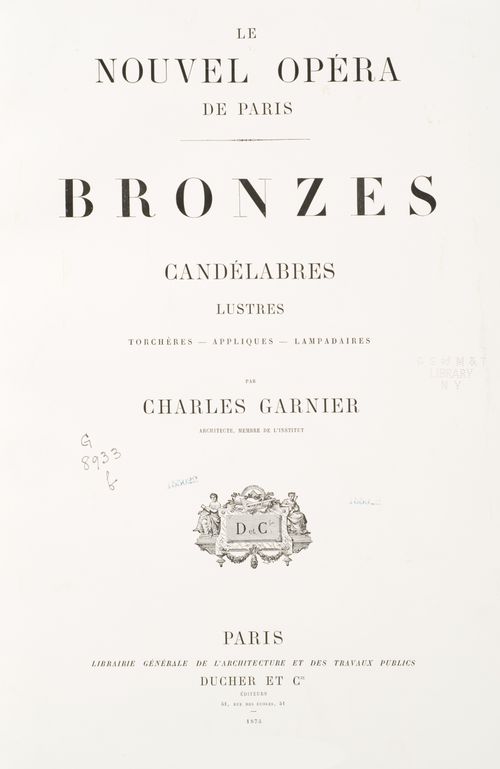
Album has title page titled as follows: Le/Nouvel Opéra/de Paris/Bronzes/Candélabres/Lustres/Torchères - Appliques - Lampadaires/par/Charles Garnier/Architecte, Membre de L'Institut/D & Cie./Paris/Librairie Générale de l'Architecture et des Travaux Publics/Ducher et Cie/Éditeurs/51, rue des Écoles, 51/1875 The album comprises a list of plates (Table des planches): Lustres 1. - Grand foyer 2. - Salle 3. - Foyer de la danse Torchères 4. - Balustrades extérieures (H. Chabaud, statuaire) 5. - Balustrades extérieures (H. Chabaud, statuaire) Candélabres 6. - Grand vestibule d'entrée 7. - Perron extérieur 8. - Trottoir extérieur 9. - Descente à couvert 10. - Rampe douce du pavillon du chef de l'État 11. - Loggia 12. - Grand escalier. - Sur les consoles 13. - Au-dessous des voûtes rampantes 14. - Petit salon du foyer. - Sur les meubles 15. - Escaliers secondaires. - Sur les gaînes
PH1979:0162.01:001-015
Description:
Album has title page titled as follows: Le/Nouvel Opéra/de Paris/Bronzes/Candélabres/Lustres/Torchères - Appliques - Lampadaires/par/Charles Garnier/Architecte, Membre de L'Institut/D & Cie./Paris/Librairie Générale de l'Architecture et des Travaux Publics/Ducher et Cie/Éditeurs/51, rue des Écoles, 51/1875 The album comprises a list of plates (Table des planches): Lustres 1. - Grand foyer 2. - Salle 3. - Foyer de la danse Torchères 4. - Balustrades extérieures (H. Chabaud, statuaire) 5. - Balustrades extérieures (H. Chabaud, statuaire) Candélabres 6. - Grand vestibule d'entrée 7. - Perron extérieur 8. - Trottoir extérieur 9. - Descente à couvert 10. - Rampe douce du pavillon du chef de l'État 11. - Loggia 12. - Grand escalier. - Sur les consoles 13. - Au-dessous des voûtes rampantes 14. - Petit salon du foyer. - Sur les meubles 15. - Escaliers secondaires. - Sur les gaînes
Personnes et institutions:
Date:
published 1875
published 1875
Titre:
Album titled "Le nouvel Opéra de Paris: Bronzes, candélabres, lustres, torchères, appliques, lampadaires par Charles Garnier"
Actions:
PH1979:0162.01:001-015
Description:
Album has title page titled as follows: Le/Nouvel Opéra/de Paris/Bronzes/Candélabres/Lustres/Torchères - Appliques - Lampadaires/par/Charles Garnier/Architecte, Membre de L'Institut/D & Cie./Paris/Librairie Générale de l'Architecture et des Travaux Publics/Ducher et Cie/Éditeurs/51, rue des Écoles, 51/1875 The album comprises a list of plates (Table des planches): Lustres 1. - Grand foyer 2. - Salle 3. - Foyer de la danse Torchères 4. - Balustrades extérieures (H. Chabaud, statuaire) 5. - Balustrades extérieures (H. Chabaud, statuaire) Candélabres 6. - Grand vestibule d'entrée 7. - Perron extérieur 8. - Trottoir extérieur 9. - Descente à couvert 10. - Rampe douce du pavillon du chef de l'État 11. - Loggia 12. - Grand escalier. - Sur les consoles 13. - Au-dessous des voûtes rampantes 14. - Petit salon du foyer. - Sur les meubles 15. - Escaliers secondaires. - Sur les gaînes
Album titled "Le nouvel Opéra de Paris: Bronzes, candélabres, lustres, torchères, appliques, lampadaires par Charles Garnier"
Actions:
PH1979:0162.01:001-015
Description:
Album has title page titled as follows: Le/Nouvel Opéra/de Paris/Bronzes/Candélabres/Lustres/Torchères - Appliques - Lampadaires/par/Charles Garnier/Architecte, Membre de L'Institut/D & Cie./Paris/Librairie Générale de l'Architecture et des Travaux Publics/Ducher et Cie/Éditeurs/51, rue des Écoles, 51/1875 The album comprises a list of plates (Table des planches): Lustres 1. - Grand foyer 2. - Salle 3. - Foyer de la danse Torchères 4. - Balustrades extérieures (H. Chabaud, statuaire) 5. - Balustrades extérieures (H. Chabaud, statuaire) Candélabres 6. - Grand vestibule d'entrée 7. - Perron extérieur 8. - Trottoir extérieur 9. - Descente à couvert 10. - Rampe douce du pavillon du chef de l'État 11. - Loggia 12. - Grand escalier. - Sur les consoles 13. - Au-dessous des voûtes rampantes 14. - Petit salon du foyer. - Sur les meubles 15. - Escaliers secondaires. - Sur les gaînes
Classification:
photographies
photographies
Date:
published 1875
published 1875
Personnes et institutions:
Classification:
photographies
photographies
Numéro de référence:
ARCH256440
Description:
"Au vol d'oiseau, voici l'île Sainte-Hélène à son état naturel, il y a deux ans, avant le début des travaux de récupération qui ont presque triplé la superficie afin d'y loger l'Exposition universelle de 1967. Le magnifique parc boisé restera tel quel pour l'agrément des visiteurs. / Air view of Ile Sainte-Hélène, as of July 23, 1963, just before work began on the enlargement of the island to provide the ground for Expo 67. View is from the upstream end of the island. Stipulation in the program for building Expo 67 is the condition that the original Ile Sainte-Helene public park be left untouched."--Description.
ARCH256440
Description:
"Au vol d'oiseau, voici l'île Sainte-Hélène à son état naturel, il y a deux ans, avant le début des travaux de récupération qui ont presque triplé la superficie afin d'y loger l'Exposition universelle de 1967. Le magnifique parc boisé restera tel quel pour l'agrément des visiteurs. / Air view of Ile Sainte-Hélène, as of July 23, 1963, just before work began on the enlargement of the island to provide the ground for Expo 67. View is from the upstream end of the island. Stipulation in the program for building Expo 67 is the condition that the original Ile Sainte-Helene public park be left untouched."--Description.
Personnes et institutions:
Date:
23 July 1963
23 July 1963
Titre:
Aerial views of the Île Sainte-Hélène and Île Notre-Dame sites prior the enlargement and the creation phases were completed, Expo 67, Montréal, Québec
Actions:
ARCH256440
Description:
"Au vol d'oiseau, voici l'île Sainte-Hélène à son état naturel, il y a deux ans, avant le début des travaux de récupération qui ont presque triplé la superficie afin d'y loger l'Exposition universelle de 1967. Le magnifique parc boisé restera tel quel pour l'agrément des visiteurs. / Air view of Ile Sainte-Hélène, as of July 23, 1963, just before work began on the enlargement of the island to provide the ground for Expo 67. View is from the upstream end of the island. Stipulation in the program for building Expo 67 is the condition that the original Ile Sainte-Helene public park be left untouched."--Description.
Aerial views of the Île Sainte-Hélène and Île Notre-Dame sites prior the enlargement and the creation phases were completed, Expo 67, Montréal, Québec
Actions:
ARCH256440
Description:
"Au vol d'oiseau, voici l'île Sainte-Hélène à son état naturel, il y a deux ans, avant le début des travaux de récupération qui ont presque triplé la superficie afin d'y loger l'Exposition universelle de 1967. Le magnifique parc boisé restera tel quel pour l'agrément des visiteurs. / Air view of Ile Sainte-Hélène, as of July 23, 1963, just before work began on the enlargement of the island to provide the ground for Expo 67. View is from the upstream end of the island. Stipulation in the program for building Expo 67 is the condition that the original Ile Sainte-Helene public park be left untouched."--Description.
Classification:
photographies
photographies
Date:
23 July 1963
23 July 1963
Personnes et institutions:


