


10573 Résultats
Classification:
livres
livres

Titre:
The Neutral
The Neutral
Actions:
Prix:
$50.00
(disponible sur commande)
Résumé:
"I define the Neutral as that which outplays the paradigm, or rather I call Neutral everything that baffles paradigm." With these words, Roland Barthes describes a concept that profoundly shaped his work and was the subject of a landmark series of lectures delivered in 1978 at the College de France, just two years before his death. Not published in France until 2002, and(...)
$50.00
(disponible sur commande)
Résumé:
"I define the Neutral as that which outplays the paradigm, or rather I call Neutral everything that baffles paradigm." With these words, Roland Barthes describes a concept that profoundly shaped his work and was the subject of a landmark series of lectures delivered in 1978 at the College de France, just two years before his death. Not published in France until 2002, and(...)
Titre:
The Neutral
Actions:
Prix:
$50.00
(disponible sur commande)
Résumé:
"I define the Neutral as that which outplays the paradigm, or rather I call Neutral everything that baffles paradigm." With these words, Roland Barthes describes a concept that profoundly shaped his work and was the subject of a landmark series of lectures delivered in 1978 at the College de France, just two years before his death. Not published in France until 2002, and appearing in English for the first time, these creative and engaging lectures deepen our understanding of Roland Barthes' intellectual itinerary and reveal his distinctive style as thinker and teacher. "The Neutral" ( le neutre), as Barthes describes it, escapes or undoes the paradigmatic binary oppositions that structure and produce meaning in Western thought and discourse. These binaries are found in all aspects of human society ranging from language to sexuality to politics. For Barthes, the attempt to deconstruct or escape from these binaries has profound ethical, philosophical, and linguistic implications. "The Neutral" is comprised of the prewritten texts from which Barthes lectured and centers around 23 "figures," also referred to as "traits" or "twinklings," that are possible embodiments of the Neutral (sleep, silence, tact, etc.) or of the anti-Neutral (anger, arrogance, conflict, etc.). His lectures draw on a diverse set of authors and intellectual traditions, including Lao-tzu, Tolstoy, German mysticism, classical philosophy, Rousseau, Baudelaire, Walter Benjamin, and John Cage. Barthes' idiosyncratic approach to his subjects gives the lectures a playful, personal, and even joyous quality that enhances his rich insights. In addition to his reflections on a variety of literary and scholarly works, Barthes' personal convictions and the events of his life shaped the course and content of the lectures. Most prominently, as Barthes admits, the recent death of his mother and the idea of mourning shape several of his lectures.
The Neutral
Actions:
Prix:
$50.00
(disponible sur commande)
Résumé:
"I define the Neutral as that which outplays the paradigm, or rather I call Neutral everything that baffles paradigm." With these words, Roland Barthes describes a concept that profoundly shaped his work and was the subject of a landmark series of lectures delivered in 1978 at the College de France, just two years before his death. Not published in France until 2002, and appearing in English for the first time, these creative and engaging lectures deepen our understanding of Roland Barthes' intellectual itinerary and reveal his distinctive style as thinker and teacher. "The Neutral" ( le neutre), as Barthes describes it, escapes or undoes the paradigmatic binary oppositions that structure and produce meaning in Western thought and discourse. These binaries are found in all aspects of human society ranging from language to sexuality to politics. For Barthes, the attempt to deconstruct or escape from these binaries has profound ethical, philosophical, and linguistic implications. "The Neutral" is comprised of the prewritten texts from which Barthes lectured and centers around 23 "figures," also referred to as "traits" or "twinklings," that are possible embodiments of the Neutral (sleep, silence, tact, etc.) or of the anti-Neutral (anger, arrogance, conflict, etc.). His lectures draw on a diverse set of authors and intellectual traditions, including Lao-tzu, Tolstoy, German mysticism, classical philosophy, Rousseau, Baudelaire, Walter Benjamin, and John Cage. Barthes' idiosyncratic approach to his subjects gives the lectures a playful, personal, and even joyous quality that enhances his rich insights. In addition to his reflections on a variety of literary and scholarly works, Barthes' personal convictions and the events of his life shaped the course and content of the lectures. Most prominently, as Barthes admits, the recent death of his mother and the idea of mourning shape several of his lectures.
Classification:
livres
livres
Publication:
septembre 2007, New York
septembre 2007, New York
Sujet:
Théorie/ philosophie
Théorie/ philosophie
Classification:
livres
livres
Actions:
Prix:
$31.99
(disponible sur commande)
Résumé:
Much orthodox economic theory is based on assumptions which are treated as self-evident : supply and demand are regarded as independent entities, the individual is assumed to be a rational agent who knows his interests and how to make decisions corresponding to them, and so on. But one has only to examine an economic transaction closely, as Pierre Bourdieu does here for(...)
$31.99
(disponible sur commande)
Résumé:
Much orthodox economic theory is based on assumptions which are treated as self-evident : supply and demand are regarded as independent entities, the individual is assumed to be a rational agent who knows his interests and how to make decisions corresponding to them, and so on. But one has only to examine an economic transaction closely, as Pierre Bourdieu does here for(...)
Titre:
The social structures of the economy
Actions:
Prix:
$31.99
(disponible sur commande)
Résumé:
Much orthodox economic theory is based on assumptions which are treated as self-evident : supply and demand are regarded as independent entities, the individual is assumed to be a rational agent who knows his interests and how to make decisions corresponding to them, and so on. But one has only to examine an economic transaction closely, as Pierre Bourdieu does here for the buying and selling of houses, to see that these abstract assumptions cannot explain what happens in reality. As Bourdieu shows, the market is constructed by the state, which can decide, for example, whether to promote private housing or collective provision. And the individuals involved in the transaction are immersed in symbolic constructions which constitute, in a strong sense, the value of houses, neighbourhoods and towns. The abstract and illusory nature of the assumptions of orthodox economic theory has been criticised by some economists, but Bourdieu argues that we must go further. Supply, demand, the market and even the buyer and seller are products of a process of social construction, and so-called 'economic' processes can be adequately described only by calling on sociological methods. Instead of seeing the two disciplines in antagonistic terms, it is time to recognize that sociology and economics are in fact part of a single discipline, the object of which is the analysis of social facts, of which economic transactions are in the end merely one aspect.
The social structures of the economy
Actions:
Prix:
$31.99
(disponible sur commande)
Résumé:
Much orthodox economic theory is based on assumptions which are treated as self-evident : supply and demand are regarded as independent entities, the individual is assumed to be a rational agent who knows his interests and how to make decisions corresponding to them, and so on. But one has only to examine an economic transaction closely, as Pierre Bourdieu does here for the buying and selling of houses, to see that these abstract assumptions cannot explain what happens in reality. As Bourdieu shows, the market is constructed by the state, which can decide, for example, whether to promote private housing or collective provision. And the individuals involved in the transaction are immersed in symbolic constructions which constitute, in a strong sense, the value of houses, neighbourhoods and towns. The abstract and illusory nature of the assumptions of orthodox economic theory has been criticised by some economists, but Bourdieu argues that we must go further. Supply, demand, the market and even the buyer and seller are products of a process of social construction, and so-called 'economic' processes can be adequately described only by calling on sociological methods. Instead of seeing the two disciplines in antagonistic terms, it is time to recognize that sociology and economics are in fact part of a single discipline, the object of which is the analysis of social facts, of which economic transactions are in the end merely one aspect.
Classification:
livres
livres
Publication:
janvier 1900, Cambridge (UK)
janvier 1900, Cambridge (UK)
Sujet:
Théorie/ philosophie
Théorie/ philosophie
Classification:
livres
livres
Titre:
The future of the image
The future of the image
Actions:
Prix:
$33.50
(disponible sur commande)
Résumé:
In "The future of the image", Jacques Rancière develops a fascinating new concept of the image in contemporary art, showing how art and politics have always been intrinsically intertwined. Covering a range of art movements, and thinkers such as Foucault, Deleuze, Adorno, Barthes, Lyotard and Greenberg, Rancière argues that contemporary theorists of the image are suffering(...)
$33.50
(disponible sur commande)
Résumé:
In "The future of the image", Jacques Rancière develops a fascinating new concept of the image in contemporary art, showing how art and politics have always been intrinsically intertwined. Covering a range of art movements, and thinkers such as Foucault, Deleuze, Adorno, Barthes, Lyotard and Greenberg, Rancière argues that contemporary theorists of the image are suffering(...)
Titre:
The future of the image
Actions:
Prix:
$33.50
(disponible sur commande)
Résumé:
In "The future of the image", Jacques Rancière develops a fascinating new concept of the image in contemporary art, showing how art and politics have always been intrinsically intertwined. Covering a range of art movements, and thinkers such as Foucault, Deleuze, Adorno, Barthes, Lyotard and Greenberg, Rancière argues that contemporary theorists of the image are suffering from religious tendencies. He suggests that there is a stark political choice in art : it can either reinforce a radical democracy, or create a new reactionary mysticism. For Rancière there is never a pure art : the aesthetic revolution will always embrace egalitarian ideals.
The future of the image
Actions:
Prix:
$33.50
(disponible sur commande)
Résumé:
In "The future of the image", Jacques Rancière develops a fascinating new concept of the image in contemporary art, showing how art and politics have always been intrinsically intertwined. Covering a range of art movements, and thinkers such as Foucault, Deleuze, Adorno, Barthes, Lyotard and Greenberg, Rancière argues that contemporary theorists of the image are suffering from religious tendencies. He suggests that there is a stark political choice in art : it can either reinforce a radical democracy, or create a new reactionary mysticism. For Rancière there is never a pure art : the aesthetic revolution will always embrace egalitarian ideals.
Classification:
livres
livres
Publication:
juin 2007, London, New York
juin 2007, London, New York
Sujet:
Théorie/ philosophie
Théorie/ philosophie
Classification:
livres
livres
Prix:
$27.00
(disponible sur commande)
Résumé:
Imagine a world without things. There would be nothing to describe, nothing to explain, remark, interpret, or complain about. Without things, we would stop speaking; we would become as mute as things are alleged to be. In nine original essays, internationally renowned historians of art and of science seek to understand how objects become charged with significance without(...)
$27.00
(disponible sur commande)
Résumé:
Imagine a world without things. There would be nothing to describe, nothing to explain, remark, interpret, or complain about. Without things, we would stop speaking; we would become as mute as things are alleged to be. In nine original essays, internationally renowned historians of art and of science seek to understand how objects become charged with significance without(...)
Titre:
Things that talk : Object lessons from art and science
Actions:
Prix:
$27.00
(disponible sur commande)
Résumé:
Imagine a world without things. There would be nothing to describe, nothing to explain, remark, interpret, or complain about. Without things, we would stop speaking; we would become as mute as things are alleged to be. In nine original essays, internationally renowned historians of art and of science seek to understand how objects become charged with significance without losing their gritty materiality. True to the particularity of things, each of the essays singles out one object for close attention: a Bosch drawing, the freestanding column, a Prussian island, soap bubbles, early photographs, glass flowers, Rorschach blots, newspaper clippings, paintings by Jackson Pollock. Each is revealed to be a node around which meanings accrete thickly. But not just any meanings: what these things are made of and how they are made shape what they can mean. Neither the pure texts of semiotics nor the brute objects of positivism, these things are saturated with cultural significance. Things become talkative when they fuse matter and meaning; they lapse into speechlessness when their matter and meanings no longer mesh. Each of the nine objects examined in this book had its historical moment, when the match of this thing to that thought seemed irresistible. At these junctures, certain things become objects of fascination, association, and endless consideration; they begin to talk. Things that talk fleetingly realize the dream of a perfect language, in which words and world merge.
Things that talk : Object lessons from art and science
Actions:
Prix:
$27.00
(disponible sur commande)
Résumé:
Imagine a world without things. There would be nothing to describe, nothing to explain, remark, interpret, or complain about. Without things, we would stop speaking; we would become as mute as things are alleged to be. In nine original essays, internationally renowned historians of art and of science seek to understand how objects become charged with significance without losing their gritty materiality. True to the particularity of things, each of the essays singles out one object for close attention: a Bosch drawing, the freestanding column, a Prussian island, soap bubbles, early photographs, glass flowers, Rorschach blots, newspaper clippings, paintings by Jackson Pollock. Each is revealed to be a node around which meanings accrete thickly. But not just any meanings: what these things are made of and how they are made shape what they can mean. Neither the pure texts of semiotics nor the brute objects of positivism, these things are saturated with cultural significance. Things become talkative when they fuse matter and meaning; they lapse into speechlessness when their matter and meanings no longer mesh. Each of the nine objects examined in this book had its historical moment, when the match of this thing to that thought seemed irresistible. At these junctures, certain things become objects of fascination, association, and endless consideration; they begin to talk. Things that talk fleetingly realize the dream of a perfect language, in which words and world merge.
Classification:
livres
livres
Publication:
novembre 2007, New York
novembre 2007, New York
Sujet:
Théorie/ philosophie
Théorie/ philosophie
Classification:
livres
livres
Titre:
The culture industry
The culture industry
Actions:
Prix:
$33.95
(disponible sur commande)
Résumé:
The creation of the Frankfurt School of critical theory in the 1920s saw the birth of some of the most exciting and challenging writings of the twentieth century. It is out of this background that the great critic Theodor Adorno emerged. His finest essays are collected here, offering the reader unparalleled insights into Adorno's thoughts on culture. He argued that the(...)
$33.95
(disponible sur commande)
Résumé:
The creation of the Frankfurt School of critical theory in the 1920s saw the birth of some of the most exciting and challenging writings of the twentieth century. It is out of this background that the great critic Theodor Adorno emerged. His finest essays are collected here, offering the reader unparalleled insights into Adorno's thoughts on culture. He argued that the(...)
Titre:
The culture industry
Actions:
Prix:
$33.95
(disponible sur commande)
Résumé:
The creation of the Frankfurt School of critical theory in the 1920s saw the birth of some of the most exciting and challenging writings of the twentieth century. It is out of this background that the great critic Theodor Adorno emerged. His finest essays are collected here, offering the reader unparalleled insights into Adorno's thoughts on culture. He argued that the culture industry commodified and standardized all art. In turn this suffocated individuality and destroyed critical thinking. At the time, Adorno was accused of everything from overreaction to deranged hysteria by his many detractors. In today's world, where even the least cynical of consumers is aware of the influence of the media, Adorno's work takes on a more immediate significance. "The culture industry" is an unrivalled indictment of the banality of mass culture.
The culture industry
Actions:
Prix:
$33.95
(disponible sur commande)
Résumé:
The creation of the Frankfurt School of critical theory in the 1920s saw the birth of some of the most exciting and challenging writings of the twentieth century. It is out of this background that the great critic Theodor Adorno emerged. His finest essays are collected here, offering the reader unparalleled insights into Adorno's thoughts on culture. He argued that the culture industry commodified and standardized all art. In turn this suffocated individuality and destroyed critical thinking. At the time, Adorno was accused of everything from overreaction to deranged hysteria by his many detractors. In today's world, where even the least cynical of consumers is aware of the influence of the media, Adorno's work takes on a more immediate significance. "The culture industry" is an unrivalled indictment of the banality of mass culture.
Classification:
livres
livres
Publication:
mai 2001, London, New York
mai 2001, London, New York
Sujet:
Théorie/ philosophie
Théorie/ philosophie
Classification:
livres
livres
Actions:
Prix:
$32.00
(disponible sur commande)
Résumé:
Michel de Certeau considers the uses to which social representation and modes of social behavior are put by individuals and groups, describing the tactics available to the common man for reclaiming his own autonomy from the all-pervasive forces of commerce, politics, and culture. In exploring the public meaning of ingeniously defended private meanings, de Certeau draws(...)
$32.00
(disponible sur commande)
Résumé:
Michel de Certeau considers the uses to which social representation and modes of social behavior are put by individuals and groups, describing the tactics available to the common man for reclaiming his own autonomy from the all-pervasive forces of commerce, politics, and culture. In exploring the public meaning of ingeniously defended private meanings, de Certeau draws(...)
Sujet:
Théorie/ philosophie
Théorie/ philosophie
Publication:
décembre 2002, Berkeley, Los Angeles, London
décembre 2002, Berkeley, Los Angeles, London
Titre:
The practice of everyday life
Actions:
Prix:
$32.00
(disponible sur commande)
Résumé:
Michel de Certeau considers the uses to which social representation and modes of social behavior are put by individuals and groups, describing the tactics available to the common man for reclaiming his own autonomy from the all-pervasive forces of commerce, politics, and culture. In exploring the public meaning of ingeniously defended private meanings, de Certeau draws brilliantly on an immense theoretical literature in analytic philosophy, linguistics, sociology, semiology, and anthropology - to speak of an apposite use of imaginative literature.
The practice of everyday life
Actions:
Prix:
$32.00
(disponible sur commande)
Résumé:
Michel de Certeau considers the uses to which social representation and modes of social behavior are put by individuals and groups, describing the tactics available to the common man for reclaiming his own autonomy from the all-pervasive forces of commerce, politics, and culture. In exploring the public meaning of ingeniously defended private meanings, de Certeau draws brilliantly on an immense theoretical literature in analytic philosophy, linguistics, sociology, semiology, and anthropology - to speak of an apposite use of imaginative literature.
Classification:
livres
livres
Publication:
décembre 2002, Berkeley, Los Angeles, London
décembre 2002, Berkeley, Los Angeles, London
Sujet:
Théorie/ philosophie
Théorie/ philosophie
Classification:
livres
livres
Titre:
On touching - Jean-Luc Nancy
On touching - Jean-Luc Nancy
Actions:
Prix:
$25.95
(disponible sur commande)
Résumé:
Using the philosophy of Jean-Luc Nancy as an anchoring point, Jacques Derrida in this book conducts a profound review of the philosophy of the sense of touch, from Plato and Aristotle to Jean-Luc Nancy, whose ground-breaking book Corpus he discusses in detail. Emmanuel Levinas, Maurice Merleau-Ponty, Edmund Husserl, Didier Franck, Martin Heidegger, Francoise Dastur, and(...)
$25.95
(disponible sur commande)
Résumé:
Using the philosophy of Jean-Luc Nancy as an anchoring point, Jacques Derrida in this book conducts a profound review of the philosophy of the sense of touch, from Plato and Aristotle to Jean-Luc Nancy, whose ground-breaking book Corpus he discusses in detail. Emmanuel Levinas, Maurice Merleau-Ponty, Edmund Husserl, Didier Franck, Martin Heidegger, Francoise Dastur, and(...)
Titre:
On touching - Jean-Luc Nancy
Actions:
Prix:
$25.95
(disponible sur commande)
Résumé:
Using the philosophy of Jean-Luc Nancy as an anchoring point, Jacques Derrida in this book conducts a profound review of the philosophy of the sense of touch, from Plato and Aristotle to Jean-Luc Nancy, whose ground-breaking book Corpus he discusses in detail. Emmanuel Levinas, Maurice Merleau-Ponty, Edmund Husserl, Didier Franck, Martin Heidegger, Francoise Dastur, and Jean-Louis Chrétien are discussed, as are René Descartes, Diderot, Maine de Biran, Félix Ravaisson, Immanuel Kant, Sigmund Freud, and others. The scope of Derrida’s deliberations makes this book a virtual encyclopedia of the philosophy of touch (and the body). Derrida gives special consideration to the thinking of touch in Christianity and, in discussing Jean-Luc Nancy’s essay “Deconstruction of Christianity,” devotes a section of the book to the sense of touch in the Gospels. Another section concentrates on “the flesh,” as treated by Merleau-Ponty and others in his wake. Derrida’s critique of intuitionism, notably in the phenomenological tradition, is one of the guiding threads of the book.
On touching - Jean-Luc Nancy
Actions:
Prix:
$25.95
(disponible sur commande)
Résumé:
Using the philosophy of Jean-Luc Nancy as an anchoring point, Jacques Derrida in this book conducts a profound review of the philosophy of the sense of touch, from Plato and Aristotle to Jean-Luc Nancy, whose ground-breaking book Corpus he discusses in detail. Emmanuel Levinas, Maurice Merleau-Ponty, Edmund Husserl, Didier Franck, Martin Heidegger, Francoise Dastur, and Jean-Louis Chrétien are discussed, as are René Descartes, Diderot, Maine de Biran, Félix Ravaisson, Immanuel Kant, Sigmund Freud, and others. The scope of Derrida’s deliberations makes this book a virtual encyclopedia of the philosophy of touch (and the body). Derrida gives special consideration to the thinking of touch in Christianity and, in discussing Jean-Luc Nancy’s essay “Deconstruction of Christianity,” devotes a section of the book to the sense of touch in the Gospels. Another section concentrates on “the flesh,” as treated by Merleau-Ponty and others in his wake. Derrida’s critique of intuitionism, notably in the phenomenological tradition, is one of the guiding threads of the book.
Classification:
livres
livres
Publication:
janvier 2004, Stanford
janvier 2004, Stanford
Sujet:
Théorie/ philosophie
Théorie/ philosophie
Classification:
livres
livres
Actions:
Prix:
$37.50
(disponible sur commande)
Résumé:
The twelve new essays in this volume use a contemporary context to think through and with Deleuze. Engaging the here and now, the contributors use the Deleuzian theoretical apparatus to think about issues such as military activity in the Middle East, refugees, terrorism, information and communication, and the State. The book is aimed both at specialists of Deleuze and(...)
$37.50
(disponible sur commande)
Résumé:
The twelve new essays in this volume use a contemporary context to think through and with Deleuze. Engaging the here and now, the contributors use the Deleuzian theoretical apparatus to think about issues such as military activity in the Middle East, refugees, terrorism, information and communication, and the State. The book is aimed both at specialists of Deleuze and(...)
Titre:
Deleuze and the contemporary world
Actions:
Prix:
$37.50
(disponible sur commande)
Résumé:
The twelve new essays in this volume use a contemporary context to think through and with Deleuze. Engaging the here and now, the contributors use the Deleuzian theoretical apparatus to think about issues such as military activity in the Middle East, refugees, terrorism, information and communication, and the State. The book is aimed both at specialists of Deleuze and those who are unfamiliar with his work but who are interested in current affairs. Incorporating political theory and philosophy, culture studies, sociology, international studies, and Middle Eastern studies, the book is designed to appeal to a wide audience. Contributors include: Rosi Braidotti, Claire Colebrook, Verena Conley, Eugene Holland, John Marks, Paul Patton, Patricia Pisters, Laurence J. Silberstein, Kenneth Surin and Nicholas Thoburn.
Deleuze and the contemporary world
Actions:
Prix:
$37.50
(disponible sur commande)
Résumé:
The twelve new essays in this volume use a contemporary context to think through and with Deleuze. Engaging the here and now, the contributors use the Deleuzian theoretical apparatus to think about issues such as military activity in the Middle East, refugees, terrorism, information and communication, and the State. The book is aimed both at specialists of Deleuze and those who are unfamiliar with his work but who are interested in current affairs. Incorporating political theory and philosophy, culture studies, sociology, international studies, and Middle Eastern studies, the book is designed to appeal to a wide audience. Contributors include: Rosi Braidotti, Claire Colebrook, Verena Conley, Eugene Holland, John Marks, Paul Patton, Patricia Pisters, Laurence J. Silberstein, Kenneth Surin and Nicholas Thoburn.
Classification:
livres
livres
Publication:
septembre 2006, Edinburgh
septembre 2006, Edinburgh
Sujet:
Théorie/ philosophie
Théorie/ philosophie
Classification:
livres
livres
Actions:
Prix:
$19.95
(disponible sur commande)
Résumé:
The Utopie group was born in 1966 at Henri Lefebvre's house in the Pyrenees. The eponymous journal edited by Hubert Tonka brought together sociologists Jean Baudrillard, René Lourau, and Catherine Cot, architects Jean Aubert, Jean-Paul Jungmann, Antoine Stinco, and landscape architect Isabelle Auricoste. Over the next decade, both in theory and in practice, the group(...)
$19.95
(disponible sur commande)
Résumé:
The Utopie group was born in 1966 at Henri Lefebvre's house in the Pyrenees. The eponymous journal edited by Hubert Tonka brought together sociologists Jean Baudrillard, René Lourau, and Catherine Cot, architects Jean Aubert, Jean-Paul Jungmann, Antoine Stinco, and landscape architect Isabelle Auricoste. Over the next decade, both in theory and in practice, the group(...)
Titre:
Utopia deferred : Jean Baudrillard, writings for Utopie (1967-1978)
Actions:
Prix:
$19.95
(disponible sur commande)
Résumé:
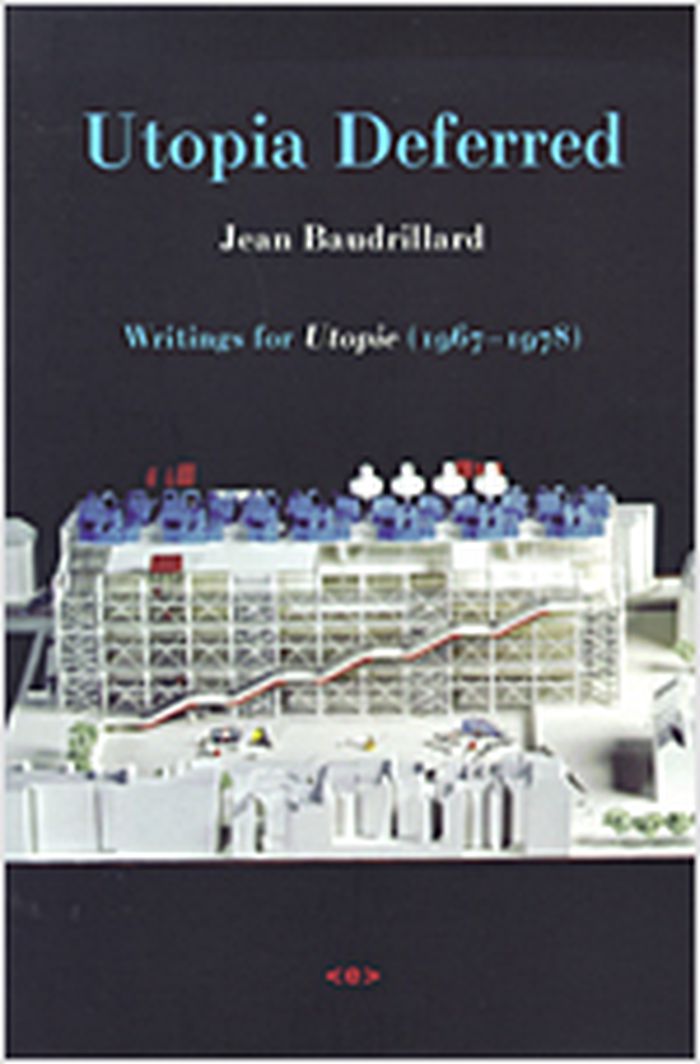
The Utopie group was born in 1966 at Henri Lefebvre's house in the Pyrenees. The eponymous journal edited by Hubert Tonka brought together sociologists Jean Baudrillard, René Lourau, and Catherine Cot, architects Jean Aubert, Jean-Paul Jungmann, Antoine Stinco, and landscape architect Isabelle Auricoste. Over the next decade, both in theory and in practice, the group articulated a radical ultra-leftist critique of architecture, urbanism, and everyday life. "Utopia deferred" collects all of the essays Jean Baudrillard published in Utopie as well as recent interviews with Jean Baudrillard and Hubert Tonka. Utopie served as a workshop for Baudrillard's thought. Many of the essays he first published in Utopie were seminal for some of his books: "For a critique of the political economy of the sign", "The mirror of production", "Simulations", "Symbolic exchange and death", and "In the shadow of the silent majorities". But Utopie was also a topical journal and a political one; the topics of these essays are often torn from the headlines of the tumultuous decade following the uprisings of May 1968.
Utopia deferred : Jean Baudrillard, writings for Utopie (1967-1978)
Actions:
Prix:
$19.95
(disponible sur commande)
Résumé:
The Utopie group was born in 1966 at Henri Lefebvre's house in the Pyrenees. The eponymous journal edited by Hubert Tonka brought together sociologists Jean Baudrillard, René Lourau, and Catherine Cot, architects Jean Aubert, Jean-Paul Jungmann, Antoine Stinco, and landscape architect Isabelle Auricoste. Over the next decade, both in theory and in practice, the group articulated a radical ultra-leftist critique of architecture, urbanism, and everyday life. "Utopia deferred" collects all of the essays Jean Baudrillard published in Utopie as well as recent interviews with Jean Baudrillard and Hubert Tonka. Utopie served as a workshop for Baudrillard's thought. Many of the essays he first published in Utopie were seminal for some of his books: "For a critique of the political economy of the sign", "The mirror of production", "Simulations", "Symbolic exchange and death", and "In the shadow of the silent majorities". But Utopie was also a topical journal and a political one; the topics of these essays are often torn from the headlines of the tumultuous decade following the uprisings of May 1968.
Classification:
livres
livres
Publication:
octobre 2006, Cambridge (MA)
octobre 2006, Cambridge (MA)
Sujet:
Théorie/ philosophie
Théorie/ philosophie
Classification:
livres
livres
Actions:
Prix:
$38.00
(disponible sur commande)
Résumé:
Fiscal crises have cascaded across much of the developing world with devastating results, from Mexico to Indonesia, Russia and Argentina. The extreme volatility in contemporary political economic fortunes seems to mock our best efforts to understand the forces that drive development in the world economy. In this book, David Harvey shows how the disciplines of historical(...)
$38.00
(disponible sur commande)
Résumé:
Fiscal crises have cascaded across much of the developing world with devastating results, from Mexico to Indonesia, Russia and Argentina. The extreme volatility in contemporary political economic fortunes seems to mock our best efforts to understand the forces that drive development in the world economy. In this book, David Harvey shows how the disciplines of historical(...)
Titre:
Spaces of global capitalism : towards a theory of uneven geographical development
Actions:
Prix:
$38.00
(disponible sur commande)
Résumé:
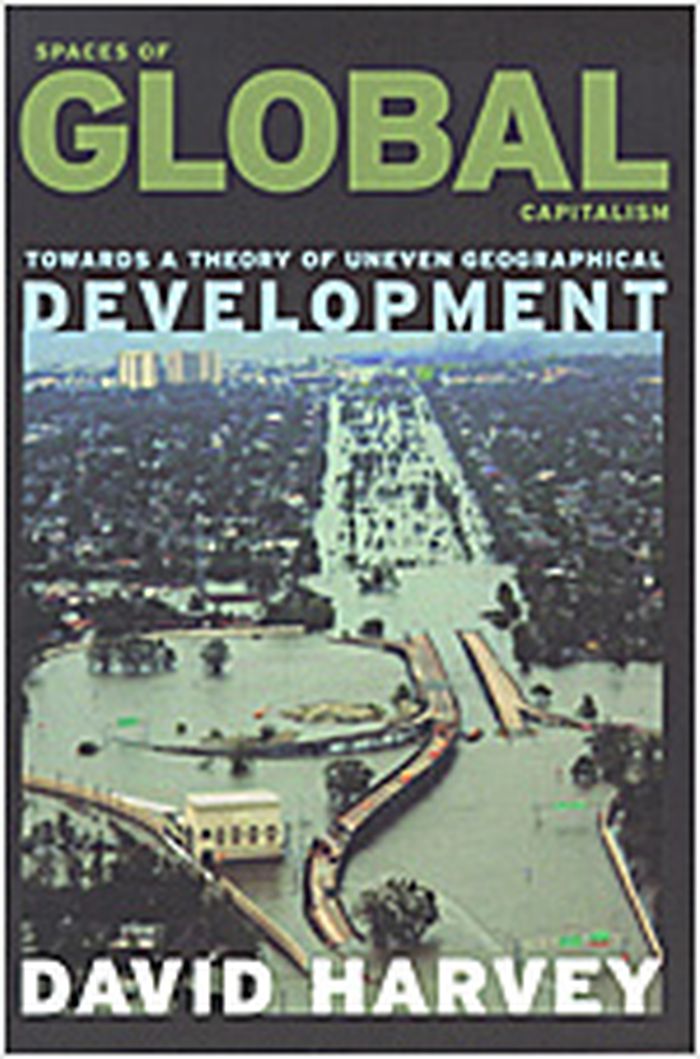
Fiscal crises have cascaded across much of the developing world with devastating results, from Mexico to Indonesia, Russia and Argentina. The extreme volatility in contemporary political economic fortunes seems to mock our best efforts to understand the forces that drive development in the world economy. In this book, David Harvey shows how the disciplines of historical geography yield decisive new insights into the workings of global capitalism, and introduces the concept of uneven geographical development as a revelatory perspective on the forces which create economic success or failure.
Spaces of global capitalism : towards a theory of uneven geographical development
Actions:
Prix:
$38.00
(disponible sur commande)
Résumé:
Fiscal crises have cascaded across much of the developing world with devastating results, from Mexico to Indonesia, Russia and Argentina. The extreme volatility in contemporary political economic fortunes seems to mock our best efforts to understand the forces that drive development in the world economy. In this book, David Harvey shows how the disciplines of historical geography yield decisive new insights into the workings of global capitalism, and introduces the concept of uneven geographical development as a revelatory perspective on the forces which create economic success or failure.
Classification:
livres
livres
Publication:
mai 2006, London, New York
mai 2006, London, New York
Sujet:
Théorie/ philosophie
Théorie/ philosophie


