


8579 Résultats
Niveau de description archivistique:
Projet
Projet
Numéro de référence:
AP178.S1.1984.PR03
Description:
This project series documents the Duas habitações e duas loja in Schilderswijk, The Hague, The Netherlands. While the records were held in the office’s archives this project was assigned the number 31/80. The office assigned the date 1985 to this project. This project was part of the urban renewal program in Schilderswijk for which Siza designed the urban plan for Deelgebied Zone 5 Schilderswijk-West, the Punt en Komma social housing, Plano de Doedijnstraat, and Van der Vennerpark. The project consisted of two houses, two retail/office spaces, and a parking garage situated on Van der Vennestraat. One house was made with red brick, while the other was given a white exterior. The project was realised with project architect Carlos Castenheira in cooperation with Architektengroep Mecanoo. This project was designed in connection with the Van der Vennepark (project series AP178.S1.1985.PR01 in this fonds). The project series contains sketches, studies, plans, elevations and details. Textual documentation includes a letter from Adri Duivesteijn, The Hague alderman responsible for the urban renewal program, letters from Architektengroep Mecanoo (engeneering firm), notes from meetings on construction, and a letter from Castanheira. Documentation regarding the Van der Vennerpark (file AP178.S1.1985.PR01.001 in this fonds) also contains information related to the housing and shopping complex. Also included are photographs of the model, as well as slides of the model, drawings, and the built project. Note that photographs of the built project can also be found among photographic materials for Punt en Komma (file AP178.S1.1984.PR02.SS1.015 in this fonds).
AP178.S1.1984.PR03
Description:
This project series documents the Duas habitações e duas loja in Schilderswijk, The Hague, The Netherlands. While the records were held in the office’s archives this project was assigned the number 31/80. The office assigned the date 1985 to this project. This project was part of the urban renewal program in Schilderswijk for which Siza designed the urban plan for Deelgebied Zone 5 Schilderswijk-West, the Punt en Komma social housing, Plano de Doedijnstraat, and Van der Vennerpark. The project consisted of two houses, two retail/office spaces, and a parking garage situated on Van der Vennestraat. One house was made with red brick, while the other was given a white exterior. The project was realised with project architect Carlos Castenheira in cooperation with Architektengroep Mecanoo. This project was designed in connection with the Van der Vennepark (project series AP178.S1.1985.PR01 in this fonds). The project series contains sketches, studies, plans, elevations and details. Textual documentation includes a letter from Adri Duivesteijn, The Hague alderman responsible for the urban renewal program, letters from Architektengroep Mecanoo (engeneering firm), notes from meetings on construction, and a letter from Castanheira. Documentation regarding the Van der Vennerpark (file AP178.S1.1985.PR01.001 in this fonds) also contains information related to the housing and shopping complex. Also included are photographs of the model, as well as slides of the model, drawings, and the built project. Note that photographs of the built project can also be found among photographic materials for Punt en Komma (file AP178.S1.1984.PR02.SS1.015 in this fonds).
Personnes et institutions:
Date:
1985-1988
1985-1988
Titre:
Duas habitações e duas lojas [Housing and shopping complex, Schilderswijk], The Hague, The Netherlands (1985-1988)
Actions:
AP178.S1.1984.PR03
Description:
This project series documents the Duas habitações e duas loja in Schilderswijk, The Hague, The Netherlands. While the records were held in the office’s archives this project was assigned the number 31/80. The office assigned the date 1985 to this project. This project was part of the urban renewal program in Schilderswijk for which Siza designed the urban plan for Deelgebied Zone 5 Schilderswijk-West, the Punt en Komma social housing, Plano de Doedijnstraat, and Van der Vennerpark. The project consisted of two houses, two retail/office spaces, and a parking garage situated on Van der Vennestraat. One house was made with red brick, while the other was given a white exterior. The project was realised with project architect Carlos Castenheira in cooperation with Architektengroep Mecanoo. This project was designed in connection with the Van der Vennepark (project series AP178.S1.1985.PR01 in this fonds). The project series contains sketches, studies, plans, elevations and details. Textual documentation includes a letter from Adri Duivesteijn, The Hague alderman responsible for the urban renewal program, letters from Architektengroep Mecanoo (engeneering firm), notes from meetings on construction, and a letter from Castanheira. Documentation regarding the Van der Vennerpark (file AP178.S1.1985.PR01.001 in this fonds) also contains information related to the housing and shopping complex. Also included are photographs of the model, as well as slides of the model, drawings, and the built project. Note that photographs of the built project can also be found among photographic materials for Punt en Komma (file AP178.S1.1984.PR02.SS1.015 in this fonds).
Duas habitações e duas lojas [Housing and shopping complex, Schilderswijk], The Hague, The Netherlands (1985-1988)
Actions:
AP178.S1.1984.PR03
Description:
This project series documents the Duas habitações e duas loja in Schilderswijk, The Hague, The Netherlands. While the records were held in the office’s archives this project was assigned the number 31/80. The office assigned the date 1985 to this project. This project was part of the urban renewal program in Schilderswijk for which Siza designed the urban plan for Deelgebied Zone 5 Schilderswijk-West, the Punt en Komma social housing, Plano de Doedijnstraat, and Van der Vennerpark. The project consisted of two houses, two retail/office spaces, and a parking garage situated on Van der Vennestraat. One house was made with red brick, while the other was given a white exterior. The project was realised with project architect Carlos Castenheira in cooperation with Architektengroep Mecanoo. This project was designed in connection with the Van der Vennepark (project series AP178.S1.1985.PR01 in this fonds). The project series contains sketches, studies, plans, elevations and details. Textual documentation includes a letter from Adri Duivesteijn, The Hague alderman responsible for the urban renewal program, letters from Architektengroep Mecanoo (engeneering firm), notes from meetings on construction, and a letter from Castanheira. Documentation regarding the Van der Vennerpark (file AP178.S1.1985.PR01.001 in this fonds) also contains information related to the housing and shopping complex. Also included are photographs of the model, as well as slides of the model, drawings, and the built project. Note that photographs of the built project can also be found among photographic materials for Punt en Komma (file AP178.S1.1984.PR02.SS1.015 in this fonds).
Niveau de description archivistique:
Project
Project
Date:
1985-1988
1985-1988
Personnes et institutions:
Niveau de description archivistique:
Projet
Projet
Numéro de référence:
AP178.S1.1958.PR01
Description:
This project series documents the Casa de Chá, Restaurante da Boa Nova in Leça de Palmeira, Portugal. While the records were held in the office’s archives this project was assigned the number 9/50. In the past the office identified the project as number 99. The office assigned the dates 1958-1963 for this project. The coastal site for this project was selected by Portuguese architect Fernando Távora. The project was built after the proposal won an architecture competition held by the municipality of Matosinhos in 1958. Távora initiated the project in collaboration with Francisco Figueiredo, and later handed the project over to Siza. In an interview with Eduardo Souto Moura, Moura recounts that Távora gave the project to Siza and five other aids before leaving on vacation (Juan Rodrigues, Carlos Seoane, et al, “Siza by Siza”). In the 1970s, Siza designed the furniture for this project and also worked on the 1990s restoration and renovation work. The project series consists of sketches, studies, plans, elevations, and details for the Casa de Chá, Restaurante da Boa Nova as well as sketches of the furniture designed by Siza. Photographs, negatives, and slides document the exterior and interior of the built project, as well as the project site. There are also postcards of the built project and photographs taken by photographers Rui Morais de Sousa, Juan Rodriguez, Alvão (Azevedo & Fernandes), Stitchting Wonen, and Charters. Textual documentation includes correspondence from the Câmara Municipal de Matosinhos, including correspondence addressed to Távora, as well as correspondence from Távora and Siza. Also included are notes and project documentation.
AP178.S1.1958.PR01
Description:
This project series documents the Casa de Chá, Restaurante da Boa Nova in Leça de Palmeira, Portugal. While the records were held in the office’s archives this project was assigned the number 9/50. In the past the office identified the project as number 99. The office assigned the dates 1958-1963 for this project. The coastal site for this project was selected by Portuguese architect Fernando Távora. The project was built after the proposal won an architecture competition held by the municipality of Matosinhos in 1958. Távora initiated the project in collaboration with Francisco Figueiredo, and later handed the project over to Siza. In an interview with Eduardo Souto Moura, Moura recounts that Távora gave the project to Siza and five other aids before leaving on vacation (Juan Rodrigues, Carlos Seoane, et al, “Siza by Siza”). In the 1970s, Siza designed the furniture for this project and also worked on the 1990s restoration and renovation work. The project series consists of sketches, studies, plans, elevations, and details for the Casa de Chá, Restaurante da Boa Nova as well as sketches of the furniture designed by Siza. Photographs, negatives, and slides document the exterior and interior of the built project, as well as the project site. There are also postcards of the built project and photographs taken by photographers Rui Morais de Sousa, Juan Rodriguez, Alvão (Azevedo & Fernandes), Stitchting Wonen, and Charters. Textual documentation includes correspondence from the Câmara Municipal de Matosinhos, including correspondence addressed to Távora, as well as correspondence from Távora and Siza. Also included are notes and project documentation.
Personnes et institutions:
Date:
1959-1999
1959-1999
Titre:
Casa de Chá, Restaurante da Boa Nova [Tea house, Boa Nova restaurant], Leça da Palmeira, Portugal (1958, 1959-1963)
Actions:
AP178.S1.1958.PR01
Description:
This project series documents the Casa de Chá, Restaurante da Boa Nova in Leça de Palmeira, Portugal. While the records were held in the office’s archives this project was assigned the number 9/50. In the past the office identified the project as number 99. The office assigned the dates 1958-1963 for this project. The coastal site for this project was selected by Portuguese architect Fernando Távora. The project was built after the proposal won an architecture competition held by the municipality of Matosinhos in 1958. Távora initiated the project in collaboration with Francisco Figueiredo, and later handed the project over to Siza. In an interview with Eduardo Souto Moura, Moura recounts that Távora gave the project to Siza and five other aids before leaving on vacation (Juan Rodrigues, Carlos Seoane, et al, “Siza by Siza”). In the 1970s, Siza designed the furniture for this project and also worked on the 1990s restoration and renovation work. The project series consists of sketches, studies, plans, elevations, and details for the Casa de Chá, Restaurante da Boa Nova as well as sketches of the furniture designed by Siza. Photographs, negatives, and slides document the exterior and interior of the built project, as well as the project site. There are also postcards of the built project and photographs taken by photographers Rui Morais de Sousa, Juan Rodriguez, Alvão (Azevedo & Fernandes), Stitchting Wonen, and Charters. Textual documentation includes correspondence from the Câmara Municipal de Matosinhos, including correspondence addressed to Távora, as well as correspondence from Távora and Siza. Also included are notes and project documentation.
Casa de Chá, Restaurante da Boa Nova [Tea house, Boa Nova restaurant], Leça da Palmeira, Portugal (1958, 1959-1963)
Actions:
AP178.S1.1958.PR01
Description:
This project series documents the Casa de Chá, Restaurante da Boa Nova in Leça de Palmeira, Portugal. While the records were held in the office’s archives this project was assigned the number 9/50. In the past the office identified the project as number 99. The office assigned the dates 1958-1963 for this project. The coastal site for this project was selected by Portuguese architect Fernando Távora. The project was built after the proposal won an architecture competition held by the municipality of Matosinhos in 1958. Távora initiated the project in collaboration with Francisco Figueiredo, and later handed the project over to Siza. In an interview with Eduardo Souto Moura, Moura recounts that Távora gave the project to Siza and five other aids before leaving on vacation (Juan Rodrigues, Carlos Seoane, et al, “Siza by Siza”). In the 1970s, Siza designed the furniture for this project and also worked on the 1990s restoration and renovation work. The project series consists of sketches, studies, plans, elevations, and details for the Casa de Chá, Restaurante da Boa Nova as well as sketches of the furniture designed by Siza. Photographs, negatives, and slides document the exterior and interior of the built project, as well as the project site. There are also postcards of the built project and photographs taken by photographers Rui Morais de Sousa, Juan Rodriguez, Alvão (Azevedo & Fernandes), Stitchting Wonen, and Charters. Textual documentation includes correspondence from the Câmara Municipal de Matosinhos, including correspondence addressed to Távora, as well as correspondence from Távora and Siza. Also included are notes and project documentation.
Niveau de description archivistique:
Project
Project
Date:
1959-1999
1959-1999
Personnes et institutions:
Niveau de description archivistique:
Projet
Projet
Numéro de référence:
AP018.S1.1974.PR02
Description:
This project series documents the design and construction of the University of Ottawa Health Sciences Building in Ottawa, Ontario from 1974-1984. The office identified the project number as 7402. The Ottawa Heath Sciences Complex, a vast hospital network encompassing institutions across the city, hired Parkin Architects Planners in 1971 to design and construct University of Ottawa buildings within the network. These campus buildings were located in the Alta Vista neighbourhood and referred to as the Health Sciences Centre. This project consists of one building in that complex, the Health Sciences Building. The distinction between these names should be noted when viewing the materials. The Health Sciences Building was built as a teaching hospital and the main hub of clinical learning at the University of Ottawa’s School of Medicine. The building was conceived as a response to a lack of research spaces in Ottawa hospitals at that time. The building was proposed to be 230,000 net assigned square feet, with 75,000 net assigned square feet designated as research space. The project is recorded through textual records, construction photographs, drawings and artwork dating from 1971-1984. The textual records show correspondence with the clients, consultants and contractors, construction change orders and instructions, site and construction reports, meeting minutes, specifications, financial records, detail and product research and planning, and schedules. There are also a large number of detail drawings disbursed throughout the textual records. Box AP018.S1.1974.PR02.001 contains an index to the textual records, which was created by the office.
AP018.S1.1974.PR02
Description:
This project series documents the design and construction of the University of Ottawa Health Sciences Building in Ottawa, Ontario from 1974-1984. The office identified the project number as 7402. The Ottawa Heath Sciences Complex, a vast hospital network encompassing institutions across the city, hired Parkin Architects Planners in 1971 to design and construct University of Ottawa buildings within the network. These campus buildings were located in the Alta Vista neighbourhood and referred to as the Health Sciences Centre. This project consists of one building in that complex, the Health Sciences Building. The distinction between these names should be noted when viewing the materials. The Health Sciences Building was built as a teaching hospital and the main hub of clinical learning at the University of Ottawa’s School of Medicine. The building was conceived as a response to a lack of research spaces in Ottawa hospitals at that time. The building was proposed to be 230,000 net assigned square feet, with 75,000 net assigned square feet designated as research space. The project is recorded through textual records, construction photographs, drawings and artwork dating from 1971-1984. The textual records show correspondence with the clients, consultants and contractors, construction change orders and instructions, site and construction reports, meeting minutes, specifications, financial records, detail and product research and planning, and schedules. There are also a large number of detail drawings disbursed throughout the textual records. Box AP018.S1.1974.PR02.001 contains an index to the textual records, which was created by the office.
Personnes et institutions:
Date:
1971-1984
1971-1984
Titre:
University of Ottawa Health Sciences Building, Ottawa, Ontario (1974-1984)
Actions:
AP018.S1.1974.PR02
Description:
This project series documents the design and construction of the University of Ottawa Health Sciences Building in Ottawa, Ontario from 1974-1984. The office identified the project number as 7402. The Ottawa Heath Sciences Complex, a vast hospital network encompassing institutions across the city, hired Parkin Architects Planners in 1971 to design and construct University of Ottawa buildings within the network. These campus buildings were located in the Alta Vista neighbourhood and referred to as the Health Sciences Centre. This project consists of one building in that complex, the Health Sciences Building. The distinction between these names should be noted when viewing the materials. The Health Sciences Building was built as a teaching hospital and the main hub of clinical learning at the University of Ottawa’s School of Medicine. The building was conceived as a response to a lack of research spaces in Ottawa hospitals at that time. The building was proposed to be 230,000 net assigned square feet, with 75,000 net assigned square feet designated as research space. The project is recorded through textual records, construction photographs, drawings and artwork dating from 1971-1984. The textual records show correspondence with the clients, consultants and contractors, construction change orders and instructions, site and construction reports, meeting minutes, specifications, financial records, detail and product research and planning, and schedules. There are also a large number of detail drawings disbursed throughout the textual records. Box AP018.S1.1974.PR02.001 contains an index to the textual records, which was created by the office.
University of Ottawa Health Sciences Building, Ottawa, Ontario (1974-1984)
Actions:
AP018.S1.1974.PR02
Description:
This project series documents the design and construction of the University of Ottawa Health Sciences Building in Ottawa, Ontario from 1974-1984. The office identified the project number as 7402. The Ottawa Heath Sciences Complex, a vast hospital network encompassing institutions across the city, hired Parkin Architects Planners in 1971 to design and construct University of Ottawa buildings within the network. These campus buildings were located in the Alta Vista neighbourhood and referred to as the Health Sciences Centre. This project consists of one building in that complex, the Health Sciences Building. The distinction between these names should be noted when viewing the materials. The Health Sciences Building was built as a teaching hospital and the main hub of clinical learning at the University of Ottawa’s School of Medicine. The building was conceived as a response to a lack of research spaces in Ottawa hospitals at that time. The building was proposed to be 230,000 net assigned square feet, with 75,000 net assigned square feet designated as research space. The project is recorded through textual records, construction photographs, drawings and artwork dating from 1971-1984. The textual records show correspondence with the clients, consultants and contractors, construction change orders and instructions, site and construction reports, meeting minutes, specifications, financial records, detail and product research and planning, and schedules. There are also a large number of detail drawings disbursed throughout the textual records. Box AP018.S1.1974.PR02.001 contains an index to the textual records, which was created by the office.
Niveau de description archivistique:
Project
Project
Date:
1971-1984
1971-1984
Personnes et institutions:
Niveau de description archivistique:
Projet
Projet
Numéro de référence:
AP018.S1.1974.PR20
Description:
This project series documents the design of a condominium complex in Sainte-Anne-de-Bellevue, Quebec from 1974-1976. The office identified the project number as 7426. This project consisted of a proposed condominium complex, composed of multiple low-rise buildings, with approximately 40-54 units located on Senneville Road next to the Lake of Two Mountains. Many schemes were considered for this project, including one with a series of modular buildings on a diagonal grid, and another with a perimeter of modular buildings with a courtyard in the middle. Despite the scheme, these condo buildings were always low-rise, with a few units per building. This may have been due to the fact that the lot was zoned for single dwelling, townhouse, duplex or triplex homes with a maximum of three storeys. There were also several schemes for the parking, such as a parking garage, individual driveways, or parking underground each unit. This project, commissioned by TransAtlantic Consultants Limited in Montreal, changed many times as budgets were reduced over the years. In the end, it seems the project was never constructed. The project is recorded through drawings and textual records dating from 1974-1976. Most of the drawings are original design drawings of plans, sections, elevations and an isometric, with some reprographic copies arranged within the textual materials. The textual records include correspondence, conference reports, interoffice memos, survey and site data, local by-laws, construction documentations, cost estimates and research. There is an index to the textual records, created by the office, located before file AP018.S1.1974.PR20.007.
AP018.S1.1974.PR20
Description:
This project series documents the design of a condominium complex in Sainte-Anne-de-Bellevue, Quebec from 1974-1976. The office identified the project number as 7426. This project consisted of a proposed condominium complex, composed of multiple low-rise buildings, with approximately 40-54 units located on Senneville Road next to the Lake of Two Mountains. Many schemes were considered for this project, including one with a series of modular buildings on a diagonal grid, and another with a perimeter of modular buildings with a courtyard in the middle. Despite the scheme, these condo buildings were always low-rise, with a few units per building. This may have been due to the fact that the lot was zoned for single dwelling, townhouse, duplex or triplex homes with a maximum of three storeys. There were also several schemes for the parking, such as a parking garage, individual driveways, or parking underground each unit. This project, commissioned by TransAtlantic Consultants Limited in Montreal, changed many times as budgets were reduced over the years. In the end, it seems the project was never constructed. The project is recorded through drawings and textual records dating from 1974-1976. Most of the drawings are original design drawings of plans, sections, elevations and an isometric, with some reprographic copies arranged within the textual materials. The textual records include correspondence, conference reports, interoffice memos, survey and site data, local by-laws, construction documentations, cost estimates and research. There is an index to the textual records, created by the office, located before file AP018.S1.1974.PR20.007.
Personnes et institutions:
Date:
1974-1976
1974-1976
Titre:
Senneville Condominiums, Sainte-Anne-de-Bellevue, Quebec (1974-1976)
Actions:
AP018.S1.1974.PR20
Description:
This project series documents the design of a condominium complex in Sainte-Anne-de-Bellevue, Quebec from 1974-1976. The office identified the project number as 7426. This project consisted of a proposed condominium complex, composed of multiple low-rise buildings, with approximately 40-54 units located on Senneville Road next to the Lake of Two Mountains. Many schemes were considered for this project, including one with a series of modular buildings on a diagonal grid, and another with a perimeter of modular buildings with a courtyard in the middle. Despite the scheme, these condo buildings were always low-rise, with a few units per building. This may have been due to the fact that the lot was zoned for single dwelling, townhouse, duplex or triplex homes with a maximum of three storeys. There were also several schemes for the parking, such as a parking garage, individual driveways, or parking underground each unit. This project, commissioned by TransAtlantic Consultants Limited in Montreal, changed many times as budgets were reduced over the years. In the end, it seems the project was never constructed. The project is recorded through drawings and textual records dating from 1974-1976. Most of the drawings are original design drawings of plans, sections, elevations and an isometric, with some reprographic copies arranged within the textual materials. The textual records include correspondence, conference reports, interoffice memos, survey and site data, local by-laws, construction documentations, cost estimates and research. There is an index to the textual records, created by the office, located before file AP018.S1.1974.PR20.007.
Senneville Condominiums, Sainte-Anne-de-Bellevue, Quebec (1974-1976)
Actions:
AP018.S1.1974.PR20
Description:
This project series documents the design of a condominium complex in Sainte-Anne-de-Bellevue, Quebec from 1974-1976. The office identified the project number as 7426. This project consisted of a proposed condominium complex, composed of multiple low-rise buildings, with approximately 40-54 units located on Senneville Road next to the Lake of Two Mountains. Many schemes were considered for this project, including one with a series of modular buildings on a diagonal grid, and another with a perimeter of modular buildings with a courtyard in the middle. Despite the scheme, these condo buildings were always low-rise, with a few units per building. This may have been due to the fact that the lot was zoned for single dwelling, townhouse, duplex or triplex homes with a maximum of three storeys. There were also several schemes for the parking, such as a parking garage, individual driveways, or parking underground each unit. This project, commissioned by TransAtlantic Consultants Limited in Montreal, changed many times as budgets were reduced over the years. In the end, it seems the project was never constructed. The project is recorded through drawings and textual records dating from 1974-1976. Most of the drawings are original design drawings of plans, sections, elevations and an isometric, with some reprographic copies arranged within the textual materials. The textual records include correspondence, conference reports, interoffice memos, survey and site data, local by-laws, construction documentations, cost estimates and research. There is an index to the textual records, created by the office, located before file AP018.S1.1974.PR20.007.
Niveau de description archivistique:
Project
Project
Date:
1974-1976
1974-1976
Personnes et institutions:
Niveau de description archivistique:
Projet
Projet
Numéro de référence:
AP018.S1.1975.PR08
Description:
This project series documents the design and planning for the third stage of the expansion of the Art Gallery of Ontario (AGO) in Toronto in 1975. The office identified the project number as 7515. This proposed project conceived the further expansion of the AGO after the completion of Stage I and Stage II, which began in 1969 and 1972 respectively. Stage III would build upon completed areas of the building to enlarge gallery, office, performance, and activity spaces. Among the proposed spaces were the satirical art gallery, a Canadian sculpture gallery, a staff lounge, and the enlargement of the library. The largest addition would be to the south of the gallery, directly west of the Grange mansion. The project would also include continuation of exterior walls and masking of the mechanical penthouse on top of the gallery. At the beginning of December 1975, the AGO suddenly asked Parkin Architects Planners to halt design work on the Stage III expansion, citing a lack of financial stability as the cause. However, conversation between the AGO and Parkin on resuming the project continued for years after. It should be noted that while AGO project contracts were originally given to John B. Parkin Associates, John C. Parkin continued the project under his new firm, Parkin Architects Planners, after parting ways with partner John B. Parkin in 1971. The project is recorded through drawings and textual records dating from 1973-1976. The drawings show preliminary ideas and design work for the project, while the textual records consist of correspondence and meeting minutes.
AP018.S1.1975.PR08
Description:
This project series documents the design and planning for the third stage of the expansion of the Art Gallery of Ontario (AGO) in Toronto in 1975. The office identified the project number as 7515. This proposed project conceived the further expansion of the AGO after the completion of Stage I and Stage II, which began in 1969 and 1972 respectively. Stage III would build upon completed areas of the building to enlarge gallery, office, performance, and activity spaces. Among the proposed spaces were the satirical art gallery, a Canadian sculpture gallery, a staff lounge, and the enlargement of the library. The largest addition would be to the south of the gallery, directly west of the Grange mansion. The project would also include continuation of exterior walls and masking of the mechanical penthouse on top of the gallery. At the beginning of December 1975, the AGO suddenly asked Parkin Architects Planners to halt design work on the Stage III expansion, citing a lack of financial stability as the cause. However, conversation between the AGO and Parkin on resuming the project continued for years after. It should be noted that while AGO project contracts were originally given to John B. Parkin Associates, John C. Parkin continued the project under his new firm, Parkin Architects Planners, after parting ways with partner John B. Parkin in 1971. The project is recorded through drawings and textual records dating from 1973-1976. The drawings show preliminary ideas and design work for the project, while the textual records consist of correspondence and meeting minutes.
Personnes et institutions:
Date:
1973-1976
1973-1976
Titre:
Art Gallery of Ontario, Stage III Expansion, Toronto (1975-1976)
Actions:
AP018.S1.1975.PR08
Description:
This project series documents the design and planning for the third stage of the expansion of the Art Gallery of Ontario (AGO) in Toronto in 1975. The office identified the project number as 7515. This proposed project conceived the further expansion of the AGO after the completion of Stage I and Stage II, which began in 1969 and 1972 respectively. Stage III would build upon completed areas of the building to enlarge gallery, office, performance, and activity spaces. Among the proposed spaces were the satirical art gallery, a Canadian sculpture gallery, a staff lounge, and the enlargement of the library. The largest addition would be to the south of the gallery, directly west of the Grange mansion. The project would also include continuation of exterior walls and masking of the mechanical penthouse on top of the gallery. At the beginning of December 1975, the AGO suddenly asked Parkin Architects Planners to halt design work on the Stage III expansion, citing a lack of financial stability as the cause. However, conversation between the AGO and Parkin on resuming the project continued for years after. It should be noted that while AGO project contracts were originally given to John B. Parkin Associates, John C. Parkin continued the project under his new firm, Parkin Architects Planners, after parting ways with partner John B. Parkin in 1971. The project is recorded through drawings and textual records dating from 1973-1976. The drawings show preliminary ideas and design work for the project, while the textual records consist of correspondence and meeting minutes.
Art Gallery of Ontario, Stage III Expansion, Toronto (1975-1976)
Actions:
AP018.S1.1975.PR08
Description:
This project series documents the design and planning for the third stage of the expansion of the Art Gallery of Ontario (AGO) in Toronto in 1975. The office identified the project number as 7515. This proposed project conceived the further expansion of the AGO after the completion of Stage I and Stage II, which began in 1969 and 1972 respectively. Stage III would build upon completed areas of the building to enlarge gallery, office, performance, and activity spaces. Among the proposed spaces were the satirical art gallery, a Canadian sculpture gallery, a staff lounge, and the enlargement of the library. The largest addition would be to the south of the gallery, directly west of the Grange mansion. The project would also include continuation of exterior walls and masking of the mechanical penthouse on top of the gallery. At the beginning of December 1975, the AGO suddenly asked Parkin Architects Planners to halt design work on the Stage III expansion, citing a lack of financial stability as the cause. However, conversation between the AGO and Parkin on resuming the project continued for years after. It should be noted that while AGO project contracts were originally given to John B. Parkin Associates, John C. Parkin continued the project under his new firm, Parkin Architects Planners, after parting ways with partner John B. Parkin in 1971. The project is recorded through drawings and textual records dating from 1973-1976. The drawings show preliminary ideas and design work for the project, while the textual records consist of correspondence and meeting minutes.
Niveau de description archivistique:
Project
Project
Date:
1973-1976
1973-1976
Personnes et institutions:
Classification:
né numérique
né numérique
Numéro de référence:
AP177.S1.008
Description:
This file consists of the digital working files retained by RUR Architecture at their office. It was transferred to CCA on an EZ Drive cartridge identified “Reiser + Umemoto Kansai-kan National Diet Library”. The following files were forward-migrated to versions 6 and 7, or 8, of form*Z Project File format: Kansai Diagrams/diagram-1 Kansai 3-D Models/building/COMPLETE BUILDING Kansai 3-D Models/building/pig.1 Kansai 3-D Models/building/scissors They are available by consulting AP177.S1.008.FM Most common file formats: form*Z Project File, Macintosh PICT Image, Quark Xpress Data File, Microstation CAD Drawing, Graphics Interchange Format, Initial Graphics Exchange Specification (IGES), Macromedia Freehand.
AP177.S1.008
Description:
This file consists of the digital working files retained by RUR Architecture at their office. It was transferred to CCA on an EZ Drive cartridge identified “Reiser + Umemoto Kansai-kan National Diet Library”. The following files were forward-migrated to versions 6 and 7, or 8, of form*Z Project File format: Kansai Diagrams/diagram-1 Kansai 3-D Models/building/COMPLETE BUILDING Kansai 3-D Models/building/pig.1 Kansai 3-D Models/building/scissors They are available by consulting AP177.S1.008.FM Most common file formats: form*Z Project File, Macintosh PICT Image, Quark Xpress Data File, Microstation CAD Drawing, Graphics Interchange Format, Initial Graphics Exchange Specification (IGES), Macromedia Freehand.
Personnes et institutions:
Date:
1996
1996
Titre:
RUR Architecture digital working files of the Kansai-kan of the National Diet Library
Actions:
AP177.S1.008
Description:
This file consists of the digital working files retained by RUR Architecture at their office. It was transferred to CCA on an EZ Drive cartridge identified “Reiser + Umemoto Kansai-kan National Diet Library”. The following files were forward-migrated to versions 6 and 7, or 8, of form*Z Project File format: Kansai Diagrams/diagram-1 Kansai 3-D Models/building/COMPLETE BUILDING Kansai 3-D Models/building/pig.1 Kansai 3-D Models/building/scissors They are available by consulting AP177.S1.008.FM Most common file formats: form*Z Project File, Macintosh PICT Image, Quark Xpress Data File, Microstation CAD Drawing, Graphics Interchange Format, Initial Graphics Exchange Specification (IGES), Macromedia Freehand.
RUR Architecture digital working files of the Kansai-kan of the National Diet Library
Actions:
AP177.S1.008
Description:
This file consists of the digital working files retained by RUR Architecture at their office. It was transferred to CCA on an EZ Drive cartridge identified “Reiser + Umemoto Kansai-kan National Diet Library”. The following files were forward-migrated to versions 6 and 7, or 8, of form*Z Project File format: Kansai Diagrams/diagram-1 Kansai 3-D Models/building/COMPLETE BUILDING Kansai 3-D Models/building/pig.1 Kansai 3-D Models/building/scissors They are available by consulting AP177.S1.008.FM Most common file formats: form*Z Project File, Macintosh PICT Image, Quark Xpress Data File, Microstation CAD Drawing, Graphics Interchange Format, Initial Graphics Exchange Specification (IGES), Macromedia Freehand.
Classification:
né numérique
né numérique
Date:
1996
1996
Personnes et institutions:
Classification:
photographies
photographies
Numéro de référence:
AP140.S2.SS7.D1.P6
Description:
views of James Stirling and James Gowan at Leicester University Engineering Building in the early 1960s; views of various participants at the 2nd Iran International Congress of Architecture conference held in 1974 in Persepolis, Iran, including Félix Candela, Buckminster Fuller, Hans Hollein, José Luis Sert, James Stirling, O.M. Ungers and Bruno Zevi; views of interior of office; views of James Stirling with Queen Mother; of exhibition opening of 'I musei di James Stirling, Michael Wilford and Associates' at the Galleria Comunale d'Arte Moderna in Bologna, dated 1990; various portraits of James Stirling and of MIchael Wilford; views of James Stirling and Michael Wilford's visit to Cornell University
AP140.S2.SS7.D1.P6
Description:
views of James Stirling and James Gowan at Leicester University Engineering Building in the early 1960s; views of various participants at the 2nd Iran International Congress of Architecture conference held in 1974 in Persepolis, Iran, including Félix Candela, Buckminster Fuller, Hans Hollein, José Luis Sert, James Stirling, O.M. Ungers and Bruno Zevi; views of interior of office; views of James Stirling with Queen Mother; of exhibition opening of 'I musei di James Stirling, Michael Wilford and Associates' at the Galleria Comunale d'Arte Moderna in Bologna, dated 1990; various portraits of James Stirling and of MIchael Wilford; views of James Stirling and Michael Wilford's visit to Cornell University
Personnes et institutions:
Date:
circa 1950-1992
circa 1950-1992
Titre:
Various portraits and views of James Stirling
Actions:
AP140.S2.SS7.D1.P6
Description:
views of James Stirling and James Gowan at Leicester University Engineering Building in the early 1960s; views of various participants at the 2nd Iran International Congress of Architecture conference held in 1974 in Persepolis, Iran, including Félix Candela, Buckminster Fuller, Hans Hollein, José Luis Sert, James Stirling, O.M. Ungers and Bruno Zevi; views of interior of office; views of James Stirling with Queen Mother; of exhibition opening of 'I musei di James Stirling, Michael Wilford and Associates' at the Galleria Comunale d'Arte Moderna in Bologna, dated 1990; various portraits of James Stirling and of MIchael Wilford; views of James Stirling and Michael Wilford's visit to Cornell University
Various portraits and views of James Stirling
Actions:
AP140.S2.SS7.D1.P6
Description:
views of James Stirling and James Gowan at Leicester University Engineering Building in the early 1960s; views of various participants at the 2nd Iran International Congress of Architecture conference held in 1974 in Persepolis, Iran, including Félix Candela, Buckminster Fuller, Hans Hollein, José Luis Sert, James Stirling, O.M. Ungers and Bruno Zevi; views of interior of office; views of James Stirling with Queen Mother; of exhibition opening of 'I musei di James Stirling, Michael Wilford and Associates' at the Galleria Comunale d'Arte Moderna in Bologna, dated 1990; various portraits of James Stirling and of MIchael Wilford; views of James Stirling and Michael Wilford's visit to Cornell University
Classification:
photographies
photographies
Date:
circa 1950-1992
circa 1950-1992
Personnes et institutions:
Classification:
dessins
Quantité:
132 drawing(s)
dessins
Quantité:
132 drawing(s)
Numéro de référence:
DR1994:0165:001-132
Description:
- This group of visual and textual documents from the office of Peter Eisenman includes miscellaneous unidentified drawings, mostly conceptual sketches, all by Eisenman except for eleven drawings for an unidentified project (DR1994:0165:077-087). The drawings by Eisenman include: drawings for unidentified houses, possibly House III and House VI (DR1994:0165:030-076); conceptual sketches, possibly for House IV (DR1994:0165:126-128); drawings for an unidentified house, possibly House X and diagrams prepared for an unidentified publication, possibly concerning House X (DR1994:0165:088-103); drawings for an unidentified row house (DR1994:0165:100-102); and doodles and layouts for an unidentified book (DR1994:0165:104-125).
DR1994:0165:001-132
Description:
- This group of visual and textual documents from the office of Peter Eisenman includes miscellaneous unidentified drawings, mostly conceptual sketches, all by Eisenman except for eleven drawings for an unidentified project (DR1994:0165:077-087). The drawings by Eisenman include: drawings for unidentified houses, possibly House III and House VI (DR1994:0165:030-076); conceptual sketches, possibly for House IV (DR1994:0165:126-128); drawings for an unidentified house, possibly House X and diagrams prepared for an unidentified publication, possibly concerning House X (DR1994:0165:088-103); drawings for an unidentified row house (DR1994:0165:100-102); and doodles and layouts for an unidentified book (DR1994:0165:104-125).
Personnes et institutions:
Sujet:
architecture
architecture
Date:
1951-1978
1951-1978
Titre:
Visual and textual documents from the Office of Peter Eisenman
Actions:
DR1994:0165:001-132
Description:
- This group of visual and textual documents from the office of Peter Eisenman includes miscellaneous unidentified drawings, mostly conceptual sketches, all by Eisenman except for eleven drawings for an unidentified project (DR1994:0165:077-087). The drawings by Eisenman include: drawings for unidentified houses, possibly House III and House VI (DR1994:0165:030-076); conceptual sketches, possibly for House IV (DR1994:0165:126-128); drawings for an unidentified house, possibly House X and diagrams prepared for an unidentified publication, possibly concerning House X (DR1994:0165:088-103); drawings for an unidentified row house (DR1994:0165:100-102); and doodles and layouts for an unidentified book (DR1994:0165:104-125).
Visual and textual documents from the Office of Peter Eisenman
Actions:
DR1994:0165:001-132
Description:
- This group of visual and textual documents from the office of Peter Eisenman includes miscellaneous unidentified drawings, mostly conceptual sketches, all by Eisenman except for eleven drawings for an unidentified project (DR1994:0165:077-087). The drawings by Eisenman include: drawings for unidentified houses, possibly House III and House VI (DR1994:0165:030-076); conceptual sketches, possibly for House IV (DR1994:0165:126-128); drawings for an unidentified house, possibly House X and diagrams prepared for an unidentified publication, possibly concerning House X (DR1994:0165:088-103); drawings for an unidentified row house (DR1994:0165:100-102); and doodles and layouts for an unidentified book (DR1994:0165:104-125).
Classification:
dessins
Quantité:
132 drawing(s)
dessins
Quantité:
132 drawing(s)
Date:
1951-1978
1951-1978
Personnes et institutions:
Sujet:
architecture
architecture
Classification:
photographies
photographies
Numéro de référence:
AP140.S2.SS7.D1.P23
Description:
views of James Stirling and James Gowan at Leicester University Engineering Building in the early 1960s; views of various participants at the 2nd Iran International Congress of Architecture conference held in 1974 in Persepolis, Iran, including Félix Candela, Buckminster Fuller, Hans Hollein, José Luis Sert, James Stirling, O.M. Ungers and Bruno Zevi; views of interior of office; views of James Stirling with Queen Mother; of exhibition opening of 'I musei di James Stirling, Michael Wilford and Associates' at the Galleria Comunale d'Arte Moderna in Bologna, dated 1990; various portraits of James Stirling and of MIchael Wilford; views of James Stirling and Michael Wilford's visit to Cornell University
AP140.S2.SS7.D1.P23
Description:
views of James Stirling and James Gowan at Leicester University Engineering Building in the early 1960s; views of various participants at the 2nd Iran International Congress of Architecture conference held in 1974 in Persepolis, Iran, including Félix Candela, Buckminster Fuller, Hans Hollein, José Luis Sert, James Stirling, O.M. Ungers and Bruno Zevi; views of interior of office; views of James Stirling with Queen Mother; of exhibition opening of 'I musei di James Stirling, Michael Wilford and Associates' at the Galleria Comunale d'Arte Moderna in Bologna, dated 1990; various portraits of James Stirling and of MIchael Wilford; views of James Stirling and Michael Wilford's visit to Cornell University
Personnes et institutions:
Date:
circa 1950-1992
circa 1950-1992
Titre:
Various portraits and views of James Stirling
Actions:
AP140.S2.SS7.D1.P23
Description:
views of James Stirling and James Gowan at Leicester University Engineering Building in the early 1960s; views of various participants at the 2nd Iran International Congress of Architecture conference held in 1974 in Persepolis, Iran, including Félix Candela, Buckminster Fuller, Hans Hollein, José Luis Sert, James Stirling, O.M. Ungers and Bruno Zevi; views of interior of office; views of James Stirling with Queen Mother; of exhibition opening of 'I musei di James Stirling, Michael Wilford and Associates' at the Galleria Comunale d'Arte Moderna in Bologna, dated 1990; various portraits of James Stirling and of MIchael Wilford; views of James Stirling and Michael Wilford's visit to Cornell University
Various portraits and views of James Stirling
Actions:
AP140.S2.SS7.D1.P23
Description:
views of James Stirling and James Gowan at Leicester University Engineering Building in the early 1960s; views of various participants at the 2nd Iran International Congress of Architecture conference held in 1974 in Persepolis, Iran, including Félix Candela, Buckminster Fuller, Hans Hollein, José Luis Sert, James Stirling, O.M. Ungers and Bruno Zevi; views of interior of office; views of James Stirling with Queen Mother; of exhibition opening of 'I musei di James Stirling, Michael Wilford and Associates' at the Galleria Comunale d'Arte Moderna in Bologna, dated 1990; various portraits of James Stirling and of MIchael Wilford; views of James Stirling and Michael Wilford's visit to Cornell University
Classification:
photographies
photographies
Date:
circa 1950-1992
circa 1950-1992
Personnes et institutions:
Classification:
dessins
dessins
Actions:
Numéro de référence:
DR1983:0859
Description:
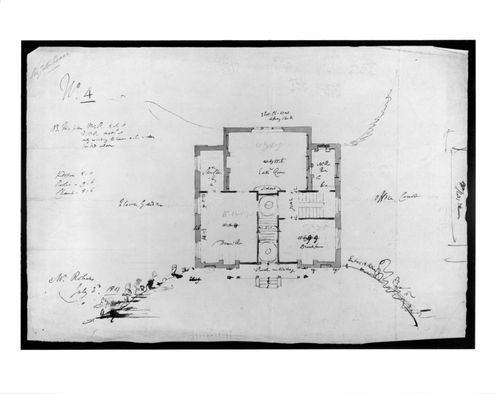
The plan of the building in pen and black ink and grey wash over graphite was executed by a draughtsman in Soane's office on the basis of pin-pricks transferring the design from another sheet. Soane's changes to this initial plan concern the addition of saucer domes in the main hall, and recesses in the "Eat. Room", which resulted in a change in the position of the fireplace in "Mr. Rs Room". The front porch was widened, presumably from the Doric version shown by Dorothy Stroud (1984, pl. 150) to one which includes "trelliage", showing a concern for setting this rural building in its landscape. This change, and its reflection in drawings in the Soane Museum (Drawer 4, set 4, Items 14-24) are discussed by Pierre du Prey (1986).
DR1983:0859
Description:
The plan of the building in pen and black ink and grey wash over graphite was executed by a draughtsman in Soane's office on the basis of pin-pricks transferring the design from another sheet. Soane's changes to this initial plan concern the addition of saucer domes in the main hall, and recesses in the "Eat. Room", which resulted in a change in the position of the fireplace in "Mr. Rs Room". The front porch was widened, presumably from the Doric version shown by Dorothy Stroud (1984, pl. 150) to one which includes "trelliage", showing a concern for setting this rural building in its landscape. This change, and its reflection in drawings in the Soane Museum (Drawer 4, set 4, Items 14-24) are discussed by Pierre du Prey (1986).
Personnes et institutions:
Sujet:
architecture
architecture
Date:
3 July 1801
3 July 1801
Titre:
Plan for a villa for Norwood Green, Middlesex
Actions:
DR1983:0859
Description:
The plan of the building in pen and black ink and grey wash over graphite was executed by a draughtsman in Soane's office on the basis of pin-pricks transferring the design from another sheet. Soane's changes to this initial plan concern the addition of saucer domes in the main hall, and recesses in the "Eat. Room", which resulted in a change in the position of the fireplace in "Mr. Rs Room". The front porch was widened, presumably from the Doric version shown by Dorothy Stroud (1984, pl. 150) to one which includes "trelliage", showing a concern for setting this rural building in its landscape. This change, and its reflection in drawings in the Soane Museum (Drawer 4, set 4, Items 14-24) are discussed by Pierre du Prey (1986).
Plan for a villa for Norwood Green, Middlesex
Actions:
DR1983:0859
Description:
The plan of the building in pen and black ink and grey wash over graphite was executed by a draughtsman in Soane's office on the basis of pin-pricks transferring the design from another sheet. Soane's changes to this initial plan concern the addition of saucer domes in the main hall, and recesses in the "Eat. Room", which resulted in a change in the position of the fireplace in "Mr. Rs Room". The front porch was widened, presumably from the Doric version shown by Dorothy Stroud (1984, pl. 150) to one which includes "trelliage", showing a concern for setting this rural building in its landscape. This change, and its reflection in drawings in the Soane Museum (Drawer 4, set 4, Items 14-24) are discussed by Pierre du Prey (1986).
Classification:
dessins
dessins
Date:
3 July 1801
3 July 1801
Personnes et institutions:
Sujet:
architecture
architecture


