


2576 Résultats
Classification:
livres
livres
Actions:
Prix:
$82.95
(disponible en magasin)
Résumé:
Of all the visual arts, illustration shares a unique relationship with the written word, often serving to visualize, enhance, or respond to a text. "Reading Pictures" presents a global history of this versatile art form, linking its emergence to modern developments such as the illustrated news, recreational reading, and ad-driven consumer culture. From the advent of(...)
$82.95
(disponible en magasin)
Résumé:
Of all the visual arts, illustration shares a unique relationship with the written word, often serving to visualize, enhance, or respond to a text. "Reading Pictures" presents a global history of this versatile art form, linking its emergence to modern developments such as the illustrated news, recreational reading, and ad-driven consumer culture. From the advent of(...)
Titre:
Reading pictures: A history of illustration
Actions:
Prix:
$82.95
(disponible en magasin)
Résumé:
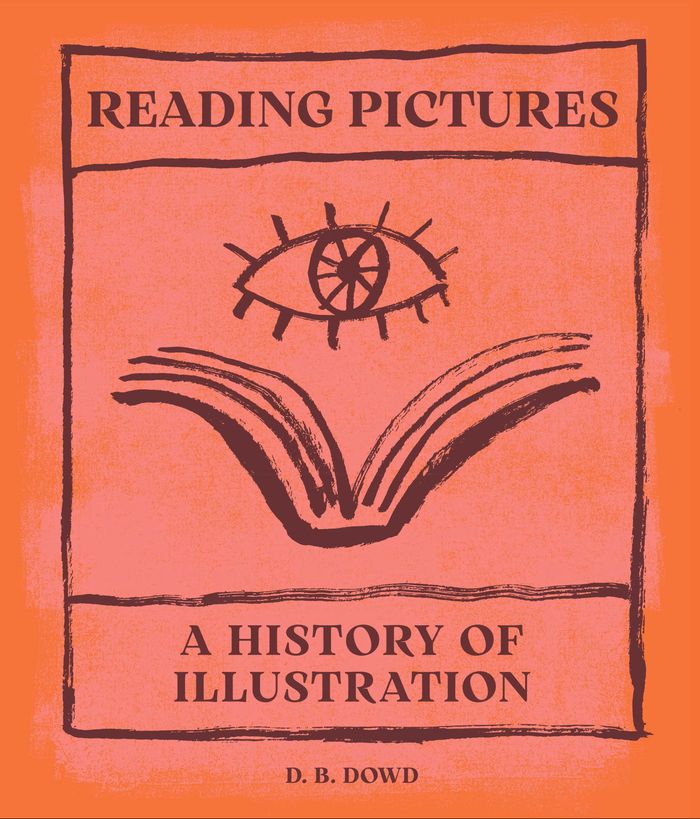
Of all the visual arts, illustration shares a unique relationship with the written word, often serving to visualize, enhance, or respond to a text. "Reading Pictures" presents a global history of this versatile art form, linking its emergence to modern developments such as the illustrated news, recreational reading, and ad-driven consumer culture. From the advent of the printing press in the mid-fifteenth century to the modernist artistic and cultural movements of the nineteenth and twentieth centuries, D. B. Dowd traces the development of illustration as an integral part of the reading experience. He examines the move from ancient scrolls to pamphlets and book forms, and a return to the scroll in electronic form on smartphones and tablets. His story begins with relief prints and woodcuts in ancient China and Japan before moving to printing and platemaking in early modern Europe. Dowd discusses how book and periodical publishing rose sharply with the innovations of wood engraving and lithography, leading to a boom in cultural literacy; and how the illustrated press reached its zenith between the 1860s and 1960s, as printed entertainment and the news of the world became commonplace in every household, bringing with them advertising, propaganda, and consumer culture. Richly illustrated with more than four hundred images spanning the iconic to the unexpected, Reading Pictures reframes the story of illustration within the broader histories of race, gender, literacy, and the transmission of cultural memory. It reveals how reading and looking have become increasingly integrated, and that, as images have become ever more prevalent today with the digital revolution, what is meant by literacy has evolved.
Reading pictures: A history of illustration
Actions:
Prix:
$82.95
(disponible en magasin)
Résumé:
Of all the visual arts, illustration shares a unique relationship with the written word, often serving to visualize, enhance, or respond to a text. "Reading Pictures" presents a global history of this versatile art form, linking its emergence to modern developments such as the illustrated news, recreational reading, and ad-driven consumer culture. From the advent of the printing press in the mid-fifteenth century to the modernist artistic and cultural movements of the nineteenth and twentieth centuries, D. B. Dowd traces the development of illustration as an integral part of the reading experience. He examines the move from ancient scrolls to pamphlets and book forms, and a return to the scroll in electronic form on smartphones and tablets. His story begins with relief prints and woodcuts in ancient China and Japan before moving to printing and platemaking in early modern Europe. Dowd discusses how book and periodical publishing rose sharply with the innovations of wood engraving and lithography, leading to a boom in cultural literacy; and how the illustrated press reached its zenith between the 1860s and 1960s, as printed entertainment and the news of the world became commonplace in every household, bringing with them advertising, propaganda, and consumer culture. Richly illustrated with more than four hundred images spanning the iconic to the unexpected, Reading Pictures reframes the story of illustration within the broader histories of race, gender, literacy, and the transmission of cultural memory. It reveals how reading and looking have become increasingly integrated, and that, as images have become ever more prevalent today with the digital revolution, what is meant by literacy has evolved.
Classification:
livres
livres
Publication:
avril 2026
avril 2026
Sujet:
Illustration
Illustration
Classification:
livres
livres
Prix:
$43.95
(disponible sur commande)
Résumé:
Pioneering conceptual artist Vito Acconci began his career as a poet. In the 1960s, before beginning his work in performance and video art, Acconci studied at the Iowa Writers Workshop and published poems in journals and chapbooks. Almost all of this work remains unknown; much of it appeared in the self-produced magazines of the Lower East Side's mimeo revolution, and(...)
$43.95
(disponible sur commande)
Résumé:
Pioneering conceptual artist Vito Acconci began his career as a poet. In the 1960s, before beginning his work in performance and video art, Acconci studied at the Iowa Writers Workshop and published poems in journals and chapbooks. Almost all of this work remains unknown; much of it appeared in the self-produced magazines of the Lower East Side's mimeo revolution, and(...)
Publication:
mars 2006, Cambridge, Mass.
mars 2006, Cambridge, Mass.
Titre:
Languages to cover a page : the early writings of Vito Acconci
Actions:
Prix:
$43.95
(disponible sur commande)
Résumé:
Pioneering conceptual artist Vito Acconci began his career as a poet. In the 1960s, before beginning his work in performance and video art, Acconci studied at the Iowa Writers Workshop and published poems in journals and chapbooks. Almost all of this work remains unknown; much of it appeared in the self-produced magazines of the Lower East Side's mimeo revolution, and many other pieces were never published. Language to Cover a Page collects these writings for the first time and not only shows Acconci to be an important experimental writer of the period, but demonstrates the continuity of his early writing with his later work in film, video, and performance. "Language to cover a page" documents a key moment in the unprecedented intersection of artists and poets in the late 1960s - as seen in the Dwan Gallery's series of "Language" shows (1967-1970) and in Acconci's own journal 0 to 9. Indeed, as Acconci moved from the poetry scene to the art world, his poetry became increasingly performative while his artwork was often structured and motivated by linguistic play. Acconci's early writing recalls the work of Samuel Beckett, the deadpan voice of the nouveau roman, and the jump cuts and fraught permutations of the nouvelle vague. Poems in "Language to cover a page" explore the materiality of language ("language as matter and not ideas," as Robert Smithson put it), the physical space of the page, and the physicality of source texts (phonebooks, thesauruses, dictionaries). Other poems take the space of the page as an analogue to performance space or implicate the poem in a network of activity (as in his "Dial-a-Poem" pieces).
Languages to cover a page : the early writings of Vito Acconci
Actions:
Prix:
$43.95
(disponible sur commande)
Résumé:
Pioneering conceptual artist Vito Acconci began his career as a poet. In the 1960s, before beginning his work in performance and video art, Acconci studied at the Iowa Writers Workshop and published poems in journals and chapbooks. Almost all of this work remains unknown; much of it appeared in the self-produced magazines of the Lower East Side's mimeo revolution, and many other pieces were never published. Language to Cover a Page collects these writings for the first time and not only shows Acconci to be an important experimental writer of the period, but demonstrates the continuity of his early writing with his later work in film, video, and performance. "Language to cover a page" documents a key moment in the unprecedented intersection of artists and poets in the late 1960s - as seen in the Dwan Gallery's series of "Language" shows (1967-1970) and in Acconci's own journal 0 to 9. Indeed, as Acconci moved from the poetry scene to the art world, his poetry became increasingly performative while his artwork was often structured and motivated by linguistic play. Acconci's early writing recalls the work of Samuel Beckett, the deadpan voice of the nouveau roman, and the jump cuts and fraught permutations of the nouvelle vague. Poems in "Language to cover a page" explore the materiality of language ("language as matter and not ideas," as Robert Smithson put it), the physical space of the page, and the physicality of source texts (phonebooks, thesauruses, dictionaries). Other poems take the space of the page as an analogue to performance space or implicate the poem in a network of activity (as in his "Dial-a-Poem" pieces).
Classification:
livres
livres
Publication:
mars 2006, Cambridge, Mass.
mars 2006, Cambridge, Mass.
Classification:
livres
livres

Prix:
$27.00
(disponible sur commande)
Résumé:
Since the first edition of "Edible Estates : Attack on the Front Lawn" was published in 2008, interest in edible gardening has exploded across the United States and abroad. This greatly expanded second edition of the book documents the eight Edible Estates regional prototype gardens that author Fritz Haeg has planted in California, Kansas, Texas, Maryland, New Jersey, New(...)
$27.00
(disponible sur commande)
Résumé:
Since the first edition of "Edible Estates : Attack on the Front Lawn" was published in 2008, interest in edible gardening has exploded across the United States and abroad. This greatly expanded second edition of the book documents the eight Edible Estates regional prototype gardens that author Fritz Haeg has planted in California, Kansas, Texas, Maryland, New Jersey, New(...)
Titre:
Edible estates : attack on the front lawn, 2nd edition
Actions:
Prix:
$27.00
(disponible sur commande)
Résumé:
Since the first edition of "Edible Estates : Attack on the Front Lawn" was published in 2008, interest in edible gardening has exploded across the United States and abroad. This greatly expanded second edition of the book documents the eight Edible Estates regional prototype gardens that author Fritz Haeg has planted in California, Kansas, Texas, Maryland, New Jersey, New York and England, and includes personal accounts from the homeowner-gardeners about the pleasures and challenges of publicly growing food where they live. Ten "Reports from Coast to Coast" tell the stories of others who have planted their own edible front yards in towns and cities across the country. In addition to essays by landscape architect and scholar Diana Balmori, edible-landscaping pioneer Rosalind Creasy, bestselling author and sustainable-food advocate Michael Pollan and artist and writer Lesley Stern, this edition features updated text by Haeg (including his observations on the Obama White House vegetable garden); a contribution from Mannahatta author Eric W. Sanderson; and Growing Power founder, MacArthur Fellow and urban farmer Will Allen's never-before-published Declaration of the Good Food Revolution. This is not a comprehensive how-to book, nor a showcase of impossibly perfect gardens. The stories presented here are intended to reveal something about how we are living today and to inspire readers to plant their own versions of an Edible Estate. If we see that our neighbor's typical grassy lawn instead can be a beautiful food garden, perhaps we will begin to look at the city around us with new eyes. Our private land can be a public model for the world in which we would like to live.
Edible estates : attack on the front lawn, 2nd edition
Actions:
Prix:
$27.00
(disponible sur commande)
Résumé:
Since the first edition of "Edible Estates : Attack on the Front Lawn" was published in 2008, interest in edible gardening has exploded across the United States and abroad. This greatly expanded second edition of the book documents the eight Edible Estates regional prototype gardens that author Fritz Haeg has planted in California, Kansas, Texas, Maryland, New Jersey, New York and England, and includes personal accounts from the homeowner-gardeners about the pleasures and challenges of publicly growing food where they live. Ten "Reports from Coast to Coast" tell the stories of others who have planted their own edible front yards in towns and cities across the country. In addition to essays by landscape architect and scholar Diana Balmori, edible-landscaping pioneer Rosalind Creasy, bestselling author and sustainable-food advocate Michael Pollan and artist and writer Lesley Stern, this edition features updated text by Haeg (including his observations on the Obama White House vegetable garden); a contribution from Mannahatta author Eric W. Sanderson; and Growing Power founder, MacArthur Fellow and urban farmer Will Allen's never-before-published Declaration of the Good Food Revolution. This is not a comprehensive how-to book, nor a showcase of impossibly perfect gardens. The stories presented here are intended to reveal something about how we are living today and to inspire readers to plant their own versions of an Edible Estate. If we see that our neighbor's typical grassy lawn instead can be a beautiful food garden, perhaps we will begin to look at the city around us with new eyes. Our private land can be a public model for the world in which we would like to live.
Classification:
livres
livres
Publication:
avril 2010
avril 2010
Classification:
périodiques
périodiques
Titre:
e-flux index #3
e-flux index #3
Actions:
Prix:
$65.00
(disponible en magasin)
Résumé:
Today we are accustomed to the apophatic gesture of free-speech fundamentalists and far-right demagogues, who use the flimsy legal cover of “just asking questions” to broadcast ever more widely the most violent and reactionary forms of hate speech. In resisting this enclosure of thought, art and theory continue to be instructive, if not essential activities. The late(...)
$65.00
(disponible en magasin)
Résumé:
Today we are accustomed to the apophatic gesture of free-speech fundamentalists and far-right demagogues, who use the flimsy legal cover of “just asking questions” to broadcast ever more widely the most violent and reactionary forms of hate speech. In resisting this enclosure of thought, art and theory continue to be instructive, if not essential activities. The late(...)
Titre:
e-flux index #3
Actions:
Prix:
$65.00
(disponible en magasin)
Résumé:
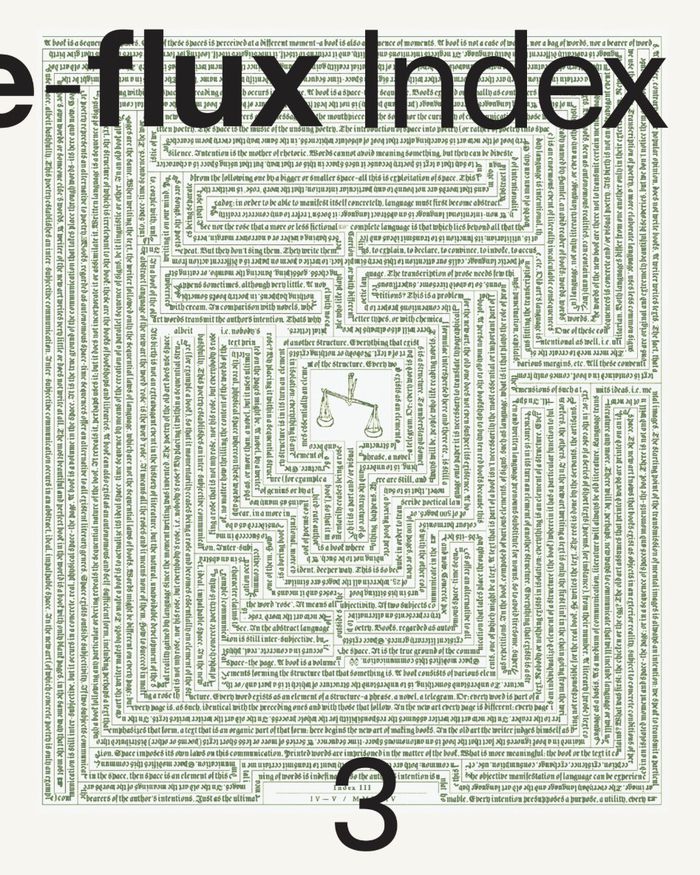
Today we are accustomed to the apophatic gesture of free-speech fundamentalists and far-right demagogues, who use the flimsy legal cover of “just asking questions” to broadcast ever more widely the most violent and reactionary forms of hate speech. In resisting this enclosure of thought, art and theory continue to be instructive, if not essential activities. The late Lawrence Weiner memorably declared that “the purpose of art is to ask questions… it doesn’t answer anybody’s question but gives them the means to answer a particular question at a particular moment.” All the better when those questions can provoke a certain illuminating friction with the contradictions of one’s environment and disrupt the automaticity of one’s learned responses, remaining themselves ambiguous or unanswered—because unanswerable. This third issue of e-flux Index, bringing together all the content commissioned and published by e-flux between April and May 2024, contains many such unexpected and unanswered (or unanswerable) questions across its 76 contributions, each of which cut across and reach beyond existing disciplines and borders: “Who is willing to care?”; “Who is the addressee at the end of the regulated pipelines of the English language?”; “Yes, but is it edible?”; “Why does everyone hate college students?”; “Is some form of suffering the condition for the emergence of an organic type of intelligence?”; “What does it mean to make a film today, in 2024, when most of our image consumption has been transferred to other (smaller) screens and other media?; “How to represent history?”; “Whose lives are worth remembering—or even, living?”; “How is it possible to speak the language of imperial renaissance and decolonization in the same breath?”; “Today is which day of the revolution?”—“Are these all just notes for a poem?”
e-flux index #3
Actions:
Prix:
$65.00
(disponible en magasin)
Résumé:
Today we are accustomed to the apophatic gesture of free-speech fundamentalists and far-right demagogues, who use the flimsy legal cover of “just asking questions” to broadcast ever more widely the most violent and reactionary forms of hate speech. In resisting this enclosure of thought, art and theory continue to be instructive, if not essential activities. The late Lawrence Weiner memorably declared that “the purpose of art is to ask questions… it doesn’t answer anybody’s question but gives them the means to answer a particular question at a particular moment.” All the better when those questions can provoke a certain illuminating friction with the contradictions of one’s environment and disrupt the automaticity of one’s learned responses, remaining themselves ambiguous or unanswered—because unanswerable. This third issue of e-flux Index, bringing together all the content commissioned and published by e-flux between April and May 2024, contains many such unexpected and unanswered (or unanswerable) questions across its 76 contributions, each of which cut across and reach beyond existing disciplines and borders: “Who is willing to care?”; “Who is the addressee at the end of the regulated pipelines of the English language?”; “Yes, but is it edible?”; “Why does everyone hate college students?”; “Is some form of suffering the condition for the emergence of an organic type of intelligence?”; “What does it mean to make a film today, in 2024, when most of our image consumption has been transferred to other (smaller) screens and other media?; “How to represent history?”; “Whose lives are worth remembering—or even, living?”; “How is it possible to speak the language of imperial renaissance and decolonization in the same breath?”; “Today is which day of the revolution?”—“Are these all just notes for a poem?”
Classification:
périodiques
périodiques
Publication:
décembre 2024
décembre 2024
Sujet:
Revues
Revues
Classification:
livres
livres
Actions:
Prix:
$67.95
(disponible sur commande)
Résumé:
The dream of the twentieth century was the construction of mass utopia. As the century closes, this dream is being left behind; the belief that industrial modernization can bring about the good society by overcoming material scarcity for all has been challenged by the disintegration(...)
$67.95
(disponible sur commande)
Résumé:
The dream of the twentieth century was the construction of mass utopia. As the century closes, this dream is being left behind; the belief that industrial modernization can bring about the good society by overcoming material scarcity for all has been challenged by the disintegration(...)
Titre:
Dreamworld and catastrophe : the passing of mass utopia in East and West
Actions:
Prix:
$67.95
(disponible sur commande)
Résumé:
The dream of the twentieth century was the construction of mass utopia. As the century closes, this dream is being left behind; the belief that industrial modernization can bring about the good society by overcoming material scarcity for all has been challenged by the disintegration of European socialism, capitalist restructuring, and ecological constraints. The larger social vision has given way to private dreams of material happiness and to political cynicism. Developing the notion of dreamworld as both a poetic description of a collective mental state and an analytical concept, Susan Buck-Morss attempts to come to terms with mass dreamworlds at the moment of their passing. She shows how dreamworlds became dangerous when their energy was used by the structures of power as an instrument of force against the masses. Stressing the similarities between the East and West and using the end of the Cold War as her point of departure, she examines both extremes of mass utopia, dreamworld and catastrophe. The book is in four parts. "Dreamworlds of Democracy" asks whether collective sovereignty can ever be democratic. "Dreamworlds of History" calls for a rethinking of revolution by political and artistic avant-gardes. "Dreamworlds of Mass Culture" explores the affinities between mass culture's socialist and capitalist forms. An "Afterward" places the book in the historical context of the author's collaboration with a group of Moscow philosophers and artists over the past two tumultuous decades. The book is an experiment in visual culture, using images as philosophy, presenting, literally, a way of seeing the past. Its pictorial narratives rescue historical data that with the end of the Cold War are threatened with oblivion and challenge common conceptions of what this century was all about.
Dreamworld and catastrophe : the passing of mass utopia in East and West
Actions:
Prix:
$67.95
(disponible sur commande)
Résumé:
The dream of the twentieth century was the construction of mass utopia. As the century closes, this dream is being left behind; the belief that industrial modernization can bring about the good society by overcoming material scarcity for all has been challenged by the disintegration of European socialism, capitalist restructuring, and ecological constraints. The larger social vision has given way to private dreams of material happiness and to political cynicism. Developing the notion of dreamworld as both a poetic description of a collective mental state and an analytical concept, Susan Buck-Morss attempts to come to terms with mass dreamworlds at the moment of their passing. She shows how dreamworlds became dangerous when their energy was used by the structures of power as an instrument of force against the masses. Stressing the similarities between the East and West and using the end of the Cold War as her point of departure, she examines both extremes of mass utopia, dreamworld and catastrophe. The book is in four parts. "Dreamworlds of Democracy" asks whether collective sovereignty can ever be democratic. "Dreamworlds of History" calls for a rethinking of revolution by political and artistic avant-gardes. "Dreamworlds of Mass Culture" explores the affinities between mass culture's socialist and capitalist forms. An "Afterward" places the book in the historical context of the author's collaboration with a group of Moscow philosophers and artists over the past two tumultuous decades. The book is an experiment in visual culture, using images as philosophy, presenting, literally, a way of seeing the past. Its pictorial narratives rescue historical data that with the end of the Cold War are threatened with oblivion and challenge common conceptions of what this century was all about.
Classification:
livres
livres
Publication:
janvier 1900, Cambridge
janvier 1900, Cambridge
Sujet:
Théorie de l’architecture
Théorie de l’architecture
Classification:
livres
livres
Actions:
Prix:
$39.95
(disponible sur commande)
Résumé:
In postwar France, the aesthetics of appropriation and collage gave cultural form to a struggle over meaning. A new wave of avant-garde experimentation used - or stole, plagiarized, and expropriated - elements from advertising, journalism, literature, art, and other sources of common discourse (the ironically named "beautiful language" of this book's title, itself an(...)
$39.95
(disponible sur commande)
Résumé:
In postwar France, the aesthetics of appropriation and collage gave cultural form to a struggle over meaning. A new wave of avant-garde experimentation used - or stole, plagiarized, and expropriated - elements from advertising, journalism, literature, art, and other sources of common discourse (the ironically named "beautiful language" of this book's title, itself an(...)
Publication:
février 2007, Cambridge (MA)
février 2007, Cambridge (MA)
Titre:
The beautiful language of my century : reinventing the language of contestation in postwar France, 1945-1968
Actions:
Prix:
$39.95
(disponible sur commande)
Résumé:
In postwar France, the aesthetics of appropriation and collage gave cultural form to a struggle over meaning. A new wave of avant-garde experimentation used - or stole, plagiarized, and expropriated - elements from advertising, journalism, literature, art, and other sources of common discourse (the ironically named "beautiful language" of this book's title, itself an appropriation from Guy Debord's collaged Mémoires). Redeployed, often in startling or pointed juxtapositions, these elements took on newly oppositional meanings. A famous photograph taken inside the occupied Sorbonne in May 1968, for example, shows a massive academic painting altered by a clever cartoonish speech bubble that transforms the painting into a parody of itself and memorializes an event very different from the one captured by the original artist."The beautiful language of my century" describes the various forms of critical culture that culminated in the events of May 1968, and investigates the ways those forms have come down to us today. McDonough explores the montage practice developed by Guy Debord and his situationist colleagues under the name of détournement and its expression in the later fifties as a form of cultural theft. He addresses the influence of colonialism on these practices, examining a 1961 exhibit of torn posters of the Algerian War ("La France déchirée"), Godard's early film Le Petit Soldat, and Christo's Project for a Temporary Wall of Steel Drums. He discusses the French left's adoption in the mid-sixties of the "end of art" as a theoretical position and describes the leftist idea of the fête as a Rabelaisian and revolutionary upwelling of everything that is low. This influential conception, inspired equally by the American urban revolts of the sixties and the writings of theorists Marcel Mauss and Georges Bataille, coalesced into a new image of revolution, a new model of contestation, in the events of May 1968 - when the struggle over language and culture merged with a broader resistance to capitalist modernization.
The beautiful language of my century : reinventing the language of contestation in postwar France, 1945-1968
Actions:
Prix:
$39.95
(disponible sur commande)
Résumé:
In postwar France, the aesthetics of appropriation and collage gave cultural form to a struggle over meaning. A new wave of avant-garde experimentation used - or stole, plagiarized, and expropriated - elements from advertising, journalism, literature, art, and other sources of common discourse (the ironically named "beautiful language" of this book's title, itself an appropriation from Guy Debord's collaged Mémoires). Redeployed, often in startling or pointed juxtapositions, these elements took on newly oppositional meanings. A famous photograph taken inside the occupied Sorbonne in May 1968, for example, shows a massive academic painting altered by a clever cartoonish speech bubble that transforms the painting into a parody of itself and memorializes an event very different from the one captured by the original artist."The beautiful language of my century" describes the various forms of critical culture that culminated in the events of May 1968, and investigates the ways those forms have come down to us today. McDonough explores the montage practice developed by Guy Debord and his situationist colleagues under the name of détournement and its expression in the later fifties as a form of cultural theft. He addresses the influence of colonialism on these practices, examining a 1961 exhibit of torn posters of the Algerian War ("La France déchirée"), Godard's early film Le Petit Soldat, and Christo's Project for a Temporary Wall of Steel Drums. He discusses the French left's adoption in the mid-sixties of the "end of art" as a theoretical position and describes the leftist idea of the fête as a Rabelaisian and revolutionary upwelling of everything that is low. This influential conception, inspired equally by the American urban revolts of the sixties and the writings of theorists Marcel Mauss and Georges Bataille, coalesced into a new image of revolution, a new model of contestation, in the events of May 1968 - when the struggle over language and culture merged with a broader resistance to capitalist modernization.
Classification:
livres
livres
Publication:
février 2007, Cambridge (MA)
février 2007, Cambridge (MA)


